Investor's Corner
Tesla's biggest bull stands firm on TSLA, gets 6,000% gains from options bets

No one could ever accuse ARK Invest CEO Cathie Wood of being a Tesla (NASDAQ:TSLA) bull who does not walk the walk. Being one of Tesla’s most prominent supporters, Wood is deep into her investment with the electric car maker, and this shows in ARK Invest’s TSLA holdings. Wood’s conviction has also paid off, with the ARK CEO netting a 6,000% gain from TSLA options bets that she personally made last year.
Wood noted in a statement to Benzinga that her strategy is quite simple: when something does not make sense, she takes action. Last year, that exact circumstance happened. Tesla shares dropped to the $170 to $180 per share despite the company improving its Model 3 production output and Elon Musk becoming more tempered on Twitter. During this time, Wood stated that she believed auto the industry did not really understand Tesla fully. The whole scenario presented a unique opportunity for ARK.
Eventually, ARK could not purchase any more TSLA shares because the firm had already reached its 10% cap with the company. Realizing the existing opportunity, Wood opted to take action herself, buying TSLA call options for her personal account. This was a risky move on the ARK CEO’s part, as options require a stock to move a specific price point at a set expiration date.
Wood ended up purchasing January 21 $460 calls when they were trading between $5 and $10. And amidst Tesla’s monster bull run that saw the stock end Monday’s trading at an all-time high of $780 per share, these very same contracts are now trading at about $327. With this, Wood’s trade has potentially generated more than 6,000% worth of returns.
Wood remains as bullish as ever on TSLA stock, especially in the long-term. In a statement, she noted the Tesla still has room to grow, and the company is poised to fend off competition from more experienced rivals, some of which are expected to be released within the next few years.
“This is an exponential growth stock, growth company. And we’ve lived in a linear growth world for so long, with the law of large numbers pulling growth rates down, that people find it hard to understand what exponential growth is. Last year when the Tesla killers came out, Audi, Taycan, and Jaguar, when they came out, you know, that’s right in their category. And Tesla’s market share of the electric vehicle market went up, not down. It went up to 18%,” Wood said.
Disclosure: I have no ownership in shares of TSLA and have no plans to initiate any positions within 72 hours.


Elon Musk
Tesla Supercharger for Business exposes jaw-dropping ROI gap between best and worst locations
Tesla’s new Supercharger for Business calculator reveals an eye-opening all-in cost and location-based ROI projections.

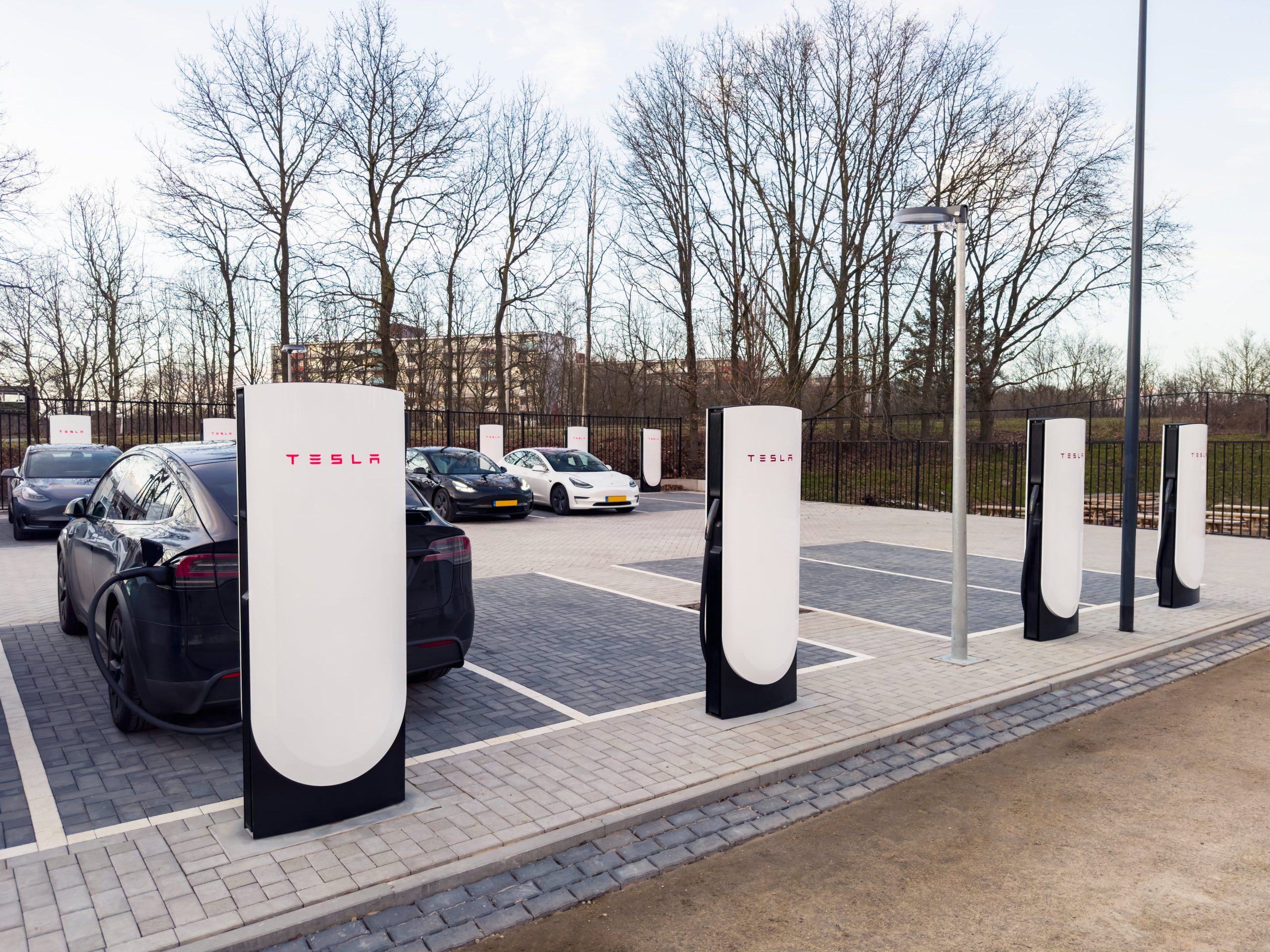
Tesla has launched an online calculator for its Supercharger for Business program, giving property owners their first transparent look at what it really costs to install Superchargers on site and what kind of return they can expect.
The program itself launched in September 2025, allowing businesses to purchase and operate Supercharger hardware on their own property while Tesla handles installation, maintenance, software, and 24/7 driver support. As Teslarati reported at launch, hosts also get their logo placed on the chargers and their location integrated into Tesla’s in-car navigation, meaning drivers are actively routed there. The stalls are open to all EVs, not just Teslas.
We launched Supercharger for Business in 2025 to help companies get charging right. We found simplicity and transparency to be a problem in this industry.
We’re now sharing pricing and a financial calculator to help make informed decisions. The goal is to accelerate investments,…
— Tesla Charging (@TeslaCharging) April 8, 2026
The new online calculator, announced by Tesla on Wednesday with the note that “simplicity and transparency” have been a problem in the industry, lets any business enter a U.S. address and get a real cost and revenue model. A standard 8-stall V4 Supercharger site runs approximately $500,000 in hardware and $55,000 per post for installation, bringing an all-in price just shy of $1 million. Tesla charges a flat $0.10 per kWh fee to cover software, billing, and network operations. Businesses set their own retail price and keep the margin above that fee.
Taking a look at Tesla’s Supercharger for Business online calculator, we can see that ROI is not uniform, and the gap between a strong location and a poor one can stretch the breakeven point by several years.
The biggest driver is foot traffic and how long people stay. A busy rest station, hotel, or outlet mall brings in repeat visitors who need to charge while they’re already stopped, pushing utilization numbers higher and shortening payback time.
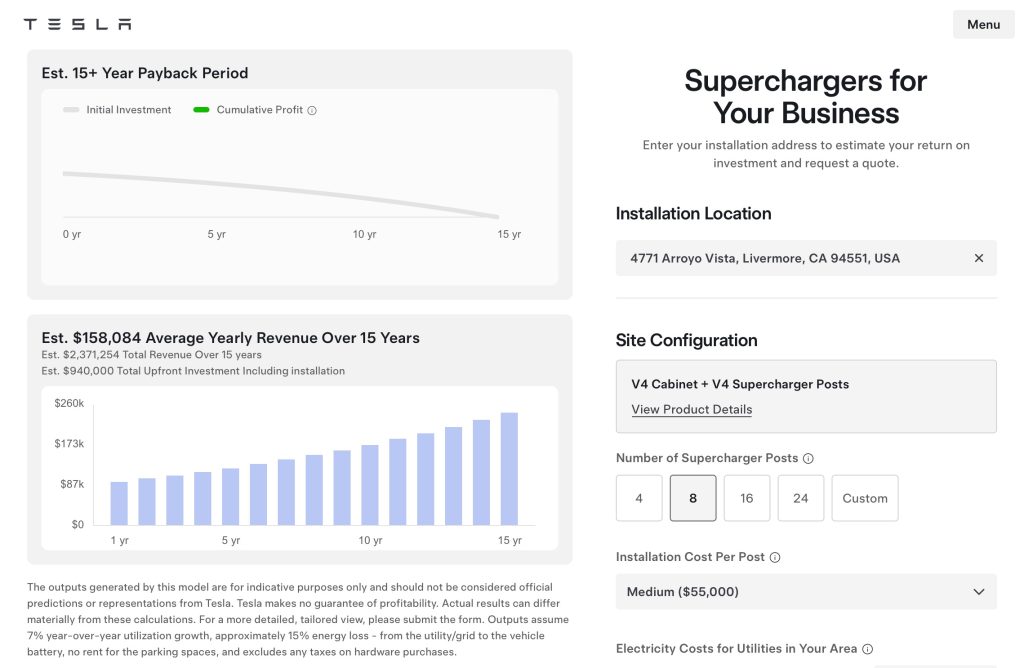
Tesla Supercharger for Business ROI calculator
Local electricity rates matter just as much on the cost side. Markets like California carry some of the highest commercial electricity rates in the country, which eats into the margin between what a host pays per kWh and what they charge drivers. At the same time, dense urban areas with high EV adoption tend to support higher retail charging prices, which can offset that cost if demand is strong enough. Weather also plays a role. Cold climates reduce battery efficiency and increase charging frequency, but they can also suppress utilization in winter months if drivers avoid stopping in exposed outdoor locations. Suburban and rural sites face a different problem: lower baseline EV traffic, which means a site with cheaper power and lower operating costs can still take longer to pay back simply because the stalls sit idle more often. Tesla’s calculator uses real fleet data to pre-fill utilization estimates by ZIP code, so businesses can run their specific address against these variables rather than relying on averages.
The program has seen real adoption. Wawa, already the largest host of Tesla Superchargers with over 2,100 stalls across 223 locations, opened its first fully owned and branded site in Alachua, Florida earlier this year. Francis Energy of Oklahoma and the city of Alpharetta, Georgia have also deployed branded stations through the program, as Teslarati covered in January.
Tesla now exceeds 80,000 Supercharger stalls worldwide, and the calculator makes the economic case for accelerating that number through private investment rather than company-owned sites alone.
Investor's Corner
Tesla stock gets hit with shock move from Wall Street analysts
Despite Tesla not being an automotive company exclusively, the Wall Street firms and analysts covering its shares are widely dialed in on its performance regarding quarterly deliveries. While it holds some importance, Tesla, from an internal perspective, is more focused on end-to-end AI, Robotaxi, self-driving, and its Optimus robot.

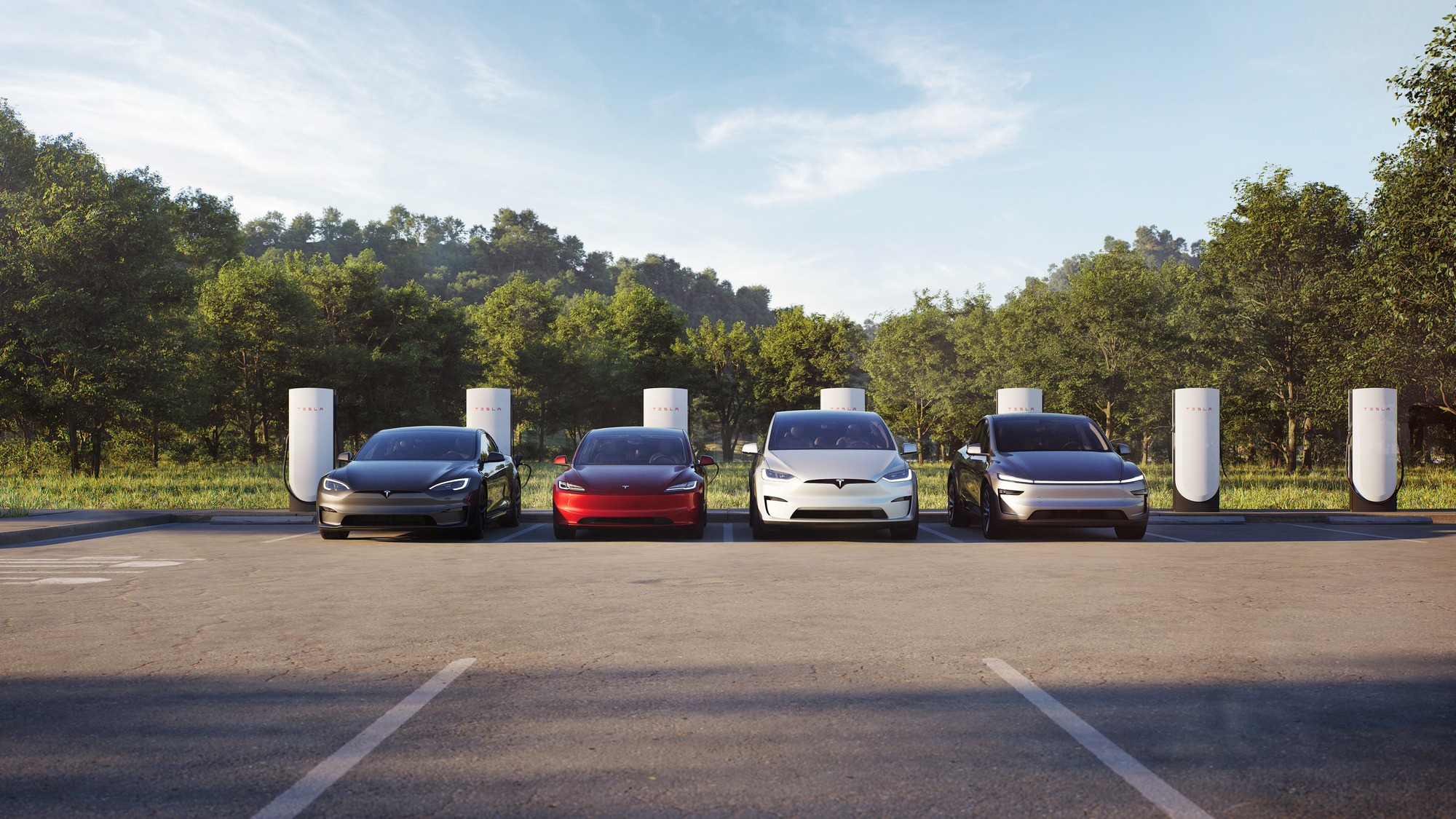
Tesla price targets (NASDAQ: TSLA) have received several cuts over the past few days as Wall Street firms are adjusting their forecast for the company’s stock following a miss in quarterly delivery figures for the first quarter.
Despite Tesla not being an automotive company exclusively, the Wall Street firms and analysts covering its shares are widely dialed in on its performance regarding quarterly deliveries. While it holds some importance, Tesla, from an internal perspective, is more focused on end-to-end AI, Robotaxi, self-driving, and its Optimus robot.
In a notable shift underscoring mounting caution on Wall Street, three prominent investment banks slashed their price targets on Tesla Inc. shares over the past two weeks following the electric-vehicle giant’s disappointing first-quarter 2026 delivery numbers. The revisions highlight softening EV sales figures and, according to some, execution challenges.
Tesla delivered 358,023 vehicles in the January-to-March period, a 14 percent sequential decline and a miss versus consensus forecasts of roughly 365,000 to 370,000 units.
Production hit 408,000 vehicles, yet the delivery shortfall, paired with limited updates on autonomous-driving progress and new-model timelines, rattled investors. Shares fell about 8.7 percent since April 1.
Wall Street analysts are now adjusting their forecasts accordingly, as several firms have made adjustments to price targets.
Goldman Sachs
Goldman Sachs cut its target from $405 to $375 while maintaining a Hold rating. Analyst Mark Delaney pointed to soft EV sales trends and margin pressures.
Truist Financial followed on April 2, lowering its target from $438 to $400 (Hold unchanged), with analyst William Stein citing misses in both auto deliveries and energy-storage deployments, plus a lack of fresh details on AI initiatives and upcoming vehicles.
It is a strange drop if using AI initiatives and upcoming vehicles as a justification is the primary focus here. Tesla has one of the most optimistic outlooks in terms of AI, and CEO Elon Musk recently hinted that the company is developing something for the U.S. market that will be good for families.
Baird
Baird’s Ben Kallo made a very modest trim, reducing its target from $548 to $538, keeping and maintaining the ‘Outperform’ rating it holds on shares. Kallo said the price target adjustment was a prudent recalibration tied to near-term risks.
Truist
Truist analyst William Stein pointed to deliveries and energy storage missing expectations, and cut his price target to $400 from $438. He maintained the ‘Hold’ rating the firm held on the stock previously.
JPMorgan
Adding to the bearish tone on Monday, April 6, JPMorgan’s Ryan Brinkman reiterated an Underweight (Sell) rating and $145 price target, implying roughly 60 percent downside from recent levels.
Brinkman highlighted a “record surge in unsold vehicles” that adds to free-cash-flow woes, with inventory swelling to an estimated 164,000 units.
Tesla’s comfort level taking risks makes the stock a ‘must own,’ firm says
He lowered his Q1 2026 EPS estimate to $0.30 from $0.43 and full-year 2026 EPS to $1.80 from $2.00, both below consensus. Brinkman noted that expectations for Tesla’s performance have “collapsed” across financial and operating metrics through the end of the decade, yet the stock has risen 50 percent, and average price targets have increased 32 percent.
This disconnect, he argued, prices in an unrealistic sharp pivot to stronger results beyond the decade, while near-term realities remain materially weaker.
He advised investors to approach TSLA shares with a “high degree of caution,” citing elevated execution risk, competition, and valuation concerns in lower-price, higher-volume segments.
The revisions have pulled the overall consensus lower. Aggregators show the average 12-month price target now ranging from approximately $394 to $416 across roughly 32 analysts, with a prevailing Hold rating and a mixed split of Buy, Hold, and Sell recommendations.
Brinkman’s $145 target stands as a notable outlier on the bearish side.
Not Everyone Has Turned Bearish on Tesla Shares
Not all firms turned more pessimistic. Wedbush Securities held its bullish $600 target, stressing that AI and full self-driving technology represent the core value drivers, with current delivery softness viewed as temporary.
These moves reflect a broader Wall Street recalibration: near-term EV demand faces pressure from high interest rates, intensifying competition, especially from lower-cost Chinese rivals, and slower adoption.
At the same time, many analysts continue to see Tesla’s technology leadership in software-defined vehicles, autonomy, robotaxis, and energy storage as pathways to outsized long-term gains once macro conditions ease and new models launch.
With Tesla’s first-quarter earnings report due later this month, upcoming details on cost discipline, Cybertruck ramp-up, and AI roadmaps will likely shape whether these target adjustments prove prescient or overly cautious. Investors remain divided between immediate delivery realities and the company’s ambitious vision.
Tesla shares are trading at $348.82 at the time of publishing.
Elon Musk
SpaceX to launch military missile tracking satellites through new Space Force contract
SpaceX wins a $178.5M Space Force contract to launch missile tracking satellites starting in 2027.
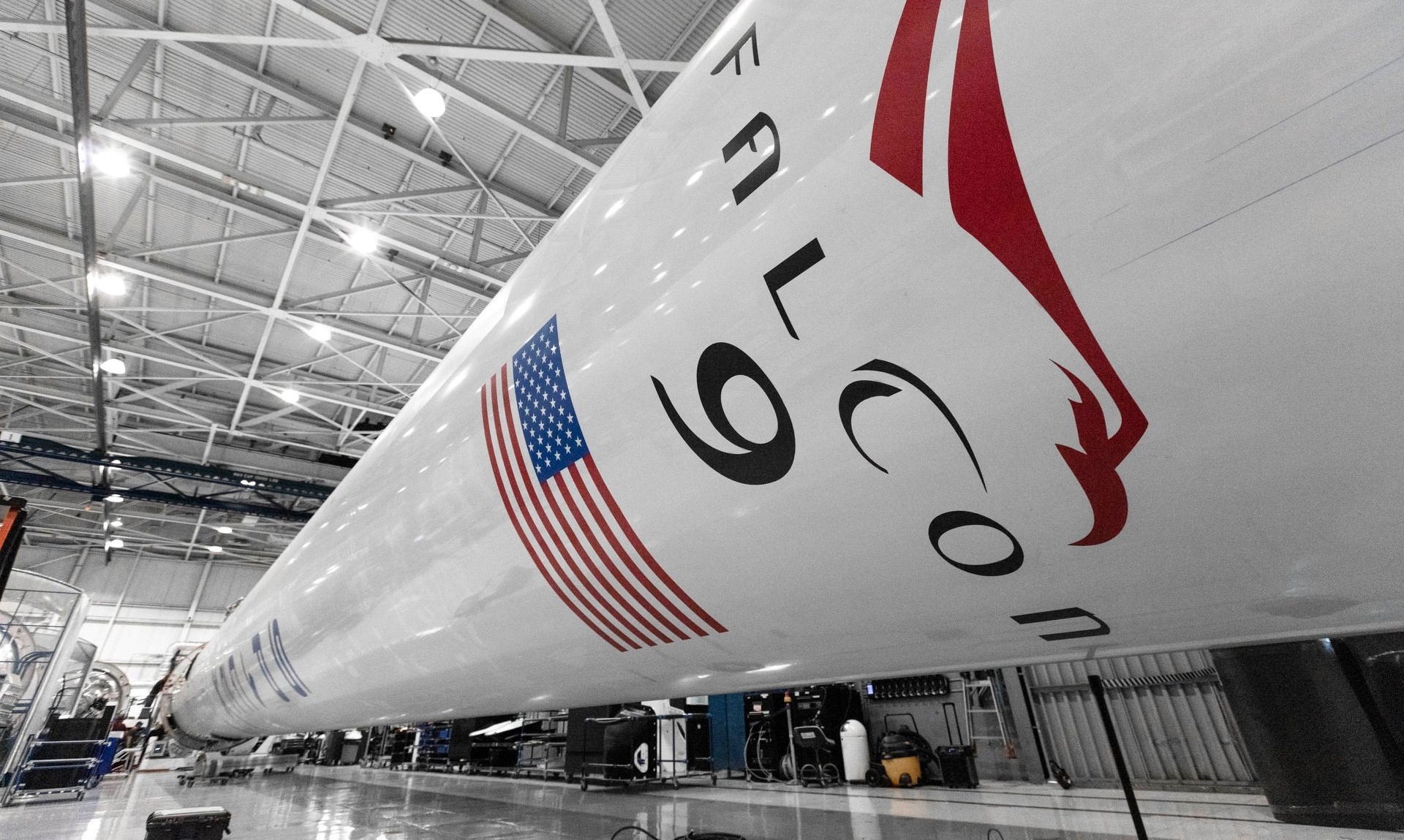
The U.S. Space Force awarded SpaceX a $178.5 million task order on April 1, 2026 to launch missile tracking satellites for the Space Development Agency. The contract, designated SDA-4, covers two Falcon 9 launches beginning in Q3 2027, one from Cape Canaveral Space Force Station in Florida and one from Vandenberg Space Force Base in California. The satellites, built by Sierra Space, are designed to bolster the nation’s ability to detect and track missile threats from orbit.
The award falls under the National Security Space Launch Phase 3 Lane 1 program, which Space Force uses to move payloads to orbit on faster timelines and at more competitive prices. “Our Lane 1 contract affords us the flexibility to deliver satellites for our customers, like SDA, more easily and faster than ever before to all the orbits our satellites need to reach,” said Col. Matt Flahive, SSC’s system program director for Launch Acquisition, in the official press release.
SpaceX is quietly becoming the U.S. Military’s only reliable rocket
The SDA-4 contract is the latest in a long string of national security wins for SpaceX. As Teslarati reported last month, the Space Force recently shifted a GPS III satellite launch from ULA’s Vulcan rocket to SpaceX’s Falcon 9 after a significant Vulcan booster anomaly grounded ULA’s military missions indefinitely. That move made it four consecutive GPS III satellites transferred to SpaceX after contracts were originally awarded to its competitor.
This didn’t come without a fight and dates back years. SpaceX originally had to sue the Air Force in 2014 for the right to compete for national security launches, at a time when United Launch Alliance held a near monopoly on the market. Since then, the company has steadily displaced ULA as the dominant provider, and last year the Space Force confirmed SpaceX would handle approximately 60 percent of all Phase 3 launches through 2032, worth close to $6 billion.
With missile defense satellites now part of its launch manifest alongside GPS, communications, and reconnaissance payloads, SpaceX is giving hungry investors something to chew on before its imminent IPO.

SpaceX is keeping the Space Station alive again this weekend

Tesla hits FSD hackers with surprise move


