

News
Scalpers selling The Boring Company ‘Burnt Hair’ perfume for as high as $1k on eBay

As with most of Elon Musk’s quirky products, The Boring Company’s (TBC) Burnt Hair perfume as made it onto eBay. Scalpers aren’t pricing TBC’s perfume at 10x the price the tunneling company listed.
The TBC’s perfume dubbed “The Essence of Repugnant Desire” has sold over 7,000 bottles so far, based on a recent order number a customer received. By Elon Musk’s count, more than 5,000 Burnt Hair bottles have been ordered.
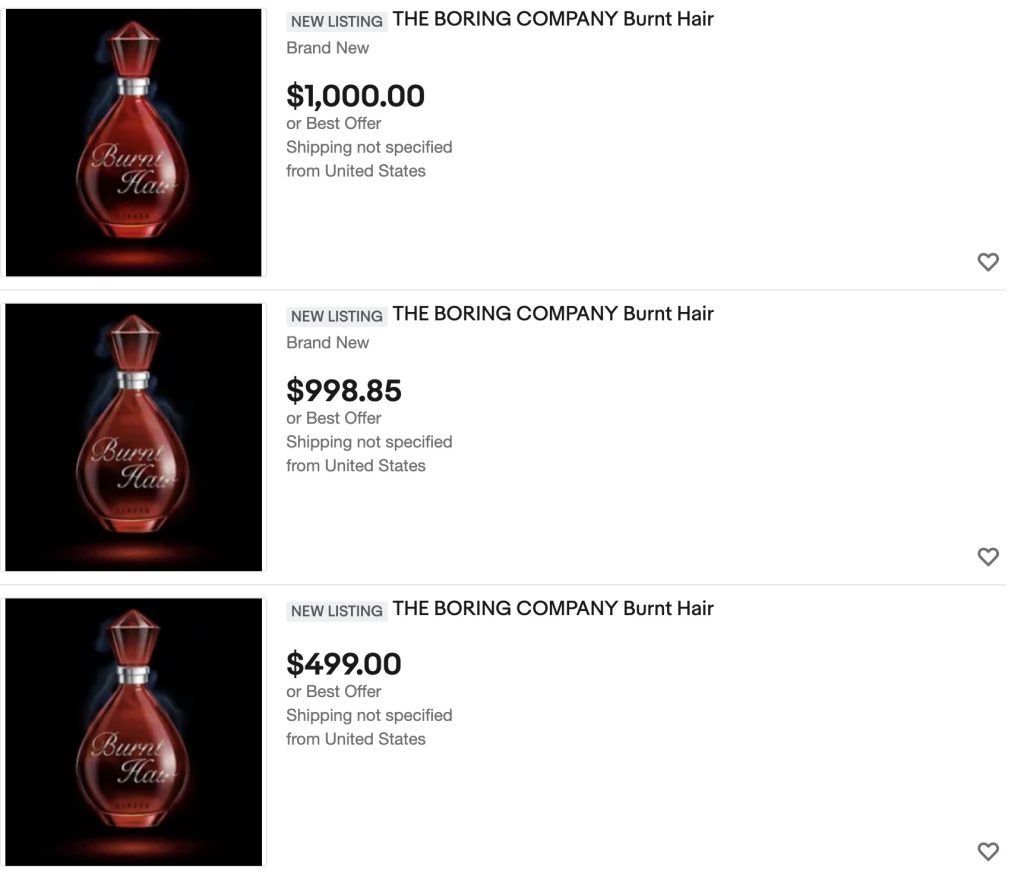
Some of those perfume buyers have already posted their Burnt Hair bottle on eBay, pricing them between $200 to $1,000 per pop. Scalpers could profit between 100% to 900%—and the scalpers’ prices continue to rise.
The Boring Company sells Burnt Hair perfume for $100, including tax and domestic shipping—it’s extra for international shipping. Burnt Hair ships out in Q1 2023 so it might make a good belated Christmas present or Three Kings Day for those who celebrate it.
The Boring Company’s Burnt Hair perfume is a perfect follow up to its Not a Flamethrower limited edition merch. The Not a Flamethrower also sold on eBay for a significant profit.
After Elon Musk announced that all 20,000 TBC “flamethrowers” were reserved, ads selling The Boring Company merch appeared online. Scalpers marked up the prices for the exclusive item, too.

BLACK FRIDAY · FINAL HOURS
Last chance. Don't miss out.
Save 40–70% on select Tesla accessories. Shop the deals before Black Friday ends tonight.
Time remaining
Ends November 28, 2026 at 11:59 PM Pacific.
Numerous posts for The Boring Company flamethrower appeared on eBay and other sites. Most of the TBC f flamethrowers advertised online was significantly higher than the company’s $500 starting price. Majority of scalpers listed it for $800 to $1000.
The Teslarati team would appreciate hearing from you. If you have any tips, contact me at maria@teslarati.com or via Twitter @Writer_01001101.


Elon Musk
Google wants more of SpaceX, reveals Elon Musk
Elon Musk says Google wants to rent more SpaceX compute as Anthropic renewal questions mount.

Elon Musk says Google wants more of SpaceX’s compute, a claim that comes just days after reports suggested the company’s biggest AI customer could be preparing to scale back.
“Not sure who will buy more, but Google has expressed interest in renting more compute from us,” Musk wrote on X late Friday night, replying to a post arguing that Google could eventually rent more capacity from SpaceX than Anthropic does. Musk did not say how much additional capacity Google wants or when an expanded deal might be signed.
Google already pays SpaceX $920 million a month for roughly 110,000 Nvidia GPUs and supporting hardware under an agreement that runs from October through June 2029, according to Reuters. Anthropic’s arrangement is larger. It started in May with all of Colossus 1 at $1.25 billion a month, as Teslarati reported, and is set to reach about $3.1 billion a month once all contracted capacity is delivered in December.
That Anthropic revenue is where the pressure has been building. Anthropic executives reportedly told analysts earlier this month that the deal would not be extended beyond the second quarter of 2027, and a SemiAnalysis note this week said the AI lab may not renew its contract for a cluster of about 50,000 H200 GPUs. Anthropic accounted for nearly a third of SpaceX’s revenue in the third quarter. Musk has countered that Anthropic told him it is “extremely likely” to keep renting and wants “significantly more.”
Musk also addressed reports that SpaceX has been cutting prices. The same SemiAnalysis note said SpaceX lowered its Blackwell spot quote for small clusters from about $15 per GPU hour to between $10 and $12. Musk said that is only part of the picture.
“The rental price for large, coherent blocks of compute configured for high-bandwidth training is increasing, sometimes very significantly, but the price for small amounts of compute (below ~5k GPUs) is decreasing,” he wrote. “Overall, the average rental price per GPU for SpaceX compute is rising.”
He followed with a jab at the traditional cloud providers: “People have no idea what happens when a super capable hardware company enters an arena of slowpokes. Hyposcalers would be a more accurate description.”
Speed is the argument Musk keeps returning to. Earlier this month, he said SpaceX can bring a data center online in eight or nine months, compared with about two and a half years for competitors, while acknowledging that the 90 day termination clauses in its compute contracts cut both ways. SpaceX is now pursuing a $50 billion supercompute campus in Cochise County, Arizona and a $24 billion gas plant and supercompute facility at Starbase, and both projects face public hearings on December 9.
Most of the capacity a larger Google deal would draw on has not been built yet. SpaceX ended the third quarter with 1.7 GW of nameplate compute and expects to finish 2026 at 2.5 to 3 GW, with roughly 10 GW more planned for 2027.

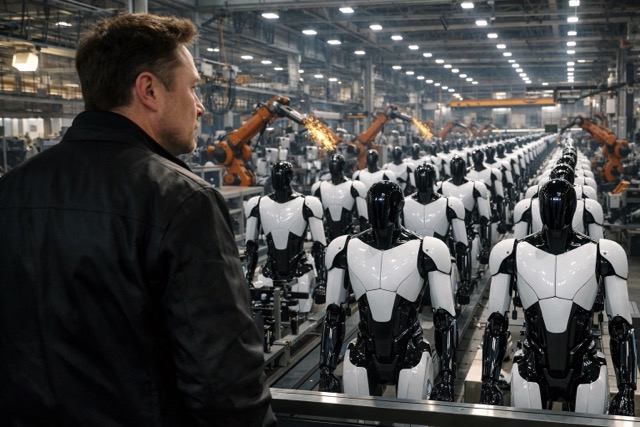
Tesla is set to make a major acquisition as it plans to buy a more than a century-old German manufacturing systems supplier. The move targets EMAG, a specialist in precision machines used to produce drive systems for humanoid robots, according to a filing with Germany’s antitrust authority that surfaced Friday.
Reuters first reported the news.
The planned transaction appeared on the Bundeskartellamt’s list of pending reviews as an asset acquisition involving Tesla and the EMAG Group, under case number B5-132/26 and dated November 23. Financial terms and the exact scope of assets remain undisclosed.
Tesla has not commented, and EMAG did not immediately respond to requests for comment.
Headquartered in Salach near Stuttgart, EMAG traces its roots to an iron foundry founded in Bautzen in 1867. It designs and builds turning, grinding, gear-cutting, and related machines long used in automotive production, but more recently those systems have been applied to the complex gears and actuators required in humanoid robots such as Tesla’s Optimus.
Why Elon Musk’s target date for buying an Optimus robot is harder than it sounds
Some local reports have suggested that the 220 EMAG employees could end up transferring to Tesla while the Salach site remains in opertaion. EMAG has faced some challenges in recent years; it has posted losses amid softer demand from traditional automotive customers. It recently cut hundreds of jobs in Germany.
Bringing specialized machining capability in-house would give Tesla tighter control over a critical production bottleneck for Optimus, whose joints require high-precision components that are difficult to scale.
The approach fits a pattern of strategic, macro-level acquisitions Tesla has used to accelerate vertical integration.
In 2019 the company completed its purchase of Maxwell Technologies for approximately $218 million in stock, primarily to obtain the firm’s dry-electrode battery manufacturing process. That technology promised to eliminate solvent-based slurry coating, reduce factory size and energy use, cut costs, and raise energy density, steps that later underpinned development of Tesla’s 4680 cells.
Although Tesla later sold Maxwell’s ultracapacitor business, it retained the dry-electrode know-how and has continued refining it for high-volume production.
Earlier, Tesla’s 2017 acquisition of German automation specialist Grohmann Engineering supplied expertise in high-speed manufacturing systems that helped ramp vehicle output. The EMAG filing signals a similar bid to internalize specialized tooling and process knowledge, this time aimed at scaling humanoid robot production rather than cars or batteries alone.
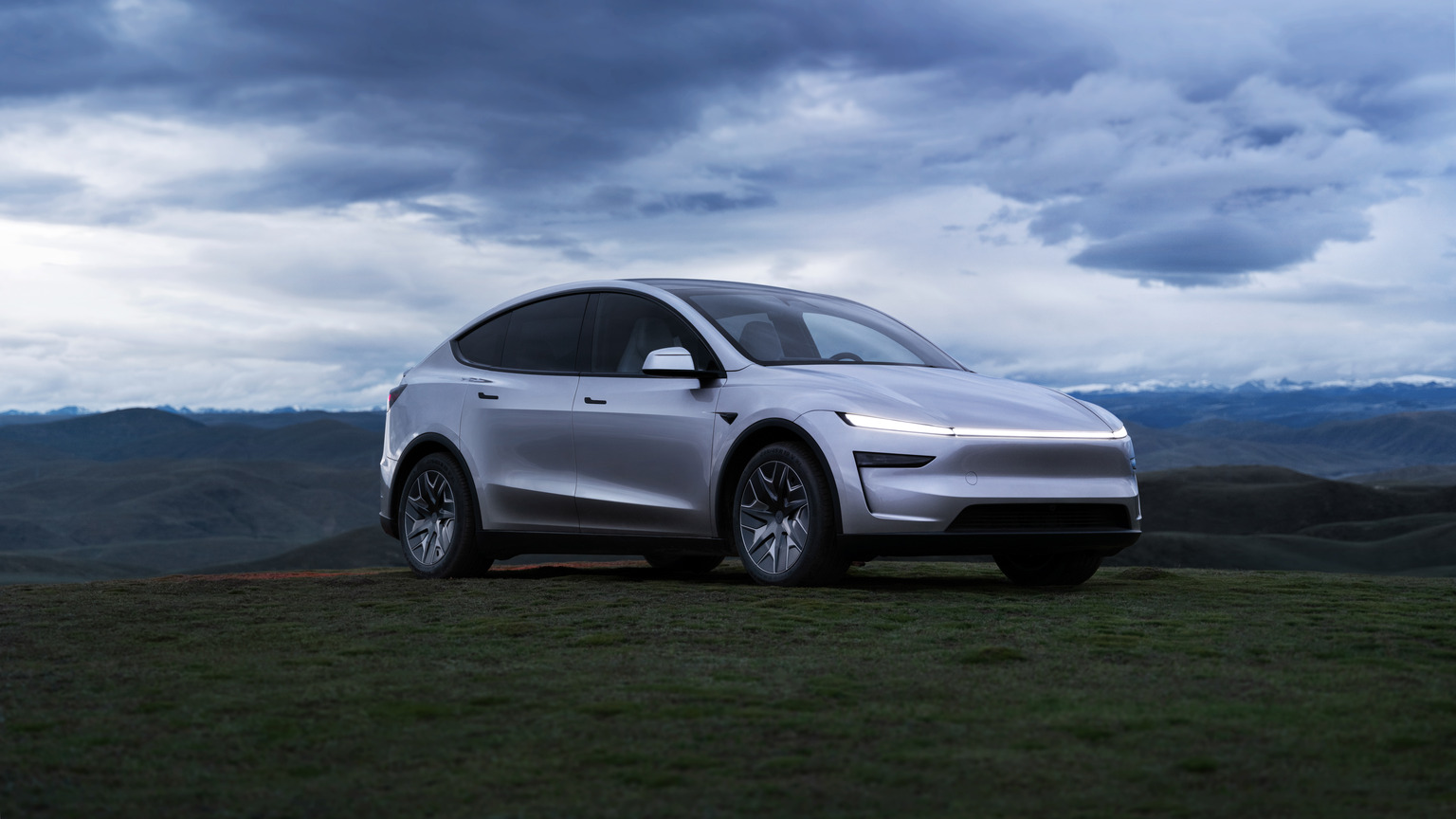
Tesla is rolling out what is likely its biggest battery feature in years through a software update, as owners are starting to reveal the new addition is hitting their cars.
Tesla is now giving owners the option to manually enable Battery Preconditioning, a feature that was previously only available at the vehicles’ discretion when heading to a Supercharger stall.
It is on its way to some owners, who are sharing the first screenshots of the feature, which lies within the Charging section of the Tesla App:
This is how 2026.44.3.1 battery preconditioning looks in the current Tesla App. 👇 https://t.co/TN9lGkc3JP
— Lothar Lindinger (@lotharlindinger) November 27, 2026
The “Preconditioning for Fast Charging” button is clearly labeled just below the charging information UI in the app. Of course, you do not need to keep it exclusively for fast charging, as preconditioning the cells can have a lot of different advantages for EV drivers.
Battery preconditioning brings your battery cells to an ideal temperature before driving or fast charging. Warming or cooling the battery cells to a proper temperature can improve charging speeds, protect the cells and their longevity, restore regenerative braking quicker in cold temperatures, and help with both performance and efficiency.
This new change comes with Tesla Software Version 2026.44.3.1, which includes several new improvements, like a new Charging Network View, Security Improvements, and Bug Fixes.
This is a welcome change and it is pretty surprising that this has not been enabled before now. There were a handful of times in the winter last year that I would set my destination as a Supercharger just to get the cells warmed up to get regenerative braking and performance to a more reasonable level.
This should be something that helps many owners in colder climates get more from their Teslas, and it also should help with long-term battery health.

Google wants more of SpaceX, reveals Elon Musk

Tesla aims to bolster Optimus with newest company acquisition


