Lifestyle
What it was like inside the Model 3 unveiling event

 It’s not very often that I am rendered speechless. Yet here I am, nearly a week since attending Tesla’s Model 3 unveiling event, without yet having put a single word down on paper about how it felt to be there. The only word that comes to mind when I’ve tried is ‘magic,’ so I’ll go with that.
The atmosphere was felt long before I walked onto the grounds. In fact, it was turning into the parking structure that I saw my very first Model X in real life. That sight was plenty to shake off the cobwebs of a long day of traveling; as was being invited to step into a shuttle bus to be driven the very short distance to the event’s entrance. The few other soon-to-be revelers on the shuttle had the same grin on their faces that I did. Perhaps it was just me, but I felt the shuttle bus driver was also in a good mood.
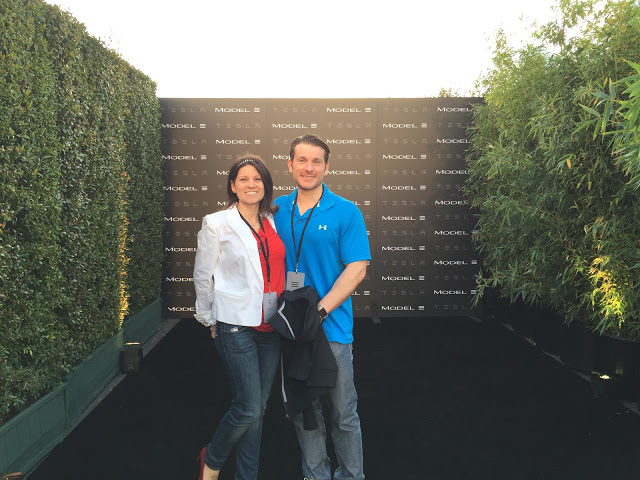
Once dropped off, we lined up to be checked in. Eager to share in the excitement with others, I promptly struck up a conversation with the two gentlemen waiting in line just ahead of us. As it turned out, they were none other than Roger and Matt Pressman of Evannex! Having reviewed the book Owning Model S, they were familiar with me and my contributions here, so chatting came easy. As promised, IDs were checked. We were handed badges and asked to wear them around our necks as we were ushered in through a beautiful green space with a Model 3 backdrop, perfect for pictures.
Immediately, we were greeted by yet another smiling face. A pleasant young woman dressed in black offered to take our picture in front of the backdrop. I was glad for the offer, since I knew once the event got started there may not be time for pictures.
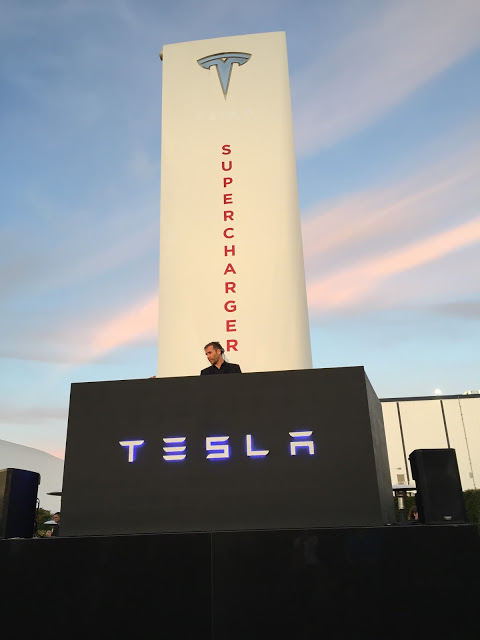
Looking around beyond the nicely decorated bars I noticed Superchargers. We were in a parking lot. Only, it a was carpeted parking lot. Nicely carpeted in fact and Superchargers oddly made beautiful display pieces. The whole place looked gorgeous and the sky that time of the day complimented it all so well.
Looking around at the many happy faces, my excitement grew for the familiar ones from the internet I hoped to catch a glimpse of in person. In fact, I was also waiting on those whose faces I had not before seen including two fellow Pennsylvanians who also hit the ticket lottery and made the trip out West and Teslarati’s very own, Gene. Very shortly after arriving, those two fine Pennsylvanians, Chris and Dave, and their guests (one spouse and one very lucky young man) found me. Everyone wore the very same look of awe on their faces as I was. We were all so thrilled just to be standing where we were at that moment.
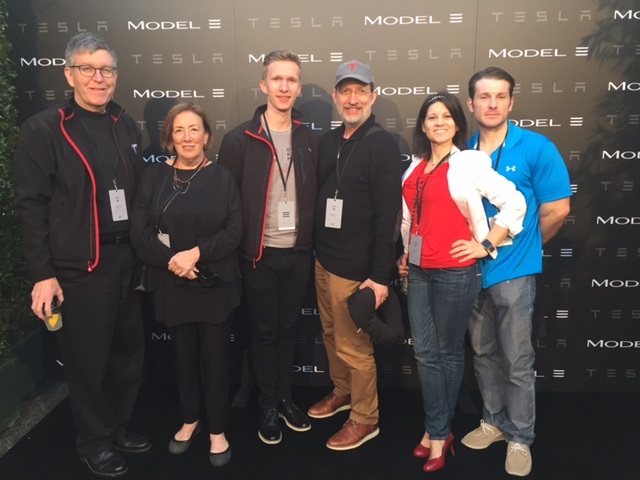
It’s mathematically impossible for all 6 people in a picture to smile at the same time
The bars were nicely stocked and the folks serving were a joy, so I grabbed something and stood with a fantastic view of a gorgeous blue Model X, while chatting. After a few minutes, I was too excited to stand still and decided to do a few laps around the event. I caught glimpses of writers such as Motley Fool’s Daniel Sparks and Bloomberg’s Dana Hull, both of whom I later had the pleasure of chatting with. I felt humbled as I walked by Tesla royalty Bonnie and Bjørn, and did a double take after passing that girl from that show I used to love. Having never attended a party like this, the whole feeling was a bit surreal. As I said earlier, magic.
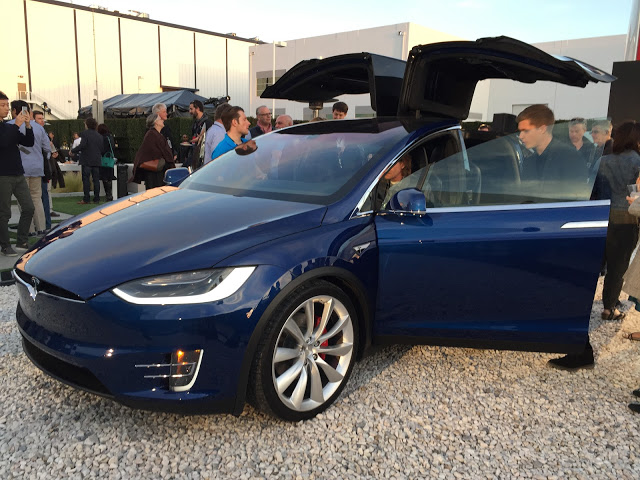
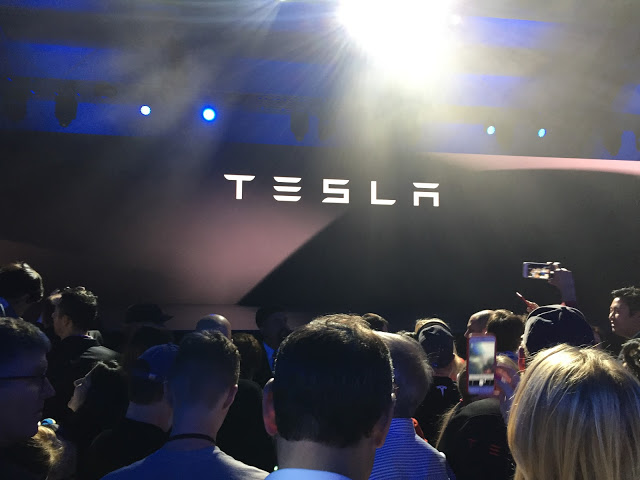
A crowd started gathering near the entry doors to the inside portion of the event, where the big show was set to occur shortly. Being all too honored just to be in attendance, I didn’t worry about getting in quickly and taking a place near the stage. It was a small, intimate event as promised, and there was plenty of room for all. The sun was just about gone at this point and the feel of a party was obvious. Everyone was anxiously awaiting the big reveal.
A Model S and Model X were prominently displayed to one side, and both were gorgeous. The stage was modern and guests were staring intently or holding up phones waiting for the big moment. Then it happened. After a long day of traveling and one heck of a scare from an erroneous flight cancellation notice (which, by the way, almost caused us to miss the flight that was not at all cancelled), Franz von Holzhausen took the stage. He was wearing a well-fitting blazer, no tie and just the right amount of facial scruff as if to say “This is the big moment and I’m fully confidant you’re going to love it!” In fact, he probably said something just like it in his short speech welcoming us and introducing Elon. I had hoped to hear a little more from him but can appreciate that since this was a live broadcast about the car, it was probably best kept prompt. (New life goal: meet this man for real!)
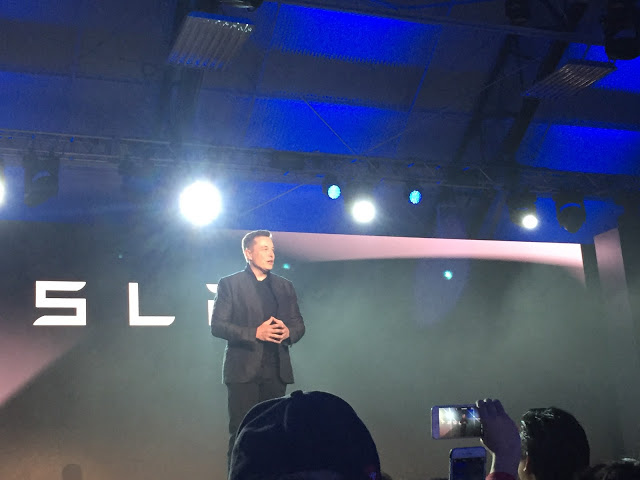
Next came Elon, right on cue. We are used to his speech patterns by now but I for one think he did an excellent job of being clear, focused and happy. He gave us just a few tidbits about the car, including 5-star safety ratings and the expected 215 miles on a charge. While neither were surprising, both drew massive cheers from the crowd. The most massive cheer, however, would come when the announcement was made that over 100,000 reservations had been made sight unseen. I projected that many within a day or so after the unveiling, but having that many before really blew me away. It also seemed to blow away everyone else in the crowd, especially the guy who yelled “You did it!” to Elon.

I’ll be the first to admit when I saw the car, I was taken aback by the front end. The rest of it was glorious but it took me spending the rest of the evening staring from all angles to appreciate that front. That instant hesitation however, was completely eclipsed by the reality of what was happening. A hundred thousand people willingly dropped a cool grand for a car they hadn’t yet seen, and won’t be in their hands for two years.
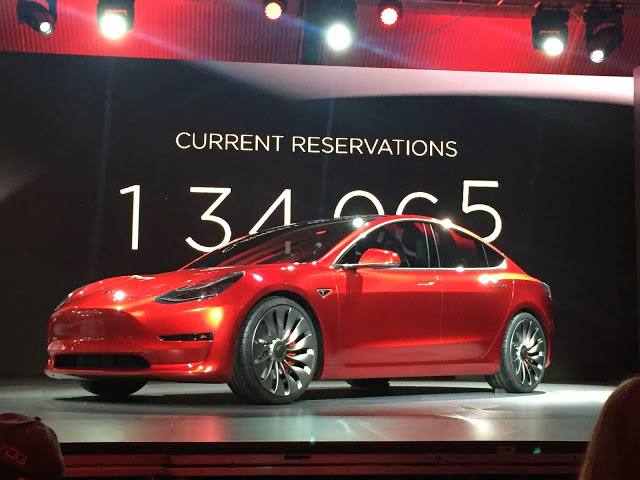
Now unveiled, online reservations started pouring in. There was a ticker on the screen behind the red Model 3 prototype, which had been left on stage. That number would double, as we now know, by the end of Saturday. Test rides were in high demand, and done numerically, so there was a large gap of time between the presentation ending and my pass #428 being called to ride. I took that time to mingle more, ride along for a Model X Ludicrous launch and congratulate as many Tesla employees as I could.
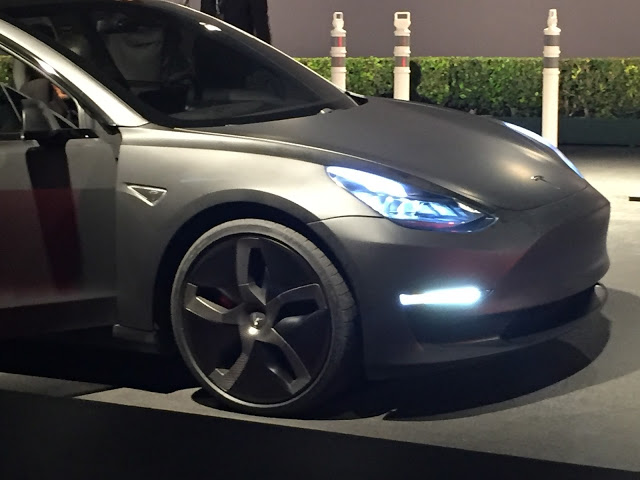
The Model 3 that was being used for test rides was a gorgeous matte silver with black rims and the same shaped door handles as the Model S. I got a nice close up while in line for the Model X test ride, which literally made my ears pop. You read and understand about the marvel that is the Model X and about how fast a ludicrous launch feels but you can’t fully fathom it until you experience it firsthand. It handled a slalom course like a race car and the handsome gentleman driving was kind in correcting my assumption that he was a professional driver for Tesla. (He was actually a high level person in product design.) In fact, he was as much a joy as the car and got a laugh out of my rolling down a window to wave at a camera. That was, after all, far better than the alternative worst case scenario he imagined, which was that I needed to roll down the window after such an intense acceleration.
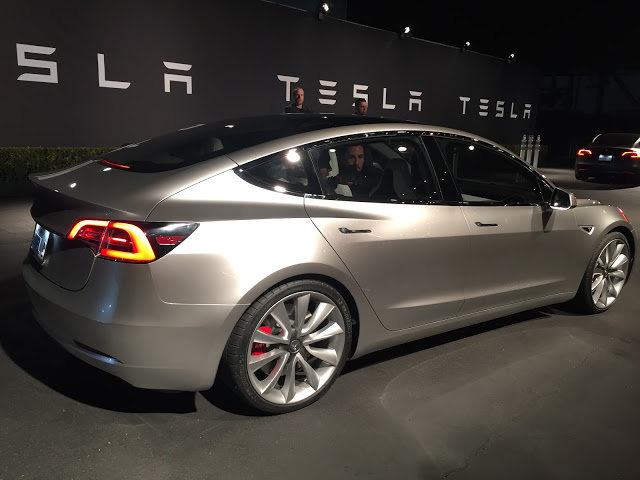
Once our batch of pass numbers was shown on the screen, it was time to line up for the Model 3 ride. I had the pleasure of standing behind and speaking with a fellow owner who once had an electric car that pre-dates the EV1. He was one of many interesting people I chatted with throughout the night, in what I can only assume was about the most friendly group of strangers ever to be at one party.
Once our turn came up, I quickly volunteered to sit in the middle of the back seat. My husband is not tall but broad shouldered and the other person in the rear with us was quite tall. While I wouldn’t want to be on a long ride with 2 other adults in the back seat in the Model 3 (or any other car!) it certainly did fit us all. It had head room for days, thanks to the glass roof and offset support. I did notice that the driver’s knees looked like they were unnaturally bent and assumed he was uncomfortable. I asked him whether he was tall or the car was small. He confirmed that he was 6’4” and had the seat up a lot further than usual to leave extra room in the rear. He also mentioned that the Model 3 is one of very few cars that he can drive without setting the driver’s seat all the way back.
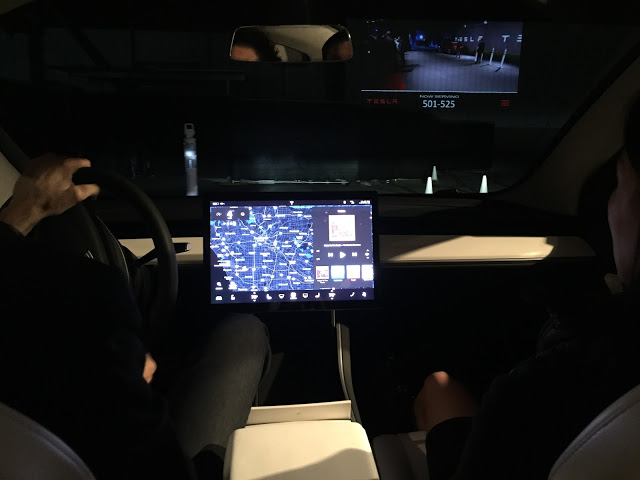
I noticed the horizontal screen, as did most others and will assume that it will be a little more integrated in its final format. Having it stick out to me seems far too risky for either theft or accidental damage. The Model S and X have their screens beautifully integrated so I have no worries about what the final product will be.
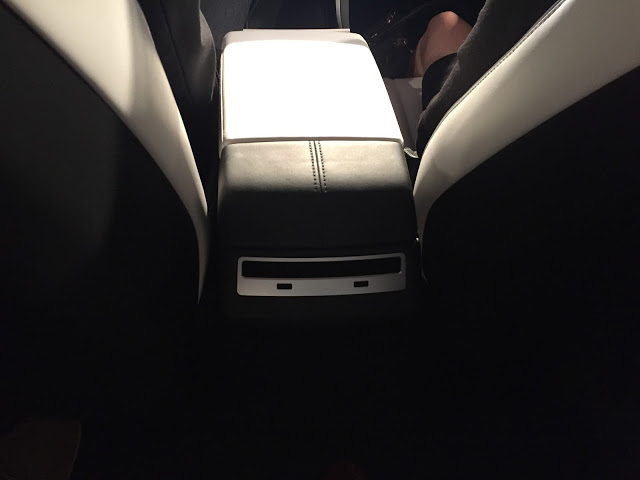
For some reason, I happened to notice two USB ports in the rear of the center console area, accessible to rear passengers. In today’s connected world, it’s pretty smart. You can power anything from a cell phone to those seat back mounted video screens by USB. What I also noticed was that the center console area extended toward the center screen and did not drop down to an empty floor like in pre-center console Model S cars. I sincerely hope for the open space to be an option on the 3, though having a mandatory center console is by no means a deal breaker. In fact, I can’t think of anything that would be a deal breaker with this car, short of it coming out looking like a Pontiac Aztech, which we knew it wouldn’t.
The test ride was short and sweet. Like the rest of the event, it left me wondering how the heck we are all going to survive waiting so long for this car to become a reality. Fortunately, Tesla has tossed us just enough scraps to keep us chomping at the bit. A little twitter Q&A provided more fuel over the weekend and an impending Part 2 reveal will leave us with plenty to speculate. Let the wait begin.


Elon Musk
Elon Musk says he knows how to save Earth for a billion years
Elon Musk says sentient AI satellites launched from the Moon could keep Earth livable forever.

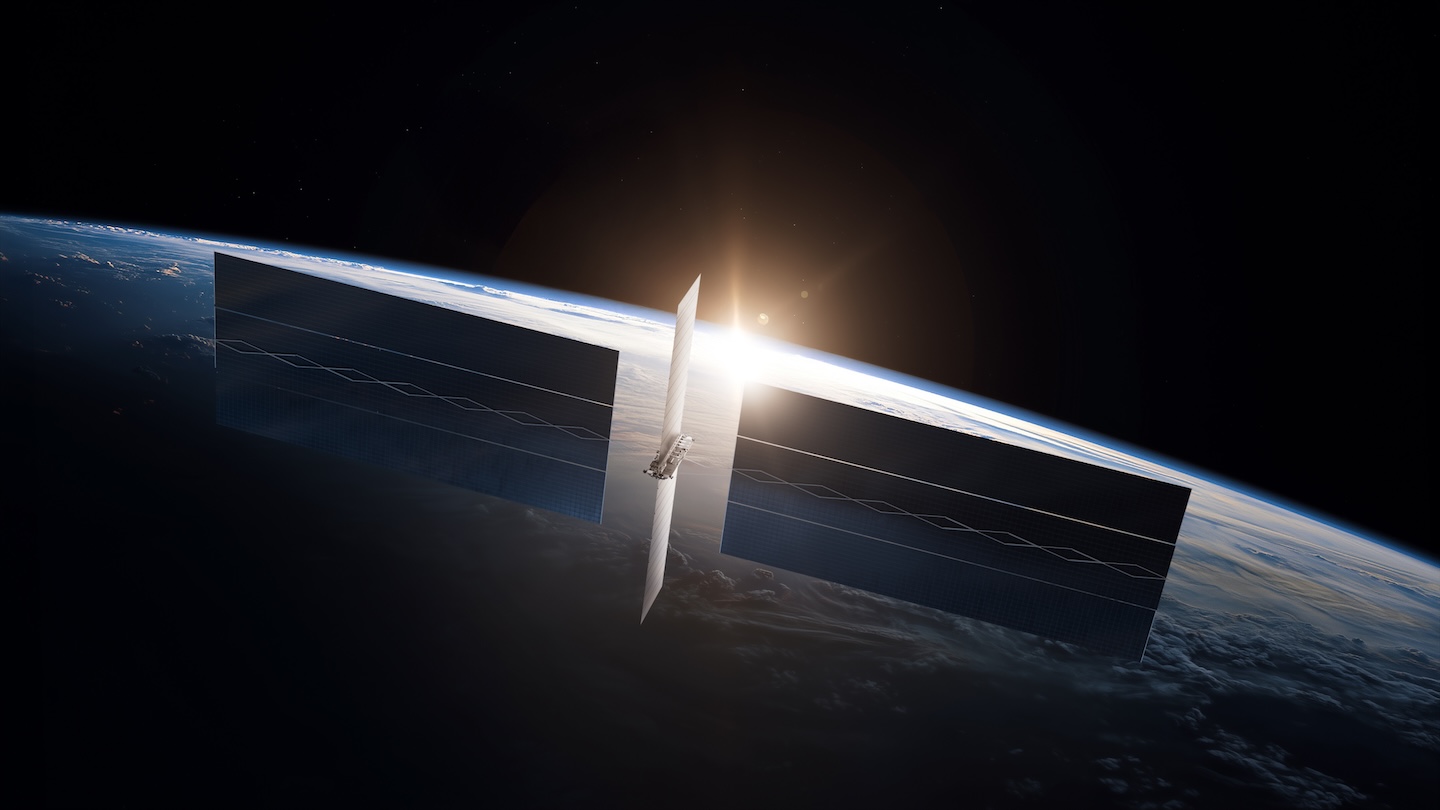
Elon Musk spent part of his weekend describing a plan to keep the planet livable for roughly a billion years, and it starts with satellites that can think for themselves.
In a post on X, Musk argued that swapping fossil fuels for solar and wind power will not be enough to protect humanity from what he called extremely severe extinction events, the kind that occur roughly every 100 million years. His fix is what he called sentient satellites, or solar-powered satellites, controlled by AI, that would sit in a fixed spot between Earth and the Sun after being launched off the Moon using a giant electromagnetic catapult instead of rockets.
The satellites’ onboard AI would make continuous, small adjustments rather than waiting on human instructions. The mass driver is Musk’s proposed way of getting the raw material there cheaply by using an electromagnetic launch track built on the Moon, where lower gravity and no atmosphere make it far easier to fling cargo into space than it is from Earth.
But we do need to act much faster than that if people still want to live where the beach is today. We have about 50 years or so to take action, which should be more than enough time for the space satellites to solve any heating problems. https://t.co/xhrVQALwQw
— Elon Musk (@elonmusk) August 30, 2026
Musk shared a Grok generated estimate suggesting roughly 5 percent of Florida’s land, or about 1.68 million acres, could face regular flooding by 2070 under a high sea level rise scenario, and said humanity has about 50 years to act before coastal living looks very different than it does today.
This is not the first time Musk has floated the idea. He raised a similar concept in November, describing a solar powered AI satellite constellation that could make tiny adjustments to incoming sunlight to fine tune Earth’s temperature. Musk has also tied planetary risk to his broader vision at SpaceX, where his compensation package is explicitly linked to establishing a self-sustaining Mars colony, one he has described as an insurance policy against the kind of extinction event he referenced this weekend, and where he has said humans could set foot within five to seven years.
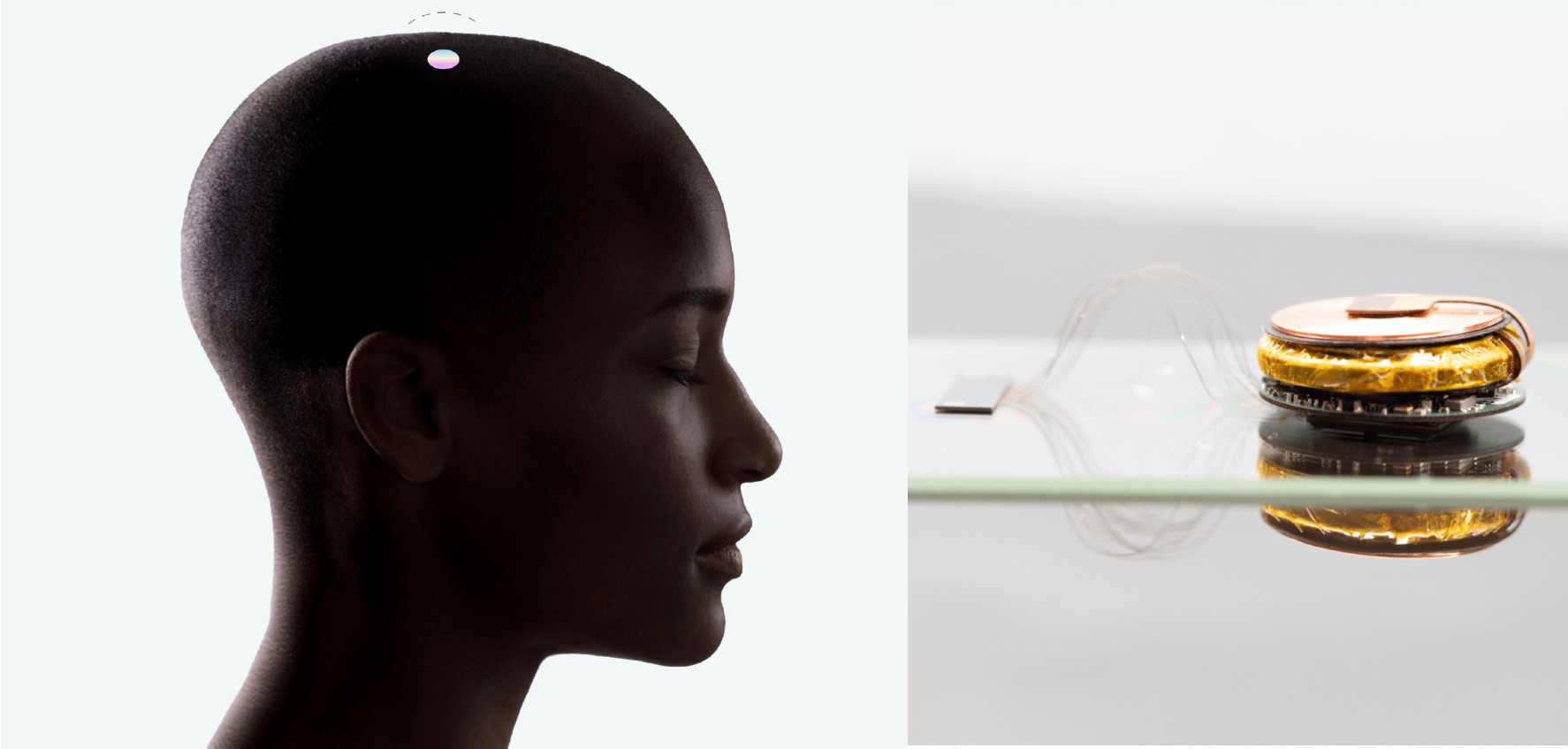
A former Vancouver police sergeant with ALS accounts his journey to become a patient for Elon Musk’s Neuralink wireless brain-computer interface technology.
“I’m texting you from my brain right now.” That was the first message Lee Marten sent after waking up from Neuralink surgery, five hours and one migraine after dozens of threads were stitched into his motor cortex.
Marten, a former Vancouver police sergeant, is one of the first Canadian ALS patients to receive Neuralink’s N1 brain implant, and the 26th recipient overall. He tells his story in a first-person account published by Maclean’s.
Marten recounts how he was a healthy, athletic Vancouver police sergeant until April 2022 when symptoms of muscle twitching and balance loss, were followed by a bad fall that broke his leg. He would eventually be diagnosed with ALS in early 2025 at the age of 47. ALS, also known as Lou Gehrig’s disease, is a fatal neurodegenerative disease that progressively destroys the motor neurons controlling voluntary muscle movement, eventually taking away a patient’s ability to walk, speak, swallow and breathe. There’s no cure, and most patients live two to five years after diagnosis.
He describes the devastation of the diagnosis and how he began preparing for it while connecting with other young ALS patients through a WhatsApp group called Young Guns. Through that group he learned about a Neuralink clinical trial at Toronto Western Hospital and, after a roughly seven-month vetting process (physical assessments, psychiatric evaluation, a final interview with the Neuralink team), was accepted this past April as the trial’s 26th recipient and the first Canadian ALS patient to get the N1 implant. He recounts the May surgery in detail, including the robotic system that stitched 64 threads into his brain, and describes the app, Link, translating his neural signals into cursor control, which he was using within hours of waking up.
Marten walks through what daily use looks like, including weekly “brain training” exercises, a real-time neural-activity display, charging the implant via a beanie-mounted MagSafe charger, and using the implant for emailing, texting, social media, and gaming via a “Magic Box” that connects it to other devices. He also gives brief context on brain-computer interface history and quite candid about Musk, calling him “divisive” but saying he found him “easy to admire.
The piece closes on a heavier note, with Marten seeking to pursue medical assistance in dying as his symptoms progressed, noting that he’ll be able to communicate his final words to his family through Neuralink rather than facing a silent decline. He expresses hope the data from his case will help future ALS patients, even without a cure in his own lifetime.
Investor's Corner
Tesla Robotaxi gets a massive upgrade in Nevada
Nevada regulators just approved a massive expansion of Tesla’s robotaxi fleet across the entire county.
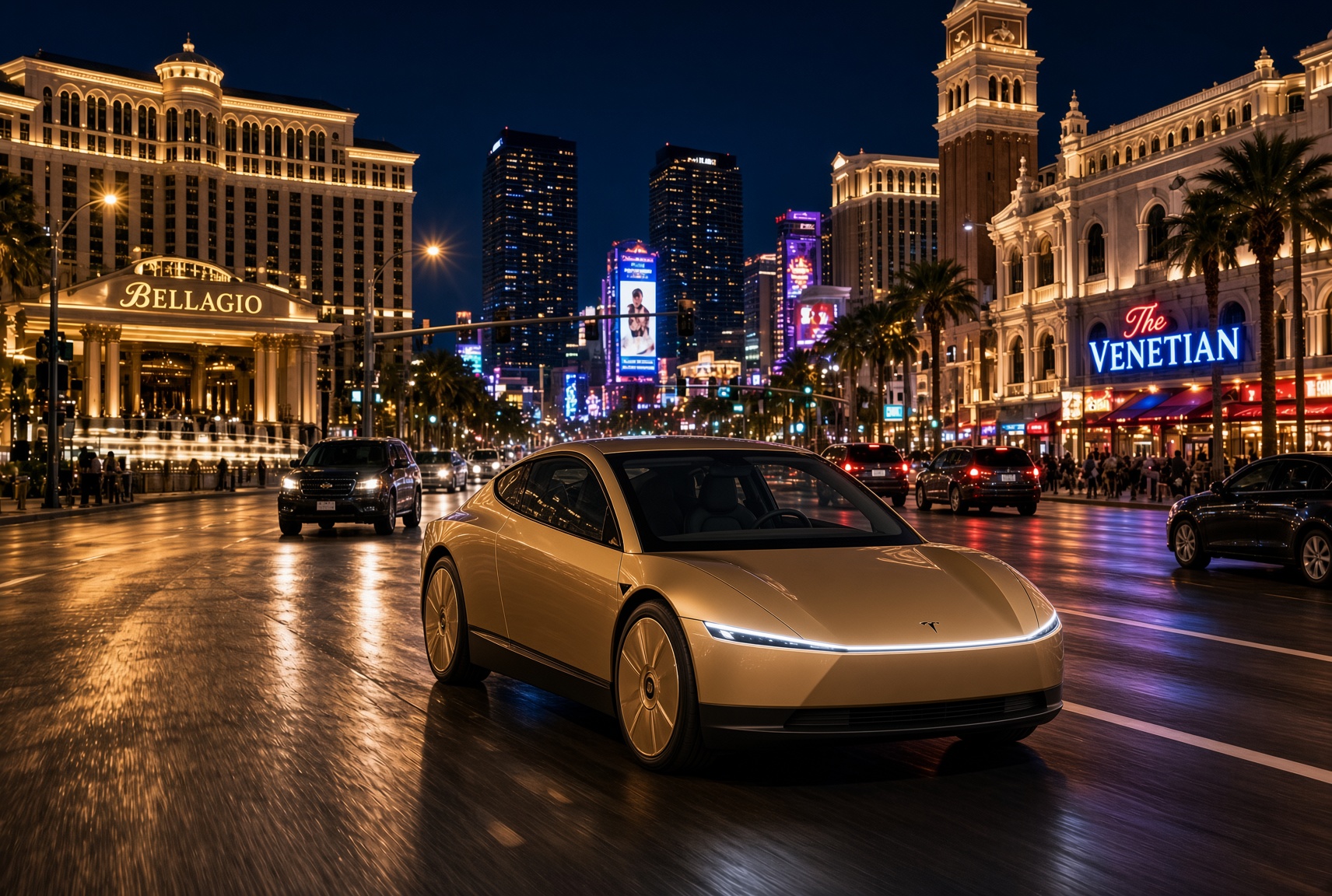
Tesla’s robotaxi footprint in Nevada just grew by roughly 500 times in a single regulatory vote.
The Nevada Transportation Authority approved Tesla’s full Autonomous Vehicle Network Company permit on Thursday, clearing the way for the company to deploy up to 5,000 driverless vehicles across Clark County over the next 12 months. The decision came during a four hour general session meeting that Tesla investor Sawyer Merritt watched live and reported on X, noting the vote replaces the interim order that had limited Tesla to just 10 robotaxis on a narrow stretch of the Las Vegas Strip.
EXCLUSIVE: Tesla has just officially received approval for its full Autonomous Vehicle Network Company permit in Nevada, clearing the way for Tesla to launch a paid public Robotaxi service in Las Vegas.
This officially allows @Tesla to deploy up to 5,000 robotaxis over the next… pic.twitter.com/DPs5UtUlrE
— Sawyer Merritt (@SawyerMerritt) August 20, 2026
That earlier cap, covered here after it surfaced on August 13, came with restrictions that looked stricter than what Tesla runs in Austin: a 45 mph speed ceiling, no airport pickups, and a geofence confined to the Strip corridor. The new approval extends Tesla’s operating authority to all of Clark County, with room to request an even wider geofence across the state.
Tesla representatives at the meeting said they have no intention of putting 5,000 cars on the road right away. Commercial rides are expected to start within 30 days, pending vehicle inspections, insurance filings, and fare approval, the standard steps every robotaxi operator in Nevada has had to clear.
Tesla’s own Robotaxi account replied to the news with a short line, The golden future is upon us.
The timing lines up with Tesla’s broader robotaxi push this month. The company is preparing to open Cybercab rides to the public in Austin as soon as this month, and it opened a sweepstakes for riders to win a seat at the launch event. Tesla filed its original application for a 5,000 vehicle Nevada fleet back in June, a request regulators trimmed to 10 vehicles when they issued the interim order in July. Thursday’s vote effectively grants the number Tesla asked for from the start.
Zoox, the Amazon owned robotaxi operator, has run in Nevada since 2025 and was capped at 100 vehicles before Thursday’s decision. Tesla’s new ceiling puts it well ahead of that comparison on paper, though the company has said its actual fleet size will depend on how quickly FSD v15 rolls out, the software update executives have called the gateway to scaling unsupervised robotaxi operations nationwide.

SpaceX tells the FCC that Starship Flight 14 is going to orbit

Tesla Cybercab Event: what to expect from Austin


