News
‘Tesla brake failed me’: Owners protest quality issues at Shanghai Auto Show

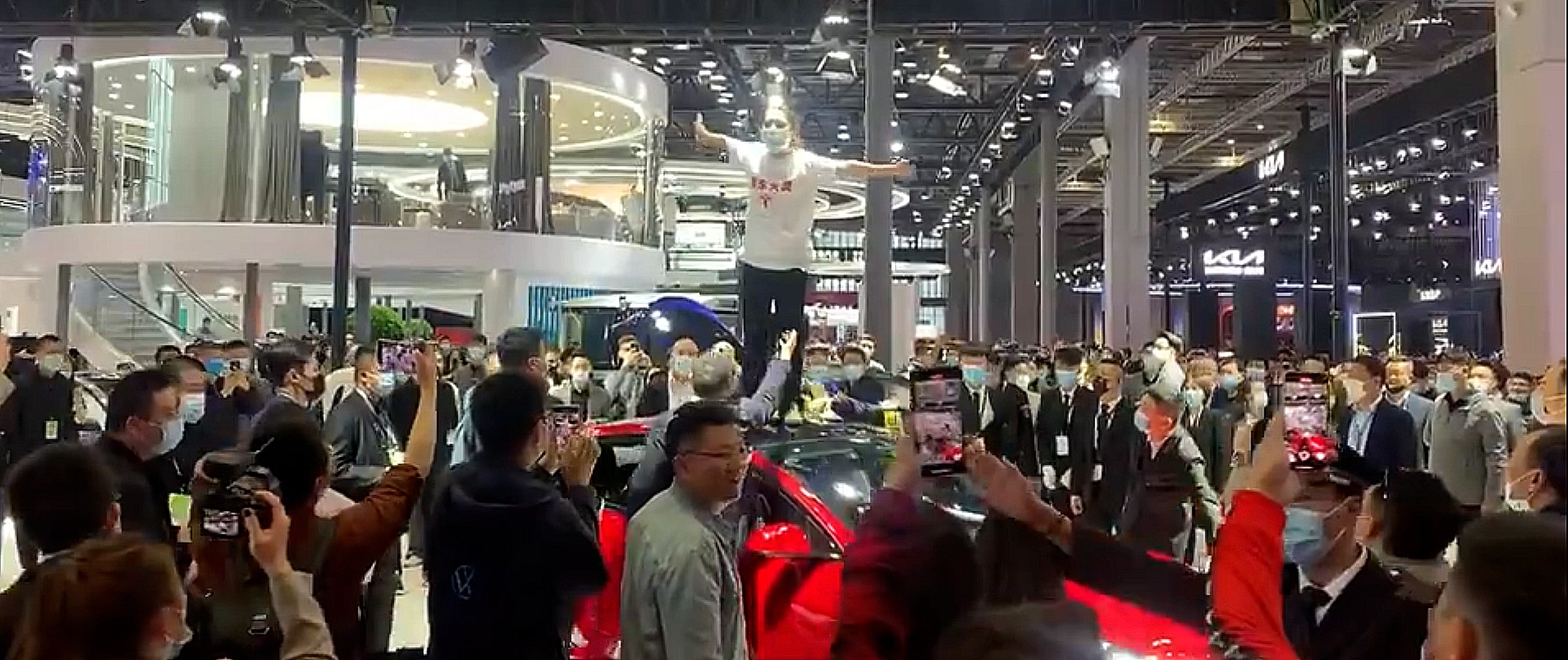
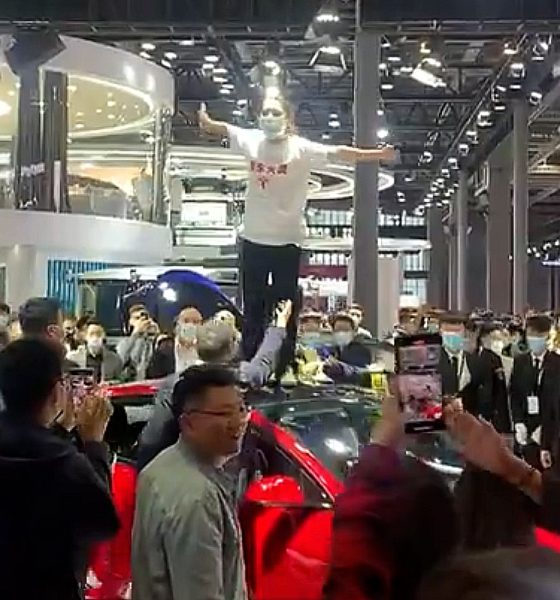
A Tesla owner made a scene at the Shanghai Auto Show in China earlier today by jumping onto the roof of a Model 3. Local media reports that the woman was protesting Tesla’s automotive quality after her vehicle’s brakes evidently malfunctioned. She was joined by another woman who also contributed to the protest.
According to numerous eyewitnesses at the Shanghai Auto Show, the two women claimed that their Teslas were of poor quality and that issues with their brakes put them in danger. Both women were wearing shirts that said “Tesla brake failure,” with a Tesla logo printed directly under the words. One woman screamed, “Tesla brakes failed me,” from the roof of a Model 3 that was parked in the Tesla booth at the event.
A female Tesla owner climbed on top of a car’s roof at the Tesla booth to protest her car’s brake malfunction at the Shanghai auto show Monday. The booth beefed up its security after the incident. pic.twitter.com/ct7RmF1agM
— Global Times (@globaltimesnews) April 19, 2021
The woman was eventually removed from the vehicle and taken away from the event by security guards. Police also commented and said the woman was taken in for questioning. As a result of the protest, the Tesla booth was roped off and protected by around 10 guards, Global Times said.
Tesla representatives told local media outlets that “police is supposedly investigating the case.”
The event at the Shanghai Auto Show follows several local protests regarding the quality of Tesla vehicles. In March, one owner in Zhengzhou said that a defective braking system “almost killed her family.” She printed “Tesla brake failure” on her car. Interestingly, this is the exact phrase that was donned on the woman’s shirt at the Shanghai Auto Show.
Tesla has experienced an impressive amount of success in China and is coming off of its biggest month in terms of vehicle registrations in the country. Earlier today, it was reported that Tesla registered 34,635 cars in China in March. This is nearly two times as many cars as Tesla registered in February (18,155) and nearly three times the number of cars registered in March 2020.
The Tesla Model Y is leading China’s electric SUV segment by a wide margin
Interestingly, there has been a recall of some Tesla vehicles in China in recent memory, but the recalls did not have to do with the braking systems. Instead, it was a simple fix for the eMMC. Routine wear and tear after several years of driving caused some malfunctions of a Tesla vehicle’s infotainment system. The same recall was issued in the United States, and Tesla began making repairs on March 31, 2021.
Relations between China and Tesla have been tested lately after some government properties have banned the company’s all-electric vehicles from being driven on State-owned properties. Fearing a possible security breach due to Tesla’s use of external cameras, some Chinese interests have chosen to ban the cars to alleviate concerns of recording sensitive information. Elon Musk has denied these claims by stating, “There’s a very strong incentive for us to be very confidential with any information. If Tesla used cars to spy in China or anywhere, we will get shut down.”


Elon Musk
SpaceX showcases exactly how it plans to catch Starship next month
SpaceX played a new Starship Flight 15 simulation showing the ship caught by tower chopsticks.

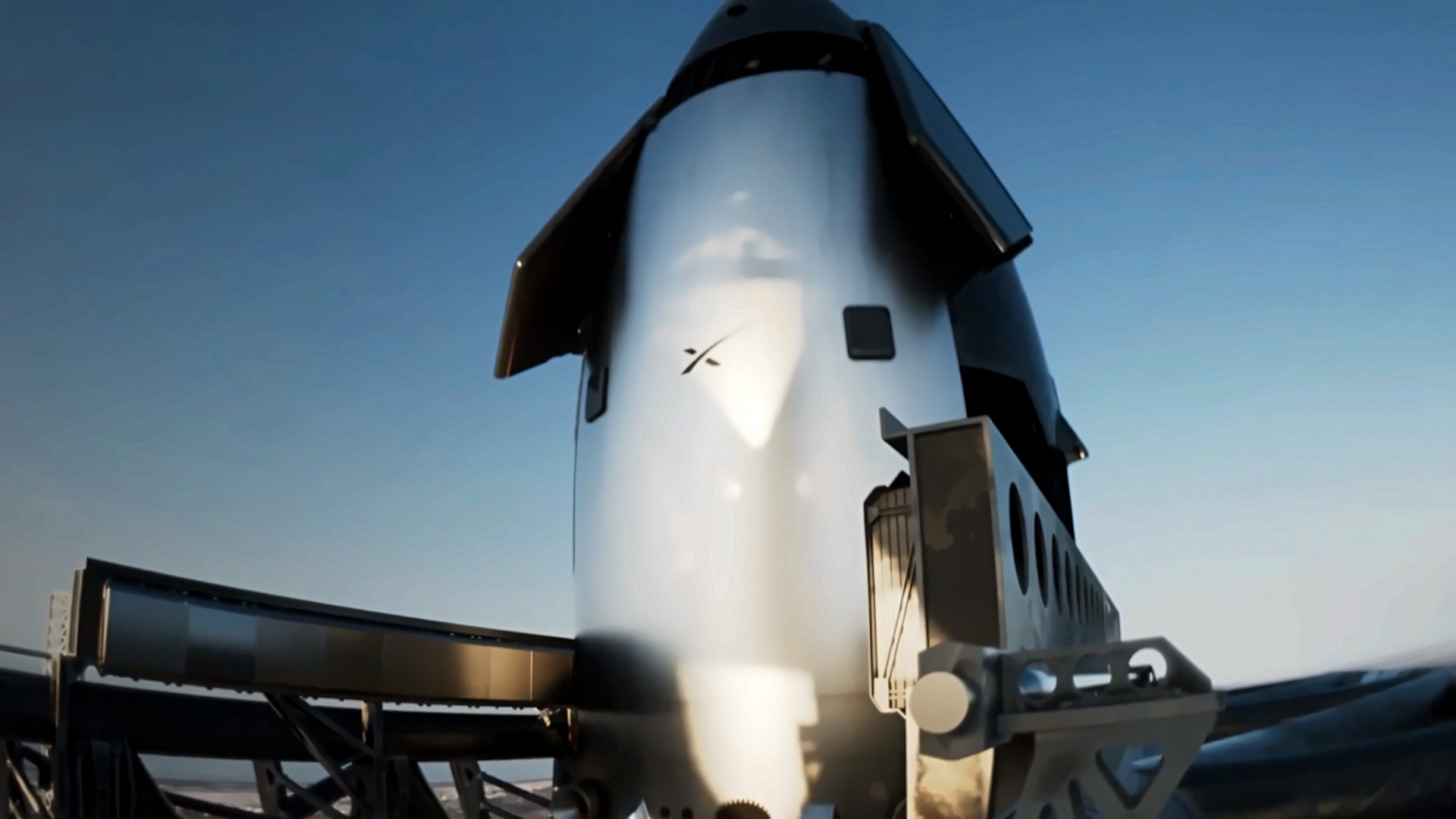
SpaceX gave its clearest look yet at how it plans to catch a Starship upper stage, playing a roughly 80 second animation of the maneuver during its third quarter earnings webcast on Tuesday. The clip ran under an “Up Next: Ship Catch” banner moments after Elon Musk confirmed that Flight 15, expected next month, will try to catch both the Super Heavy booster and the ship with the launch tower.
The animation opens at ground level, looking up through the launch mount at a tower with its chopstick arms spread wide. It then cuts to the ship gliding back through the atmosphere in its horizontal belly flop position, with its forward and aft flaps steering the descent. A wide shot from the Starbase shoreline follows, where the ship is a small dot in the sky before it swings vertical and drops toward the launch towers. The final shots show the ship sliding down past the top of the tower, a close view of the hardware along its side meeting the arms, and the vehicle hanging in the chopsticks.
SpaceX has released a new Starship tower catch animation for the upcoming Flight 15! https://t.co/kStn01Da8u — Truthful🛰️ (@Truthful_ast) October 20, 2026
Musk called the catch the step that closes Starship’s reuse loop. “If we succeed, it will be the first time that an orbital launch vehicle has been fully recovered,” he said. He put the odds of success on the first attempt at “more likely than not,” and said SpaceX has “a steady stream of Starship flight attempts through the end of this year” if Flight 15 falls short.
The sequence mirrors work SpaceX has already done with real hardware. In September, Ship 42, the vehicle assigned to Flight 15, was lifted by the Pad 2 chopsticks into a simulated catch position, where crews cycled the arms and connected the ship quick disconnect arm while it hung from the tower. NASASpaceflight has since reported that SpaceX removed Ship 42’s engines before its static fire and sent it back for another cryogenic test.
Gwynne Shotwell covered the regulatory side on the same call. After what she called “significant constructive engagement with the FAA,” SpaceX expects the Flight 15 license “to include return to launch site and tower catch for both stages.” Bringing the ship home means reentering toward land instead of the open ocean, which Musk said in February would only happen once the chance of the ship breaking up over land was very low, after two perfect soft landings at sea.
SpaceX has caught Super Heavy with the tower three times, on Flights 5, 7 and 8, but the ship returns from orbit at far higher speed and has never been caught. Flight 14 on September 28 was the first Starship to reach orbit, and it deployed 26 Starlink V3 satellites before splashing down, a mission SpaceX counted as its first revenue flight in the Q3 results it reported Tuesday.
The timing lines up with what Musk told the crowd at Giga Texas earlier this month, when he said Flight 15 would probably launch a little before Thanksgiving and that Flight 16 could refly both stages. On Tuesday’s call he went further, saying Starship should fly weekly at some point in the first half of 2027 and twice weekly or more by the end of next year as SpaceX works toward landing a rocket and launching it again with no refurbishment.
Elon Musk
Elon Musk just confirmed the Tesla and SpaceX merger step everyone was waiting for
Tesla and SpaceX formed special committees to weigh a merger, and Elon Musk supports it.
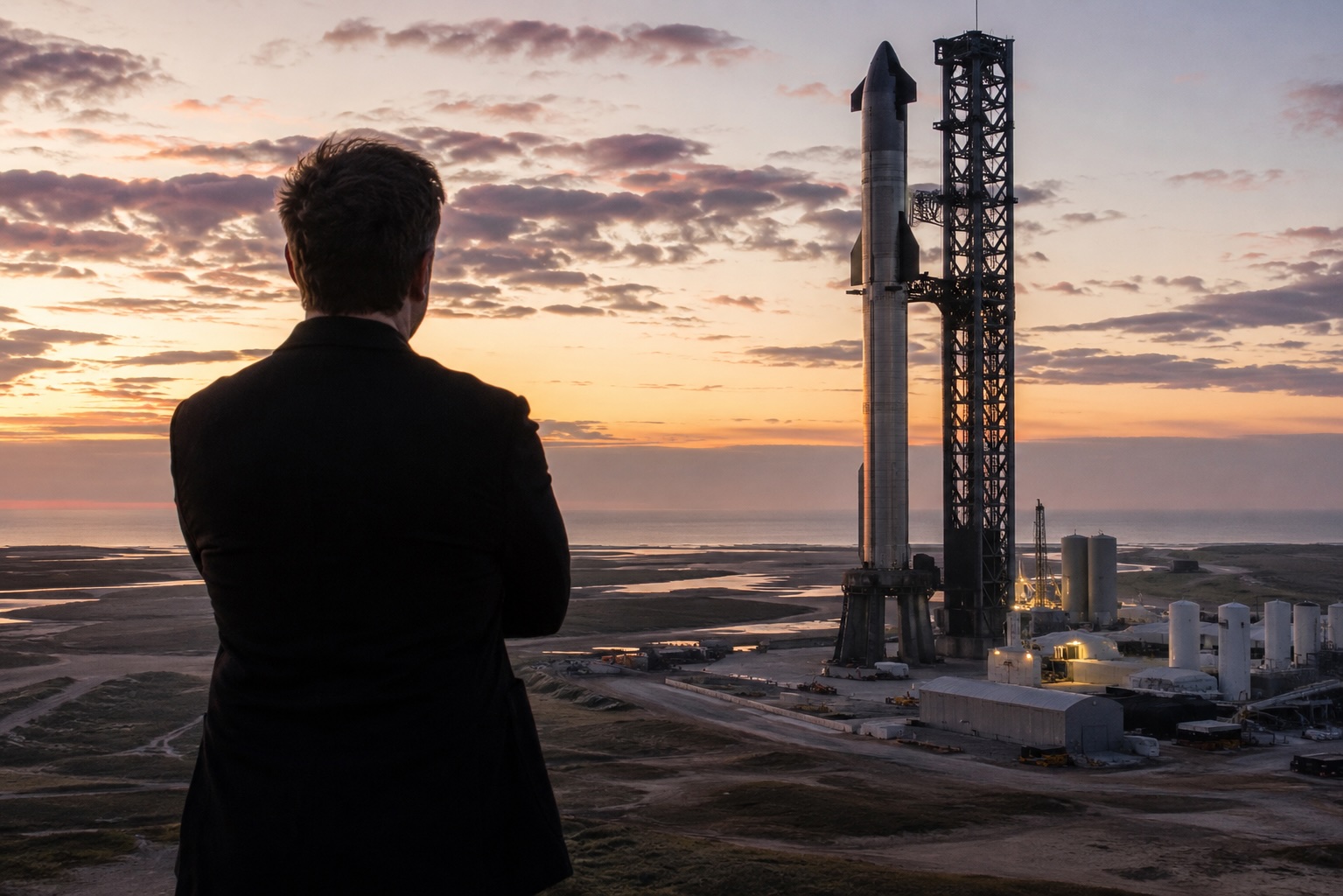
Elon Musk confirmed Tuesday that Tesla and SpaceX have each formed special committees of independent directors to study a possible merger, the first formal step toward combining the two companies after months of speculation.
Musk made the disclosure during SpaceX’s third quarter earnings call. “Both SpaceX and Tesla have formed special committees to discuss this idea at the request of shareholders,” he said. “Because I’m a conflicted party, I can’t actually be in the discussions of the special committees.” He described the setup as “an odd kabuki dance where two groups of people are talking and I can’t be in the conversation.”
Musk did not hide where he stands. “Do I think it would be a good idea? Yes,” he said, pointing to shared work on super intelligence software, chip design, the Terafab facility in Austin, robotics, mass to orbit and connectivity. “I do think there’s a lot of merit to combining the companies as we are pretty much in the super intelligence singularity.”
He also tried to cool expectations. The committees have not agreed on terms for any transaction, and Musk said assuming a merger is a certainty “would be overstating it.” Any deal would go to shareholders, and on the Tesla side it would need approval from 50 percent of all outstanding shares, not just the shares that are voted. Musk called that “quite a high hurdle.”
That bar has tripped Tesla up before. The company’s 2025 attempt to declassify its board won support from only 39.4 percent of outstanding shares and failed. Musk’s own voting stake sits near 20 percent after he exercised his 2018 options in June, so a deal would need broad backing from institutions and a retail base that often leaves votes uncast.
Timing is another open question. Tesla filed its proxy statement Monday for its December 3 annual meeting, and the ballot has only three items: director elections for Musk, Robyn Denholm and JB Straubel, a say on pay vote and auditor ratification. Barclays analyst Dan Levy had argued that an announcement would need to land by late October or early November to make the annual meeting, as Teslarati noted in its SpaceX earnings preview. With no terms agreed, any vote would likely require its own special meeting.
Elon Musk gives his most telling Tesla-SpaceX merger conversation yet
Musk has been edging toward this for weeks. At the All-In Summit in September, he asked “who can imagine what action one might take when there’s so much close collaboration,” Teslarati reported. Last week’s Roadster unveil, built around SpaceX derived cold gas thrusters, pushed the talk further. The two companies already share the Terafab chip project, and Tesla holds a small SpaceX stake that came from its earlier investment in xAI.
SpaceX brought strong numbers to the conversation. It reported Q3 revenue of $14.58 billion, up 161 percent year over year, with its Super Intelligence segment now its largest at $7.56 billion. A higher SpaceX valuation would shape any exchange ratio Tesla holders are offered.
Tesla reports its own third quarter results after the close on Wednesday, October 21. Investors had already ranked merger timing among the top retail questions for SpaceX’s call, and the committees will almost certainly come up again on Tesla’s.
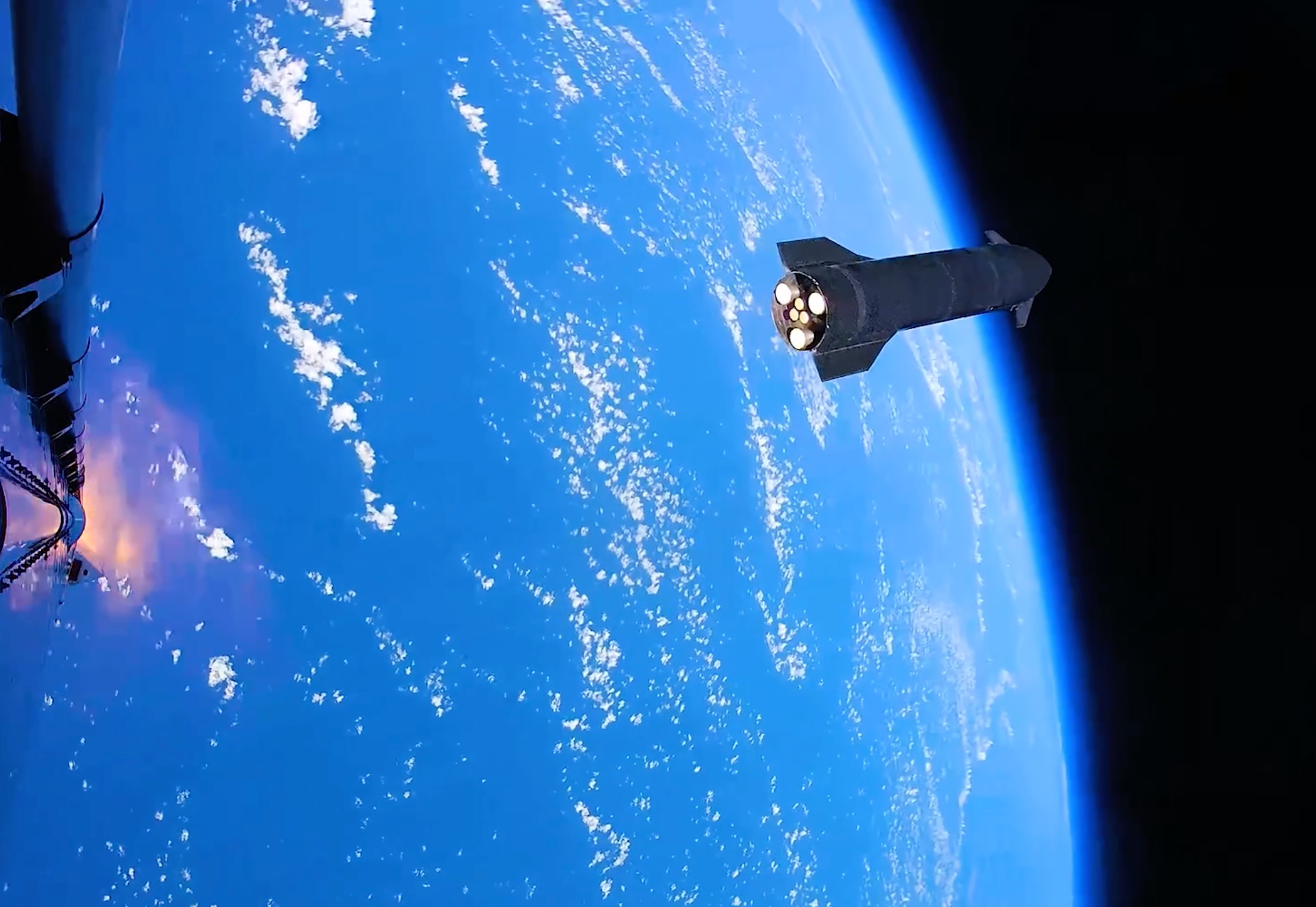
SpaceX reported its third-quarter 2026 financial results on October 20, posting the company’s first solidly profitable quarter since going public earlier in the year under the ticker $SPCX.
Revenue reached $14.58 billion, up 161 percent year-over-year from $5.6 billion, and well ahead of consensus estimates in the $12.7 to $12.9 billion range. The results highlight a rapid shift in SpaceX’s center of gravity toward artificial intelligence/super intelligence, while Starlink and traditional space operations continue to show robust progress.
Here are the key financial results for the quarter:
- Revenue of $14.58 billion (+161% YoY)
- Adjusted EBITDA of $8.8 billion (+306% YoY)
- GAAP net income of $4.4 billion (versus a $1.1 billion net loss in the prior-year quarter)
- Adjusted EPS of approximately $0.35 (versus roughly $0.13–0.16 expected)
- Income from operations of $2.8 billion
The AI/SI segment generated $7.56 billion in revenue, an 830 percent year-over-year increase, making it the company’s largest segment for the first time. Growth was primarily driven by the activation of major cloud services agreements, the integration of Cursor (acquired earlier in 2026), and rising usage of Grok models and the newly introduced Grok Bot personal agent.
🚨 SpaceX just reported earnings! Here are some highlights:
Financial:
Revenue $14.58B (+161% YoY) vs. consensus ~$12.7–12.9B
Adjusted EBITDA $8.8B (+306% YoY)
GAAP net income $4.4B (vs. prior-year loss; first solidly profitable quarter post-IPO)
Adjusted EPS ~$0.35 vs. ~$0.13–0.16 expectedSegments:
Super Intelligence (SI, formerly AI): $7.56B (+830% YoY) — now the largest segment, driven by cloud contracts, Cursor, and Grok.
Connectivity (Starlink): $5.25B (+69% YoY).
Space: $1.77B.Other highlights:
Starlink subscribers: 13.6M (+89% YoY).
Nameplate compute: 1.7 GW.
Capex: $19.6B (majority AI infrastructure).
Cash & marketable securities: ~$90B.
First revenue-generating Starship mission (26 V3 Starlink satellites, ~10× Falcon 9 downlink capacity per launch).— TESLARATI (@Teslarati) October 20, 2026
SI adjusted EBITDA reached $5 billion, and nameplate compute capacity stood at 1.7 GW at quarter-end, up from 1.4 GW in June and 0.6 GW a year earlier. Capital expenditures totaled $19.6 billion, with the majority allocated to AI infrastructure, including continued expansion of the Colossus facilities.
The Connectivity segment, which primarily surrounds Starlink, produced $5.25 billion in revenue, a 69 percent year-over-year and 22 percent sequentially. These are pleasant results to see and expected, considering how many airlines have adopted Starlink over the past year.
Starlink consumer subscribers reached 13.6 million, an 89 percent increase from the prior year, and a sequential gain of 1.6 million. Consumer average revenue per user improved to $69. Meanwhile, Enterprise and Government revenue also grew strongly, and Starlink is now installed on more than 3,800 aircraft, making internet more accessible and better performing than previous options.
The Space segment also performed well and contributed $1.77 billion in revenue, up 6 percent year-over-year and 84 percent sequentially. A major milestone was the successful first revenue-generating Starship mission (Flight 14), which deployed 26 V3 Starlink satellites. Those satellites added roughly 10 times the downlink capacity of a typical Falcon 9 Starlink launch.
SpaceX completed 12 customer launches during the quarter, including NASA’s Nancy Grace Roman Space Telescope mission, and continued to grow its backlog of crewed, national security, and commercial flights.
CFO commentary noted that the combination of launch leadership, recurring Starlink revenue, and rapid SI expansion is producing meaningful operating leverage.
The company ended the quarter with roughly $90 billion in cash and marketable securities, providing substantial resources for ongoing investment while targeting an investment-grade balance sheet. Sequential revenue nearly doubled from the $7.81 billion reported in the second quarter, illustrating the pace of the AI-driven acceleration. Things are looking strong for SpaceX.
What’s incredibly striking is the fact that SI has grown to be larger than the rest of the company in such a short amount of time. CEO Elon Musk said on the earnings call that Grok Bot is the “fastest-growing product I’ve ever seen,” so it seems that it could be a true keystone of SpaceXSI over the next few years.

SpaceX showcases exactly how it plans to catch Starship next month

Elon Musk just confirmed the Tesla and SpaceX merger step everyone was waiting for

SpaceX delivers blockbuster Q3 results as Super Intelligence segment booms

SpaceX reveals how its 1 Million AI satellite network will work and prevent space collisions

Tesla Roadster: Three configs, one can fly, 0-60 in 0.8 seconds


