Investor's Corner
Piper Sandler expects Tesla to post 507k deliveries in Q4, 1.83M for 2023

Tesla (NASDAQ:TSLA) has received an optimistic outlook from Piper Sandler, with the firm estimating that the electric vehicle maker would be able to achieve its ambitious vehicle delivery target for 2023. Piper Sandler analyst Alexander Potter also reiterated his “Overweight” rating and $295 per share price target for the company.
In his recent comments, the analyst noted that Piper Sandler is expecting Tesla to post 507,000 vehicle deliveries for the fourth quarter of 2023. If the electric vehicle maker achieves this feat, the analyst noted that Tesla would be able to post a full-year total of about 1.83 million cars. Following is Potter’s comment.
“Overweight-rated TSLA will be announcing Q4 deliveries early next week (probably on January 2nd). We are currently expecting the company to deliver 507k vehicles in the quarter, implying a full-year total of 1.83M units. After considering the latest intra-quarter data, we think our estimate appears doable (though admittedly, our forecast is perhaps on the high end of a believable range),” the analyst noted.
Piper Sandler reiterated an Overweight rating and $295 PT on $TSLA! ⚡️? https://t.co/MlrKKsDDGj #Tesla #EV pic.twitter.com/5yLA76HgEB— Tesla New York (@TeslaNY) December 26, 2023
Potter also noted that even if Piper Sandler’s estimate proves optimistic, Tesla would likely post record numbers this fourth quarter just the same. The firm also noted that it is optimistic about the company’s margins, which could see some improvements from the third quarter. Tesla’s margins this Q4 seem to be quite stable, considering the lack of volatility in the company’s vehicle prices this quarter.
“Even if our estimate proves optimistic, we still think Q4 will set a record, with the annualized production rate exceeding 2M vehicles per year. We expect margins will also rise vs. Q3, given stable pricing and better fixed cost leverage. We will re-assess our margin forecast once Q4 delivery results have been released,” the analyst noted.
For context, Tesla delivered a total of 422,875 vehicles in the first quarter, 466,140 vehicles in the second quarter, and 435,059 vehicles in the third quarter worldwide. For Tesla to achieve its goal of delivering 1,800,000 vehicles this year, the company would have to deliver about 476,000 cars this Q4. Tesla seems to have a decent shot at such a target, considering the smooth ramp of the Model 3 Highland in China and the strong sales of the Model Y worldwide.
Don’t hesitate to contact us with news tips. Just send a message to simon@teslarati.com to give us a heads up.


Elon Musk
Tesla and SpaceX merger talks hit a new stage, and one hurdle remains
Tesla and SpaceX merger talks are reportedly advancing, and a deal could arrive by December.

Tesla and SpaceX are moving closer to a combination, with a deal announcement possible as soon as December, Bloomberg reported on Thursday, citing people familiar with the matter. The companies have also discussed a scenario in which the announcement slips into early 2027.
Boards and advisers on both sides are now working through the terms of the deal and the governance structure of the combined company, according to the report. One open item is how many SpaceX shares Tesla investors would receive. Bloomberg had previously reported that the two companies were aiming to announce a deal in the first half of next year and close it before the end of President Donald Trump’s term, so a December announcement would pull that schedule forward by months.
Tesla shares rose as much as 1.9% to $398.35 after the report, while SpaceX gained 0.6% to $140.63. SpaceX carries a market value of about $1.9 trillion following its June IPO, and Tesla is valued at about $1.55 trillion, which would make a combination the largest corporate deal on record. Neither company responded to requests for comment.
The talks became official on October 20, when Elon Musk said on SpaceX’s third quarter earnings call that both companies had formed special committees of independent directors to study a merger, as Teslarati reported. Musk said he could not take part because he is “a conflicted party” and called the process “an odd kabuki dance.” He also noted that Tesla would need approval from 50 percent of all outstanding shares, a bar the company missed in 2025 when a board declassification proposal won support from only 39.4 percent.
China remains the biggest structural problem. Bloomberg’s sources said the companies still need to work out how to isolate Tesla’s large and profitable manufacturing business in China from SpaceX’s U.S. government and defense contracts. JPMorgan analyst Rajat Gupta described those two factors last month as “key dynamics that are at odds with each other” for regulatory and shareholder approval. Musk has repeatedly said Tesla has no plans to separate its China business, a position he restated in August after ARK Invest predicted a merger announcement before the end of the year.
Washington adds another layer. Democrats took control of Congress in this month’s midterms and have pledged to investigate Musk’s business and political activities, which could bring added scrutiny to a deal involving one of the Pentagon’s most important launch and satellite contractors.
The report also lands three weeks before Tesla’s December 3 annual meeting at Giga Texas. That ballot has only three items, led by the re-election of Musk, board chair Robyn Denholm and JB Straubel, and includes no merger proposal. Any deal announced in December would likely require a separate special meeting for Tesla shareholders to vote on it.
The two companies already share a growing list of projects, including the Terafab semiconductor plant in Texas. Tesla’s next generation Roadster, which uses cold gas thrusters built on SpaceX hardware, turned up on display at SpaceX headquarters last month and has become one of the clearest public examples of that overlap.
Elon Musk
Nvidia’s board meets on Jensen Huang, and Elon Musk already has an answer
Elon Musk says it would be an honor to hire Jensen Huang amid Nvidia turmoil.
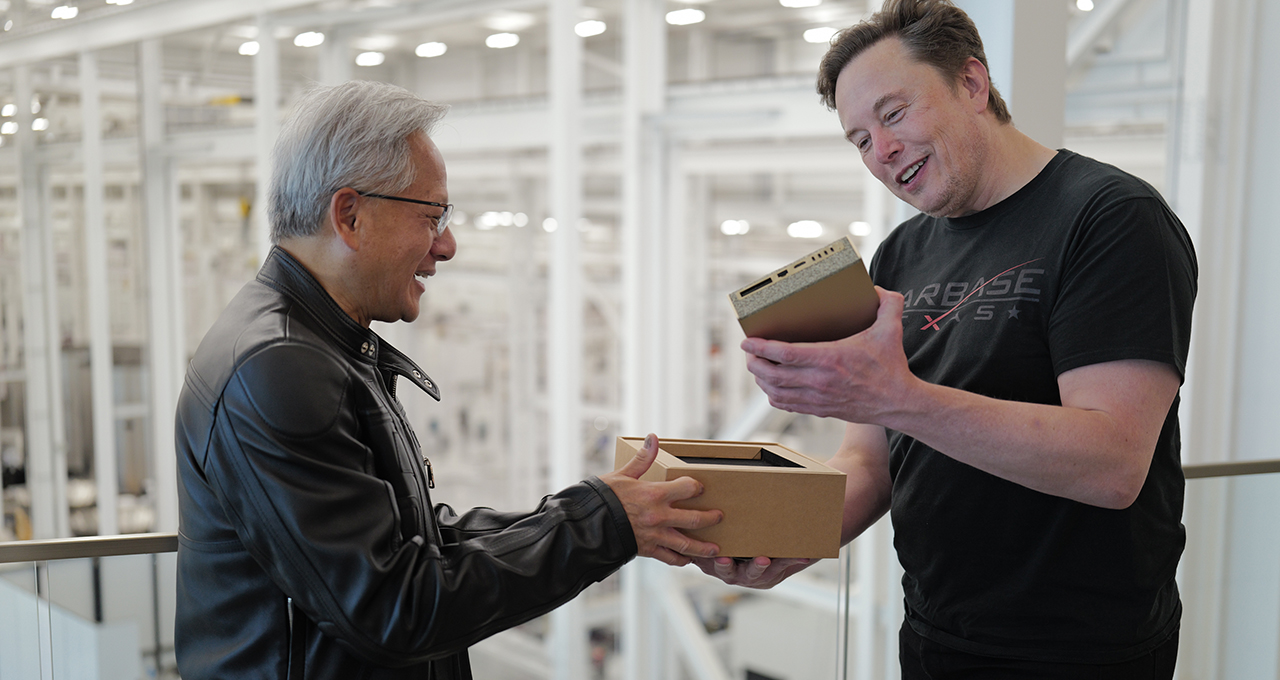
Elon Musk says he would welcome Jensen Huang at one of his companies if Nvidia’s board decides to push out its longtime chief executive.
On Wednesday evening, the financial account ZeroHedge posted “Elon please hire Jensen” on X. Musk replied roughly two hours later: “That would be an honor.” Neither Huang nor Nvidia had responded publicly as of Wednesday night.
Musk’s reply came as Nvidia’s board met to decide Huang’s future. The Wall Street Journal reported that directors were preparing to oust him following reports of two extramarital relationships. One involves Alice Huang, a Singapore-based businesswoman whom U.S. intelligence officials reportedly believe was working for China’s Ministry of State Security. The New York Times separately reported a relationship with Kimberly Powell, Nvidia’s vice president of health care. Huang acknowledged being unfaithful in a memo to employees on Sunday but gave no details.
@zerohedge That would be an honor
— Elon Musk (@elonmusk) November 12, 2026
Under Nvidia’s bylaws, a majority of its 11 directors can remove the CEO with or without cause. Bloomberg reported that the board has been working with an outside firm on possible replacements and may name an interim chief, with CFO Colette Kress seen as the likely pick. Nvidia shares fell more than 8 percent in extended trading, according to CNBC, and the company is scheduled to report quarterly earnings on November 17.
Musk has more riding on Nvidia’s leadership than most tech executives. In August, he told investors on SpaceX’s first earnings call as a public company that it would build its AI infrastructure exclusively on Nvidia hardware, calling Vera Rubin “the best architecture.” SpaceX is also working with Nvidia on the compute payload for Starmind, its planned orbital AI constellation. In October, SpaceX said it had a binding commitment for a roughly $40 billion lease of Vera Rubin GPUs and related equipment, with the leases expected to begin in the first half of 2027.
The scale of that dependence is already enormous. On its Q3 call, SpaceX said it was bringing roughly 200,000 to 220,000 Nvidia GB300 GPUs online each month and expects 2.5 to 3 GW of nameplate compute by the end of the year. That buildout is now reaching new sites like the proposed $24 billion power plant and supercomputer campus at Starbase.
The relationship between the two executives also goes back nearly a decade. Huang has often told the story of personally delivering Nvidia’s first DGX-1 AI supercomputer to Musk in 2016, when no other customer wanted one. “Nobody wanted to be part of it, except for Elon,” Huang said on the Joe Rogan Experience last December.
Musk did not say what role Huang might fill, and his reply stops short of a formal offer. Huang co-founded Nvidia in 1993 and still owns about 3.6 percent of its stock, so any move to a Musk company would depend on whether, and how, he leaves the chipmaker he has run for more than three decades.
Elon Musk
SpaceX’s Anthropic deal has a catch, and Elon Musk just addressed it
Elon Musk says SpaceX’s Anthropic compute deal cuts both ways after Chamath floats higher prices.
Elon Musk pushed back on Sunday against the idea that SpaceX’s compute contract with Anthropic is a one way bet, after venture capitalist Chamath Palihapitiya argued the company could use a termination clause to charge the AI lab far more.
“It works both ways, of course. If compute becomes plentiful and cheap, SpaceX revenue will drop. No crying in the casino for either party,” Musk wrote on X Sunday evening, replying to a clip of Palihapitiya’s comments shared by AI commentator Rohan Paul.
On the All-In podcast released Sunday, Palihapitiya said either side can walk away from the agreement on 90 days’ notice. If data center supply tightens, he argued, SpaceX could exercise that option and bring the contract back at two to three times the current price, and Anthropic would have little choice but to accept. He called it “the kingmaking move,” according to BigGo Finance.
The clause itself is not new. SpaceX disclosed in its IPO filings in May that Anthropic would pay $1.25 billion per month for dedicated capacity at its Colossus clusters through May 2029, nearly $45 billion in total, with both companies able to terminate on 90 days’ notice, as Teslarati reported at the time. SpaceX’s later compute deals with Google and Reflection AI carry similar exit terms.
What has changed is the political backdrop. Palihapitiya’s thesis rests on incoming Democratic governors pulling tax incentives for data centers and slowing new construction. In Texas, Gov.-elect Gina Hinojosa campaigned on a moratorium on new data center approvals, and Deutsche Bank analysts warned last week that SpaceX’s Texas compute capacity could face delays. SpaceX and Tesla shares both fell after the midterm results.
A slowdown would favor companies that already own capacity. SpaceX acquired xAI in February and has been renting data centers to outside AI labs before the space is needed for Grok. At the Baron Investment Conference on Friday, Musk said SpaceX was “getting 50 billion a year for 35 billion dollar investments” and that it can bring a data center online in eight or nine months, compared to two and a half years for competitors. He also said SpaceX is tracking toward an annualized revenue rate above $100 billion in December, with a “best guess” of $500 billion by December 2027.
Musk’s reply points to the other side of the clause. Anthropic has signed large compute agreements with Amazon, Google and Microsoft, and if that capacity comes online faster than new construction slows, the AI lab would have its own leverage to renegotiate or leave. Musk has called Anthropic “obviously currently the leader in AI,” and it remains one of SpaceX’s largest compute customers.
SpaceX shares rose more than 2 percent in overnight trading late Sunday after closing Friday at $134.27, according to Stocktwits.

Tesla’s Powercore could change how data centers get power

Tesla changes vehicle computers from ‘AI’ to ‘SI,’ reflecting President Trump change


