News
I took a Tesla Cybertruck weekend Demo Drive – Here’s what I learned
I had a Cybertruck for 48 hours thanks to Tesla, and here’s what I thought about it.


Tesla was kind enough to offer me a Cybertruck ‘Beast’ for an entire weekend after the company started offering 48-hour test drives of the vehicles across its lineup. I got a call from my local showroom asking if I would like to partake in a weekend of fun with perhaps the coolest truck around, and of course, I said yes.
It was a little different from past weekend Demo Drives in the sense that I picked up the Cybertruck in the morning on Saturday instead of the evening, when the showroom would be closed, and I would have to have it back at open time on Monday. I had my full Saturday with it; I took it for a round of golf, I took it to dinner with my Fiancè and parents, and it truly gave me a full-fledged feel of what it would be like to own one.
There were a lot of things I liked, and there were a handful of things I’d like to change. I’ll go through all of those in this article:
First Impressions
This was the second time I had ever driven Cybertruck, with the first being at early Demo Drives last August when I drove to West Chester, PA.
I picked it up at 10 am on Saturday morning, and the team at Tesla Mechanicsburg had me in and out in less than five minutes. I grabbed my paperwork and was on my way, and I took my best friend with me as he had never been in one. He was never a fan of the Cybertruck’s look, but could not deny the interior’s clean and minimalistic appearance.
This Cyberbeast was in terrific shape. I do wish the inside was vacuumed, the windshield was cleaned, and the wiper fluid reservoir was full, but these were all things I took care of myself after I got home. I would love to know how some Cybertruck owners clean their windshields, as I could get most, but not all. The bottom portion remained a tad smudged-up, but it was nothing unusual.
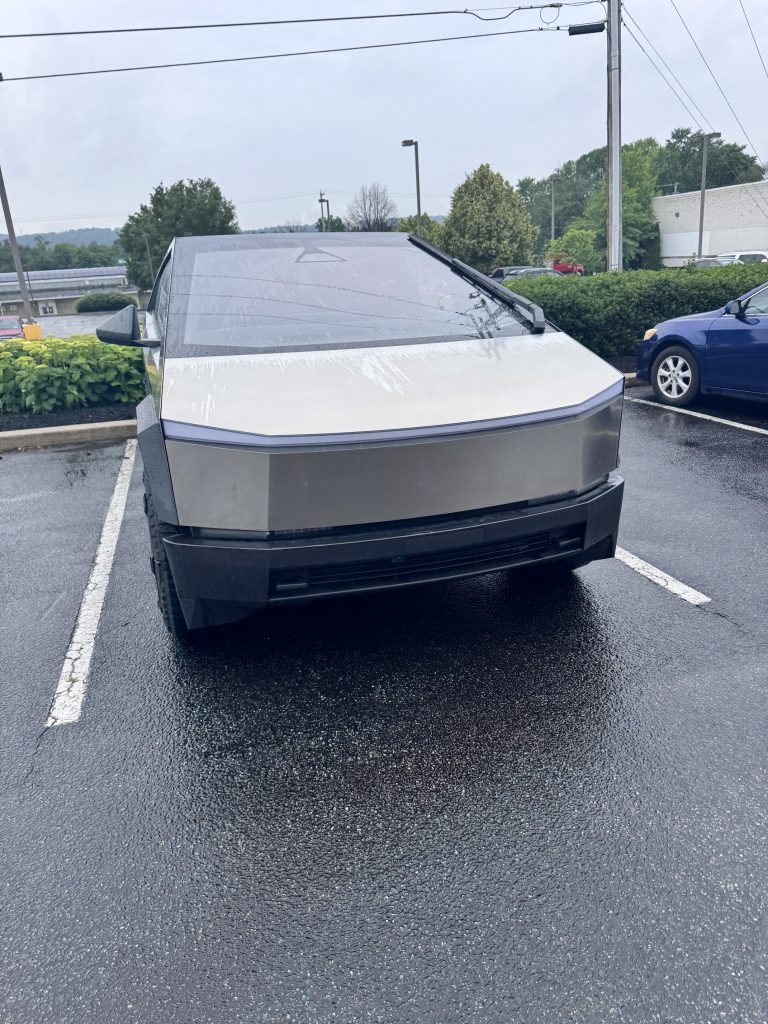
It was fun to pull into my local diner near my house, and about 45 minutes away from the Mechanicsburg showroom, to see all of the people nearby turn their heads just to get a look at this thing. Of course, I knew it would be soon that I’d get some middle fingers, but for now, it was all friendly. Smiles, waves, and fun. It was genuinely a fun experience.
My Weekend in the Cybertruck
First things first, I had an afternoon tee time with some buddies of mine who did not know that I was getting the Cybertruck for the weekend. They were all surprised to see it, to say the least!
They had never been inside one, and did mention that the interior was just plain awesome. The glass ceiling was among their favorite features of the Cybertruck, but conditioning the cabin to be nice and cool as we finished up on the 18th was awesome too. Their cars do start remotely, but do not feature adjustable climate settings.
This kept me cool on my entire ride home, and is something all Teslas feature. It’s among the best little additions, especially as the Summer months approach.
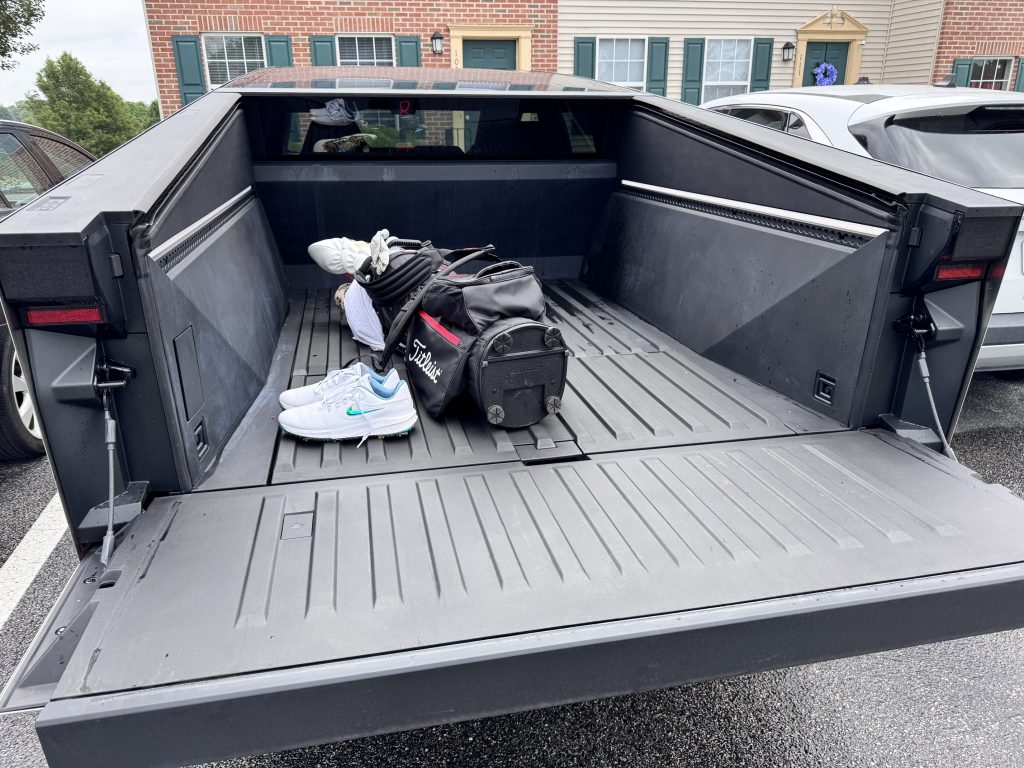
A reader and follower told me to throw my clubs in the frunk next time. I will do that.
After golf, it was time to pick my Fiancè up from the house and my parents as well, where we drove about an hour to Hampstead, Maryland, for a nice dinner to celebrate my better-half’s graduation from nursing school. My parents were truly blown away by the Model Y a few weekends ago, so this was what I was really looking forward to for them, because their reaction is genuinely so exciting.
My favorite thing about driving this truck was the positive reactions I got from many. I got a lot of waves, a lot of people wanting me to honk the horn, one of my neighbors even said, “Do you mind if I look inside of it?” I showed him all the cool features like the tonneau, the power frunk, and the size of everything.
Of course, I also had a handful of people who made their feelings about the car very apparent with a quick fling of the middle finger toward me as I drove by. I never understood flicking people off over a car: maybe how they drive, or maybe if they have a weird bumper sticker. I wasn’t around any of the middle finger-givers long enough for them to assess my driving, and the Cybertruck was void of any stickers or decals.
Oh well.
Sunday was a lengthy, 300-or-so-mile drive from my house to the Flight 93 National Memorial in Shanksville, PA. I try to go twice a year to pay my respects to the heroes, but I also saw it as a good time to test the range, experience Supercharging, see how the Cybertruck handled a longer day, and see how I felt in the car after the drive.
My first Supercharging stop was in Fort Littleton, PA, where v4 Supercharger stalls were placed in what was very obviously a small, rural, and predominantly blue-collar town. It was pretty fun to see a Supercharger in such a rural area. I had great speeds, as you can see, and we topped out at upwards of 330 kW.
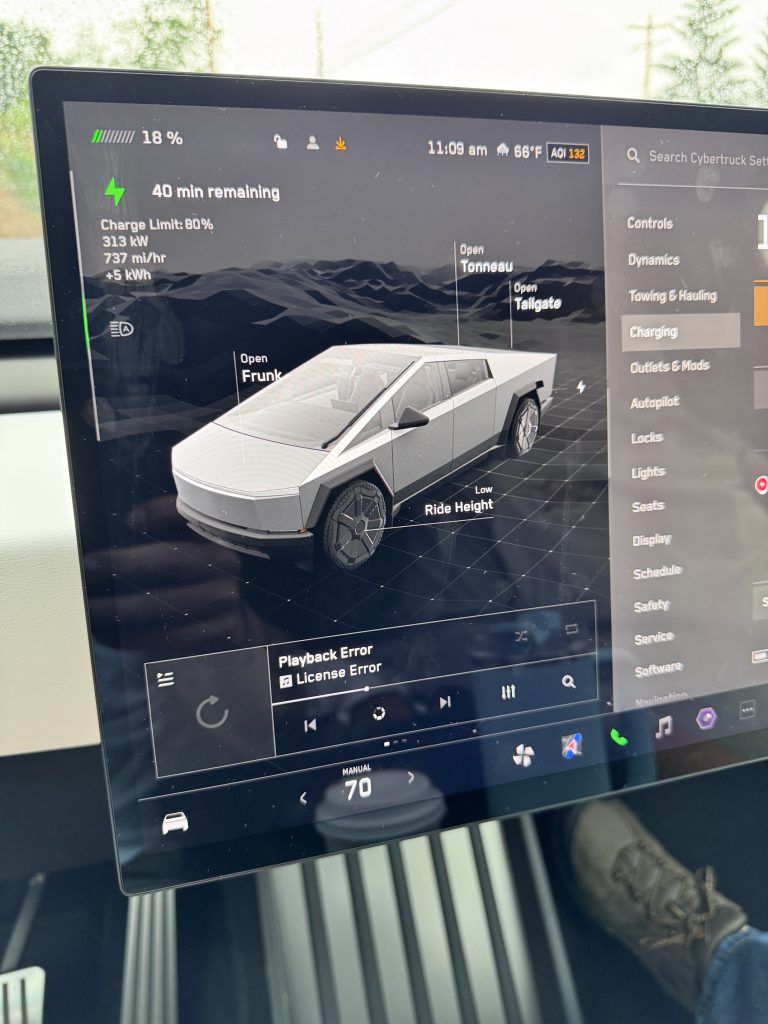
It was nice to sit there and feel what charging would be like as opposed to driving a gas car and having a quick stop at a gas station. I’ll be honest: it’s not at all what a gas station experience is like, which is quick, painless, and easy. However, stopping for ~20 minutes to grab some mileage was also a nice break from the drive. It let me take a few minutes to wind down because the weather was awful, and driving in the rain is never super fun.
This was one of two charging stops, the other being in Breezewood, PA, using V3 Superchargers. This was a stop that was more congested than the Fort Littleton charger, but there was much more to offer, like a Dunkin Donuts, a pizza shop, and even a Starbucks down below. It was a quick stop, but the charging experience was very sound. I would say that if you are someone who wants to get from Point A to Point B as fast as possible, the charging experience might not be for you.
I tend to be one of those people, but I didn’t feel like it disrupted my drive or ruined anything. There was plenty to do, and it was 20 minutes maximum before I was back on the road and heading back to my destination, whether it was the Memorial or home.
Why I Didn’t Use Full Self-Driving
I didn’t use Full Self-Driving at all during my weekend with the Cybertruck. There are two reasons for this.
The first is that I know what FSD is capable of. I know it’s great, and I know I love it. This weekend was a very quick one, and my time with the car was limited. I wanted to have as much hands-on experience with the Steer-by-Wire and four-wheel steering as I could. I had an extremely fast and powerful vehicle that was faster than anything I’ve ever had the pleasure of driving. I wanted to have fun with it.
The second was that I genuinely LOVED driving the Cybertruck. I will admit, I think I am one of those people who is not in love with driving, so I was really happy to have a car that made me want to drive.
My Final Thoughts
Share this article so I can afford to buy one. Just kidding (or am I?).
It was genuinely one of my favorite weekends in recent memory. I really loved a lot about the truck. It was fast, it was fun to drive, and it is a high-tech car. It’s never fun going back to my car when I have to drop off whatever Tesla I have for the weekend back at the showroom.


Elon Musk
Elon Musk follows Trump’s lead, says a SpaceX name change is coming
Elon Musk says SpaceXAI will become SpaceXSI, marking its second rebrand in under three months.

Elon Musk wants to rename his artificial intelligence company again, less than three months after its last rebrand.
In a string of posts on X early Sunday morning, Musk wrote “No more AI,” followed by “SI” and “It’s better.” He then added, “SpaceX is a super intelligence company.” When a user asked whether SpaceXAI could become SpaceXSI, Musk replied, “Yes, we will make that change.”
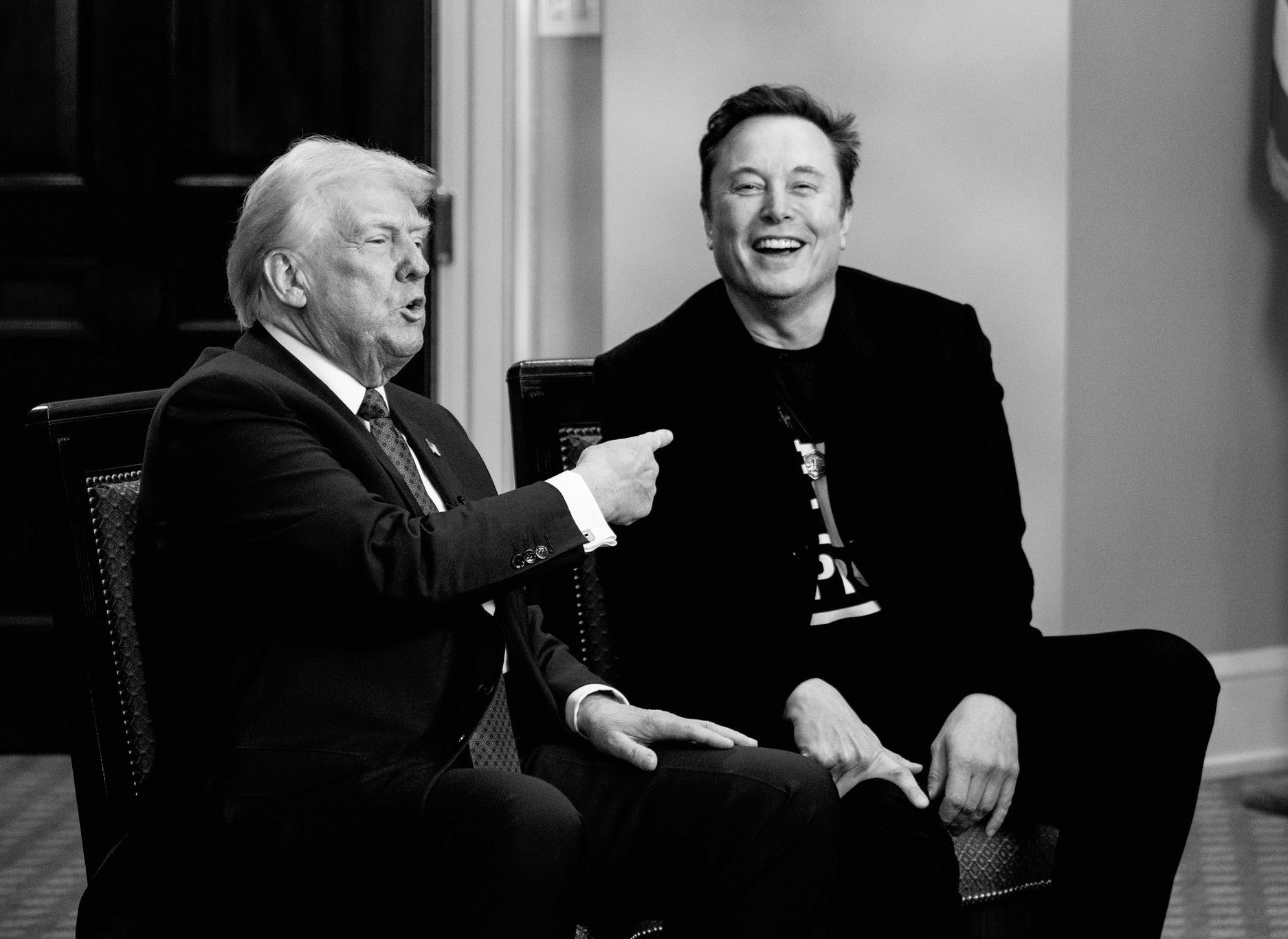
The posts extend a terminology push that began at the White House last week. On September 29, President Donald Trump signed an executive order directing federal agencies to replace “artificial intelligence” and “AI” with “Super Intelligence” and “SI” on government websites, policy documents and press releases. The same day, Musk sat beside Trump as the heads of the largest AI companies signed a voluntary safety accord, as Teslarati reported. Speaking to reporters afterward, Musk caught himself mid sentence: “I think it is worth highlighting the positive benefits of A.I. … S.I., pardon me.”
Elon Musk and Trump are closer than ever, and Tesla could be the big winner
SpaceXSI would be the third name for the business since February. SpaceX acquired xAI on February 2 in a deal that valued the combined company at $1.25 trillion. In May, Musk said xAI would be dissolved as a separate company, and on July 6 the division adopted the SpaceXAI name and a new logo that placed the xAI letters inside the SpaceX identity.
Musk gave no timeline. He did not say whether SpaceXSI would be a legal name change or a branding update, whether the @SpaceXAI handle on X would change, or how the shift would apply to products like Grok. The company had not issued a formal announcement as of Sunday morning.
The change would reach well beyond a chatbot. SpaceXAI now houses Grok, the X platform, the Colossus training clusters in Memphis and the coding tool Cursor, which SpaceX acquired in August. It also runs the orbital compute effort SpaceX is building around Nvidia hardware, which Musk said during the company’s first earnings call would be exclusive to Nvidia.
It’s unclear if rivals like Anthropic, OpenAI, Google, Meta and Nvidia have plans to also rename their companies or products. OpenAI CEO Sam Altman has continued to say “AI” in public, while Nvidia CEO Jensen Huang has gone partway, describing data centers as “super intelligence factories.”
The rename would also line up SpaceX’s AI branding with the federal government’s language as Musk takes on a new advisory role at the Pentagon, where he is helping lead the Project Meridian study on the future of warfare.
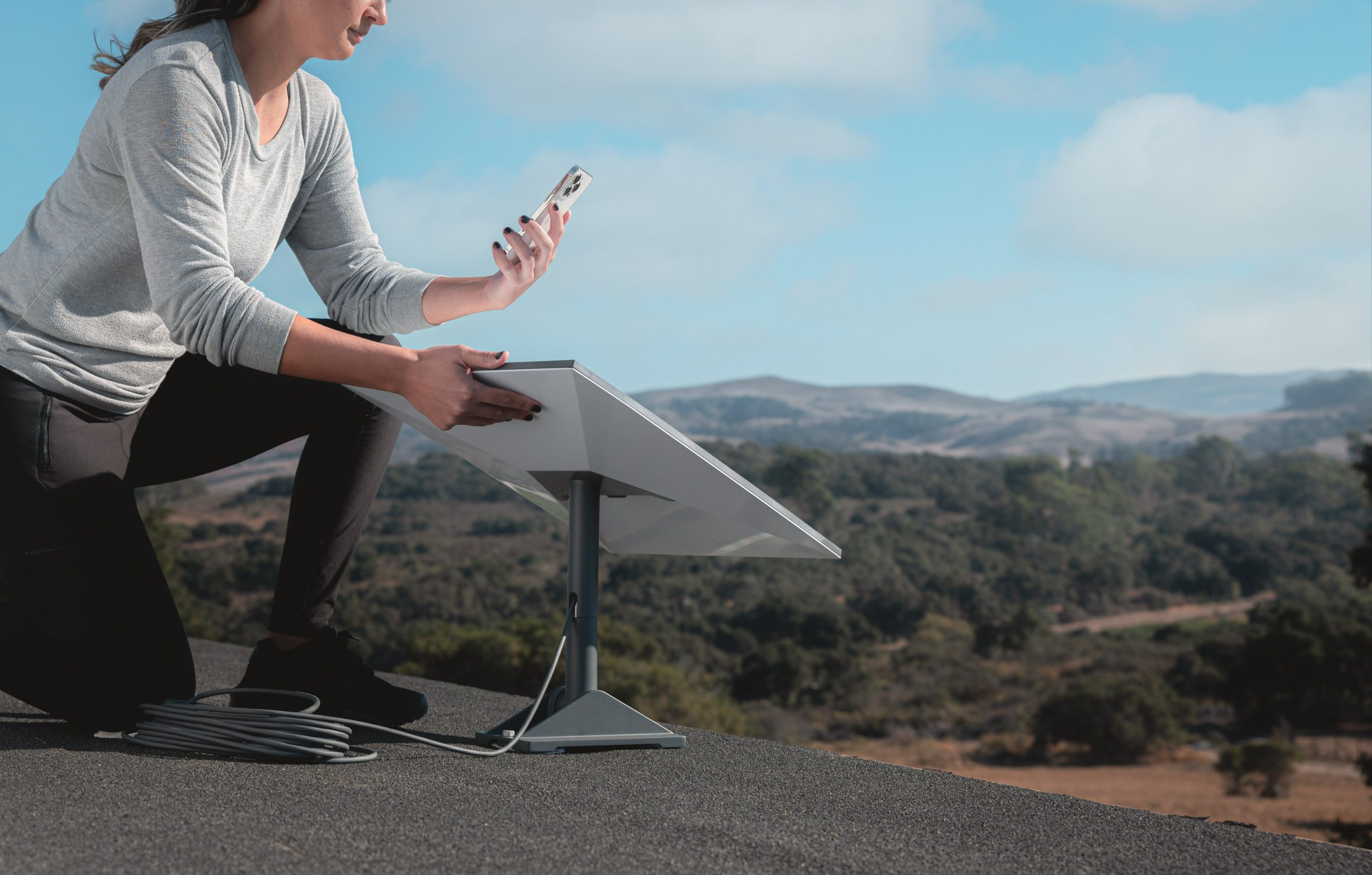
Starlink is launching a new beta path for ordinary property owners and local operators to turn a single Starlink kit into a small shared-access business for passive income.
Under the Starlink for Communities program, a host installs one dish and router setup in a location with nearby demand: an apartment complex, campground, rural crossroads, or event site. Neighbors or local users can buy short-term passes rather than full individual subscriptions, giving the Starlink provider a potential path to passive income.
Hour, day, and week passes cover one device. A month pass covers up to four. Starlink handles account creation, payments, access controls, and the satellite link itself. The host’s role is mainly placement, power, and basic upkeep, with earnings tied to each paid connection.
Big news! SpaceX is introducing a new @Starlink for Communities program that lets you earn money by providing Starlink internet to your neighbors or people nearby, who can pay for access by the hour, day, week, or month.
Neighbors pay for the access they need, while the person… pic.twitter.com/DtOUs0Ekvt
— Sawyer Merritt (@SawyerMerritt) October 1, 2026
The model echoes the passive-income vision long attached to Tesla’s Robotaxi plans, and it seems like it’s something Musk has hinted toward in the past as he believes AI will make the need to work relatively optional. In both cases, the platform owns the hard parts of matching, billing, and network management, while an individual supplies a physical asset that sits idle much of the time.
A Starlink host’s dish can serve multiple nearby users without each household buying and installing its own terminal. A Tesla owner, under the stated Robotaxi concept, would leave a vehicle enrolled in the fleet during unused hours so the car generates rides while the owner is at work or asleep.
Both arrangements convert under-utilized hardware into a revenue stream. They also let the company scale coverage or capacity without owning every endpoint.
Differences are practical. A Starlink kit is a fixed, relatively low-cost terminal whose main constraint is local congestion and line-of-sight. A Tesla Robotaxi is a mobile, high-value vehicle whose earnings depend on demand density, utilization rates, insurance, cleaning, and charging.
Starlink’s program is already accepting host applications in multiple countries and describes the revenue split as ongoing. Tesla’s owner-network version remains more aspirational.
The company currently operates a limited company-controlled robotaxi service in select areas and has solicited interest from fleet buyers for Cybercab vehicles, while private Full Self-Driving owners have not yet been able to dispatch their own cars for paid rides at scale.
Tesla primes Cybercabs for 4K streaming and high bandwidth gaming with Starlink integration
Starlink is a satellite broadband service operated by SpaceX that uses a constellation of low-Earth-orbit satellites to deliver internet to locations where terrestrial broadband is slow, expensive, or absent. It has grown to millions of subscribers worldwide by selling direct residential, mobile, and enterprise terminals, and have become widely available at a wide array at retail locations like Target and Best Buy.
The Communities program extends that reach by letting hosts resell short bursts of capacity to people nearby, while also providing high-speed internet access to those who are simply around a Starlink user.
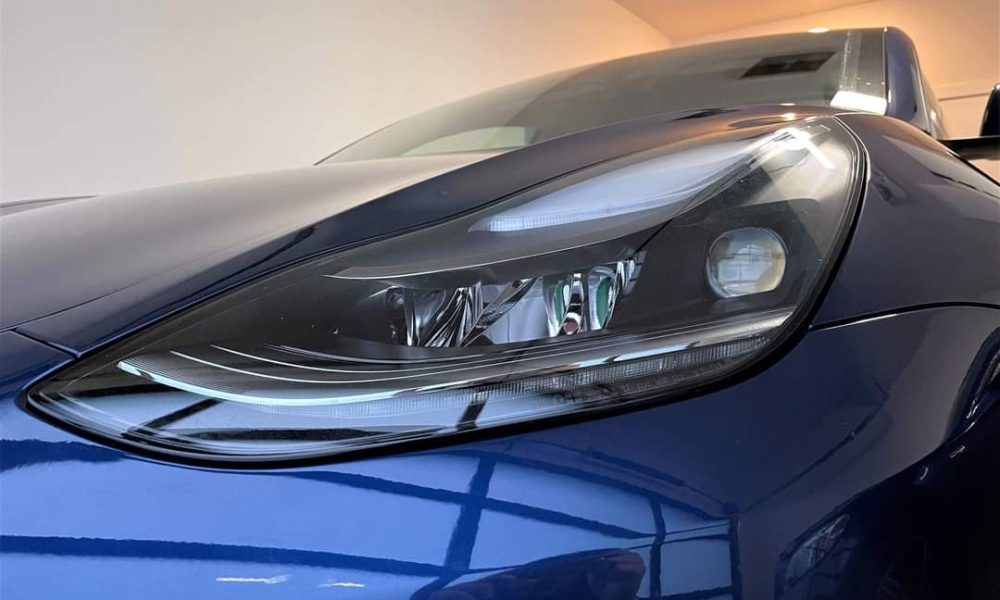
Tesla just upgraded its headlights through a software update, making them even better without any physical or hardware upgrade.
Tesla’s latest software update is quietly improving nighttime driving for a small number of owners. Version 2026.38 includes a new capability called Dynamic Headlight Leveling.
The feature automatically adjusts the aim of the low beams in response to driving conditions and nearby traffic, with the goal of giving the driver more usable light on the road while reducing glare for oncoming vehicles and traffic ahead.
2026.38 just dropped.
Model 3 gets Dynamic Headlight Leveling — low beams auto-aim around traffic for max visibility, less glare. Model 3 / Y (AMD HW3) also pick up sharper Tesla visuals + an enhanced park scene on the center display.
Legacy Intel cars get Supercharger Site… pic.twitter.com/45ac4AH6Vs
— Frunk To Trunk (@FrunkToTrunk) September 30, 2026
Unlike Tesla’s matrix high-beam system, which selectively dims individual LED segments to create shadows around other cars, Dynamic Headlight Leveling physically tilts the low-beam projectors. Internal motors respond to changes in vehicle pitch.
When the car accelerates hard, climbs a steep grade, or carries extra weight in the rear, the headlights can otherwise point higher than intended. The software counters that movement in real time so the beam stays aimed at the road surface rather than into the eyes of other drivers.
Early indications reveal the update is reaching a limited set of vehicles, including certain Model 3 and Cybertruck examples in the United States and the United Arab Emirates. The rollout does not appear tied to a single hardware revision, and Tesla has not published a broader schedule. It is simply a common waiting game until your car receives it.
The change arrives against a backdrop of wider complaints about headlight glare. Some earlier Model 3 and Model Y vehicles were the subject of an NHTSA recall related to excessive low-beam glare; the software adjustment offers a potential mitigation for cars equipped with the necessary leveling hardware. It does not replace adaptive high beams where those are already available, nor does it alter the basic low-beam pattern itself.
Instead, it keeps an existing beam pointed where it is most useful.
For drivers who have received the update, the system requires no new settings or user input. The headlights simply respond as road conditions and traffic change. As the feature reaches more vehicles, it adds another example of Tesla using over-the-air software to refine existing hardware rather than waiting for a new model year. Nighttime visibility and reduced glare for others are the practical results owners are expected to notice first.

Elon Musk follows Trump’s lead, says a SpaceX name change is coming

Starlink launches Communities Program for passive income through internet sharing


