News
Luminar-Volvo breakdown deepens as lidar maker warns of potential bankruptcy
The automaker stated that Luminar failed to meet contractual obligations.

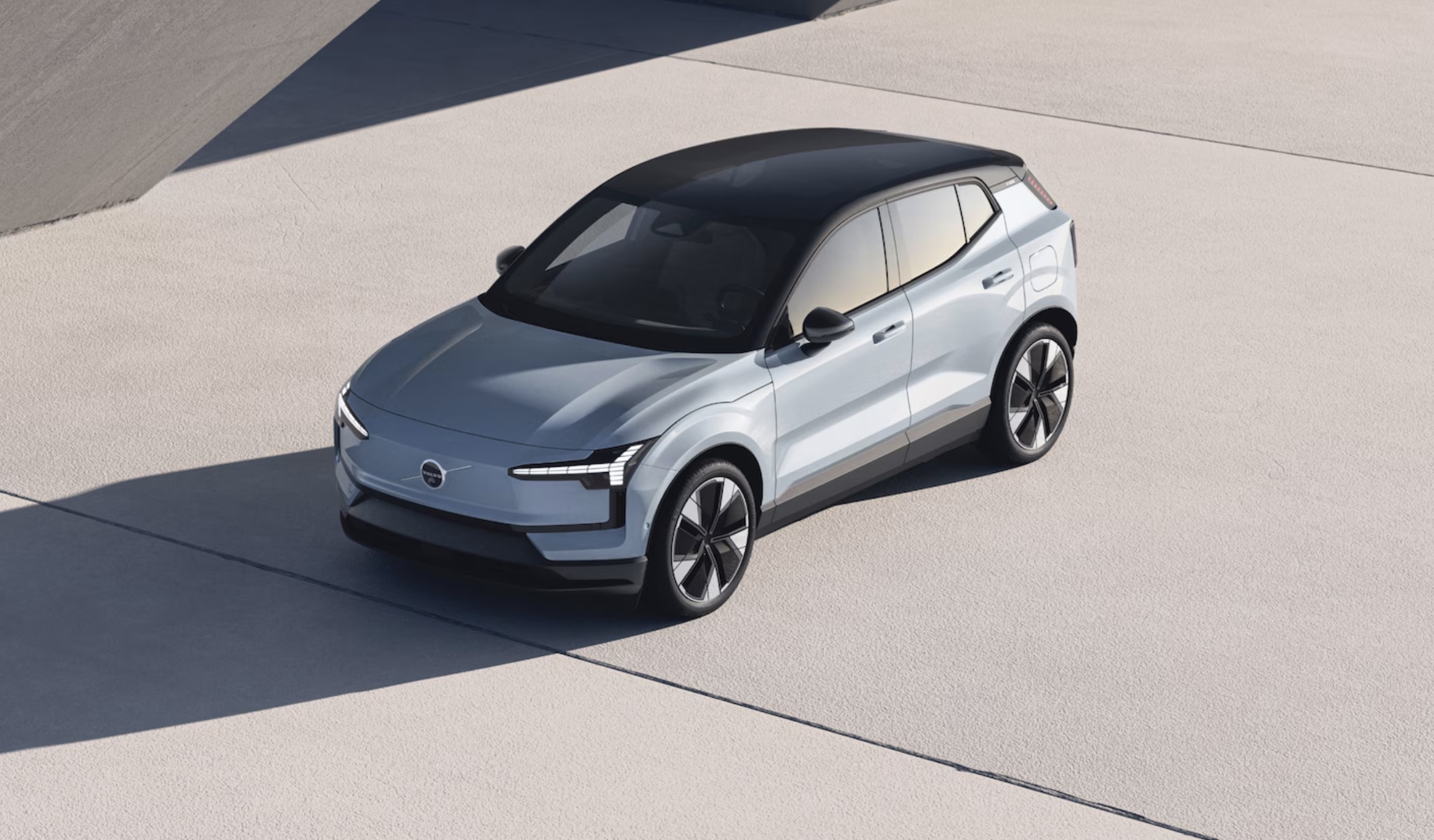
Luminar’s largest customer, Volvo, has canceled a key five-year contract as the lidar supplier warned investors that it might be forced to file for bankruptcy. The automaker stated that Luminar failed to meet contractual obligations, escalating a dispute already unfolding as Luminar defaults on loans, undergoes layoffs, and works to sell portions of the business.
Volvo pulls back on Luminar
In a statement to TechCrunch, Volvo stated that Luminar’s failure to deliver its contractual obligations was a key driver of the cancellation of the contract. “Volvo Cars has made this decision to limit the company’s supply chain risk exposure and it is a direct result of Luminar’s failure to meet its contractual obligations to Volvo Cars,” Volvo noted in a statement.
The rift marked a notable turn for the two companies, whose relationship dates back several years. Volvo invested in Luminar early and helped push its sensors into production programs, while Luminar’s technology bolstered the credibility of Volvo’s safety-focused autonomous driving plans. Volvo’s partnership also supported Luminar’s 2020 SPAC listing, which briefly made founder Austin Russell one of the youngest self-made billionaires in the industry.
Damaged Volvo relations
The damaged Volvo partnership comes during a critical period for Luminar. The company has defaulted on several loans and warned investors that bankruptcy remains a possibility if restructuring discussions fall through. To conserve cash, Luminar has cut 25% of its workforce and is exploring strategic alternatives, including partial or full asset sales.
One potential buyer is founder Austin Russell, who resigned as CEO in May amid a board-initiated ethics inquiry. The company is also the subject of an ongoing SEC investigation.
Luminar, for its part, also noted in a filing that it had “made a claim against Volvo for significant damages” and “suspended further commitments of Iris” for the carmaker. “The Company is in discussions with Volvo concerning the dispute; however, there can be no assurance that the dispute will be resolved favorably or at all,” the lidar maker stated.


Elon Musk
Tesla Cybercabs narrowly miss deadly Amazon cargo plane crash
An Amazon cargo plane crash near Miami’s airport stopped feet from dozens of Tesla Cybercabs.

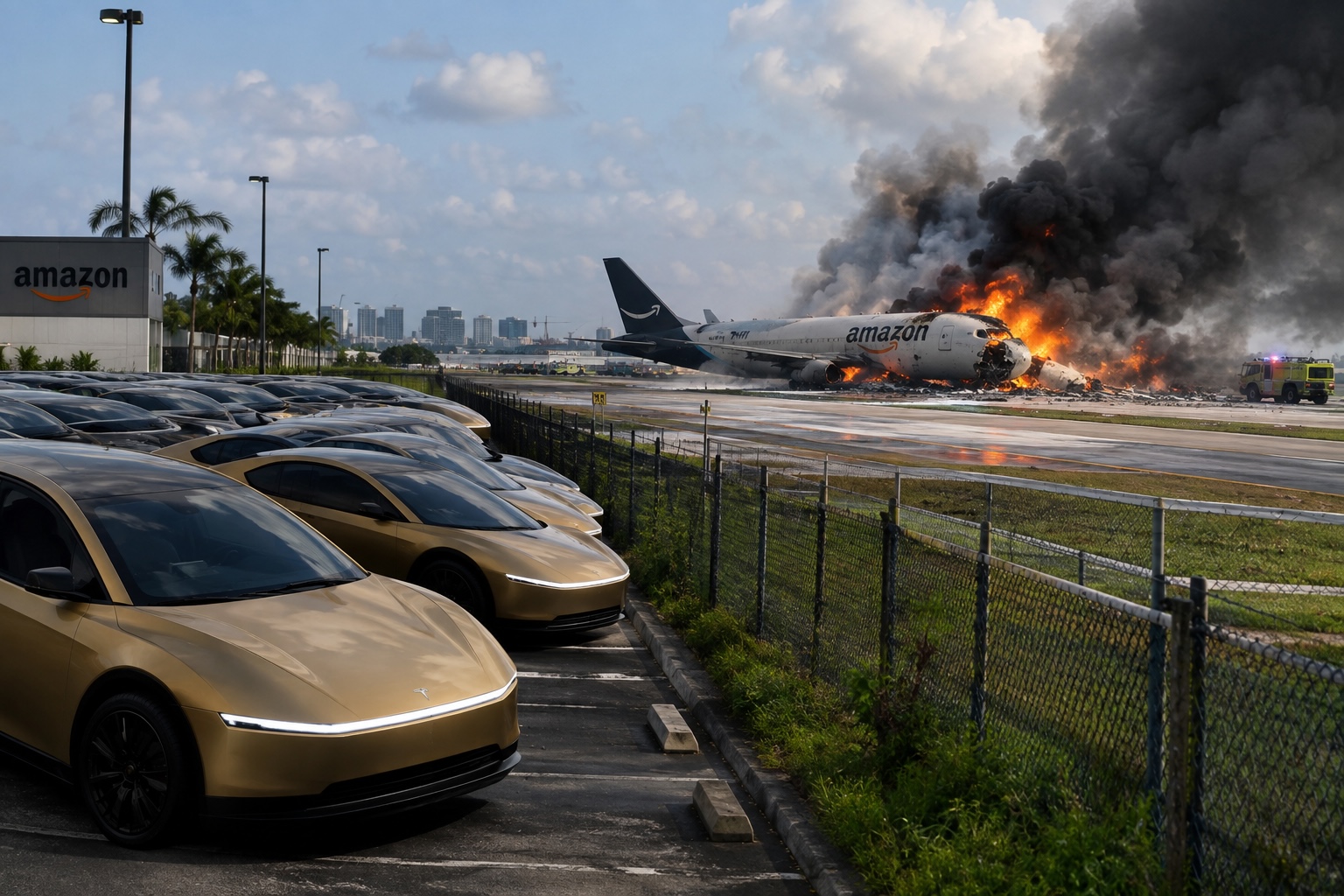
An Amazon Prime Air Boeing 767 cargo jet overran the runway at Miami International Airport on Sunday afternoon, killing five people and injuring five more. The jet, operated by North Carolina based carrier 21 Air as Flight 7598, touched down around 2 p.m. after arriving from San Juan, Puerto Rico, then crossed the airport perimeter, plowed across NW 67th Avenue and struck multiple vehicles before catching fire, according to the Associated Press.
Photos and video from the scene show the aircraft’s nose stopped within meters of a fenced staging lot holding dozens of gold painted Tesla Cybercabs, the steering wheel free robotaxi Tesla began putting on public roads in Austin last week. Miami-Dade Fire Rescue has confirmed the plane struck “multiple vehicles” but has not said whether any Cybercabs were among them, and neither Tesla nor airport officials have addressed the fleet directly.
The Cybercabs had not yet entered commercial service in Miami. Tesla’s existing Robotaxi operation there runs on modified Model Y vehicles and has been unsupervised since Ashok Elluswamy confirmed the detail on X in July.
Footage of the plane crash from earlier today | #ONLYinDADE pic.twitter.com/iGoOtnd6cD
— ONLY in DADE (@ONLYinDADE) September 6, 2026
Elon Musk offered the briefest of reactions. Replying to a Zero Hedge post about the Cybercabs sitting so close to the wreckage, he wrote a single word: “Weird.” He has not commented further, and Tesla has not issued a statement.
The timing puts Tesla’s newest vehicle near an unrelated but highly visible tragedy just days after its Austin debut, a launch that had already drawn scrutiny from federal regulators. The National Highway Traffic Safety Administration opened an audit how Tesla certified the Cybercab as compliant with federal vehicle safety standards, a process Teslarati covered after the vehicle’s September 3 launch event. That inquiry concerns the car’s lack of a steering wheel and pedals, not the Miami crash.
Investigators from the FAA and NTSB are focused on the plane, not the parking lot beside it. Flight data reviewed by outlets including Simple Flying show the 767 touched down around 170 knots, well above the 135 to 140 knot range typical for the aircraft, though investigators have not determined a cause. Amazon said it is working with authorities and that its priority is the safety of everyone affected.
Whether any Cybercabs were damaged, and what Tesla plans for the fleet parked near one of the country’s busiest airports, remain open questions.

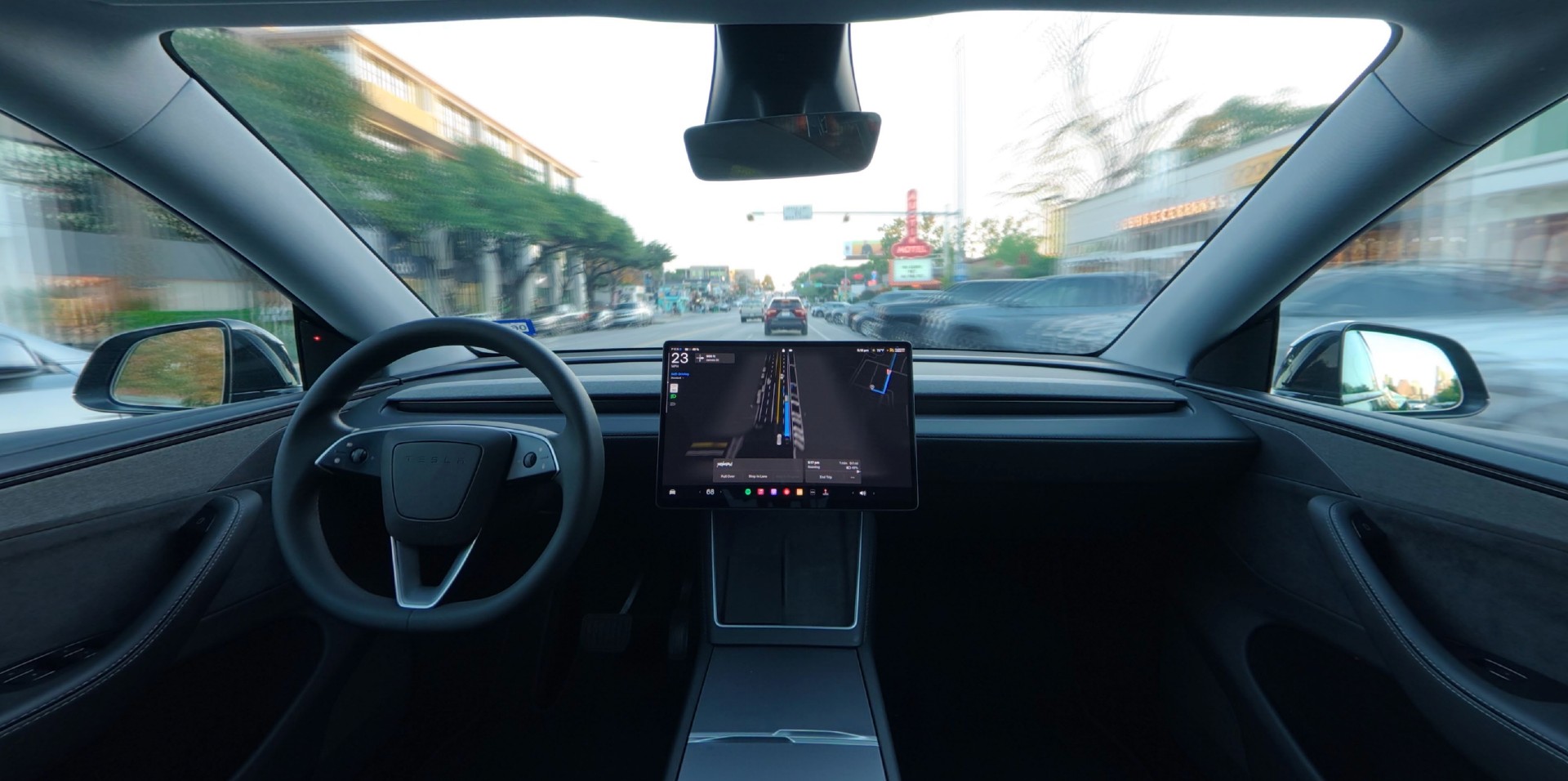
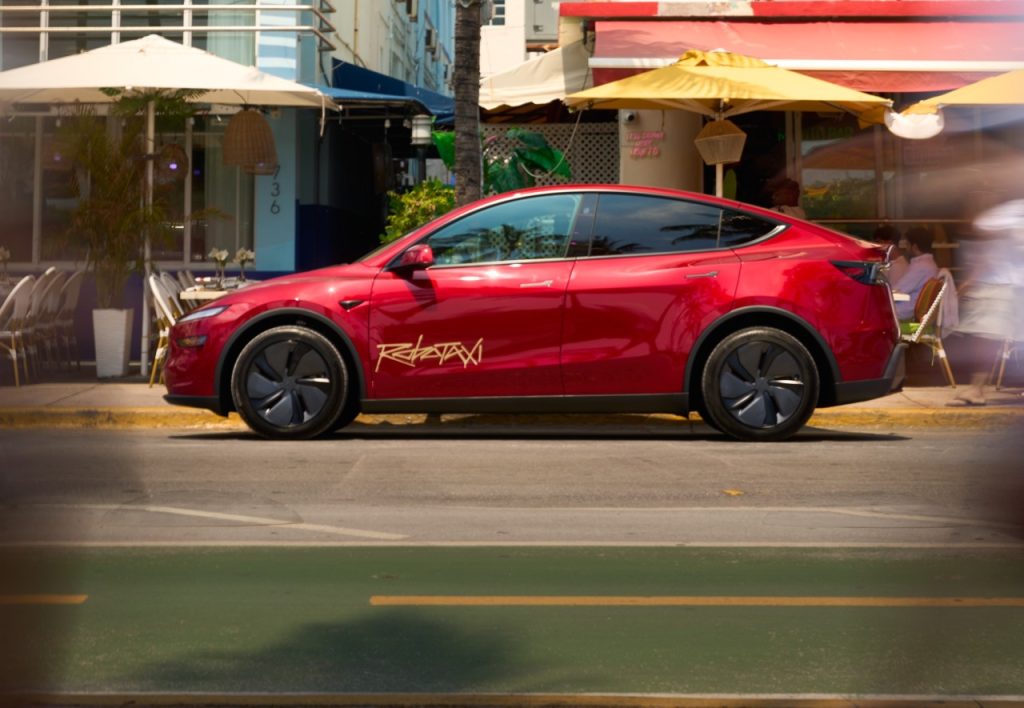
Tesla has reached a notable benchmark in its autonomous driving program after its Robotaxi fleet surpassed one million miles of unsupervised operation. The company made the announcement during its Cybercab event in Austin on September 3.
Tesla Vice President of AI Ashok Elluswamy told attendees he was happy to report the fleet had achieved one million miles of unsupervised Robotaxi operation as a testament to safety.
The new total marked a sharp increase from the 380,000 unsupervised miles Tesla disclosed during its second-quarter 2026 earnings update in late July.
In roughly six weeks, the company added about 620,000 miles. That acceleration followed Tesla’s decision to remove in-vehicle safety monitors from most of its operations outside the San Francisco Bay Area.
Credit: Tesla
Tesla first launched Robotaxi service in Austin in June 2025 with safety drivers present. It later began fully unsupervised rides and expanded into Dallas, Houston, Miami, Orlando, and Tampa. The San Francisco Bay Area remains the exception, where a safety monitor still rides in the vehicle under California permitting rules.
The company has not released a city-by-city breakdown of the one million unsupervised miles.
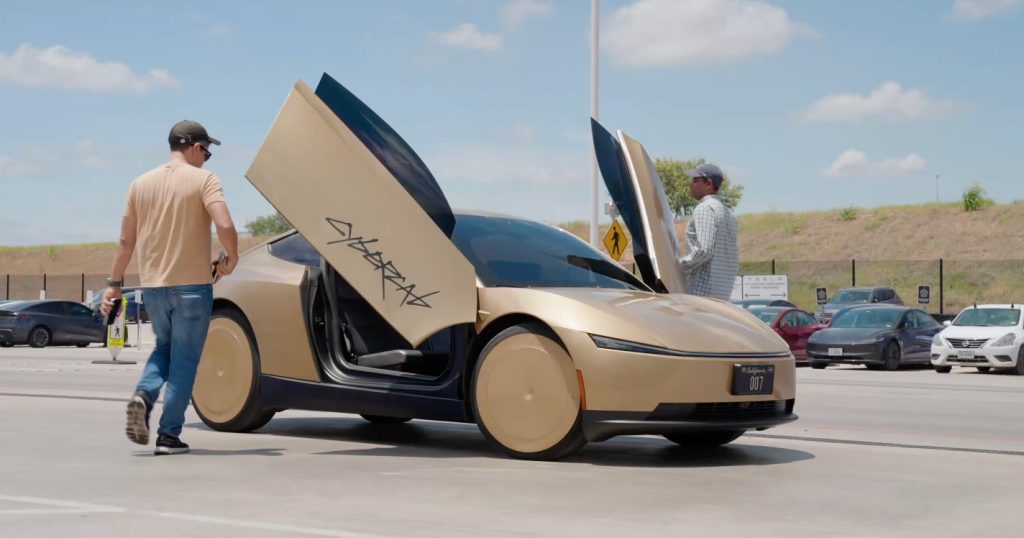
The milestone arrived as Tesla began offering public Cybercab rides in Austin. The purpose-built vehicle has no steering wheel or pedals and is designed only for autonomous ride-hailing. Production versions joined the existing fleet of modified Tesla vehicles already operating in the service.
Tesla’s unsupervised mileage is growing at a double-digit weekly rate according to earlier company comments, yet its fleet size remains modest compared with established competitors. Waymo has accumulated more than 200 million fully autonomous rider-only miles. Tesla has described its own unsupervised operations as having recorded zero notable incidents in the period leading up to the July update.
The one-million-mile figure reflects Tesla’s shift from supervised testing to broader driverless service in multiple states. It also highlights the company’s strategy of using both existing Model Y vehicles and the new Cybercab to scale its network.
Credit: Tesla
Whether the rapid recent growth continues will depend on further city expansions, regulatory approvals, and the performance of the purpose-built Cybercab in everyday paid rides. Tesla has not specified how many of the latest miles involved the new vehicle versus the rest of the fleet.
The announcement underscores Tesla’s progress toward a larger robotaxi network while illustrating the remaining gap in total autonomous experience relative to longer-operating rivals.
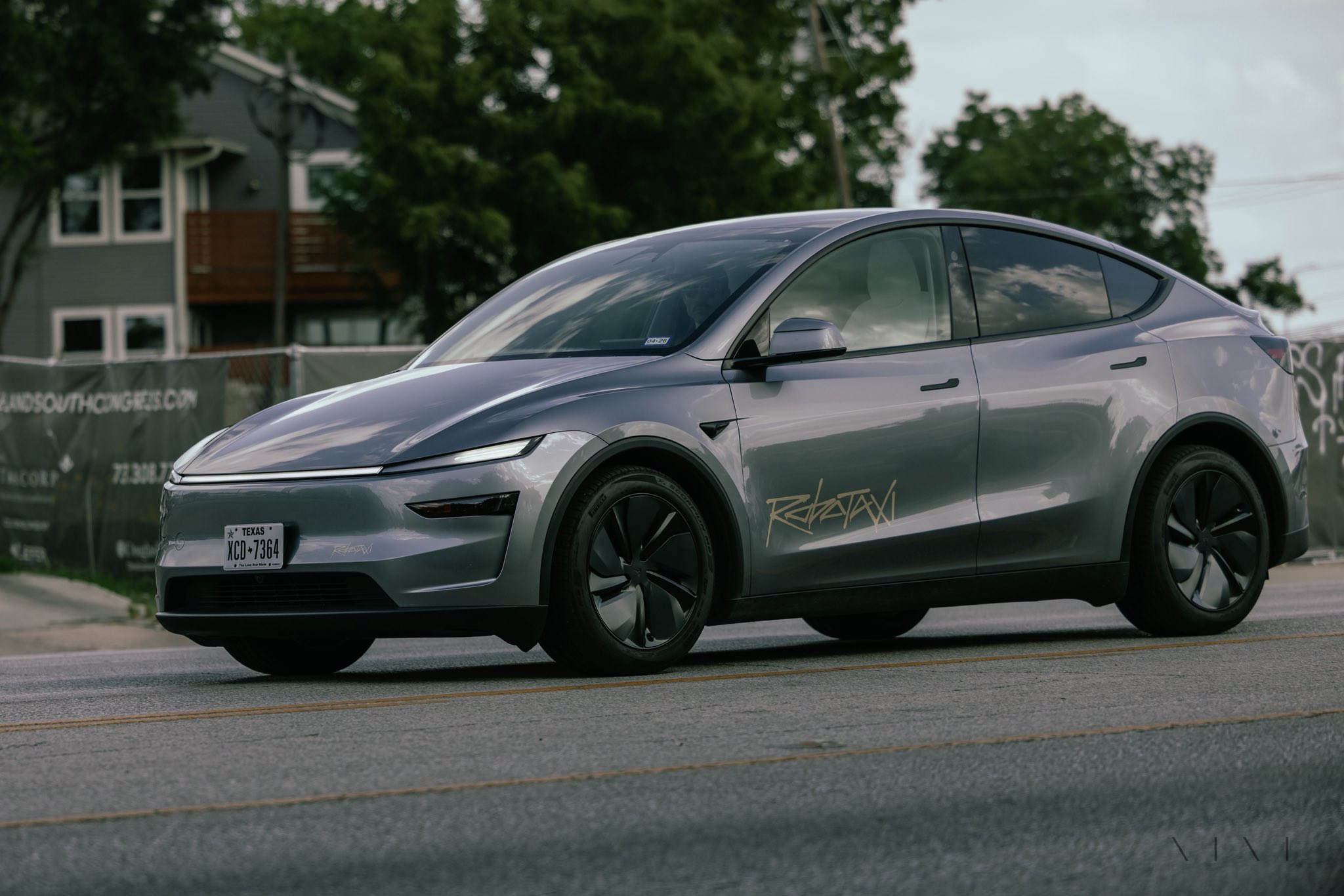
Tesla AI lead Ashok Elluswamy said this week that 24-hour Robotaxi service is close. Replying on X to a rider who wanted Cybercab trips all night, he wrote that the capability would arrive “next month or so” once “the next tech to merge on the v15 plan” is ready.
The comment landed on September 4, one day after Tesla opened public Cybercab rides in Austin. It is the clearest near-term timeline yet for overnight unsupervised operation. Tesla’s paid Robotaxi network currently runs from 6 a.m. to 10 p.m. seven days a week across Austin, Dallas, Houston, Miami, Orlando, and Tampa.
next month or so. the next tech to merge on the v15 plan will enable it.
— Ashok Elluswamy (@aelluswamy) September 4, 2026
That 16-hour window is shorter than the 6 a.m. to 2 a.m. schedule the company used for much of the prior year.
Elluswamy did not name the specific feature or say whether the change would apply first to purpose-built Cybercabs, the existing Model Y fleet, or both. He also offered no city-by-city rollout list. The link to Full Self-Driving v15 is nevertheless significant.
Tesla has described v15 as a step-change architecture with seven parallel improvement tracks and roughly ten times more parameters than earlier builds. Early versions of that software already operate on the Robotaxi fleet and contain about 40 percent of the planned gains.
By July 2026, the unsupervised fleet had logged more than 380,000 miles across six cities in two states with what the company called an impeccable safety record and no notable incidents caused by the vehicles themselves. Tesla has repeatedly argued that camera-based end-to-end neural networks, rather than extra sensors, are the core of the solution.
Overnight service would test that claim in lower-light conditions and would also raise vehicle utilization, a key variable for Robotaxi unit economics. The company has already begun using public Superchargers at night and is building dedicated Robotaxi charging sites.
Riders have asked why software must change if the cars already drive in the dark. The practical answer appears to be reliability and scale: Tesla has held back mass expansion until more of the v15 stack is merged, citing the need for higher confidence before putting thousands of unoccupied vehicles on streets around the clock.
If the next module arrives on the timetable Elluswamy sketched, 24-hour service could begin in October 2026 in at least some markets.
That would mark a shift from a daytime-bounded pilot to a service that can run whenever demand exists, including the late-night hours that have so far remained out of reach.

Tesla Cybercabs narrowly miss deadly Amazon cargo plane crash

Tesla crosses major Unsupervised Self-Driving milestone


