News
Tesla offers Model 3 Performance buyers free unlimited Supercharging in latest referral program update

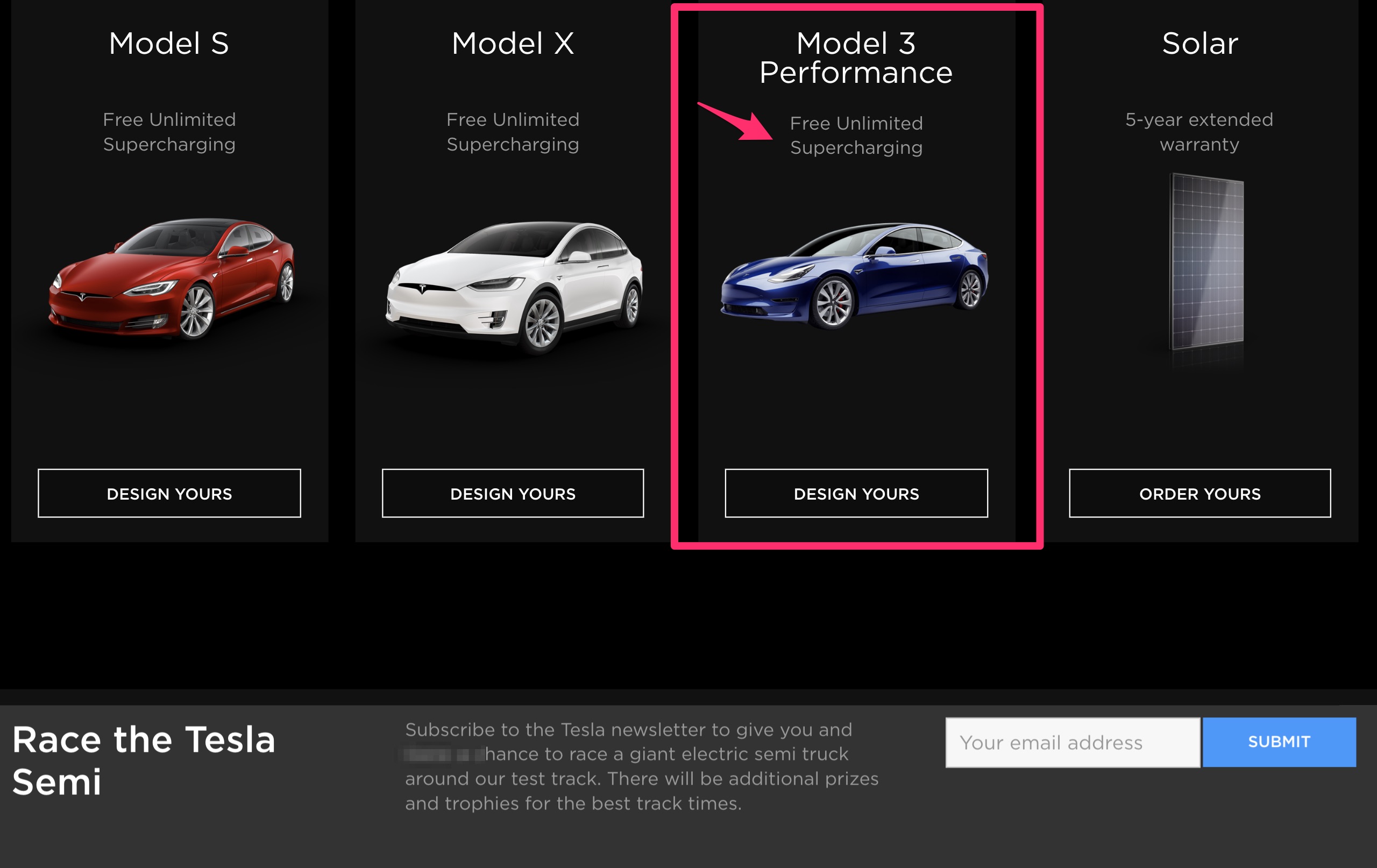
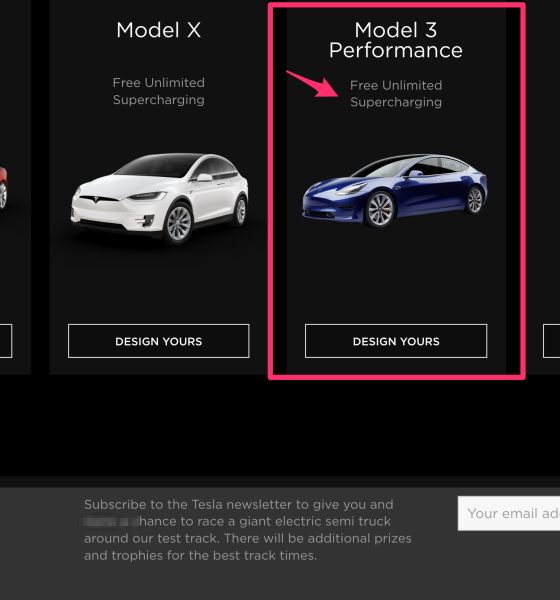
Tesla has updated the details for its latest Referral Program to include Model 3 Performance as a vehicle that’s eligible for incentives when purchased through a referral code. In addition, Tesla has extended free unlimited Supercharging to Model S and Model X purchases made between August 1 and September 16, which also includes Model 3 Performance.
With a new Referral Program in place, owners can give five of their referrals free unlimited Supercharging with the purchase of a Model S, Model X, or Model 3 Performance. Vehicles purchased before September 16 would enjoy the full, unlimited fast-charging perk for the lifetime of the vehicle under its original ownership. After September 16, Tesla would be limiting unlimited Supercharging to one year for the Model S, Model X, and Model 3 Performance. The limits of the new Referral Program also indicate that all Model 3 Performance orders placed before August 1, 2018 would be given unlimited Supercharging, including vehicles not purchased through a referral code. This is the first time Model 3 buyers are being offered free use of the company’s global network of Superchargers.
Tesla has been rolling out a Referral Program for Model 3 owners over the past few months, though some owners were only able to receive their referral codes recently. Ultimately, the updated Referral Program features benefits designed specifically for the growing Model 3 community, but it also comes with a time limit. If the company does follow through and retires the program after September 16, it will only be a matter of time before new owners of Tesla’s vehicles, including its flagship Model S and X, would have to pay for Supercharging.
-
- The Tesla Model 3 is establishing itself as a formidable competitor in the US passenger car market. [Credit: Tesla]
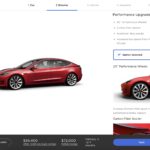
Tesla’s introduction of rewards directly linked to the Model 3 Performance appears to be the electric car maker’s latest way of upselling the vehicle to reservation holders. Considering that the company is pushing for profitability this third quarter, every order of the Model 3 Performance, which starts at $64,000, would likely help Tesla become profitable this Q3. The Model 3, after all, has been found to the profitable, with a recent teardown and analysis of the vehicle from Detroit veteran Sandy Munro revealing that the electric car’s Long Range RWD variant exceeds 30% profit. The Model 3 Performance, being priced higher, would most likely give Tesla even more.
Apart from the introduction of free unlimited Supercharging to the Model 3 Performance, Tesla’s updated Referral Program still features much of the same perks as before. The following is a breakdown of referral awards for participating Tesla owners.
1 to 2 Qualifying Referrals
- Signature Black Wall Connector – This item is only available under the Referral Program. Shipping started in July 2018.
- Founders Series Tesla Model S for Kids – This item is a miniature version of the Tesla Model S, complete with working headlights, a sound system, and even a working charge port. Anecdotes from the Tesla community note that the large box of the Model S for Kids fits perfectly at the back of the family sedan with the rear seats folded down.
3 Qualifying Referrals
- Early Access Token for Solar Roof – Customers who opt for this perk would get early access and priority scheduling for Solar Roof installations, which already begun earlier this year. This perk could be given to a friend.
4 Qualifying Referrals
- 21” Arachnid Wheels for Model S or 22” Turbine Wheels for Model X — Wheels designed to improve the performance of the Model S and X.
- One Week with Model S or Model X – The Teslas used for this perk could be used on a road trip. Customers who opt to not use this reward can give this to a friend.
5 Qualifying Referrals
- Tesla Unveiling Invitation – Owners who reach five referral orders will be invited to a future unveiling event. The VIP invitation is valid for the Tesla owner and one guest.
- Founders Series Powerwall 2 – This home battery storage unit features a unique red color scheme.
Tesla is also extending its Race an Electric Semi Truck referral award. Just like before, the person who can get the most number of friends to sign up for Tesla’s newsletter would have the opportunity to race the Tesla Semi around the company’s test track.
Referral rewards for Tesla Solar have also been extended with the updated program. Owners could give their referrals a 5-year extended limited warranty on new solar energy system installations. One to four qualifying referrals would give Tesla owners $400 cash of $750 credit per installed referrals. Five qualifying referrals gives owners a free Founders Series Powerwall 2 battery.



SpaceX has selected Qualcomm Technologies to supply core infrastructure for Starlink Mobile’s planned nationwide terrestrial 5G network in the United States.
Announced on November 4, the multi-year agreement covers radios, baseband units, and commercial-grade Layer 1 software based on Qualcomm’s Dragonwing Cellular Infrastructure platforms, specifically the QRU100 and QDU100:
🚀 SpaceX has picked Qualcomm to supply radios, baseband units and Layer 1 software for Starlink Mobile’s nationwide terrestrial 5G network.
Deployment across tens of thousands of U.S. cell sites starts in 2027. Qualcomm calls it its biggest 5G deal yet. https://t.co/YKLRakuJjB
— TESLARATI (@Teslarati) November 4, 2026
These will power Massive MIMO radio units featuring 64 transmit and 64 receive paths (64T64R), designed to boost coverage, capacity, and spectral efficiency at scale. Qualcomm has described the pact as its largest 5G deal to date, with deployment across tens of thousands of U.S. cell sites scheduled to begin in 2027.
The terrestrial build-out is meant to complement, not replace, Starlink’s satellite direct-to-cell capabilities. SpaceX has assembled substantial spectrum holdings for this purpose: roughly 65 MHz of mid-band frequencies acquired from EchoStar (including AWS-4 and related bands) and up to 14 MHz of low-band 800 MHz spectrum from Grain Management.
The low-band airwaves improve indoor penetration and range, while mid-band supports higher capacity. SpaceX executives, including President Gwynne Shotwell, have outlined a hybrid architecture in which satellites eliminate outdoor dead zones and terrestrial nodes add capacity where demand is highest.
Earlier comments suggested small cells or femtocells potentially co-located with existing Starlink user terminals on roofs, though later filings also reference more conventional antennas on towers and structures.
The big picture is SpaceX’s bid to become a full-fledged U.S. mobile carrier rather than a satellite partner or dead-zone filler. AT&T, Verizon, and T-Mobile together generate hundreds of billions in annual wireless revenue; Shotwell has said SpaceX expects to win customers by offering superior coverage, including during disasters, through seamless satellite-terrestrial handoff.
Verizon, AT&T and T-Mobile are trying to shut Starlink out before FCC vote
Starlink already represents a major share of SpaceX’s revenue and profit following the company’s 2026 IPO. By vertically integrating spectrum, satellite manufacturing, launch capacity, and now ground radio equipment, SpaceX aims to control more of the connectivity stack.
Qualcomm’s involvement also positions the network for future evolution toward AI-native 6G infrastructure, with energy-efficient processing that could improve deployment economics.
Challenges remain: spectrum depth still lags the Big Three, capital costs for tens of thousands of sites will be substantial, and regulatory approvals continue, but the Qualcomm deal marks a concrete step from spectrum accumulation toward operational network build-out.
In short, the partnership accelerates Starlink Mobile’s shift from orbital broadband specialist to hybrid mobile competitor, testing whether a space-based company can reshape terrestrial wireless economics and coverage in the world’s largest market.
Elon Musk
Elon Musk’s Grok Bot is picking up the phone now, and the first calls are wild
Elon Musk wants Grok Bot users making phone calls, and one Comcast call saved $500.

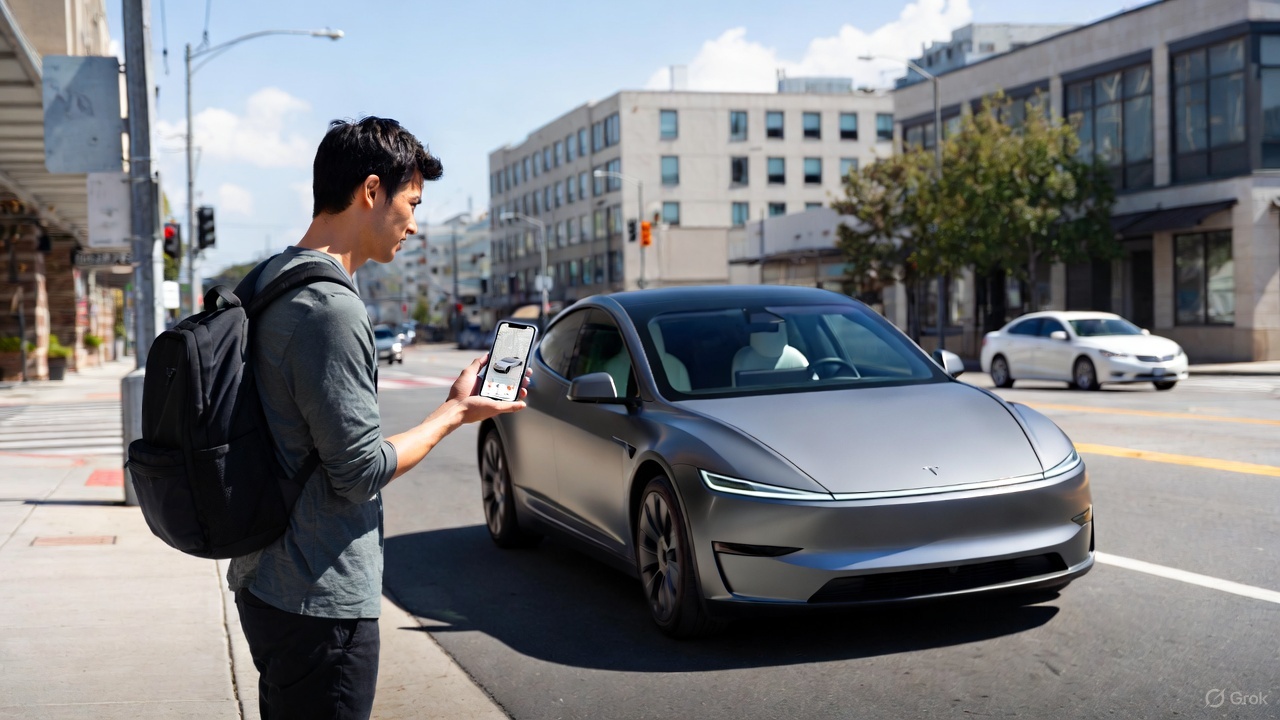
Elon Musk is pushing Grok Bot users toward a feature that, until this week, few of them could actually use. “Try asking Grok @Bot to make calls!” Musk wrote on X Tuesday afternoon, quoting a demo from Sawyer Merritt that included audio from a live call.
Musk first announced calling on October 25, writing that the agent could “call someone or a business for you, make a request on your behalf, take notes on the response and send you a note summarizing the conversation.” There were no release notes at the time, and the feature only appeared in preview builds. That changed on Tuesday, when creator Peter Yang said all Grok Bot users should now be able to call US businesses. Musk reposted his demo.
Try asking Grok @Bot to make calls! — Elon Musk (@elonmusk) November 3, 2026
Yang’s call shows how far the feature goes. In his video, his bot dialed Comcast, worked through the phone menu, deflected small talk about the weather by saying it does not “have eyes on the sky,” turned down three upsells and used a cheaper fiber offer from competitor Sonic as leverage. His bill dropped from $84 to $45 per month on a faster plan, a savings of nearly $500 a year. The call ran about 25 minutes, and the bot paused to get Yang’s approval before accepting the final terms.
Merritt described what the user sees: a live transcript runs during the call, and when the business asks for something the bot does not know, an answer box pops up in the chat. The user types a reply and Grok relays it to the person on the line. Other users posted results Tuesday, including a $100 gift card recovered from Verizon Fios after a 51 minute call and a same day pediatric appointment, which Musk also shared. Not every call worked. One user said a rep refused to cancel a subscription once it was clear an AI was on the phone.
Grok @Bot can now call someone or a business for you, make a request on your behalf, take notes on the response and send you a note summarizing the conversation! — Elon Musk (@elonmusk) October 25, 2026
The Grok Bot terms require every call to identify itself as a virtual assistant calling on the user’s behalf and warn that calls may be recorded. Marketing, mass calling and impersonation are prohibited, and calling currently works only with US numbers.
The timing stands out. Days ago, users began hitting their weekly limits early, and Musk said the cost of serving Grok Bot was “unsustainably high relative to revenue,” as Teslarati reported. A call that spends most of its 25 or 50 minutes on hold is the kind of long running task that eats into usage, and SpaceXSI has not said how calls count against the weekly pool. Grok Bot is included from the $30 Premium tier of The X Subscription upward.
For Tesla owners, the agent has been in their cars since September 22 and is enabled across every Cybercab and Model Y Robotaxi. Musk has already pitched it for phone chores like scrubbing your number from spam call lists. Neither Tesla nor SpaceXSI has confirmed whether a bot can place one of these calls on request from inside the vehicle.
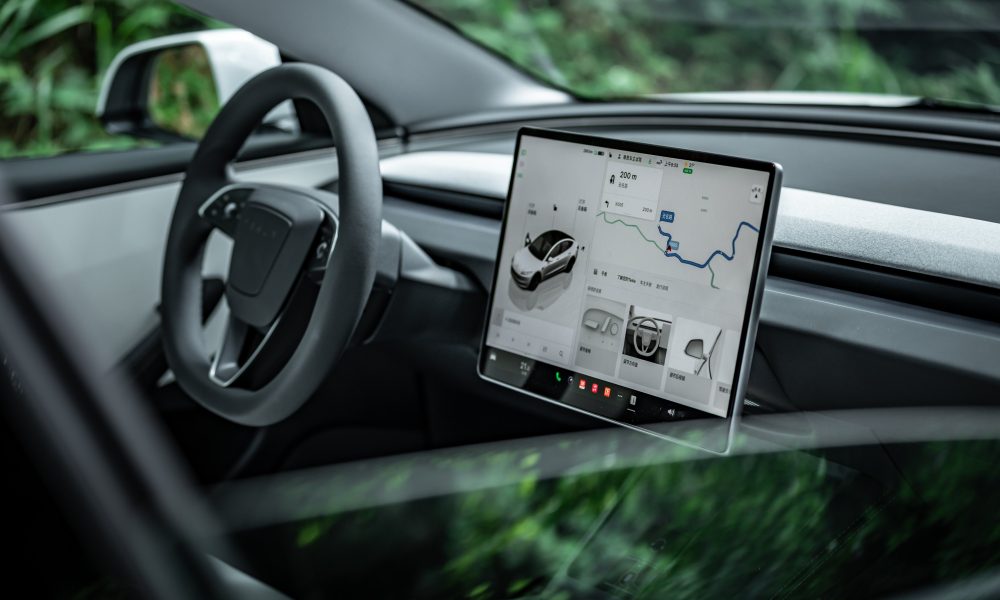
Tesla Full Self-Driving, which is now referred to in Europe as “Tesla Assisted Driving” (TAD), is getting hit with a handful of new changes at the hands of the Netherlands’ vehicle authority, the RDW (Rijksdienst voor het Wegverkeer).
On 3 November, the RDW announced that it has assessed and approved a set of changes to Tesla’s FSD Supervised driver-assistance system. The updates introduce the official European name TAD and impose stricter controls on the system’s speed behaviour.
The new name will appear on the in-car display, in the owner’s manual, and in all other driver-facing information. The change applies to Tesla models equipped with Tesla Assisted Driving and hardware version 4.0 (HW4) or later.
Importantly, the RDW stressed that the name change does not alter the system’s fundamental operation: it remains a supervised driver-assistance feature that supports the driver in performing driving tasks. The driver stays fully responsible for controlling the vehicle at all times.
Beyond the rebranding, the most significant functional adjustments concern speed settings. Drivers will still be able to set a speed margin, a percentage by which the system may exceed the applicable speed limit when necessary for safety or traffic flow. However, the maximum allowable margin has been reduced from +50% to a maximum of +10%.
In addition, every time the vehicle is started, the speed-margin setting will default to 0% deviation, and other speed-related functions will be disabled by default. These changes will be delivered through an over-the-air (OTA) software update from Tesla.
Tesla requested the RDW’s review of these “minor changes.” After evaluating how the modifications were implemented and how the system behaves, the authority found no adverse or unintended effects on the system’s operation or the vehicle’s driving behaviour. Consequently, the existing type approval remains valid under the same conditions and for the same use; no amendment or extension of the approval is required.
The RDW has informed the nine EU member states that have already accepted its type approval—Belgium, Denmark, Estonia, Croatia, Latvia, Lithuania, Slovenia, Slovakia and Czechia—about the updates. Broader EU-wide approval is still under discussion within the European Technical Committee on Motor Vehicles (TCMV). Those proceedings remain confidential, and the RDW has declined to comment on them.
The approved changes align with earlier discussions involving German authorities, which had advocated both for clearer naming to avoid misleading drivers and for a tighter speed offset.
By formally incorporating these adjustments while leaving the core type approval intact, the RDW has cleared the way for Tesla to roll out the updated TAD software via OTA to eligible vehicles in the Netherlands and the other countries that recognise the Dutch approval. The system continues to function strictly as supervised driver assistance, with the human driver remaining the responsible party.

SpaceX moves to challenge AT&T, Verizon with Qualcomm-powered 5G

Elon Musk’s Grok Bot is picking up the phone now, and the first calls are wild


