News
The Lucid Air Dream Edition R’s first in-depth review reveals the car is a stunner

Lucid frontman Peter Rawlinson has spent plenty of years in the electric vehicle realm, so he definitely has an idea of what goes into creating a fast, luxurious, and effective electric car. Prior to his time at Lucid, Rawlinson was one of the key members of Tesla’s Model S development team back in the early 2010s, before leaving the company to pursue his own interests, eventually landing at Lucid Motors. As the electric vehicle sector continues to develop quite nicely in the grand scheme of things, with both exclusively electric companies and legacy automakers all contributing to the sustainable energy transition, Lucid is set to deliver its first vehicle, the Air Dream Edition sedan, later this year, and Motortrend got an in-depth and exclusive look at the car that could quite possibly be the king of the hill when it enters the market.
Design
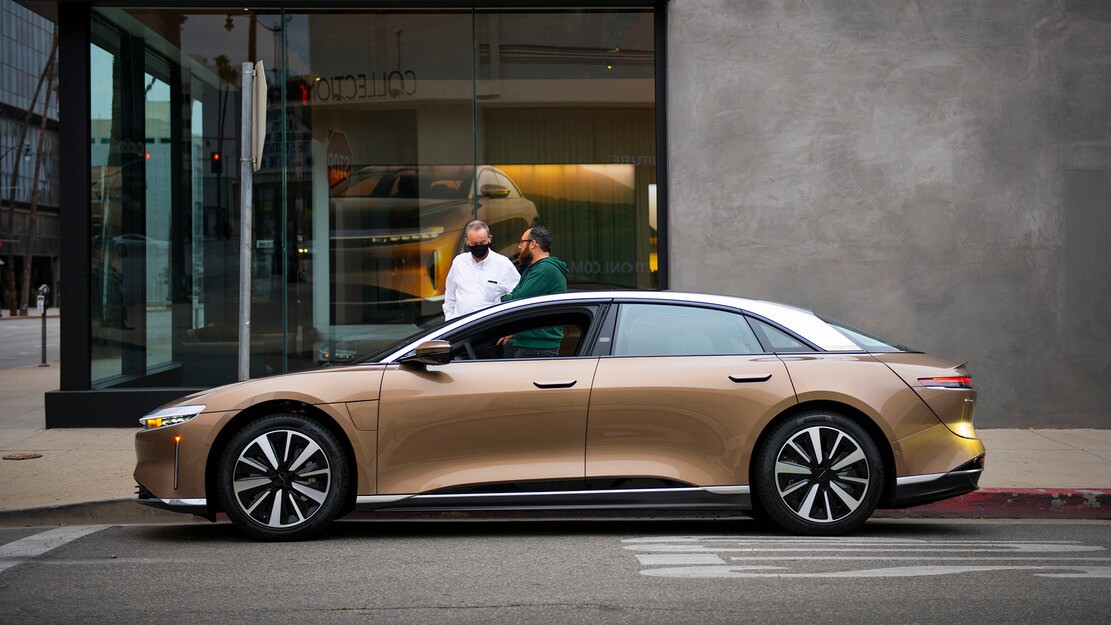
One of the sharpest vehicles in the automotive sector, the Air Dream Edition was outfitted in Eureka Gold for this breakdown by Motortrend. Reminiscent of the Citroën DS redesigned for Blade Runner, the car is simple yet futuristic in its design. It’s a long sedan, and in photographs almost reminds me of an older Ford Taurus in its “boaty” nature. However, it is much more pleasing to the eye, in my opinion. (The Ford Taurus was my second car. I drove it to class in college, and Lord, I hated that thing.)
Credit: MotorTrend
Sleek and luxurious, the reviewers were more particular to this interior than that of the Tesla Model S, stating that “every Tesla since day one has seemingly shipped without a finished interior, Lucid not only crafted a perfectly wonderful luxury-car cabin, but it also smartly avoided the screens über alles aesthetic that plagues cars like the Mercedes EQS.” Truth is, the Air interior is still relatively simplistic, and while it does have a few more bells and whistles than the Tesla Model S, it is not all that different other than an extended instrument cluster, a repositioned center screen, and more material options.
Credit: MotorTrend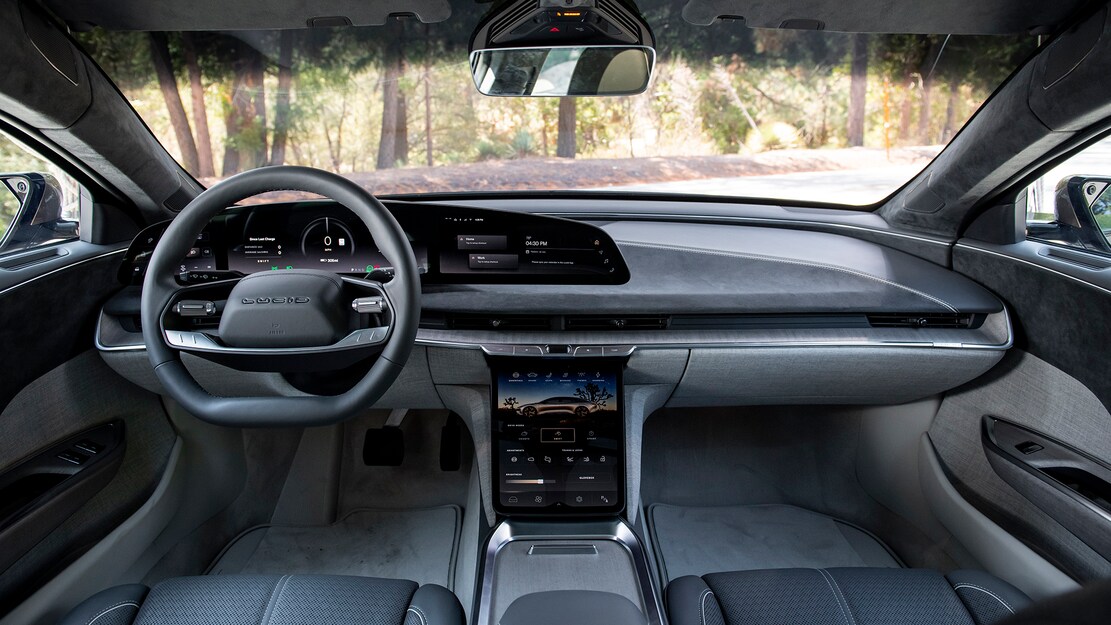
Performance
The Air Dream does not drive like a Lotus, which Rawlinson wanted when he designed the car: the look of a Mercedes with the ride of a Lotus. In fact, Jonny Lieberman, who wrote MotorTrend’s review, said it’s more like a Nissan GT-R. It has great handling, and with 933 horsepower, it’s extremely quick. Couple these performance tidbits based on Lieberman’s experience with the already stunning design and comfortable interior, and you have a car that is sure to appeal to many.
Carving turns in the Air was one of the highlights of the test drive. “I assumed the Air Dream Edition R would be decent enough to drive around big sweepers, but about 10 miles into our run up Angeles Crest Highway, I discovered the car enjoyed being manhandled through tight corners,” Lieberman wrote. The harder he drove the car, the better it performed, making it an ideal choice for a scenic joyride through winding and curvy rods, especially with the all-wheel-drive system to help navigate through those corners.
Not only is the car fun to drive, but it’s fast too, even if it’s over 5,000 pounds. Impressive with this pre-production Air model that was available for the test drive, the car will only improve as Lucid begins cranking out production models of the vehicle soon. This is where Lieberman expects Lucid to improve on an already great car. The front end seemed to be a little too free for his liking, while the back tires provided sufficient grip and maneuverability through tight corners. According to Lucid’s Director of Chassis and Vehicle Dynamics David Lickfold, the front spring rate will be reduced by 10% before production begins. The anti-roll bar will be stiffened for more support and stability, and active dampers will get an adjustment, too, providing an even smoother ride than already given.
Credit: Motortrend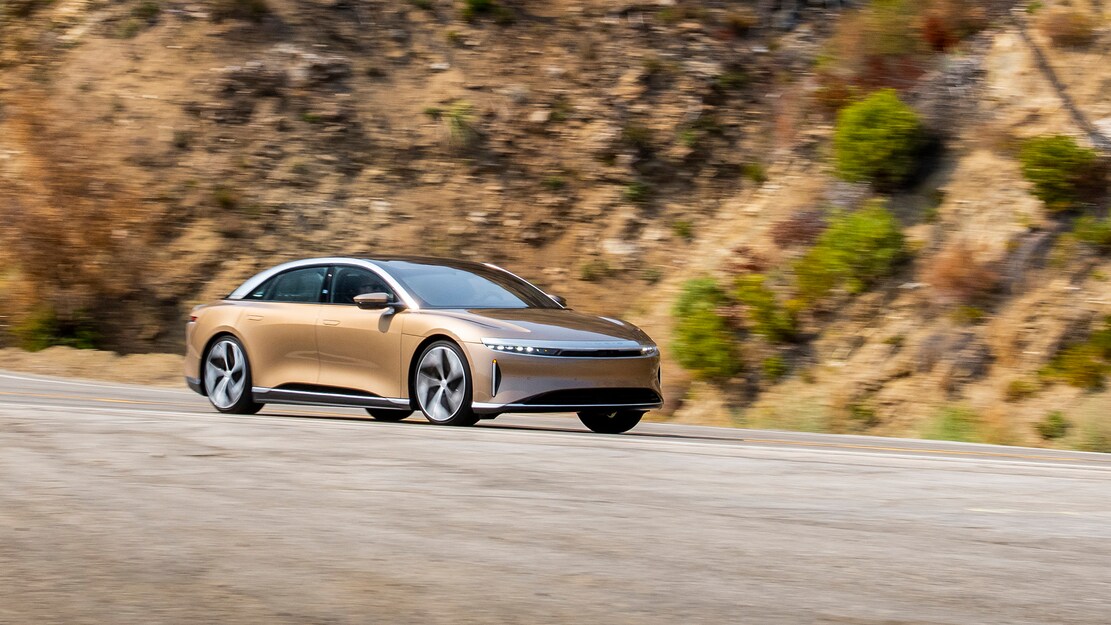
Three Drive Modes
The Air will come with three available drive modes, as Lickfold was curious about the condition of the roads that the Air was being tested on by MotorTrend. He suggested Lieberman leave it in Swift Mode, the second option, between Smooth and Sprint.
- Smooth Mode: Motors limited to 670 horsepower, softens dampers and brake pedal feel, the steering wheel is “free” feeling
- Swift Mode: Motors limited to 670 horsepower, much firmer feel than smooth mode, suitable for quicker driving on winding roads, but still holding back some performance
- Sprint Mode: Motors can reach full 933 horsepower potential, dampers are very hard, extremely sporty driving feel with “Tesla Plaid-like battery conditioning” for battery performance
Swift Mode brings out about 75% of the total power output, according to Emad Dlala, Lucid’s Senior Director of Efficiency and Energy Technology.
Credit: MotorTrend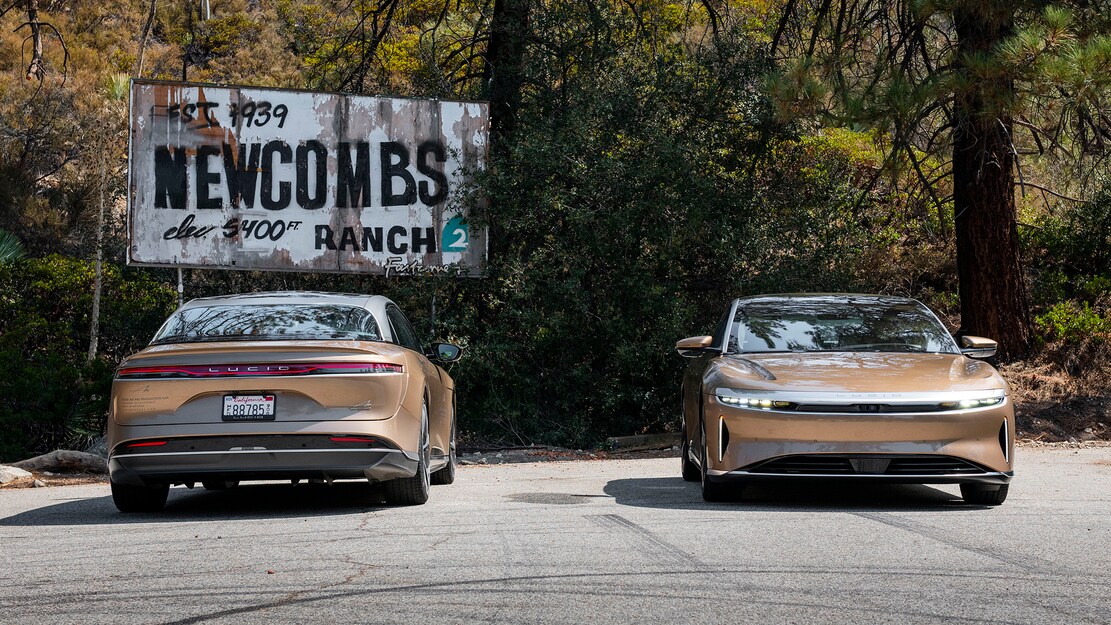
Efficiency, Range, Battery Pack
The Air Dream Edition R is supposed to have 500 miles of range at a minimum, and the EPA will either confirm or deny this when it certifies the car in the coming months. MotorTrend decided to test the range on its own terms with a drive from Los Angeles to San Francisco, close to 350 miles. Not only did this drive provide some insight on how the range of the vehicle would be, but it would also give the reviewers an opportunity to get a look at what the vehicle would be like in its most frequent way of travel: abiding by speed limits and traffic rules during highways, while having to navigate through traffic and provide the driver and passengers with safety, but also entertainment and comfortability through the lengthy quest up the California coast.
It’s a smooth ride, there was wind noise, a common complaint among EVs due to their lack of an engine to drown out road sounds, but tire noise was minimal, Lieberman said. The car sat on Pirelli P Zeros, specifically designed for Lucid. After 205 miles of driving, the range of the vehicle had gone from 503 miles to 286, so there was slightly more energy usage through the 205 miles of driving as 217 miles had been subtracted from the range since the start of the trip. The additional range usage was due to air conditioning, so Lieberman adjusted the temperature from 69 to 71 to see if there was any impact.
The team arrived in San Francisco with 69 miles of range remaining, not needing to charge up at any point during the drive.
Credit: Motortrend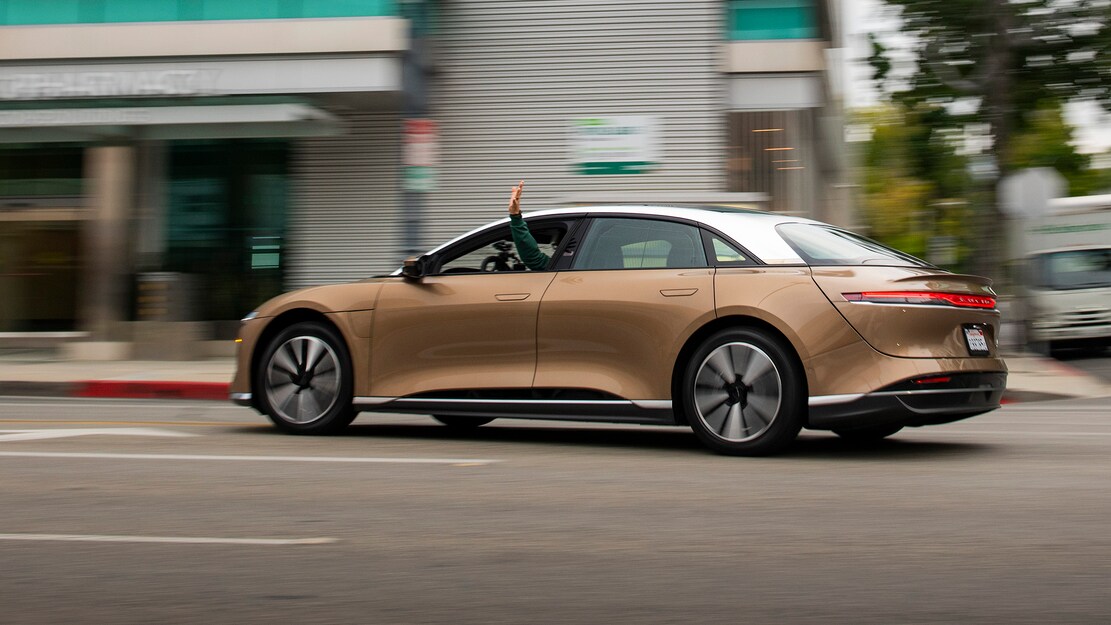
While Lucid still remains very vague in terms of when the Air Dream Edition will begin deliveries, the company still expects them to occur this year. With its unique design, different drive modes, impressive range, fast performance, and sporty but luxury interior, the car is certainly one of the most-anticipated EVs in the last several years. The car, along with Tesla’s vehicles, continues to chip away at the idea that range anxiety is an issue and EVs are not fast and fun. The Air is its own vehicle, and it’s important to not count it out before it hits the road, especially as Lieberman, who has reviewed hundreds of vehicles, was quite impressed by the Air Dream Edition.
Don’t hesitate to contact us with tips! Email us at tips@teslarati.com, or you can email me directly at joey@teslarati.com.


Elon Musk
Elon Musk calls out $2 trillion SpaceX IPO valuation as ‘BS’
In a swift rebuke on X, Elon Musk dismissed reports claiming SpaceX had confidentially filed for an initial public offering targeting a valuation above $2 trillion, labeling the information as unreliable.
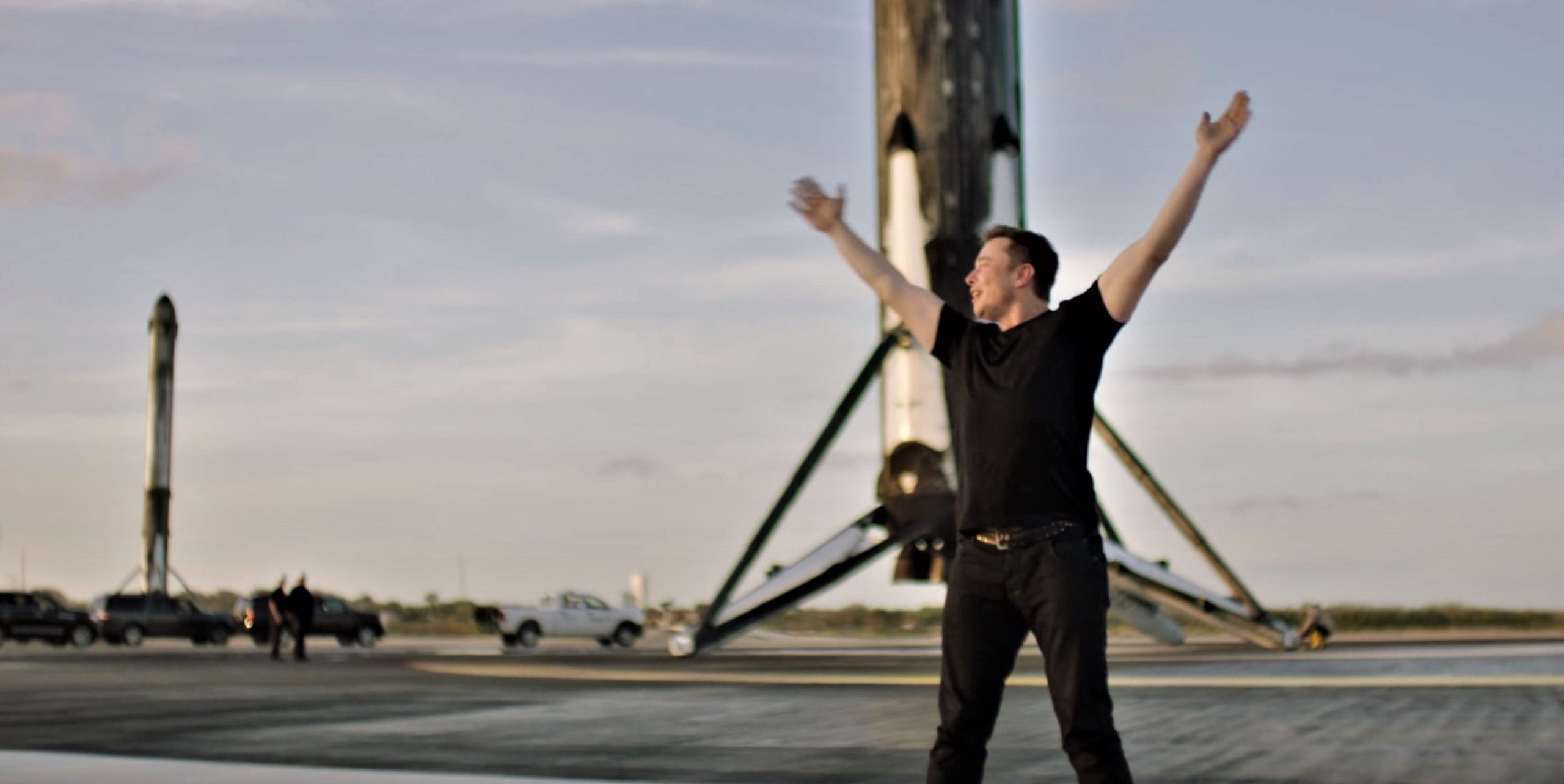
Elon Musk is quick to call out any false information regarding him or his companies on his social media platform, known as X.
A recent report that claimed SpaceX was aiming to go public with an IPO in the coming weeks at a massive valuation of $2 trillion was called out by Musk, who referred to it as “BS.”
In a swift rebuke on X, Elon Musk dismissed reports claiming SpaceX had confidentially filed for an initial public offering targeting a valuation above $2 trillion, labeling the information as unreliable.
The exchange highlights ongoing media speculation about the rocket company’s future and Musk’s frustration with what he views as inaccurate financial reporting. The report came from Bloomberg.
Don’t believe everything you read.
Bloomberg publishes bs.
— Elon Musk (@elonmusk) April 3, 2026
The controversy erupted on April 2, 2026, when influencer Mario Nawfal amplified claims from Bloomberg.
The outlet posted that SpaceX had boosted its IPO target valuation above $2 trillion, describing it as potentially one of the largest public offerings in history. Musk challenged the story.
It echoes past instances where Musk has corrected valuation rumors about his companies, emphasizing that speculation often outpaces reality.
Background context adds nuance.
Earlier reports indicated SpaceX had filed confidential IPO paperwork with the U.S. Securities and Exchange Commission, potentially positioning it for a record-breaking debut that could eclipse Saudi Aramco’s 2019 listing.
Initial estimates pegged a possible valuation north of $1.75 trillion, building on a post-merger figure around $1.25 trillion after SpaceX absorbed xAI. A subsequent Bloomberg update claimed advisers were floating figures above $2 trillion to investors, with the offering potentially raising up to $75 billion.
SpaceX remains a private powerhouse. Its achievements include thousands of Starlink satellites providing global broadband, routine Falcon 9 rocket reusability, and a mission to slash launch costs, along with ambitions for Starship to enable Mars colonization.
The company also benefits from government contracts with NASA and the Department of Defense. A public listing could democratize access for retail investors while subjecting SpaceX to greater scrutiny and quarterly reporting pressures.
Critics of the reports point to the confidential nature of filings, which limits verifiable details. Musk has previously downplayed inflated valuations, once calling an $800 billion figure for SpaceX “too high.”
Supporters argue that hype around mega-IPOs, especially amid the ongoing AI fervor, fuels premature narratives that distract from core technical milestones, such as full Starship reusability and Starlink constellation expansion.
The incident reflects broader tensions in tech finance. Anonymous sourcing in valuation stories can drive market chatter and betting activity, yet it risks misinformation.
Bloomberg defended its reporting through multiple articles citing “people familiar with the matter,” but Musk’s blunt dismissal resonated widely on X, with users piling on to question media reliability.
Whether SpaceX ultimately goes public remains uncertain. Musk has teased an IPO tied to Starlink maturity, but priorities center on engineering breakthroughs over Wall Street timelines. For now, the $2 trillion figure joins a list of rumored milestones that Musk insists should be taken with skepticism.
Elon Musk
Elon Musk reveals date of SpaceX Starship v3’s maiden voyage
The announcement arrives after Flight 11 on October 13 of last year, which concluded a busy 2025 testing campaign. Since then, SpaceX has focused on ground testing, including cryoproofing of Ship 39 and preparations for Booster 19, the first V3 Super Heavy.
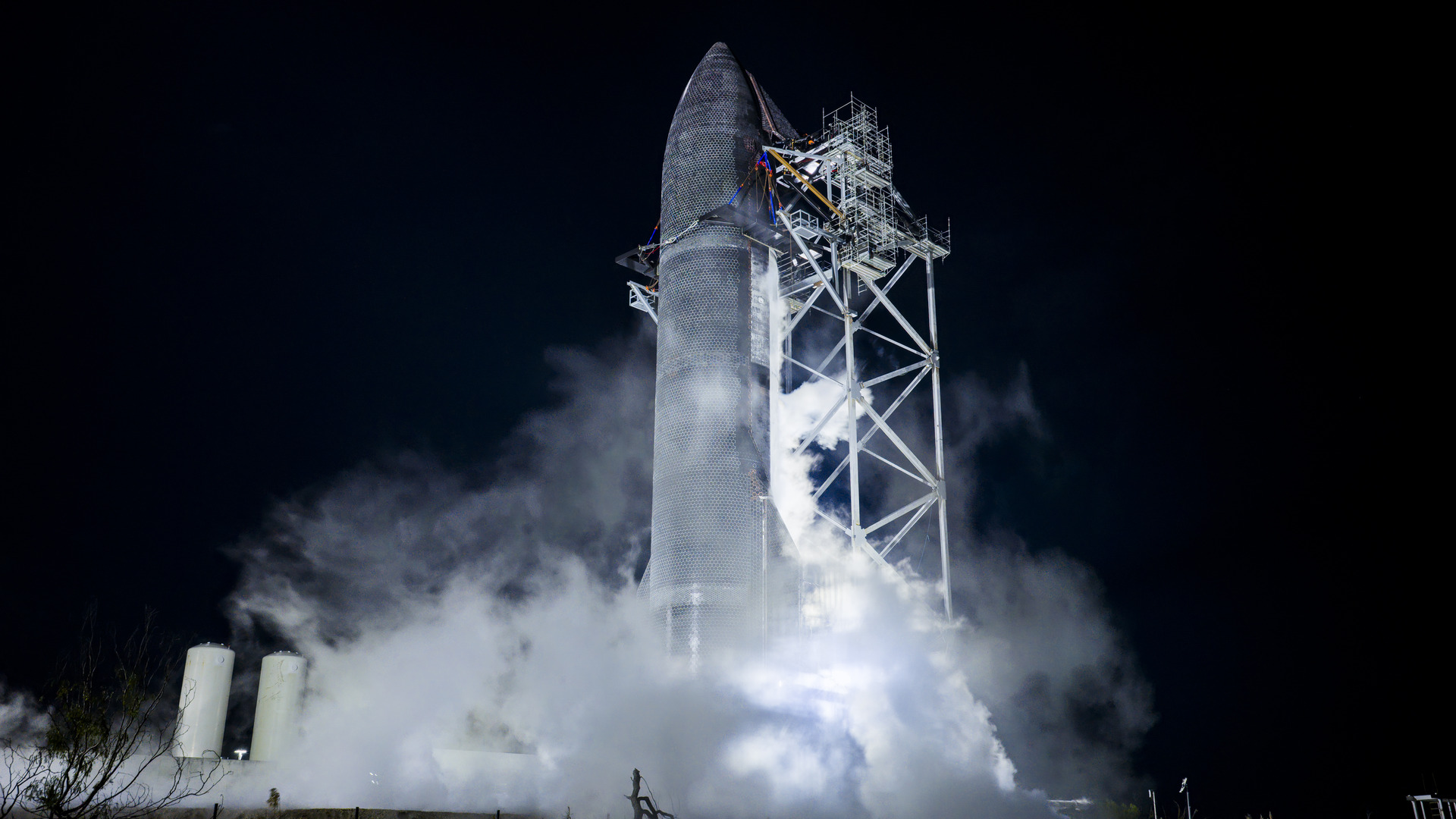
SpaceX CEO Elon Musk has revealed the timeline for the next Starship launch. It will be the first launch using SpaceX’s revamped design for Starship, as its v3 rocket will take its maiden voyage sooner than many might expect.
Musk announced on April 3 on X that the next Starship flight test, and the first flight of the upgraded v3 ship and booster, is 4 to 6 weeks away. The update signals the end of a nearly six-month hiatus since the program’s last launch.
Elon says the first V3 Starship launch will occur in 4-6 weeks
It will be the first Starship launch since Flight 11 on October 13, 2025 https://t.co/QnnYPTdbUu
— TESLARATI (@Teslarati) April 3, 2026
The upcoming mission, designated as Starship’s 12 integrated flight test (IFT-12), marks a significant milestone. It will be the debut of the v3 configuration, featuring a taller Super Heavy Booster and Starship upper stage. The changes SpaceX has made with the v3 rocket and booster are an increased propellant capacity and the more powerful Raptor 3 engines.
Earlier predictions from Musk in March had pointed to an April timeframe, but the latest timeline now targets a launch window in early to mid-May 2026.
The V3 iteration represents a substantial evolution from previous Starship prototypes. Engineers have optimized the design for improved manufacturability, higher thrust, and greater efficiency. Raptor 3 engines deliver significantly more power while reducing weight and production costs compared to earlier variants.
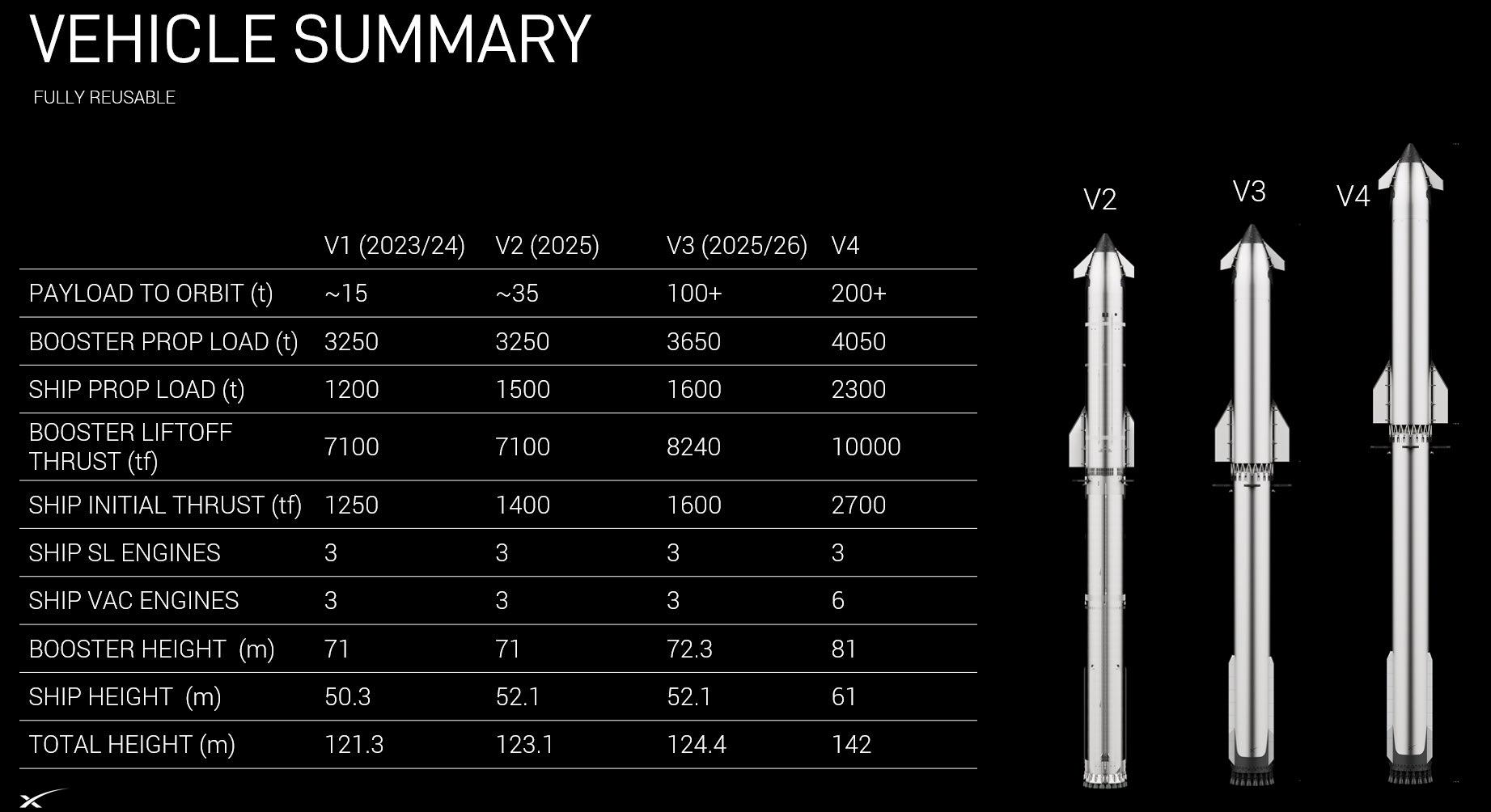
With these enhancements, SpaceX aims to boost payload capacity toward 200 metric tons to low Earth orbit in a fully reusable configuration — a dramatic leap from the roughly 35-ton target of prior versions. Such capabilities are critical for ambitious goals, including NASA’s Artemis lunar missions and eventual crewed flights to Mars.
The announcement arrives after Flight 11 on October 13 of last year, which concluded a busy 2025 testing campaign. Since then, SpaceX has focused on ground testing, including cryoproofing of Ship 39 and preparations for Booster 19, the first V3 Super Heavy.
Recent activities have involved static fires, activation of the new Pad 2 at Starbase in Boca Chica, Texas, and integration of Raptor 3 engines.
A prior incident with an early V3 booster on the test stand in late 2025 contributed to the delay, necessitating additional assembly and qualification work.
Musk’s timeline updates have become a hallmark of the Starship program, often described with characteristic optimism.
SpaceX’s Starship V3 is almost ready and it will change space travel forever
While past targets have occasionally shifted by weeks, the rapid iteration pace remains impressive. However, don’t be surprised if this timeline shifts again, as Musk has been overly optimistic in the past with not only launches, but products under his other companies, too.
SpaceX continues to refine launch infrastructure, including new propellant loading systems and tower mechanisms designed to support higher cadence operations. A successful V3 flight could pave the way for more frequent tests, tower catches of both booster and ship, and progression toward operational reusability.
The v3 debut is viewed as a transition point for Starship, moving beyond experimental flights toward a system capable of supporting large-scale deployment of Starlink satellites, lunar landers, and interplanetary transport.
Success on IFT-12 would demonstrate not only the new hardware’s performance but also SpaceX’s ability to recover from setbacks and maintain momentum.
As the 4-to-6-week countdown begins, anticipation builds at Starbase. Teams are finalizing vehicle stacking, conducting final pre-flight checks, and preparing for regulatory approvals. The world will be watching to see if Starship V3 can deliver on its promise of transforming humanity’s access to space.
Elon Musk
SpaceX to launch military missile tracking satellites through new Space Force contract
SpaceX wins a $178.5M Space Force contract to launch missile tracking satellites starting in 2027.

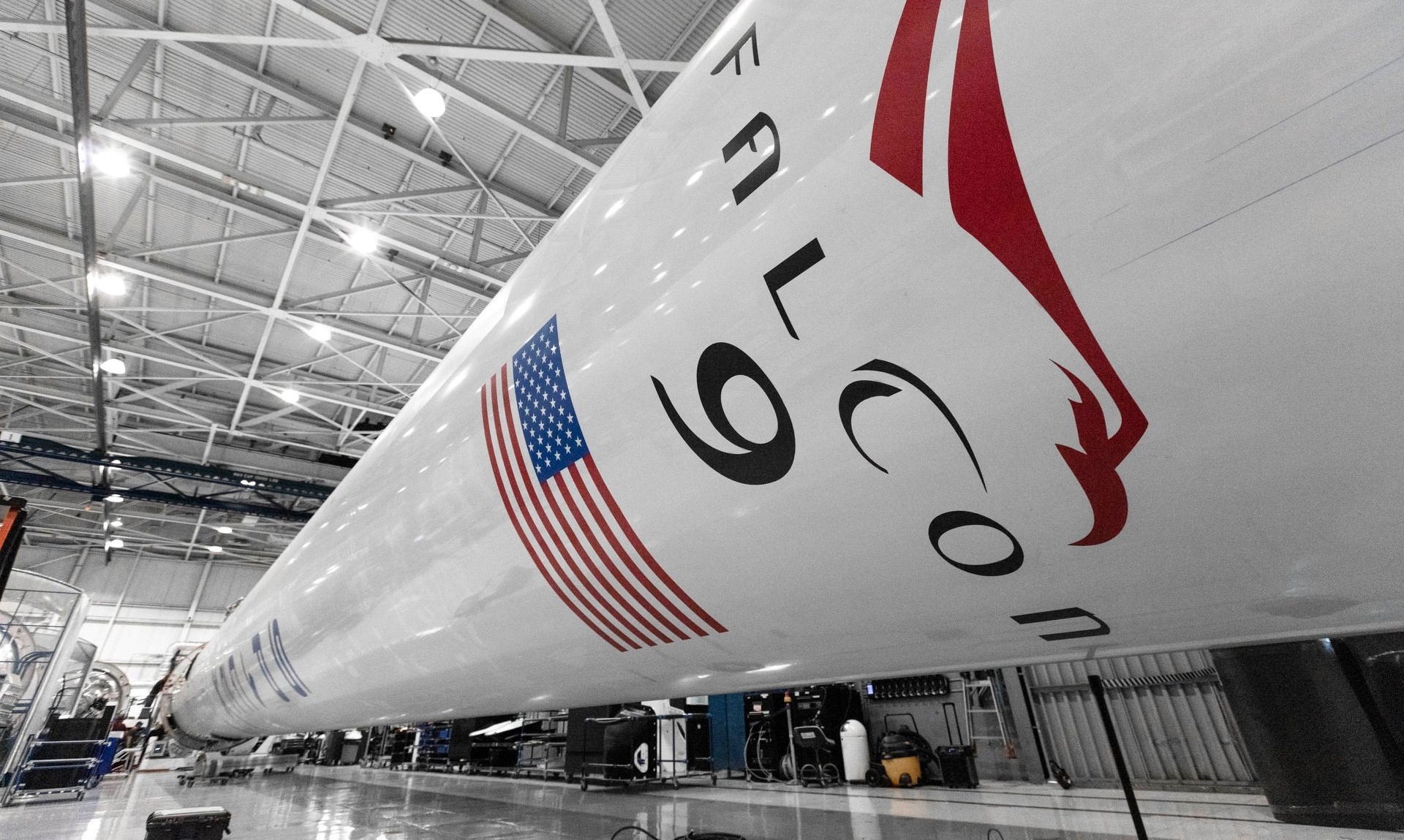
The U.S. Space Force awarded SpaceX a $178.5 million task order on April 1, 2026 to launch missile tracking satellites for the Space Development Agency. The contract, designated SDA-4, covers two Falcon 9 launches beginning in Q3 2027, one from Cape Canaveral Space Force Station in Florida and one from Vandenberg Space Force Base in California. The satellites, built by Sierra Space, are designed to bolster the nation’s ability to detect and track missile threats from orbit.
The award falls under the National Security Space Launch Phase 3 Lane 1 program, which Space Force uses to move payloads to orbit on faster timelines and at more competitive prices. “Our Lane 1 contract affords us the flexibility to deliver satellites for our customers, like SDA, more easily and faster than ever before to all the orbits our satellites need to reach,” said Col. Matt Flahive, SSC’s system program director for Launch Acquisition, in the official press release.
SpaceX is quietly becoming the U.S. Military’s only reliable rocket
The SDA-4 contract is the latest in a long string of national security wins for SpaceX. As Teslarati reported last month, the Space Force recently shifted a GPS III satellite launch from ULA’s Vulcan rocket to SpaceX’s Falcon 9 after a significant Vulcan booster anomaly grounded ULA’s military missions indefinitely. That move made it four consecutive GPS III satellites transferred to SpaceX after contracts were originally awarded to its competitor.
This didn’t come without a fight and dates back years. SpaceX originally had to sue the Air Force in 2014 for the right to compete for national security launches, at a time when United Launch Alliance held a near monopoly on the market. Since then, the company has steadily displaced ULA as the dominant provider, and last year the Space Force confirmed SpaceX would handle approximately 60 percent of all Phase 3 launches through 2032, worth close to $6 billion.
With missile defense satellites now part of its launch manifest alongside GPS, communications, and reconnaissance payloads, SpaceX is giving hungry investors something to chew on before its imminent IPO.

Elon Musk calls out $2 trillion SpaceX IPO valuation as ‘BS’

Elon Musk reveals date of SpaceX Starship v3’s maiden voyage


