News
UPDATE: Tesla quietly registers to build electric motors for non-land vehicles

Update: 8:53 PM EST: Bloomberg reported Tesla did not file this application, but it was instead filed by a fan named Jerome Eady. Tesla had no knowledge of the filing, according to the report.
Tesla has quietly registered to build electric motors intended for non-land vehicles, according to the United States’ Patent and Trademark Office.
Initially spotted and reported by Electrek, Tesla applied and submitted paperwork to the USPTO on December 29, with the trademark application describing the electric automaker’s plans to potentially develop and build motors for airplanes and boats:
“TESLA™ trademark registration is intended to cover the categories of
The application was accepted and is currently undergoing processing as of December 31, which is the last update the USPTO website describes.
While its U.S. classes do not reveal too much information, the International classes do. The application lists the International one as “Class 7,” which fits the description of “Machines and machine tools; motors and engines (except for land vehicles); machine coupling and transmission components (except for land vehicles).”
Looking over the past two years, CEO Elon Musk has hinted toward several non-road vehicle applications that Tesla could potentially explore. After Teslarati reported on the expansion of Gigafactory Texas last year, Musk told us the purpose was to begin working on the ecological paradise surrounding the property. Musk went on to detail the potential development of an electric boat that visitors could use to float on the Colorado River, which runs directly through Austin.
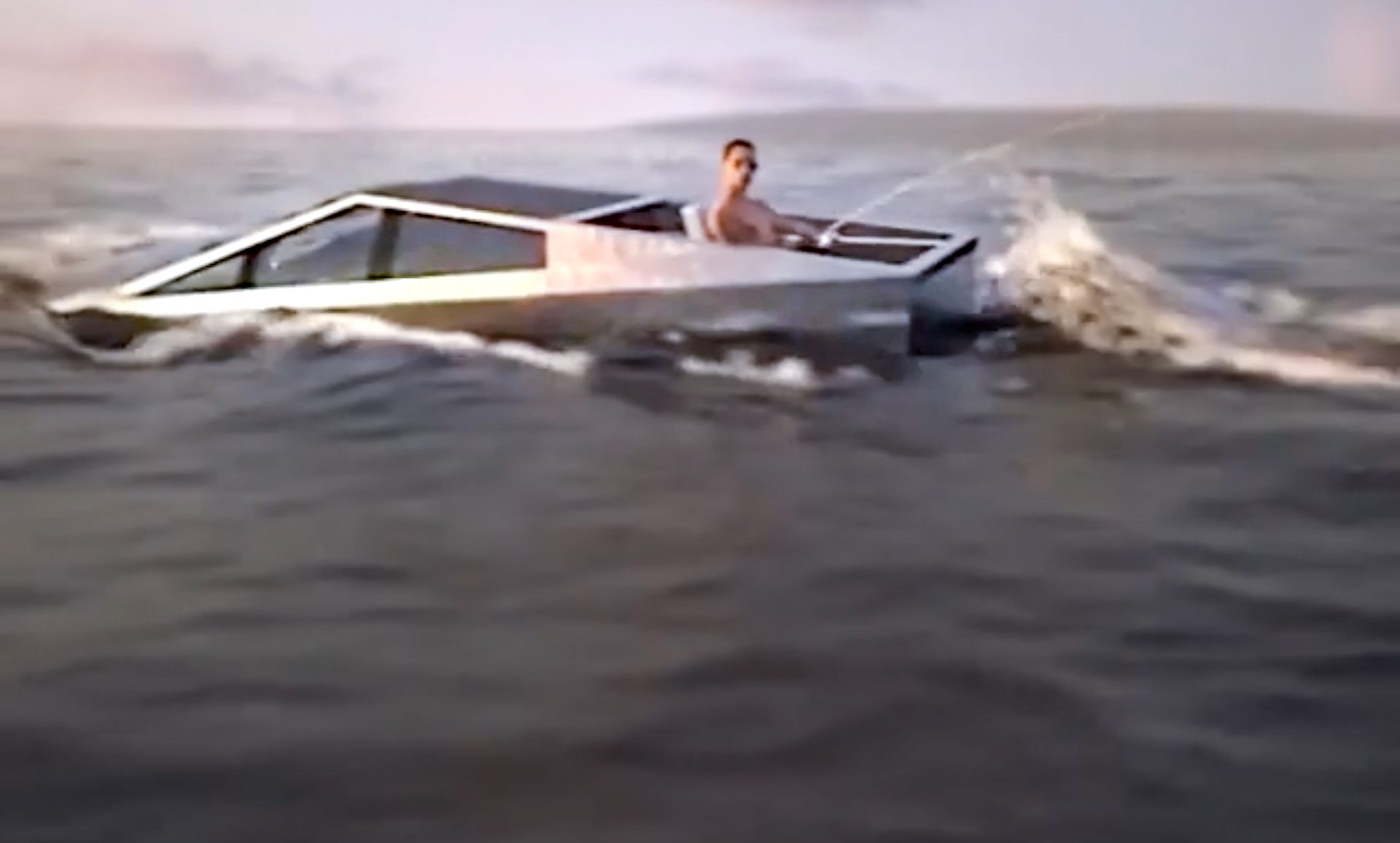
Additionally, Musk has hinted that the upcoming all-electric pickup, the Cybertruck, would be waterproof and hold enough capability to travel across the South Bay and Brazos Santiago Pass between Starbase and South Padre Island in Texas.
Elon Musk says the Tesla Cybertruck will cross rivers, lakes, and seas with waterproof ability
Of course, patents and trademarks can take years to work through the system, so there is no timetable on when Tesla could possible implement these designs into either present or future products. However, Musk has hinted toward several unorthodox travel methods for Tesla vehicles, including a potential hovering capability with the Roadster.
I’d love to hear from you! If you have any comments, concerns, or questions, please email me at joey@teslarati.com. You can also reach me on Twitter @KlenderJoey, or if you have news tips, you can email us at tips@teslarati.com.


News
Tesla Robotaxi gets a small but significant change
In the world of Tesla, where billion-dollar battery breakthroughs and autonomy milestones dominate headlines, a quiet design update can still pack a punch.
In the world of Tesla, where billion-dollar battery breakthroughs and autonomy milestones dominate headlines, a quiet design update can still pack a punch.
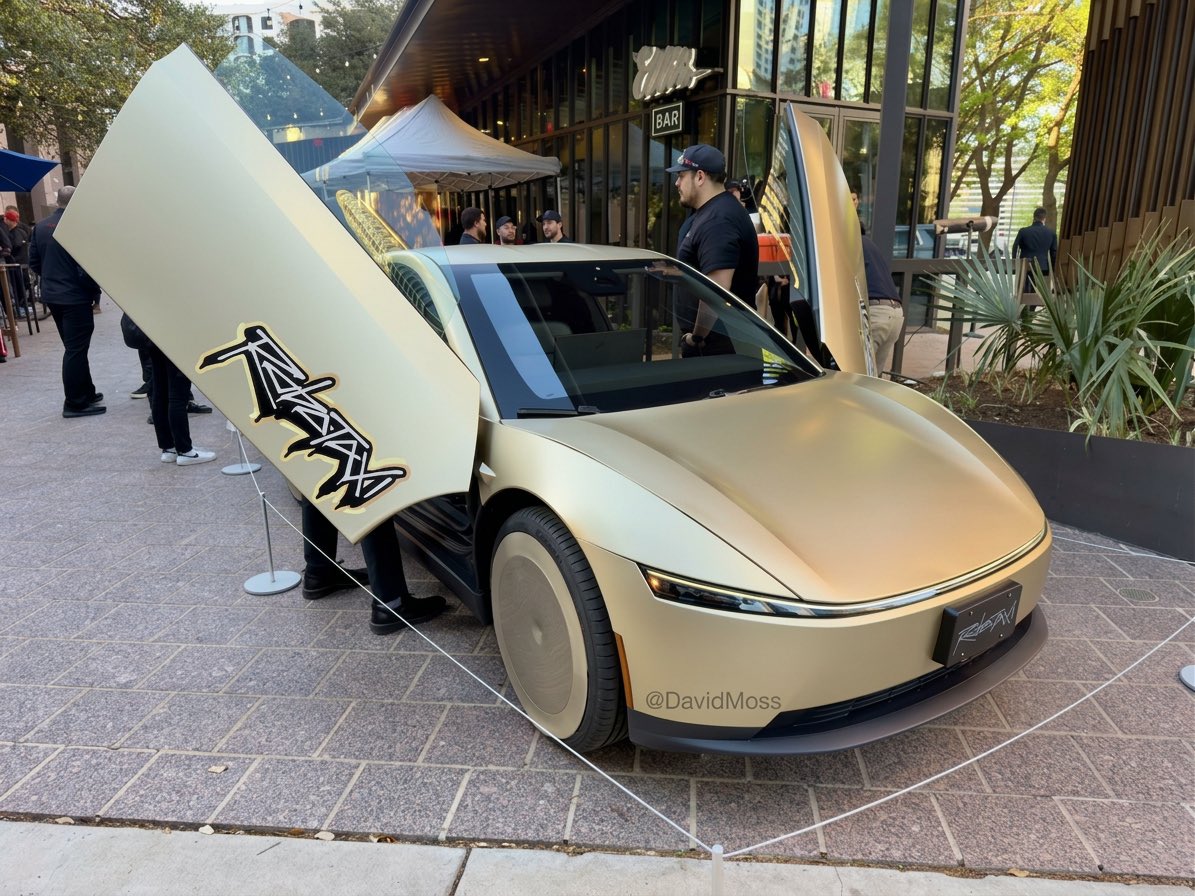
Last week in downtown Austin, sharp-eyed observers spotted a subtle but telling evolution on the Cybercab: a new “ROBOTAXI” logo graphic now graces the vehicle’s doors at Tesla’s Autonomy Popup.
What looks at first glance like a minor stylistic choice is, in fact, a deliberate rebranding move that hints at how the company envisions its robotaxi fleet fitting into everyday life.
The updated lettering is bold, graffiti-inspired, and unapologetically street-smart. Rendered in black with dripping white accents and a glowing yellow outline, the font evokes urban energy and playful irreverence.
Live From Downtown Austin:
Tesla Cybercab with new logo Graphic at their Autonomy Popup pic.twitter.com/MTTb9KDr3b
— David Moss (@DavidMoss) March 13, 2026
Gone is the sleek, minimalist typography that defined earlier Cybercab prototypes. In its place is something more human, almost rebellious.
The new logo pops against the Cybercab’s smooth, metallic body, turning the autonomous pod into a rolling piece of public art rather than just another futuristic taxi.
Designers know that fonts are silent brand ambassadors. They shape perception before a single ride is taken. Tesla’s classic sans-serif aesthetic screams precision engineering and Silicon Valley cool.
The new Robotaxi script leans into accessibility and fun, suggesting the vehicle is approachable, not intimidating. For a product meant to ferry strangers through city streets 24/7, that matters. It signals that the robotaxi isn’t reserved for tech elites; it’s for everyone.
Tesla Cybercab spotted next to Model Y shows size comparison
The timing is no accident. With regulatory approvals for unsupervised autonomy advancing and Tesla preparing to scale Cybercab production, the company is shifting from prototype showcase to fleet deployment.
A fresh logo helps differentiate the vehicles visually in dense urban environments—crucial for rider recognition and brand recall. It also aligns with Elon Musk’s long-standing ethos: make the future feel exciting, not sterile.
Small changes like this often foreshadow a larger strategy. Tesla has always obsessed over details—door handles, screen interfaces, even the curvature of a steering wheel.
Updating the Robotaxi font reflects the same meticulous care now applied to consumer-facing autonomy. It’s not just paint on metal; it’s a statement that the ride of the future should feel personal, memorable, and undeniably cool.
In an industry racing toward self-driving fleets, Tesla’s willingness to evolve even the smallest visual cues shows confidence. A font won’t launch the robotaxi network, but it might just help millions climb aboard with a smile.
News
Tesla makes latest announcement on Model S and Model X
The announcement follows Tesla CEO Elon Musk’s statement on the Q4 2025 earnings call in late January. Musk described the decision as an “honorable discharge” for the two vehicles, noting that production would wind down in Q2 2026.
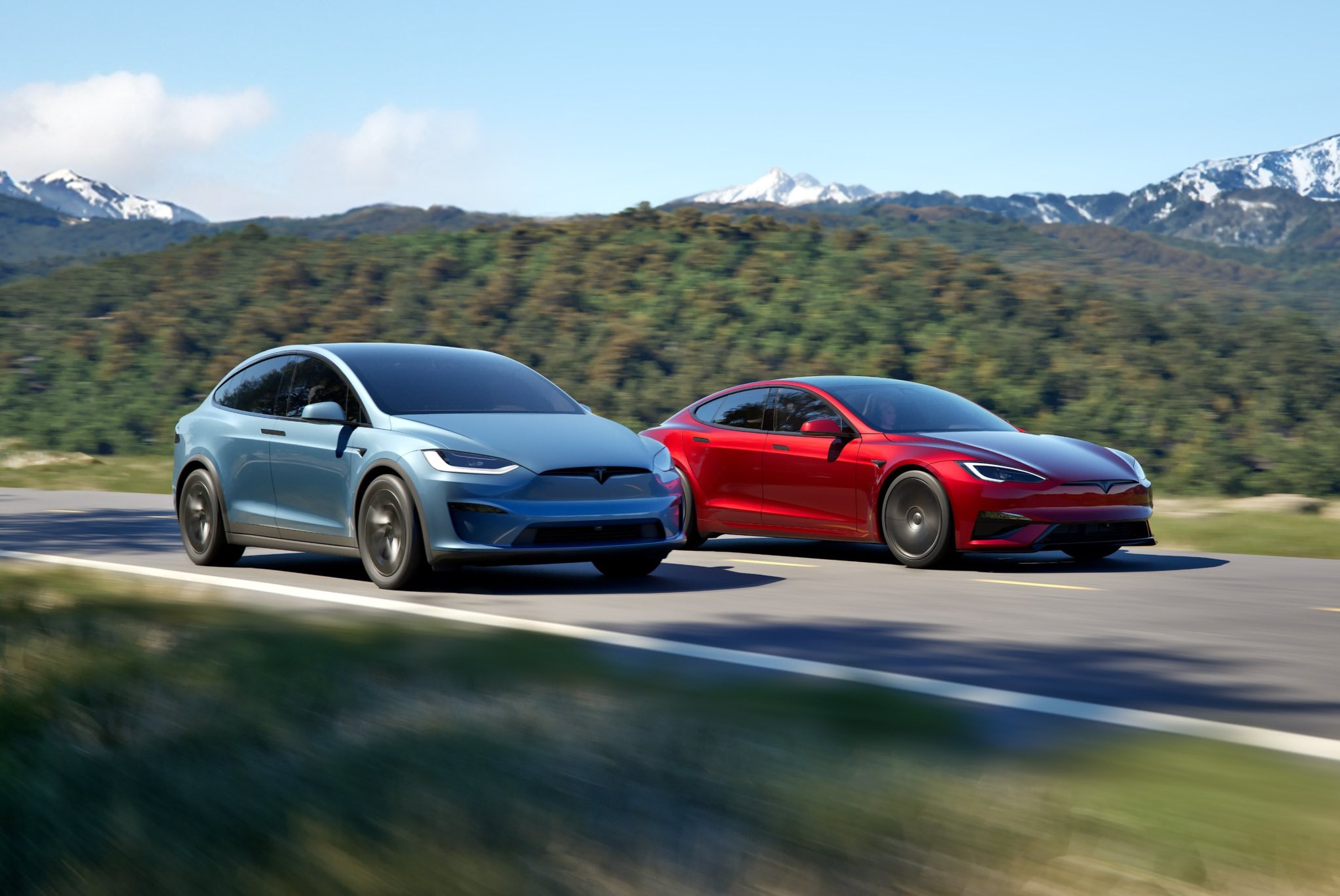
Tesla has officially begun winding down production of its flagship Model S and Model X in the United States, notifying owners via email that the long-running models will soon reach the end of the line.
The email, sent to U.S. customers on March 27, opens with gratitude. “Model S and Model X marked the beginning of the world’s transition to electric transportation,” it reads. “These vehicles also made it possible for Tesla to develop the technology that would move our world toward autonomy.”
It then delivers the news directly: “As we make way for this autonomous future, Model S and Model X production will be ending. If you’d like to bring home a new Model S or Model X, order yours soon from our limited inventory.”
Tesla just sent out a new email thanking Model S/X owners.
“These vehicles made it possible for Tesla to develop the technology that would move our world toward autonomy. As we make way for this autonomous future, Model S and Model X production will be ending. If you’d like to… pic.twitter.com/IeUhZ3iDnX
— Sawyer Merritt (@SawyerMerritt) March 27, 2026
The message closes with a simple thank-you: “Thank you for being part of our journey.”
The announcement follows Tesla CEO Elon Musk’s statement on the Q4 2025 earnings call in late January. Musk described the decision as an “honorable discharge” for the two vehicles, noting that production would wind down in Q2 2026.
The move frees factory floor space at Fremont, California, for next-generation manufacturing, including Optimus humanoid robots and the upcoming Robotaxi platform.
Introduced in 2012 and 2015, respectively, the Model S and Model X were Tesla’s original halo cars. They proved EVs could outperform gasoline luxury vehicles in acceleration, range, and tech features while pioneering over-the-air updates and early autonomy hardware.
Although they never matched the volume of the Model 3 and Model Y, their engineering breakthroughs laid the foundation for the company’s current lineup and full self-driving development.
Early adopters highlighted how the cars convinced them to invest in Tesla stock and the EV movement. Some U.S. owners who had not yet received the note voiced mild frustration, and international customers confirmed the outreach remains U.S.-only for now.
Tesla has not detailed an exact final production date beyond the Q2 2026 target or confirmed immediate replacements. Speculation continues about a possible Cybertruck-derived SUV, but the company’s public focus has shifted squarely to autonomy and robotics.
For buyers still interested in the S or X, the window is closing. Inventory is described as limited, and Tesla’s Korean division has already set a March 31 cutoff for new orders in that market. The email serves as both a farewell and final sales push, an elegant close to a chapter that helped define modern electric driving.
Elon Musk
Tesla drives drunk owner while he naps, Police still arrest him on DUI
A Vacaville man let his Tesla drive while he napped, but police had other ideas.

![Tesla drives drunk owner, Police arrest on DUI [Credit: Vacaville Police via Facebook]](https://www.teslarati.com/wp-content/uploads/2026/03/tesla-fsd-drunk-driver-dui-arrest-e1774678014371.jpg)
A Northern California man found a creative solution to drunk driving this week by letting his Tesla drive him around while he took a booze snooze. Police in Vacaville arrested a man on a DUI charge after he was found, what appears to be, completely passed out behind the wheel of a Tesla Model Y, which was safely self-navigating the owner through busy streets. The man’s passenger seat told the rest of the story, with a four-pack of Sutter Home wine bottles and a box of Round Table pizza clearly visible.
According to the Vacaville Police Department, as posted through their Facebook page, a concerned community member spotted the very relaxed driver, stayed on the line with dispatch, and guided officers to the intersection of Elmira Road and Shasta Drive where they stopped the vehicle. Alcohol and marijuana were confirmed. No medical emergency, and what appears to be just an extremely committed drunken nap.
-
![Tesla drives drunk owner, Police arrest on DUI [Credit: Vacaville Police via Facebook]](https://www.teslarati.com/wp-content/uploads/2026/03/tesla-fsd-drunk-driver-dui-arrest-e1774678014371-300x259.jpg)
- Tesla drives drunk owner, Police arrest on DUI [Credit: Vacaville Police via Facebook]
-
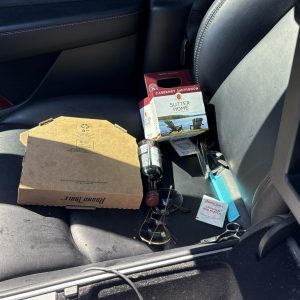
- Tesla drunk driver passenger seat , Police arrest on DUI [Credit: Vacaville Police via Facebook]
The Vacaville Police noted that California permits drivers to use assistive driving features like Tesla’s FSD, but the law still requires them to be “conscious, alert, and not under the influence while operating them.” The post drew some humorous reactions in the comments section, with one commenter piping in, “That time when his vehicle had more situational awareness than he did.” Another commenter chimed in, “Sutter all the way home….”
Tesla Full Self-Driving v14.2.1 texting and driving: we tested it
The incident lands in an interesting moment for Tesla. Elon Musk caused his own stir in December 2025 when he responded to a user question about whether FSD v14.2.1 allowed texting behind the wheel with a simple “Depending on context of surrounding traffic, yes.” He had earlier told investors that drivers turning off autopilot to check texts while steering with their knees was “significantly less safe” than simply letting FSD run, which he called “kind of the killer app.” Neither statement included anything about Sutter Home wine being part of the equation.

Tesla Robotaxi gets a small but significant change

Tesla makes latest announcement on Model S and Model X
![Tesla drives drunk owner, Police arrest on DUI [Credit: Vacaville Police via Facebook]](https://www.teslarati.com/wp-content/uploads/2026/03/tesla-fsd-drunk-driver-dui-arrest-e1774678014371-80x80.jpg)
Tesla drives drunk owner while he naps, Police still arrest him on DUI

Elon Musk says Tesla is developing a new vehicle: ‘Way cooler than a minivan’

Elon Musk launches TERAFAB: The $25B Tesla-SpaceXAI chip factory that will rewire the AI industry


