Investor's Corner
Tesla stock acts as replacement for Uber in legendary investor’s portfolio

Legendary investor Brad Gerstner said that Tesla stock is the replacement for Uber shares in his portfolio because Tesla has so much upside in the self-driving race.
Bred Gerstner is the CEO and founder of Altimeter Capital, a hedge fund that manages $10.7 billion in investments. On Thursday, he appeared on CNBC to talk about several stocks, including Tesla.
Gerstner was formerly bullish on Uber shares, being one of the firm’s most notable holdings. However, AltCap sold its Uber holdings after the U.S. Presidential Election, dumping every share and putting it directly into Tesla stock, which is up over 36 percent since President-elect Donald Trump defeated Vice President Kamala Harris.
Gerstner said on CNBC:
“Let me say at the start, Dara [Khosrowshahi] has been an incredible CEO at Uber. He’s dramatically increased free cash flow, he’s increased the competitive position of that company, and they’re dominant leader now in global mobility. We love the company, and it’s inexpensive. However, leading up to the election, we’ve been taking down our position size and rotating it into Tesla. Why? Because I said before, we had a ChatGPT moment with Full Self-Driving in 2024. I think 2025 is going to be about Robotaxi. We were present at Robotaxi Day, and we were impressed by Robotaxi. For Uber, they have to get past this moment, where they have a hugely disruptive force coming in the case of Tesla and now we know that the Trump Adminsitration is going to push for a massive regulatory change, so that will be good for Waymo and good for Tesla. Uber has a few Waymos in its platform, but we want to see how it plays out.”
Gerstner added that he believes “the optics” are going to look bad for Uber in the coming months, while Tesla will benefit from CEO Elon Musk’s close relationship with President-elect Trump.
He also said he believes Tesla’s Robotaxi launch will be in Q2 of next year, which seems optimistic.
Elon Musk details Tesla’s road to selling Optimus and Robotaxi affordably
Gerstner continued:
“I think 18 months ago, nobody would have said that this was winner take all or winner take most. They would have said everyone was going to have self-driving capabilities. I will tell you right now, Tesla is running away with their Full Self-Driving capabilities. The only other game in town really is Waymo.”
- https://shop.teslarati.com/collections/tesla-cybertruck-accessories
- https://shop.teslarati.com/collections/tesla-model-y-accessories
- https://shop.teslarati.com/collections/tesla-model-3-accessories
Please email me with questions and comments at joey@teslarati.com. I’d love to chat! You can also reach me on X @KlenderJoey, or if you have news tips, you can email us at tips@teslarati.com.


Elon Musk
Trump’s invite for Elon just reshuffled Tesla’s big Signature Delivery Event
Tesla rescheduled its final Model S farewell to May 20 after Musk joined Trump in China.

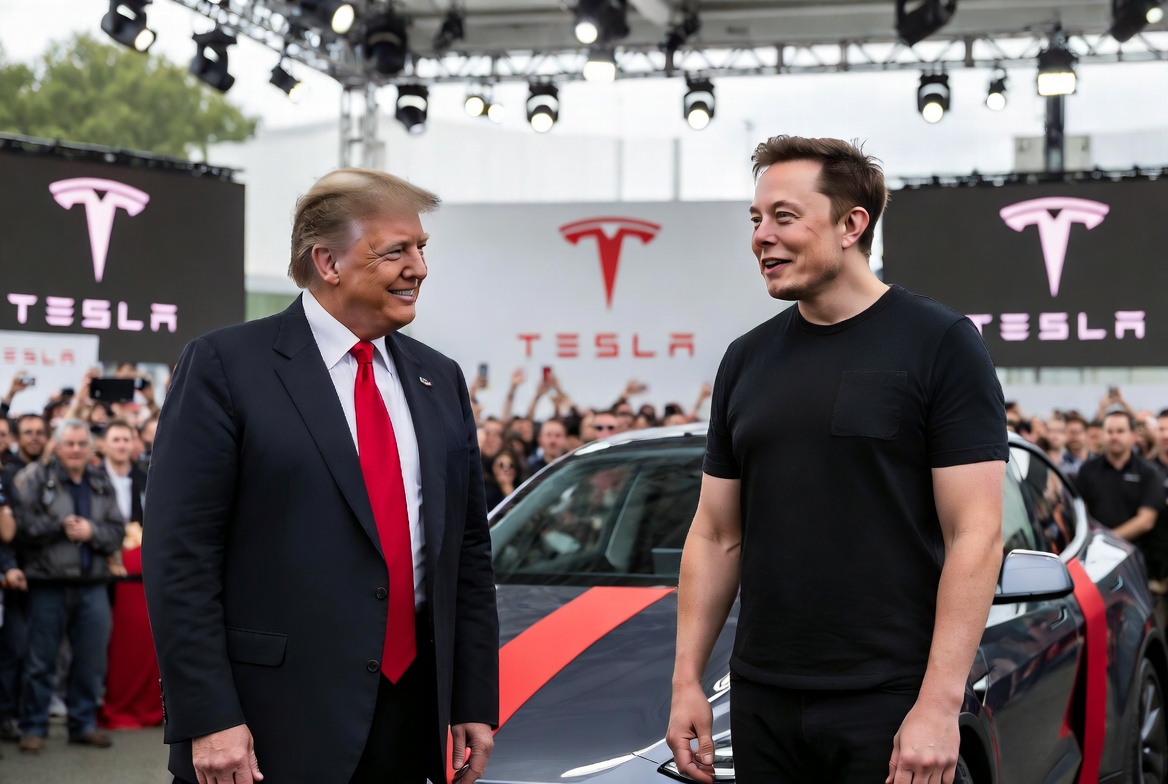
Tesla has rescheduled its Model S and Model X Signature Edition delivery event to Wednesday, May 20, 2026, after abruptly calling off the original May 12 celebration. The event will take place at Tesla’s factory at 45500 Fremont Boulevard in Fremont, California, the same location where the Model S first rolled off the line in 2012. Invitees received a follow-up email asking them to reconfirm attendance and download a new QR code ticket, with Tesla noting that all travel and accommodation expenses remain the buyer’s responsibility.
The reason behind the original cancellation came into focus the same day it was announced. President Trump invited Elon Musk, Apple’s Tim Cook, BlackRock’s Larry Fink, Boeing’s Kelly Ortberg, and executives from Goldman Sachs, Blackstone, Citigroup, and Meta to join his trip to China this week for a summit with President Xi Jinping. The agenda covers trade, artificial intelligence, export controls, Taiwan, and the Iran war, following weeks of escalating friction between Washington and Beijing over AI technology, sanctions, and rare earth exports. Trump wrote on Truth Social, “I am very much looking forward to my trip to China, an amazing Country, with a Leader, President Xi, respected by all.”
Tesla launches 200mph Model S “Gold” Signature in invite-only purchase
The vehicles at the center of all this are the last Model S and Model X units Tesla will ever build. Priced at $159,420 each, the 250 Model S and 100 Model X Signature Edition units come finished in Garnet Red with a one-year no-resale agreement, giving Tesla right of first refusal if the owner decides to sell. As Teslarati reported, the Model S defined Tesla’s early identity as a serious luxury automaker, and the Fremont factory line that built it is now being converted to manufacture Optimus humanoid robots.
Musk’s inclusion in the China delegation drew attention given his very public relationship with Trump, and the invitation signals the two have moved past and past grievances. Trump originally brought Musk on to lead the Department of Government Efficiency following his inauguration, and despite a sharp public dispute in mid-2025, the two have appeared together repeatedly in recent months. A seat on the China trip, the most diplomatically consequential visit of Trump’s current term, puts Musk back at the table on U.S. economic policy at a moment when Tesla’s China revenue remains one of the company’s most important financial pillars.
Investor's Corner
Tesla Optimus is already benefiting investors, top Wall Street firm says
Piper Sandler has updated its detailed valuation model for Tesla (NASDAQ: TSLA), concluding that at recent share prices around $400–$420, investors are essentially acquiring the company’s ambitious Optimus humanoid robot project at no extra cost.

Tesla Optimus is already benefiting investors from a fiscal standpoint, at least that is what Alexander Potter at Piper Sandler, a top Wall Street firm covering the company, says.
Piper Sandler has updated its detailed valuation model for Tesla (NASDAQ: TSLA), concluding that at recent share prices around $400–$420, investors are essentially acquiring the company’s ambitious Optimus humanoid robot project at no extra cost.
Analyst Alexander Potter, in the firm’s latest “Definitive Guide to Investing in Tesla,” built a comprehensive framework covering 17 separate product lines.
This granular approach values Tesla’s core businesses—including electric vehicles, energy storage, Full Self-Driving (FSD) software, in-house insurance, Supercharging network, and a standalone robotaxi operation—at approximately $400 per share, without assigning any value to Optimus or related inference-as-a-service opportunities.
“At $400/share, we think investors can buy Optimus for ‘free,’” Potter stated in the note. Piper Sandler maintained its Overweight rating on Tesla shares and a $500 price target, which implicitly attributes roughly $100 per share to the robot-related businesses— a figure the analyst views as potentially conservative.
The updated model incorporates elements often overlooked by other sell-side analysts, such as detailed forecasts for Tesla’s insurance operations, Supercharger revenue, and a distinct valuation for the robotaxi business separate from FSD software licensing. It also accounts for Tesla’s 2025 CEO compensation plan for the first time.
Potter acknowledged that his estimates for 2026 and 2027 fall below Wall Street consensus, citing factors like declining deliveries from certain discontinued models and reduced regulatory credit income.
However, he expressed limited concern, noting that traditional vehicle delivery metrics are expected to matter less over time as FSD subscriber growth and robotaxi deployment metrics gain prominence. On Optimus specifically, Potter suggested the humanoid robot program, combined with inference services, “arguably will be worth more than Tesla’s other businesses combined,” though the firm has not yet produced formal long-term forecasts for these segments.
Tesla shares have traded near the $400 range in recent sessions, reflecting ongoing investor focus on the company’s autonomous driving progress and expansion into robotics and AI. The Optimus project remains in early development stages, with Tesla aiming to deploy the robots initially for internal factory tasks before broader commercial applications.
This Piper Sandler analysis highlights the growing emphasis among some investors and analysts on Tesla’s long-term technology platform potential beyond its current automotive and energy businesses.
As with any forward-looking valuation, outcomes will depend on execution timelines, technological breakthroughs, regulatory approvals for autonomous systems, and market adoption of humanoid robotics—areas that carry significant uncertainty and execution risk.
The note underscores a common theme in Tesla coverage: differing views on how to quantify emerging high-growth opportunities like robotics within the company’s overall enterprise value. Investors are advised to consider their own risk tolerance and conduct thorough due diligence regarding these speculative elements.
Elon Musk
Tesla confirmed HW3 can’t do Unsupervised FSD but there’s more to the story
Tesla confirmed HW3 vehicles cannot run unsupervised FSD, replacing its free upgrade promise with a discounted trade-in.
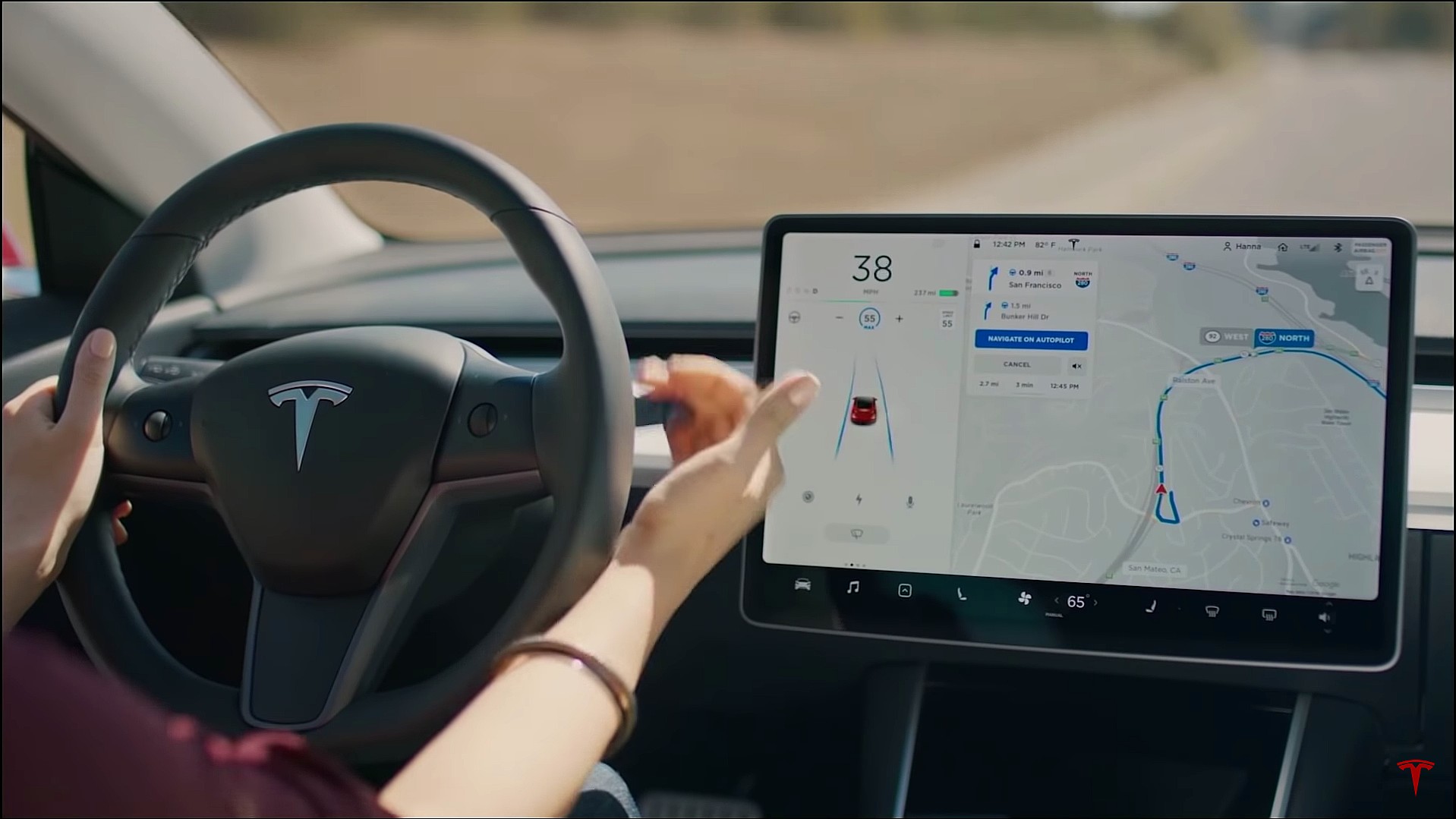
Tesla has officially confirmed that early vehicles with its Autopilot Hardware 3 (HW3) will not be capable of unsupervised Full Self-Driving, while extending a path forward for legacy owners through a discounted trade-in program. The announcement came by way of Elon Musk in today’s Tesla Q1 2026 earnings call.
🚨 Our LIVE updates on the Tesla Earnings Call will take place here in a thread 🧵
Follow along below: pic.twitter.com/hzJeBitzJU
— TESLARATI (@Teslarati) April 22, 2026
The history here matters. HW3 launched in April 2019, and Tesla sold Full Self-Driving packages to owners on the understanding that the hardware was sufficient for full autonomy. Some owners paid between $8,000 and $15,000 for FSD during that period. For years, as FSD’s AI models grew more demanding, HW3 vehicles fell progressively further behind, eventually landing on FSD v12.6 in January 2025 while AI4 vehicles moved to v13 and then v14. When Musk acknowledged in January 2025 that HW3 simply could not reach unsupervised operation, and alluded to a difficult hardware retrofit.
The near-term offering is more concrete. Tesla’s head of Autopilot Ashok Elluswamy confirmed on today’s call that a V14-lite will be coming to HW3 vehicles in late June, bringing all the V14 features currently running on AI4 hardware. That is a meaningful software update for owners who have been frozen at v12.6 for over a year, and it represents genuine effort to keep older hardware relevant. Unsupervised FSD for vehicles is now targeted for Q4 2026 at the earliest, with Musk describing it as a gradual, geography-limited rollout.
For HW3 owners, the over-the-air V14-lite update is welcomed, and the discounted trade-in path at least acknowledges an old obligation. What happens next with the trade-in pricing will define how this chapter ultimately gets written. If Tesla prices the hardware path fairly, acknowledges what early adopters are owed, and delivers V14-lite on the June timeline it committed to today, it has a real opportunity to convert one of the longest-running sore subjects among early adopters into a loyalty story.

Trump’s invite for Elon just reshuffled Tesla’s big Signature Delivery Event

Tesla launches its solution to rare but relevant Supercharger problem


