
News
Is Twitter retaliating against verified users for supporting Elon Musk?

Is Twitter retaliating against verified users for supporting Elon Musk? It seems like it in the case of Andrea Stroppa, a former contributor to the World Economic Forum, and cyber security researcher focusing on digital communication, and social media.
Andreas’s research includes topics such as digital propaganda, bots, and counterfeiting. He’s been mentioned in academic papers, media outlets, and think tanks. Andrea told me that the U.S. Government cited his work on digital counterfeiting in a report for the President of the U.S.
Andrea has been very outspoken about Twitter’s bot problems and he’s backed his claims up with hours of research shared in detailed threads. Elon Musk followed him earlier this year after interacting with some of those threads.
To be clear, Andrea changed his Twitter name to avoid messages from verified bots that sent him malicious links and signed "Twitter support". So in fact, he was pushed to take action in an attempt to protect himself.
— Eva Fo𝕏 🦊 Claudius Nero's Legion (@EvaFoxU) August 23, 2022
My friend and fellow journalist, Eva Fox, (Tesmanian) first pointed out the observation. She tweeted that Andrea lost his blue checkmark because he changed his Twitter name to avoid messages from verified bots sending out malicious links signed with “Twitter support.”
Eva pointed out to me that this isn’t just wrong, but it’s a policy that encourages the proliferation of bot/spam accounts. The real question is how do these scam bots get verified without losing their verification status when changing their names? @Nfkmobile posed that question and noted that it does look like an inside job.
Andrea has been keeping up with the Twitter and scam bots and I’ve written about a few of those threads in the articles below.
- Opinion: Fmr President Trump was wrong to call Elon Musk “another bullshit artist”
- This included Andrea’s thread documenting the bots that amplified Insider’s article about Elon Musk’s personal life which led to the harassment of a person close to him.
- Scammers use Elon Musk’s face to advertise on Facebook and Instagram
- Although Andrea’s thread covers another social media platform, it’s an example of his work documenting the bot activities across social media networks.
- Elon Musk raises awareness of Twitter’s lack of transparency on ad audits
- In this article, Andrea’s thread highlighted the questions that Elon Musk thinks that Twitter is doing all it can do to avoid answering.
How Andrea lost his Twitter verification status.
Andrea shared the full story with me on how he lost his Twitter verification status. He has been constantly bombarded by verified accounts sending him fake logins to compromise his account. Thinking that his user name was on some list of malicious actors, he decided to protect his account by changing it.
The verified account harassing him, Andrea told me, was the former head of communication at Zoom, who told Teslarati in a statement that they were working with Twitter to recover their account.
Andrea wasn’t aware that if you changed your user name, you lose your verification.
Although the verified account is allowed by Twitter to continue its phishing, Andrea was punished for protecting his account. Still, he opened a ticket and Twitter sent him a general link about verification. So he re-applied and two days later, was denied because he didn’t “their notoriety requirements.”
Andrea told me that he’s often flooded with spam and insults from trolls and bots. In a statement to Teslarati, he said:
“Companies like Twitter have colossal power and so a considerable responsibility. It’s worrying if Twitter starts retaliating against users because it breaks the trust between users and the company. I’m not against Twitter. I love Twitter.”
“In fact, I think that Twitter deserves better and most of the employees are great people, but I’m worried that some leadership members are betraying the little blue bird. In the Divine Comedy, Dante Alighieri considered one of the worst sins the betray.”
“I worked on these topics, bots, and digital propaganda, for years and I have a good relationship with many reporters. With some of them, I said: you’re all underestimating Elon’s questions. These questions he posed are fundamental, and sooner or later, the truth will come up. And it’s coming.”
Twitter, Elon Musk, Bots, shadow banning & more.
In many cases, Twitter has been known to randomly shadow ban and even suspend accounts that have interacted with Elon Musk. It happened to me. My account was suspended in 2020 after Elon replied to me about shipping ventilators to Louisiana during Covid-19.
It was a horrible feeling losing my account. After several months, I got it back, and was verified less than a year later. However, I’ve seen other friends who were verified lose their status. And have seen friends lose their accounts for absolutely no reason at all. Even Teslarati was shadow banned until Elon Musk questioned why with one single emoji.
🤔
— Elon Musk (@elonmusk) July 18, 2022
And now, Andrea took measures to protect his account from verified crypto scam bots that Twitter allows to freely change their names and loses his status. Andrea’s threads are highly visible and with Elon Musk following him, it sure does look suspicious that Twitter will allow these crypto scam bots to continue while actively refusing to give Andrea his verification status back.
In the tweet below, Gail Alfar found that a Fox News account based in North Carolina was also promoting crypto scams in response to one of Elon Musk’s tweets.
@elonmusk @FOX4 it looks like this bot account @alliyahsimsTV was once yours. A news account that was hacked into. pic.twitter.com/UlfLhcR34M
— Gail Alfar (@GailAlfarATX) August 23, 2022
The fact that Andrea has been documenting the bots with his threads has not gone unnoticed. And now that he was a target of the very bots and scam accounts that he was documenting, he took steps to protect his account and lost his verification. Twitter’s refusal to verify Andrea while allowing these bots and crypto scam accounts to continue has me wondering if Twitter is actually retaliating against verified users for supporting Elon Musk.
It sounds extreme, but in Andrea’s case, one has to wonder. Although I am not personally accusing them of such, Twitter’s actions make it look really, really bad. One way the network can prove itself is by restoring Andrea’s verification. Another way is to actually suspend these verified bot and crypto accounts. Even Elon Musk has called Twitter out on them.
Ahem @twitter pic.twitter.com/LCDpOeIei5
— Elon Musk (@elonmusk) August 13, 2022
Note: Johnna is a Tesla shareholder and supports its mission.
Your feedback is important. If you have any comments, concerns, or see a typo, you can email me at johnna@teslarati.com. You can also reach me on Twitter @JohnnaCrider1


News
Tesla makes good on its Cybercab promise in just two weeks
Tesla Cybercab riders can now pull up a rear camera view and darken the screen.

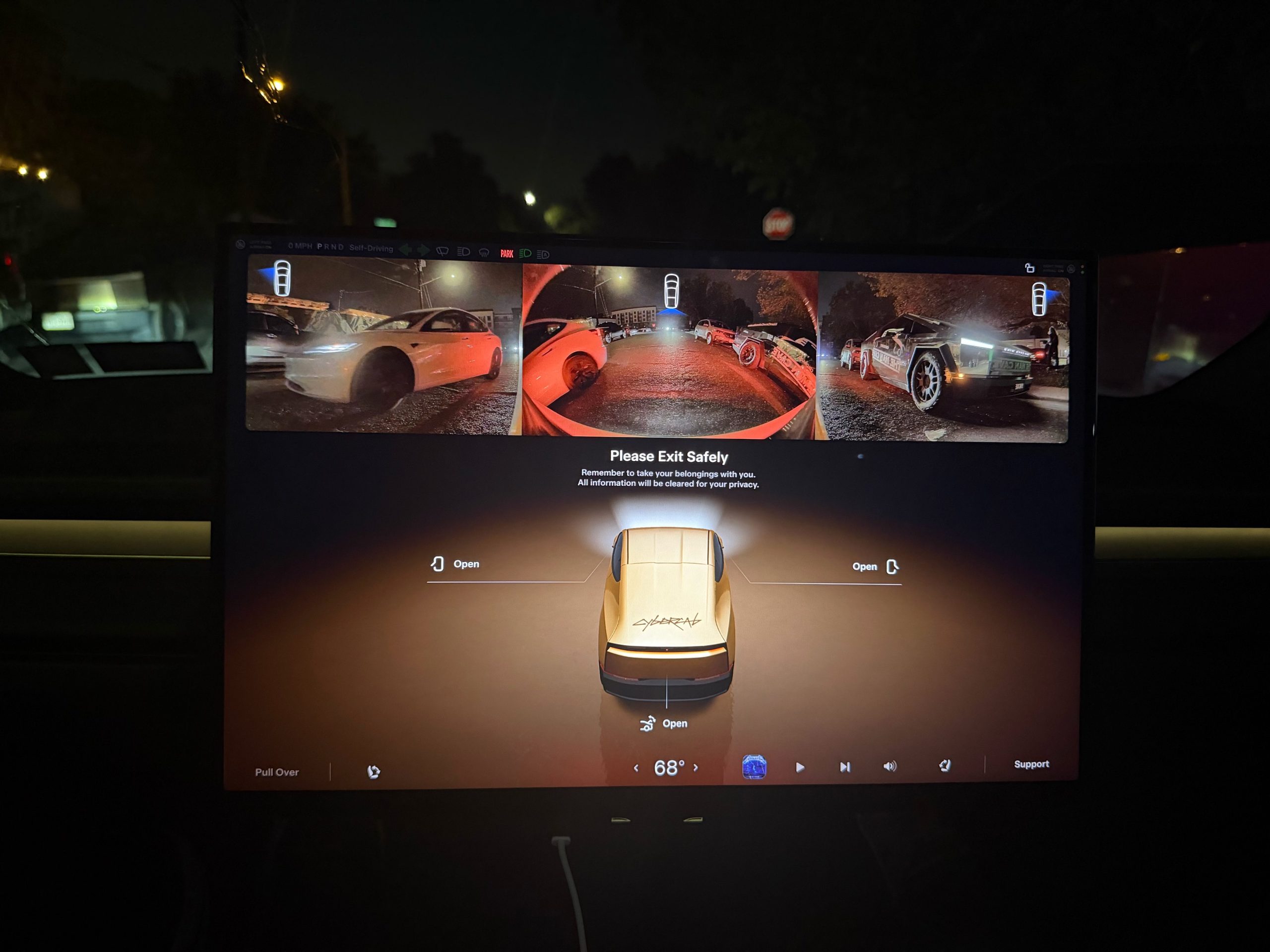
Tesla has given Cybercab passengers a way to see what is behind them, along with a way to turn the cabin screen off entirely.
Riders in Austin can now bring up a live rearview camera feed on the Cybercab’s center display in the middle of a trip. Austin rider Ethan McKanna spotted the change late Friday night, posting from a ride that “You can now open the camera to view what’s behind you in Cybercab!” His photo shows a strip of rear camera video across the top of the screen, with another Cybercab following on a bridge. Sawyer Merritt shared the image Saturday and wrote that it “sounds like” there is also a new quiet mode that darkens the entire screen for riders who want to relax, sleep, or avoid a bright display at night.
The camera view goes beyond the rear feed. Tesla UI software engineer Evan, who posts as @CarCoder, replied to McKanna with a tip: “You can also tap it to see more cameras, and swipe it up or down to hide and show.” Until now, the Cybercab only showed its rear and repeater feeds on the “Please Exit Safely” screen at the end of a ride, so passengers could check for cyclists and traffic before opening a door.
Quiet mode surfaced a day earlier. Austin rider Jackson Blatz posted a video Friday morning of the new Robotaxi interface in a Cybercab with the option. Tesla has not published release notes for either feature.
The rear camera view moved quickly from request to release. Earlier this month, Cybercab rider Dan Burkland asked Tesla to let passengers pull up the rear and repeater cameras whenever they want, “especially for peace of mind.” Evan answered “In development,” as Teslarati reported at the time. About two weeks later, riders have it.
The feature fills a gap created by the Cybercab’s design. With no steering wheel, no pedals, no mirrors and no rear window, a passenger has no natural way to glance behind the car. The eight exterior cameras that feed Tesla’s autonomy software were already on board, so the change only required software.
There is also an AI angle to how it was built. Yun-Ta Tsai, a senior staff engineer on Tesla’s AI team, quoted Merritt’s post and wrote that the “(human) camera view tuning is optimized with Grok and implements part of the algorithm by directly programming the fixed-function hardware, so I don’t even need to check the datasheet.” Tsai did not say which part of the algorithm Grok handled. Grok already plays a bigger role inside the vehicle, with Grok Bot now enabled across every Cybercab and the Model Y Robotaxi fleet after Tesla brought the agent into its cars in September.
The two features join a busy week of changes for riders in Austin, which also brought a redesigned Live Activity for iPhone and Apple Watch and live trip sharing. They also arrive as Tesla prepares the Cybercab for life outside its own fleet. On the third quarter earnings call, Lars Moravy said the company is aiming to deliver Cybercabs to customers before the end of 2026. Tesla has not said whether the camera view and quiet mode will also come to its Model Y Robotaxis.
Elon Musk
Tesla shows what Roadster drivers will see on screen before thruster activation
Tesla’s Roadster video reveals a fighter jet inspired cockpit with a 5,500 PSI thruster gauge.
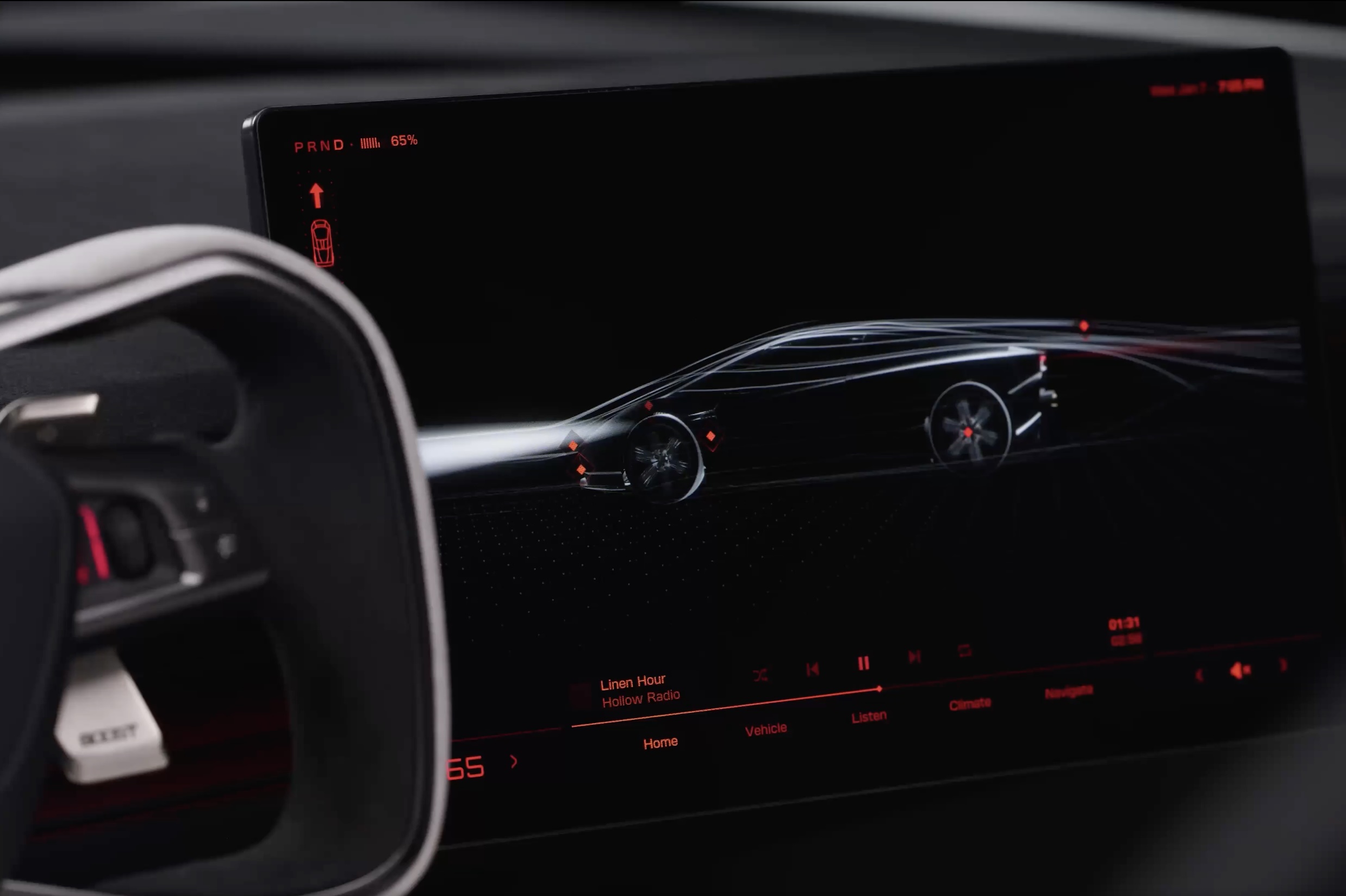
Tesla has given future owners their clearest look yet at the cockpit of its next generation Roadster. In a 34 second video posted to X on Friday afternoon, the company walked through the car’s touchscreen with a caption: “Inspired by fighter jet cockpits, Roadster’s interface was designed around the pilot.”
The clip opens on a black screen with red graphics and a 3D wireframe of the car, which sits beside the Roadster’s squared off yoke. Tapping parts of the model brings up controls for the rear wing, including low drag and high downforce positions, along with a charging page with a charge limit bar and a small music player. A row of tabs along the bottom reads Home, Vehicle, Listen, Climate and Navigate.
Most of the video is spent in Track Mode. The dashboard shows a live circuit map, a list of session lap times, brake and motor temperatures, and pressure and temperature readouts for each tire. A setup page lets the driver pick Auto, Low Drag, High Downforce or Custom aero modes, adjust aero balance and brake balance, and switch stability and traction control off. Along the bottom, a status bar reads “Thruster · 5,500 PSI” next to a “Boost Ready” indicator.
That gauge ties the software to the hardware Tesla showed off near Waco, Texas on October 15. The Thrust and Rocket versions use cold gas thrusters fed by carbon overwrapped pressure vessels, and Tesla lists 0 to 60 mph times of under 0.9 seconds and under 0.59 seconds for them, as Teslarati detailed in its breakdown of the three Roadster configurations. The base Performance car relies on a fan and ground sealing system for grip, and the aero settings on screen match the active wings and suction setup covered in our look at how the Roadster generates downforce.
The Roadster layout is a departure from the rest of Tesla’s lineup. Instead of a map centered screen, the Roadster puts the car itself at the center of the home page, and Tesla’s Roadster page lists two smaller forward displays alongside the main touchscreen. Tesla has not said whether any of the Track Mode telemetry will make its way to the Model 3 Performance or other vehicles.
The interface could still change before deliveries. Elon Musk said at the event that Roadster production will begin in 2028, and Tesla says the flagship Rocket version is not approved for public road use. Reservations are open with a $50,000 payment, while Thrust is listed as a limited release and Rocket is invite only.
Those who want to see the car in person will get their first chance this weekend. The Roadster goes on display in the lobby of the Petersen Automotive Museum in Los Angeles from October 24 to 27, according to Sawyer Merritt, the first time the public will be able to view it up close.
Elon Musk
Tesla reveals Optimus Academy, where robots teach themselves
Tesla has begun building production quality Optimus robots in Fremont and revealed its training plan.
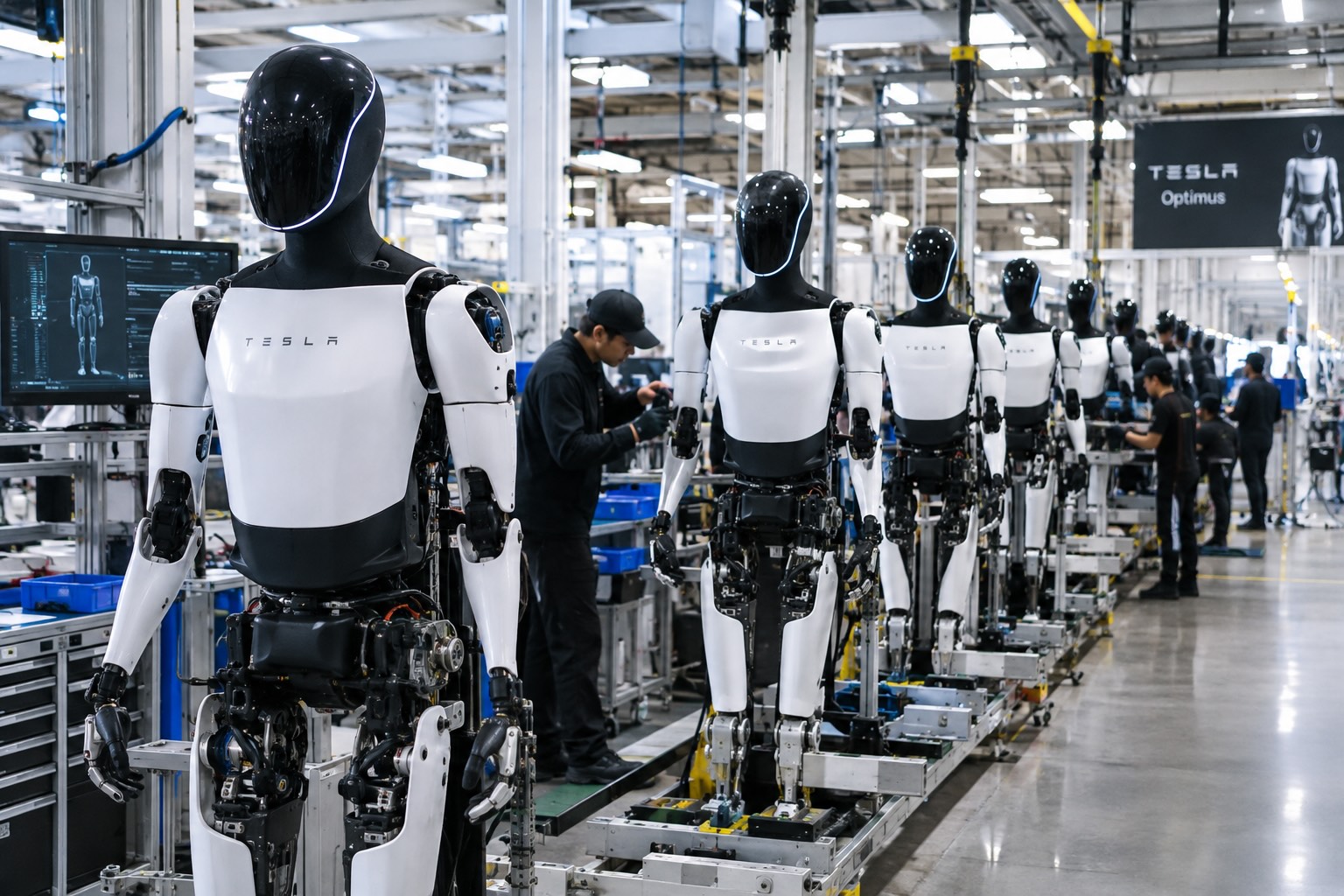
Tesla has started building Optimus on the high volume line it set up inside its Fremont factory, and the company says the robots coming off it are the first that meet the bar for a real product. “The bots coming off this line are the first production-quality bots that we have manufactured,” Tesla wrote in its third quarter shareholder letter, adding that it has “proven that the current manufacturing process for Optimus is suitable for a commercial product.”
The line sits in space that built the Model S and Model X until this spring. Tesla cleared the old vehicle line in 46 days, as Teslarati reported in July, to make room for robot production sized for one million units a year. On Wednesday’s earnings call, Elon Musk said most of the equipment for that capacity is already in Fremont, with output set to climb toward roughly 20,000 robots a week as the line ramps.
Musk described the ramp as a classic S curve. “The growth of Optimus is an S curve, but the initial curve is a shallow slope,” he said. The team is now refining the robot’s AI, electromechanical design, reliability and service life, and Musk expects that work to be finished by the end of next year, when Tesla plans to start delivering Optimus to outside companies for dangerous, repetitive and around the clock jobs.
The most interesting part of the call was how Tesla plans to teach the robots. Its cars send real driving data back to the AI team from millions of vehicles, but Optimus has no fleet like that yet. “A big difference with Optimus versus the cars is we don’t have this vast fleet of cars from which we can gather training data,” Musk said. Tesla’s answer is an Optimus Academy, where 10,000 to 20,000 robots will practice a wide range of tasks and feed what they learn into the next version of the model. Every unit off the Fremont line becomes a source of that training data.
Smarter hardware is on the way too. Tesla plans to put its AI5 chip into Optimus next year, and Musk said a new Optimus video should arrive within one or two months showing the robot completing tasks driven by AI rather than preprogrammed motions. He took aim at rival humanoid demos that only run scripted routines, saying those would not hold up in the real world.
The supply chain is lining up behind the program. In September, Tesla certified Tuopu, Joyson and Sanhua as mass production partners for Optimus components. A far larger Optimus factory is also rising at Giga Texas, where drone footage from Joe Tegtmeyer showed the steel frame nearing completion, and Musk has pegged that plant’s long term target at 10 million robots a year.
Tesla executives also said Optimus production costs are trending toward the expected manufacturing cost of Cybercab, a sign the robot is being engineered for volume from the start. The hands remain the toughest piece of the design, a point Musk also made at the X Takeover event earlier this month, as Teslarati covered at the time, and that is where much of the current engineering effort is focused.

Tesla makes good on its Cybercab promise in just two weeks

Tesla shows what Roadster drivers will see on screen before thruster activation


