Lifestyle
EKM Digital Submeter Measures EV Charging Efficiency

Electric vehicle owners may now know that 10-12% of drawn electricity is lost during the charging process when AC is converted to DC.
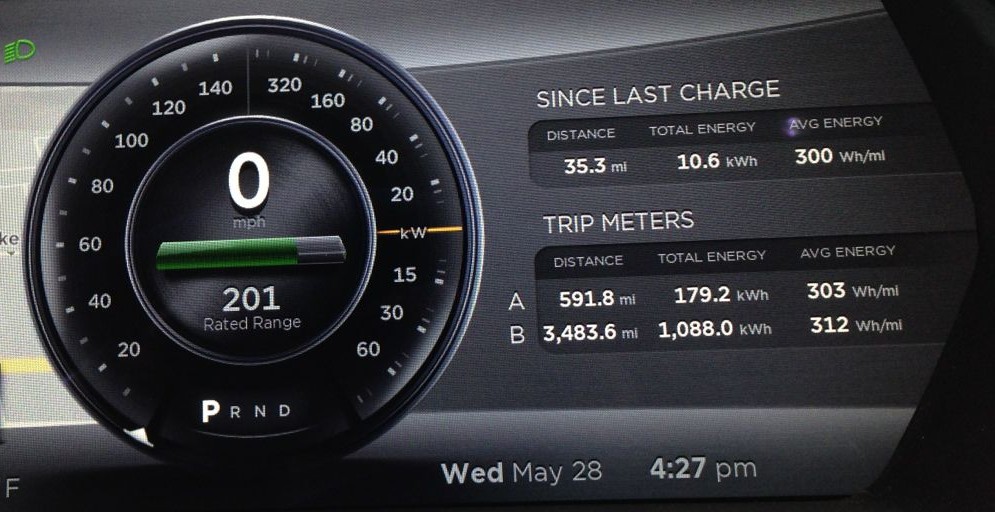 The “Since Last Charge” indicator on the Tesla Model S driver’s console keeps count of distance, energy used and average energy used per mile since the last time you unplugged, but matching this energy consumption to what you’re being billed by your company is more difficult than one might think.
Taking the 10.6kWh Total Energy readout from the dash and multiplying it by my billable electricity rate of $0.1670/kWh, I would think that it costs me $1.77 to drive 35.3 miles. However the actual costs are slightly higher because of the power conversion losses when charging. Charging via a standard 110V wall plug in the US is reported to be much less efficient than a NEMA 14-50 hence you’ll be using even more energy to reach the same state of charge.
Tesla’s charging calculator appears to take into account some of these charging loses. According to the calculator, 35 miles of range added to the Model S requires 11.6kWh of energy although I was able to achieve that with through 10.6 kWh as seen through my dash readout. This could imply a 91% charge efficiency but of course this is a very loose calculation and based on many assumptions such as the speed in which you drive, elevation changes and weather. It’s not simple to calculate how much actual energy you’re using to charge your Tesla Model S.
The EKM Digital Submeter
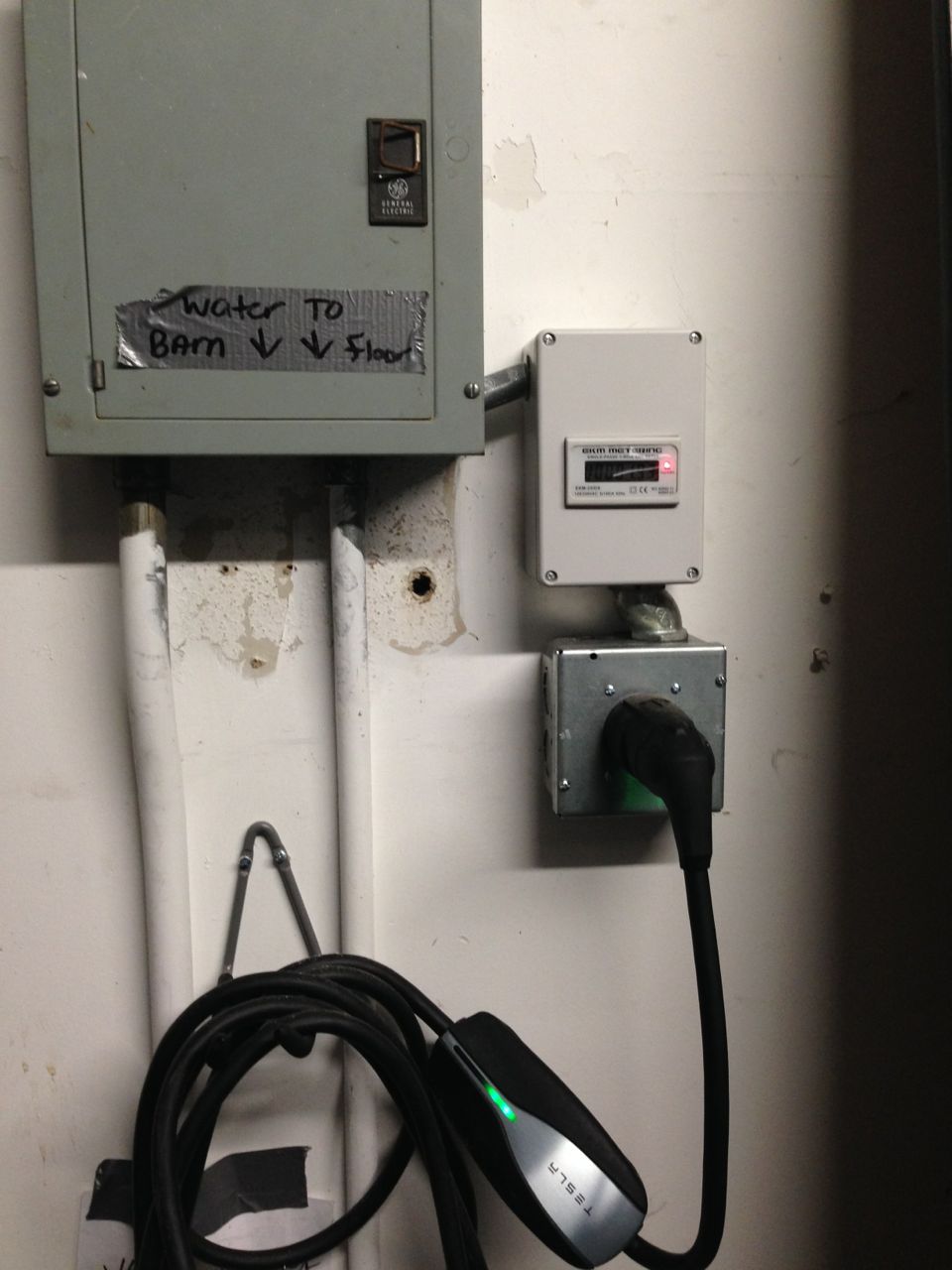 The solution I found was to put a submeter between the EV charge outlet and main power supply. There are many types of meters on the market from basic kWh counters to advanced meters that can broadcast actual use over a wifi network, plot graphs, etc. After doing some extensive research, I decided to go with a metering solution from EKM Metering. My electrician did some independent research and came up with the same brand so I felt pretty good about my choice. I ended up purchasing the 100A kWh EKM digital submeter and enclosure.
My electrician was able to complete the installation in 3 hours with a portion of the time spent on retrofitting the EKM enclosure to accommodate for the larger 240v conduit. Total cost spent for products, labor and materials was $292.
How Does it Work?
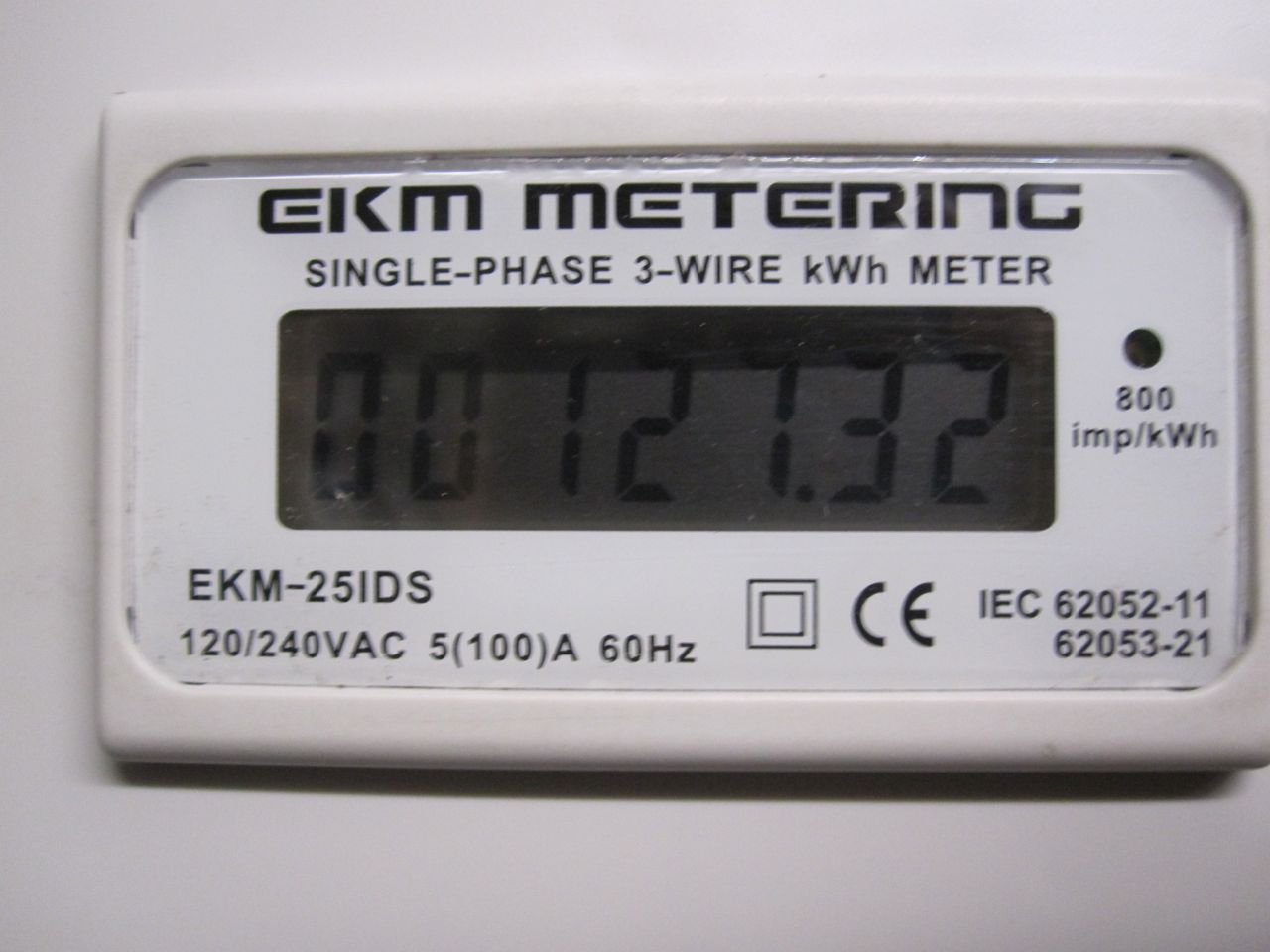
The EKM submeter is like an odometer but with an energy readout that continuously increments as power is being drawn. There is no reset button. A blinking red light indicates that 1.25Wh is drawn per single blink of the LED.
Measuring actual energy consumed over a specific time period requires taking some notes. Here are the the measurements and results of my tests:
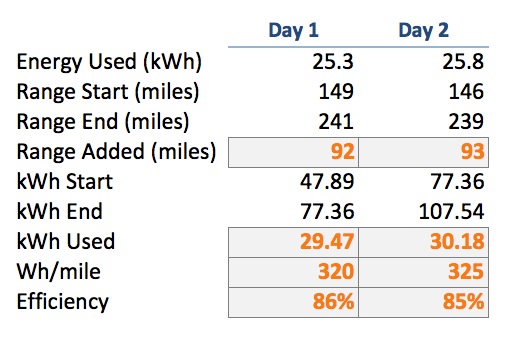
My results indicate that there’s approximately a 85% charging efficiency for my Tesla Model S which is less than the 91% efficiency that Tesla Motors seems to be using in their online calculator.
I’ll be performing several more tests over a longer period of time. I want to look at power draw differences while the Model S is asleep and also analyze variations in energy consumption due to software updates.
Conclusion
Overall the EKM Digital Submeter is a nice addition to any EV charging setup if you’re looking for a true picture of how much energy usage is going into your Tesla Model S / electrical vehicle. Assuming a $0.167/kWh electricity cost and 325 Wh/mile, the cost of the meter plus installation would require 5,380 miles of EV driving to break even.
If you’re looking for a cheaper alternative, simply add 15% to the energy usage readout on your EV to approximate the true energy cost per EV mile driven. Drive clean and drive smart!


Lifestyle
Tesla wins over Netflix’s Selling Sunset star, who’s now ditching his Bentley
Selling Sunset’s Jason Oppenheim swapped his Bentley for a Tesla and promised ten for employees.

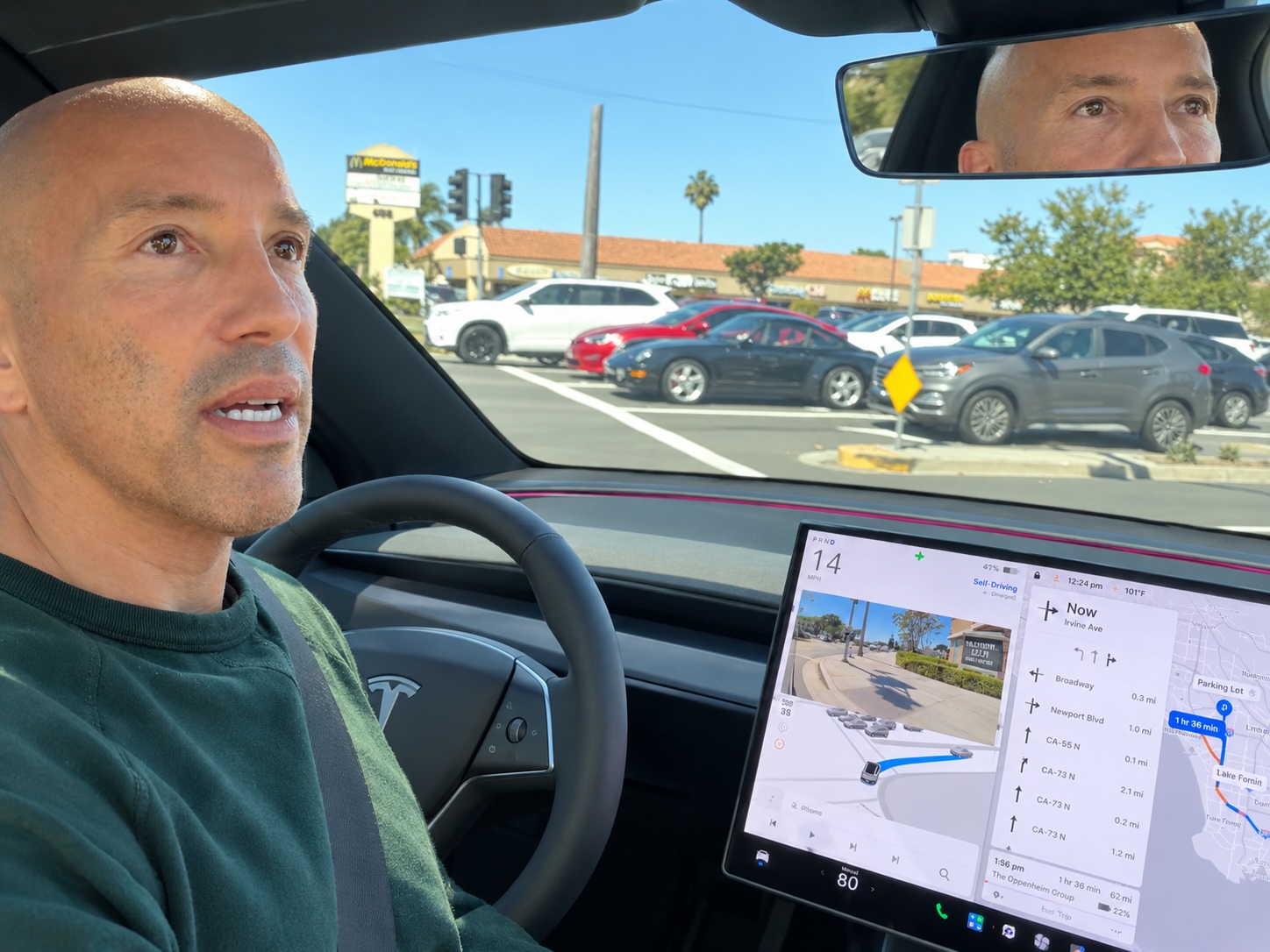
Jason Oppenheim, the luxury real estate broker best known as the star of Netflix’s Selling Sunset, has parked his Bentley for good and moved into a Tesla Model Y, and he says Full Self-Driving (Supervised) is the reason.
Oppenheim, who founded The Oppenheim Group, the Los Angeles brokerage at the center of the show, posted a video to X on Saturday evening that he called “the most important video I’ve ever posted.” In it, he rides from Newport Beach to his firm’s Los Angeles office, a trip he put at roughly an hour and 15 minutes, while FSD handles the drive and parks the car without him touching the wheel or the accelerator. He said he handed the Bentley to his father because he no longer has any use for it.
Tesla shared the clip from its main account on X about two hours later, pulling out the quote that has since spread well beyond the Tesla community:
“[FSD Supervised] is life-changing. I was on the phone with my brother last night, and I made him buy one. He literally bought one while we were talking. I’m buying 10 of my employees a Tesla with FSD. It’s 8x safer than the average driver. There’s nothing more important than the safety of you and your loved ones.”
Oppenheim was candid about why the safety pitch landed with him. He admitted in the video that he is a distracted driver who answers emails and texts behind the wheel, and framed the employee purchases as a way to keep his team off their phones while driving. Elon Musk posted “Tesla FSD feels like magic” less than half an hour after the video went live.
The endorsement lands at a convenient moment for Tesla. The company delivered 486,532 vehicles in Q3, beating Wall Street’s estimates and marking its best quarter ever without the $7,500 federal EV tax credit.
A public service announcement. https://t.co/NYa1IpKwBX
— Jason Oppenheim (@OppenheimJason) October 4, 2026
Tesla FSD has been subscription only in the U.S. since February at $99 per month, and Tesla said in its Q2 update that active subscriptions hit 1.48 million, up 56 percent year over year, with more than 55 percent of new North American deliveries leaving with FSD attached. That attach rate is the figure Ron Baron cited last month when he told CNBC “the time to buy the stock is now.” At current pricing, Oppenheim’s 10 employee cars alone would add $990 a month, or about $11,880 a year, in FSD revenue.
Tesla AI head Ashok Elluswamy said in July that FSD had logged more than 12 billion miles while going roughly twice as far between collisions as manual driving. FSD also remains a supervised system, so Oppenheim and his employees are still required to watch the road, even as Tesla rolls out v14.3.10 with Automatic Collision Evasion, which can steer or brake on its own to avoid a frontal crash.
Lifestyle
Tesla teases “Halloween Mode” update with Optimus rising from a graveyard
Tesla’s Halloween teaser hides a covered vehicle and an Optimus hand rising from the ground.
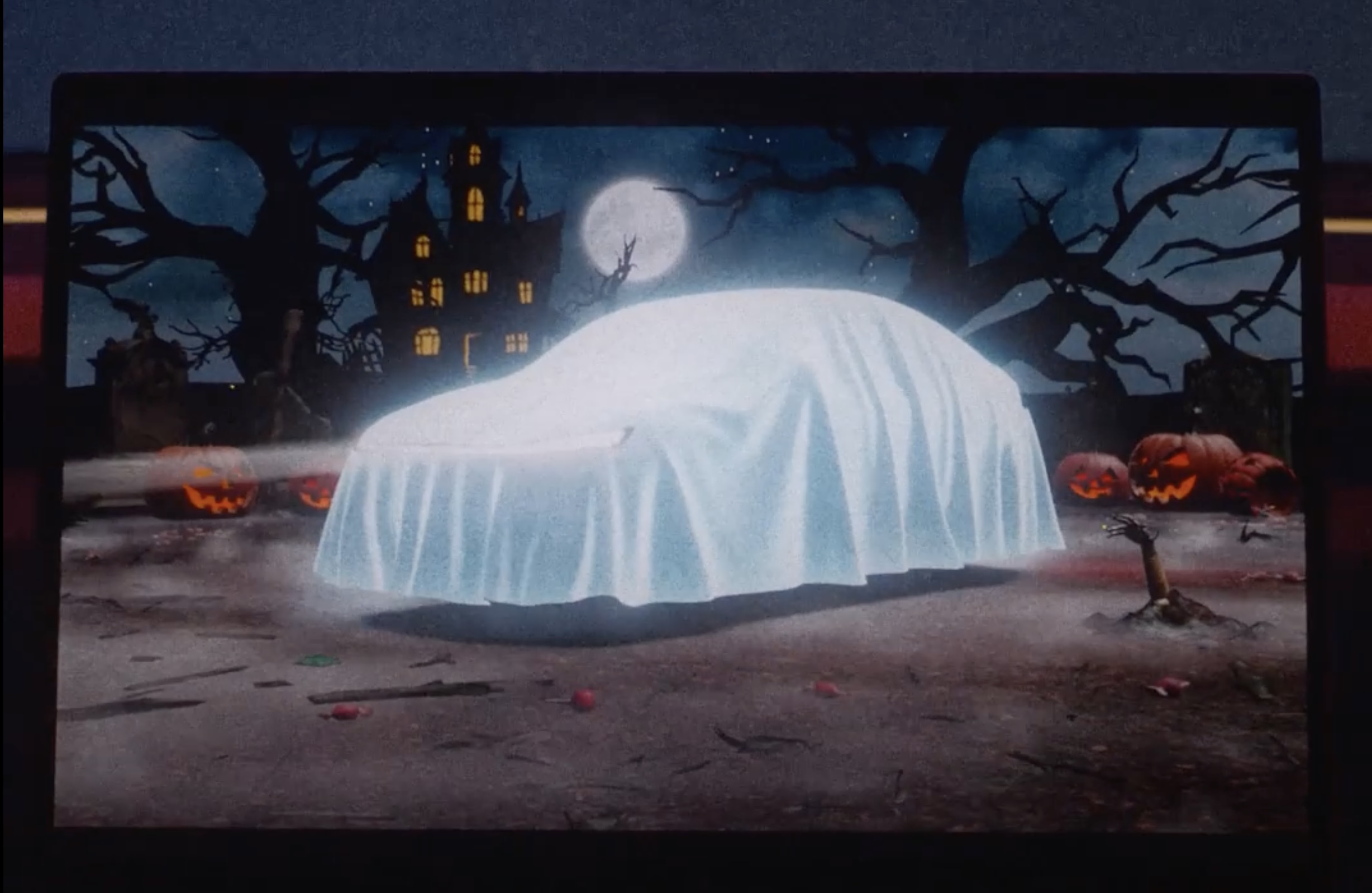
Tesla has started teasing a Halloween software update for its vehicles, with a short clip on X that reads, “Halloween is coming.” The clip opens on a glowing pumpkin before pulling back to the car’s center touchscreen, where the usual parked visualization has been replaced by a graveyard scene, and the vehicle draped with a white sheet so it reads as a cartoon ghost.
Halloween is coming pic.twitter.com/lM3ASUeOqX
— Tesla (@Tesla) October 1, 2026
The second detail is a robotic hand clawing its way out of the dirt like a zombie, which looks to be the hand of Tesla’s latest Optimus V3 humanoid robot. While Tesla still has not formally shown Optimus Gen 3 walking around in service, renders pulled from Tesla’s Android app last month gave the clearest look yet, including far more refined hands that Tesla has said carry 22 degrees of freedom. The hand has been the hardest part of the program. Musk has called it the majority of the robot’s engineering difficulty, and Tesla’s patents describe a design driven by tendons with the actuators moved into the forearm.
Tesla Optimus V3 hand and arm details revealed in new patents
Optimus also has a Halloween track record. Last October the robot handed out candy in Times Square, and a costumed “zombie” Optimus shuffled around the Tesla Diner in Los Angeles on Halloween night.
On the software side, Tesla’s 2025 Holiday Update expanded Santa Mode with a Santa sleigh, snowmen, snow effects, and a festive lock chime, so it wouldn’t be too far fetched if we saw something similar but themed for a Halloween Mode.
Lifestyle
Tesla’s newest feature lets you floor it out of a Supercharger while plugged in
Tesla’s new Emergency Drive Away feature lets owners flee a Supercharger while still plugged in.
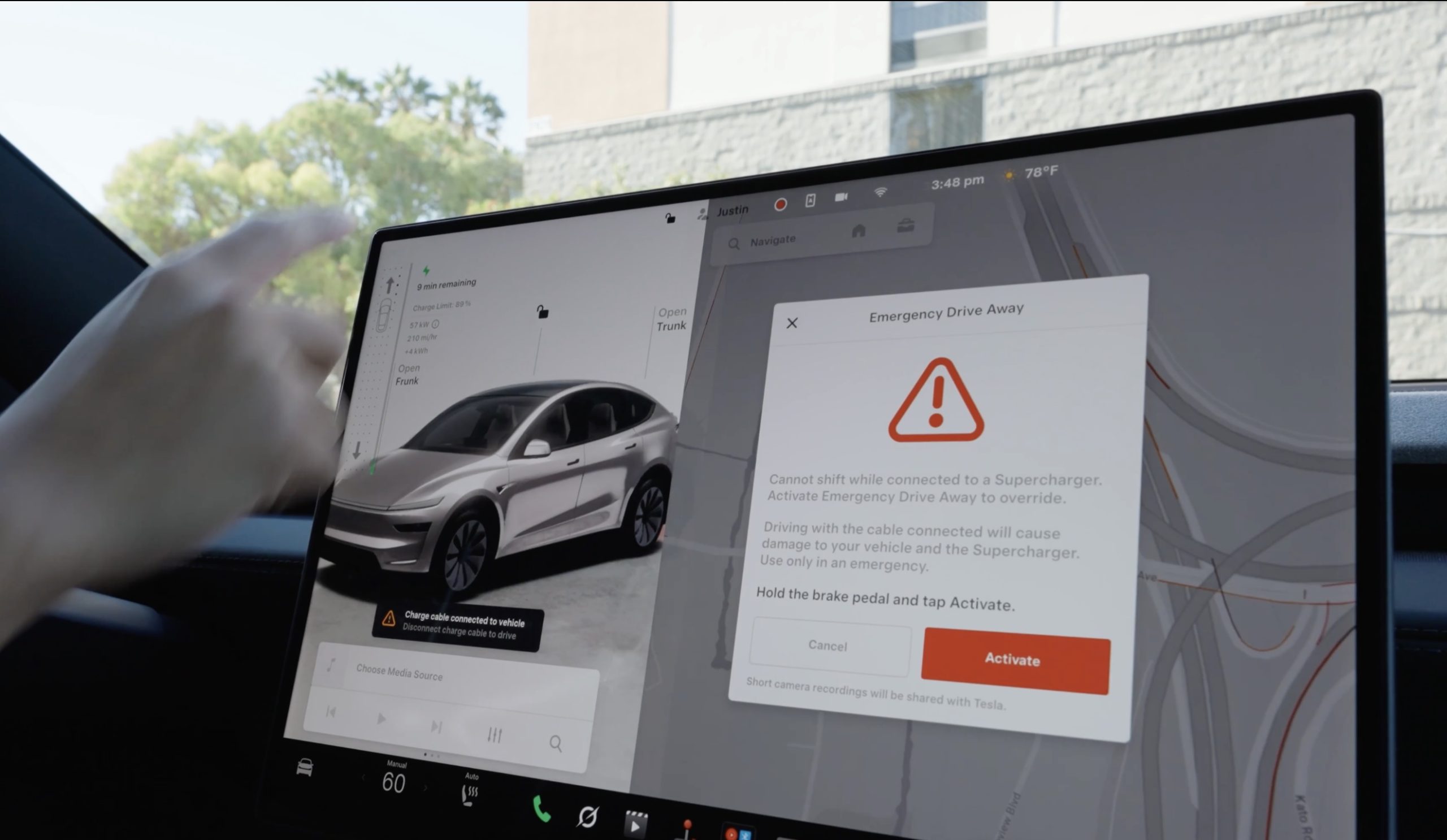
Tesla has given drivers a way to escape while a vehicle is plugged-in at a Supercharger, in the event of an emergency. The company’s charging team announced a new feature on X called Emergency Drive Away, which lets a driver shift into Drive and pull away while the charging cable is still connected to the car.
Until now, a Tesla would not leave Park with a charge cable plugged in. Drivers had to release the latch from the touchscreen, the Tesla app, or the button on the charge handle, then wait for the port to let go. Emergency Drive Away removes that lockout, but Tesla is clear that it comes at a cost. “Use of this feature will damage your vehicle and the Supercharger,” the company wrote, adding that the function is meant for emergencies only and that deliberate misuse will lead to “additional penalties.” Tesla did not say what those penalties are.
Emergency Drive Away lets you shift into Drive while still plugged into a Supercharger pic.twitter.com/40GSzyP4lG
— Tesla Charging (@TeslaCharging) October 1, 2026
The in-car prompt is just as direct, with the warning reading: “Driving with the cable connected will cause damage to your vehicle and the Supercharger. Short camera recordings will be shared with Tesla.” That footage gives Tesla a way to separate a real emergency from someone who simply did not want to wait for the latch.
The feature requires software update 2026.38.3, and Tesla said in replies to owners that it works at every Supercharger in the United States without new stall hardware. Model S and Model X vehicles built before 2021 are not supported, and the company says the feature applies to U.S. Superchargers “for now,” leaving Canada and other markets out at launch.
Tesla Supercharger argument leads to tragic shooting incident
Tesla did not tie the announcement to any specific event, but it arrives two months after a gunman opened fire at an In-N-Out in Twin Falls, Idaho, on August 1, targeting three people in two Teslas at the neighboring Supercharger. One of them, a 66 year old man from Salt Lake City, was killed. Superchargers have been the scene of violence before, including a fatal shooting at a station near Denver in 2023.
In the weeks after Twin Falls, owners pushed Tesla for a native way to escape a stall, and many pointed back to EVject, the aftermarket breakaway connector Tesla sued in 2024 over claims it lacked overtemperature protection. The two companies later reached an agreement that led EVject to recall its earlier connectors in favor of a version with thermal sensors.
Our mission has always been about providing peace of mind and eliminating sitting duck scenarios.
We patented the built-in breakaway charger tip on Feb 15, 2023. Awarded Jan 30, 2024. Then shared the designs with @TeslaCharging
Thank you @Tesla for rolling out a solution. This… https://t.co/djOzswLw9N
— EVject (@EVject) October 2, 2026

Tesla snags Semi supply deal with major logistics firm

Tesla wins over Netflix’s Selling Sunset star, who’s now ditching his Bentley


