Investor's Corner
Tesla Gigafactory 3’s rise shows that it’s too early to dismiss Elon Musk’s ‘sci-fi projects’

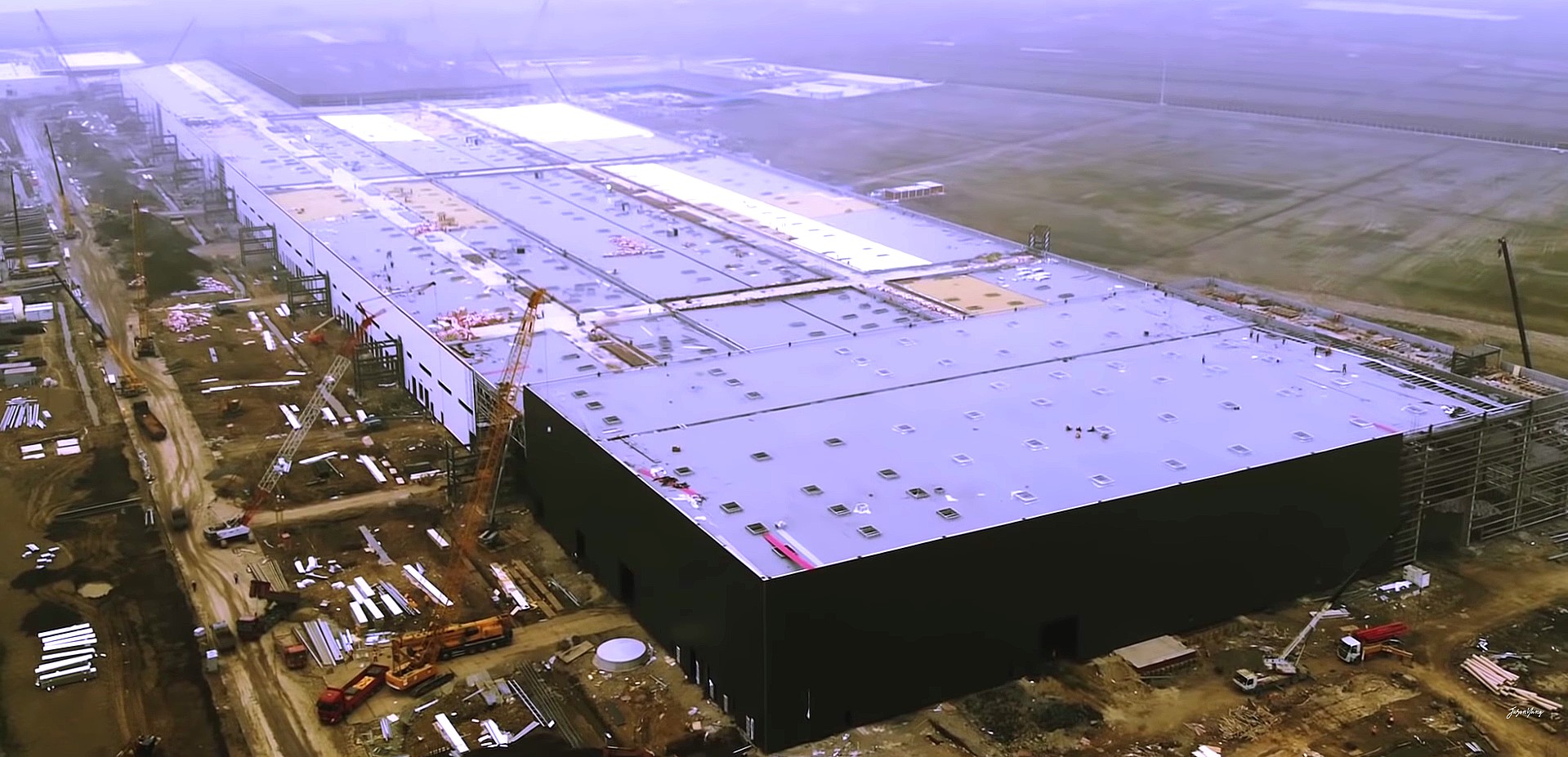
A drone flyover of Gigafactory 3 on Monday has revealed that the factory shell of Tesla’s China-based electric car production facility is all but complete. Only a few small sections of the massive general assembly building do not have roofing yet, and the same is true for Gigafactory 3’s walls. Around the facility’s grounds, workers continued their activities, and cement trucks were seen heading inside the massive factory, hinting at the work being started inside.
Other sections of Tesla’s Gigafactory 3 complex are coming to form as well, including what appears to be dormitories for employees and a possible open-air event staging area. Outside the factory, several large trucks are loaded with massive machinery, seemingly intended for use on the 24/7 construction site. Shanghai officials have noted that Gigafactory 3’s initial construction would be done by May. Considering the progress of the buildout as of Monday, this target appears more than feasible.
The pace of Gigafactory 3’s construction is unprecedented, and it is one that will likely make it to books in the future. China itself, which holds a solid reputation for quick, surgically-precise buildouts, will probably set records with the construction of Gigafactory 3. As Tesla’s electric car factory in Shanghai rises, it is pertinent to note that there was a time, not too long ago, when the idea of Gigafactory 3’s factory shell being completed in roughly five months was considered implausible.
Just over two months ago, Gigafactory 3 was comprised of leveled ground and one steel pillar. A few months before that, it was but a muddy field. Go back a few more months and one will find Elon Musk’s initial announcement for the project’s target timeframe, where the brazen CEO estimated that Tesla would start producing electric cars in the Shanghai facility within two years from construction. During that time, Musk’s two-year timeframe was considered in the United States as “not feasible.” Convention demands car factories to be built over years, after all.
Yet here it stands now, tangible, and ahead of Elon Musk’s own target schedule. After Gigafactory 3’s shell is completed this May, the facility is set to undergo ground hardening in June. These will be followed by pipeline communication, equipment stationing, equipment commissioning, and trial production runs, which could start as early as September barring any unexpected issues. This means that by the end of the year, Gigafactory 3 might already hit some of its stride in the production of Tesla’s midsize electric sedan.
Tesla is simply not a conventional company, and neither is its projects. It’s a disruptor that has reached a critical mass — no longer small enough to be ignored, but not yet large enough to warrant unquestionable respect. This, together with Elon Musk’s persona, both in real life and online, has brought a lot of attention to Tesla. Unfortunately, most of this attention today are predominantly negative, as could be seen in the overarching narrative surrounding the company. An example of this could be seen in a recent note published by Wedbush analyst Dan Ives, where he criticized Tesla and Elon Musk for pursuing “sci-fi” projects like Full Self-Driving, an in-house insurance service, and a Robotaxi network.
Elon Musk is an optimist, and this shows when he announced target timeframes for projects like the Model 3 ramp or the release of features such as Advanced Summon. Nevertheless, Elon Musk might tend to overpromise and deliver late; but his ideas, his visions, are not implausible. They might sound like ideas that are straight out of science fiction, but he, Tesla, SpaceX, and his other ventures are hard at work making that science fiction a reality. There was a time, after all, where people thought replacing the yellow pages, or managing their money through the internet, or landing rockets on a drone ship, was an insane idea. And yet here we are.
Here’s Tesla’s Gigafactory 3 site as of Monday, May 20, 2019.
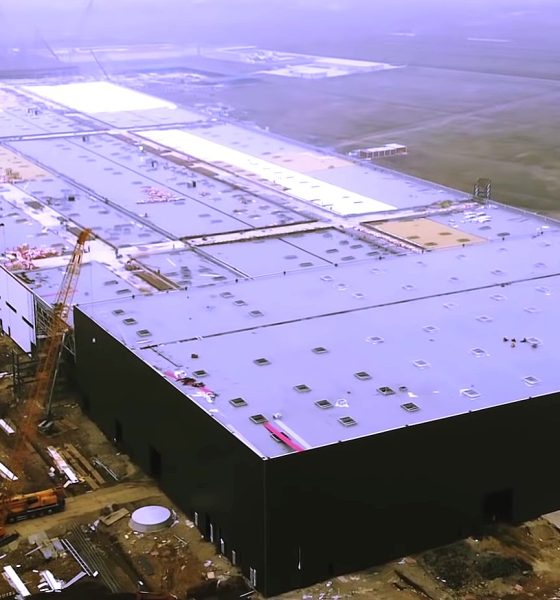
And here’s the site back in late January.


Elon Musk
X changed how everyone gets paid, and this lawsuit shows why
X sued a Bitcoin account network over fake payouts as its creator pay model shifts

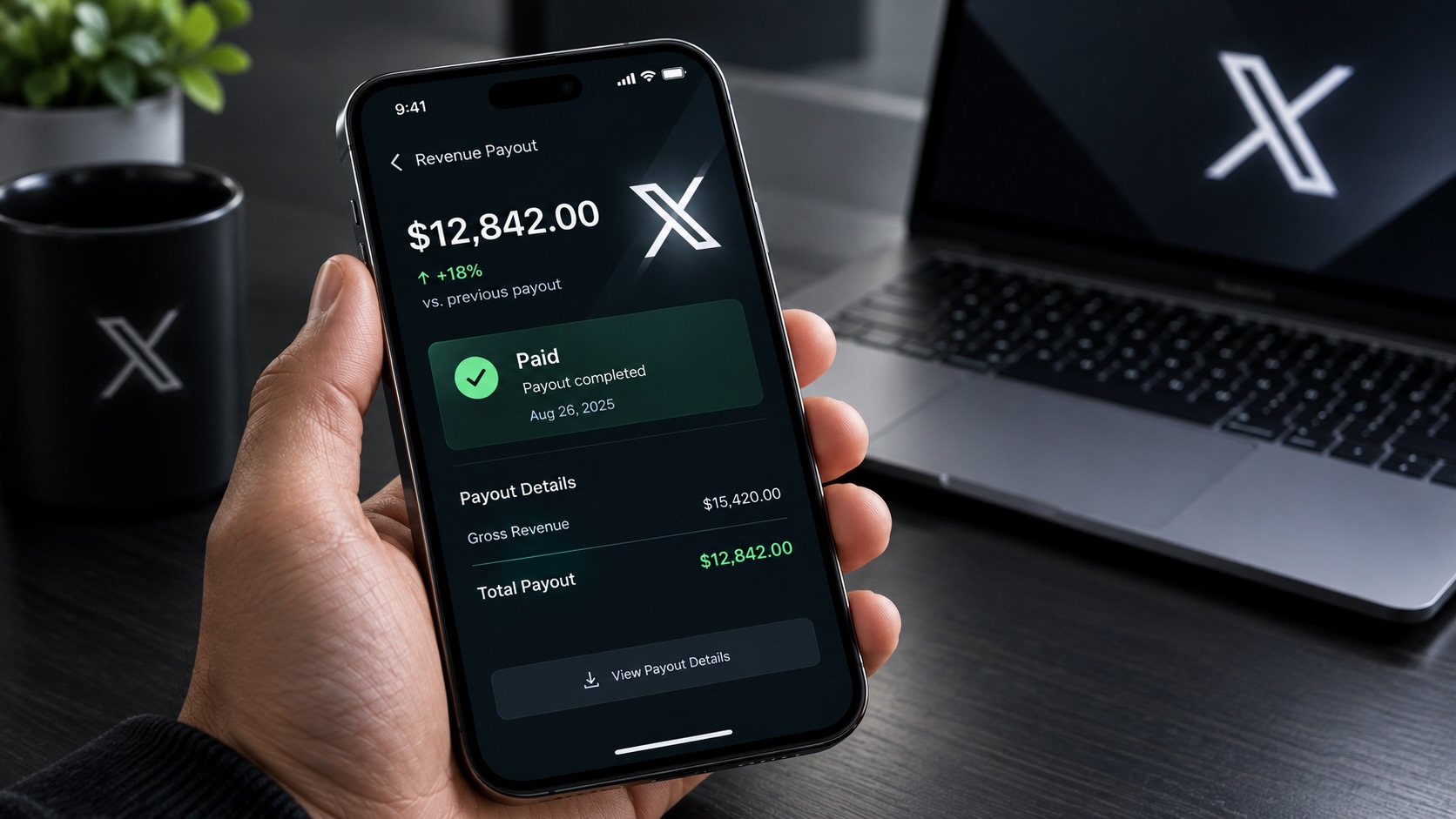
Elon Musk’s X has taken a Bitcoin-focused engagement ring to court, and the case doubles as a receipt for how differently the platform pays creators today. The company filed suit in the High Court of England and Wales against Vivek Kumar Sen and Zamyang Sherpa, alleging the pair ran six accounts, including @Vivek4real_, @Bitcoin_Teddy and @TrendingBitcoin, as one coordinated operation to fake the kind of engagement that used to translate directly into money.
According to the filing, first reported by Gizmodo, the accounts posted near identical “BREAKING” crypto headlines seconds apart, in one case 11 seconds, then had three more handles like, reply to and repost the material to manufacture what X called “a false appearance of genuine, human communication and interaction.” X says the scheme pulled in at least £207,384, about $278,000, and pegs its own investigation and remediation costs at another £75,000. The accounts were suspended August 18. X general counsel James Burnham announced the case on X last weekend, writing that the company “will act forcefully to protect our platform and the earnings of genuine creators.” Musk’s own reaction, posted shortly after, was three words: “Don’t mess with 𝕏.”
Don’t mess with 𝕏 https://t.co/HSmd5hL6aQ
— Elon Musk (@elonmusk) September 21, 2026
The timing lines up with a a recent update to how X pays its creators. The program these accounts allegedly gamed, Creator Revenue Sharing, launched in mid 2023 and paid out based on how much a post got engaged with. Originality was never part of the formula, which is exactly how the platform ended up flooded with recycled clips, copy pasted “BREAKING” posts and replies engineered purely to farm reactions from paying subscribers.
X tried patching the model more than once, including an April cut to aggregator payouts and a March regional weighting change that Musk personally paused hours after it was announced. X retired Creator Revenue Sharing for good on September 7 and opened its replacement, Original Content Rewards, the next day.
Today, we’re launching Original Content Rewards.
The reality is that Revenue Sharing had reached a point where its incentives were misaligned. Creators should be focused on bringing net new content to the platform instead of maximizing payouts. We could have kept adding more… pic.twitter.com/VJIxqlPrjm
— Allegra Jacchia (@allegrajacchia) August 7, 2026
The new math is stricter. Payouts now come only from qualified impressions, meaning unique Home Timeline views from Premium subscribers where at least half the post is visible, and replies no longer count toward eligibility at all. Copied posts, reuploaded media and reposts without meaningful changes are explicitly excluded. Allegra Jacchia, senior product manager for Creators at SpaceXAI, which now runs X’s product and AI work following xAI’s acquisition of the platform, put it bluntly, saying the goal is to reward creators who bring original ideas and perspective, “not those who have become best at gaming the system.”
Read that way, the lawsuit isn’t really about six crypto accounts. It’s X putting a dollar figure on what the old incentive structure cost, then suing to collect it right as the new one goes live. For live updates on how the case and the new rewards program shake out, follow @Teslarati on X.
Elon Musk
Why automakers keep turning down Elon Musk’s Tesla Full Self-Driving offer
Elon Musk confirms no automaker has ever accepted Tesla’s offer to license Full Self-Driving software.
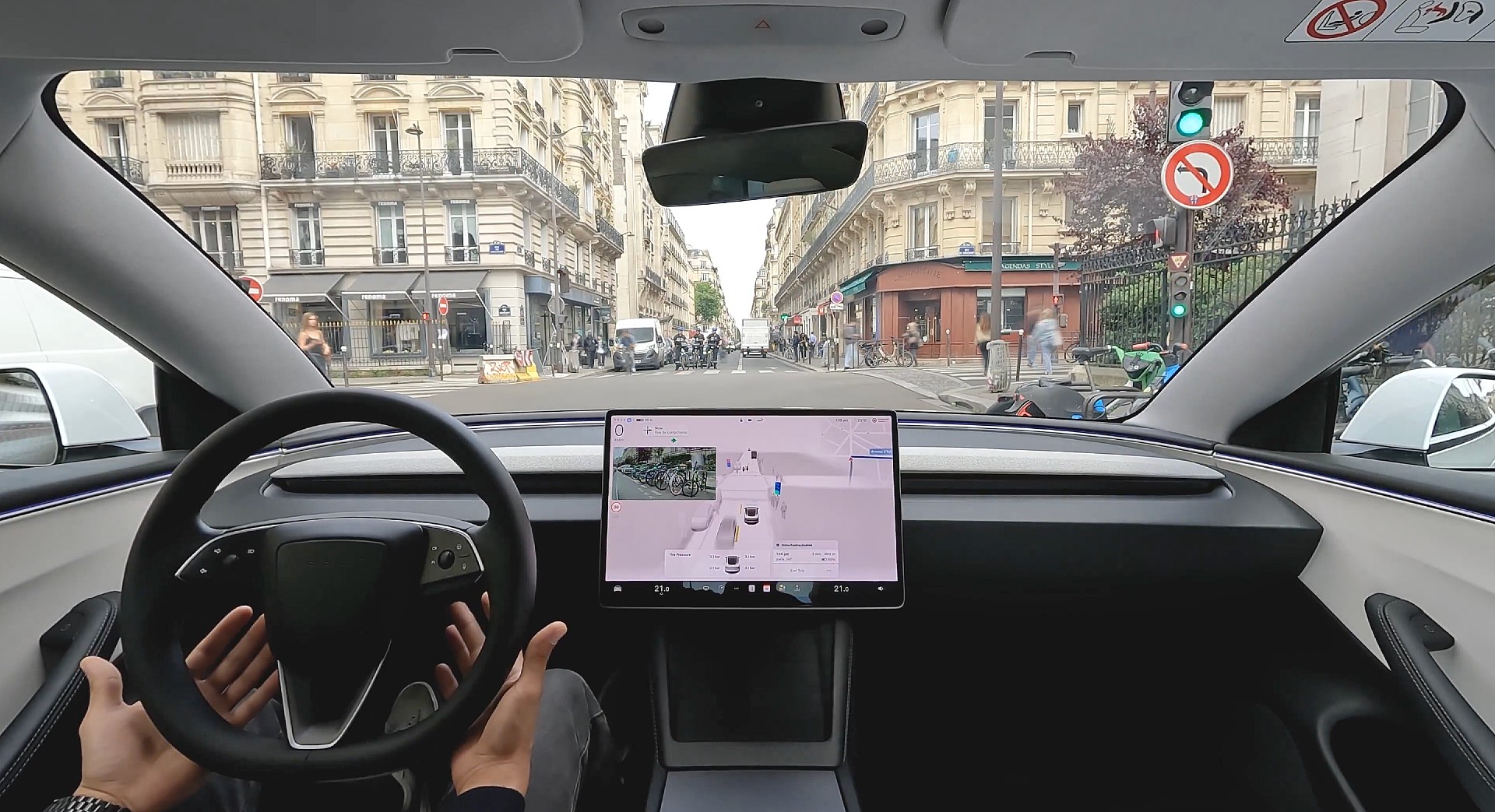
Elon Musk gave a brief answer on X Monday that confirmed that Tesla’s standing offer to license Full Self-Driving to other automakers still has zero takers. Sawyer Merritt wrote that “Tesla has for years openly invited other automakers to license FSD. None of them have accepted,” responding to a prediction from Boom Supersonic founder Blake Scholl that Tesla would eventually open FSD the way it opened its Supercharger network to rival brands. Musk’s reply to Merritt was one word: “Exactly.”
It is not the first time Musk has made this point. He said something similar in November, when he called legacy automakers reluctance to adopt FSD “crazy,” and Tesla has floated the offer publicly since at least 2021. Scholl’s prediction touches on something real. Once NACS became the de facto charging standard, adoption from Ford, GM, Rivian and others followed within about a year. FSD licensing was supposed to work the same way once Tesla built enough of a lead that switching made sense for everyone.
Tesla has for years openly invited other automakers to license FSD. None of them have accepted. https://t.co/kgz4idpoUM
— Sawyer Merritt (@SawyerMerritt) September 22, 2026
The case for licensing now is stronger than it was two years ago. Waymo and Zoox are logging hundreds of thousands of unsupervised autonomous miles, along with Tesla’s own Robotaxi fleet. Every automaker still selling driver assist systems that lag FSD has given the robotaxi conversation to Tesla, Waymo and Zoox by default. Licensing FSD would let a GM or a Ford compete on the same field without spending a decade and billions of dollars building a stack from scratch, the same argument Tesla made when it opened the Supercharger network to bring more EVs onto its chargers.
But FSD is not a connector standard. As one reply to Musk’s post pointed out, licensing FSD is not a software license the way NACS was a plug spec. It requires adopting Tesla’s eight camera layout and its onboard compute architecture, meaning a licensee’s cars would effectively become Tesla hardware wearing someone else’s badge. That is the visible obstacle. The less visible one is data. A licensed FSD stack would report back the same telemetry Tesla collects from its own fleet, giving Tesla a continuous read on how a competitor’s cars are actually driven, where they struggle, and how often drivers intervene. For an automaker trying to build its own autonomy program, or simply trying to keep its build quality and safety record private, handing Tesla that visibility could be a bigger cost than the hardware bill. It is the reason the Supercharger comparison only goes so far. Opening a charging plug cost Tesla very little. Opening FSD would cost a rival something it cannot get back.
Elon Musk
Tesla eyes supply partners for Optimus mass production
Tesla certified three Chinese suppliers for Optimus mass production, signaling its robot timeline is accelerating.
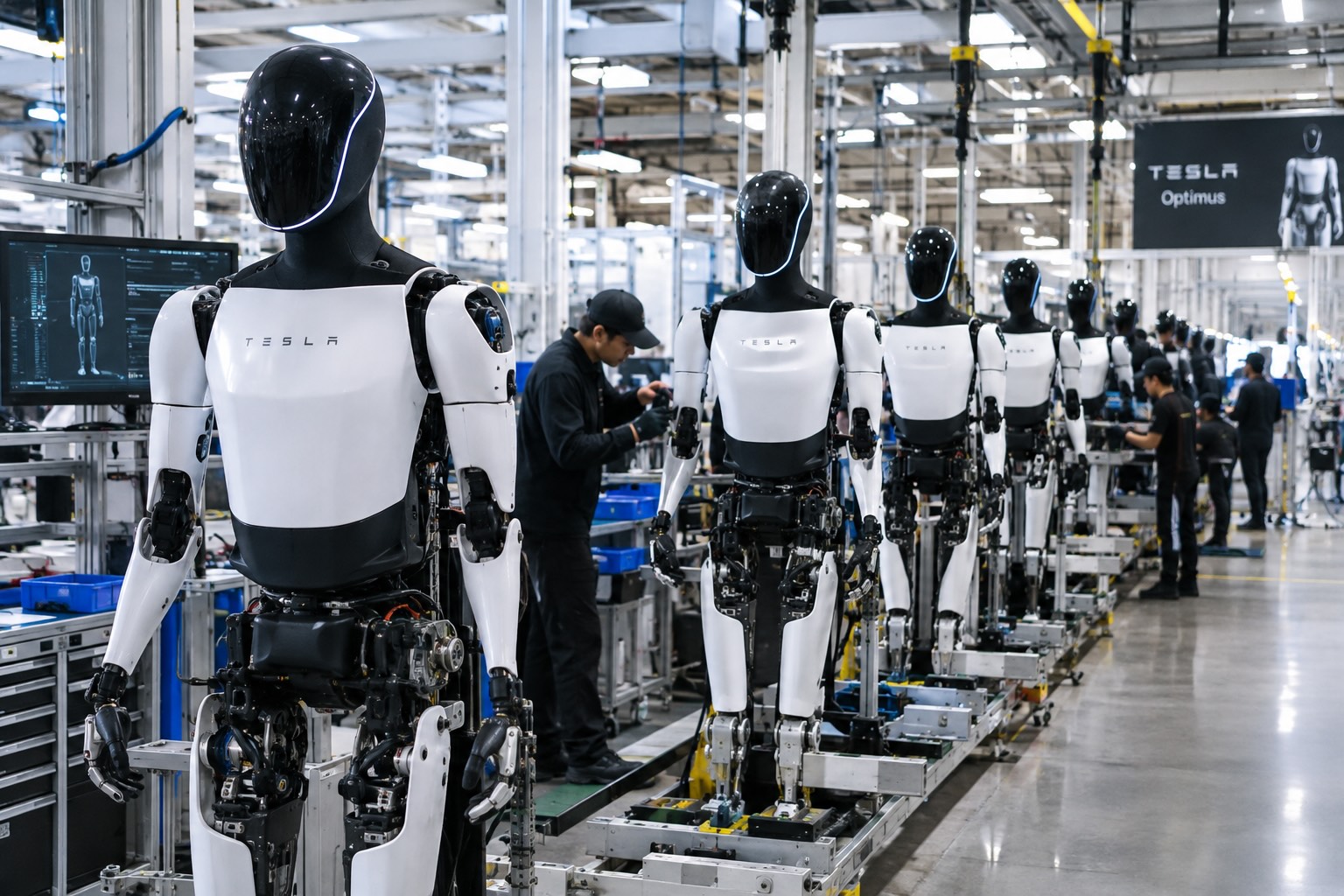
Tesla’s robotics team traveled to Ningbo, in China’s Zhejiang province, on September 16 and spent the following day auditing component suppliers for Optimus, according to a Bloomberg report cited by RobotAIGeek. The visit moved three manufacturers from provisional status to certified mass production partners: Tuopu Group, which handles actuators and chassis components, Ningbo Joyson Electronic, a sensor supplier, and Zhejiang Sanhua Intelligent Controls, which builds thermal management systems. All three already supply parts to Tesla’s electric vehicles, and the audit reportedly came with fresh orders that supply chain reports put at an initial batch of roughly 5,000 units.
Tuopu, Joyson, and Sanhua built their manufacturing base serving the automotive industry, where tolerances and volume requirements are already close to what a mass produced humanoid robot demands. Sanhua in particular has history here. Teslarati reported last October that the company had received a roughly $685 million order for linear actuators tied to Optimus, a volume industry watchers estimated could cover around 180,000 robots once production ramped.
Supply chain reports tied to this week’s audit put Tesla’s near term production goal at about 1,000 Optimus units a week by late September, rising to 2,000 to 2,500 units a week by the end of the year. That pace would put real weight behind the timeline Tesla has been building toward since May, when it wound down Model S and Model X production at Fremont to convert that floor space into a dedicated Optimus line targeting one million units annually. JPMorgan analysts who toured the factory in August confirmed the conversion took roughly four months, a pace Musk has called unprecedented for a facility that size.
New drone video shows Tesla’s Optimus Factory reaching a turning point
Fremont is only the first phase. A second, larger Optimus plant is rising at Gigafactory Texas, where drone footage shared by Joe Tegtmeyer last week showed the structural steel nearing completion on the north end of the building. Tesla has said that facility is meant to eventually support production of up to 10 million units a year, though volume output there is not expected before 2027.
Commercial sales of Optimus are still targeted for the second half of 2027, but production is expected to start well before then. JPMorgan analyst Rajat Gupta has said Tesla’s “Optimus Academy” program, which uses early units to collect real world training data inside Tesla’s own facilities, is expected to be running later this year. Bloomberg Intelligence analyst Ian Ma described the Ningbo audits as “a positive commercialization signal for China’s humanoid supply chain,” noting that sentiment could improve further if the visit leads to confirmed supplier nominations and larger orders. The Solactive China Humanoid Robotics Index rose about 1.4% on the news, though it remains down roughly 30% for the year.

Tesla integrates Grok Bot into its vehicles for the ultimate personal assistant

X changed how everyone gets paid, and this lawsuit shows why


