News
Porsche Taycan’s repeatable performance claims put to the test by veteran drag racer

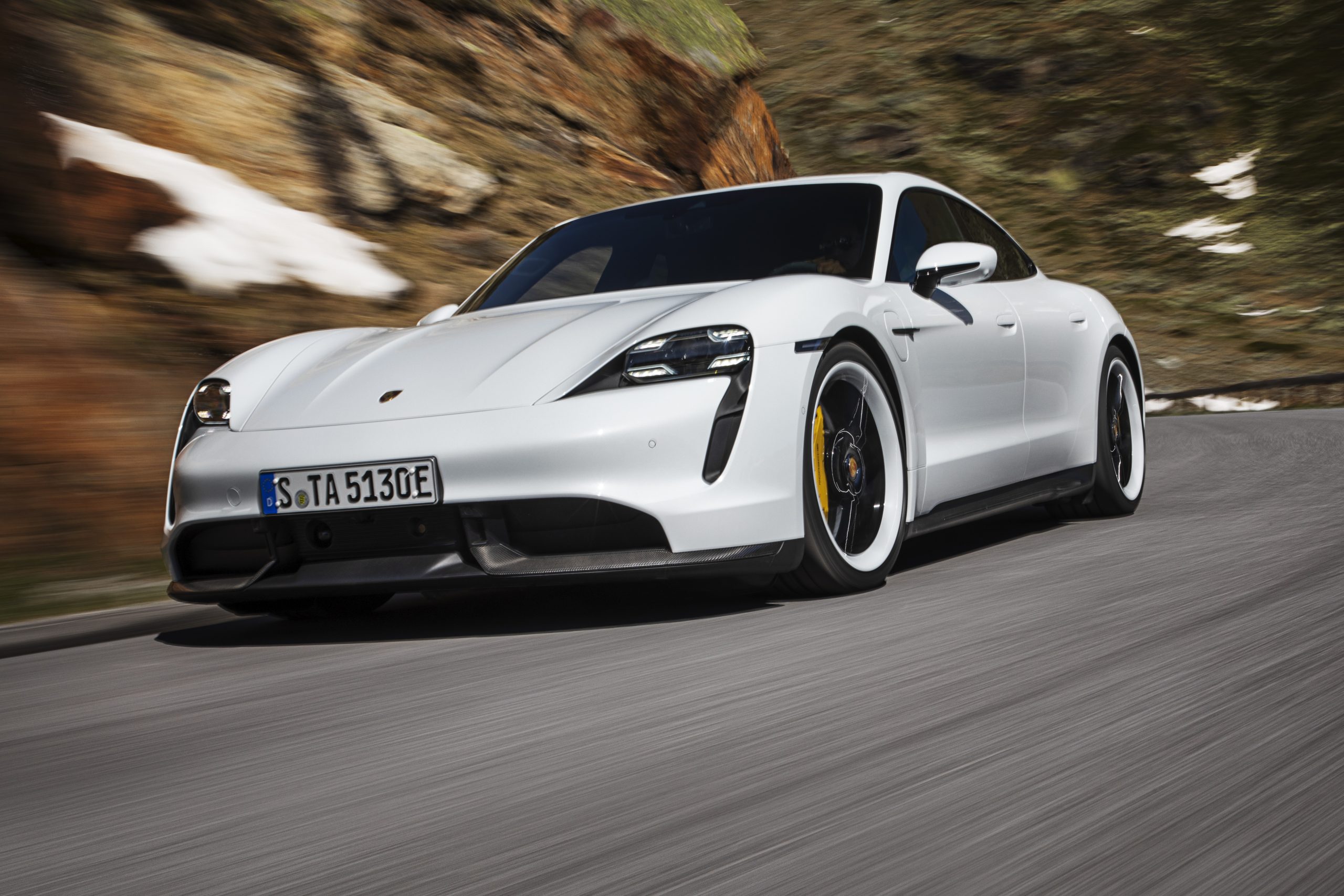
When Porsche launched the Taycan last year, its message was clear. It’s an all-electric performance car built for the track. You can take it with a battery half charged and you’ll still get the same level of performance you’d expect at full charge. At least that’s what Porsche promises.
DragTimes YouTube channel host and Tesla owner Brooks Weisblat recently put the Taycan Turbo’s repeatable performance claim to a real-world test. He took a Taycan Turbo and the more powerful Turbo S out on the track to see how they would perform launching from 0 to 60 mph and covering the 1/4 mile.
Weisblat specifically asked the engineers at Champion Porsche in Pompano Beach, FL to have both cars ready at full charge. However, while the Turbo had a 91% charge when he arrived, while the Turbo S was only at 57%. This presented a unique opportunity to test just how well the vehicles performed with such discrepancy in their battery levels.
At just a little bit more than half charge, the $185,000 Turbo S went from 0 to 60 mph in 2.67 seconds and ran a quarter-mile at 124 mph. It’s impressive for an all-electric vehicle but not so much for one housing the world’s first two-speed gearbox in an electric car.
“I kind of expected it to be a little better especially given it having the transmission,” Weisblat says. “I was expecting track speeds near 130 mph. The launch I wasn’t so sure because Porsche’s claiming it does 0 to 60 in 2.8 seconds.”
Previous testing done by DragTimes shows the Tesla Model S with a 96 percent charge can go from 0 to 60 mph in 2.45 seconds. That’s a couple of tenths of a second faster than the Turbo S, which has acceleration and speed advantages due to its two-speed transmission.
The Turbo, which has 90 less horsepower than the Turbo S, went from 0 to 60 mph at 2.8 seconds. It’s not as fast as the Turbo S but it’s nothing to scoff at. But here’s the kicker. After the first 60 mph, the Turbo S didn’t have much of an advantage over the less powerful Turbo. If the state of charge doesn’t matter as Porsche says, the Turbo should have at least similar or less performance.
But Weisblat’s testing shows the Turbo at 91% charge went from 60 to 100 mph in 8.41 seconds and took the 1/4 mile at 127 mph. That’s a whole 3 mph faster than the Turbo S, which was at 56% charge when testing began. Had both cars been raced against each other, the Turbo would have won hands down over the Turbo S. Weisblat also says that both Turbo and Turbo S used up about 2% of the battery after each 1/4 mile.
“State of charge does matter with the Porsche. There’s no question about it. Because the Taycan Turbo S sitting at 56 percent is tracking at 124 mph. The Turbo at 91 percent is going 3 mph faster. For those of you who don’t know about road racing or drag racing, that is a significant difference,” he said.
The results would have been different had both cars been charged fully. Weisblat estimates the Turbo S could go the 1/4 mile at 130 mph and launch from 0 to 60 mph at around 2.5 seconds so that it’s right in line with the Tesla Model S. However, he believes that the Turbo S would further drop to 7 seconds once it goes from 60 to 130 mph, just up to par with a Lamborghini Huracan. If so, he says the Model S could be “in trouble,” at least when you take it down to the race track.
To maintain these numbers, Porsche has to keep the Taycan’s battery at optimal temperatures using a unique battery thermal management system. Unfortunately, because the car relies purely on electricity, the Taycan uses up extra energy from the battery just to maintain its energy-intensive temperature control system.
It’s a double-edged sword, especially for an electric vehicle. Porsche had to sacrifice a few things in exchange for performance. A lot of people weren’t happy to hear that the EPA gave the Taycan Turbo S a range rating of 192 miles. The Taycan Turbo didn’t do much better at 201 miles, which is 182 whole miles less than the 373 miles of the Model S Long Range.
But then again, the Taycan isn’t exactly made for most people. In fact, with a six-figure price tag and the Porsche logo on its hood, it’s not even made for mainstream EV buyers. And it’s a good thing for the electric car market as a whole.


News
SpaceX completes another secret Pentagon launch, adding to suspected Starshield buildout
SpaceX launched the classified USSF-385 mission from Vandenberg, landing its booster on a tenth flight.

SpaceX launched another classified mission for the U.S. Space Force from California early Saturday morning, and the Falcon 9 booster that carried it landed on a drone ship in the Pacific for the tenth time. The USSF-385 mission lifted off from Space Launch Complex 4E at Vandenberg Space Force Base at 7:00 a.m. PT.
Booster B1100 touched down on Of Course I Still Love You roughly eight and a half minutes after liftoff. It was the booster’s tenth flight and tenth successful landing, following the NROL-95 national security mission and eight Starlink launches. Its previous flight, a Starlink Group 15 mission on August 22, came just 35 days earlier. SpaceX ended its livestream shortly after the landing, which is standard for classified payloads, and neither the company nor the Space Force has said what the rocket carried.
Watch Falcon 9 launch the USSF-385 mission from pad 4E in California https://t.co/CAdbx85Ydy
— SpaceX (@SpaceX) September 26, 2026
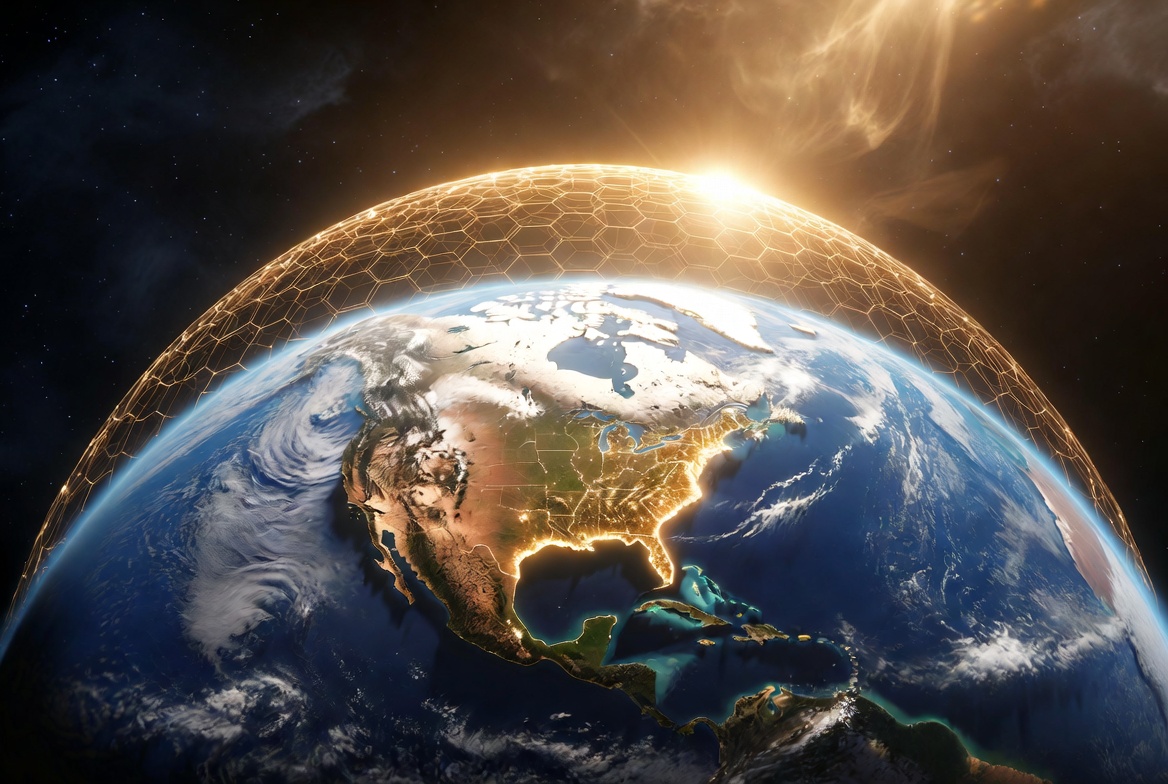
USSF-385 is the fourth Space Force launch from the same Vandenberg pad in roughly six weeks, following USSF-366 on August 15, USSF-153 on September 10, and USSF-259 on September 17. When SpaceX flew USSF-366 in August, independent trackers noted that the rocket’s stage drop zones matched SpaceX’s Starlink Group 15 missions, pointing to Starshield, the government version of the Starlink satellite bus. The Space Force later cataloged 23 satellites after both USSF-366 and USSF-153, while USSF-259 placed 17 satellites into a different orbital plane, per KeepTrack. Launch databases describe USSF-385 the same way, though the payload remains officially unidentified.
The cadence lines up with the contracts, because in July, the Space Force awarded SpaceX $1.6 billion in task orders for 18 Falcon 9 missions from Vandenberg through the end of 2027. SpaceX also holds contracts to build pieces of that same network, which pushed its Pentagon contract total for 2026 past $8 billion.
Saturday’s flight was also the sixth and final Falcon 9 launch from Vandenberg in September, according to Spaceflight Now, while only one Falcon 9 flew from the East Coast this month as SpaceX shifts its Florida infrastructure toward Starship. Launch trackers list it as SpaceX’s 112th mission of 2026 and the 108th Falcon 9 flight of the year, with SLC-4E turned around about six and a half days after its previous launch.
The West Coast pad will not stay quiet for long, considering SpaceX has another Starlink mission scheduled from SLC-4E on September 30. Meanwhile, in Texas, the company is two days away from Starship Flight 14, which is targeting Monday at 7:15 a.m. CT for the vehicle’s first attempt to reach orbit.
News
Tesla hints at new Roadster design in surprise clip
Tesla ended its Semi event with a Roadster teaser revealing a new front light bar.
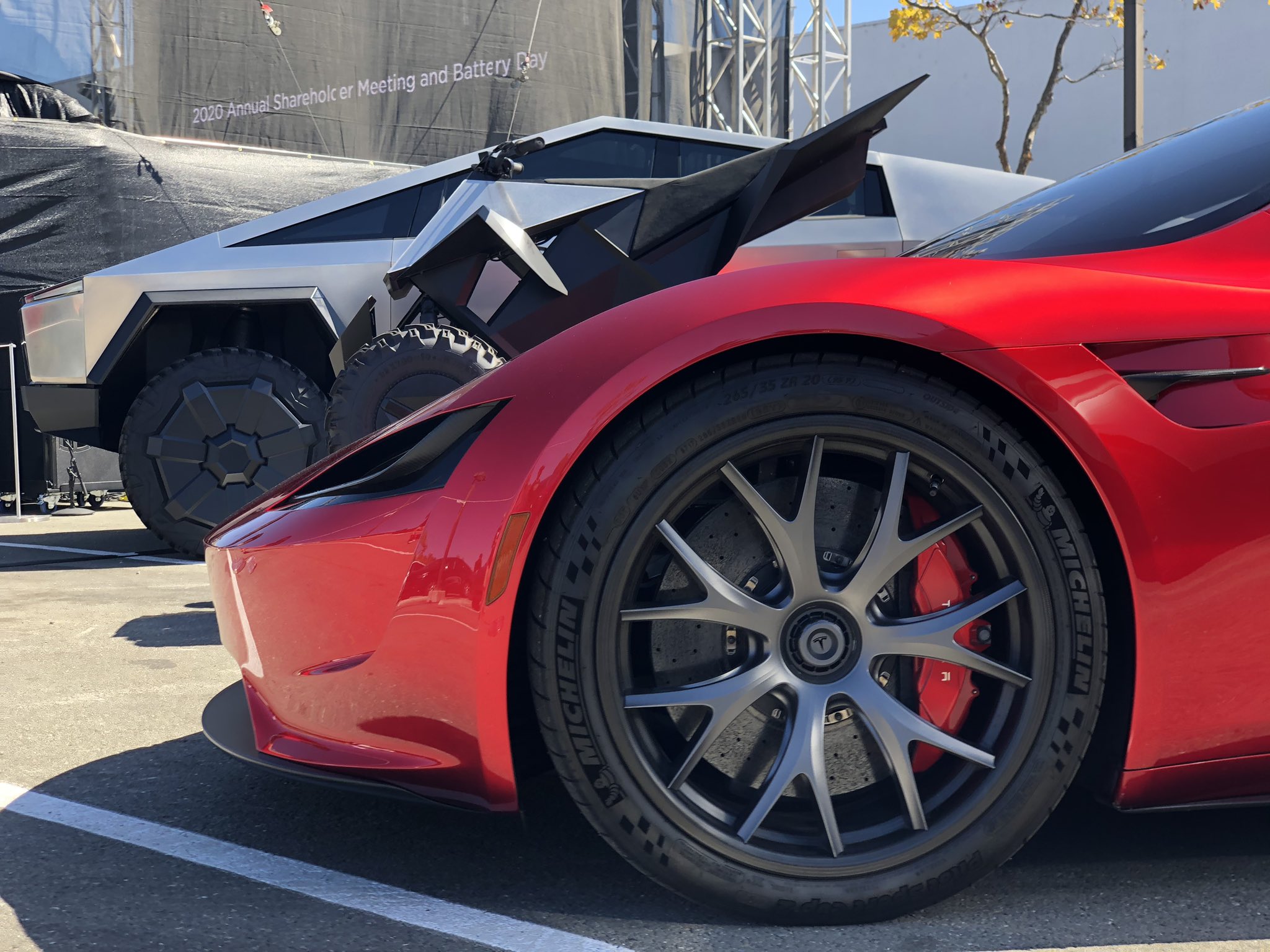
Tesla closed out its Semi event in Nevada on Thursday night with a nod to its own history, dropping a short Roadster teaser that suggests the production car will look noticeably different from the prototype first shown in 2017.
“We can’t have a Semi event without the Roadster,” Tesla engineering executive Lars Moravy told the crowd before the clip played. The line was a deliberate callback. Tesla first revealed the next generation Roadster in November 2017 by driving it out of the back of a Semi trailer at the truck’s original unveiling in Hawthorne, California.
The new video opens on trailer doors swinging apart in the dark. A thin white light bar glows across what appears to be the nose of the car, Tesla and SpaceX logos flash over the frame, and the Roadster name appears before the clip ends on “See you next week.” Tesla posted the nine second clip on X after the livestream wrapped.
See you next week pic.twitter.com/BT52bGVxFu
— Tesla (@Tesla) September 25, 2026
The light bar is the most concrete design detail so far. The 2017 prototype used two separate curved headlamp pods, while a connected front light strip would bring the Roadster in line with the Cybertruck, Cybercab, Semi, and refreshed Model Y. Sawyer Merritt was among the first to point out what looked like part of a SpaceX logo in the video, something Tesla has not addressed.
That logo fits the buildup around the optional SpaceX Package, which Elon Musk has long said would use cold gas thrusters to improve acceleration and possibly allow the car to briefly leave the ground. Tesla’s “Go for launch” post on September 12 set the October 1 date, and invitations sent to reservation holders place the event in Waco, Texas, at 8:30 p.m. Eastern. Waco sits roughly 20 minutes from SpaceX’s McGregor rocket test site, where the FAA has put a temporary flight restriction in place from September 18 through October 2, covering a 1.5 nautical mile radius from the surface up to 10,000 feet.
Tesla is also taking money ahead of the reveal. The company reopened Roadster reservations earlier this week with a $5,000 refundable card payment, followed by a $45,000 wire transfer due within 10 days. That puts buyers at $50,000 committed before Tesla has published a price.
The original pitch set a high bar: 0 to 60 mph in 1.9 seconds before any upgrades, 620 miles of range, a top speed above 250 mph, and production in 2020. That timeline has slipped repeatedly, and Tesla has since pointed to production at Gigafactory Texas no earlier than 2027. The company has said next Thursday’s event will include pricing, specifications, and production targets, the three details original reservation holders have been waiting on for nearly nine years.

Tesla Full Self-Driving’s release in Europe is set to be delayed by at least a few months.
The European Union will not vote on Tesla’s Full Self-Driving (Supervised) on October 6. The draft agenda for the 119th meeting of the Technical Committee on Motor Vehicles lists only a 25-minute “continuation of discussions” on the Netherlands’ Article 39 request, not a decision. The next scheduled TCMV session is in December, which is now the earliest date a bloc-wide vote could occur.
Tesla Europe had pointed to October 6 as a possible EU-wide vote after the Dutch vehicle authority RDW granted the first European type approval on April 10.
That approval, under UN Regulation 171 plus an Article 39 exemption in EU Regulation 2018/858, is the legal file other member states have been recognizing one by one. The same committee has already discussed the request twice without voting.
Elon Musk’s reply to the delay was a single word: “Sigh.”
Sigh
— Elon Musk (@elonmusk) September 25, 2026
Seven EU countries have now cleared FSD Supervised on their own roads: the Netherlands, Lithuania, Estonia, Denmark, Belgium, Slovenia, and Czechia. Those seven states represent about 53 million people, or roughly 12 percent of the EU population. An EU-wide authorization still needs a qualified majority: at least 15 of 27 member states representing 65 percent of the bloc’s population, about 292 million people.
Germany, France, Italy, and Spain remain the decisive markets. France has already rejected the current system; several other governments have flagged speed-limit compliance as the main sticking point.
The safety case Tesla is putting in front of those governments is now public. On September 1, Tesla Europe said FSD Supervised was in use by more than 70,000 customers, covering over 1 million kilometers a day, and was 4.1 times less likely to be involved in a crash than manual driving across 100 million kilometers on EU public roads.
An earlier mid-year cut of the same fleet data, covering 65 million kilometers in five approved countries, put the collision advantage at 5.2 times, with zero highway collisions over 41.9 million kilometers. Tesla also reported far fewer automatic emergency braking events, harsh accelerations, and hard swerves than in comparable manual Tesla driving. Those figures are company-reported, not independently audited.
Tesla Full Self-Driving is taking over Europe: fourth country gets FSD approval
The public-health backdrop is harder to dispute. European countries recorded about 19,400 road deaths in 2025, or roughly 53 a day, most of them attributed to human error. FSD Supervised is not unsupervised autonomy; the driver remains legally responsible. But the software is already legal and in daily use across seven member states.
Until TCMV votes, the rest of the EU remains a patchwork: available in Prague and Amsterdam, locked behind review in Paris and Berlin. December is now the next chance to close that gap.

SpaceX completes another secret Pentagon launch, adding to suspected Starshield buildout

Tesla hints at new Roadster design in surprise clip


