News
Tesla Cybercab ‘breakdown’ image likely is not what it seems

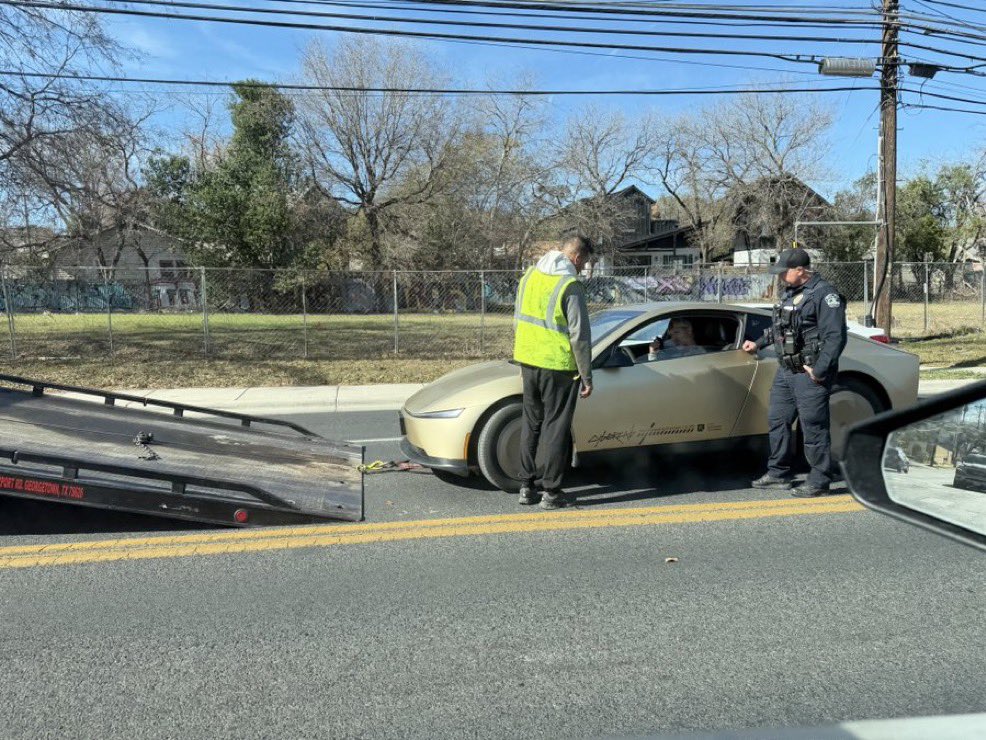
Tesla Cybercab is perhaps the most highly-anticipated project that the company plans to roll out this year, and as it is undergoing its testing phase in pre-production currently, there are some things to work through with it.
Over the weekend, an image of the Cybercab being loaded onto a tow truck started circulating on the internet, and people began to speculate as to what the issue could be.
Hmmmmmm… https://t.co/L5hWcOXQkb pic.twitter.com/OJBDyHNTMj
— TESLARATI (@Teslarati) January 11, 2026
The Cybercab can clearly be seen with a Police Officer and perhaps the tow truck driver by its side, being loaded onto, or even potentially unloaded from, the truck.
However, it seems unlikely it was being offloaded, as its operation would get it to this point for testing to begin with.
It appears, at first glance, that it needs assistance getting back to wherever it came from; likely Gigafactory Texas or potentially a Bay Area facility.
The Cybercab was also spotted in Buffalo, New York, last week, potentially undergoing cold-weather testing, but it doesn’t appear that’s where this incident took place.
It is important to remember that the Cybercab is currently undergoing some rigorous testing scenarios, which include range tests and routine public road operation. These things help Tesla assess any potential issue the vehicle could run into after it starts routine production and heads to customers, or for the Robotaxi platform operation.
This is not a one-off issue, either. Tesla had some instances with the Semi where it was seen broken down on the side of a highway three years ago. The all-electric Semi has gone on to be successful in its early pilot program, as companies like Frito-Lay and PepsiCo. have had very positive remarks.
The Cybercab’s future is bright, and it is important to note that no vehicle model has ever gone its full life without a breakdown. It happens, it’s a car.
Nevertheless, it is important to note that there has been no official word on what happened with this particular Cybercab unit, but it is crucial to remember that this is the pre-production testing phase, and these things are more constructive than anything.


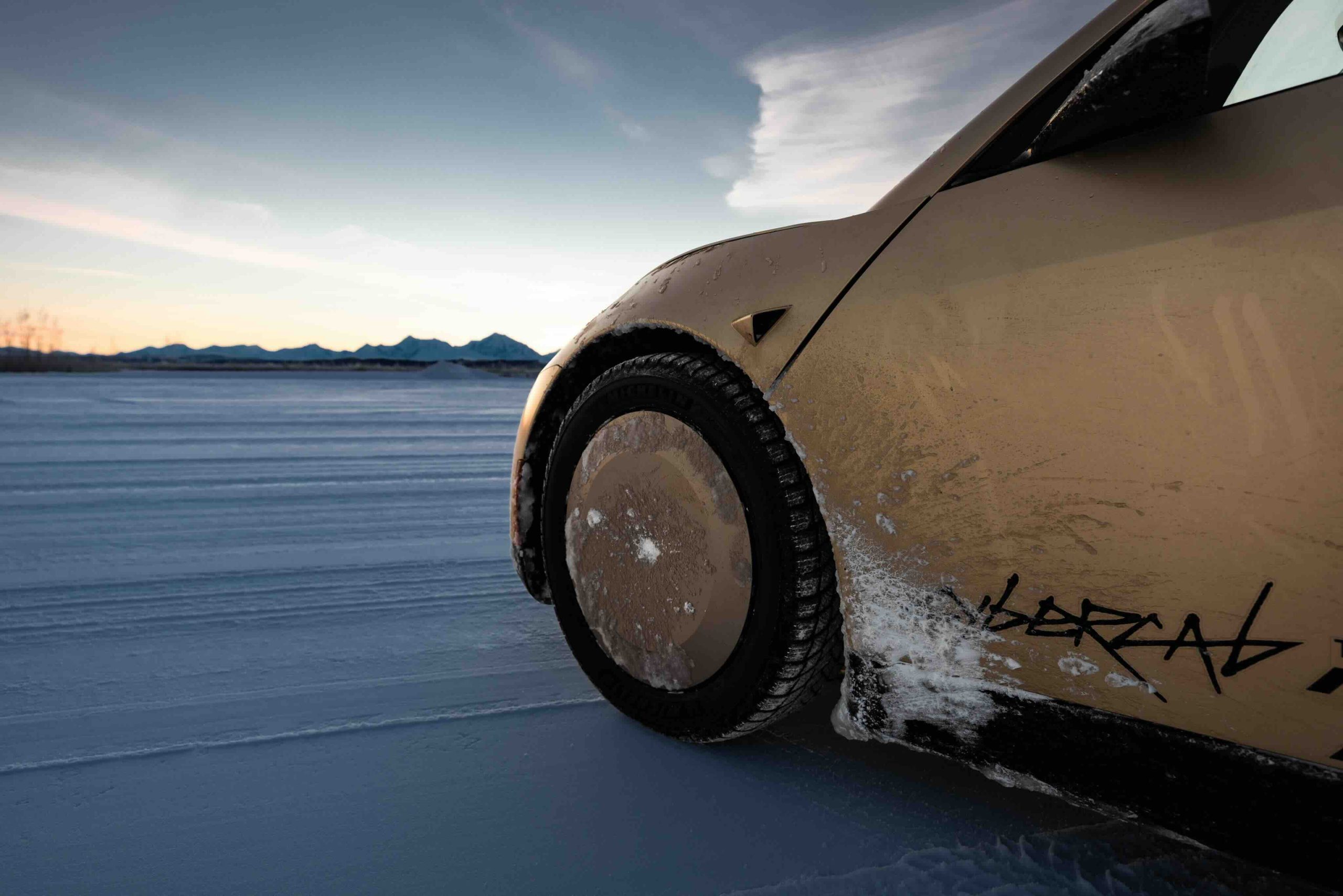
Tesla Cybercab sightings are broadening far and wide, well outside of downtown Austin, Texas, with autonomy in focus as the company plans to launch the all-electric, two-seater this evening in the Lone Star State.
Tesla is set to launch Cybercab to a small group of people this evening in a dedicated event in Austin, Texas. Public details on the event are relatively slim.
However, Tesla’s focus on Cybercab falls well outside of the downtown Austin area and is expanding well across the United States as things continue to move quickly with the company’s autonomous efforts in 2026. Today, various images of Cybercab fleets in interesting locations have started to circulate.
The most notable is a fleet of at least 20 Cybercabs at Miami International Airport in Florida. Spotted last night, the fleet is expansive and is indicative of a looming release of Cybercabs once regulatory boxes are checked off.
Tesla has already been operating the Robotaxi platform in Miami for several months, but this Cybercab fleet at the airport could be joining the ride-hailing platform as approvals arrive:
20+ Cybercabs spotted near Miami international airport. pic.twitter.com/ORLsw8yFhf
— Sawyer Merritt (@SawyerMerritt) September 3, 2026
Another fleet of Cybercabs was spotted at the Devon, PA showroom just outside of Philadelphia. We have seen several Cybercab units testing around the Philadelphia Metro Area, which is interesting considering Tesla does not have any active Robotaxi geofence in Pennsylvania.
Cybercab at the Devon location in PA has multiplied over the weekend. Seeing a few more test vehicles in the lot 👀 pic.twitter.com/DhJT4P1EkU
— Billy (@billykyle) August 22, 2026
Philadelphia would be an ideal location to test ride-hailing due to its dense tourist population, large, sprawling city layout, and to compete with other ride-hailing companies that operate in the city.
Expansive fleets of Cybercabs will be popping up in and around major cities throughout the rest of the year, if we were betting on it. Tesla has made it obvious that the Cybercab rollout will be aggressive and fast-paced, but within reason. Tesla is still prioritizing safety, so these testing phases will likely go on for some period of time before more members of the public are able to snag a Cybercab for a personal chariot.
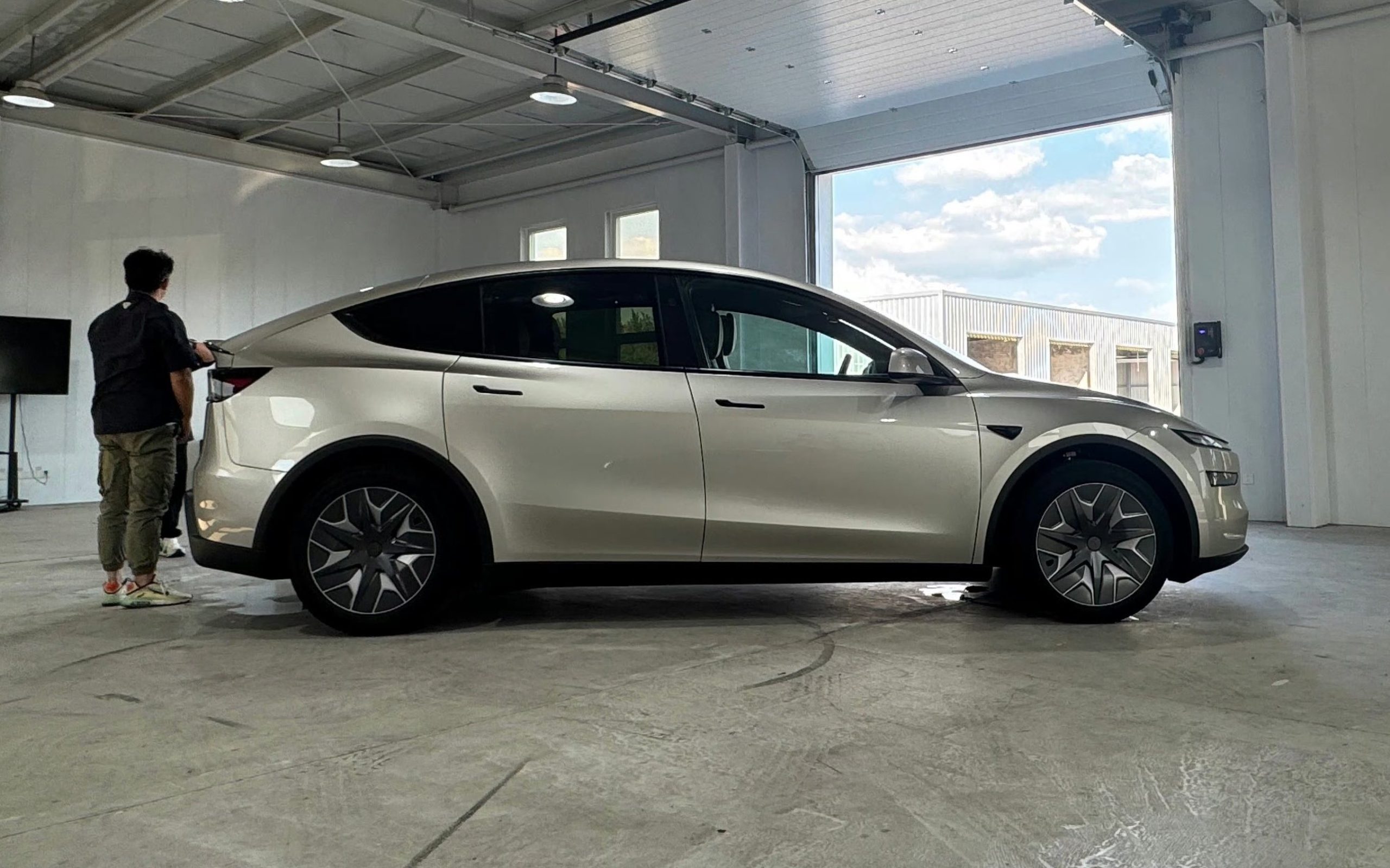
The Tesla Model Y L is arguably the most hyped trim of the all-electric crossover, other than the Performance configuration that comes with white-knuckle speed and sports car-level handling.
However, it is not all perfect. Tesla owners in China who took delivery of the Model Y L, denoted with an L to highlight its longer wheelbase, are experiencing what they are referring to as “collapsing” of the rear wheels, as suspension issues appear to be an issue with some of the builds.
🚨 Model Y L owners in China report rear suspension sag
• Six-seat long-wheelbase Y. Shanghai. On sale since August 2025
• Owners say the rear tire-to-arch gap shrinks after mileage or a full load. Some cases after about 9,000 km loaded. Others near 30,000 km
• Tesla service… pic.twitter.com/Lr6i5Tbi07— Joe Hansen (@joehansen) September 1, 2026
The gap between the wheel arch and tire has narrowed to the point that “not even a single finger” could fit, according to a report from Car News China. The failures are not tied to a specific mileage, as one owner said that after just 9,000 kilometers (5,600 miles), they noticed the suspension issue when their car was fully loaded.
Another one had the issue at 30,000 kilometers (18,640 miles) and noticed that the wheel gap shrank to two fingers, so not as drastic as the person who reported a similar issue at 9,000 km.
Tesla Model Y L is gaining momentum in China’s premium segment
Along with the visual recognition of the issue, others are saying the sagging is causing abnormal wear on the inside of the tires. Extra weight and instant torque already provide additional stress on the tires in electric vehicles during normal operation, so it is no surprise that this is another complaint.
There has been no recall issued by Tesla, and the company has not yet publicly acknowledged the issue.
Some are suggesting that owners use a “finger test” to self-diagnose whether there is an issue with the suspension. There should be four fingers between the tire and the wheel well; anything less than that starts to get dicey.
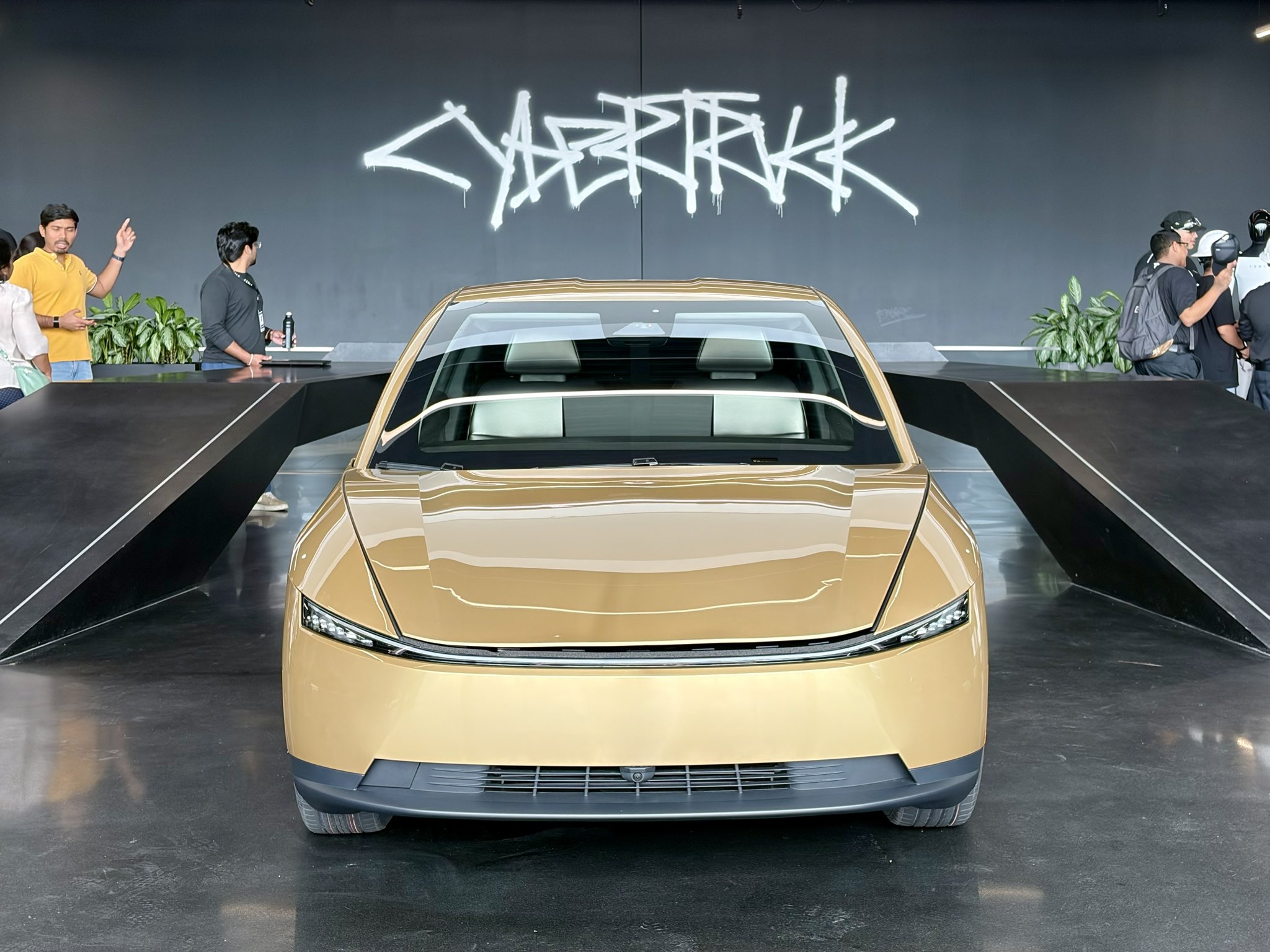
Tesla is starting to truly tease and hype its groundbreaking Cybercab event, which takes place tomorrow in Austin, Texas. It will be the first time members of the public will be able to ride in a Cybercab, a vehicle without any manual controls, on public roads.
Tesla has been dropping some hype on X over the past several days, but this morning, the excitement has truly started to build up for the event. Although Cybercab has been unveiled before, this is truly Tesla’s announcement that it is ready to start offering autonomous rides for public passengers in its new ride-hailing-geared vehicle for the first time.
The hype has started with a variety of different social media posts that are a true indication that Tesla is preparing for something big. Teasing so much of the potential of Cybercab, including its ability to truly revolutionize how people hail rides for local travel, is what the big idea for the event entails. The time that many Tesla owners, fans, and investors have been waiting for is potentially here:
— Tesla (@Tesla) September 2, 2026
The event has remained slim on details. Even invitees are still awaiting true details about what the event will entail, where they’ll go, and what is in store for the evening. This is pretty typical for an event run by Tesla; they keep things under wraps for the most part until the very last minute.
However, there is no secret about what the real intention of Tesla is for this event: it is going to be a huge reveal party for a vehicle that has no steering wheel and no pedals. It is a truly massive step for the company moving forward.
No steering wheel, no pedals
— Tesla Robotaxi (@robotaxi) September 2, 2026
Speculation persists as to whether this is going to be an event that simply announces that rides will begin with the Cybercab, or it will be something more substantial. Tesla has said in the past that they plan to sell the Cybercab to the general public in what could become a great way to earn passive income by adding it to a more global fleet of Robotaxi-geared vehicles.
Tomorrow, the show begins in Austin, and the Cybercab goes live at some capacity; we just don’t know exactly how quite yet.

Tesla Cybercab sightings broaden well outside of Austin with autonomy in focus

Tesla Model Y L gets suspension complaints in over odd issue China


