Investor's Corner
Trending $TSLA: Remove the “noise”

Last week I introduced the MACD indicator. This week I will present a different way of displaying stock charts that works well with the MACD to help in forecasting future stock behavior.
Most profits and losses are generated when markets are trending. Market “noise” is simply all of the price data that distorts the picture of the underlying trend. This includes mostly small corrections and intraday volatility. Noise removal is one of the most important aspects of active trading. By employing noise-removal techniques, traders can avoid false signals and get a clearer picture of an overall trend.
The Heikin Ashi technique (“average bar” in Japanese) is one of many techniques used to remove noise and improve the isolation of trends to predict future prices.
Heikin Ashi charts are a type of candlestick chart that shares many characteristics with standard candlestick charts, but differs because of the values used to create each bar. I will not bore you with the formulas used to calculate the candlestick components (close, open, high, low). The Heikin Ashi formula factors in the current bar with an average of past bars in order to create a smoother trend. This process creates smoother price patterns that are much easier to read.
Daily Heikin Ashi charts are used to display “pay-day cycles” that display the daily trends, without the “noise.”
Take a look at the difference between the standard candlestick and the Heikin Ashi charts of TSLA stock for the past 5 months. First let’s take a look at the standard candlestick chart.
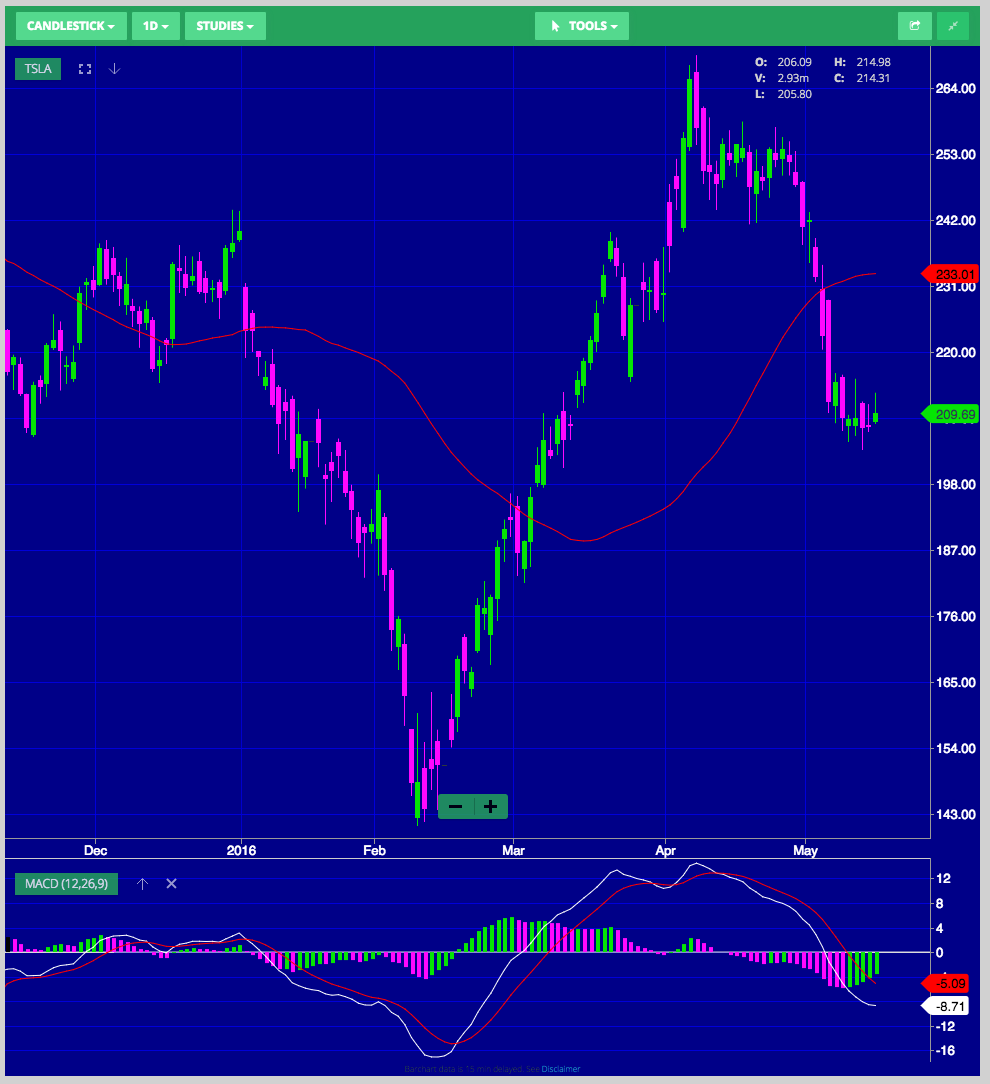
Candlestick Chart (Source: Wall Street I/O)
Now let’s take a look at the Heikin Ashi chart.
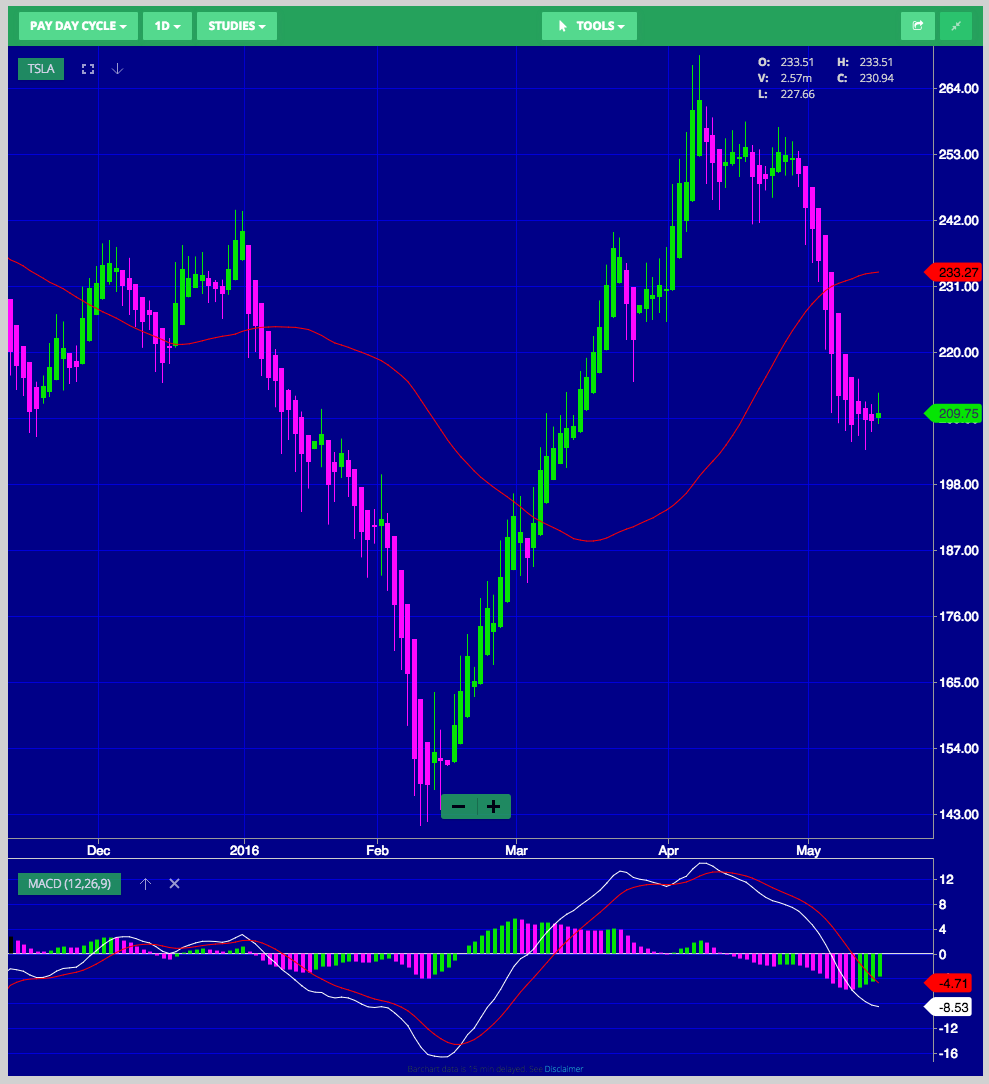
Heikin Ashi Chart (Source: Wall Street I/O)
Notice that in the latter chart the Jan.-Feb. and the May downtrends are more clearly visible, as well as the Feb-March huge uptrend gain.
In my trading I combine pay-day-cycles with the MACD. I make sure that the pay-day-cycle has turned positive (colored green in the chart above), and then I wait for the MACD to cross to the bulls to initiate a probing bullish trade.
Taking a look at today’s situation, this may be the first day of a green Heikin Ashi bar after 12 red bars. I also notice that the MACD is starting to flatten. We may be starting to form a bottom, and this could be the beginning of a potential reversal in the downtrend in TSLA stock, so I will be watching closely for an entry point when both indicators turn positive. Notice that in general the pay-day-cycle turns positive before the MACD does.
Heikin Ashi charts are now provided by most trading platforms: Wallst.io (select Chart Type – Pay Day Cycle), TD Ameritrade’s Thinkorswim (select Style – Chart Type – Heikin Ashi, Daily), OptionHouse (select Style: Heikin Ashi, Range: 6 Months, Frequency: 1 Day).
Also StockCharts.com offers free Heikin Ashi charts (enter TSLA, Chart Attributes, Type Heikin-Ashi, Update).
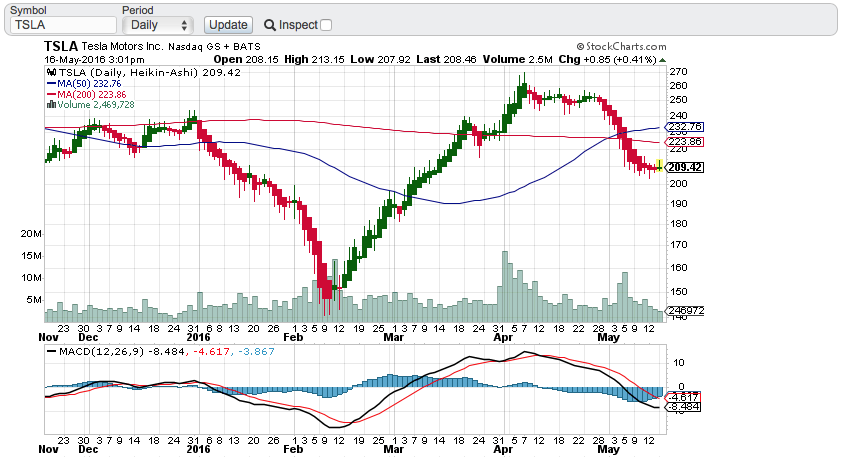
Source: StockChart.com
One interesting pattern that formed at the closed today is a “Doji”: a Doji candlestick looks like a cross, inverted cross or plus sign, and forms where a security’s open and close of the day are virtually equal. This often can be the precursor of a reversal. Secondly, the recent 50-day MA (Moving Average) move above the 200-day MA occurred a couple of weeks ago (see the chart above), again another usual precursor of a forthcoming bullish trend. And lastly, TSLA has support at the 206 level, from last November 2015. All of these are reasons to be bullish on TSLA, especially for short-term swing traders.
Is $TSLA going to reverse and move back up or will it start to compress, i.e. go sideways like it did in April? What do you guys think?


Elon Musk
SpaceX Starship Flight 13 aborted at Zero and Musk just told us what broke
Four Raptor engines failed to ignite at T-zero, forcing SpaceX to scrub Starship Flight 13 Thursday.

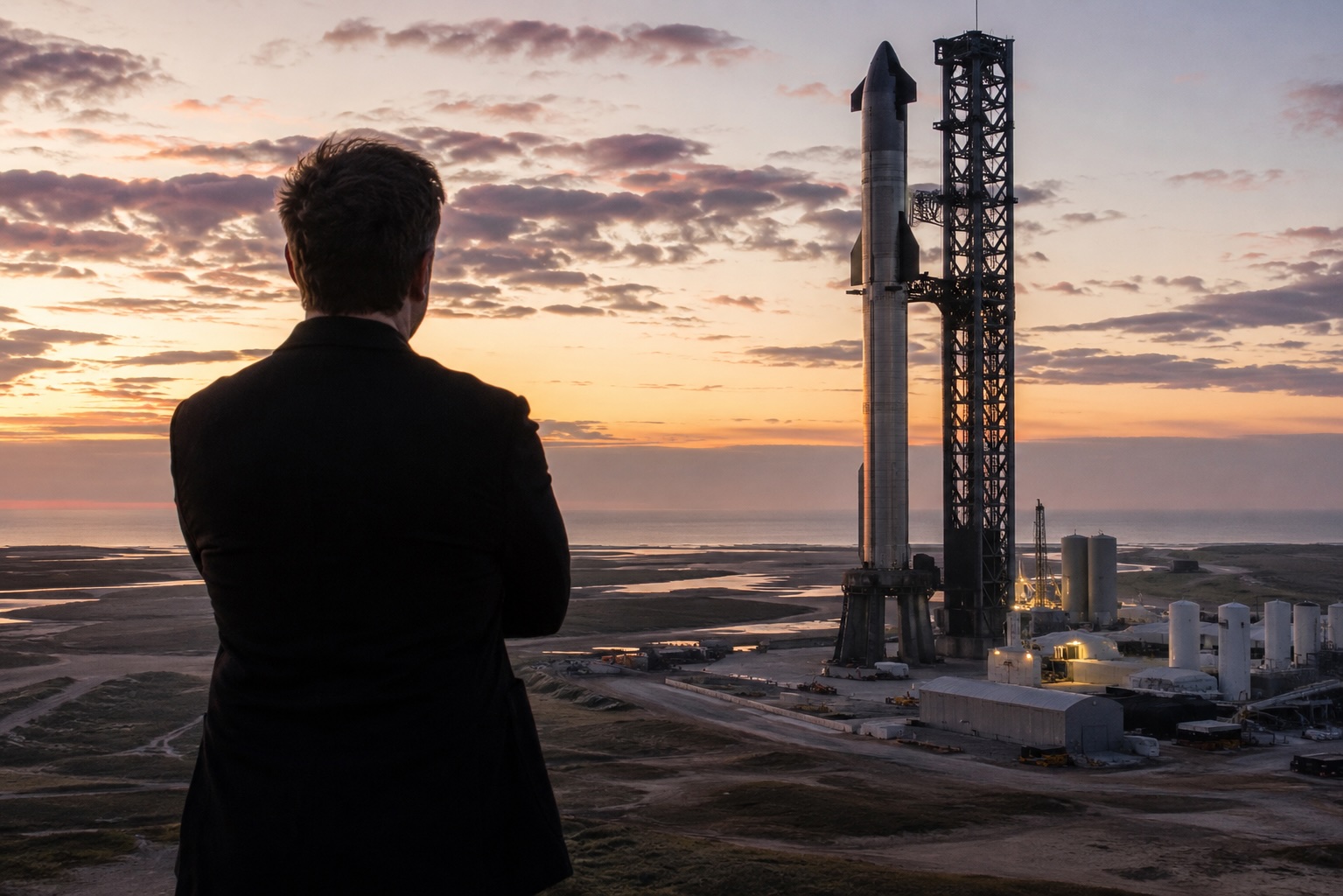
SpaceX scrubbed the Starship Flight 13 launch attempt Thursday evening at the last possible moment, after four of the Super Heavy booster’s 33 Raptor 3 engines failed to ignite during the startup sequence. The 90-minute window had opened at 6:45 p.m. EDT from Starbase in Boca Chica, Texas, and the countdown had proceeded without issue all day, with more than 11.5 million pounds of liquid methane and liquid oxygen being fully loaded into the rocket before the automated abort triggered. SpaceX’s launch directors posted on X, “Standing down from today’s flight test attempt,” and shut down the livestream shortly after.
Musk confirmed the root cause within hours. “Some of the engines didn’t start, triggering an automatic launch abort,” he wrote on X. “To be confident of a good flight, 2 Raptors will be removed and replaced. Most probable launch timing is early next week.” SpaceX engineers began draining propellant tanks immediately and Booster 20 was rolled back to its hangar for inspection.
The timing adds a layer of significance that did not exist during any of the previous 12 Starship flights. This is the first time SpaceX has attempted to launch Starship since the company made its stock market debut in June, listing under ticker SPCX at $135 per share. Public investors are now watching every Starship outcome in real time, and a last-second abort carries more visibility than it would have six months ago.
Flight 13 was designed to be one of the most consequential tests in the program’s history. It was set to carry 20 Starlink V3 satellites, the first operational payload Starship has ever attempted to deploy. Six of those satellites carried external cameras to photograph Starship’s heat shield from the outside during flight, which would act as a self-inspection approach SpaceX has never attempted before. The mission also needed to complete a Raptor engine relight in space, a step SpaceX skipped on Flight 12 in May after losing an engine during ascent. That Flight 12 booster also flipped 90 degrees off course during its boostback burn when five engines failed to reignite.
SpaceX has not announced an official next launch date. Musk’s “early next week” window points to July 21 or 22 at the earliest, pending the engine swap and a return to the pad.


Lucid CEO Silvio Napoli responded to rumors of an imminent bankruptcy that was reportedly being mulled after a report stated the automaker was working with the firm AlixPartners to iron out its next steps.
The company felt a massive loss on Wall Street yesterday, as the report essentially pushed the stock down as much as 55 percent on Tuesday.
The report, published initially by Eletric-Vehicles.com, claimed Lucid was essentially in dire straits and was told by AlixPartners, a commonly used restructuring advisor, to either take shares private or file for Chapter 11 bankruptcy protection.
Lucid’s head of Communications, Nick Twork, immediately challenged the report and stated the company “has sufficient liquidity to carry its operations well into next year.”
Now, the company’s CEO is chiming in as well, stating that the report is “so far from the facts that they require a direct response.”
Napoli said:
“Lucid is not considering bankruptcy or a transaction to take the company private. Those reports are false. The Board did not explore either scenario. Period.
As disclosed in our most recent quarterly filing, Lucid has sufficient liquidity to fund its operations well into next year.
We work with outside advisors to improve operational performance and execution. They are not advising Lucid on a take-private transaction or bankruptcy, and any suggestion that they have recommended either course of action to management or the Board is false.
My priority is clear: turn this company around. That is where the leadership team and I are focused.
I look forward to providing a full update during our quarterly earnings call on August 4th.”
🚨 Lucid CEO Silvio Napoli calls rumors of financial issues “so far from the facts that they require a direct response.”
Read his full remarks here: https://t.co/t3Pg1NHvzy pic.twitter.com/LvHUPhO4Qf
— TESLARATI (@Teslarati) July 15, 2026
It seems pretty clear that Lucid is confident things will be okay, and, to be honest, they should not have much to worry about, especially considering the company has been backed by the Saudi Public Investment Fund (PIF) for years. It has solid financial backing, and its sales, while weak, are pretty much right on par with a company of this age.
Lucid also sent a Cease & Desist letter to the publication for their report.
Lucid shares have rebounded nicely and are up nearly 21 percent at the time of publication. As soon as the company dispelled the rumors of bankruptcy yesterday, the stock began to climb back toward more reasonable levels.

Electric vehicle maker Lucid Group has denied rumors of an imminent bankruptcy after a report from this morning sent the stock on a dramatic drop on Wall Street, seeing losses of more than 40 percent during trading hours.
Lucid’s Director of Communications, Nick Twork, responded to the report from Eletric-Vehicles.com, which stated the company’s restructuring advisor, AlixPartners, was asked to review two decisions: taking Lucid shares private or filing for Chapter 11 bankruptcy protection.
The report also claims AlixPartners told the Lucid board to “concentrate on Gravity production while improving its quality, and to temporarily hold back the Lucid Air, the sedan that has defined the company since its launch.”
Twork said:
$LCID The rumors are completely false. The company has sufficient liquidity to carry its operations well into next year, as recently published in its last quarterly filings, and it has not formed any special Board committee to explore the scenarios reported today. Our focus is…
— Nick Twork (@ntwork) July 14, 2026
Shares rebounded after the response to the report, halving its losses as the trading day neared 3 p.m. Eastern.
Lucid has struggled to get its sales off the ground and into more respectable numbers, but the company is in its early years, when things are hard to begin with. It is also backed by several notable investors, including the Saudi Public Investment Fund (PIF), which has nearly limitless money and likely would not ditch an investment of this size so soon.
Lucid shares were down just 14 percent at the time of publication, a far cry from the 55 percent its losses topped out at during the day.

Tesla enters two new markets on two different continents in one week

SpaceX announces new Starship 13 test flight target date


