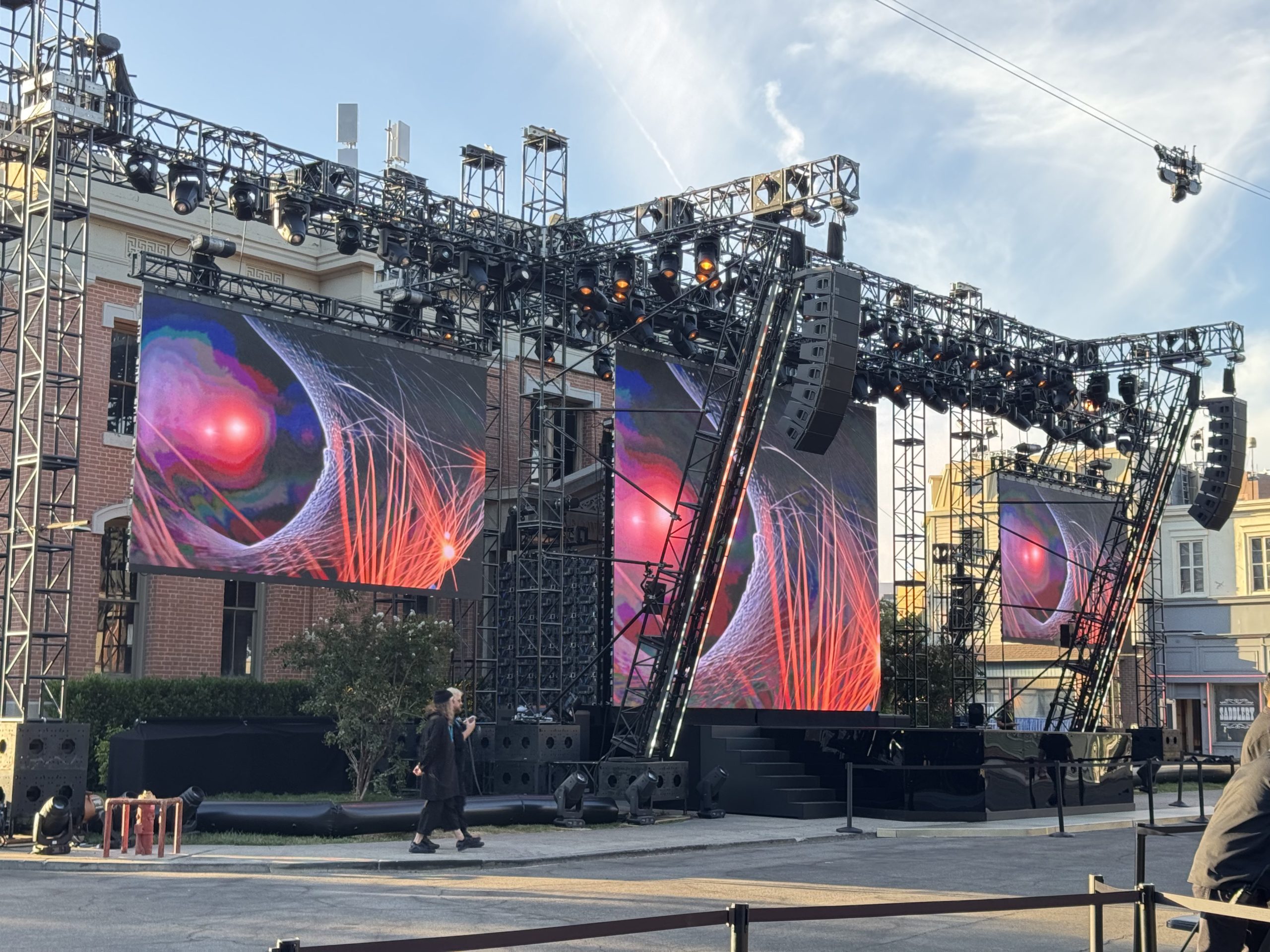

Tesla’s highly-anticipated 10/10 Robotaxi unveiling event, dubbed “We, Robot,” is finally here. To state that expectations are high for the Robotaxi would be an understatement, as CEO Elon Musk has been pretty open about the idea that the vehicle would be a huge player in Tesla’s future.
“We, Robot” is being held at the Warner Brothers Studios in Burbank, CA, with remarks expected to start around 7 p.m. PT. Seemingly highlighting the Robotaxi’s importance to Tesla’s overall potential, watch parties for the event are being held at selected showrooms, and a livestream of the occasion is available online.
The future will be streamed live
10/10, 7pm PT https://t.co/YJEjZIYoTA— Tesla (@Tesla) October 9, 2024
We will be closely following the updates from Tesla’s Robotaxi unveiling event in this live blog. We will also be publishing a number of articles focused on the key announcements at the event. I will be updating this article in real-time, so please keep refreshing the page to view the latest updates on this story. The first entry starts at the bottom of the page.
20:30 PT – And with that, the demonstration rides in the Cybercab are starting! Thank you so much for staying with us for this live blog. We had a blast. Please check out our further coverage of “We, Robot’s” updates. Until the next time!
The robots are dancing. @Tesla #Optimus pic.twitter.com/zu5oDBTCjw— Ryan McCaffrey (@DMC_Ryan) October 11, 2024
20:15 PT – Elon Musk shared an optimistic take on the future. “It will be the age of abundance,” Musk said.
He notes that the Optimus robots would be walking alongside the attendees of the “We, Robot” event. The Optimus robots will serve drinks at the bar. “It’s a wild experience,” Musk said. “And with that, let’s party!”
Autonomy will create the world we want
It covers all transportation needs with fewer cars, since they won't sit idle for most of the day anymore
Instead, cities will be greener & liveable pic.twitter.com/4EAl5ZHLBY— Tesla (@Tesla) October 11, 2024
20:13 PT – An army of Optimus Gen 2 units is now coming out.
“If you extrapolate this, it will be something spectacular. Something you can own,” Elon Musk said. “At scale, this should cost somewhere around $20,000 to $30,000.” A video showcasing Optimus’ home uses is also showcased. “I think this will be the biggest product ever of any kind,” Musk said.
Robotaxi is premium point-to-point electric transport, accessible to everyone pic.twitter.com/oLykwaaTHm— Tesla (@Tesla) October 11, 2024
Faster, more affordable
– No driver fee
– No expensive radar or lidar equipment. FSD uses cameras alone
– Call it once & and it’s yours as long as needed, for quick trips or all day
Will be less than $30k when purchased— Tesla (@Tesla) October 11, 2024
20:11 PT – Musk noted that with the advent of Robotaxis, parking lots could be reclaimed as parks.
The Robovan (Robovin?) also takes to the stage. The vehicle could carry up to 20 people or transport goods. It’s Tesla’s high-density transport.
It looks extremely futuristic, and its cabin looks very spacious.
“The future should look like the future,” Musk said.
Boom. Transit for tunnels! pic.twitter.com/ISZp9Lmvg6— Steve Jurvetson (@FutureJurvetson) October 11, 2024
20:09 PT – “Our autonomous future is here,” Musk said. He also noted that the attendees of the event would have an extended experience with the Cybercab, since the demonstration rides are pretty long.
Musk also announced that the Cybercab will not have a NACS plug. It will use inductive charging instead.
20:06 PT – Elon Musk reiterated that self-driving cars will be a lot safer than humans, because AI and Vision never gets distracted, or drinks. He reiterated the idea that all Teslas today will be capable for unsupervised FSD.
Today's transportation sucks.
It costs too much, isn't safe & isn't sustainable.
Autonomy is your ride, not a car – but safer, faster & affordable pic.twitter.com/J4D8oDtqyf— Tesla (@Tesla) October 11, 2024
20:05 PT – Elon Musk noted that Tesla expects Unsupervised FSD by next year in Texas and California. “We’ll make this vehicle in very, very high volume,” Musk said, though customers can already experience the Robotaxi experience with the self-driving Model 3 and Model Y.
Cybercab production is expected before 2027.
20:03 PT – The cost of autonomous transport would be so low, you can think of it as individualized mass transit, Musk said. It’s premium point to point transportation.
Elon Musk also confirms that the Cybercab can be bought for personal use. “We expect its cost to be below $30,000. I think it will be a glorious future,” Musk said
20:00 PT – Musk notes that today’s transportation kinda sucks. It’s dirty and crowded and exhausting. Especially if you have to drive. If you have a Tesla, it’s a lot better due to FSD (Supervised).
“We’ll move from Supervised Full Self-Driving to Unsupervised Full Self-Driving,” Musk said. He also highlighted that cars tend to cost too much, especially if one were to consider that cars on average tend to get used just 10 out of 170 hours per week. An autonomous car can then be used about five times as much.
“With autonomy, you’ll get your time back,” Musk said, noting that autonomous cars will be ten times safer than human drivers.
pic.twitter.com/LmwazyxR7Z— The Kilowatts ?⚡️ (@klwtts) October 11, 2024
19:58 PT – Elon welcomes everyone to the “We, Robot” party. He calls the Robotaxi the “Cybercab.” There’s 20 more in the event.
“The vehicles are autonomous. No drivers. “We have 50 fully autonomous cars tonight,” Musk said. Driverless Model Ys are in the area as well. “I hope this goes well. We’ll find out,” Elon Musk joked.
19:54 PT – Elon Musk enters the stage. The Robotaxi is here! It is definitely Cybertruck-inspired.
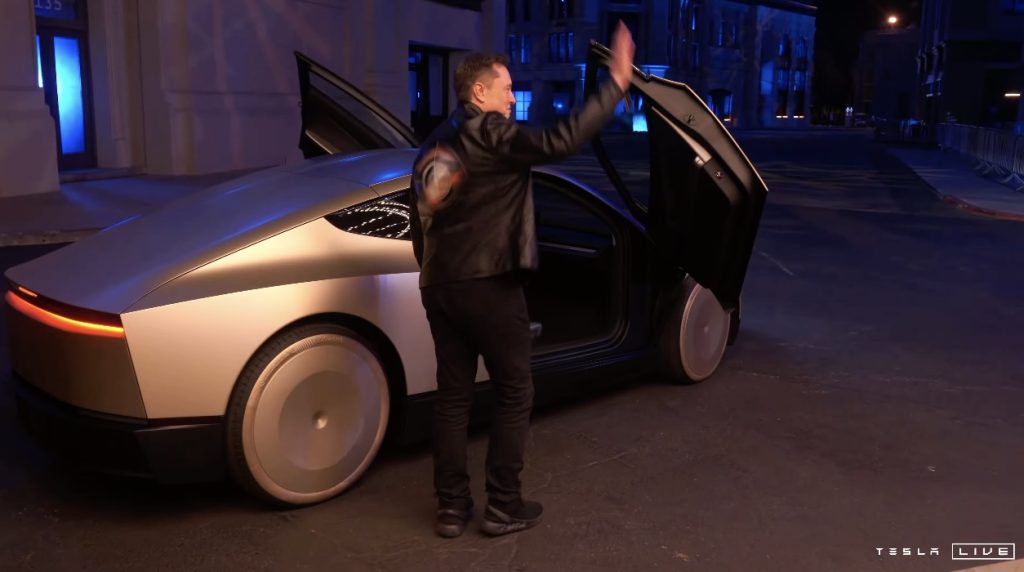
19:53 PT – Ok, the event’s starting. Tesla just posted a disclaimer/disclosure. That’s new. Franz is taking the stage. “We’re here to experience a future that’s closer than you think,” Franz said.
19:45 PT – Nope, still waiting. X live viewers are now up to 2.3 million and YouTube’s livestream is up to 107k now though.
19:44 PT – Ok, the music has stopped in the livestream. Perhaps the event is starting now.
19:41 PT – Elon Musk’s kids have chosen this opportunity to play in front of the stage. They seem to be having tons of fun.
Having fun while waiting for @elonmusk pic.twitter.com/n8hpKZ4htZ— Lincoln (@MobofJoggers) October 11, 2024
19:38 PT – Elon Musk has confirmed that the attendee’s medical emergency has been addressed. The event will start shortly.
A person in the crowd had a medical emergency. We have taken care of them and will be starting shortly.— Elon Musk (@elonmusk) October 11, 2024
19:31 PT – Elon Musk seems ready, if any.
Elon is about to walk out pic.twitter.com/oqJFHM1Nsu— Sawyer Merritt (@SawyerMerritt) October 11, 2024
19:30 PT – Looks like the medical emergency is over. The attendee is reportedly back on their feet, and medics are now clearing out.
19:24 PT – Elon Musk has confirmed that Tesla is taking care of the attendee who had a medical emergency before officially starting the event.
A person in the crowd had a medical emergency, so we’re taking care of them before starting— Elon Musk (@elonmusk) October 11, 2024
19:21 PT – Unfortunately, someone seems to have passed out. Emergency responders are catering to the attendee. Hope the attendee is alright.
Hope he’s okay. pic.twitter.com/WQiSEHWQY0— Tesla Owners Silicon Valley (@teslaownersSV) October 11, 2024
19:18 PT – The X livestream now has 1.1 million viewers. 105k on YouTube.
19:15 PT – The event is now 15 minutes late. This is not very surprising since Tesla tends to start its events late. The anticipation is notable, though. In the event’s livestream, 882k are tuned in on X and another 101k are tuned in to YouTube.
19:13 PT – Thanks so much for the shoutout Steve! You rock!
Casually hanging with @FutureJurvetson during what might be the biggest day in @Tesla history! https://t.co/Puf9dRPEld— TESLARATI (@Teslarati) October 11, 2024
So funny!! Yes
I had not noticed but they are filming right behind me. Go Teslarati!— Steve Jurvetson (@FutureJurvetson) October 11, 2024
19:10 PT – Now there are two helicopters hovering overhead!
A second helicopter ? has arrived at Warner Bros.
We are at a movie studio after all — maybe it's Tom Cruise or Robert Downey Jr? pic.twitter.com/lxZ7WVz5fL— TESLARATI (@Teslarati) October 11, 2024
19:08 PT – The Musk family are here to support Elon. Hello there, Kimbal and Tosca! Mom Maye Musk is here too.
Sup @kimbal @ToscaMusk @mayemusk pic.twitter.com/lgAg3pKoIw— Tesla Owners Silicon Valley (@teslaownersSV) October 11, 2024
The Musks! pic.twitter.com/NkGYeMd7KX— Whole Mars Catalog (@WholeMarsBlog) October 11, 2024
19:03 PT – If the Cybertruck unveiling gave “Blade Runner” vibes, the Robotaxi event is definitely giving “Westworld” vibes. Futuristic, but not dystopian. I personally prefer it.
Hella smoke at the Tesla Robotaxi event
Sick vibes. pic.twitter.com/QBYW50uelr— Tesla Owners Silicon Valley (@teslaownersSV) October 11, 2024
19:00 PT – The livestream is live! Let’s go! On the other hand, these graphics are starting to become a standard for Tesla events.
18:59 PT – One minute to go, everyone!
18:58 PT – There will most definitely be demonstration rides tonight, as per Elon Musk.
Wild rides tonight (literally)— Elon Musk (@elonmusk) October 11, 2024
18:56 PT – Tesla sure knows how to entertain its guests. Good vibes all around.
No signs of Optimus serving drinks just yet… #werobot pic.twitter.com/LXISpBgPWd— Kim Java (@ItsKimJava) October 11, 2024
18:54 PT – Tesla set up its stage behind a road. Attendees speculate that this road may be where the Robotaxi will come out.
Tesla Robotaxi will come out here most likely pic.twitter.com/QdBNdC9vDp— Tesla Owners Silicon Valley (@teslaownersSV) October 11, 2024
18:50 PT – Tesla knows what it’s doing. We haven’t seen a party like this in a while. Last nine minutes!
Extraordinary is the passing grade— Tesla (@Tesla) October 11, 2024
18:46 PT – Tesla is LOCKED IN on this event. So. Much. Attention. To. Detail.
pic.twitter.com/U6uQsqPsGU— Elon Musk (@elonmusk) October 11, 2024
Awesome details around the studio. Tesla went all out pic.twitter.com/CFyMYX1u89— Nic Cruz Patane (@niccruzpatane) October 11, 2024
18:45 PT – It’s 15 minutes before the remarks at “We, Robot” are expected to start, and the energy is positively electric. Unveiling the Robotaxi at Warner Brothers Studios Burbank may have been a genius move, because the vibe here is real.
Check out the YouTube livestream of the event below.
Don’t hesitate to contact us with news tips. Just send a message to simon@teslarati.com to give us a heads up.


News
Tesla Cybercabs take over Austin’s F1 weekend
Tesla Cybercabs swarmed Austin’s F1 Grand Prix as sightings hit a record during race weekend.

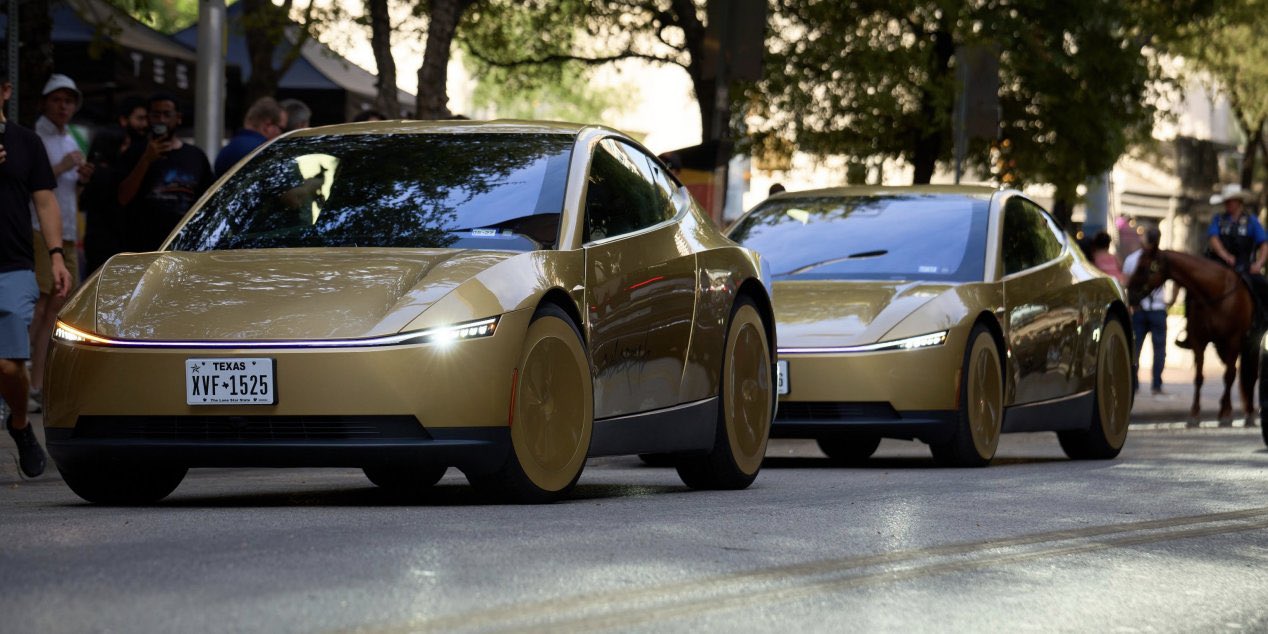
Tesla’s driverless Cybercabs used the Formula 1 United States Grand Prix in Austin as their biggest public stress test yet. On Sunday afternoon, Tesla head of AI software Ashok Elluswamy quoted a photo from X user Ben Steindl showing a long line of gold Cybercabs and Model Y Robotaxis stacked up on a road near Circuit of the Americas. “Robotaxis as far as the eye can see!” Elluswamy wrote. Steindl’s original post was more matter of fact: “@Tesla @robotaxi is busy for the Austin F1.”
The fleet also handled the trip home. The race started at 3 p.m. Central, and once it ended, Cybercab Spotter, an account that logs Cybercab sightings around Austin, posted that “People are requesting Cybercabs to get home.”
Robotaxis as far as the eye can see! 🤩
— Ashok Elluswamy (@aelluswamy) October 25, 2026
Tesla set this up days in advance without announcing it. Late on October 22, rider David Moss posted Robotaxi app screenshots showing the Austin service area wrapping around the track toward Elroy and FM 812, with ride requests open until 1 a.m. A banner in the app read “Last call is 1am · Limited to nearby dropoffs.” Austin rides ended at 11 p.m. as recently as early October, as Teslarati reported, before moving to midnight on October 17.
Not every rider got dropped at the gate. Early app searches showed spots like COTA Karting as “Service blocked,” and one rider who took a Cybercab to the track Friday said the rideshare area was less than a 20 minute walk from the front gate.
The weekend also produced a new activity record. Cybercab Spotter counted 1,250 Cybercab sightings in Austin on Saturday, qualifying day. The previous high was 1,072 on October 16. Sightings count the same car more than once, so they measure how busy the fleet is rather than how big it is. For size, the Texas automated vehicle registry listed 463 Cybercabs at midday Sunday, up from the 300+ Tesla claimed on October 10, when Elluswamy also said Dallas is next for Cybercab.
The track was out of reach for Tesla’s main rival. Waymo runs in Austin only through Uber, and its service area stops well short of COTA. Waymo did not announce any race day service.
Tesla has not said how many rides it gave to and from the circuit, or whether the expanded zone and 1 a.m. cutoff will stay after race weekend. On the third quarter earnings call, Elluswamy said 2 a.m. service is coming “pretty soon” and that Tesla plans to run Robotaxi around the clock before the end of the year. The company is also aiming to hand the first Cybercabs to customers before 2026 ends, which would put cars like these outside Tesla’s own fleet for the first time.
News
Tesla makes good on its Cybercab promise in just two weeks
Tesla Cybercab riders can now pull up a rear camera view and darken the screen.
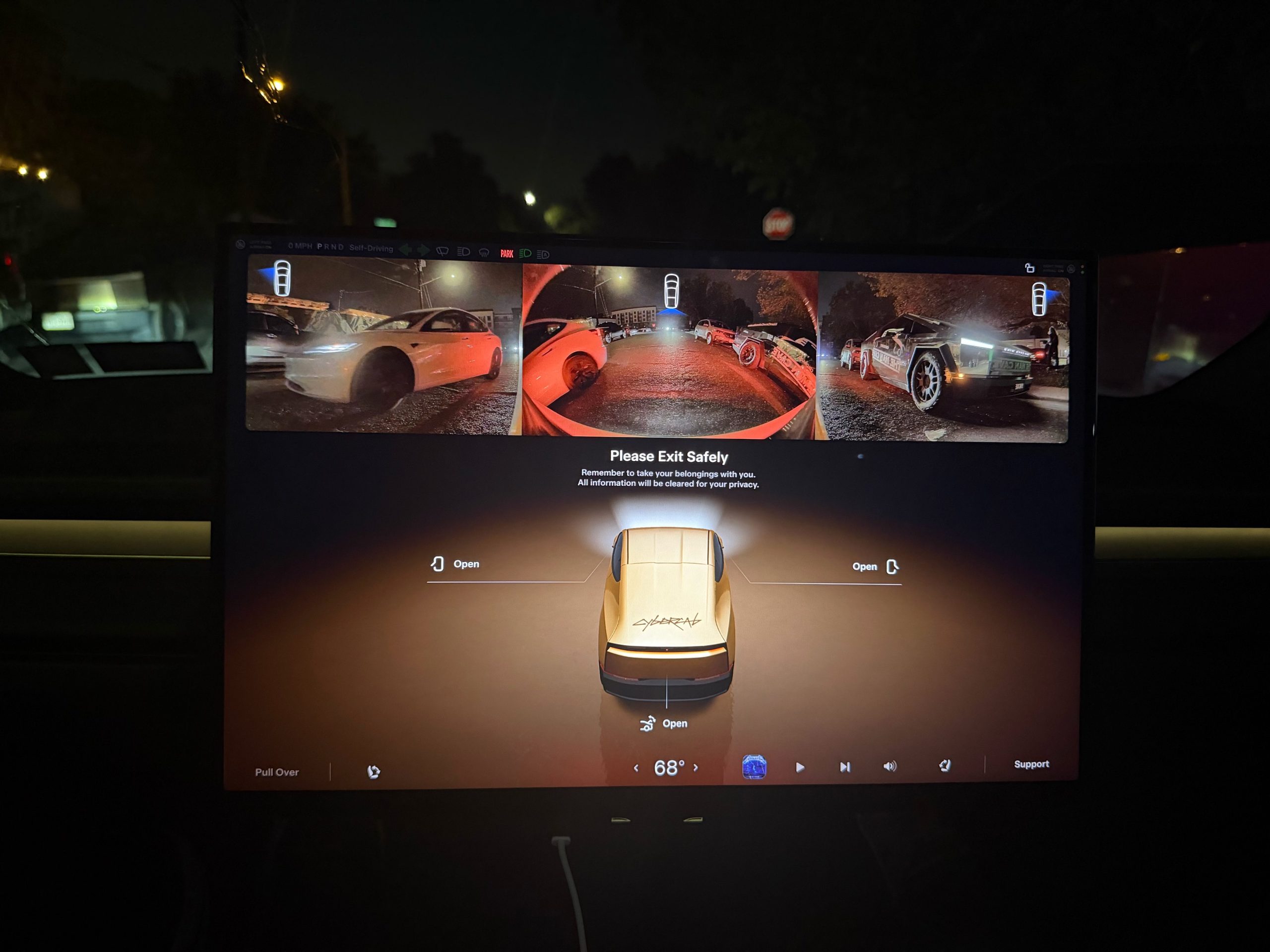
Tesla has given Cybercab passengers a way to see what is behind them, along with a way to turn the cabin screen off entirely.
Riders in Austin can now bring up a live rearview camera feed on the Cybercab’s center display in the middle of a trip. Austin rider Ethan McKanna spotted the change late Friday night, posting from a ride that “You can now open the camera to view what’s behind you in Cybercab!” His photo shows a strip of rear camera video across the top of the screen, with another Cybercab following on a bridge. Sawyer Merritt shared the image Saturday and wrote that it “sounds like” there is also a new quiet mode that darkens the entire screen for riders who want to relax, sleep, or avoid a bright display at night.
The camera view goes beyond the rear feed. Tesla UI software engineer Evan, who posts as @CarCoder, replied to McKanna with a tip: “You can also tap it to see more cameras, and swipe it up or down to hide and show.” Until now, the Cybercab only showed its rear and repeater feeds on the “Please Exit Safely” screen at the end of a ride, so passengers could check for cyclists and traffic before opening a door.
Quiet mode surfaced a day earlier. Austin rider Jackson Blatz posted a video Friday morning of the new Robotaxi interface in a Cybercab with the option. Tesla has not published release notes for either feature.
The rear camera view moved quickly from request to release. Earlier this month, Cybercab rider Dan Burkland asked Tesla to let passengers pull up the rear and repeater cameras whenever they want, “especially for peace of mind.” Evan answered “In development,” as Teslarati reported at the time. About two weeks later, riders have it.
The feature fills a gap created by the Cybercab’s design. With no steering wheel, no pedals, no mirrors and no rear window, a passenger has no natural way to glance behind the car. The eight exterior cameras that feed Tesla’s autonomy software were already on board, so the change only required software.
There is also an AI angle to how it was built. Yun-Ta Tsai, a senior staff engineer on Tesla’s AI team, quoted Merritt’s post and wrote that the “(human) camera view tuning is optimized with Grok and implements part of the algorithm by directly programming the fixed-function hardware, so I don’t even need to check the datasheet.” Tsai did not say which part of the algorithm Grok handled. Grok already plays a bigger role inside the vehicle, with Grok Bot now enabled across every Cybercab and the Model Y Robotaxi fleet after Tesla brought the agent into its cars in September.
The two features join a busy week of changes for riders in Austin, which also brought a redesigned Live Activity for iPhone and Apple Watch and live trip sharing. They also arrive as Tesla prepares the Cybercab for life outside its own fleet. On the third quarter earnings call, Lars Moravy said the company is aiming to deliver Cybercabs to customers before the end of 2026. Tesla has not said whether the camera view and quiet mode will also come to its Model Y Robotaxis.
Elon Musk
Tesla shows what Roadster drivers will see on screen before thruster activation
Tesla’s Roadster video reveals a fighter jet inspired cockpit with a 5,500 PSI thruster gauge.
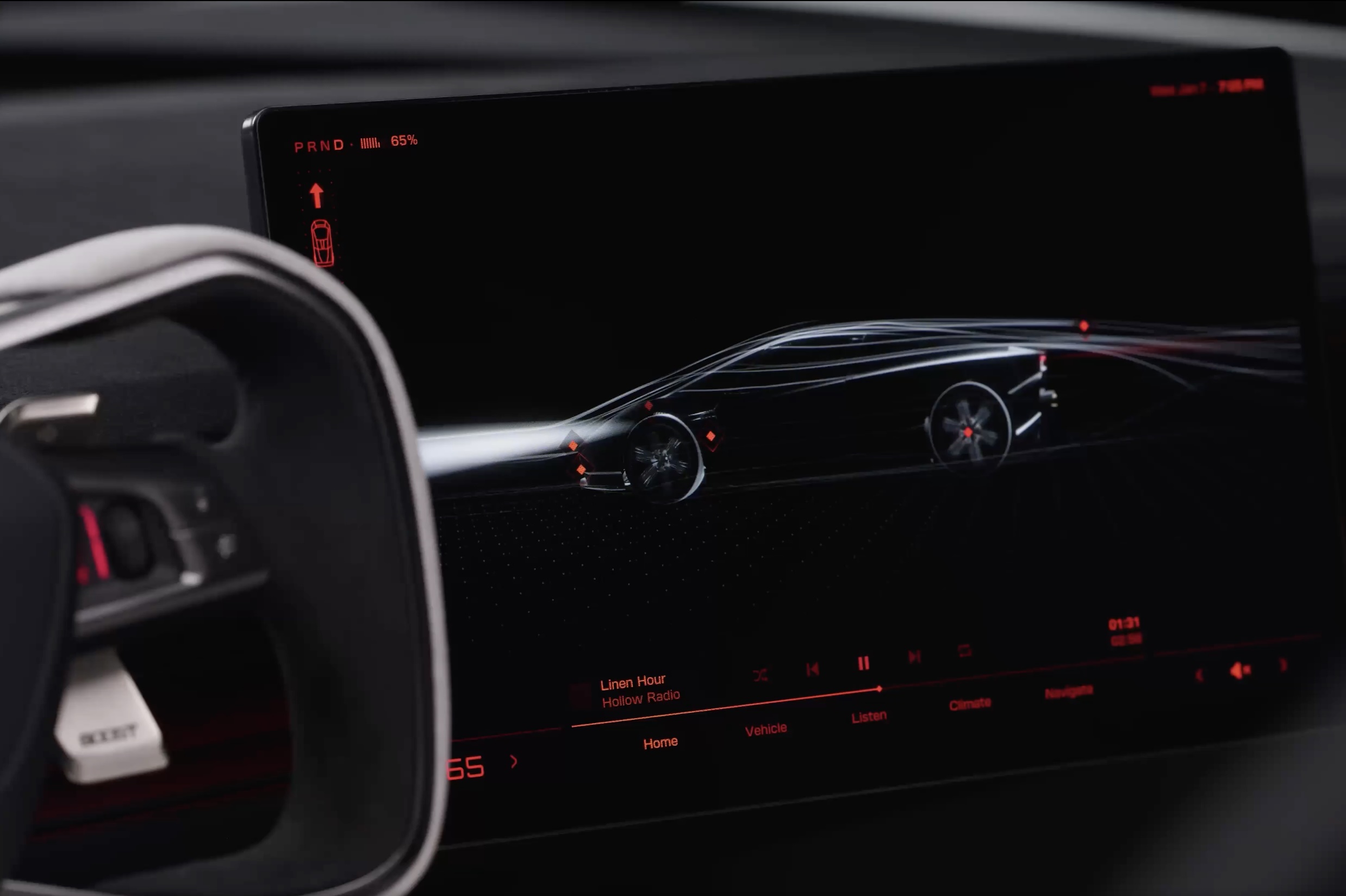
Tesla has given future owners their clearest look yet at the cockpit of its next generation Roadster. In a 34 second video posted to X on Friday afternoon, the company walked through the car’s touchscreen with a caption: “Inspired by fighter jet cockpits, Roadster’s interface was designed around the pilot.”
The clip opens on a black screen with red graphics and a 3D wireframe of the car, which sits beside the Roadster’s squared off yoke. Tapping parts of the model brings up controls for the rear wing, including low drag and high downforce positions, along with a charging page with a charge limit bar and a small music player. A row of tabs along the bottom reads Home, Vehicle, Listen, Climate and Navigate.
Most of the video is spent in Track Mode. The dashboard shows a live circuit map, a list of session lap times, brake and motor temperatures, and pressure and temperature readouts for each tire. A setup page lets the driver pick Auto, Low Drag, High Downforce or Custom aero modes, adjust aero balance and brake balance, and switch stability and traction control off. Along the bottom, a status bar reads “Thruster · 5,500 PSI” next to a “Boost Ready” indicator.
That gauge ties the software to the hardware Tesla showed off near Waco, Texas on October 15. The Thrust and Rocket versions use cold gas thrusters fed by carbon overwrapped pressure vessels, and Tesla lists 0 to 60 mph times of under 0.9 seconds and under 0.59 seconds for them, as Teslarati detailed in its breakdown of the three Roadster configurations. The base Performance car relies on a fan and ground sealing system for grip, and the aero settings on screen match the active wings and suction setup covered in our look at how the Roadster generates downforce.
The Roadster layout is a departure from the rest of Tesla’s lineup. Instead of a map centered screen, the Roadster puts the car itself at the center of the home page, and Tesla’s Roadster page lists two smaller forward displays alongside the main touchscreen. Tesla has not said whether any of the Track Mode telemetry will make its way to the Model 3 Performance or other vehicles.
The interface could still change before deliveries. Elon Musk said at the event that Roadster production will begin in 2028, and Tesla says the flagship Rocket version is not approved for public road use. Reservations are open with a $50,000 payment, while Thrust is listed as a limited release and Rocket is invite only.
Those who want to see the car in person will get their first chance this weekend. The Roadster goes on display in the lobby of the Petersen Automotive Museum in Los Angeles from October 24 to 27, according to Sawyer Merritt, the first time the public will be able to view it up close.

Tesla Cybercabs take over Austin’s F1 weekend

Tesla makes good on its Cybercab promise in just two weeks


