News
Tesla sells 74k vehicles in China in September amid new Model 3 ramp

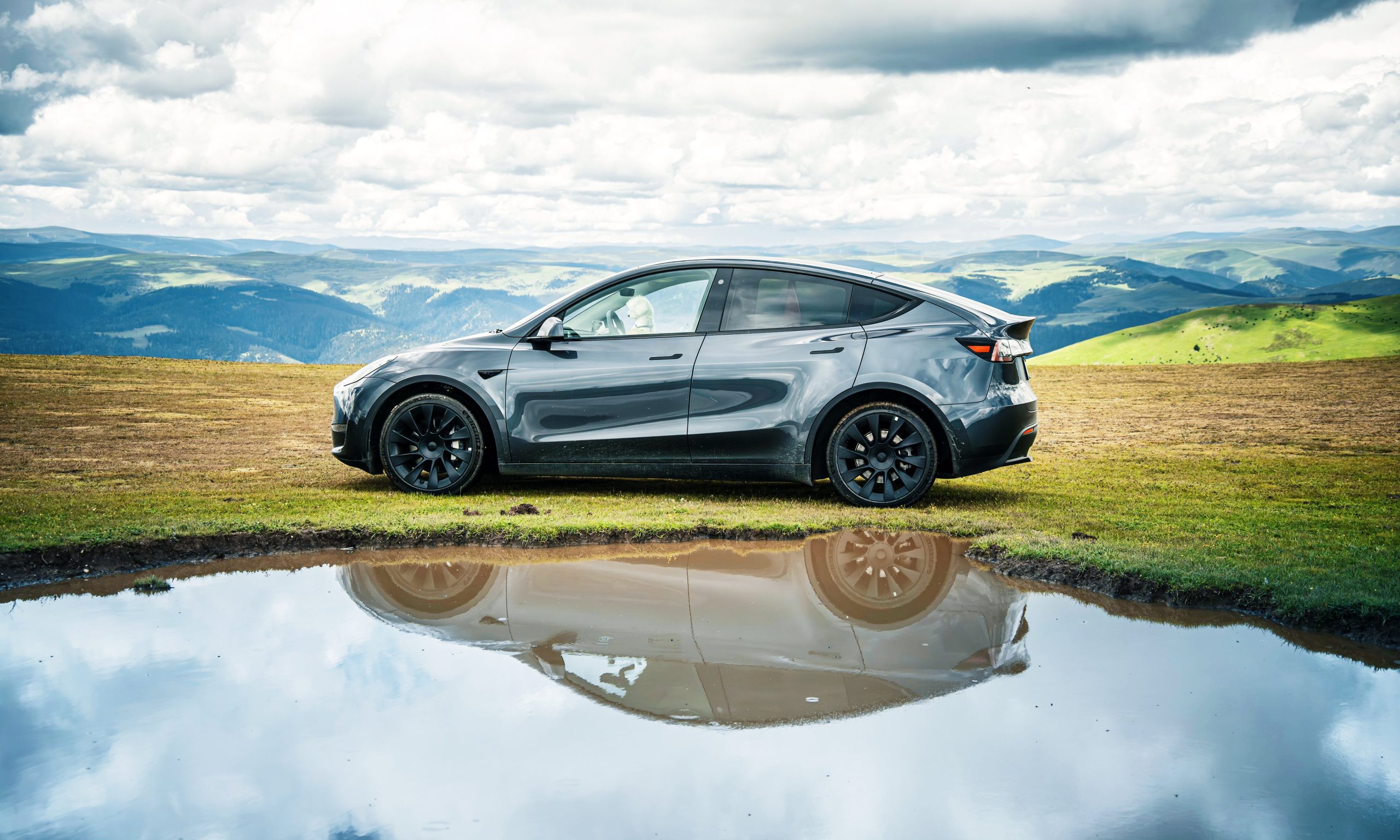
Tesla China sold 74,073 Giga Shanghai-made vehicles in September, down 10.9% from the 83,135 units that were sold a year earlier. Considering that Tesla China sold 84,159 vehicles in August, September’s results also represent an 11.98% month-over-month decline.
The figures comprise vehicles that were sold domestically and exported to foreign territories. They were released by the China Passenger Car Association (CPCA) over the weekend.
While Tesla China saw a decline in sales this September, the electric vehicle maker still posted strong sales for the third quarter overall. In Q3 2023, Tesla sold 222,517 China-made vehicles, up 18.16% year-over-year, as noted in a CNEV Post report. The number also accounts for 51.15% of Tesla’s global deliveries.
For context, Tesla delivered 435,059 vehicles globally in Q3 2023, up 26.53% from a year earlier but down 6.67% from Q2. The company also produced 430,488 vehicles in the third quarter.
Tesla China has so far sold a notable number of vehicles in 2023. As per industry watchers, Tesla China has sold 699,056 Giga Shanghai-made vehicles from the beginning of January to the end of September. That’s a 44.71% year-over-year increase.
It should be noted that Tesla China’s domestic sales were slowed down in September by the absence of the Model 3 sedan. While the Model 3 has been outsold by the Model Y crossover, it still comprises a notable portion of Tesla’s overall sales in China. Tesla released started pre-sales for the new Model 3 in China, which starts at 259,900 yuan ($35,600), though consumer deliveries of the vehicle are yet to begin.
Once domestic deliveries of the new Model 3 are included, Tesla China’s monthly results would likely see a notable improvement. Deliveries of the new Model 3 are expected to begin this fourth quarter, both in China and in territories where the vehicle is offered. Tesla is expected to adopt an aggressive push this fourth quarter, especially as the company is aiming to achieve a worldwide delivery milestone of 1.8 million cars this 2023.
Don’t hesitate to contact us with news tips. Just send a message to simon@teslarati.com to give us a heads up.


Elon Musk
Tesla Supercharger for Business exposes jaw-dropping ROI gap between best and worst locations
Tesla’s new Supercharger for Business calculator reveals an eye-opening all-in cost and location-based ROI projections.

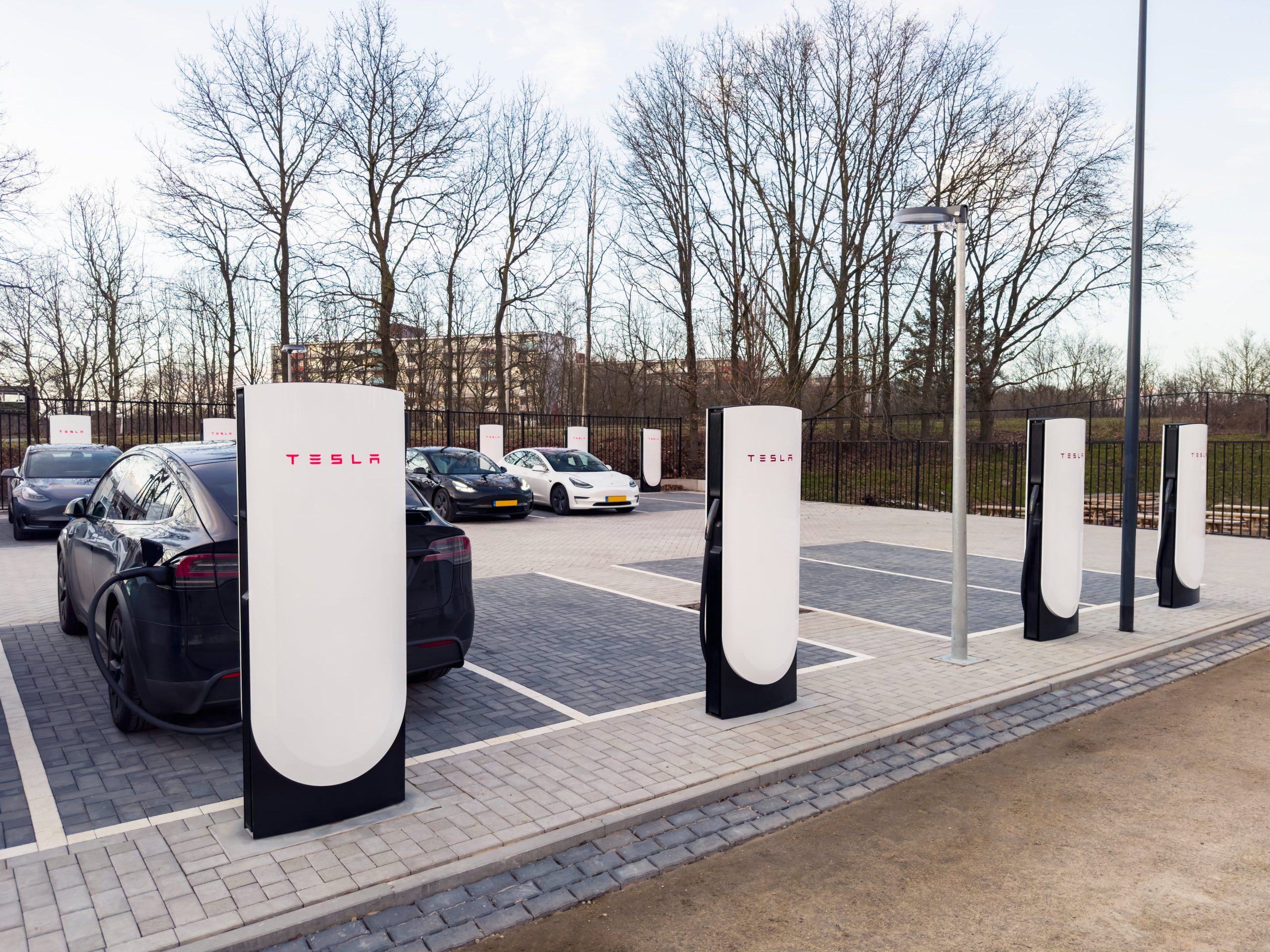
Tesla has launched an online calculator for its Supercharger for Business program, giving property owners their first transparent look at what it really costs to install Superchargers on site and what kind of return they can expect.
The program itself launched in September 2025, allowing businesses to purchase and operate Supercharger hardware on their own property while Tesla handles installation, maintenance, software, and 24/7 driver support. As Teslarati reported at launch, hosts also get their logo placed on the chargers and their location integrated into Tesla’s in-car navigation, meaning drivers are actively routed there. The stalls are open to all EVs, not just Teslas.
We launched Supercharger for Business in 2025 to help companies get charging right. We found simplicity and transparency to be a problem in this industry.
We’re now sharing pricing and a financial calculator to help make informed decisions. The goal is to accelerate investments,…
— Tesla Charging (@TeslaCharging) April 8, 2026
The new online calculator, announced by Tesla on Wednesday with the note that “simplicity and transparency” have been a problem in the industry, lets any business enter a U.S. address and get a real cost and revenue model. A standard 8-stall V4 Supercharger site runs approximately $500,000 in hardware and $55,000 per post for installation, bringing an all-in price just shy of $1 million. Tesla charges a flat $0.10 per kWh fee to cover software, billing, and network operations. Businesses set their own retail price and keep the margin above that fee.
Taking a look at Tesla’s Supercharger for Business online calculator, we can see that ROI is not uniform, and the gap between a strong location and a poor one can stretch the breakeven point by several years.
The biggest driver is foot traffic and how long people stay. A busy rest station, hotel, or outlet mall brings in repeat visitors who need to charge while they’re already stopped, pushing utilization numbers higher and shortening payback time.
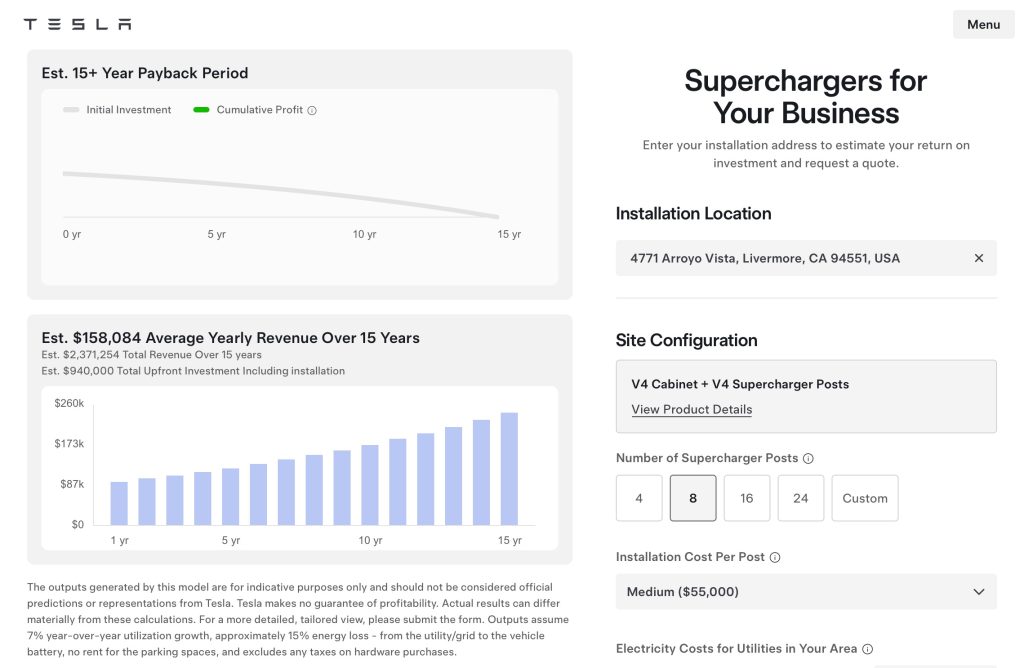
Tesla Supercharger for Business ROI calculator
Local electricity rates matter just as much on the cost side. Markets like California carry some of the highest commercial electricity rates in the country, which eats into the margin between what a host pays per kWh and what they charge drivers. At the same time, dense urban areas with high EV adoption tend to support higher retail charging prices, which can offset that cost if demand is strong enough. Weather also plays a role. Cold climates reduce battery efficiency and increase charging frequency, but they can also suppress utilization in winter months if drivers avoid stopping in exposed outdoor locations. Suburban and rural sites face a different problem: lower baseline EV traffic, which means a site with cheaper power and lower operating costs can still take longer to pay back simply because the stalls sit idle more often. Tesla’s calculator uses real fleet data to pre-fill utilization estimates by ZIP code, so businesses can run their specific address against these variables rather than relying on averages.
The program has seen real adoption. Wawa, already the largest host of Tesla Superchargers with over 2,100 stalls across 223 locations, opened its first fully owned and branded site in Alachua, Florida earlier this year. Francis Energy of Oklahoma and the city of Alpharetta, Georgia have also deployed branded stations through the program, as Teslarati covered in January.
Tesla now exceeds 80,000 Supercharger stalls worldwide, and the calculator makes the economic case for accelerating that number through private investment rather than company-owned sites alone.
News
Elon Musk drops a bomb regarding Tesla Model S, X inventory
After more than a decade on the road, the original flagship sedan and SUV platforms are effectively at the end of the line. Production of new Model S and Model X vehicles has ceased, and custom orders were quietly halted in early April. What remains are roughly a few hundred factory inventory units scattered across the globe, mostly Plaid variants, and they are disappearing fast.

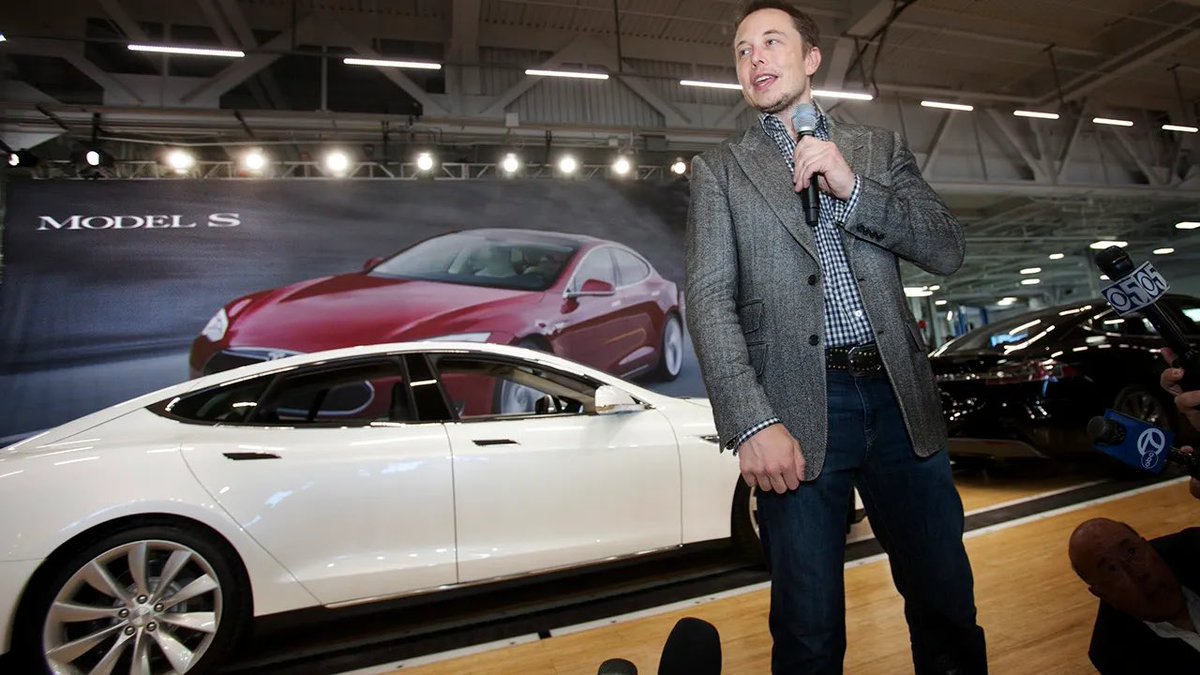
Elon Musk just dropped a bomb regarding Tesla Model S and X inventory, and as the company is phasing out the flagship vehicles, it sounds like the time to purchase one brand new is almost over.
Musk confirmed on Wednesday that there are “only a few hundred Tesla Model S & X cars left in inventory. Order now if you want one.”
Tesla is running out of units rather quickly.
The message from Musk reads like a final call for two of the company’s most storied vehicles.
Only a few hundred Tesla Model S & X cars left in inventory. Order now if you want one.
— Elon Musk (@elonmusk) April 8, 2026
After more than a decade on the road, the original flagship sedan and SUV platforms are effectively at the end of the line. Production of new Model S and Model X vehicles has ceased, and custom orders were quietly halted in early April. What remains are roughly a few hundred factory inventory units scattered across the globe, mostly Plaid variants, and they are disappearing fast.
The news marks the close of a remarkable 14-year chapter. Launched in 2012, the Model S redefined the electric vehicle with blistering acceleration, over-the-air updates, and a luxury interior that embarrassed traditional sedans.
The Model X followed in 2015, turning heads with its Falcon-wing doors and seating for seven.
Together, the Model S and Model X proved EVs could be desirable halo cars, not just eco-friendly commuters. Their departure clears factory space at Tesla’s Fremont plant for something the mass production of the Optimus humanoid robot, which Musk believes will be the greatest contributor to the company’s value.
Musk has repeatedly signaled that Tesla’s future lies beyond passenger cars. Resources once devoted to low-volume flagships are shifting toward autonomy, Robotaxis, and AI hardware. Optimus, the company’s general-purpose robot, is expected to handle manufacturing, household chores, and eventually complex labor.
In the short term, the scarcity has already driven prices on remaining inventory up by about $15,000, turning the last Model S and X into instant collector’s items.
Tesla uses Model S and X ‘sentimental’ value to enforce massive pricing move
The announcement underscores Tesla’s relentless pivot. While the Model Y continues to hold strong sales, the legacy S and X represented an earlier era of pure performance luxury.
The future has been paved by Tesla and Musk’s focus on autonomy, at least in the United States. Customers continue to call for a large SUV, which might be on the way after a recent nudge from Musk on X.
However, whatever the future holds, it has been forged by Tesla’s two flagship vehicles.
Once these final cars are gone, the Model S and Model X will live on only in driveways, forums, and the rear-view mirror of automotive history.
News
Tesla Cybercab production ignites with 60 units spotted at Giga Texas
Designed exclusively for unsupervised Full Self-Driving, the Cybercab promises to deliver safe, affordable, on-demand mobility without human drivers. Early units with temporary controls allow engineers to refine hardware and software in controlled settings before full autonomous fleets hit the roads.
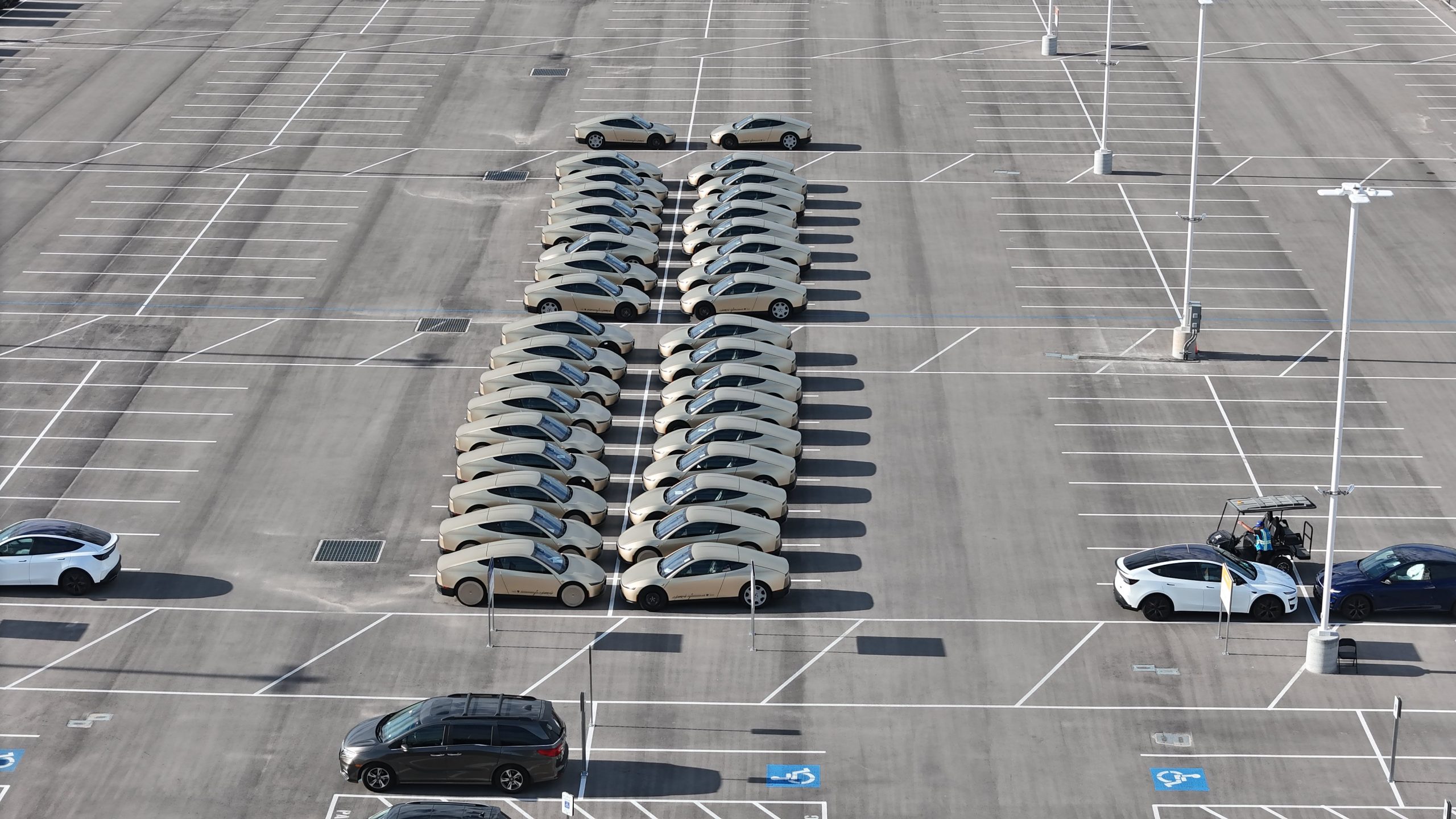
Tesla Cybercab production at Giga Texas seems to have ignited, as 60 units were spotted outside of the production facility on Wednesday, with speculation hinting the all-electric ride-hailing vehicle could be headed to the lineup sooner rather than later.
Interestingly, they were also spotted with steering wheels, which Tesla said the car would be void of.
Giga Texas observer and drone operator Joe Tegtmeyer shared on X a new post that revealed approximately 60 Cybercabs parked in two organized groups in the factory’s outbound lot—the largest concentration observed to date.
Happy 8 April (Wednesday) at Giga Texas, especially for those wanting an update on Cybercabs … I saw about 60 of them in two groups in the outbound lot today … the largest grouping yet!
Also, looks like at least some of these have white seats and most still have clearly… pic.twitter.com/mZbKH96bA7
— Joe Tegtmeyer 🚀 🤠🛸😎 (@JoeTegtmeyer) April 8, 2026
Tegtmeyer noted white seats inside several vehicles and clearly visible steering wheels on most. These are not yet the final steering-wheel-free production versions unveiled in 2024, but early units are likely undergoing validation testing for new features and real-world robotaxi operations across the country.
The timing could not be more symbolic. Tesla has consistently affirmed that mass manufacturing of the Cybercab would begin this month.
CEO Elon Musk has reiterated the April 2026 target multiple times, emphasizing that while initial output will be slow, following the classic S-curve of new-vehicle ramps, the Giga Texas line is being prepared to produce hundreds of units per week.
Tesla CEO Elon Musk outlines expectations for Cybercab production
The first Cybercab already rolled off the line in February, but April marks the official shift to volume production of this purpose-built, pedal- and steering-wheel-free autonomous vehicle.
These 60 Cybercabs signal far more than parked prototypes. They represent tangible proof that Tesla is executing on its ambitious robotaxi roadmap.
Designed exclusively for unsupervised Full Self-Driving, the Cybercab promises to deliver safe, affordable, on-demand mobility without human drivers. Early units with temporary controls allow engineers to refine hardware and software in controlled settings before full autonomous fleets hit the roads.
As production scales, Giga Texas, already home to Cybertruck production, will become the epicenter of Tesla’s autonomous revolution, targeting millions of vehicles annually in the years ahead.
For Tesla and its investors, this sighting underscores manufacturing excellence and timeline discipline. It counters skepticism about the company’s ability to deliver on next-generation vehicles amid a competitive autonomous landscape.
Broader implications are profound: lower transportation costs, reduced emissions, and safer roads as robotaxis proliferate. Musk’s vision of a future where Cybercabs operate 24/7, generating revenue for owners and riders alike, is now visibly underway.
With mass production officially ramping in April, today’s images are not just a snapshot of parked vehicles; they are the first frames of a mobility transformation. Tesla is not only meeting its commitments; it is accelerating toward an era where autonomy reshapes daily life. The Cybercab era has begun.

Tesla Supercharger for Business exposes jaw-dropping ROI gap between best and worst locations

Elon Musk drops a bomb regarding Tesla Model S, X inventory


