Investor's Corner
Tesla Earnings: What to Expect

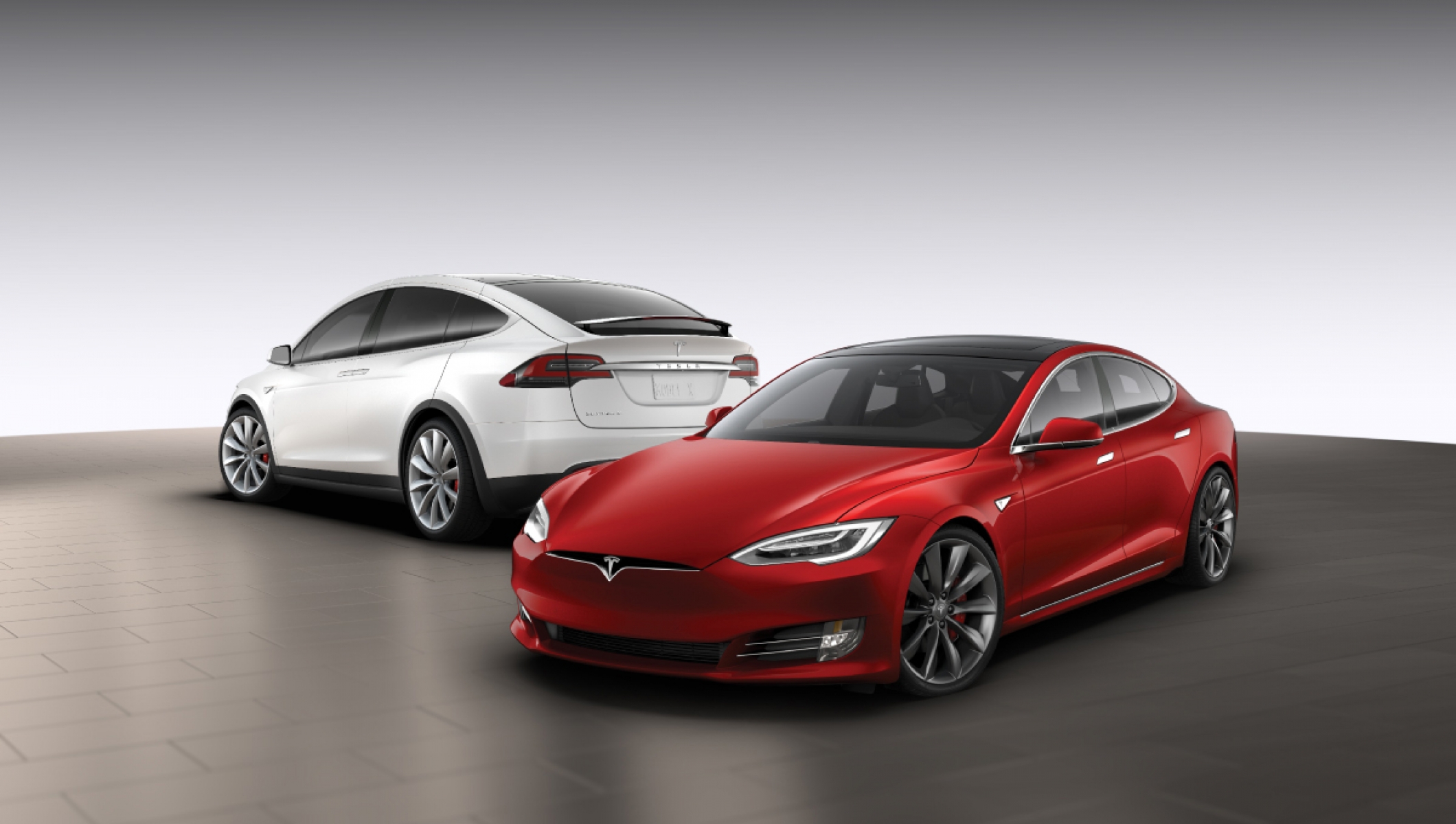
This is a brief update on a few things to watch in Wednesday release of quarterly results and subsequent conference call with company officers.
Model X Deliveries
Tesla reported deliveries of 2,400 Model X vehicles in Q1, below their expected projections, due to supplier part shortages. Tesla stated that “once these these issues were resolved, delivery rates improved dramatically.” But just this weekend, in response to a customer that complained that his Model X 90D, promised by April 15, still had no ETA, Elon Musk tweeted “Have been reviewing end of line production quality personally. Slowed things down temporarily, but its’s for the Best.”
@MacTechGenius @SacEV Have been reviewing end of line production quality personally. Slowed things down temporarily, but it's for the best.
— Elon Musk (@elonmusk) May 1, 2016
Elon response tells me that there are still production quality issues with the Model X and as a result delivery has “slowed down” even in Q2. A second consecutive quarter of Model X deliveries slower than expected would likely affect the annual sales goal of 80,000 to 90,000 for 2016, one of the closest-watched metrics, since it correlates to both the amount of cash needed and the expectation of being able to scale the business, and obtain higher margins.
Analyst Sentiment
Of the top 16 analysts listed on TipRanks covering Tesla, 8 rate the stock as a BUY, 6 as a SELL and 2 as a HOLD (tipranks.com). Only one, Patrick Archambault of Goldman Sachs, recently upgraded its price target to 245, on “Model 3 order strength.” All others reiterated their target, with an average of $244.
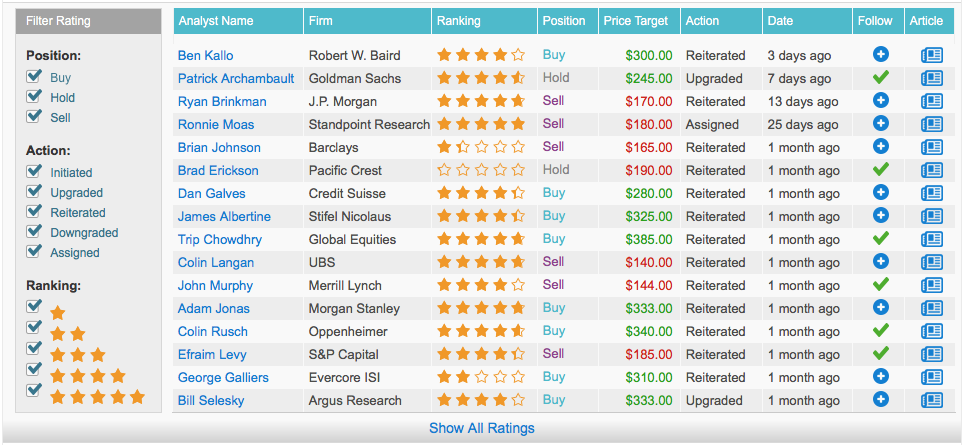
Source: TipRanks
Earnings
The consensus estimate is a per share $ -.57 loss for the quarter. Tesla has a mixed record regarding beating or missing estimates. Zacks Equity Research reports that “Tesla delivered mixed earnings surprises in the last four quarters. It outperformed in two and missed the other two.”
On the other hand, a miss does not seem to affect TSLA as it does other hi-tech stocks like Apple, Netflix, or Google. While Tesla missed the consensus on 4th quarter 2015 earnings, reported on February 10, on that date it started a 78% run to $269.
Short-Term Action
During the past month, TSLA stock has been in “compression”, i.e. without much direction, up or down, hovering between 240 and 260. Moreover, on several occasions, the stock has changed by over $10 during the same session. This type of behavior makes TSLA fairly difficult to trade as there is no momentum, and the stock can swing back and forth fairly quickly. These are periods where I stay out of trying to trade TSLA and look for other more predictable stocks.
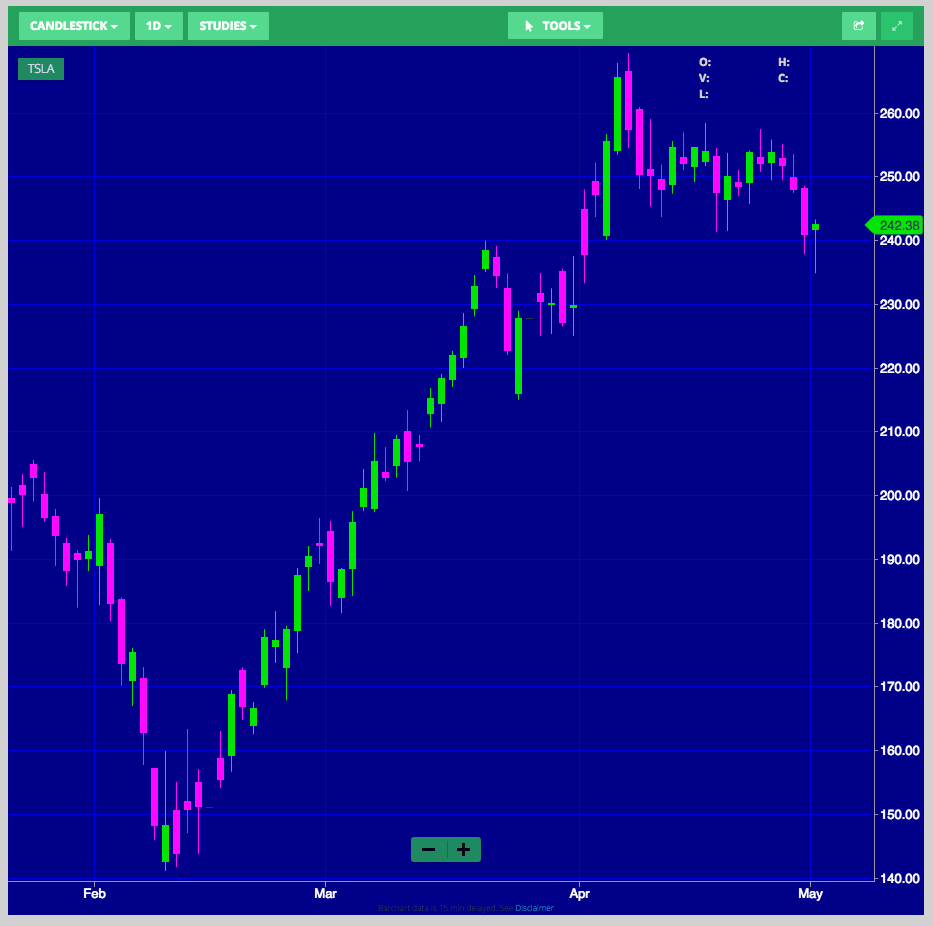
Source: WallSt I/O
Now this latest behavior in TSLA stock was to be expected after such a dramatic move as we had in February and March, and it is actually “healthy” for the stock. After such an incredible run, a cool period, and possibly even a drop, is needed to refuel the bulls.
Live Q&A Webcast
Join the webcast on May 4 at 2:30pm Pacific Time, where officers will discuss the Company’s financial and business results and outlook.
I’ll be listening to the Webcast and will report on my analysis in my next post.


Elon Musk
SpaceX Starship Flight 13 aborted at Zero and Musk just told us what broke
Four Raptor engines failed to ignite at T-zero, forcing SpaceX to scrub Starship Flight 13 Thursday.

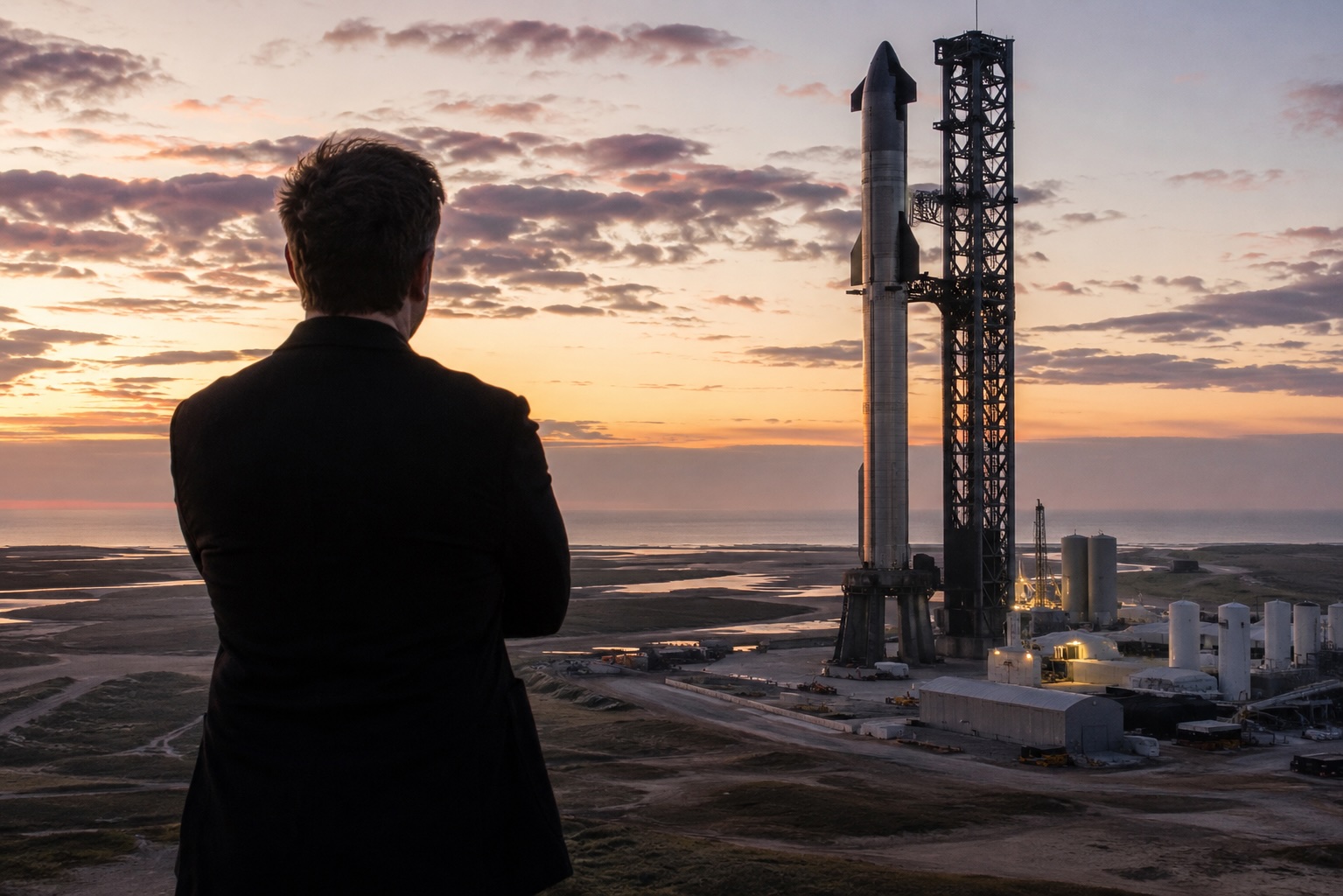
SpaceX scrubbed the Starship Flight 13 launch attempt Thursday evening at the last possible moment, after four of the Super Heavy booster’s 33 Raptor 3 engines failed to ignite during the startup sequence. The 90-minute window had opened at 6:45 p.m. EDT from Starbase in Boca Chica, Texas, and the countdown had proceeded without issue all day, with more than 11.5 million pounds of liquid methane and liquid oxygen being fully loaded into the rocket before the automated abort triggered. SpaceX’s launch directors posted on X, “Standing down from today’s flight test attempt,” and shut down the livestream shortly after.
Musk confirmed the root cause within hours. “Some of the engines didn’t start, triggering an automatic launch abort,” he wrote on X. “To be confident of a good flight, 2 Raptors will be removed and replaced. Most probable launch timing is early next week.” SpaceX engineers began draining propellant tanks immediately and Booster 20 was rolled back to its hangar for inspection.
The timing adds a layer of significance that did not exist during any of the previous 12 Starship flights. This is the first time SpaceX has attempted to launch Starship since the company made its stock market debut in June, listing under ticker SPCX at $135 per share. Public investors are now watching every Starship outcome in real time, and a last-second abort carries more visibility than it would have six months ago.
Flight 13 was designed to be one of the most consequential tests in the program’s history. It was set to carry 20 Starlink V3 satellites, the first operational payload Starship has ever attempted to deploy. Six of those satellites carried external cameras to photograph Starship’s heat shield from the outside during flight, which would act as a self-inspection approach SpaceX has never attempted before. The mission also needed to complete a Raptor engine relight in space, a step SpaceX skipped on Flight 12 in May after losing an engine during ascent. That Flight 12 booster also flipped 90 degrees off course during its boostback burn when five engines failed to reignite.
SpaceX has not announced an official next launch date. Musk’s “early next week” window points to July 21 or 22 at the earliest, pending the engine swap and a return to the pad.


Lucid CEO Silvio Napoli responded to rumors of an imminent bankruptcy that was reportedly being mulled after a report stated the automaker was working with the firm AlixPartners to iron out its next steps.
The company felt a massive loss on Wall Street yesterday, as the report essentially pushed the stock down as much as 55 percent on Tuesday.
The report, published initially by Eletric-Vehicles.com, claimed Lucid was essentially in dire straits and was told by AlixPartners, a commonly used restructuring advisor, to either take shares private or file for Chapter 11 bankruptcy protection.
Lucid’s head of Communications, Nick Twork, immediately challenged the report and stated the company “has sufficient liquidity to carry its operations well into next year.”
Now, the company’s CEO is chiming in as well, stating that the report is “so far from the facts that they require a direct response.”
Napoli said:
“Lucid is not considering bankruptcy or a transaction to take the company private. Those reports are false. The Board did not explore either scenario. Period.
As disclosed in our most recent quarterly filing, Lucid has sufficient liquidity to fund its operations well into next year.
We work with outside advisors to improve operational performance and execution. They are not advising Lucid on a take-private transaction or bankruptcy, and any suggestion that they have recommended either course of action to management or the Board is false.
My priority is clear: turn this company around. That is where the leadership team and I are focused.
I look forward to providing a full update during our quarterly earnings call on August 4th.”
🚨 Lucid CEO Silvio Napoli calls rumors of financial issues “so far from the facts that they require a direct response.”
Read his full remarks here: https://t.co/t3Pg1NHvzy pic.twitter.com/LvHUPhO4Qf
— TESLARATI (@Teslarati) July 15, 2026
It seems pretty clear that Lucid is confident things will be okay, and, to be honest, they should not have much to worry about, especially considering the company has been backed by the Saudi Public Investment Fund (PIF) for years. It has solid financial backing, and its sales, while weak, are pretty much right on par with a company of this age.
Lucid also sent a Cease & Desist letter to the publication for their report.
Lucid shares have rebounded nicely and are up nearly 21 percent at the time of publication. As soon as the company dispelled the rumors of bankruptcy yesterday, the stock began to climb back toward more reasonable levels.

Electric vehicle maker Lucid Group has denied rumors of an imminent bankruptcy after a report from this morning sent the stock on a dramatic drop on Wall Street, seeing losses of more than 40 percent during trading hours.
Lucid’s Director of Communications, Nick Twork, responded to the report from Eletric-Vehicles.com, which stated the company’s restructuring advisor, AlixPartners, was asked to review two decisions: taking Lucid shares private or filing for Chapter 11 bankruptcy protection.
The report also claims AlixPartners told the Lucid board to “concentrate on Gravity production while improving its quality, and to temporarily hold back the Lucid Air, the sedan that has defined the company since its launch.”
Twork said:
$LCID The rumors are completely false. The company has sufficient liquidity to carry its operations well into next year, as recently published in its last quarterly filings, and it has not formed any special Board committee to explore the scenarios reported today. Our focus is…
— Nick Twork (@ntwork) July 14, 2026
Shares rebounded after the response to the report, halving its losses as the trading day neared 3 p.m. Eastern.
Lucid has struggled to get its sales off the ground and into more respectable numbers, but the company is in its early years, when things are hard to begin with. It is also backed by several notable investors, including the Saudi Public Investment Fund (PIF), which has nearly limitless money and likely would not ditch an investment of this size so soon.
Lucid shares were down just 14 percent at the time of publication, a far cry from the 55 percent its losses topped out at during the day.

Elon Musk says your Tesla will start to learn your individual preferences

Ron DeSantis calls out media bias in Tesla crash coverage


