Investor's Corner
Tesla Gigafactory 1 expands with massive new lot as site activity increases

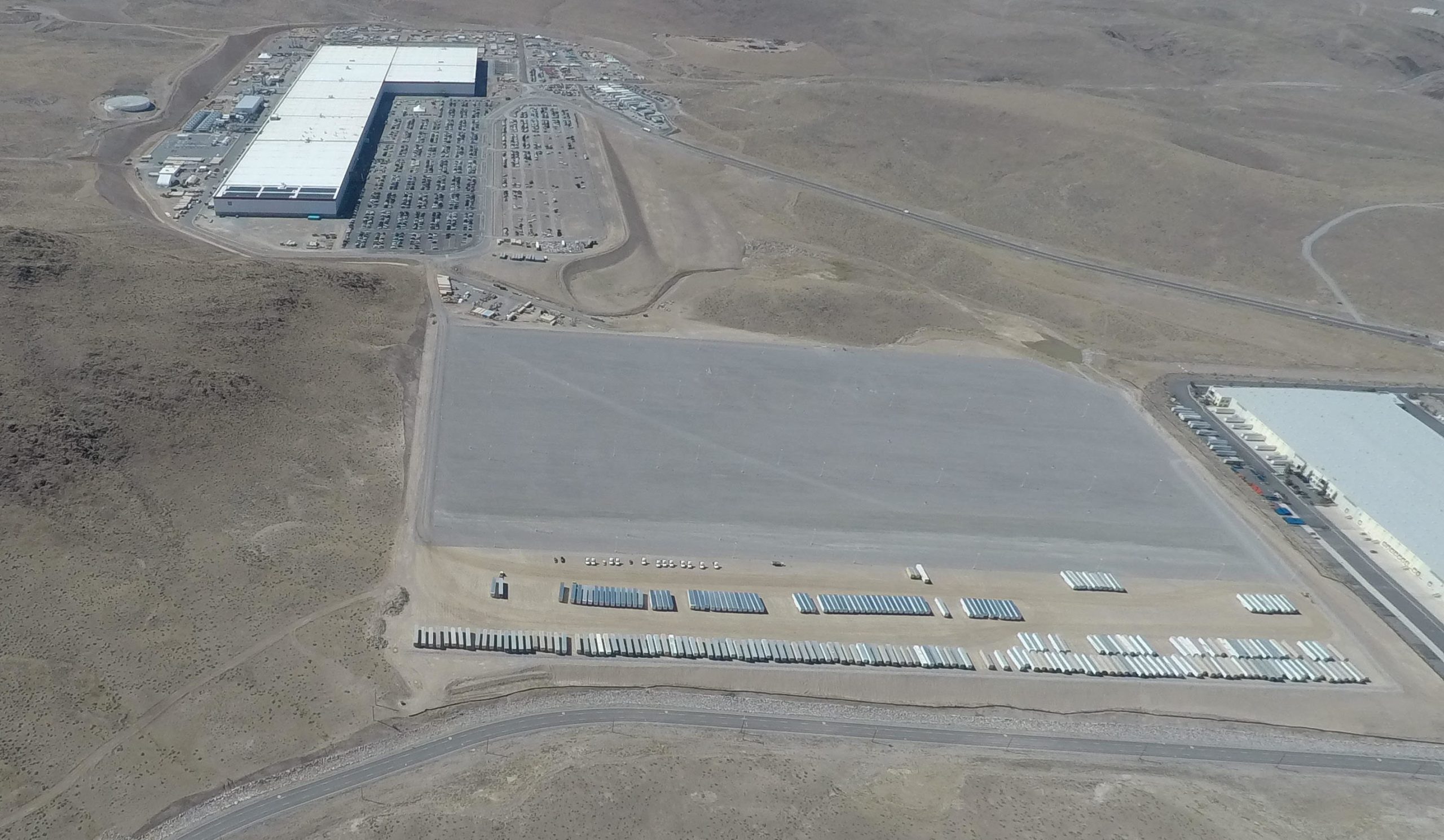
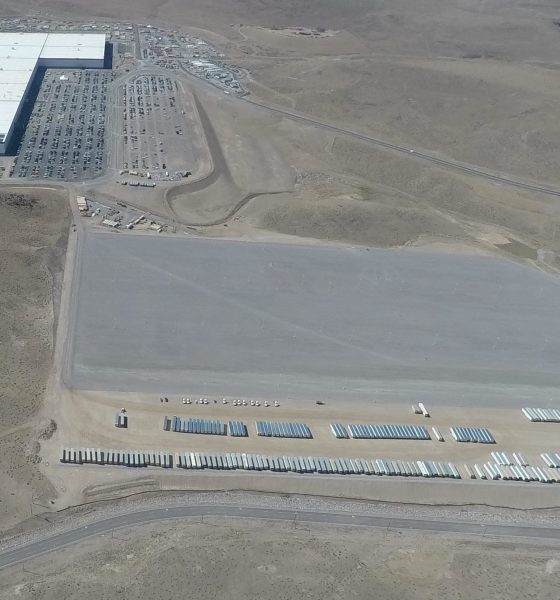
Aerial photographs obtained by Teslarati have revealed that Tesla’s expansive new parking lot in Gigafactory 1 is practically complete. As seen in the latest images, which we obtained on June 1, Tesla is done overlaying its new lot with asphalt, and numerous electric posts now stand in the area.
Tesla started moving the land north of Gigafactory 1 sometime in March. As noted by avid members of the r/TeslaMotors community then, the new parking lot appears to be around 2,000 x 1,500 ft (roughly 600 m x 470 m). The massive parking lot seems to have been developed quickly as well, as aerial images captured a few weeks after initial reports of the project indicated that Tesla was halfway done overlaying the new lot with asphalt.
-
- An aerial photo of Tesla’s Nevada Gigafactory as of June 1, 2018. [Credit: Joshua Mcdonald]
-
- An aerial photo of Tesla’s Nevada Gigafactory as of June 1, 2018. [Credit: Joshua Mcdonald]
-
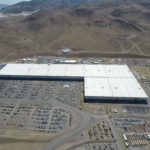
- An aerial photo of Tesla’s Nevada Gigafactory as of June 1, 2018. [Credit: Joshua Mcdonald]
-
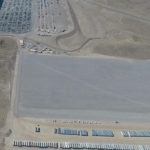
- A close up of Tesla’s expansive new parking lot at Gigafactory 1. [Credit: Joshua Mcdonald]
-
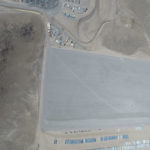
- An aerial photo of Tesla’s Nevada Gigafactory as of June 1, 2018. [Credit: Joshua Mcdonald]
-
- A close up of Tesla’s expansive new parking lot at Gigafactory 1. [Credit: Joshua Mcdonald]
Overall, the latest developments in Gigafactory 1, together with the installation of solar panels at the facility’s roof, underscore increased activity within the factory itself. The site, after all, is working around the clock in order to ramp up production of the Model 3’s battery packs. Just last week, reports emerged that Tesla has flown in six airplanes’ worth of new robots and equipment from Europe, the first two of which had reportedly been delivered at the Sparks, Nevada facility.
According to people familiar with the matter, the deliveries of the robots were done “in a massive hurry.” One of the individuals, who spoke to Reuters, further noted that engineers from Grohmann, Tesla’s engineering arm in Germany, were also in Gigafactory 1 to help address production bottlenecks in the Model 3 battery pack line.
The Model 3 production ramp is Tesla’s primary objective this second quarter. Despite missing its goal of producing 2,500 Model 3 per week by the end of Q1 2018, Tesla has nonetheless maintained its expectations of producing the compact electric car at a rate of 5,000 per week by the end of Q2 2018. In order to accomplish this elusive goal, both Tesla’s Fremont factory and Gigafactory 1 have to work at optimum efficiency.
Recent signs of the developments in the Model 3 production line have been encouraging so far. In May alone, Tesla registered more than 18,000 new Model 3 VINs, a number that took the company until March to achieve, despite starting the production of the vehicle mid-2017. Apart from this, a leaked email from CEO Elon Musk to Tesla employees also revealed that the company has been producing the Model 3 at a consistent rate of 500 vehicles per day, or roughly 3,500 per week.
Optimizing Gigafactory 1 and refining the Model 3 production ramp are just a few steps in the company’s overall plans, however. During Tesla’s Q1 2018 earnings call, Tesla CEO Elon Musk revealed that the next Gigafactory would be built in China. What’s more, Musk also announced that the upcoming facility would have the capability to manufacture vehicles. Ultimately, Musk stated that “future Gigafactories will all incorporate vehicle production.”
Establishing its next Gigafactory in China is a strategic move for Tesla, considering that Elon Musk has specifically mentioned during Tesla’s Q3 2017 earnings call last November that the upcoming facility will be tasked with manufacturing the next vehicle in Tesla’s lineup — the Model Y, an all-electric, crossover SUV that is expected to have a demand that surpasses even that of the Model 3.


Investor's Corner
Tesla just did something in South Korea that no foreign carmaker has ever done
Tesla’s Model Y just became South Korea’s best-selling car, beating every domestic model in May.

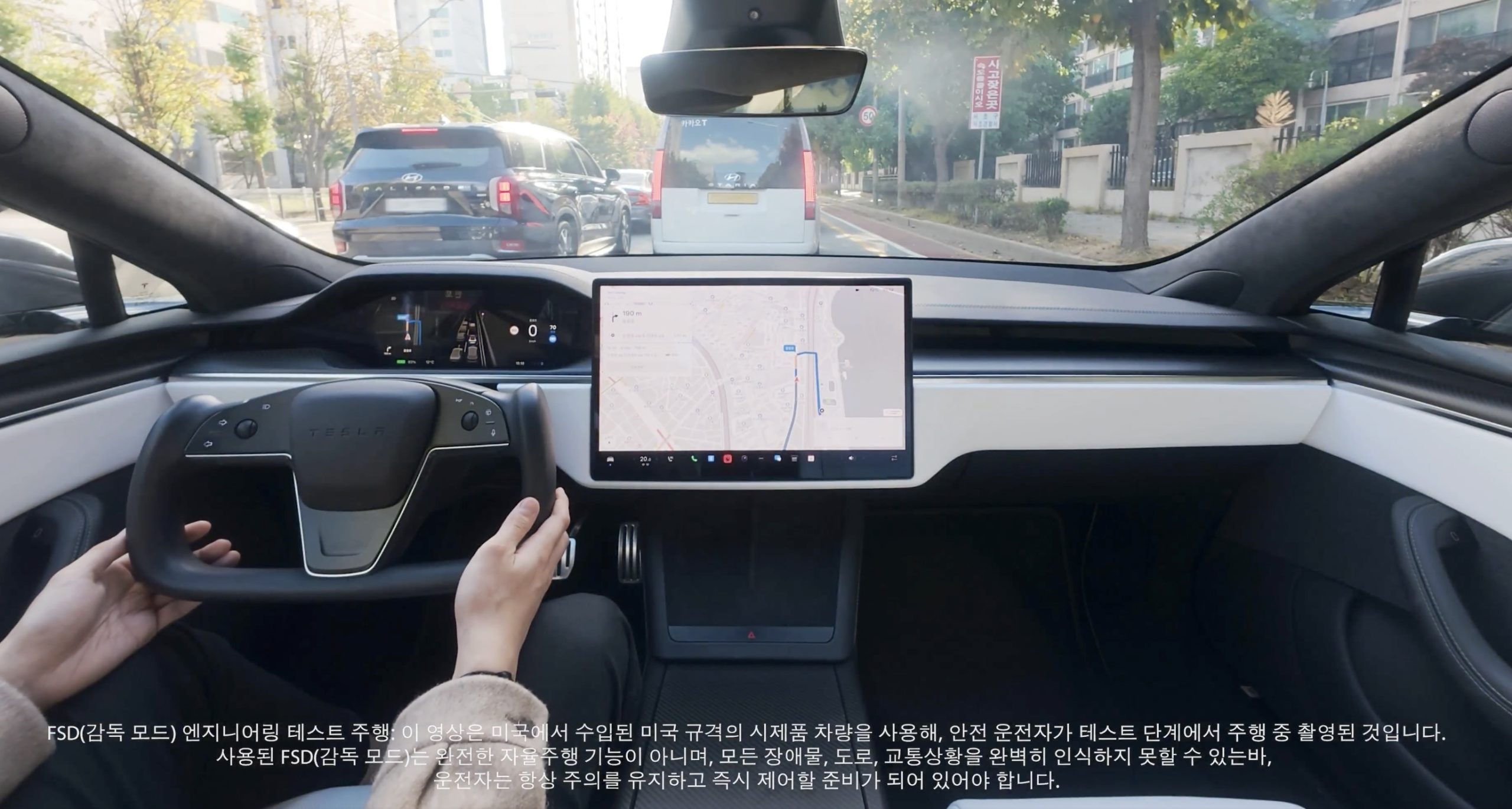
Tesla did something last month that no foreign car has ever done in South Korea by outselling every vehicle in the country, domestic or imported, finishing the month with Model Y as the single best-selling car across the entire Korean market. According to data from the Korea Automobile Importers and Distributors Association released on June 4, the Model Y recorded 8,762 units sold in May, pushing the Kia Sorento into second place at 7,836 units and the Hyundai Grandeur into third at 5,183 units. It is the first time an imported vehicle has outsold every domestic model on a single-month basis.
Tesla imported 10,866 cars into South Korea in May, making it the top import brand for the fourth consecutive month. BMW followed at 6,555 units, less than two-thirds of Tesla’s total, while BYD registered just 1,032 units. The combined domestic sales of GM Korea, Renault Korea, and KG Mobility last month totaled just 7,019 units, meaning a single Tesla model outsold three Korean automakers combined.
Tesla FSD earns high praise in South Korea’s real-world autonomous driving test
South Korea has historically been one of the hardest markets for foreign automakers to crack. Hyundai and Kia together control close to 70% of the overall market and carry deep consumer loyalty built over decades. Tesla’s path into this market was an uphill battle due to high import duties, limited service infrastructure, and early skepticism about charging networks. In 2024, the Model Y was the best-selling imported car in South Korea with 18,717 units for the full year. By 2025, after the Juniper refresh, it cleared 50,000 units and took the top spot among all EVs.
Year to date, Tesla has a 250.8% increase in the country over the same period last year, and now holds a 30.8% share of the entire imported car segment for 2026. EVs as a category represented 48.6% of all imported passenger car registrations in May. As Teslarati has reported, the Juniper refresh brought meaningful improvements to range, interior quality, and ride refinement that addressed the most common criticisms of earlier Model Y versions. Those upgrades appear to be resonating in markets like South Korea where buyers compare Tesla directly against high end domestic competitors.

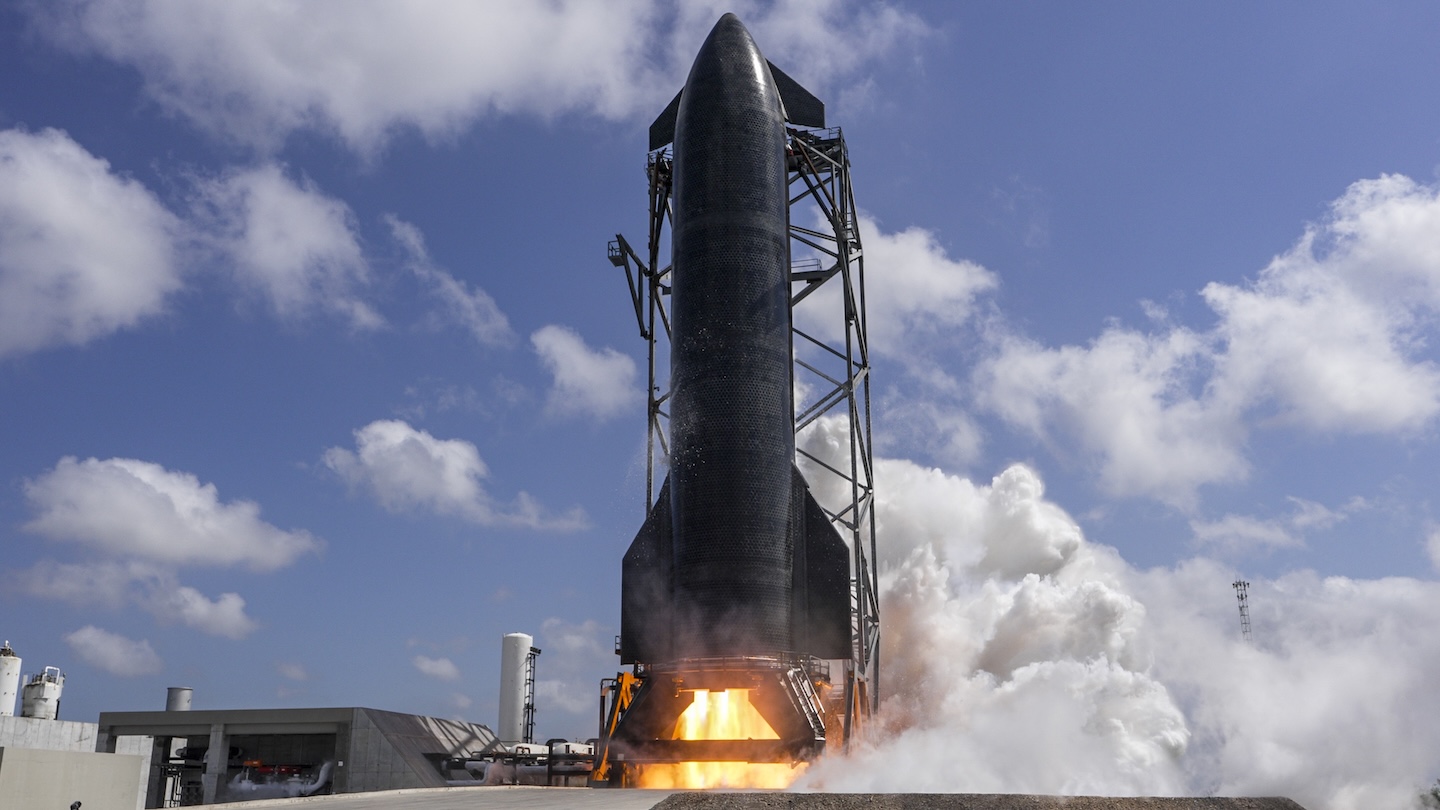
The Ontario Teachers’ Pension Plan (OTPP) stands to reap one of the most extraordinary returns in pension fund history thanks to a bold 2019 investment in SpaceX.
According to a recent report from The Globe and Mail, the Toronto-based fund invested roughly $300 million CAD (~$220 million USD at the time) in Elon Musk’s space company as its inaugural deal through the Teachers’ Innovation Platform.
At SpaceX’s anticipated $1.75 trillion IPO valuation, set for a mid-June debut on Nasdaq under ticker $SPCX, that stake could now be worth up to $11.6 billion USD. This would represent a roughly 50x return and easily become OTPP’s most successful single investment ever.
The fund manages $279 billion in assets for approximately 346,000 working and retired teachers in Ontario, potentially delivering an average boost of around $33,500 per member if fully realized.
SpaceX has filed its S-1 and plans to price shares at $135 each, aiming to raise a record $75 billion in what would be the largest IPO in history, surpassing Saudi Aramco. The company reported $18.67 billion in revenue for 2025, driven primarily by Starlink satellite internet growth and NASA contracts, though it continues to post significant losses tied to ambitious R&D in Starship and AI initiatives.
Important pieces moving forward include:
- Starlink Expansion: The satellite broadband service is scaling rapidly, targeting global connectivity, especially in underserved rural and remote areas. This segment offers massive recurring revenue potential as numbers climb.
- Starship and Reusability Leadership: SpaceX’s fully reusable Starship aims to slash launch costs dramatically, enabling frequent missions, Mars ambitions, and lucrative government/defense contracts. Success here could unlock exponential growth.
- AI and Diversification: Recent moves, including ties to xAI, position SpaceX in high-growth AI infrastructure, broadening beyond traditional aerospace.
- Validation Scrutiny: While the $1.75 trillion target excites investors, analysts like Morningstar value the company closer to $780 billion, citing high multiples (around 90x trailing revenue) and execution risks. A 180-day lockup period will prevent early investors like OTPP from selling immediately post-IPO.
The irony has not been lost on observers. Ontario’s government previously canceled a Starlink rural internet contract amid political tensions involving Musk, yet the pension fund’s savvy investment, made when SpaceX was valued around $33-36 billion, and Starlink was nascent, delivers outsized gains independent of politics.
For OTPP, this windfall strengthens its already solid 111 percent funding ratio and underscores the value of patient, innovation-focused capital allocation.
For SpaceX, the IPO marks a new chapter: greater transparency, access to public markets for talent retention and growth capital, and heightened pressure to deliver on its multi-planetary vision.
All eyes are fixed on whether SpaceX can justify its lofty valuation through sustained execution. For Ontario teachers, the returns are already stellar, but SpaceX, like other Musk companies in the past, has plenty of things to prove. Perhaps the most ideal person for the job is at the helm, hoping to bring the company to a massive valuation.
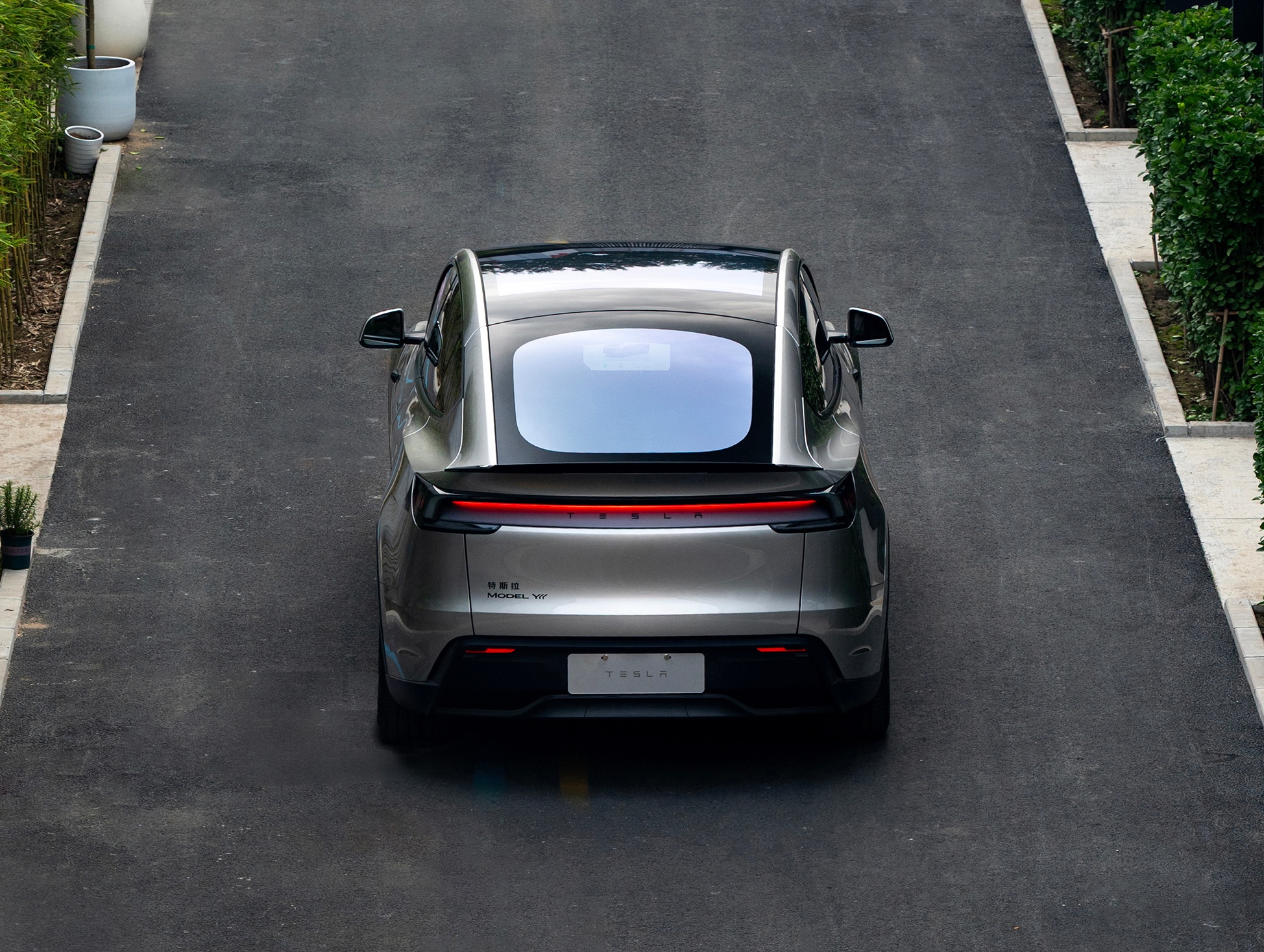
Tesla has its answer to grow its automotive sales over the next few years, TD Cowen analyst Itay Michaeli says, but it just has to bring it to the U.S.
On Thursday, Michaeli reiterated his $490 price target and the ‘Buy’ rating he already held on Tesla stock (NASDAQ: TSLA). However, its automotive division has struggled to show sequential growth over the past few years, mostly due to its focus on AI and Full Self-Driving. Tesla already axed two of its lower-volume vehicles with the Model S and Model X earlier this year.
However, Tesla does not need to engineer an entire new vehicle to trigger an upward tick in sales; it just has to bring it from China to the U.S., Michaeli said.
He is talking about the Model Y L, a slightly larger version of the all-electric crossover that is already available in China. U.S. customers have been pleading with CEO Elon Musk to bring it to the country since its launch in Asia last year, but he’s not convinced of it because of the advent of self-driving and its importance in this particular market.
The problem is that Tesla owners have been requesting something larger that could fit a typical American family. The Model Y L is slightly larger than the standard Model Y, but some are concerned that it could still be too small to fit what most people might need.
Instead, they have asked for a full-size SUV from Tesla.
Tesla gives big hint that it will build Cyber SUV, smaller Cybertruck
Nevertheless, the Model Y L still presents a great opportunity for Tesla in the U.S., and Michaeli says that there is an additional sales opportunity of about 100,000 units, with demand potential falling somewhere between 60,000 and 135,000 units.
TD Cowen’s note to investors also analyzed that Tesla’s growth could come from a stock perspective as well, positively impacting the stock price, as it has been widely reliant on vehicle sales, even though Tesla has truly phased itself away from that being an important metric.
Tesla stands to gain greatly from the introduction of the Model Y L in the U.S., but only if Elon Musk sees it as a viable fit for the market. Families may need to see Tesla bring something larger to the U.S., or they might be forced to buy from another automaker that offers something that fits is needs for more interior space to haul around the kids.

Tesla revises FSD transfer policy on new Cybertruck trim, causing cancellations

Tesla tipped its hand at where Robotaxi is heading next


