Energy
Tesla under the gun to create jobs at Gigafactory 2 in Buffalo, NY as countdown begins

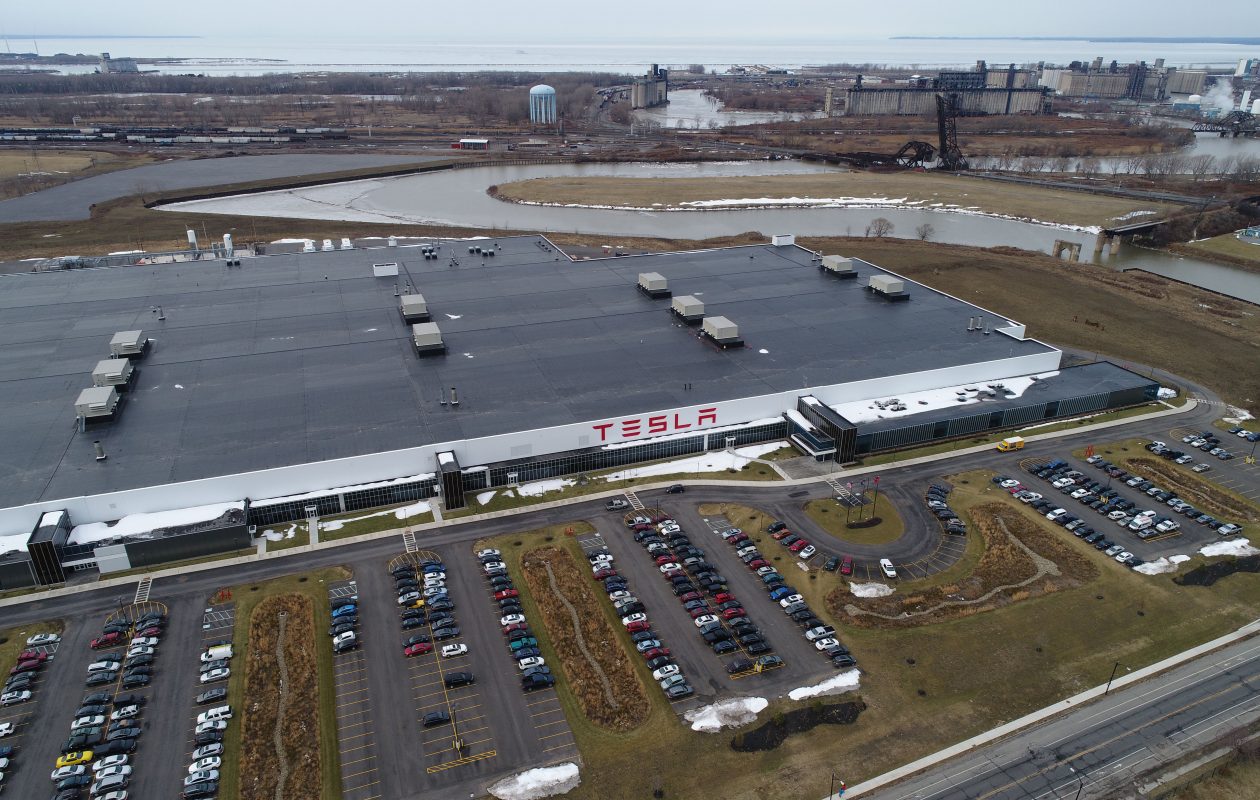
Tesla’s Gigafactory 2 in Buffalo, NY was dubbed fully complete by state and company officials this past April, starting a countdown clock for Tesla to provide 1,460 jobs to Buffalo, NY within the next two years. Failure to do so could result in fines of up to $41.2 million for every year that it does not meet this employment goal.
When Tesla received support from the state worth $750 million to build and equip the solar factory, the company committed to providing 5,000 jobs to the state of New York within the next ten years. These job-creation targets have evolved over the years, particularly when SolarCity was acquired by Tesla. The state of New York’s original agreement with SolarCity required the company to provide 1,460 jobs at the solar factory and another 1,440 jobs at suppliers and service providers in the Buffalo region. This gave SolarCity a target of providing 2,900 jobs for local workers.
Once Tesla took over, the requirement to bring in 1,440 suppliers was waived by the state. The revised agreement with New York included requirements for Tesla to create 1,460 jobs in Buffalo within two years after the factory is complete, including 500 manufacturing jobs at Gigafactory 2. In a statement to The Buffalo News, Tesla officials stated that the company had already surpassed the first employment target — one that required Tesla to create 500 jobs by April 2019. By meeting this target, Tesla is now tasked to more than double the number of jobs it created so far, in order to meet the state’s April 2020 deadline.
Tesla’s Gigafactory 2 might seem almost dormant amidst the company’s push to ramp the production of the Model 3, but the electric car and energy company maintains that it intends to produce its solar products at a larger scale in the Buffalo facility within the coming quarters. Before its Q2 2018 earnings call, CTO JB Straubel stated that Tesla is “aggressively ramping” the production of its residential solar products, which are manufactured at the New York factory. Straubel also stated that production of the Solar Roofs are expected to accelerate in 2019, as residential installations of the shingles are rolled out to reservation holders.
The Tesla executive reiterated this statement in the company’s second-quarter earnings call, stating that while the company’s electric car business is bigger today, the growth of Tesla Energy is faster. Elon Musk even noted that Tesla Energy would likely catch up to the electric car business’ size in the future.
“Yeah, if you extrapolate energy growth rate, well, obviously, if you extrapolate anything when that triples for a year pretty soon becomes the size of the universe, but long-term we would expect the energy business to catch up to the auto business in size,” Musk said.
Tesla’s Gigafactory 2 in Buffalo, NY is tasked with the production of the company’s Solar Roof tiles, which, together with the Powerwall 2 home battery, are part of the company’s initiative to help customers achieve “sustainable energy independence.” At full capacity, Tesla’s Gigafactory 2 is expected to manufacture 1 GW worth of solar products every year. In classic Elon Musk fashion, the CEO gave a more optimistic forecast for the facility back in 2016, stating that he estimates the factory to be capable of producing as much as 10 GW worth of solar products annually.


Elon Musk
Why SpaceX just made a $60 billion bet on AI coding ahead of historic IPO
SpaceX has secured an option to acquire Cursor AI for $60 billion ahead of its historic IPO.

SpaceX announced today it has struck a deal with AI coding startup Cursor, securing the option to acquire the company outright for $60 billion later this year, while committing $10 billion for joint development work in the interim. The announcement described the partnership as building “the world’s best coding and knowledge work AI,” and comes just days after Cursor was separately reported to be raising $2 billion at a valuation above $50 billion.
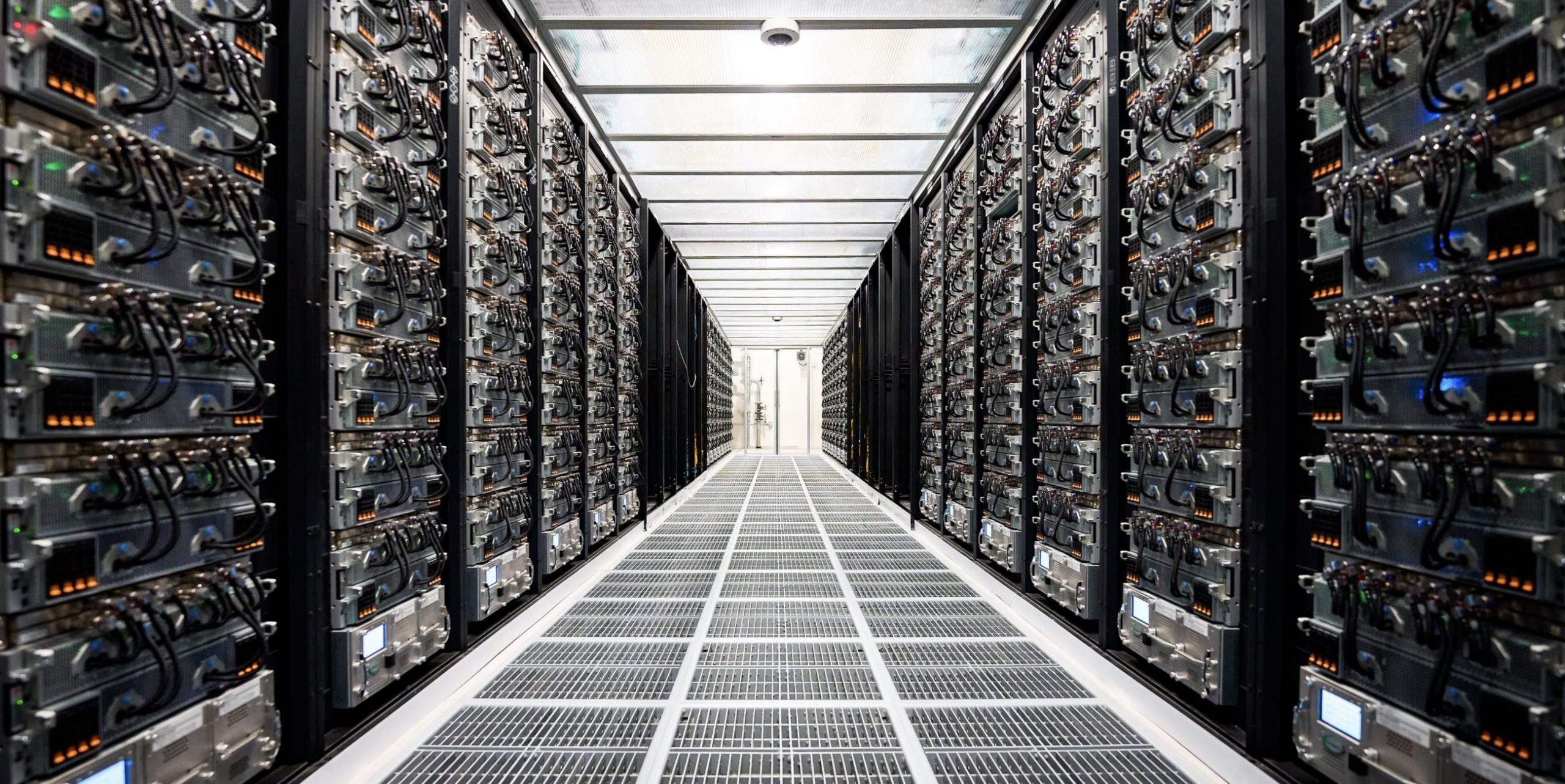
The move makes strategic sense given where each company currently stands. Cursor currently pays retail prices to Anthropic and OpenAI to the same companies competing directly against it with Claude Code and Codex. That means every dollar of revenue Cursor earns partially funds its own competition. With SpaceX bringing computational infrastructure to the Cursor platform, that could reduce Cursor’s dependence on OpenAI and Anthropic’s Claude AI as its providers. Access to SpaceX’s Colossus supercomputer, with compute equivalent to one million Nvidia H100 chips, gives Cursor the infrastructure to run and train its own models at a scale it could never afford independently. That one change restructures the entire unit economics of the business.
Elon Musk teases crazy outlook for xAI against its competitors
Cursor’s $2 billion in annualized revenue and enterprise reach across more than half of Fortune 500 companies gives SpaceX something its xAI subsidiary currently lacks, which is a proven, fast-growing software business with real enterprise distribution.
For Cursor, SpaceX’s $10 billion in joint development funding is transformational. Cursor raised $3.3 billion across all of 2025 to reach that $2 billion in revenue. A single $10 billion commitment from SpaceX, even as a development payment rather than an acquisition, dwarfs everything Cursor has raised in its entire existence. That capital accelerates product development, enterprise sales infrastructure, and proprietary model training simultaneously.
The timing is deliberate. SpaceX filed confidentially with the SEC on April 1, 2026, targeting a June listing at a $1.75 trillion valuation, in what would be the largest public offering in history. The company is expected to begin its roadshow the week of June 8, with Bank of America, Goldman Sachs, JPMorgan, and Morgan Stanley serving as underwriters. Adding Cursor to the portfolio before that roadshow gives IPO investors a concrete enterprise software revenue story to price in, alongside rockets and satellite internet.
The deal also addresses a weakness that became visible after February’s xAI merger. Several xAI co-founders departed following that acquisition, and SpaceX had already hired two Cursor engineers, signaling where its AI talent strategy was heading. Cursor, for its part, faces a pricing disadvantage competing against Anthropic’s Claude Code.
Whether SpaceX exercises the full acquisition option before its IPO or after remains the open question. Either way, this deal reshapes what investors will be buying into when SpaceX goes public.
Elon Musk
Tesla Supercharger for Business exposes jaw-dropping ROI gap between best and worst locations
Tesla’s new Supercharger for Business calculator reveals an eye-opening all-in cost and location-based ROI projections.
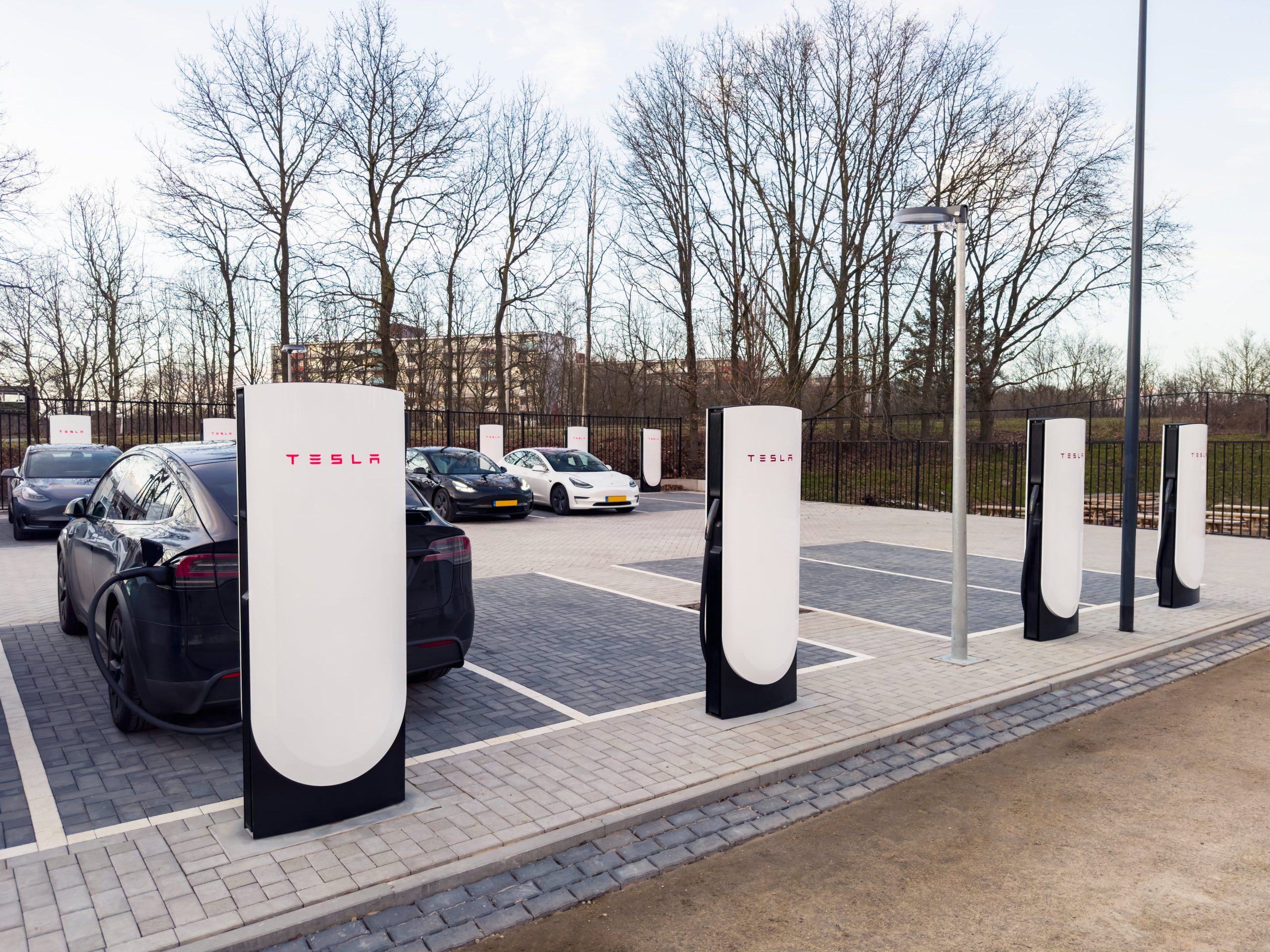
Tesla has launched an online calculator for its Supercharger for Business program, giving property owners their first transparent look at what it really costs to install Superchargers on site and what kind of return they can expect.
The program itself launched in September 2025, allowing businesses to purchase and operate Supercharger hardware on their own property while Tesla handles installation, maintenance, software, and 24/7 driver support. As Teslarati reported at launch, hosts also get their logo placed on the chargers and their location integrated into Tesla’s in-car navigation, meaning drivers are actively routed there. The stalls are open to all EVs, not just Teslas.
We launched Supercharger for Business in 2025 to help companies get charging right. We found simplicity and transparency to be a problem in this industry.
We’re now sharing pricing and a financial calculator to help make informed decisions. The goal is to accelerate investments,…
— Tesla Charging (@TeslaCharging) April 8, 2026
The new online calculator, announced by Tesla on Wednesday with the note that “simplicity and transparency” have been a problem in the industry, lets any business enter a U.S. address and get a real cost and revenue model. A standard 8-stall V4 Supercharger site runs approximately $500,000 in hardware and $55,000 per post for installation, bringing an all-in price just shy of $1 million. Tesla charges a flat $0.10 per kWh fee to cover software, billing, and network operations. Businesses set their own retail price and keep the margin above that fee.
Taking a look at Tesla’s Supercharger for Business online calculator, we can see that ROI is not uniform, and the gap between a strong location and a poor one can stretch the breakeven point by several years.
The biggest driver is foot traffic and how long people stay. A busy rest station, hotel, or outlet mall brings in repeat visitors who need to charge while they’re already stopped, pushing utilization numbers higher and shortening payback time.
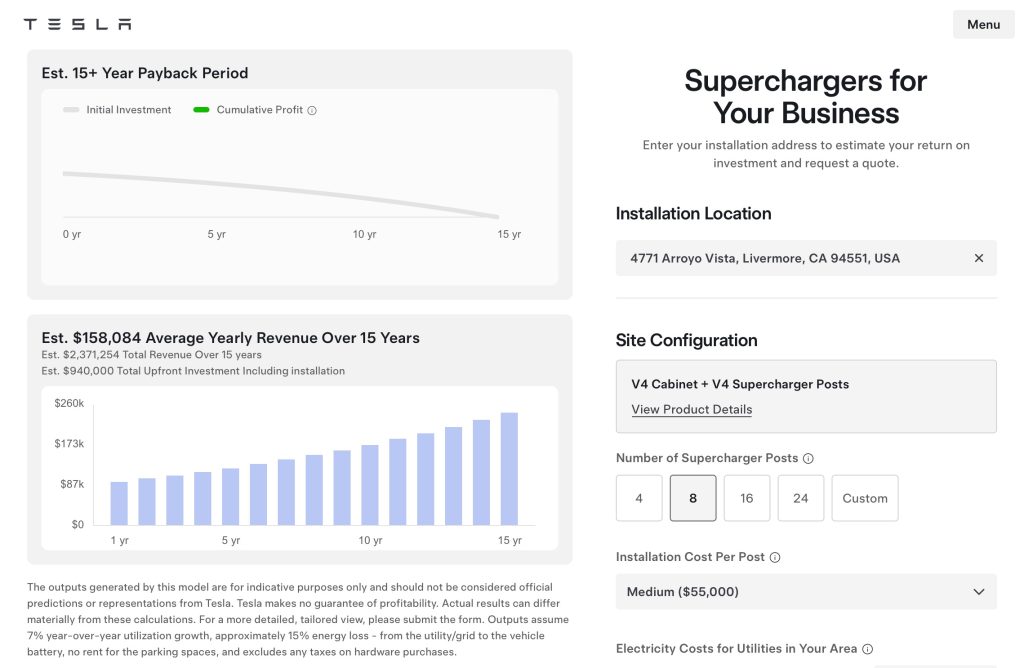
Tesla Supercharger for Business ROI calculator
Local electricity rates matter just as much on the cost side. Markets like California carry some of the highest commercial electricity rates in the country, which eats into the margin between what a host pays per kWh and what they charge drivers. At the same time, dense urban areas with high EV adoption tend to support higher retail charging prices, which can offset that cost if demand is strong enough. Weather also plays a role. Cold climates reduce battery efficiency and increase charging frequency, but they can also suppress utilization in winter months if drivers avoid stopping in exposed outdoor locations. Suburban and rural sites face a different problem: lower baseline EV traffic, which means a site with cheaper power and lower operating costs can still take longer to pay back simply because the stalls sit idle more often. Tesla’s calculator uses real fleet data to pre-fill utilization estimates by ZIP code, so businesses can run their specific address against these variables rather than relying on averages.
The program has seen real adoption. Wawa, already the largest host of Tesla Superchargers with over 2,100 stalls across 223 locations, opened its first fully owned and branded site in Alachua, Florida earlier this year. Francis Energy of Oklahoma and the city of Alpharetta, Georgia have also deployed branded stations through the program, as Teslarati covered in January.
Tesla now exceeds 80,000 Supercharger stalls worldwide, and the calculator makes the economic case for accelerating that number through private investment rather than company-owned sites alone.
Energy
Tesla’s newest “Folding V4 Superchargers” are key to its most aggressive expansion yet
Tesla’s folding V4 Supercharger ships 33% more per truck, cuts deployment time and cost significantly.
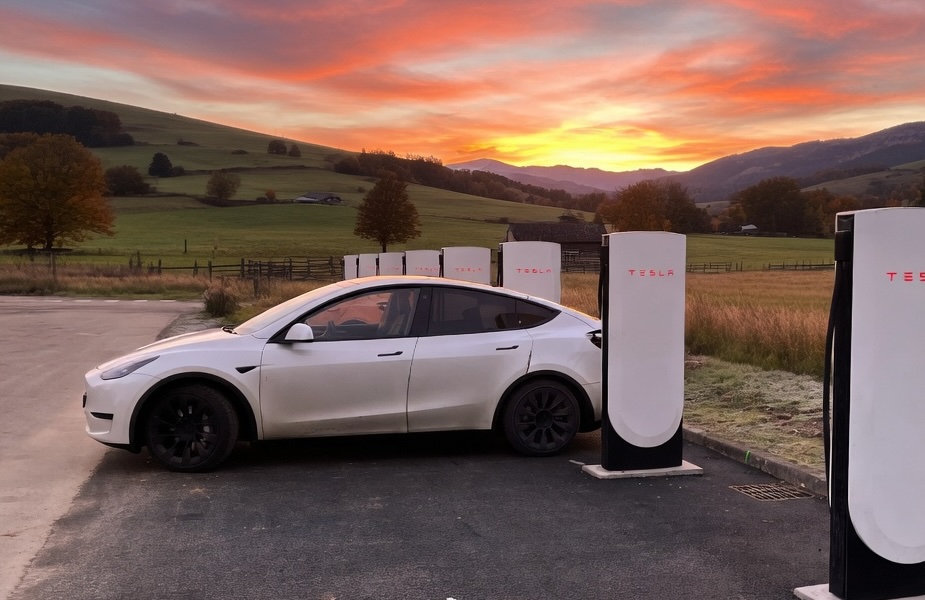
Tesla is rolling out a folding V4 Supercharger design, an engineering change that allows 33% more units to fit on a single delivery truck, cuts deployment time in half, and reduces overall installation cost by roughly 20%.
The folding mechanism addresses one of the least glamorous but most consequential bottlenecks in charging infrastructure: getting hardware from factory floor to job site efficiently. By collapsing the form factor for transit and unfolding into an operational configuration on arrival, the new design dramatically reduces the logistics overhead that has historically slowed Supercharger rollouts, particularly at large or remote sites where multiple units are needed simultaneously.
The timing aligns with a broader acceleration in Tesla’s network strategy. In March 2026, Tesla’s Gigafactory New York produced its final V3 Supercharger cabinet after more than seven years and 15,000 units, pivoting entirely to V4 cabinet production. The V4 cabinet itself is already a generational leap, delivering up to 500 kW per stall for passenger vehicles and up to 1.2 MW for the Tesla Semi, while supporting twice the stalls per cabinet at three times the power density of its predecessor. The folding transport innovation layers logistical efficiency on top of that technical foundation.
Tesla launches first ‘true’ East Coast V4 Supercharger: here’s what that means
Tesla Charging’s Director Max de Zegher, commenting on the V4 cabinet when it launched, captured the operational philosophy behind these changes: “Posts can peak up to 500kW for cars, but we need less than 1MW across 8 posts to deliver maximum power to cars 99% of the time.” The design philosophy has always been about maximizing real-world throughput, not just peak specs, and the folding transport upgrade extends that thinking into the supply chain itself.
Posts can peak up to 500kW for cars, but we need less than 1MW across 8 posts to deliver maximum power to cars 99% of the time.
No more DC busbar between cabinets. Power comes from a single V4 cabinet to 8 stalls. Easier to install, cheaper, more reliable.
Introducing Folding Unit Superchargers
– V4 cabinet with 500kW charging
– 8 posts per unit
– 2 units per truck
– 2 configurations: folded, unfoldedFaster. Cheaper. Better. pic.twitter.com/YyALz0U5cA
— Tesla Charging (@TeslaCharging) March 25, 2026
The network is expanding rapidly on multiple fronts. The first true 500 kW V4 Supercharger on the East Coast opened in Kissimmee, Florida in March 2026, followed closely by a new site in Nashville, Tennessee. A public Megacharger for the Tesla Semi launched in Ontario, California in early March, with 37 additional Megacharger sites targeted for completion by end of year. Meanwhile, more than 27,500 Supercharger stalls are now accessible to non-Tesla EVs from brands including Ford, GM, Rivian, Hyundai, and most recently Stellantis, whose Dodge, Jeep, Ram, Fiat, and Maserati BEV customers gained access in March 2026.
As Tesla pushes toward a denser, faster, and more open charging network, innovations like the folding V4 Supercharger reflect the company’s growing focus on deployment velocity, not just hardware performance. Getting chargers to the ground faster, cheaper, and in greater volume per shipment may ultimately matter as much as the kilowatts they deliver.

Tesla is making sweeping improvements to Robotaxi

Starship V3 is here putting SpaceX closer to Mars than it has ever been


