


During the summer, Tesla took its S3XY lineup to Wanaka, New Zealand, to continue winter testing all year round. During those winter tests, Tesla took the Model Y’s track mode out for a spin on Wanaka’s snowy roads.
Wanaka is a small town in the Otago region of the South Island of New Zealand. It is surrounded by mountains of the Southern Alps and is known for its outdoor recreation, including skiing or just leisurely walking past the stunning views. Winter in Wanaka runs from June through the end of August, with an average temperature of 10°C.
Tesla Model Y Track Mode Winter Test
Tesla Model Y Performance owners have been waiting for Track Mode for a long time. Musk announced Track Mode for the Model Y Performance back in 2020, and it took some time before it was officially rolled out.
Tesla released Track Mode for the Model Y Performance during its 2022 Holiday Update. With Track Mode, Model Y Performance owners can save up to 20 driving profiles specific to a different driving scenario or track.
Tesla tested the Model Y’s Track Mode in Wanaka. The Tesla team worked hard on the feature, ensuring it is both fun and safe for Model Y drivers.
“We’re out here in New Zealand, working on Model Y Track Mode, a new development for the Model Y Performance package. So this is full oversteer. All you drifter guys are going to love this kind of setting because as soon s you just tip out, you can just rotate the car around and do pretty wild maneuvers,” said JD Price from Tesla’s testing team.
Winter Tests for the S3XY Lineup
Tesla tested all S3XY vehicles in Wanaka while it was summer in California. The team tested the cars and worked with Tesla’s team in California on software improvements for them. With Tesla’s unique software structure, the Wanaka team could test updates as soon as the California team rolled them out.
“It’s super cool to talk to people in California, send the update halfway across the world [and then] you go on top of a mountain [and] test their update. That’s something I’ve never experienced before,” said one member of the Tesla testing team.
Another member of the Wanaka team mentioned that they go to different places to test the S3XY lineup so customers can drive their cars on many kinds of terrain and surfaces through varying weather.
“We’re almost always on a proving ground, testing new software, and we run these thousands of times per software we release,” said one member of the time.
“We do everything from driving the car, writing the code, doing that collaboration. That feedback look is really quick,” elaborated another team member.
Check out Tesla’s Winter Testing video from Wanaka below!
If you have any tips, contact me at maria@teslarati.com or via Twitter @Writer_01001101.


News
Tesla Model Y L gets new entertainment feature
Beyond audio quality, Immersive Sound X aligns with Tesla’s ecosystem of over-the-air updates, potentially allowing future refinements.

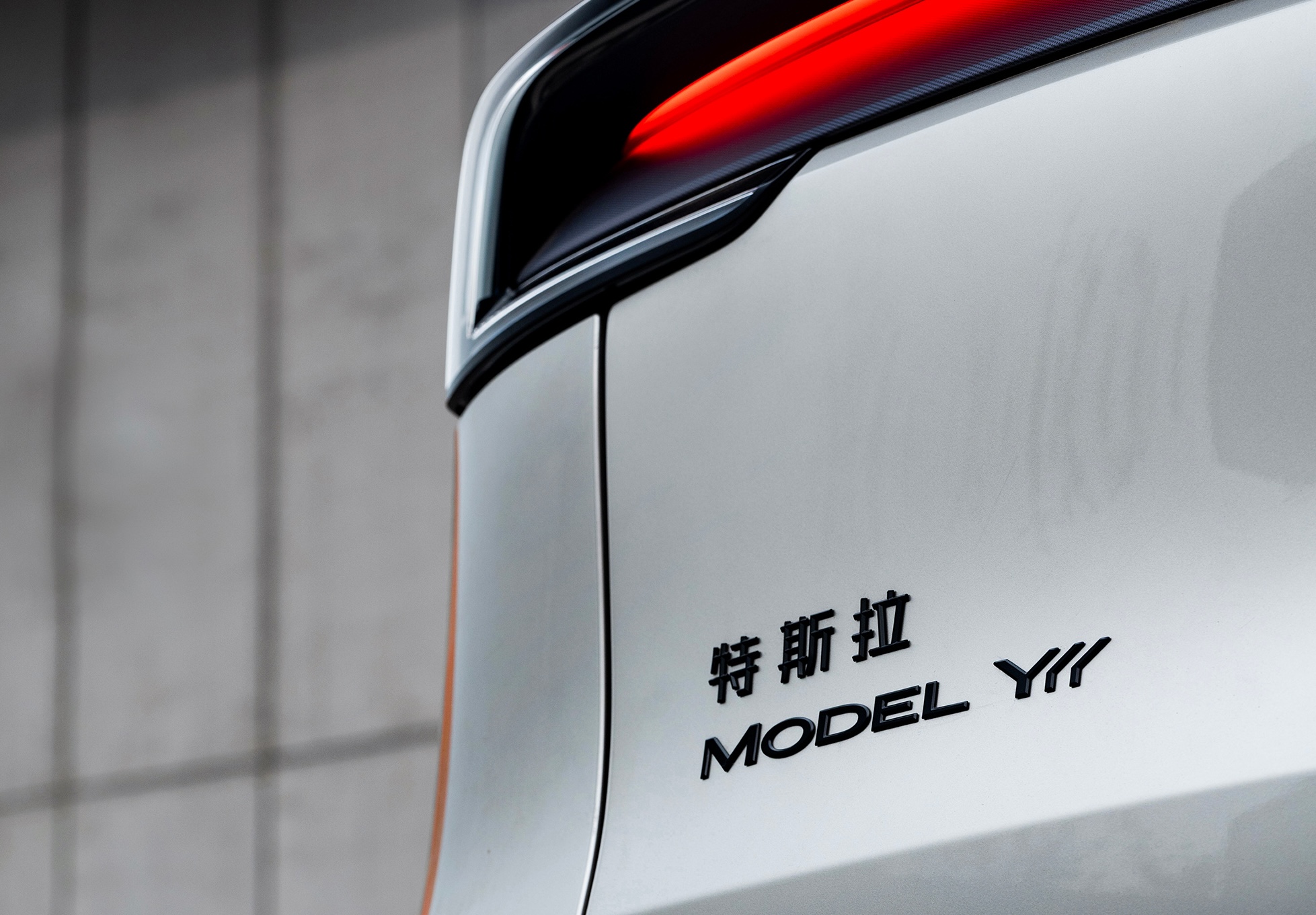
Tesla is including a new entertainment feature in the Model Y L, improving the vehicle even further and making it what appears to be the best configuration of the all-electric crossover globally.
Unfortunately, we in the U.S. do not yet have access to the vehicle, and the plans for it to enter the market remain up in the air, as CEO Elon Musk has said it could appear late this year. However, there is nothing concrete at this time.
Tesla’s latest enhancement to the Model Y L is a new Immersive Sound X feature, exclusive to the Model Y L.
Model YL has new sound system setting. Immersive Sound X. This is NOT on the new Y and 3 pic.twitter.com/7OpJuzyoGf
— Electric Future (@electricfuture5) March 16, 2026
It aims to transform the in-car listening experience into something truly cinematic. First introduced by Tesla China in October 2025, this advanced audio mode is now rolling out to deliveries in Australia and New Zealand, highlighting Tesla’s approach to region-specific premium upgrades.
At its core, Immersive Sound X leverages real-time sound extraction technology to create a customizable 3D soundstage. Using advanced algorithms, it analyzes audio tracks to separate direct sounds, such as vocals or lead instruments, from ambient elements like echoes and reverb.
The system then positions direct sounds front and center while diffusing ambient sounds to the side and rear speakers, simulating an expansive virtual environment. This results in a heightened sense of depth and spatial awareness, making listeners feel as if they’re in a concert hall or studio.
What sets Immersive Sound X apart from the standard Immersive Sound found in other Tesla models is its hardware dependency and enhanced processing. The Model Y L boasts an 18-speaker system with a subwoofer, compared to the 15-speaker setup, plus a subwoofer, in the Model Y Long Range’s previous premium audio configuration.
This upgrade provides more “kick” and precision, enabling finer control over the soundstage. Unlike traditional surround sound, which requires multi-channel mixes like Dolby Atmos, Immersive Sound X works with any stereo source from platforms like Spotify or Apple Music, so every owner will be able to use it.
Tesla Model Y lineup expansion signals an uncomfortable reality for consumers
You can fine-tune the experience via an adjustable immersion slider, scaling the “size” of the virtual space to personal preferences. This caters to a more custom sound.
An Auto mode intelligently adapts based on media type, whether it’s music, podcasts, or videos, ensuring optimal immersion without manual tweaks. This feature is unavailable on standard Model Y variants (with 7 or 15 speakers) or Model 3 trims, underscoring Tesla’s strategy to differentiate higher trims through superior hardware and software integration.
Beyond audio quality, Immersive Sound X aligns with Tesla’s ecosystem of over-the-air updates, potentially allowing future refinements.
For audiophiles and casual listeners alike, it elevates mundane commutes into immersive journeys, proving Tesla’s commitment to blending cutting-edge tech with user-centric design.
News
Tesla Model Y outsells everything in three states, but Ford dominates
The Model Y’s success here highlights accelerating mainstream adoption of electric SUVs, which offer spacious interiors, impressive range, rapid acceleration, and low operating costs.
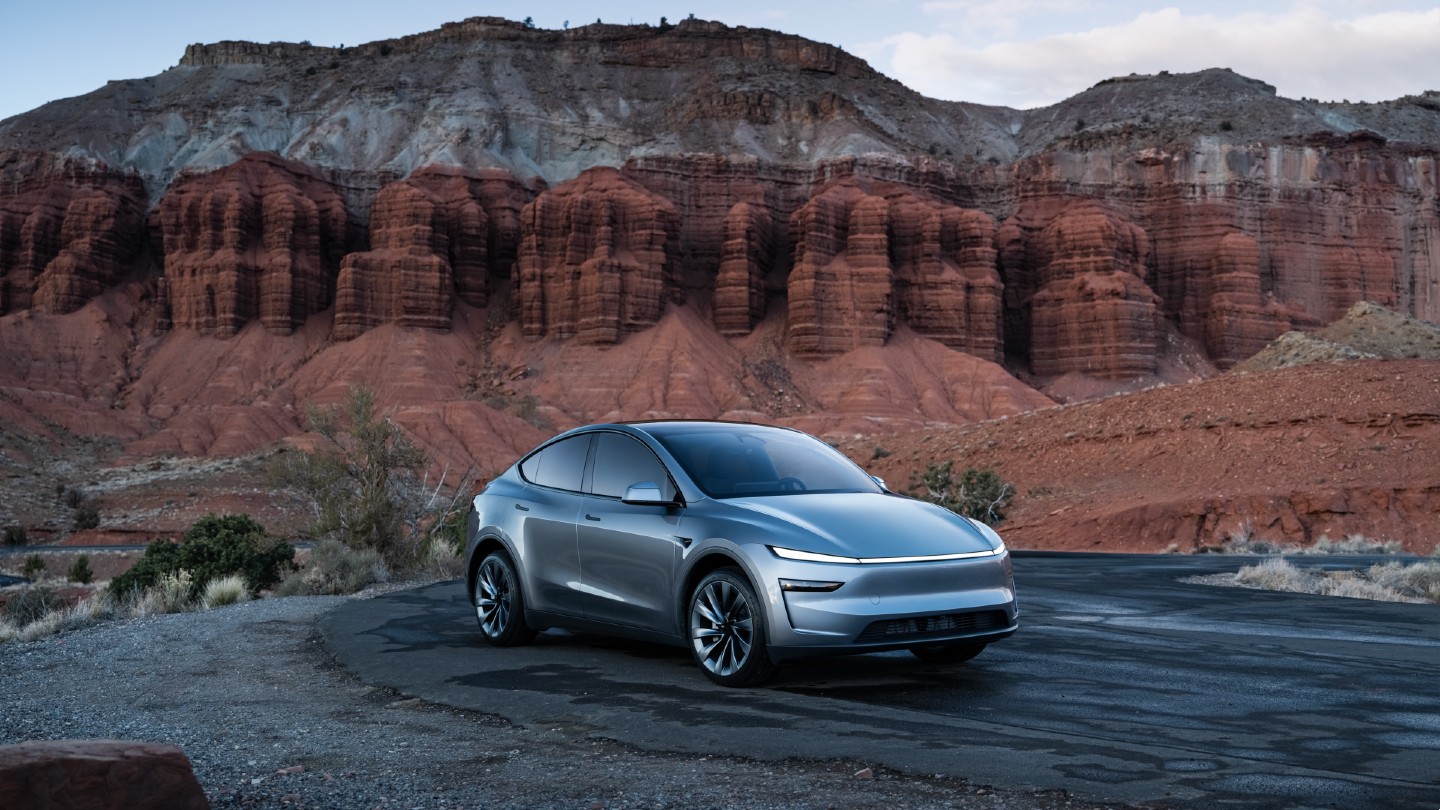
The Tesla Model Y was the best-selling vehicle in three different states in the U.S. last year, according to new data that shows the all-electric crossover outsold every other car in a few places. However, Ford widely dominated the sales figures with its popular F-Series of pickups.
According to new vehicle registration data compiled by Edmunds and visualized by Visual Capitalist, the Ford F-Series, encompassing models like the F-150, F-250, F-350, and F-450, claimed the title of best-selling vehicle in 29 states.
This dominance underscores the pickup truck’s unbreakable appeal across much of the country, particularly in rural, Midwestern, Southern, and Western states, where towing capacity, durability, and utility for work or recreation remain top priorities.
The Tesla Model Y is the best-selling vehicle in California, Washington, and Nevada
How many states will it dominate next year? https://t.co/ERyoyce42D
— TESLARATI (@Teslarati) March 9, 2026
The F-Series has held the crown as America’s overall best-selling vehicle for decades, a streak that continued strong into 2025 despite broader market shifts.
Yet, amid this truck-heavy reality, Tesla made a notable breakthrough. The Model Y emerged as the top-selling vehicle, not just the leading EV, but the outright best-seller in three key states: California, Nevada, and Washington.
These West Coast strongholds reflect regions with robust EV infrastructure, high environmental awareness, generous incentives, and tech-savvy populations. In California alone, nearly 50 percent of new vehicle registrations were electrified, far outpacing the national average of around 25 percent.
The Model Y’s success here highlights accelerating mainstream adoption of electric SUVs, which offer spacious interiors, impressive range, rapid acceleration, and low operating costs.
Elon Musk: Tesla Model Y is world’s best-selling car for 3rd year in a row
Elsewhere, Japanese crossovers filled many gaps: Toyota’s RAV4 and Honda’s CR-V topped charts in several urban and densely populated Northeastern and Midwestern states, where fuel efficiency, reliability, and family-friendly features win out over larger trucks.
While Ford’s broad reach shows traditional preferences persist, at least for now, Tesla’s Model Y victories in high-population, influential states signal a gradual but undeniable transition toward electrification. As charging networks expand and battery technology improves, more states could follow the West Coast’s lead in the coming years.
This 2025 map captures a pivotal moment: pickup trucks still rule the majority, but EVs are carving out meaningful territory where consumer priorities align with sustainability and innovation. The road ahead promises continued competition between legacy giants and electric disruptors.
News
I figured out how to charge my Tesla at my rented townhouse – Here’s how
I hope that this article is able to help the prospective EV buyer or the current Tesla owner who is living in a rental and does not have a straightforward solution to home charging. My situation will be presented in this article, and I will tell you why I went with the solution I went with, and alternatives, because there is more than one way to do this.
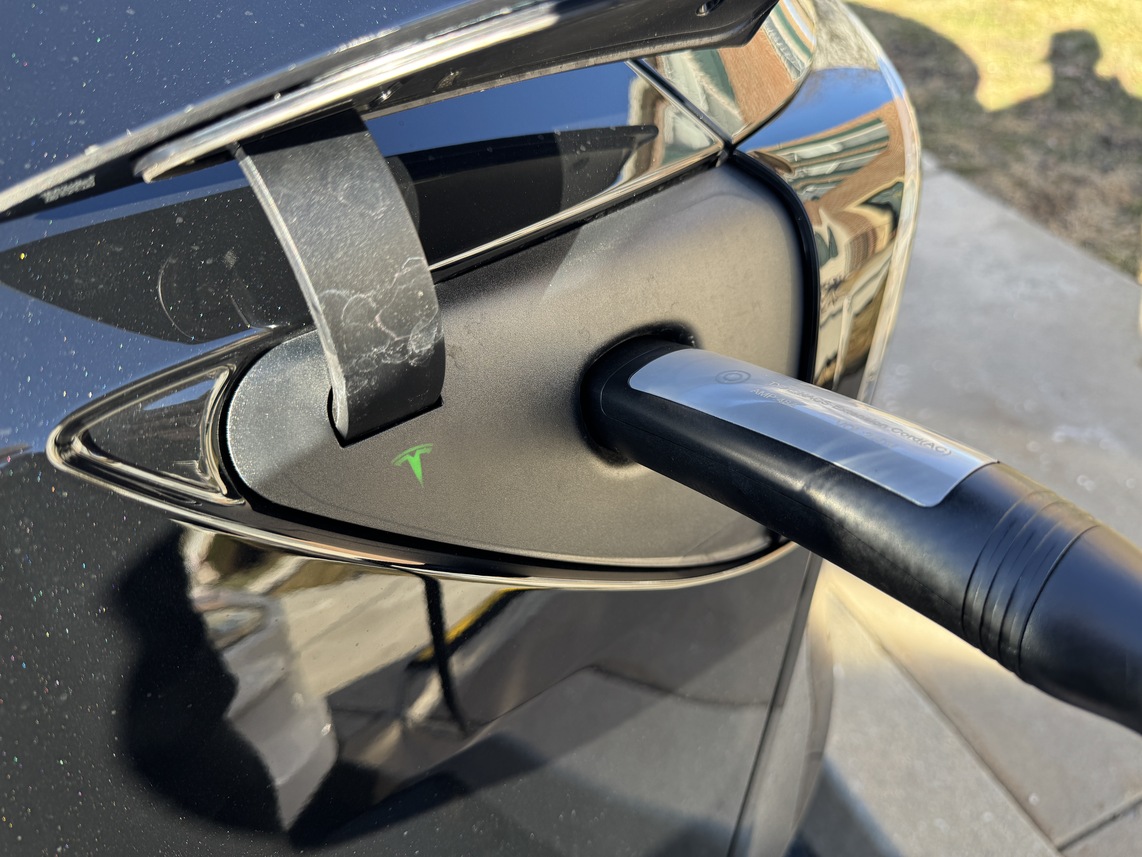
When I bought my Tesla Model Y Premium All-Wheel-Drive last year, I knew I would have to try to figure out a way not become totally reliant on Superchargers. After about six months of ownership, it came time to resolve that problem once and for good, and being a tenant in a rented townhouse community definitely added to my challenge.
Before I even bought my Tesla, I emailed my leasing office to see if the community had any plans to bring EV charging to the neighborhood. I had made myself available to them as I am familiar with a lot of the solutions out there and how much of an advantage this could be for the community, and attracting new tenants. After months of trying, I bought my Tesla in August anyway, and figured I’d be able to find an answer — whether positive or negative — and go from there.
I hope that this article is able to help the prospective EV buyer or the current Tesla owner who is living in a rental and does not have a straightforward solution to home charging. My situation will be presented in this article, and I will tell you why I went with the solution I went with, and alternatives, because there is more than one way to do this.
My Challenge with Home Charging
In a rental community, apartment complex, or even townhouse row, parking spots are a little complicated. I have assigned parking at my house, and unfortunately, my parking spot is not right in front of my front door. Instead, it is staggered, so my car is parked in front of my neighbor’s front door.
Initially, I had spoken to my neighbor whose spot is right in front of my front door and had gotten permission to park in their spot during the day while it is vacant. However, I was not going to be able to upgrade my outlet from a 110v-120v to the typical and suggested 220v-240v alternative.
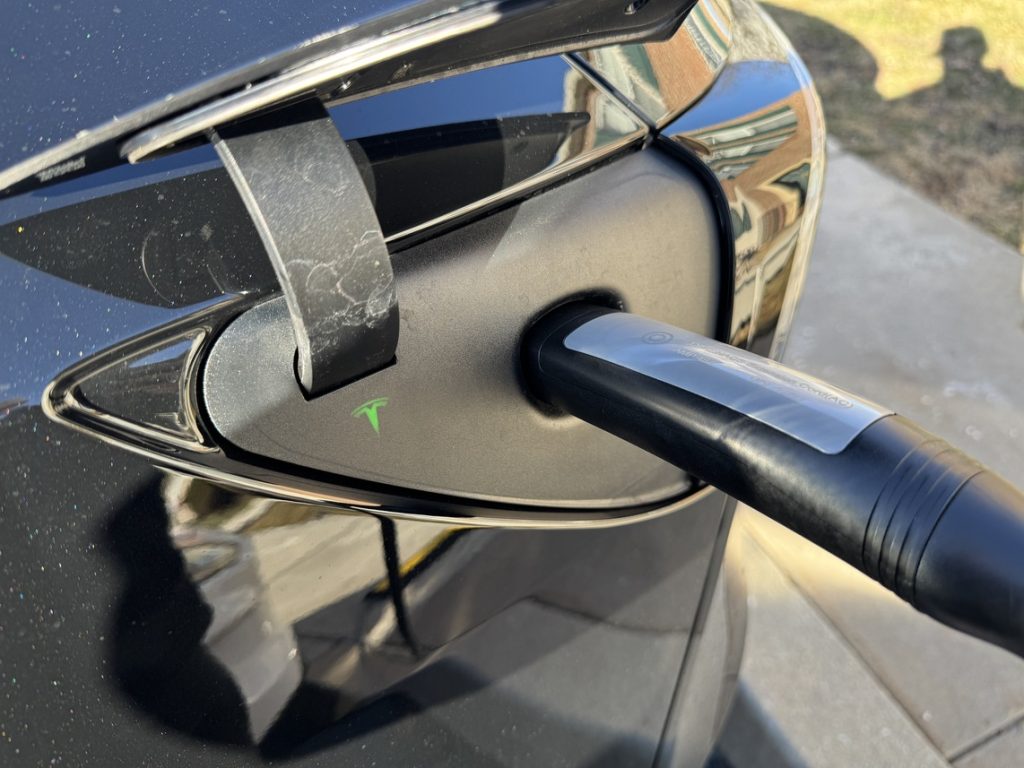
I knew that this would mean I would need to be in my permanent spot because charging sufficiently, especially in preparation for trips or errands, would require overnight charging.
The Tesla Mobile Connector is 20 feet long, which is sufficient for most applications. Mine, however, required about 30 feet, maybe even a little more, to charge.
My Options
I had a few options: Use the Mobile Connector and park in my neighbor’s spot and charge when I could, buy an 8 or 10-gauge extension cord that could handle moving power from the Mobile Connector to my car, or buy an NACS to NACS extension cord.
I didn’t really want to do the first option, considering I knew that spot would only be available when my neighbor was not there. It didn’t seem like a viable option, and I figured it would be better to figure out something from my personal, permanent parking spot anyway.
The 10-gauge extension cord option was what I first considered: it was less expensive than buying an NACS extension, it was more readily available, and it was the first thing my friends who are electricians recommended.
However, running this option would have put the Mobile Connector in the grass or on the ground, and I was not interested in doing that. Running the risk of having that $300 connector that came with the car in the grass and exposing it to dew, dogs, and various other things just did not seem like the best idea.
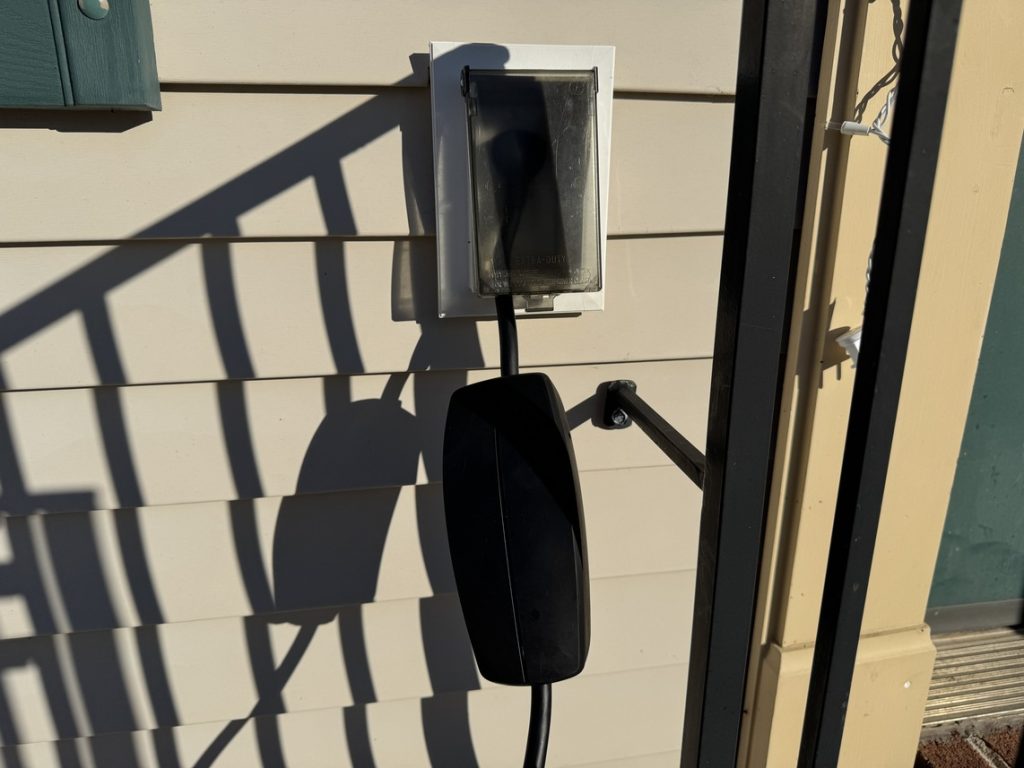
I looked around for some NACS to NACS connectors, and there are a lot of options. Given that this was something that was going to plug into a $50,000 car, I chose to spend the additional money on one that was not from Amazon, and I went with this one from A2Z, which was recommended by other owners, and their reputation seemed more than positive. I was leaning toward this option anyway because it would keep the Mobile Connector off the ground, and it gave me an additional 16 feet of length to work with.
This was the solution.
Putting It Into Action
It was a relatively simple process: Plug the Mobile Connector into my house, plug the NACS to NACS extension into the Mobile Connector, plug the NACS extension into the car. It all worked immediately, but there are some things you should know if you are also planning to do this.
The first is that you should be very aware that these cables are going to be a target of thieves. I don’t have too much of an issue with this in my area, but if you’re in a place where copper wiring is heavily sought after, be sure to keep these in a place where they won’t be stolen. I put mine away when they’re not charging, and at night, they’re visible from my Ring camera, so I’m not overly concerned. Definitely be aware of it, though.
Additionally, if you’re going to run it across the sidewalk like I am, you’re going to want to pick up some sort of cable cover from a local hardware store. I picked up this one from Amazon because it was a little more heavy-duty, and it was big enough to cover the thicker gauge of the NACS to NACS extension:
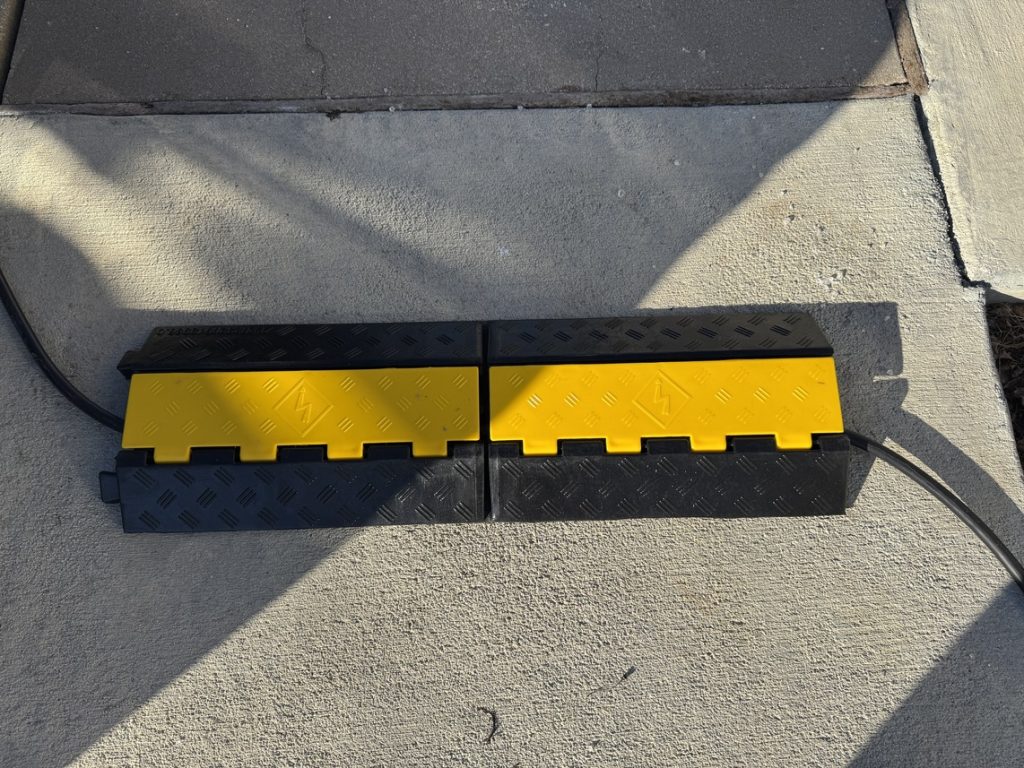
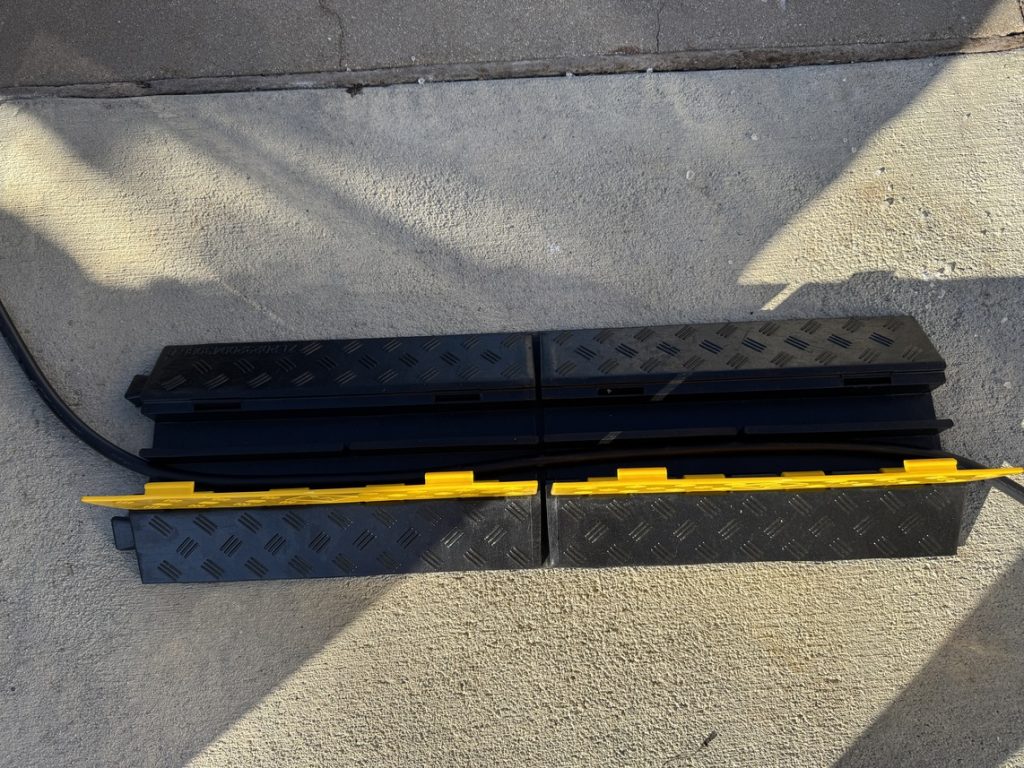
I’ve considered picking up a second one for the visible cable, but I am undecided.
So far, I’ve been able to add some range to my car three times using this strategy, and while it is very slow, it is definitely worth it. It’s better than it sitting there stagnant.
Speed of Charging
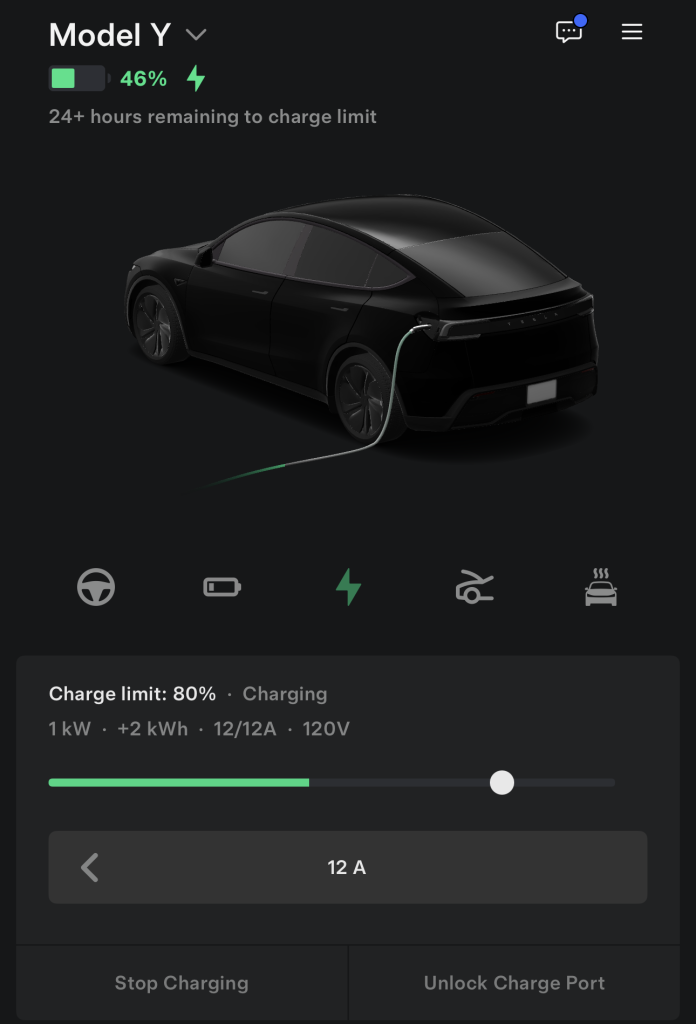
Tesla says the Mobile Connector will provide you with between 3 and 5 miles of range per hour when plugged into a typical wall outlet. That is about what I’ve gotten with it. From 30 percent to 80 percent, be aware that it will take well over 24 hours to charge your car.
I plan to cover some additional details on this as time goes on, including any troubleshooting I might have to do, how much my electric bill goes up, and whether or not I run into any issues with my neighbors or my leasing office.
If you’re looking for some help on an at-home charging solution or have any questions about my setup, please email me at joey@teslarati.com.
🚨 I FINALLY figured out a way to charge my Tesla at home as a renter — Using Superchargers exclusively was inconvenient, tough on the battery, and expensive
Here’s how I did it: https://t.co/TZokpc6Fh3 pic.twitter.com/UtRYKLvB2Y
— TESLARATI (@Teslarati) March 2, 2026

Tesla Cybertruck just won a rare and elusive crash safety honor

Elon Musk’s Boring Co. Tunnel Vision Challenge ends with a surprise for Louisiana, Maryland and Dallas


