News
Volkswagen has repaid Dieselgate victims an outrageous compensation package

Volkswagen’s Dieselgate scandal has tarnished the German automaker in more ways than one. This week, however, the Federal Trade Commission issued a press release stating that Volkswagen has successfully returned more than $9.5 billion in compensation to car buyers who purchased the company’s “clean diesel” vehicles because of an advertising campaign.
The FTC announced that both Volkswagen and Porsche both repaid a total of more than $9.5 billion to car buyers. Those who purchased “Clean Diesel” vehicles from either VW or Porsche were given two options of repayment: Return the car to the manufacturer in exchange for compensation, or have the car modified to comply with clean-air rules put into place by the Environmental Protection Agency.
The report from the FTC indicates that more than 86 percent of the victims chose to return their vehicles through a buyback or early lease termination.
The FTC filed their Final Status Report with the U.S. District Court for the Northern District of California.
“Most important, the FTC orders and related private class settlements provided redress sufficient to compensate consumers fully,” the FTC stated in its report, which was released on July 27.
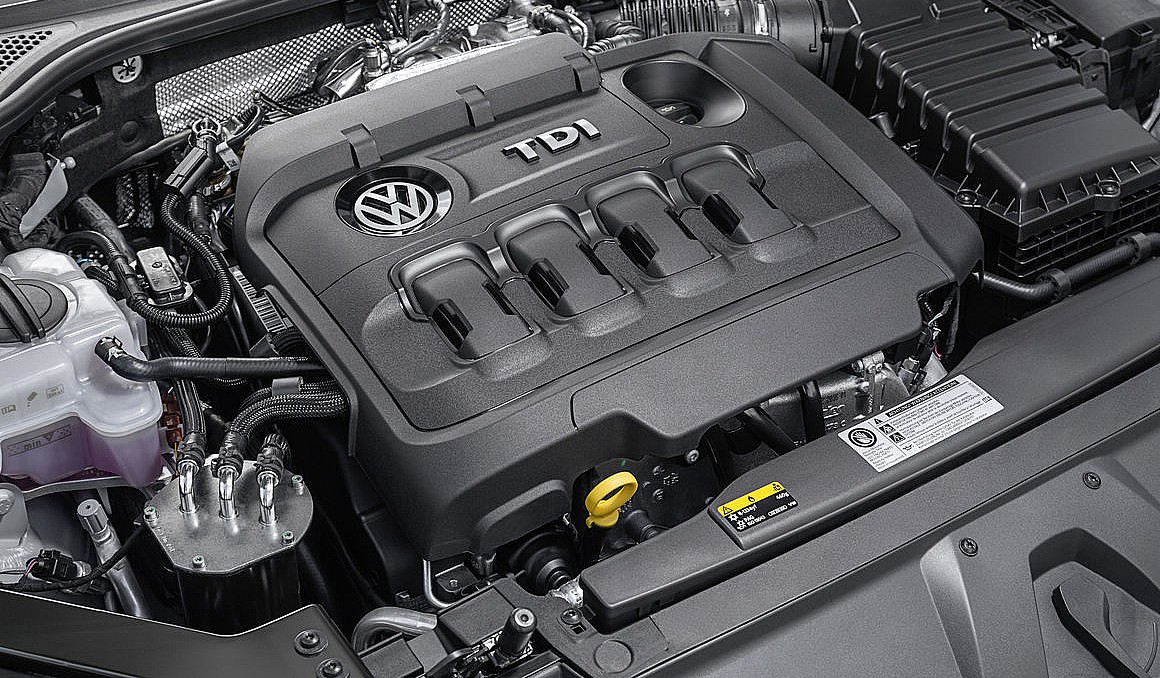
In 2015, Volkswagen Auto Group admitted to placing secret software and cheat devices in more than 550,000 vehicles. These devices were used in the company’s diesel vehicles, which are among its most popular cars in the world. Many VW models sport a TDI or Turbocharged Direct Injection, which uses direct fuel injection systems. Many owners report that fuel economy is better with TDI models.
However, some of these tested vehicles would have never hit the road if the company would not have installed the cheat devices. After the Environmental Protection Agency noticed that there was a violation of the Clean Air Act, an investigation ensued. The EPA then found that the German car company had intentionally programed cheat devices to help vehicles that emitted up to 40-times the number of Nitrogen oxides into the air.
Despite the tough economic circumstances, the FTC indicated that Volkswagen appropriately handled the settlements by “managing the settlement administration process effectively.”
Since the settlement, Volkswagen has done its best to put the scandal in the past. The German automaker has made significant strides in developing a series of electric models, starting with the ID.3 which will begin deliveries later this Summer, the company said.
Volkswagen has also started transitioning several of its German manufacturing plants to begin building electric cars. With sustainability in mind, Volkswagen has paid its penalties and will look to help the world solve the climate crisis one car at a time.
The Federal Trade Commission’s final report on the Dieselgate Scandal is available below.
Volkswagen Clean Diesel Settlement Report FTC by Joey Klender on Scribd


News
Tesla officially begins sunset of Model S and Model X
In the latest move to show Tesla is planning to eliminate the Model S and Model X from production, the company’s Korean arm has officially set a firm cutoff date of March 31, 2026, for new orders of both models.
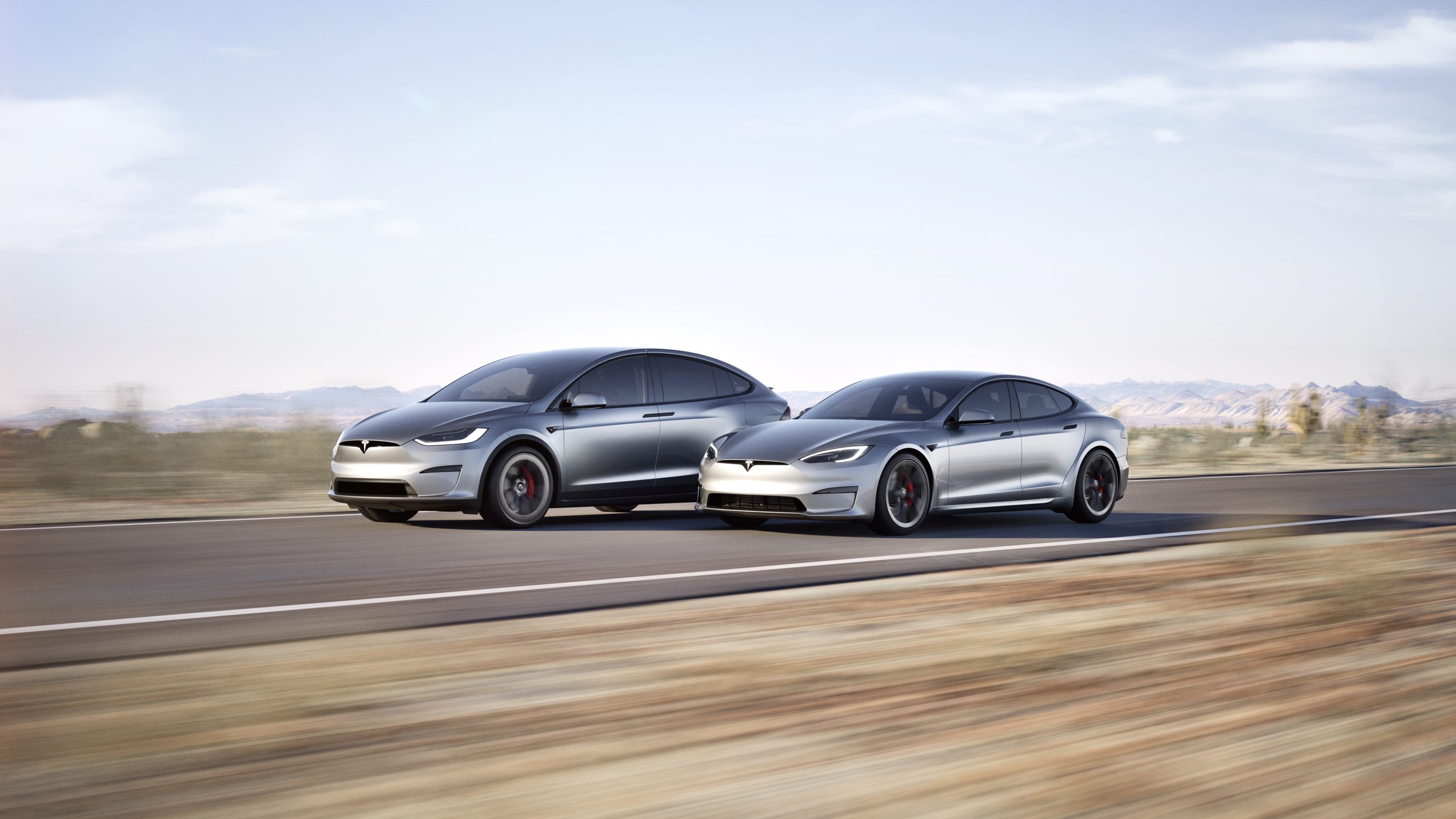
Tesla has officially started its process of sunsetting the Model S and Model X just months after the company confirmed it would stop producing the two flagship vehicles in 2026.
This step marks the end of an era for the vehicles that helped establish not only Tesla’s prowess as an automaker but also its status as a disruptor in the entire car industry. While these two cars have done a tremendous amount for Tesla, the signal that it is time to wind down their production has evidently arrived.
In the latest move to show Tesla is planning to eliminate the Model S and Model X from production, the company’s Korean arm has officially set a firm cutoff date of March 31, 2026, for new orders of both models.
This is the first time Tesla has announced a hard global deadline for the Model S and X, as after that date, only existing inventory will be available in South Korea.
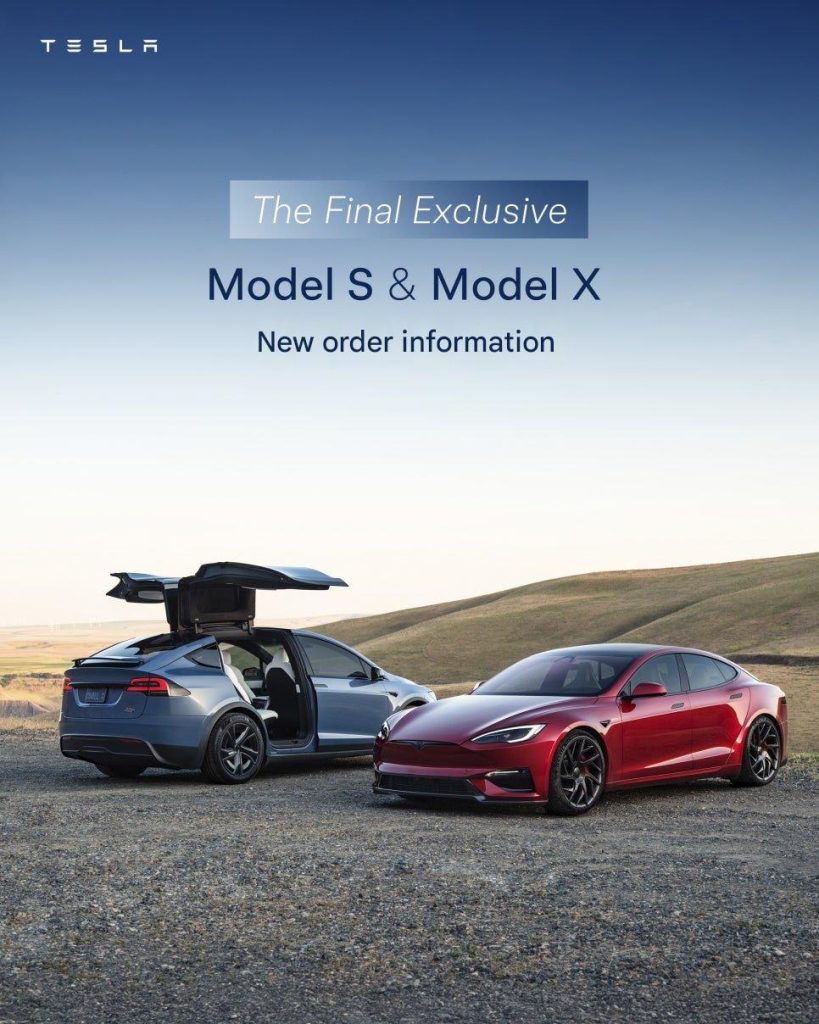
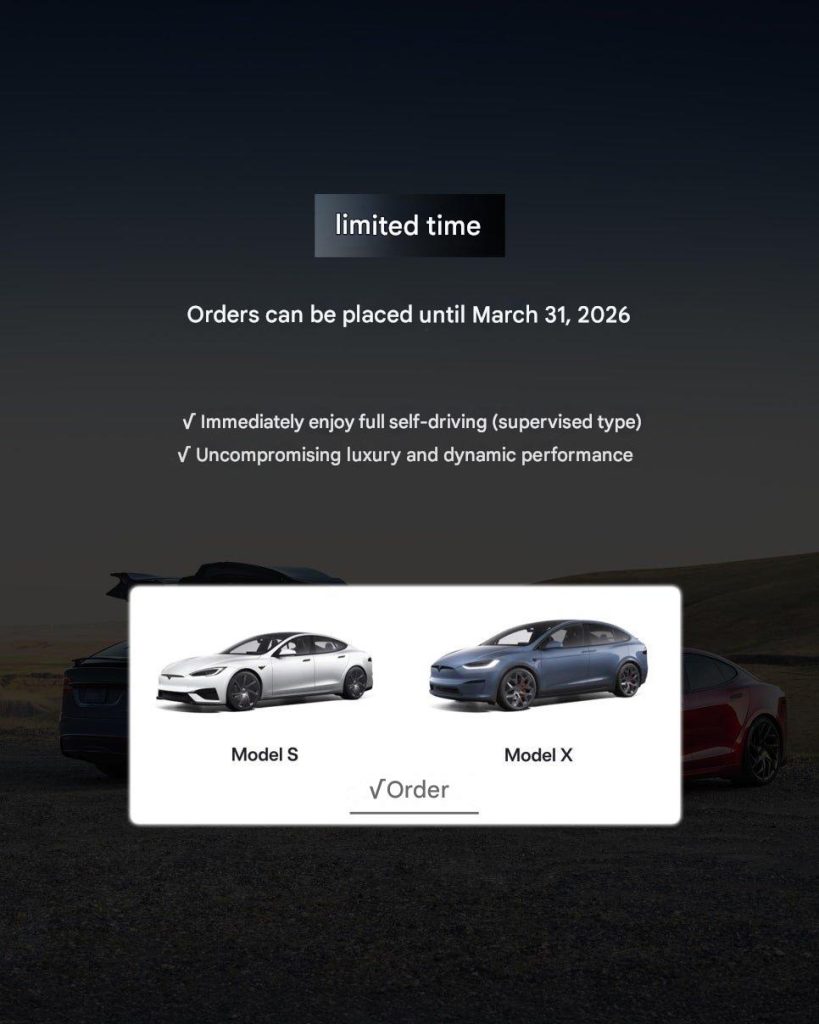
The move to bring closure to the Model S and Model X aligns with CEO Elon Musk’s plans for Tesla moving forward. During the Q4 2025 Earnings Call in January, Musk said the two cars deserved an “honorable discharge” for what they have done for the company.
The long-running programs are primarily being removed so that manufacturing lines can be repurposed for high-volume manufacturing of the Optimus humanoid robot. Tesla is targeting a production rate of up to one million units each year.
The Model S and Model X being removed from Tesla’s plans is a tough choice, but it was one that was written on the wall. Sales of these premium models have declined sharply in recent years, and even with Plaid configurations that are performance-forward, the company still has had trouble getting them sold.
In 2025, the Model S and Model X together accounted for roughly 3 percent of Tesla’s global deliveries, down significantly from prior periods as competition intensified in the luxury EV segment and buyers shifted toward more affordable options like the Model 3 and Model Y.
The Model S saw sales drop over 50 percent year-over-year in some quarters, while the Model X faced similar pressures from rivals, including the Rivian R1S and BMW iX.
Despite their dwindling volume, the Model S and Model X remain technological showcases. The Plaid variants deliver blistering acceleration, advanced Full Self-Driving capability, and luxurious interiors.
The phase-out paves the way for Tesla’s strategic pivot toward autonomy, robotics, and higher-volume vehicles.
Tesla brings closure to flagship ‘sentimental’ models, Musk confirms
Fremont will continue producing the refreshed Model 3 and Model Y, ensuring the factory remains a key automotive hub while expanding into robotics. Tesla has stated that the shift is not expected to result in job losses and could increase headcount as Optimus production ramps up.
For Tesla fans, the sunset represents a bittersweet moment. The Model S, introduced in 2012, proved EVs could compete with luxury sedans, while the Falcon-wing-door Model X set new standards for family haulers. Owners can expect continued software support and service for years to come.
Many fans have pushed for the Model X to hang around due to its appeal for families.
With the two cars heading out, Tesla’s priority now becomes its future products, especially that of the Optimus robot, which is the main reason for the S/X platform’s conclusion.
News
Tesla shows off mysterious vehicle at Giga Texas
The mysterious structure, partially unboxed amid construction materials, has sparked widespread speculation among Tesla enthusiasts and analysts. Many are convinced it is the long-rumored Model Y L, the extended-wheelbase variant already popular in China, now arriving in Texas for potential U.S. production.
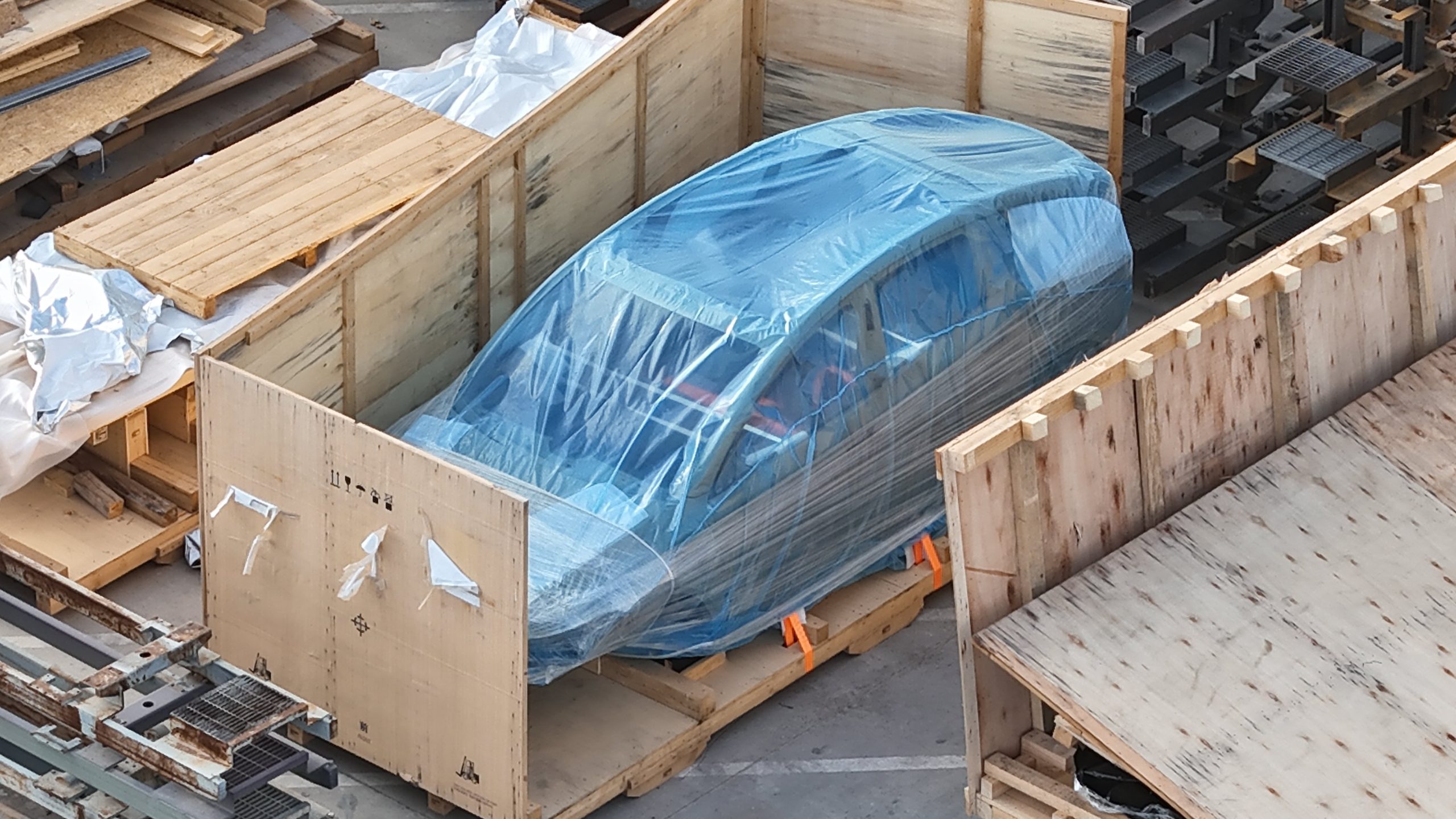
Tesla seemingly showed off a mysterious vehicle at Giga Texas, one that seems to be completely different than anything the company currently makes for the U.S. market.
The vehicle, which was spotted on the plant’s property, appears to be similar to the Model Y L that has not yet launched in North America, and is currently built at Gigafactory Shanghai in China.
Drone pilot Joe Tegtmeyer captured intriguing footage at Tesla’s Giga Texas on March 23, 2026, revealing what appears to be a large, blue plastic-wrapped vehicle body resting inside a wooden shipping crate outdoors.
Well this is interesting at Giga Texas today … what do YOU think this is? 🤔😎 pic.twitter.com/U9pLvqbf7L
— Joe Tegtmeyer 🚀 🤠🛸😎 (@JoeTegtmeyer) March 23, 2026
The mysterious structure, partially unboxed amid construction materials, has sparked widespread speculation among Tesla enthusiasts and analysts. Many are convinced it is the long-rumored Model Y L, the extended-wheelbase variant already popular in China, now arriving in Texas for potential U.S. production.
The images show an elongated silhouette that stands out from standard Model Y bodies. Side-by-side comparisons shared in replies to Tegtmeyer’s post highlight key differences: the rear door extends farther over the wheel arch than on a regular Model Y, and the rear glass appears to run all the way to the spoiler lip without the metal trim seen on shorter versions.
One overlay analysis noted that the visible proportions align precisely with the Chinese-market Model Y L, which measures approximately 4.98 meters long with a 3.04-meter wheelbase, which is about seven inches longer overall than the standard Model Y sold in the U.S.
Model Y L, with a support structure on top, likely for shipping. pic.twitter.com/ET3w46DjpJ
— Owen Sparks (@OwenSparks) March 23, 2026
The vehicle is a bare “body-in-white” shell, typical of prototypes sent abroad for tooling validation and local manufacturing ramp-up. Tesla has already launched the six- and seven-seat Model Y L in China and other markets, where it offers roughly 10% more cargo space and greater family-friendly versatility.
This sighting fits Tesla’s broader strategy. Industry observers expect the company to localize Model Y L production at Giga Texas by mid-2026 to serve American families seeking extra room without stepping up to the larger Cybertruck or a future full-size SUV.
Bringing the design stateside could add tens of thousands of annual deliveries while leveraging existing Model Y lines. People have been adamant that they want the Model Y L in the U.S., especially as Tesla plans to fade the Model X, the company’s most ideal vehicle for large families, out of production in the near future.
Tesla Model Y lineup expansion signals an uncomfortable reality for consumers
While Tesla has made no official comment, the timing, amid Giga Texas expansion and steady Model Y output, suggests the mysterious crate is more than a random prototype.
If confirmed as the Model Y L, it marks another step in Tesla’s effort to refresh its bestselling SUV for global demand. The vehicle would perform exceptionally well in the U.S., and despite the company’s rather mute stance on bringing it to America, this might be the biggest hint to date that it could be on the way.
Cybertruck
Tesla Cybertruck just won a rare and elusive crash safety honor
Only the most outstanding of performances in crash tests can warrant an IIHS Top Safety Pick+ award, as vehicles listed with that ranking must achieve “Good” ratings in the small overlap front, updated side, and updated moderate overlap front tests, along with “Acceptable” or “Good” headlights standard on all trims.
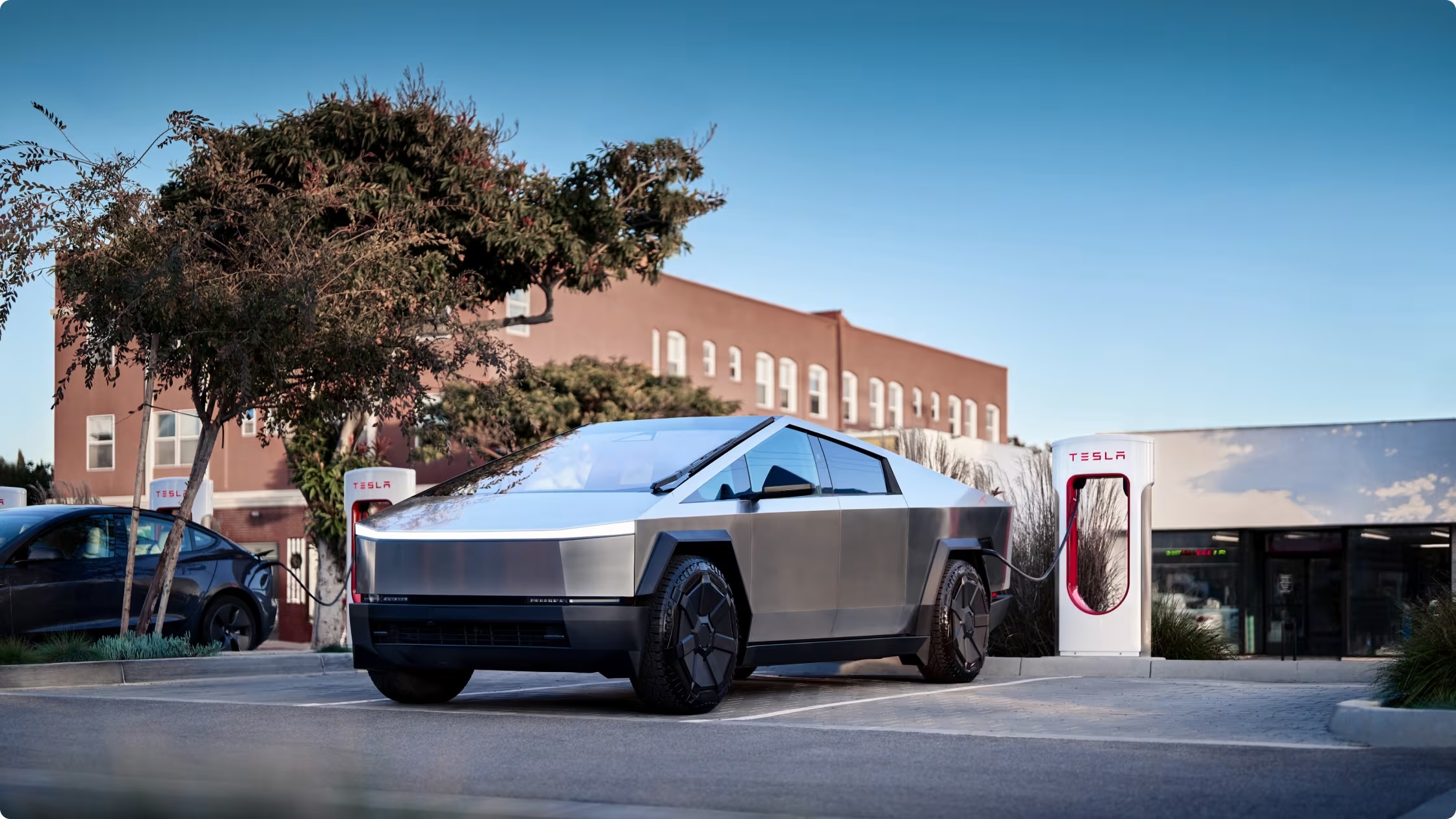
Tesla Cybertruck landed a rare and elusive safety honor from the Insurance Institute for Highway Safety (IIHS). It was the only pickup truck in the U.S. market to do so.
The IIHS rewarded the Cybertruck with the Top Safety Pick+ honors, the highest marks a vehicle can receive from the agency.
Only the most outstanding of performances in crash tests can warrant an IIHS Top Safety Pick+ award, as vehicles listed with that ranking must achieve “Good” ratings in the small overlap front, updated side, and updated moderate overlap front tests, along with “Acceptable” or “Good” headlights standard on all trims.
🚨 Absolutely insane.
Tesla Cybertruck was the ONLY pickup on the market to be awarded a Top Safety Pick+ rating by the IIHS
The safest rating out there belongs to Cybertruck 📐 pic.twitter.com/Y8gLOqaL0d
— TESLARATI (@Teslarati) March 24, 2026
Cybertruck was the only truck to also win an NHTSA Five-Star Safety rating, making it the only pickup available on the market to be recognized with top marks from both agencies.
There are a multitude of options for pickups in the U.S. market, as it is one of the most popular vehicle types for consumers in the country. Pickups are great vehicles for anyone who does any sort of hauling or is just looking for extra space for any variety of reasons.
Pickups are also inherently safer than other body types on the road, mostly because they are larger and heavier, making them more favorable against other vehicle types in the event of a collision. However, Tesla has a significant advantage in safety with its vehicles because it engineers them to not only be safer in collisions, but also easier to repair.
The Cybertruck managed to achieve “Good” ratings, the highest marks available by the IIHS, in all three Crashworthiness categories, as well as “Good” ratings in both Crash Avoidance and Mitigation assessments.
It also received “Good” ratings across all driver and pedestrian crash-test performance metrics, except for one, where it earned an “Acceptable” rating for rear passengers in the Chest category.
The Cybertruck’s outstanding crash test performance has won it this incredible mark as the pickup still tends to be one of the more polarizing vehicle designs on the market.
It is no secret that Tesla has struggled with demand of the Cybertruck due to pricing, but the recent rollout of a trim that was temporarily priced at just $59,990 showed plenty of people want the all-electric pickup.

Tesla officially begins sunset of Model S and Model X

Tesla shows off mysterious vehicle at Giga Texas


