Investor's Corner
Elon Musk makes a rare appearance on SolarCity’s Q2 conference call

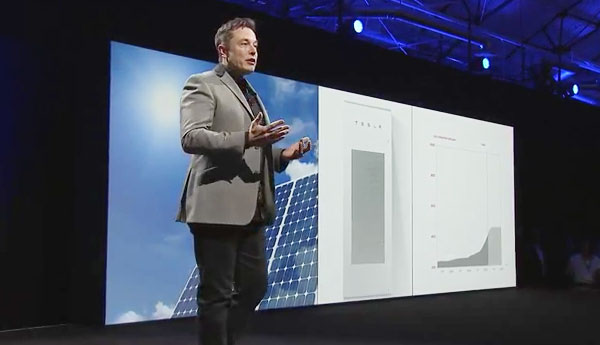
SolarCity reported its Q2 quarterly results on Tuesday August 9, 2016, but unlike calls from the past where CEO Lyndon Rive’s provides a financial outlook for the nation’s largest full-service solar provider, Tesla CEO and SolarCity Chairman Elon Musk took stage to discuss future plans for the company. This marks a rare occasion for Musk and arrives at a time when discussions for the impending merger between Tesla and SolarCity is the hot topic among shareholders and analysts.
SolarCity provided shareholders with a Q2 2016 Shareholder Letter and accompanying Slide Presentation. While there might be little interest in the earnings report for Tesla owners and fans, quite a few interesting tidbits were provided during the afternoon SolarCity Analysts conference call by Musk.
Tesla Acquisition
Philip Lee-Wei Shen of ROTH Capital Partners asked why “the final deal and offer price was actually lower than the original price.”
Elon responded that “this is a negotiation of the independent board members. I actually wasn’t part of – and part of it was simply what they came up after, I think, a quite exhaustive discussion that lasted a week or two. So I’ve not inquired about the details and I’m not privy to the details, but it was ultimately what they concluded was fair between the independent board members of SolarCity and the board members of Tesla. Obviously, this is now up to the shareholder votes, independent shareholder votes where, I would say, I’m recusing myself. I’m not legally obligated to recuse myself, I’m just doing so, because I think it’s morally the right thing to do and so is Lyndon and Pete and JB Straubel.”
A new Product: Solar Roof
SolarCity is going to enter the “solar roof” market.
“We’re going to be making a pretty interesting product and I’m excited to kind of reveal to you all at some point, but it is not just your typical module, it is both very efficient and it looks really, really good,” said Peter Rive (CTO).
Elon elaborated that “It’s a solar roof as opposed to a module on a roof. I think, this is really a fundamental part of achieving a differentiated product strategy – it’s not a beautiful roof, that it is a solar roof, it’s not a thing on a roof, it is the roof. That’s – which is quite a difficult engineering challenge, and not something that is available really anywhere else that is at all good. I think this will be something that’s quite a standout. So one of the things I’m really very excited about the future.”
“It’s just addressing a really big market segment, so just in the U.S., there is 5 million new roofs installed every year,” said Lyndon Rive (CEO).
“The interesting thing about this is that it actually doesn’t cannibalize the existing product of putting solar on roof, because essentially if your roof is nearing end-of-life, you definitely don’t want to put solar panels on it, because you’re going to have to replace the roof,” said Elon Musk (Chairman). “So, there is a huge market segment that is currently inaccessible to SolarCity, because people know they’re going to have to replace their roof, you don’t want to put solar panels on top of a roof you’re going to replace. However, if you are close – if your roof is nearing end-of-life, well, you’ve got to get a new roof anyway, there’s 5 million new roofs a year just in the U.S. And so, why not have a solar roof that’s better in many others ways as well. We don’t want to show all of our cards right now, but I think people are going to be really excited about what they see.”
Notice that roof solar is a business where there are players already: Luma Resources, CertainTeed and Integrated Solar Technology, in particular and one that DOW Chemical just exited.
The solar roof product will be manufactured in Buffalo, NY. Elon added that “it’s really important to manufacturing in-house because its panels control the aesthetics and ideally really design – it’s kind of like making a custom car, like when somebody orders a car from Tesla, they’ll pick a wide array of options, that car will be custom made to their preferences, and you really want the roof custom-made to the individual customer as a kit and then sent to, that will be, the delivery team to get installed.”
Home Energy Management
Colin Rusch of Oppenheimer inquired “how long is it going to be before the combined entity [Tesla Motors + SolarCity] introduces a home energy management system or some sort of robust energy efficiency offering?”
To which Elon joked that “solar and battery go together like peanut butter and jelly. You obviously need the battery, particularly as you get to scale and you want to have solar be a bigger and bigger percentage of the grid. If you don’t have the batteries there to balance the grid and buffer the power, you really can’t go beyond a certain percentage of solar in a particular neighborhood. Maybe you can go up to about 20% solar, but more than that, it starts to unbalance the grid and you need to buffer it, because the energy generation is low at dawn and dusk, it’s high in middle of the day, and it’s at zero during at night. So you got to smooth that out.”
Elon reiterated the usual “sustainable energy” mantra he has been preaching for a decade: “if you like sort of fast forward to where do we want the world eventually to be is want the world to have a sustainable energy generation, a sustainable energy consumption, so that it really requires the three critical ingredients for that, there is the solar panels, the stationary batteries, and electric vehicles.”
Who is going to Win? Rooftop or centralized generation?
“You’ll have millions of these batteries, you’ve got to manage that and integrate it with the utility,” said Elon. “I do want to emphasize, there’s still a very important role for utilities here, sometimes people think that this is an either/or thing, it’s like either rooftops are going to win or centralized generation is going to win and actually both are going to win, because the electricity usage is going to increase dramatically as we transition away from burning old dinosaurs to electric cars, and then to electric transport, we would see roughly a doubling of electricity consumption as all transport moves to electric. And then, there is a tripling of electricity usage if you take all heating and make that electric as well, because obviously most heating is from oil and natural gas particularly.”
Combining battery and rooftop solar
Gordon Johnson of Axiom Capital Management inquired what was the rationale behind the acquisition [of SolarCity by Tesla] when “combining a battery and a rooftop solar company didn’t make a ton of sense because when you have a rooftop solar company with net metering, the grid acts as, effectively, a battery, ruling out the need for a battery technology.”
“Where we see net metering evolving over the next few years, I think this is a really important part of how storage is a combination with the solar,” answered Peter Rive (CTO). “A case that I’d like everybody to review is what just recently happened in New York. This is a collaboration of the local utilities and the solar industry. And the collaboration is net metering for the next three years and then a phasing to more of a grid services model, where you combine solar, storage, smart inverters and provide all these additional grid services, and you phase that in and then essentially you phase-out net metering into that grid services model.”
Peter concluded that “we see that probably happening as a standard policy and we’re going to promote that across all the different states. But you – we have to get to a point where it is the grid services, so that, actually it recognizes the value that solar and storage can provide you to grid.”
I think Peter Rive indeed sees the writing on the wall for “net metering” as being phased out over time. Net metering has disappeared already from states like Nevada, and while it has been retained in California, at least until 2019, all local utilities are switching gradually to TOD (Time-of-Day) billing (the “grid services” model Peter references above), where a “smart battery storage” product that provides “time-shifting” will solve the solar basic dilemma: while solar production peaks during midday, energy consumption is highest in the morning and evening. With storage, you can save the energy you produce for when you need it most, and at the same time you limit the output to the grid, a benefit to the local utility.
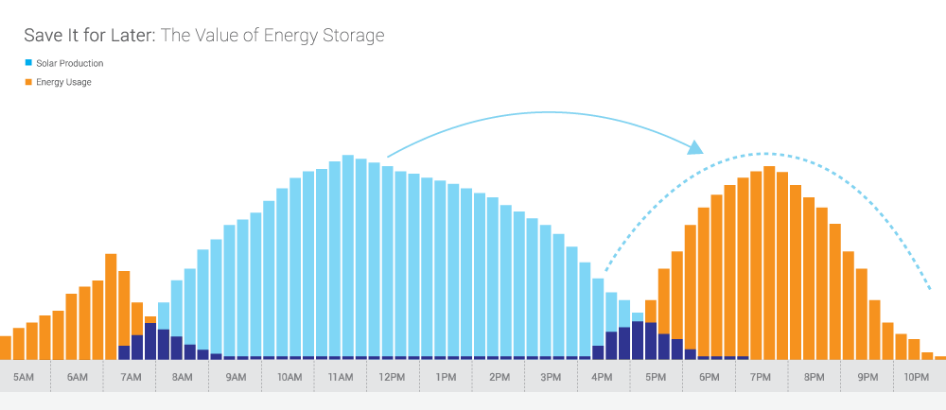
Source: Enphase Energy



Tesla has its answer to grow its automotive sales over the next few years, TD Cowen analyst Itay Michaeli says, but it just has to bring it to the U.S.
On Thursday, Michaeli reiterated his $490 price target and the ‘Buy’ rating he already held on Tesla stock (NASDAQ: TSLA). However, its automotive division has struggled to show sequential growth over the past few years, mostly due to its focus on AI and Full Self-Driving. Tesla already axed two of its lower-volume vehicles with the Model S and Model X earlier this year.
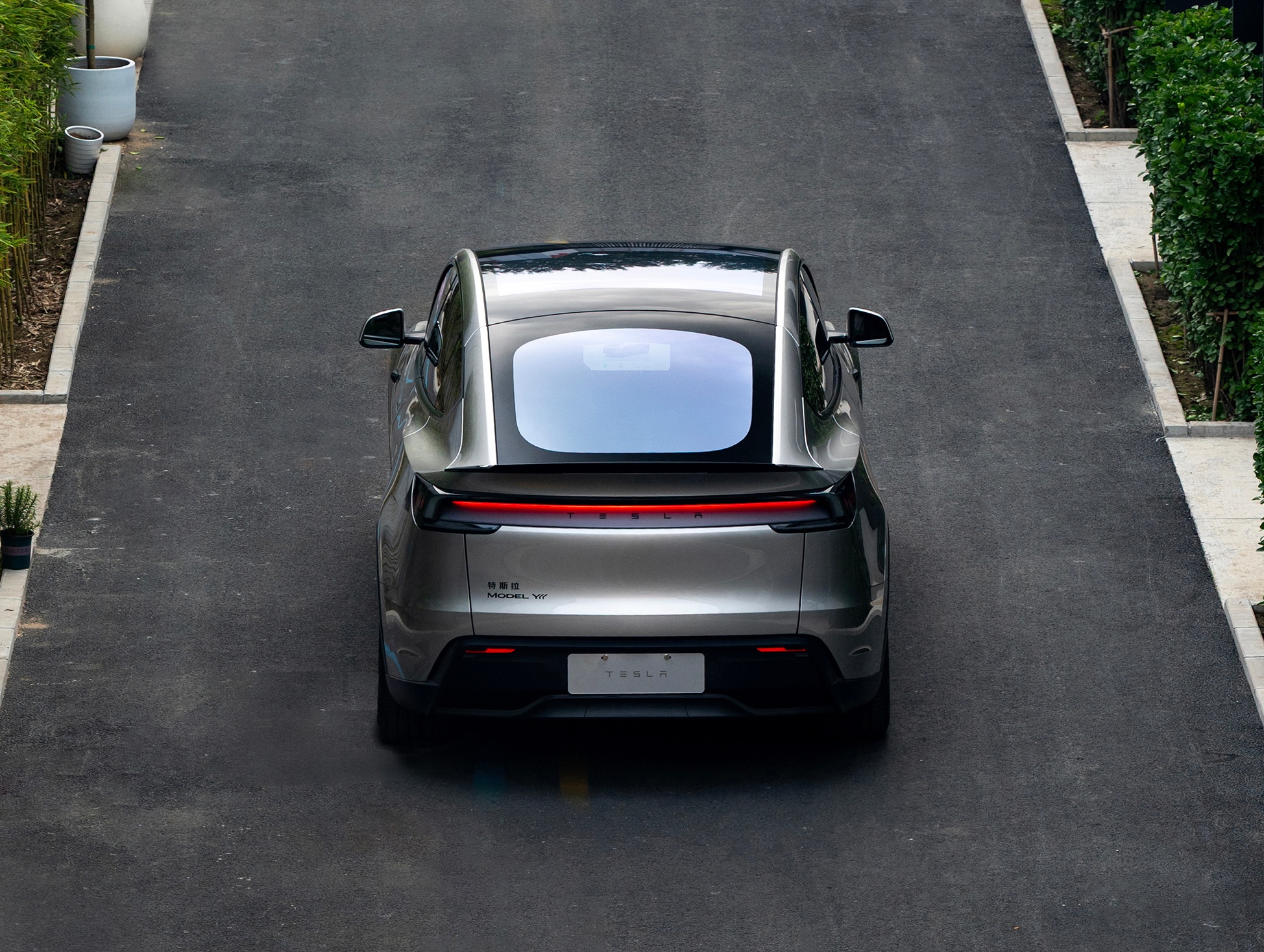
However, Tesla does not need to engineer an entire new vehicle to trigger an upward tick in sales; it just has to bring it from China to the U.S., Michaeli said.
He is talking about the Model Y L, a slightly larger version of the all-electric crossover that is already available in China. U.S. customers have been pleading with CEO Elon Musk to bring it to the country since its launch in Asia last year, but he’s not convinced of it because of the advent of self-driving and its importance in this particular market.
The problem is that Tesla owners have been requesting something larger that could fit a typical American family. The Model Y L is slightly larger than the standard Model Y, but some are concerned that it could still be too small to fit what most people might need.
Instead, they have asked for a full-size SUV from Tesla.
Tesla gives big hint that it will build Cyber SUV, smaller Cybertruck
Nevertheless, the Model Y L still presents a great opportunity for Tesla in the U.S., and Michaeli says that there is an additional sales opportunity of about 100,000 units, with demand potential falling somewhere between 60,000 and 135,000 units.
TD Cowen’s note to investors also analyzed that Tesla’s growth could come from a stock perspective as well, positively impacting the stock price, as it has been widely reliant on vehicle sales, even though Tesla has truly phased itself away from that being an important metric.
Tesla stands to gain greatly from the introduction of the Model Y L in the U.S., but only if Elon Musk sees it as a viable fit for the market. Families may need to see Tesla bring something larger to the U.S., or they might be forced to buy from another automaker that offers something that fits is needs for more interior space to haul around the kids.
Elon Musk
SpaceXAI just launched into your kitchen with their new app
SpaceXAI just powered its first consumer app and it predicts what you want to buy.

SpaceXAI just made its first move into consumer AI, and it involves your grocery cart. On June 3, 2026, Gopuff and SpaceXAI announced the launch of Go, a Grok-powered shopping assistant built directly into the Gopuff app that predicts what you need before you even start searching for it.
Gopuff is an instant delivery platform that operates more than 400 micro-fulfillment centers across the U.S., delivering everyday essentials, snacks, drinks, and household items in as little as 15 minutes. It is not a restaurant delivery app or a marketplace. It owns its inventory, controls its warehouses, and handles its own logistics, which means it has built one of the most detailed consumer behavior datasets in retail over its 13-year history.
Go combines SpaceXAI’s advanced reasoning, voice, and image generation models with Gopuff’s dataset of hundreds of millions of orders and real-time cultural signals from X to prepare a suggested cart the moment a customer opens the app. It learns each shopper’s habits and automatically builds a personalized cart based on time of day, location, order history, and real-time indicators. Returning customers can check out with a single tap.
Rather than searching for specific items, users can describe a situation like a game-day party or the desire for a healthy breakfast and Go will assemble a cart automatically. It can also predict when shoppers are running low on items like coffee or paper towels and have them packed and delivered in under 15 minutes. Grok voice integration lets users talk to the app in plain conversational language and check out completely hands-free.
Gopuff co-founder and co-CEO Yakir Gola said: “Today, we believe the greatest friction left in commerce is not delivery or instantaneous access to the essentials customers need. It’s the moment before: the thinking, the deciding, the remembering. We’re combining Gopuff’s demand intelligence with xAI’s frontier reasoning to create an everyday shopping experience that feels like a true extension of you.”
Why SpaceX just made a $60 billion bet on AI coding ahead of historic IPO
The timing carries context beyond the product launch. SpaceXAI was formed after SpaceX completed an all-stock merger with Elon Musk’s xAI earlier this year, folding one of the most advanced AI labs in the world into the same corporate structure as the company preparing what could be the largest IPO in history. SpaceXAI is dipping into consumer-focused AI just as it prepares for its public debut, and while Musk has openly discussed building an everything app, this launch uses Grok to power another company’s product rather than launching a standalone consumer platform. Every consumer-facing deployment of Grok ahead of the IPO roadshow adds tangible evidence that SpaceXAI is not just an infrastructure play but a direct competitor in the AI application layer where OpenAI and Google are already fighting for dominance.
Elon Musk
SpaceX’s amended S-1 is sparking a major Tesla merger conversation
A single line in SpaceX’s amended S-1 just sent Tesla stock down 5% in one day.
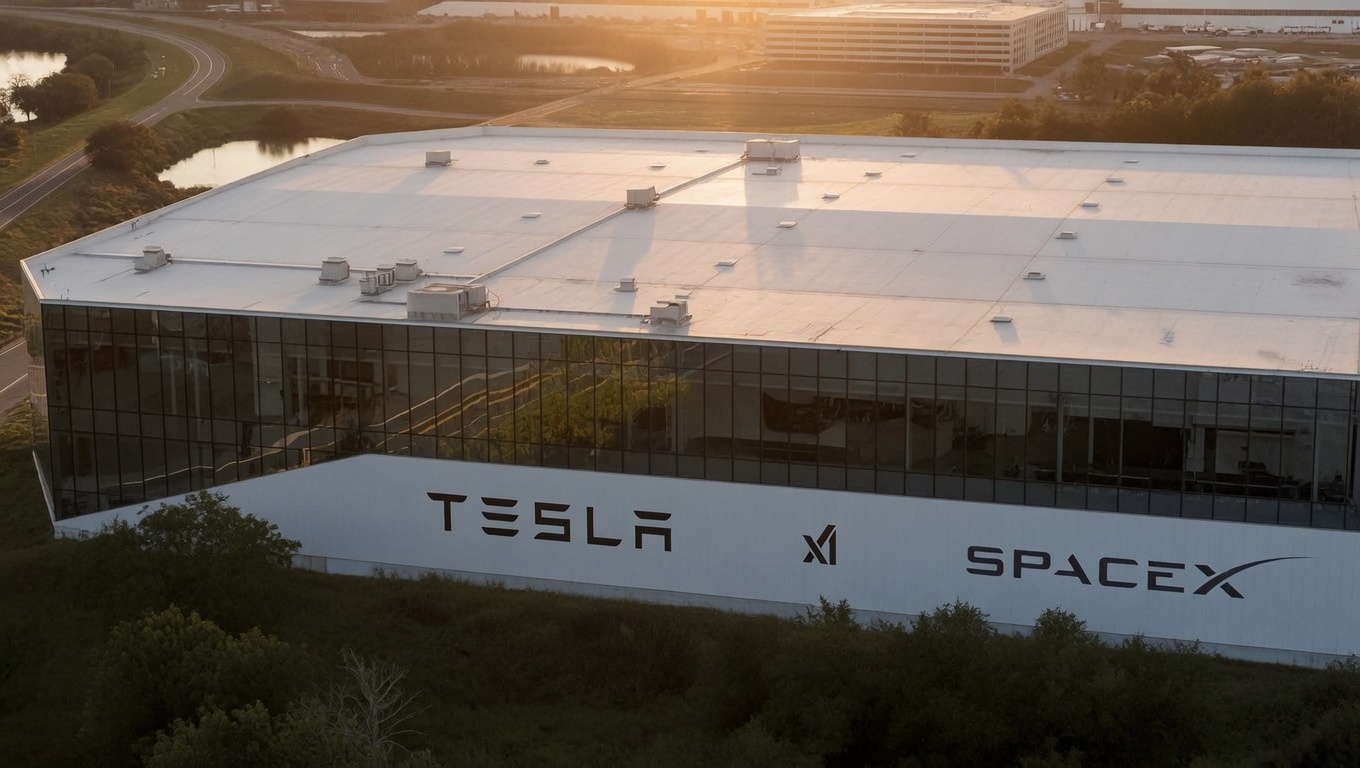
A single line buried in SpaceX’s amended S-1 filing is doing more to move Tesla’s stock price than anything Tesla itself has announced in months. The clause, disclosed as SpaceX prepares for what could be the largest IPO in Wall Street history, states that the company “may issue a significant amount of equity in connection with future transactions.” While this may be seen as boilerplate language in S-1 filings, the historical ties between SpaceX and Tesla, and with Elon Musk reportedly discussing a possible merger with close colleagues, investors are interpreting it as something closer to a signal.
The concern among institutional investors like Gary Black, managing director of The Future Fund, pointed directly to the amended filing on X, saying it “strongly suggests more SPCX equity will be issued,” which could potentially be used to acquire Tesla. He estimated such a deal could be 28% dilutive to Tesla shareholders since SpaceX would likely command a significantly higher valuation multiple. Black added that institutional investors he knows hate the idea of a combination because they prefer pure plays over conglomerates, which he said “nearly always gravitate to the lowest common multiple.”
The Tesla and SpaceX merger everyone is talking about is quietly building
The bull case runs the math differently. Tesla influencer and retail shareholder advocate AleXandra Merz pushed back on what she called a widespread misunderstanding of how merger-of-equals deals actually work. Rather than simply splitting the difference between two market caps, a merger exchange ratio is negotiated based on relative fair market values, meaning the lower valued company typically sees its stock reprice upward toward the deal value.
Under her model, SpaceX enters at a $2.5 trillion valuation and Tesla at $1.6 trillion, producing a combined entity worth $4.1 trillion split evenly between both shareholder groups. That implies Tesla’s side of the deal would be valued at $2.05 trillion, a gain of roughly $450 billion from its current market cap. She cited Dow-DuPont and CBS-Viacom as historical examples of how markets reprice both companies toward the announced exchange ratio after a deal is unveiled.
What does a Merger of Equals mean to Elon’s compensation packages?
Well, it changes everything.
Enjoy https://t.co/uekCldyITw pic.twitter.com/kolq1C9qTu
— AleXandra Merz 🇺🇲 (@TeslaBoomerMama) June 1, 2026
The SpaceX S-1 amendments also revealed just how much financial infrastructure already binds the two companies together. As Teslarati has reported, SpaceX purchased $697 million in Tesla Megapacks, $131 million in Cybertrucks, and the two companies have shared supply chain resources, and semiconductor fabrication plans since well before any merger conversation became public. A retail poll by Tesla influencer Sawyer Merritt is finding that 36% of respondents do not plan to buy SpaceX shares at IPO and 15.3% saying their decision depends on the valuation.
Do you plan on buying @SpaceX stock at its IPO?
— Sawyer Merritt (@SawyerMerritt) June 1, 2026
Whether the merger happens or not, the amended filing is seemingly moving markets and sharpened a debate that is no longer theoretical. SpaceX is weeks away from trading publicly, and Tesla shareholders are now watching every word of every filing for clues about what Musk plans to do next.

Tesla has its answer to auto growth, it just has to bring it to the U.S.: analyst

Tesla Hardware 3 owners could be made whole this month


