News
Tesla’s snub from White House EV event: the Pros and Cons

As the United States government continues its monumental push of domestic automakers to transition to electrification, President Joe Biden and fellow White House staff have invited companies like Ford, General Motors, and Stellantis to Washington to discuss what steps can be taken at the federal level to reach lofty EV delivery goals. However, perhaps the Biden Administration’s biggest ally, Tesla, wasn’t there because it was not extended an invitation. While CEO Elon Musk called the no-invite “odd,” there are potentially some bright spots in the situation, although the question of whether they outweigh the negatives is up to the reader to decide.
White House Electrification Event for U.S. Automakers
A relatively groundbreaking announcement that comes on the heels of President Biden’s request for legacy automakers to commit to a 40% electrified fleet by 2030, the companies agreed to a loftier but more satisfying figure of 50%. Now that half of all legacy automaker vehicles sold in 2030 will be electric, the big question is, how will it work? How will this plan be carried out?
Effectively, a game plan is likely being discussed among the White House staff and the leaders of the automakers who were invited to the event. With each company outlining specific goals through various announcements over the past several years, it is now time for action. The talking is done, a plan needs to be laid out and completed. The thing about electrification is that it is vastly different from building an ICE car, which each of these companies has long, storied, and successful histories of doing. Building an electric vehicle is a completely different project, and it goes much further than putting some electric motors and batteries in a pack and calling it an EV. There needs to be efficient and effective software, the batteries need to have a specific cell chemistry to operate for a long time, charging infrastructures need to be established, along with many other factors.
Tesla’s absence from White House EV event sidestepped in Pete Buttigieg interview
The overall issue that many of these companies have when transitioning to electrification is finding out how to make EVs operational. Far too many times, we have heard about incredible EVs that will come to the market in a few years, they are going to be amazing and effective, and they will show Tesla who is boss. But every time this has happened, these cars fall short of their mark.
The Cons: Why Tesla should be at the White House, no questions asked
Tesla has the experience to help these automakers navigate through extremely difficult times, which are likely to come based on many of these companies’ current situations with developing electric powertrains. Creating one or two vehicles and selling between thirty and fifty thousand of them definitely helps the cause. However, keeping these delivery rates and simply putting a few new bells and whistles in the interior doesn’t make it a new car. Consumers want new technology, new looks, new aesthetics. This means cars with more range, more features, and sleeker, more modern designs.
The goal should be for these automakers to develop a plan by 2030, about eight and a half years, to have four to five different electrified models on the road by that year. Rolling out that many new models while simultaneously engineering and building effective electric powertrains is extremely difficult. Many companies may find that the road to this goal is not necessarily as simple as they thought.
Ask Tesla about it.
After unveiling the Model 3, Tesla and CEO Elon Musk entered the toughest few years of Tesla’s short life.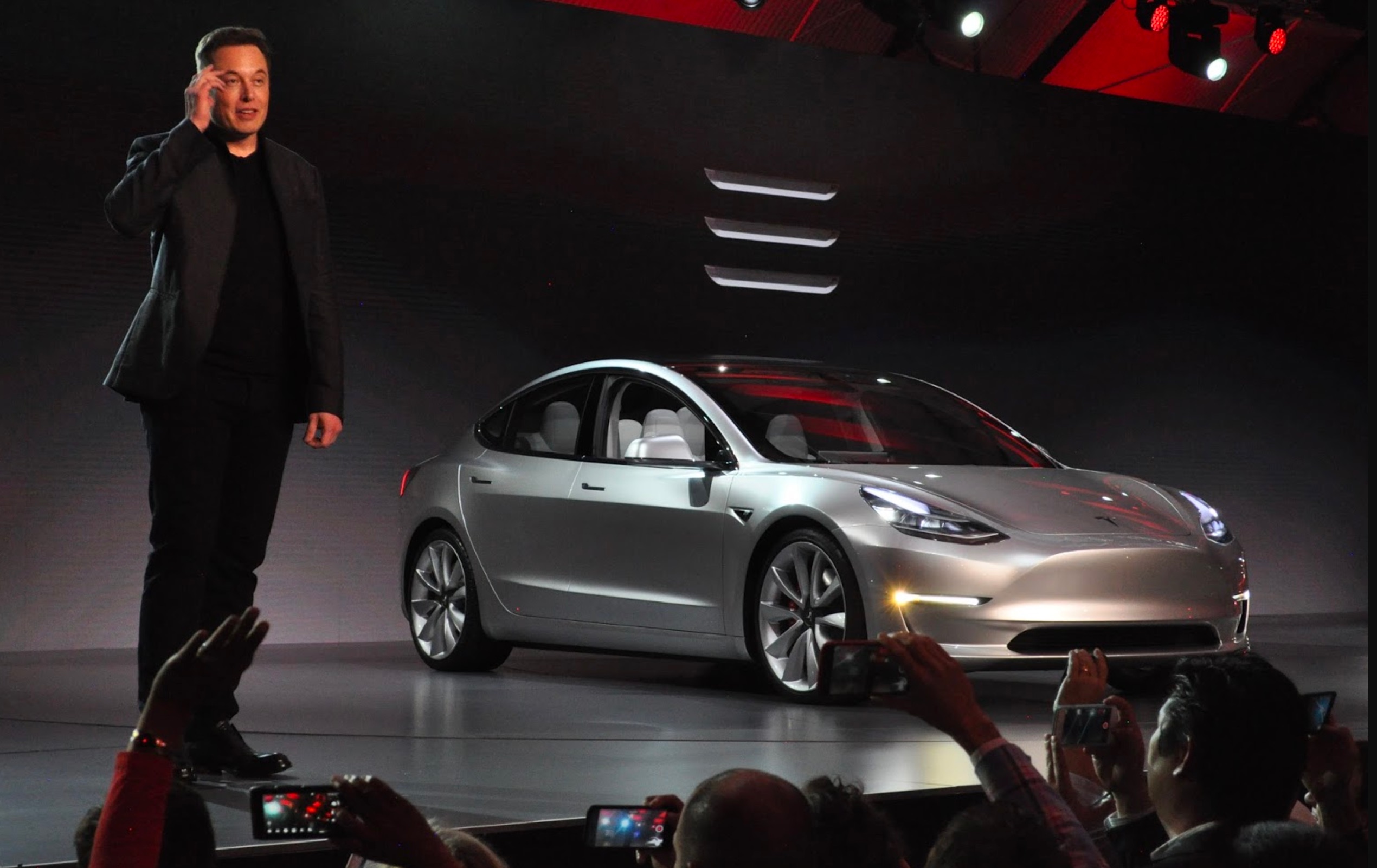
However, Tesla overcame all odds by delivering four electric models in just eight years: the Model S in 2012, the Model X in 2015, the Model 3 in 2017, and the Model Y in 2020.
Ideally, Tesla would be the biggest advantage for all of these companies from a consultant standpoint. If Tesla’s goal really is to accelerate the world’s transition to sustainable energy, it would have no issue helping car companies figure out where their shortcomings are. No technological advantages would need to be shared. Still, a roadmap of how Tesla navigated through the toughest portion of its existence by releasing popular, profitable, and effective EVs would undoubtedly help. Not to mention, these companies are much more financially stable than Tesla was while it was ramping up its production of vehicles. That would only help the cause as money really isn’t an issue.
Another negative comes from a perceptive standpoint, but it can’t be a good look for the Biden administration to go through with this event without having the industry leader there. It would be like having a tech event without Apple, an Olympic highlight reel without Phelps, a chef’s get-together without Gordon Ramsay. It just doesn’t make sense, and on top of it, it doesn’t necessarily show that the country’s leaders support Tesla’s efforts. After all, Joe Biden hasn’t uttered the word “Tesla” since he’s taken office.
The Pros: Why it might not be so bad after all
If the purpose of this event is to get automakers on board with electrification, then Tesla really would have no business being there. After all, the companies invited have pledged to have half of their vehicle deliveries be electric in 2030. Tesla already delivers only electric vehicles, and it has since day 1. Some could see it as the Straight A student going to tutoring; it’s really kind of pointless.
Additionally, it might be a good look for Tesla not to go to the event from a political standpoint. Currently, 52% of Americans disapprove of Biden’s job performance. This is according to Rasmussen, which updates the poll daily.
Tesla also does not need any assistance federally, and it does not need any entity to tell it how to handle its business. This is something that Tesla should take pride in. The hard-working giants who have ruled the automotive industry for a century need guidance on continuing to move forward.
For Tesla, the answers came through its own hard work and its own want to change the world for the better.
What do you think? Let us know in the comments below, or be sure to email me at joey@teslarati.com or on Twitter @KlenderJoey.


Elon Musk
The Boring Company’s latest Tesla tunnel truck mod “fits like a glove”
The Boring Company has modified a Tesla powered tunnel truck to carry freight containers underground.

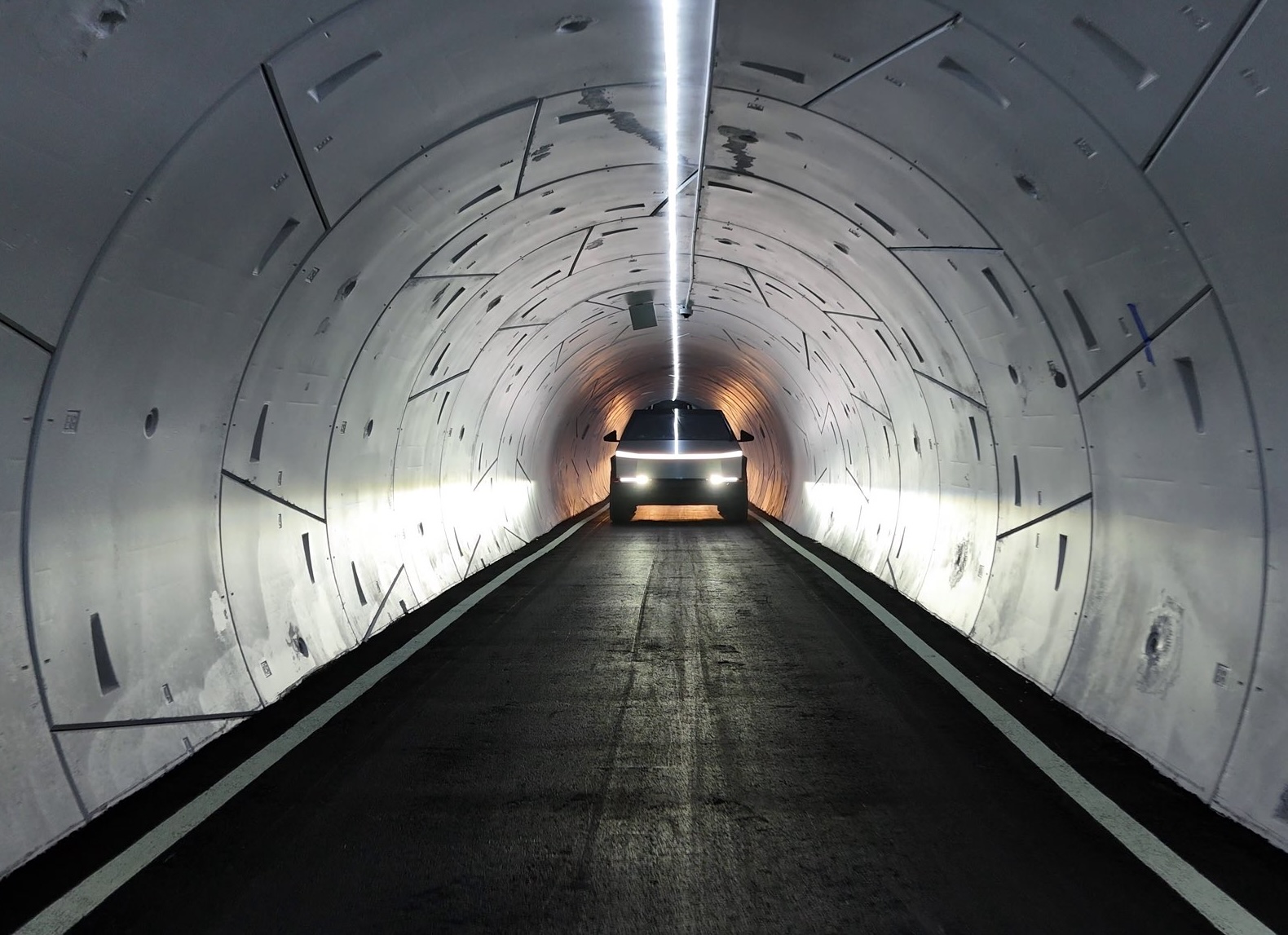
The Boring Company has found a second job for the Tesla hardware it already runs underground. In a post on X, Elon Musk’s tunneling company showed its latest Prufrock Liner Truck modified to carry a standard 20 foot shipping container. “Using TBC tunnels to transport freight,” the company wrote. “The latest Prufrock Liner Truck (using Tesla Model 3 batteries and drive units) has been modified to carry a standard 20′ shipping container. Fits like a glove!”
The photo shows a red container sitting on a long, low white chassis parked outside, with drive hardware visible at one end. The Boring Company did not say where or when freight hauling would start, which customers it has in mind, or how many trucks it is converting.
Using TBC tunnels to transport freight.
The latest Prufrock Liner Truck (using Tesla Model 3 batteries and drive units) has been modified to carry a standard 20’ shipping container.
Fits like a glove! https://t.co/VV0phWK4fc
— The Boring Company (@boringcompany) October 19, 2026
Until now, the liner trucks have hauled concrete. Teslarati reported in August on Liner Truck 3, which uses Model 3 battery packs and drive units to move more than 22,000 pounds of precast tunnel segments to the boring machine. It has 28 miles of range, tops out at 12 mph, and is piloted remotely from the company’s operations center in Texas. The freight version appears to be the same platform with a different bed, and The Boring Company has not said whether it will also be remotely piloted.
Freight has been on the company’s menu for years. When TBC updated its product lineup in 2021, its freight tunnel was described as sized to fit a standard shipping container, “barely.” The company later used the idea at Tesla’s own factory, where Prufrock 3 dug a tunnel to Giga Texas that now moves finished Cybertrucks away from the production line.
The Boring Company closed a $3 billion Series D in September at a $23 billion valuation, and Teslarati has covered how that money is tied to a UAE tunneling push and a faster Nashville build. In Nashville, Prufrock MB1 and MB2 are mining at the same time, and a third machine is expected to launch in late October. Each machine needs a steady supply of liner trucks, so any design that works for segments and containers alike gives the company more use out of the same Tesla parts.
The Vegas Loop remains the only Boring Company system open to the public, and it moves passengers in Tesla vehicles. A freight service would be a separate product, and the post gave no indication that one is close to launch. For now, it is a truck, a container and a short caption saying they fit together.
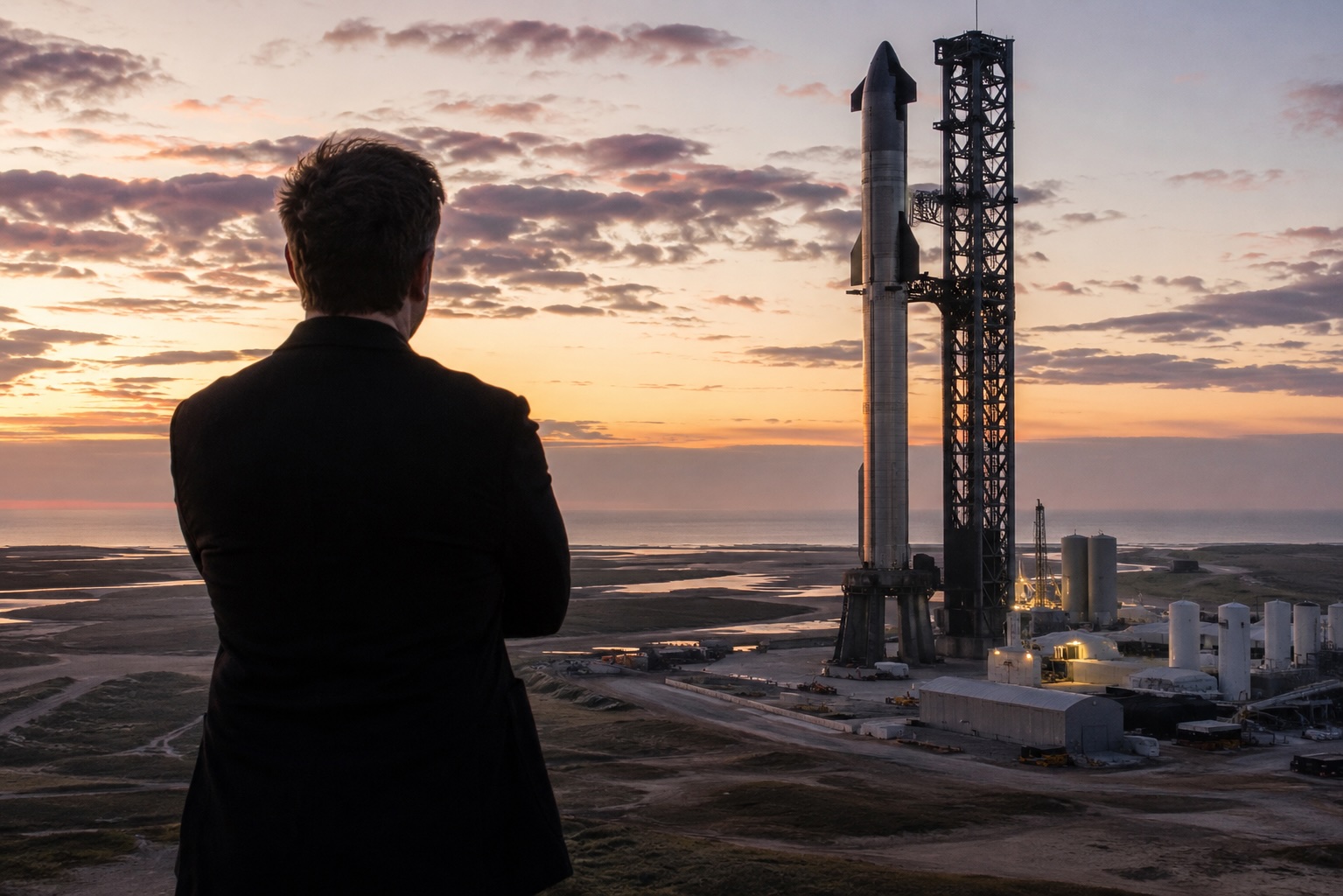
Elon Musk said he is planning to give “every one of his SpaceX shares to every kid in America” in 2027, stating that “this will be the first of many.”
SpaceX went public earlier this year, and its stock price has been relatively stable since leveling off shortly after its IPO. Based on its current price, it’s a gift of just over $10 billion to children across the United States.
It appears to be closely related to President Donald Trump’s bank accounts for children, which were set up earlier this year as Trump Accounts.
Just hours earlier, Anthropic had announced the establishment of its Anthropic Public Benefit Fund, “a new wholly-owned entity dedicated entirely to public benefit.” Musk responded by stating he recommended “giving the shares directly to the public,” and that he would be doing it that way.
Just a little bit later, Musk said children across the U.S. would be getting a share from him:
Next year, I will give one of my SpaceX shares to every kid in America.
This will be the first of many.
— Elon Musk (@elonmusk) October 19, 2026
There are roughly 70 million children, meaning someone under the age of 18, in the United States, according to the Federal Interagency Forum on Child and Family Statistics. Musk’s ownership of SpaceX stock shows he has around 849 million Class A shares of SpaceX stock, according to filings with the SEC.
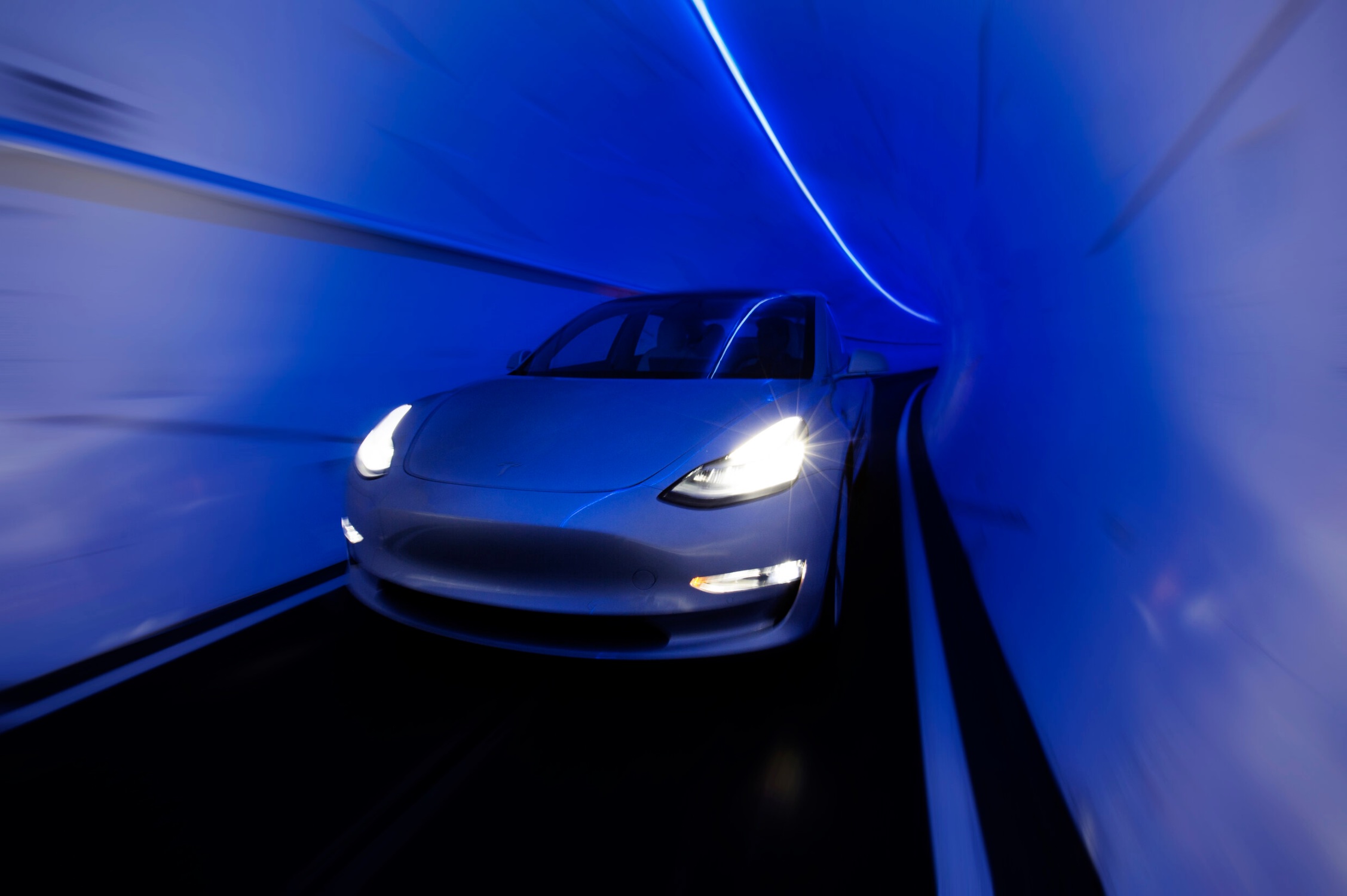
Elon Musk revealed in a post on X that “Permits were impossible to get,” explaining the fate of The Boring Company’s most ambitious East Coast proposal.
The comment responded to a query about what became of his July 20, 2017 announcement that he had “just received verbal govt approval” for an underground Hyperloop connecting New York City, Philadelphia, Baltimore, and Washington, D.C., capable of carrying passengers from the Big Apple to the Nation’s Capital in just 29 minutes.
The Boring Company receives verbal ‘approval’ to build NY to DC Hyperloop tunnel
The 2017 post, which envisioned city-center stations and multiple elevators in each city, sparked immediate scrutiny. Local and state officials in New York, Philadelphia, Baltimore, and D.C. said they had no knowledge of any approval. A White House spokesperson confirmed only “promising conversations” about the transformative infrastructure.
Musk clarified shortly after that there was “still a lot of work” to do for formal approvals.
@cybrtrkguy Permits were impossible to get
— Elon Musk (@elonmusk) October 19, 2026
Limited progress followed, as Maryland Governor Larry Hogan’s administration issued a conditional utility permit and supported work near Fort Meade. In 2018, Washington, D.C., granted a preliminary permit for site preparation and excavation on a vacant lot at 53 New York Ave. NE in the NoMa neighborhood, which The Boring Company said could become a station.
A draft environmental assessment for a D.C.-Baltimore segment was released in 2019. Yet, by April 2021, the company had removed the project from its website, and the Federal Highway Administration reported receiving no indication of further interest. Communication with Maryland officials had ceased.
The full corridor would have required coordination among the District of Columbia, Maryland, Pennsylvania, New York, the Federal Highway Administration, the Army Corps of Engineers, the National Park Service, and other agencies.
Environmental reviews under the National Environmental Policy Act, utility clearances, and approvals for novel infrastructure added to the overall complexity of the project and its approval.
Speculation on the permitting barriers centers around a few factors, but a multi-state, multi-level route involving unproven high-speed vacuum-tube technology inherently triggers exhaustive safety, environmental, and engineering reviews that can stretch for years, even for conventional projects.
There are also other elements, of course, like officials who may face political exposure if a privately funded, untested system encountered anything such as cost overruns, delays, or safety issues. On the outset of this project, there were limited things such as engineering plans or demonstrated technology maturity, which also added to the potential skepticism.
The East Coast vision for Boring Co., once framed as a privately funded revolution that could reshape Northeast travel, quietly ended without construction of the promised network. Musk’s recent statement frames the outcome as a regulatory impasse, unfortunate but not unexpected.

The Boring Company’s latest Tesla tunnel truck mod “fits like a glove”

Elon Musk will give ‘every kid in America’ a SpaceX share in 2027

Elon Musk reveals why Boring Co’s biggest East Coast project never happened

SpaceX reveals how its 1 Million AI satellite network will work and prevent space collisions

Tesla Roadster: Three configs, one can fly, 0-60 in 0.8 seconds


