
Used Tesla Model 3s and Model Ys aren’t depreciating nearly as fast as their luxury vehicle counterparts, despite five price cuts in the year’s first quarter.
One concern many Tesla owners have shared online following the series of price cuts implemented by Tesla is that their vehicles would, in turn, dramatically depreciate. However, according to a new report, that appears not to be the case. Moreover, Recurrent Auto, the company that published the report, has more good news for current and will-be Tesla owners.
The revelation regarding used Tesla depreciation was unearthed by Recurrent’s Q2 2023 Used EV Report, which it publishes quarterly to track used EV market trends. According to this report, the average used Tesla Model 3 and Model Y has only depreciated roughly 10% over the past three years, which is significantly less than counterparts from Mercedes, Lexus, and even Porsche.
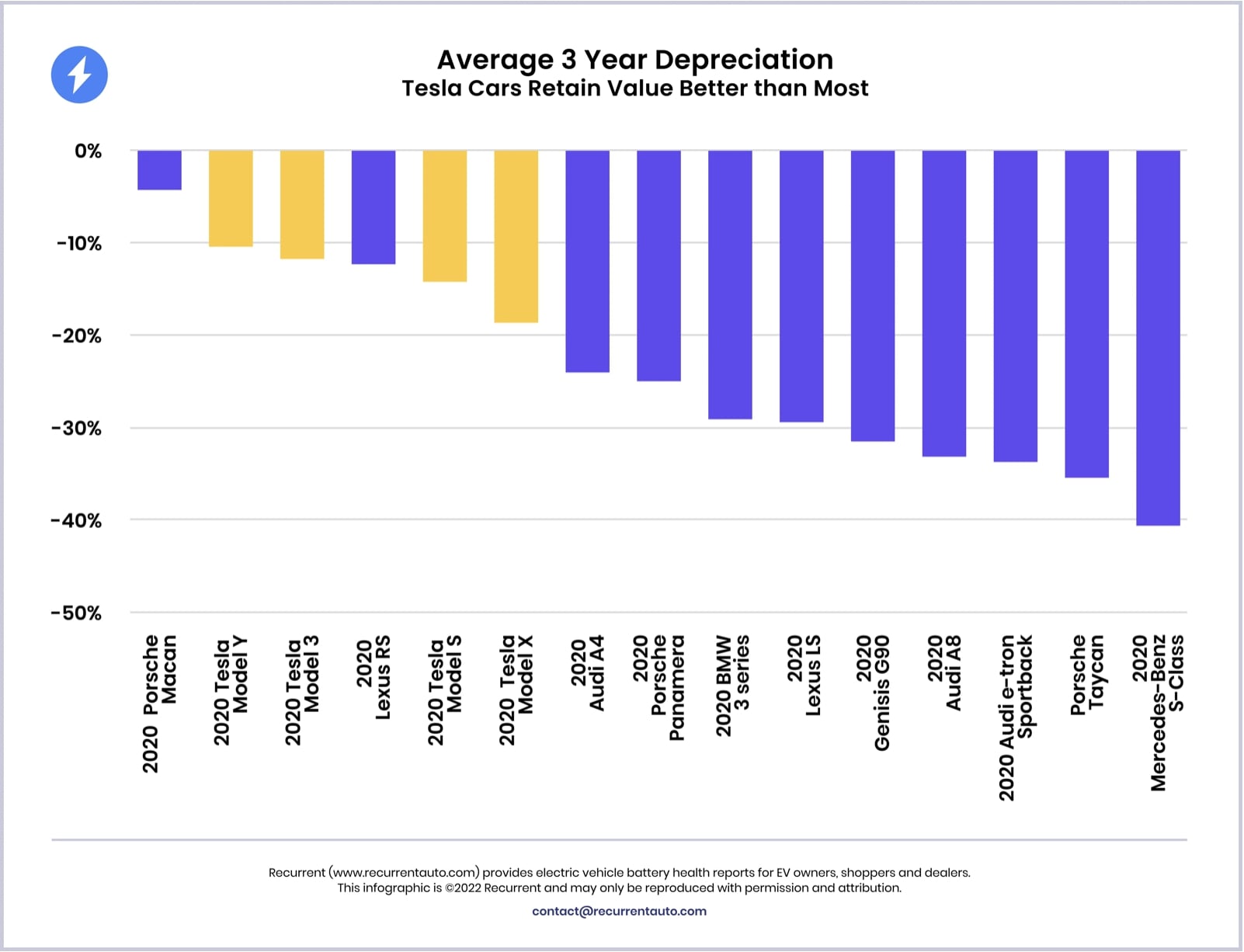
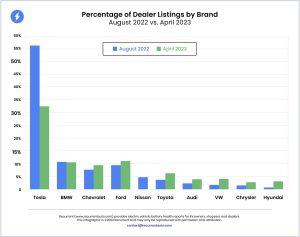
The shift from Teslas being appreciating assets to more typical depreciating vehicles has been a dramatic one. Still, other than changing the used EV market’s average price tag, which has continued to cool to just $38,000 in the second quarter of the year, it has also likely rapidly changed the Tesla ownership experience overall. Most prominently, Recurrent believes Tesla owners are holding onto their vehicles for longer than ever, which can be seen in the decreased number of used Teslas for sale.
This change in ownership length adds to the still strong demand for used Teslas, which remain the top choice for many buyers, only further exacerbating the decrease in available Model 3s and Model Ys. Recurrent reports that the number of used Tesla vehicles for sale has been cut in half since one year ago.
-
- Credit: Recurrent Auto
-
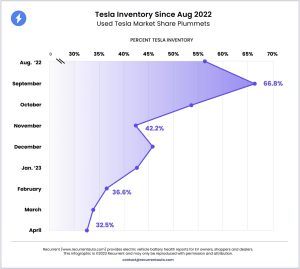
- Credit: Recurrent Auto
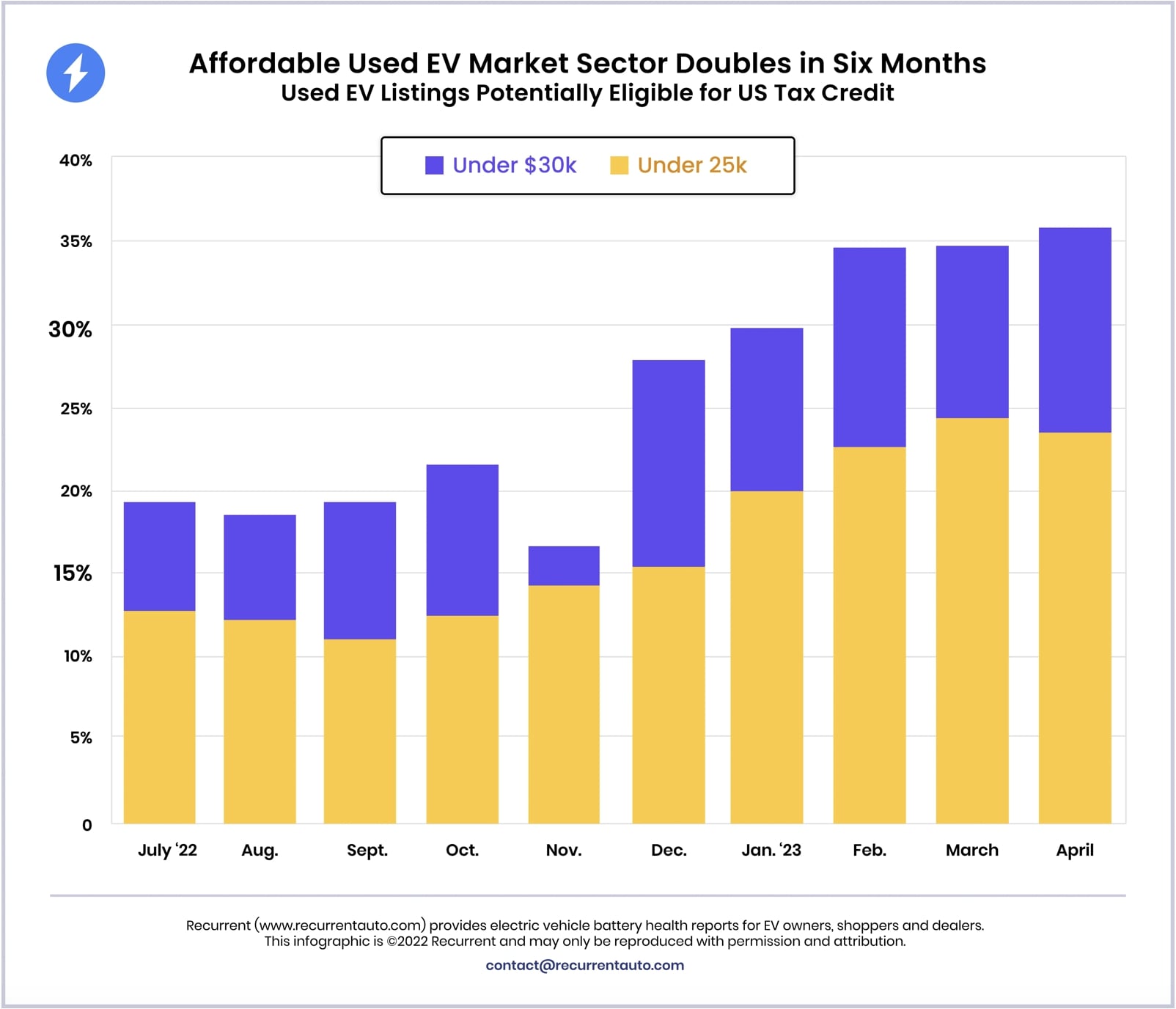
Outside of Tesla, Recurrent had more good news for will be EV-buyers. As mentioned above, the average used EV has continued to come down in price, now hitting just $38,000, which matches the average from August 2021. Further, despite the drop in the volume of used offerings from America’s favorite EV brand, the number of affordable EVs under $30,000 has doubled in the past six months.
What do you think of the article? Do you have any comments, questions, or concerns? Shoot me an email at william@teslarati.com. You can also reach me on Twitter @WilliamWritin. If you have news tips, email us at tips@teslarati.com!



Give the gift of Tesla upgrades.
Shop for someone else or treat yourself. Get more shopping power with a Teslarati gift card.

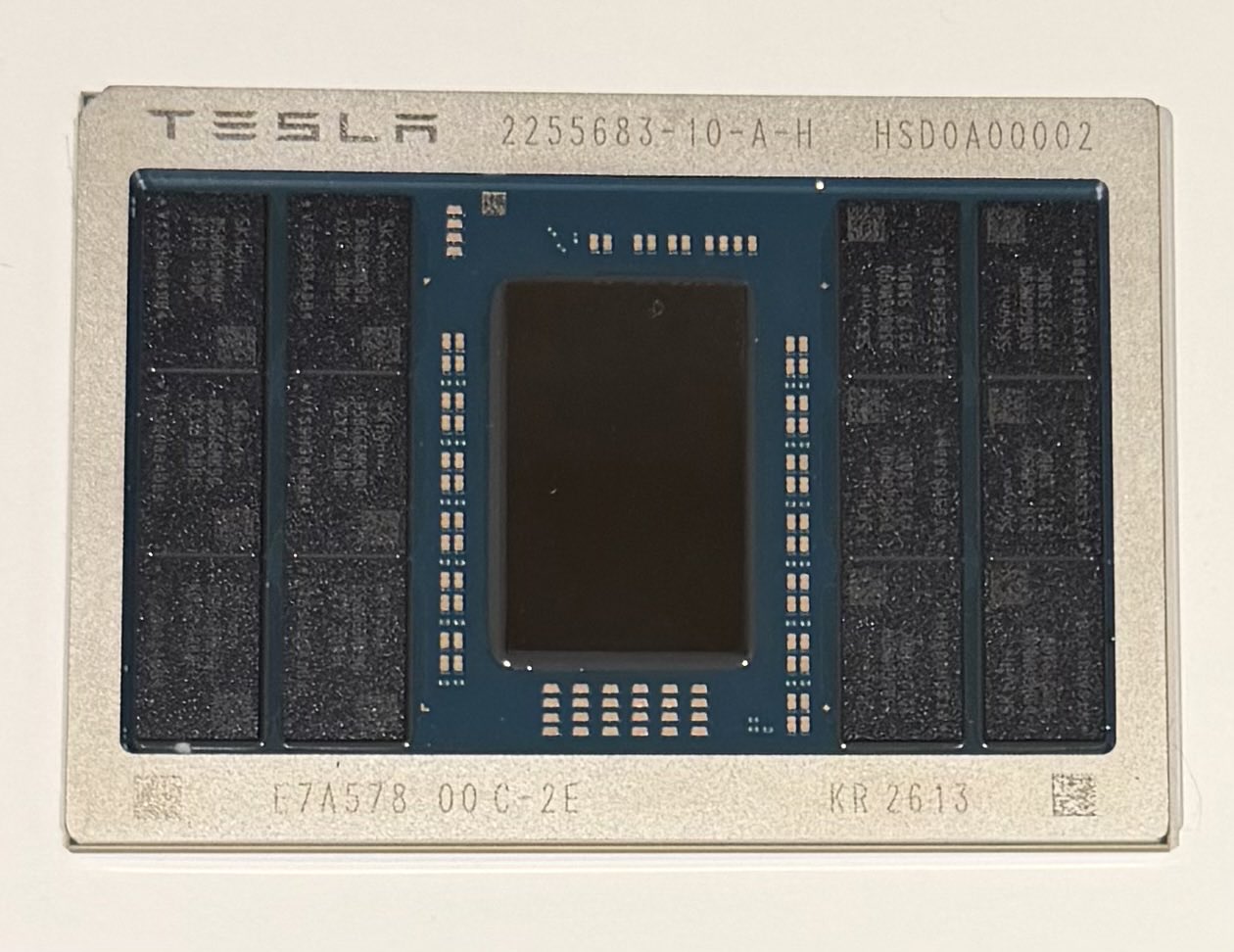
Tesla will set aside its AI5 chip exclusively for the Optimus robot, a product that CEO Elon Musk said he believes will one day be the biggest in the world. The decision sparked conversation regarding AI4’s prowess and capability as a self-driving chip, and less-than-fond memories of the Hardware 3 conundrum that many owners find themselves in to this day.
Musk stated on November 22 that Tesla vehicles will remain on the AI4 computer, which he said it sufficient to achieve “superhuman driving,” while the next generation AI5 chip will be set aside for Optimus. Musk was initially asked by a Hardware 3 Model Y owner when AI5 would appear in new cars.
@JBrunner8484 @BLKMDL3 @wholemars It’s going to Optimus. Cars will remain at AI4. That’s enough to solve superhuman driving.
— Elon Musk (@elonmusk) November 22, 2026
“It’s going to Optimus. Cars will remain at AI4. That’s enough to solve superhuman driving,” Musk wrote. The exchange quickly drew high engagement and follow-up questions from owners about potential retrofits for AI3 vehicles and the status of FSD.
The statement is consistent with some comments Musk made in the first quarter earnings call. In April, he said that AI5 would be prioritized for Optimus and the company’s AI training clusters rather than vehicles, because AI4 had already proven to offer enough computing capability for unsupervised self-driving at safety levels well above that of humans.
Musk also said on that call that Hardware 3 vehicles would lack the capacity for unsupervised self-driving, and that Tesla would be working on an upgrade plan for those owners if they wanted to bolster their cars with new cameras and a computer.
At one time, HW3 owners were led to believe fully unsupervised FSD would be capable with their vehicles. That revelation was dismissed and earlier this year, they were given clarity.
AI4, also known as HW4, is the computer currently installed in new Tesla vehicles. It powers recent FSD software, including the v15 series that introduced the “Reality View” overhead visualization generated in real time on the car’s AI accelerators. Tesla has also discussed an intermediate AI4+ or AI4.5 variant focused mainly on increased memory and modest performance gains, driven in part by rising memory and storage costs.
Tesla Full Self-Driving v15: Reality View review, new features explained
Musk noted around the same time that the AI4 computer itself had roughly doubled in cost due to those component price increases.
By directing AI5 toward Optimus, Tesla is allocating its highest-performance silicon to the humanoid robot and training infrastructure. AI5 has reached tape-out and entered pilot production, with broader volume manufacturing targeted for 2027.
The decision underscores Tesla’s view that vehicle autonomy can be solved on existing AI4 hardware while the more complex perception, planning, and motor-control demands of a general-purpose humanoid robot benefit from the next chip generation.
For current and prospective Tesla owners, Musk’s message is that AI4 cars already have the hardware headroom necessary for fully autonomous travel. Customers should see if as welcome clarification that could influence purchasing decisions for them moving forward.
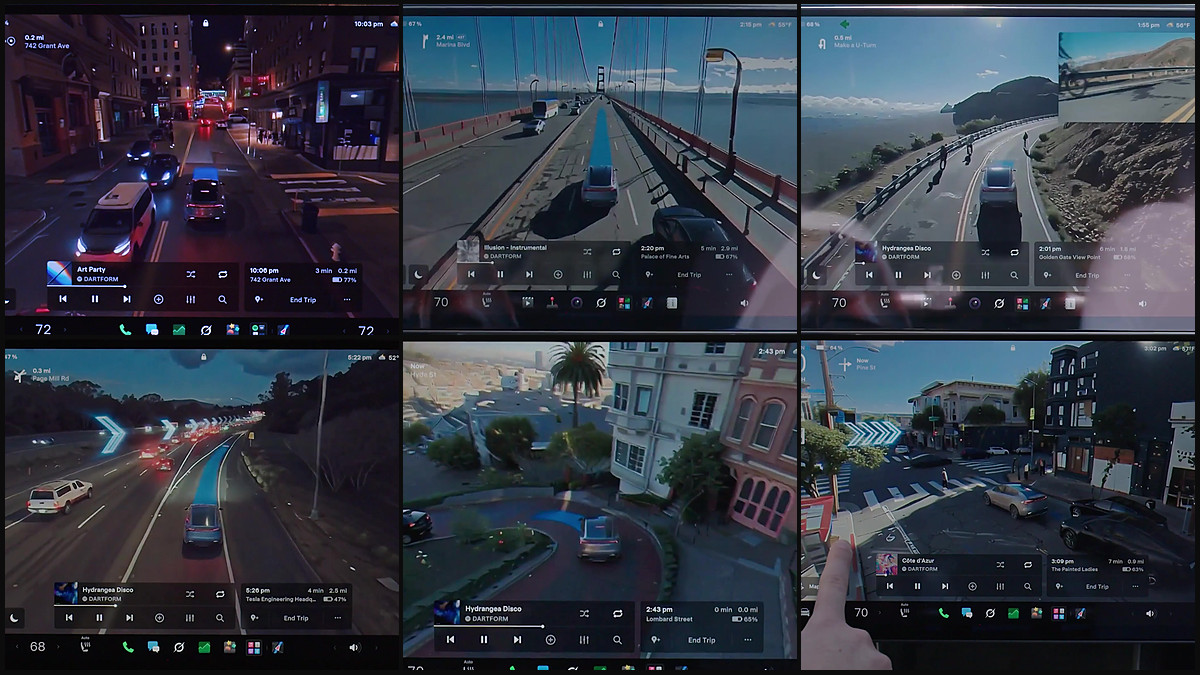
Tesla Full Self-Driving version 15’s biggest feature, “Reality View,” has one complaint, but in typical fashion, CEO Elon Musk already announced a solution.
Upon the release of the v15 Full Self-Driving suite on Saturday, one of the first impressions of the new Reality View feature is that there is a bit of input lag on the screen when dragging your finger to change perspectives. The rendering is also a fraction of a second behind what you would see out of your windshield.
Tesla Full Self-Driving v15: Reality View review, new features explained
Here’s my first impressions of the Reality View feature. You can hear me explicitly mention that it is not quite as responsive as past Driver Visualization techniques that Tesla has used:
🚨 Tesla Reality View – First Impressions https://t.co/uSTS94P8Qg
— TESLARATI (@Teslarati) November 22, 2026
Upon the initial impressions that we and many other Tesla owners put out, Musk was able to show that the company is aware of the slight latency in FSD v15, but it can be easily combatted.
He already has a solution that will resolve any lag or latency that is present:
“Currently, the latency is a bit high due to compute constraints, but we have ways to interleave newer UVE features along the diffusion transformer layers to cut roughly 35% of the latency.”
The primary near-term fix does not require new hardware. Tesla plans to interleave newer UVE features along the layers of the diffusion transformer. By injecting fresher encoder data deeper into the denoising process rather than relying solely on earlier features, the model can converge on accurate visualizations faster.
Musk estimated this change will cut roughly 35 percent of the latency.
Reality View is produced by a roughly 1-billion-parameter diffusion model that runs separately from the main driving stack. It draws on the same sequence of Tesla Universal Vision Encoder (UVE) features used by the larger 3-billion-parameter model that outputs driving actions. The system takes the previous Reality View frame, adds noise, and denoises it into the current visualization.
It generates short video chunks, eight images at 36 frames per second at UI-screen resolution, using half of one TRIP accelerator engine, processing every UVE frame at 18 Hz and spreading the work across four cycles.
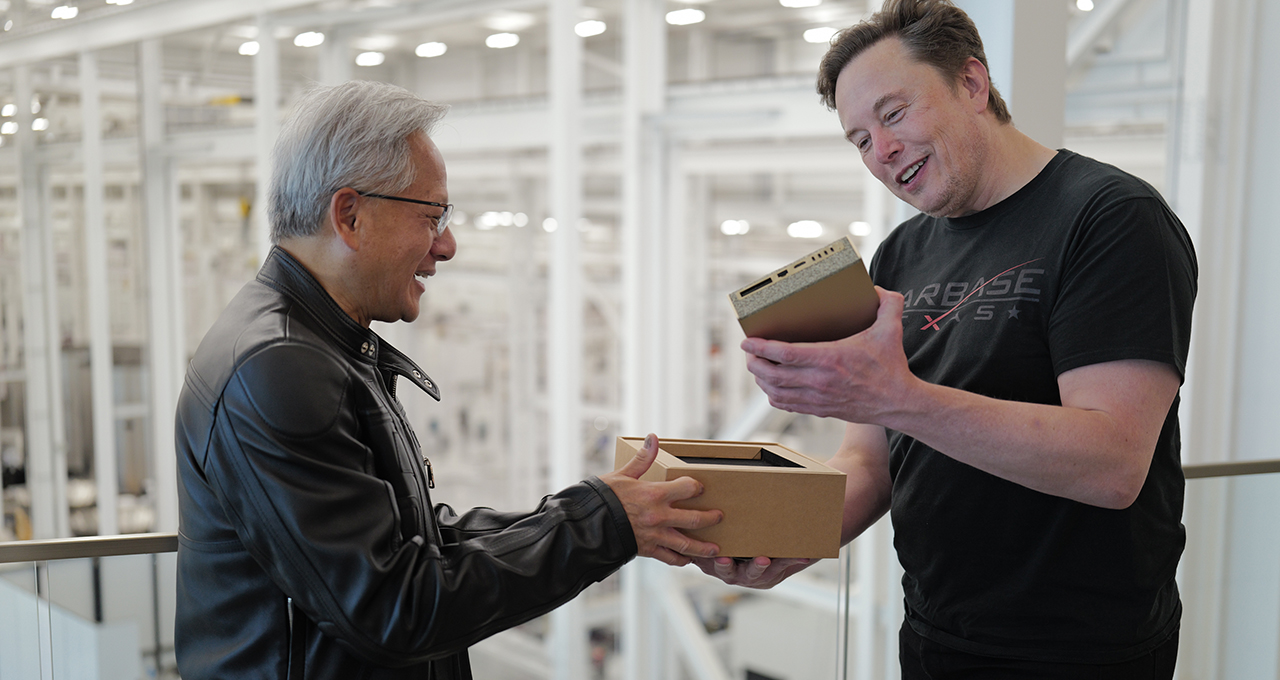
Tesla and SpaceXAI CEO Elon Musk has reacted to Jensen Huang’s return to NVIDIA as President, CEO, and Board Director, a move that Musk has been calling for since Huang was removed by the chip maker’s board.
“The mistake has been corrected,” Musk said as NVIDIA announced in a press release this morning that it would reinstate Huang as President, CEO, and Board Director:
The mistake has been corrected
— Elon Musk (@elonmusk) November 23, 2026
NVIDIA said that it “believes Jensen is the right person to lead NVIDIA, and that his reinstatement is in the best interests of our stockholders, employees, partners and customers,” according to Harvey C. Jones, Chair of the Board.
Huang said he was “honored” to return to the company and said he take his role “with the greatest humility and renewed commitment.”
After Huang was accused of having an affair with a Chinese spy and selling chips to China illegally, he was removed from NVIDIA’s CEO, President, and Board Chair role. This decision was met with a lot of pushback from NVIDIA’s partners, including Tesla and SpaceX, both of which utilize NVIDIA products for its SI efforts.
NVIDIA said it has recently formed a National Security and Export Control Committee to “oversee trade compliance and national security risks. The committee is engaging counsel with experience in national security matters, and such counsel will be retaining advisors with expertise in national security matters.”
The search for a Chief Compliance Officer is also underway, the company said in its release.
The broader implications for Tesla and SpaceXAI as Jensen’s return is now official are positive. Musk and Huang have a great relationship, so their partnership momentum sees a lot of benefits from his reinstatement. Additionally, SpaceXAI is building AI compute exclusively on NVIDIA GPUs.
Musk has said on various occasions that Huang is the best option for NVIDIA, stating that “there’s no one that can really replace Jensen.”
The biggest win for the three parties in the near-term is supply and delivery certainty is now restored. With proper management and Huang’s guidance, it is hard to believe NVIDIA will not pick right back up where it left off.
This gives Tesla and SpaceXAI time for their own chip efforts, and also keeps them locked into what Musk’s views as the leading architecture versus going to competitors or alternatives.
However, there are still some risks and uncertainty, especially considering the underlying investigations into Huang continue, and any residual national security scruitny could complicate government-related work or exports.

Tesla eyes AI5 chip as exclusive Optimus trait, not needed for self-driving

Tesla FSD v15’s ‘Reality View’ has one complaint and Musk has the solution


