News
Tesla’s new Model Y gets first software update—Here’s what’s in it
Tesla’s new Model Y started delivering over the past few weeks, and its first software update is now here.

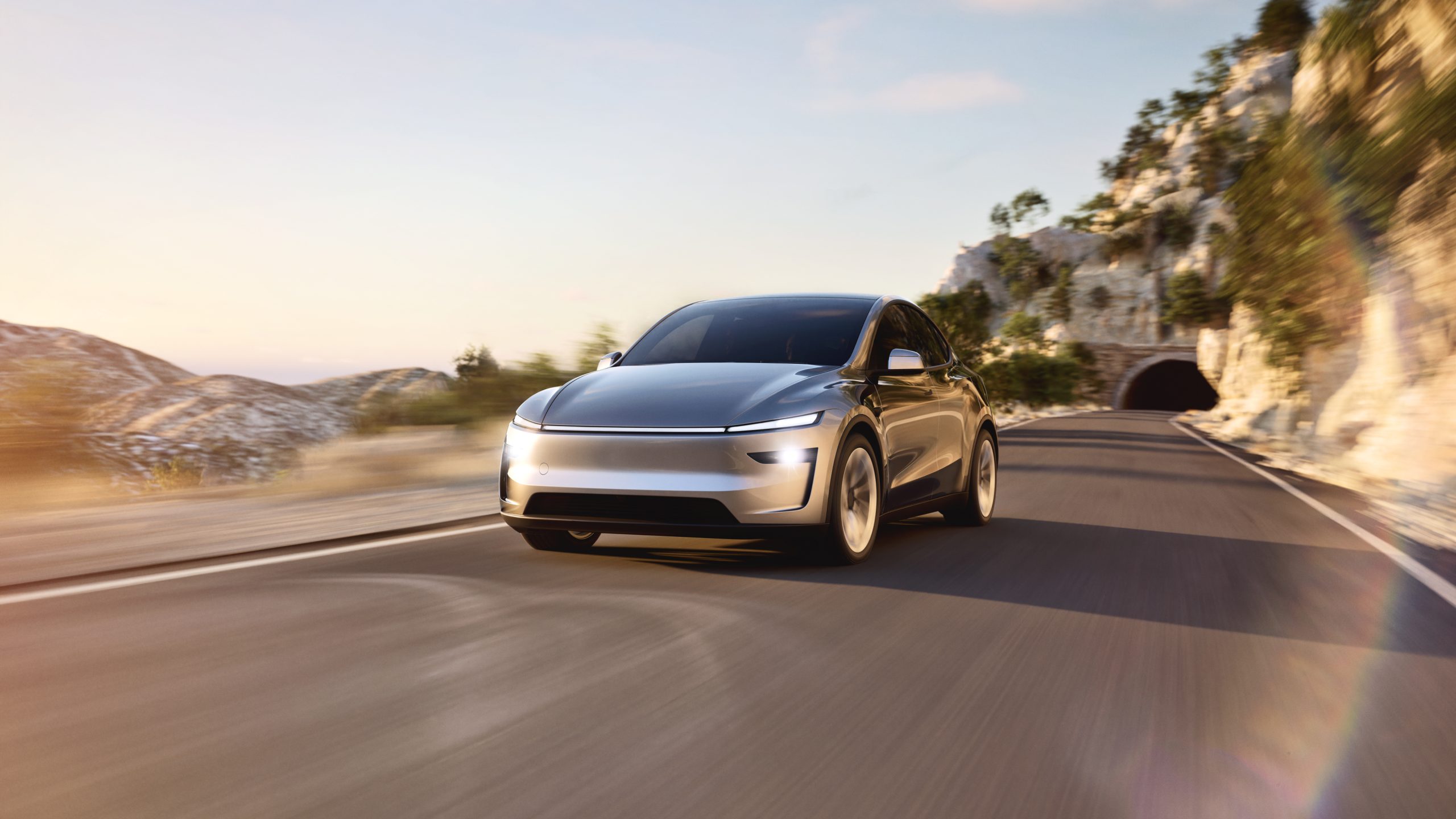
Tesla has officially started deploying its first software update for the recently refreshed Model Y, and it appears to add additional parts of a beta version of the Auto Shift feature, as highlighted by one owner this week.
After Tesla began deploying its software update 2025.8.6 over the past few days, photos from a couple of owners show that the refreshed Model Y has also started receiving the update. One Model Y owner, X user LRESP, posted on Sunday that the update also enables the latest version of Tesla’s beta Auto-Shift feature, as was echoed by another user in the thread.
Although some have pointed out that the new Model Y already had Auto-Shift enabled, the user points out that this update includes the version of the feature that allows three-point turns, though previous versions only allowed it to get out of park.
You can see the message displayed on the Model Y owner’s vehicle below, along with a few other notes about the recent software update.
Tesla’s Auto Shift (Beta) on Model Y
Auto Shift is currently in Beta.
For parking and multipoint turns, Auto Shift (Beta) can assist with shifting out of Park (P) or between Drive (D) and Reverse (R) drive modes based on your surroundings without you using the touchscreen.
Before you press the accelerator pedal, always check that the proposed drive mode matches your expectations and that it is safe to move in that direction.
Auto Shift (Beta) will only shift between Drive (D) or Reverse (R) drive modes in certain circumstances, and when transitioning out of Park (P) – not any other drive mode or situation. You must manually shift using the drive mode strip if the vehicle doesn’t do so.
Before you enable this feature, be sure that you understand how to operate the drive mode strip.
Do you want to enable Auto Shift while it is in Beta?
[No][Yes]
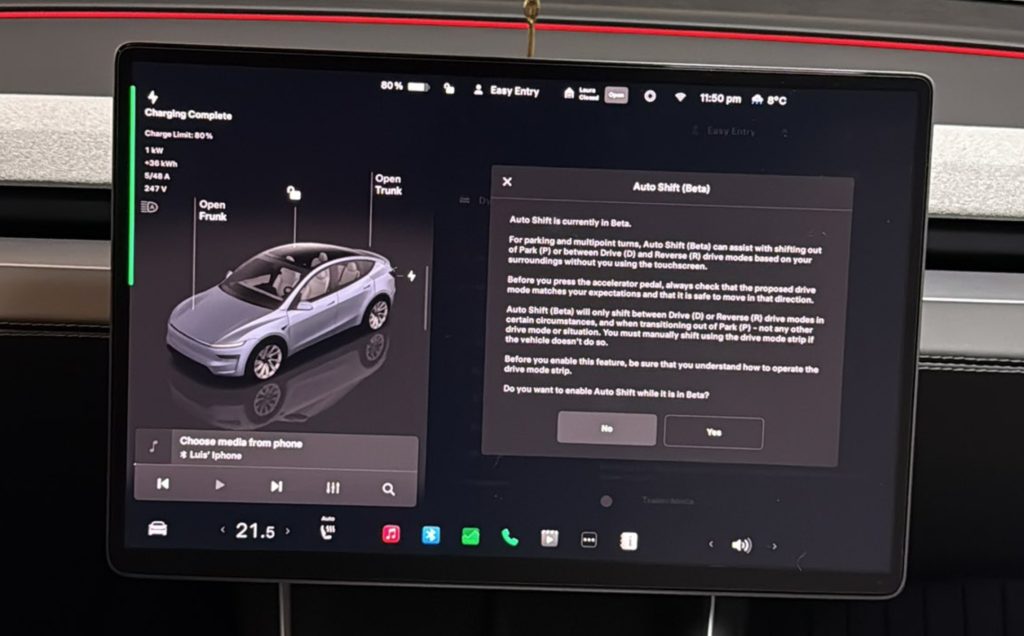
Credit: RE_LuisEV | X
Auto Shift between D & R is arguably one of the most underrated features of Tesla’s vehicles.
It’s something that has to be experienced to be fully appreciated. But once experienced, it’s pretty difficult to go back.pic.twitter.com/m60nDslbhy
— TESLARATI (@Teslarati) March 13, 2025
READ MORE ON TESLA MODEL Y: Tesla redesigned this crucial piece of hardware on the new Model Y
Tesla’s software update 2025.8.6
Along with Auto-Shift, Tesla has also added a number of other features with software update 2025.8.6, as shared a few days ago by Not a Tesla App. The update is also going out to legacy vehicles and Cybertrucks, and while the Auto-Shift beta addition is the only feature exclusively going out to the new Model Y, a handful of minor improvements are going out to most or all of Tesla’s lineup.
These include the ability to view the last 10, 100, or 200 miles of energy usage in the Consumption page, and the ability to clear your energy history. Tesla also notes that the battery’s energy estimates now account for all vehicle usage characteristics, along with being adjusted over time based on your driving history.
The update also lets owners run a Battery Health Test, which measures battery energy retention since the vehicle was new. This option can be found in the Controls, Service, and Battery Health menus.
Select Model Y units with model years between 2022 and 2024 have now been updated to use the cabin radar, a feature which is now being deployed standard with the refreshed version of the SUV.
The update also includes security fixes and other improvements that aren’t specifically documented, which went out to the company’s entire lineup.
These include some improvements to voice guidance and spoken directions, including that they automatically and immediately stop when ending a trip, rather than finishing phrases that have already started being spoken.
Additionally, Tesla improved the rainbow road feature in the update, no longer overlaying the visual overtop of the blue Autopilot visualization as it did in past updates. It also still incorporates certain Autopilot features, such as the display of arrows when the vehicle suddenly slows down.
For the Cybertruck, the update adds steer-by-wire improvements and the ability to adjust air suspension ride height using the Tesla mobile app. Meanwhile, the update also makes it so that Model 3 vehicles automatically transition to Standard Ride & Handling when Autopilot is engaged, though it can be disabled by navigating to Controls, Dynamics, and Use Standard Ride & Handling in Autopilot within the menus.



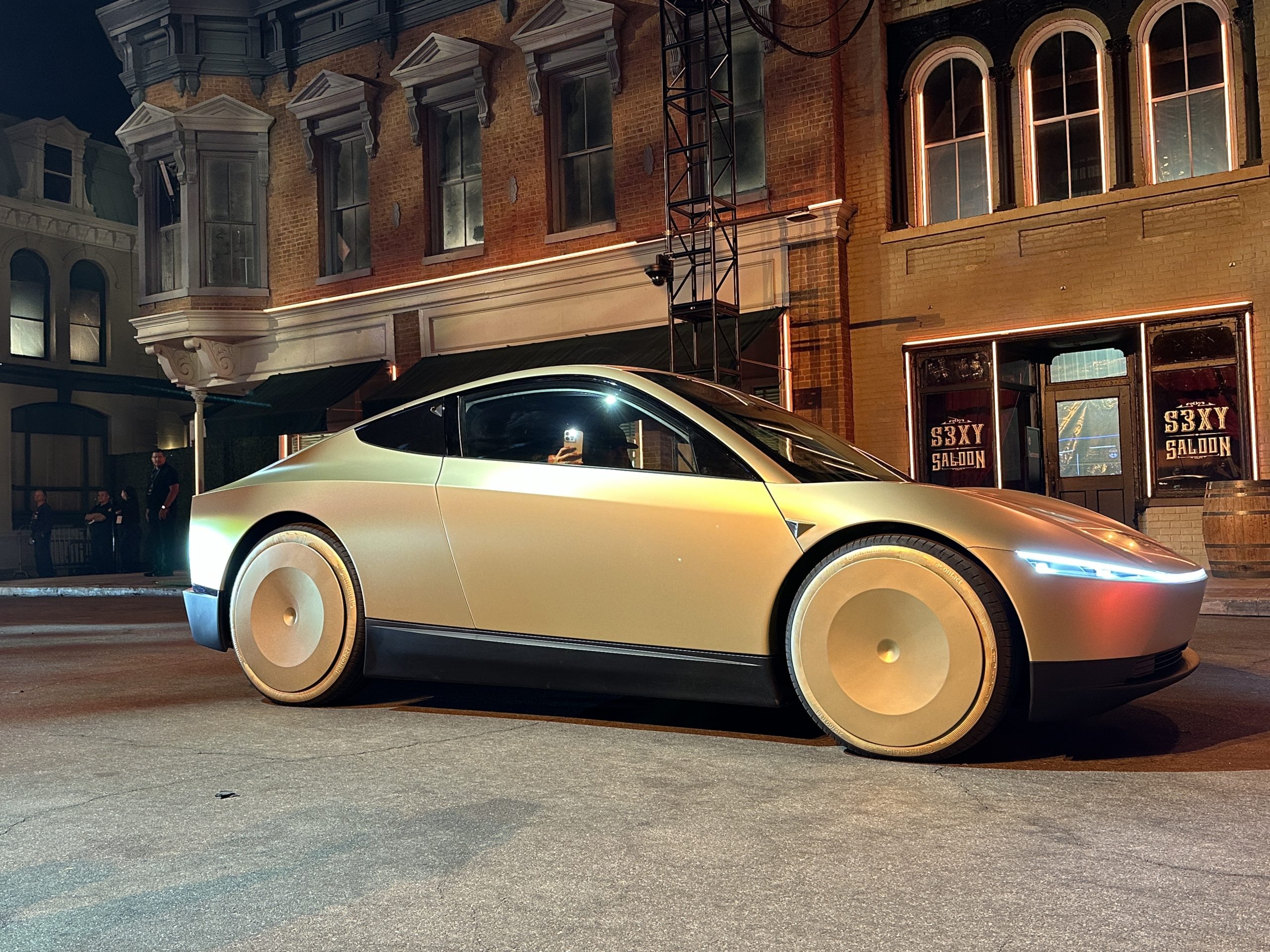
After launching in Austin, Texas, last week, Tesla is looking to expand the Cybercab to new parts of the United States in an effort that will see the driverless, steering wheel-less, and pedal-less vehicle chauffeur people around as part of the Robotaxi ride-hailing service.
However, the expansion will go far beyond the United States, and CEO Elon Musk revealed he hopes Europe will be the next market where Cybercab will be operational.
Musk has publicly expressed hope that Tesla’s Cybercab robotaxi will reach Europe in the near future.
On September 8, Tesla’s Chief Executive quoted a German rider who had just completed a trip in Austin, Texas, and wrote that he hoped the vehicle would not take years to arrive in Germany. Musk replied with a short but notable message: “Hopefully soon in Europe too.”
Hopefully soon in Europe too https://t.co/vqQ69bLJuN
— Elon Musk (@elonmusk) September 8, 2026
The comment arrived only days after Tesla opened Cybercab ride-hailing to the public in Austin. The two-seat vehicle has no steering wheel or pedals and relies entirely on Tesla’s Full Self-Driving software. Early passengers have described the rides as quiet, smooth, and more stylish than competing robotaxis such as Waymo.
Austin is currently the only city where members of the public can hail a Cybercab through Tesla’s Robotaxi app. The initial fleet is small; Texas registration records show only a few dozen of the purpose-built vehicles on the road.
Tesla set to open Cybercab rides to the public, with no steering wheel or pedals
Tesla has also been operating a larger number of conventional Model Y robotaxis in the same area, but the Cybercab itself represents the company’s first dedicated, controls-free taxi design.
Europe presents a different regulatory picture. The European Union does not permit manufacturers to self-certify vehicles the way Tesla did in the United States.
Type-approval rules and a small-series limit of 1,500 automated vehicles per type per year apply across the bloc.
Supervised Full Self-Driving has gained provisional approval in several member states through national recognition of Dutch certification, yet unsupervised robotaxi operation remains a separate and more distant step. Tesla has not announced a European launch city, date, or approval pathway for the Cybercab.
Musk himself has previously cautioned that the company does not control European regulators. In an earnings call earlier in 2026, he noted that even supervised FSD took an “immense amount of time” to clear and that unsupervised service would be “somewhat at the mercy of the governments in Europe and the EU.”
The latest social-media remark therefore functions more as an expression of intent than a timetable.
If the Cybercab eventually reaches European streets, it would mark a significant expansion of Tesla’s robotaxi ambitions beyond the United States. For now, the vehicle remains an Austin-only experience, and the gap between Musk’s hope and actual deployment will be decided by regulators rather than by engineering alone.
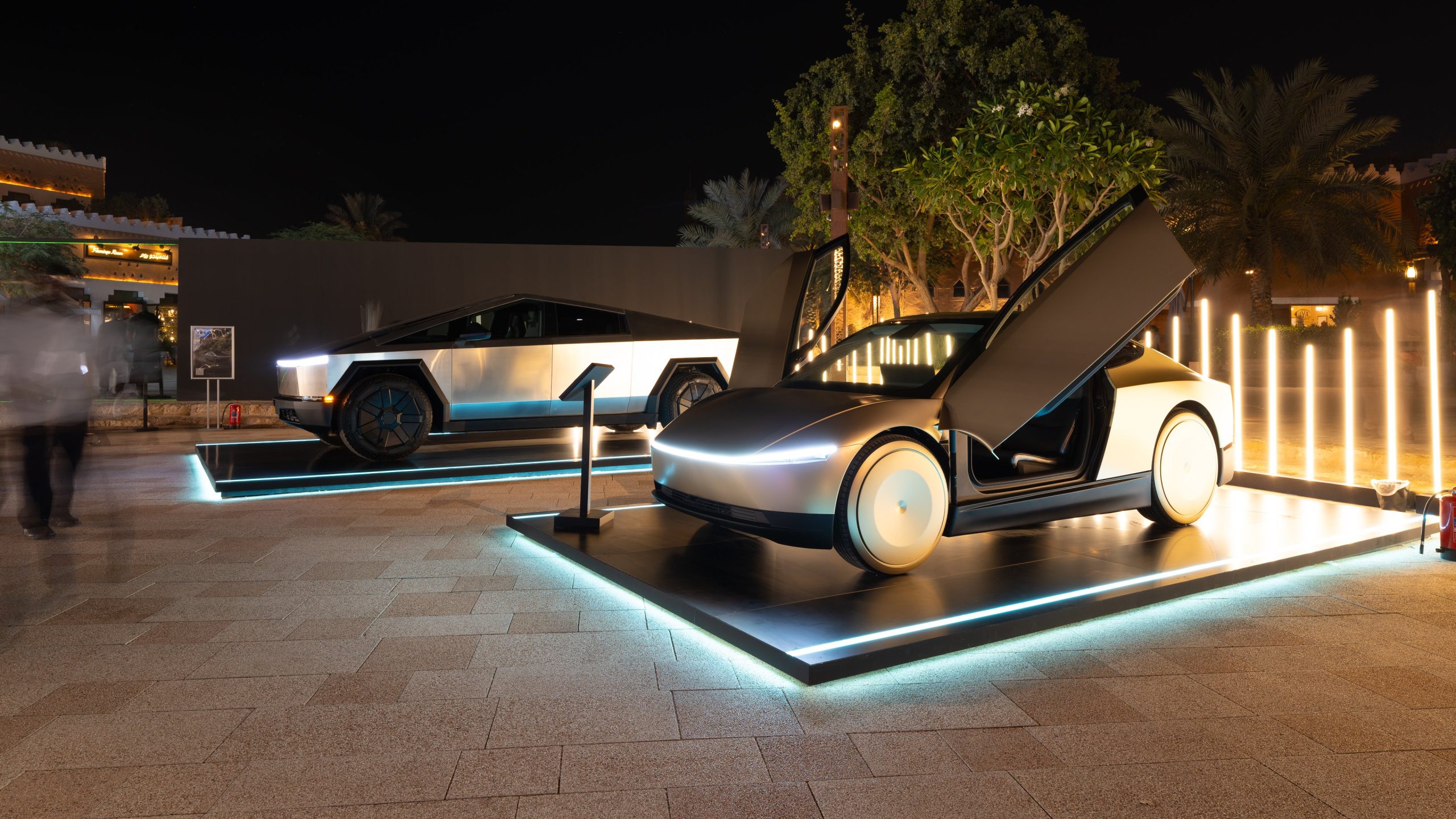
Tesla Cybercab might have just rolled out to the public as it entered the company’s Robotaxi suite in Austin this past week. However, the vehicle might already be on its way to becoming even better, as the company is asking riders to describe what they’d like to see improved with the Cybercab.
Tesla sent a rider experience survey to Cybercab passengers only days after paid rides began in Austin. The questionnaire asks how satisfied riders were with the overall trip. Then it requests star ratings for availability and wait time, door functionality, vehicle touchscreen, mobile app experience, seat comfort, interior space, ride comfort, cleanliness, and cargo space.
A later section asks which features riders would most like to have and allows selection of up to three items from a list that includes heated seats, ventilated seats, fully reclining seats, a tray table, a wireless phone charger, a better sound system, and more storage. Respondents may also choose none of these or write in another idea. The survey closes with a recommendation score from zero to ten.
Tesla just sent out a Cybercab rider experience survey so you can give feedback to the team. pic.twitter.com/YsU5OYdAjW
— Sawyer Merritt (@SawyerMerritt) September 8, 2026
This rapid request for input illustrates Tesla’s habit of treating early users as collaborators rather than mere customers. The company has long refined vehicles through software updates and hardware changes informed by real-world use across its passenger cars.
Collecting structured opinions so soon after commercial service started shows the same mindset applied to a purpose-built autonomous taxi. The questions themselves reveal an openness to cabin changes even after the first vehicles reached public streets, which is no surprise.
Tesla has always hoped to cater a great experience to anyone in its vehicles, which is why so many fan-requested features have made it into its vehicles.
Replies already circulating online favor reclining seats, tray tables, wireless charging, improved audio, and extra room when seats fold back.
Tesla Cybercabs narrowly miss deadly Amazon cargo plane crash
Those preferences point toward comfort upgrades that Tesla can implement in later production batches or through cabin revisions. Because the Cybercab is designed around software first principles, many requested amenities can arrive faster than in traditional automakers.
Tesla’s willingness to survey riders immediately after launch therefore makes near-term cabin and experience improvements likely as the team reviews responses and iterates toward a more refined robotaxi people will choose daily.
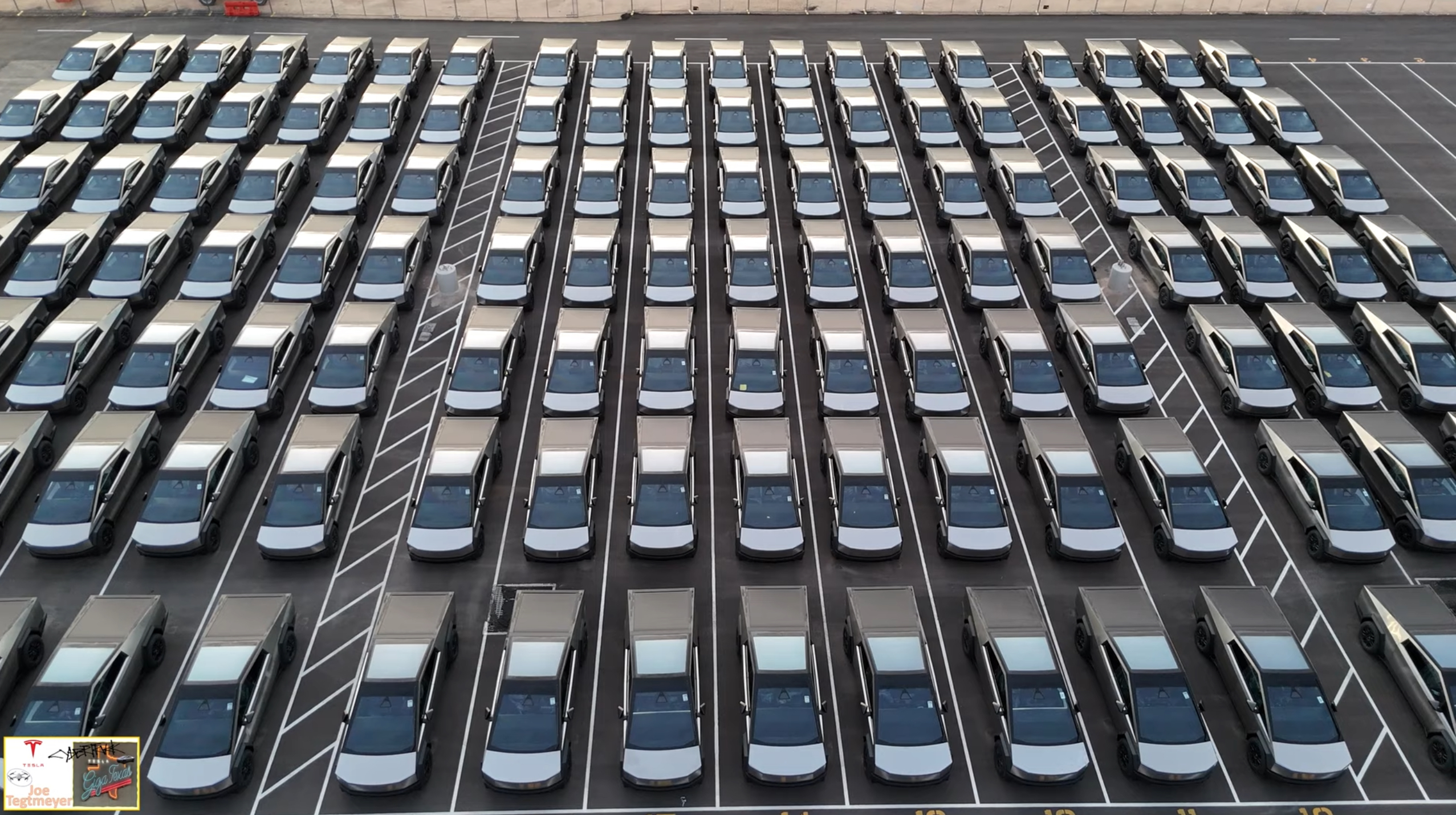
Tesla Cybertruck Lead Engineer Wes Morrill revealed the company has made several changes to the all-electric pickup, which he calls a “living thing, constantly evolving and improving.”
Cybertruck is manufactured at Tesla’s Gigafactory Texas just outside of Austin, and over the past few years, Tesla has continued to make small changes to the pickup to improve everything from cost, reliability, serviceablility, and manufacturability.
“The finish line isn’t getting to production. A product is a living thing, constantly evolving and improving,” Morrill added.
RELATED:
Tesla Cybertruck AWD is a steal at $60k, is it still at $75k? Full Review
Some of those changes are yet to be revealed, but perhaps the most notable one was the change Tesla made to the aero shield that sits underneath the truck. In the past, it was aluminum, but now the Cybertruck is using a self-reinforcing polypropylene.
Morrill said that the polypropylene is “stretched into fibers and then laminated into the form,” and is much more durable, much lighter, and significantly cheaper than aluminum when it is manufactured this way.
It also enabled some improvements in the geometry of the Cybertruck, improving the manufacturing around the bolts and edges, in addition to minor form changes. These all benefitted the Cybertruck in more ways than one: specifically with durability and improved drag.
I was surprised by how interested people were to find out we made a relatively benign change to the Cybertruck aero shield, a part of the car most people never even see. So I’ll share some more details.
Here are two photos, the left is one of the latest trucks off the… pic.twitter.com/F5cZo2CZKf
— Wes (@wmorrill3) September 7, 2026
Typically, Teslas are not necessarily identified by model year because these changes are fluid and occur when the company sees fit to implement them. It is not like other automotive companies, which usually make sweeping manufacturing changes when building a new model year.
Instead, Teslas are recognized by their “generation” or “era.” For example, those with a newer Model Y might refer to their car as a “Juniper.” This is the same with Model 3, as many refer to the new body style as the “Highland.”
Tesla’s manufacturing changes are proof of the company’s constant need to improve its products and move things forward with its vehicles. There is no need to drag one’s feet and wait until next year if the product can be made better right now, and that’s precisely what Tesla did with the Cybertruck.

Elon Musk hints at Tesla Cybercab’s next market

Tesla Cybercab improvements are already on the minds of company engineers


