News
Tesla Holiday Update is incoming, and the wishlist is Merry and Bright
There are a handful of big wishes, and we’ve seen a lot of different requests out there based on what owners are saying on social media. Nevertheless, what Tesla should bring and what Tesla will bring are two different things.

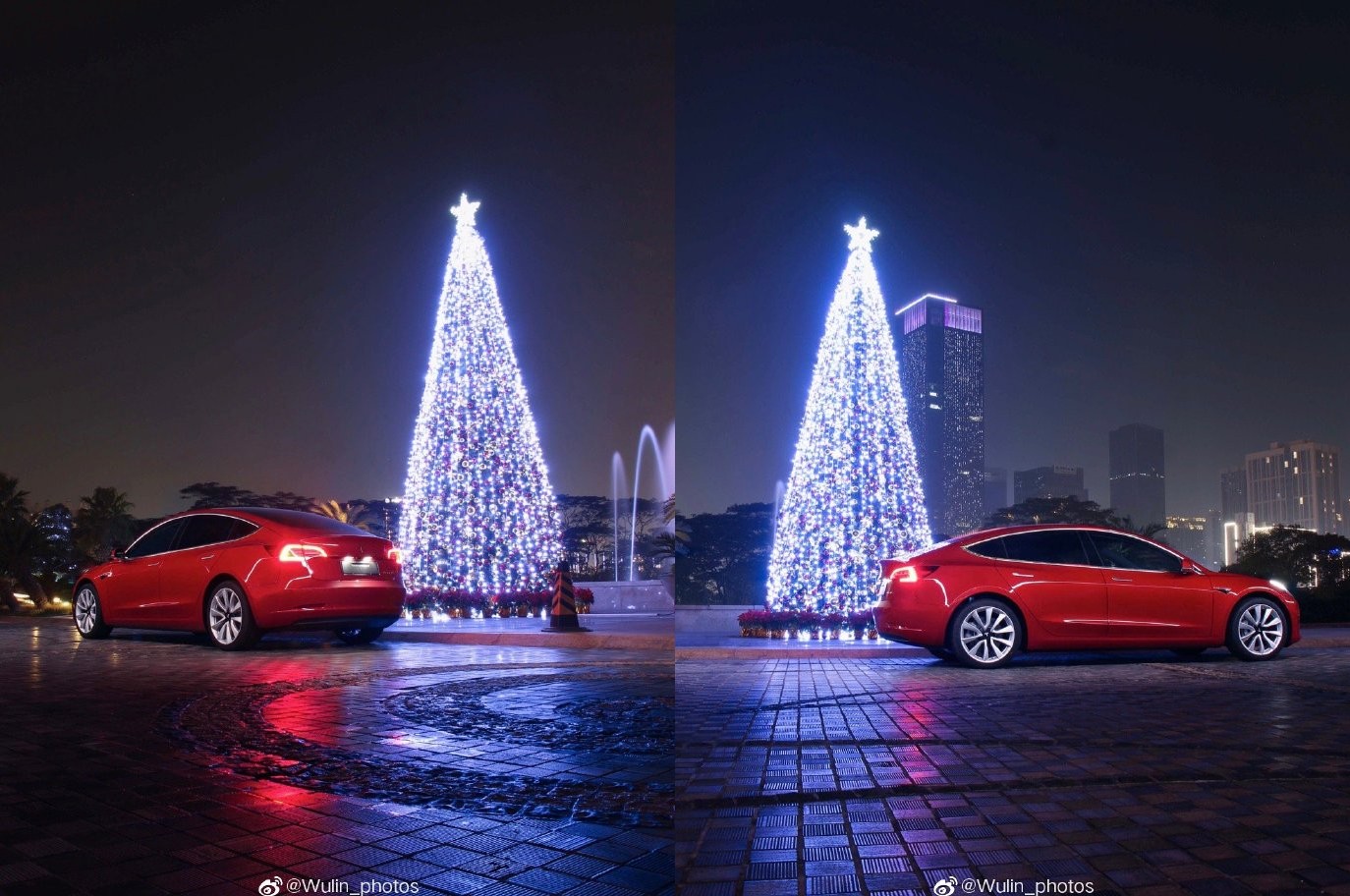
Tesla’s Holiday Update is going to be on its way soon, and although we have no idea what the company is planning to implement into vehicles with the 2025 iteration.
However, the wishlist is extensive, and owners are hoping to get a vast array of new features, both useful and artificial. That’s the fun thing about owning a Tesla — not everything is necessary, and it’s okay for your car to be fun.
There are a handful of big wishes, and we’ve seen a lot of different requests out there based on what owners are saying on social media. Nevertheless, what Tesla should bring and what Tesla will bring are two different things.
🚨 All I Want for Christmas (in the Tesla Holiday Update) is:
1. More streaming platforms
2. Summon for Cybertruck
3. Easier Navigation adjustment for a preferred route instead of the optimal choiceWhat else? pic.twitter.com/qapS1jXAuB
— TESLARATI (@Teslarati) November 16, 2025
In past years, Tesla has brought both useful things and fun things with the Holiday Update. The Custom Lock Sound, new Light Shows, and even High Fidelity Park Assist have all come in past updates, among many other things. But for 2025, people want even more, and here’s what we have seen most frequently thus far:
More Streaming Platforms
This is a personal request of ours, and it’s something that we feel is long overdue.
Sure, Netflix, Disney+, and Hulu are all great — but there’s a lot of meat left on that bone. HBOMax, Paramount+, and even YouTube TV would be a great option for those of us who have subscriptions and want to watch Live Events while Supercharging or eating in our cars.
The fact that Tesla has not added more platforms to its in-car Theater in a few years has been, dare I say, disappointing?
Full Self-Driving for Europe
This is something not even Santa can help with. Although his Elves are known for their high productivity, we’re not even sure they could convince European regulators to open the door for FSD’s entrance into the market.
Tesla deploys Unsupervised FSD in Europe for the first time—with a twist
FSD is definitely capable of handling European driving conditions, but regulators are truly dragging their feet through the mud with the approval process. Tesla has tested FSD in several countries in Europe, but nothing has been set in stone yet.
Deeper Grok Integration
Many owners have said something about how Grok is truly not super in-tune with the vehicles. This is something any owner will experience.
It seems Grok should be capable of handling all in-car requests; everything from changing the A/C to a specific temperature to adding a stop within the Navigation should be handled by Grok.
Instead, Grok cannot handle those things currently. You have to speak to the car itself using the microphone button on the steering wheel.
Interestingly, some vehicles already have the Grok logo replacing the microphone. It is likely the most realistic request of all.
‘Learn’ Mode for Full Self-Driving Arrival Options
Although it is great for public destinations, FSD still does not allow you to choose a set parking spot at your residence. It also does not allow you to choose preferences for parking in large parking lots.
Renters, and even those who live in purchased townhomes, often have assigned parking spots. Full Self-Driving v14 has done a great job of doing half the work, but there have been too many times when I’ve arrived home, the car pulls me into a spot, and I’m forced to manually back out and park in my assigned space.
Many people also do not like to park toward the entrance of a store, me included. Parking away from the front of a store eliminates parking congestion and usually is a safer bet for your vehicle to keep from being dinged by careless drivers who swing their doors open.
Navigation Adjustments
Sometimes you don’t want to turn left on the street the navigation chooses. Maybe you want to go a block down and check out that new Portuguese restaurant that just opened on the way to your next destination.
This is only possible currently by inputting a waypoint that would take you that way. Instead, the center screen could be opened, and the driver should be able to select an alternative route by simply touching a street they’d rather travel on.


Lifestyle
Tesla app update makes Robotaxi ownership make a lot more sense
Tesla’s app now shows a live indicator when your car is actively driving itself.

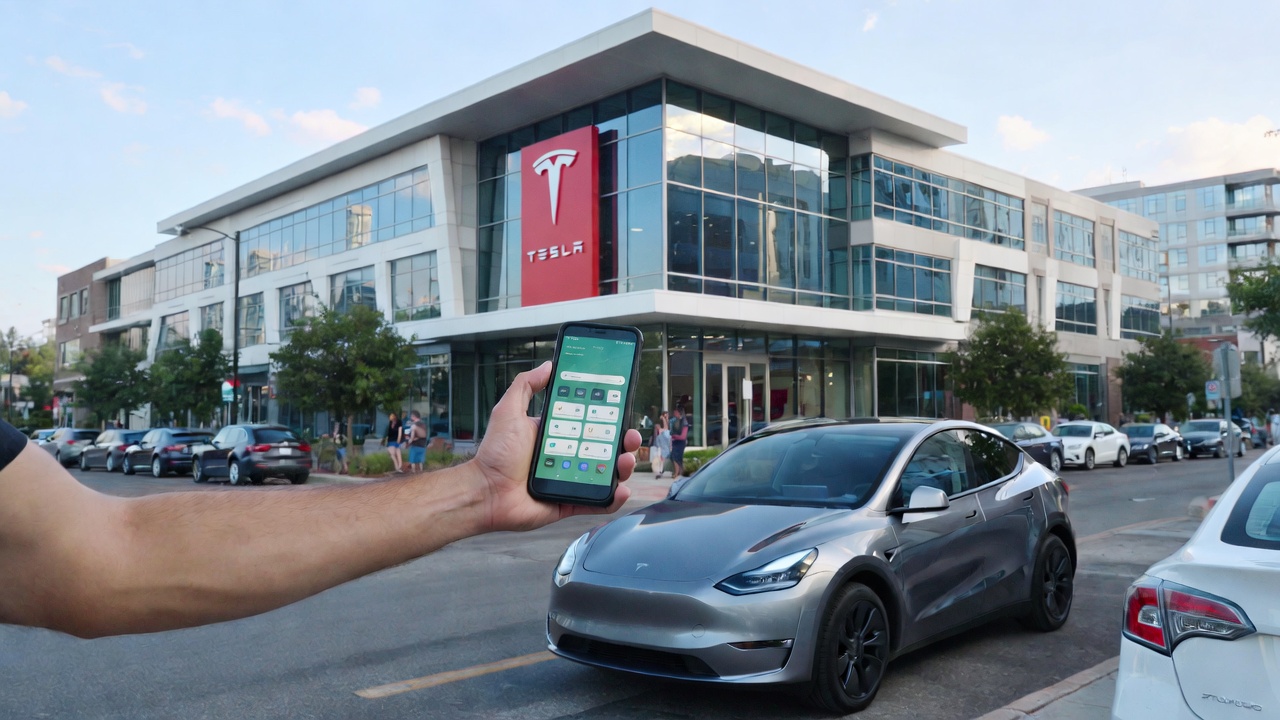
A recent Tesla app update, released last week (4.58.5), gives visibility on whether a vehicle is navigating in its semi-autonomous mode or being drive by a human driver. The updated app now displays a live “Self-Driving” indicator in bright blue text directly beneath the vehicle’s speed readout whenever Full Self-Driving is actively engaged, along with the signature glowing blue navigation path that FSD users see on the main touchscreen. It is a small visual update with meaningful implications for how Tesla owners monitor their vehicles remotely.
The feature was first spotted in the wild by X user Jordan Camina, who shared video of a Hardware 3 Model S displaying the new animation through the app while driving. That detail is significant because it confirms the update is not limited to newer HW4 vehicles. It works across hardware generations, and Tesla confirmed it will eventually support all vehicles regardless of chip platform once both the app and vehicle software are updated. The vehicle side requires software version 2026.20.6.1, which has reached nearly 40% of the fleet so far, as monitored by NotaTeslaApp.
The feature makes the most practical sense when viewed through the lens of Tesla’s expanding robotaxi operation. In a robotaxi context, the owner of a vehicle generating ride revenue has a direct financial and safety interest in knowing whether their car is operating under autonomous control at any given moment. The app’s new FSD indicator gives fleet owners exactly that visibility, the same way a logistics company monitors whether a delivery driver is following the planned route. It also carries implications for Tesla’s insurance model. Tesla’s own insurance product prices premiums in part based on FSD engagement rates, and real-time visibility into when FSD is active creates a feedback loop that could eventually tie directly into policy pricing. For individual owners who have opted their personal vehicles into the robotaxi network, the update effectively turns the Tesla app into a fleet management dashboard, one that tells you whether your car is earning money, whether it is driving itself to do it, and whether everything is operating the way it should from wherever you happen to be.
Tesla expands Robotaxi to Florida, marking its third state for autonomy
As Teslarati has reported, Tesla launched unsupervised robotaxi rides in Miami this summer, a milestone that makes a remote FSD status indicator significantly more practical than a cosmetic feature. When a vehicle is operating as a robotaxi without a driver present, the owner or fleet operator needs a reliable way to confirm autonomy is engaged. The app now provides exactly that.
As noted by NotATeslaApp, The update also arrived alongside a hint buried in the same app version that Tesla plans to use the cabin camera to verify driver identity before FSD can be activated. Pairing identity verification with a live autonomy status indicator points toward the infrastructure Tesla is building for a fleet of driverless vehicles that owners can monitor the way you would track a package delivery.
Elon Musk
California snubs Tesla in its newly passed EV incentive that favors Rivian and Lucid
California passed a $135 million EV incentive that rewards Rivian and Lucid while sidelining Tesla
California just drew a line in the EV incentive sand to put Tesla on the wrong side of it. The state recently passed a $135 million program offering first-time electric vehicle buyers a direct incentive with no application required, but the rules were written in a way that leaves Tesla at a structural disadvantage compared to Rivian and Lucid.
The program caps eligible vehicles at $50,000 for new EVs and $25,000 for used ones. That pricing threshold rules out a significant portion of Tesla’s lineup, though some lower-priced Model 3 and Model Y configurations would still qualify. California-based automakers are exempt from the price cap entirely, regardless of what their vehicles cost. Rivian, headquartered in Irvine, and Lucid, based in the San Francisco Bay Area, both benefit from that exemption. Rivian’s R2 starts at roughly $45,000 but has versions above the cap. Lucid’s Air and Gravity start at $70,990 and $79,990 respectively, well above any threshold a non-California company would face.
California hits Tesla Cybercab and Robotaxi driverless cars with new law
Tesla built its reputation and a significant portion of its early market share in California, where EV adoption has consistently led the nation. The company operates its original factory in Fremont, California, and the state was home to Tesla’s headquarters for most of its existence. That changed in 2021 when Tesla moved its corporate headquarters to Austin, Texas. Since then, the relationship between the company and California Governor Gavin Newsom has been openly adversarial, with Musk and Newsom trading public criticism on multiple occasions.
California’s EV incentive landscape has shifted repeatedly in recent years, and Tesla has previously lost eligibility for state-level programs as its vehicles exceeded income-adjusted price thresholds. The federal $7,500 EV tax credit, which Tesla models have qualified for and lost depending on policy cycles, is no longer available after it expired without renewal, making state-level programs more meaningful to buyers than they have been in years.
The practical impact for buyers is more nuanced than the headline suggests. California residents purchasing a Tesla under $50,000 for the first time can still access the incentive. But the exemption written for California-based manufacturers is a structural advantage that rewards where a company plants its headquarters flag rather than where it builds its products, and Tesla moved that flag to Texas.
Elon Musk
SpaceX’s newest logo confirms everything about what it’s become
SpaceX officially absorbed xAI under the SpaceXAI brand, completing the largest private merger in history.
SpaceX made its corporate transformation official in May 2026 when Elon Musk posted on X that xAI would cease to exist as a standalone company. “xAI will be dissolved as a separate company, so it will just be SpaceXAI, the AI products from SpaceX,” he wrote.
A new SpaceXAI logo was announced today, visually embedding the xAI letters inside the SpaceX identity, which can be seen as a deliberate design choice that signals the merger is not a partnership but a full absorption and XAi a core function of the same company. The same way Starlink is not a separate brand but a SpaceX product. The announcement closed the loop on a process that began February 2, 2026, when SpaceX acquired xAI in the largest private merger in history, valued at $1.25 trillion. SpaceX at $1 trillion and xAI at $250 billion.
We are now @SpaceXAI. pic.twitter.com/ema66xDWC9
— SpaceXAI (@SpaceXAI) July 6, 2026
The reason SpaceX bought xAI was stated plainly by Musk at the time of the deal: to build orbital data centers. SpaceX had simultaneously filed with the FCC to launch up to one million satellites designed to function as AI compute nodes in low Earth orbit, escaping what Musk described as the energy constraints limiting AI development on Earth.
xAI provided the AI software stack, with Grok, the X platform, and the Colossus supercomputer infrastructure in Memphis with over 220,000 NVIDIA GPUs, while SpaceX provided the rockets, Starlink, and the capital base to fund it. The two companies needed each other. xAI was burning $2.5 billion in losses on $250 million in revenue. SpaceX was generating an estimated $8 billion in profit on $15 billion in revenue and needed an AI narrative to command the valuation it was targeting for its IPO.
What SpaceX has done, regardless of how the orbital AI vision ultimately plays out, is walk into a public market as something no company has been before: a rocket manufacturer, satellite internet provider, AI software company, social media platform, and supercomputer operator under one ticker. Whether that combination is worth $2 trillion depends entirely on which of those businesses you believe in most.

Tesla app update makes Robotaxi ownership make a lot more sense

California snubs Tesla in its newly passed EV incentive that favors Rivian and Lucid


