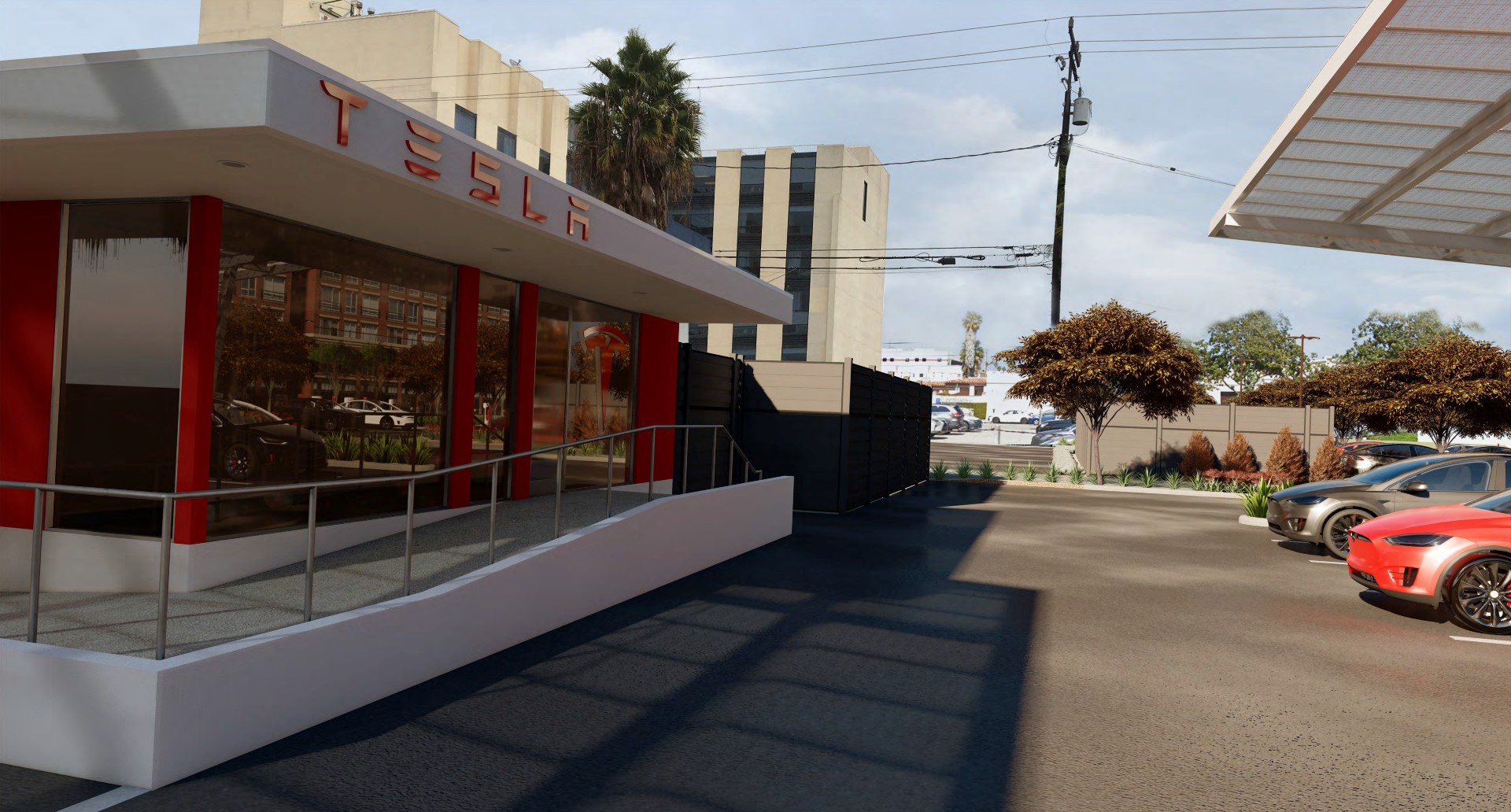
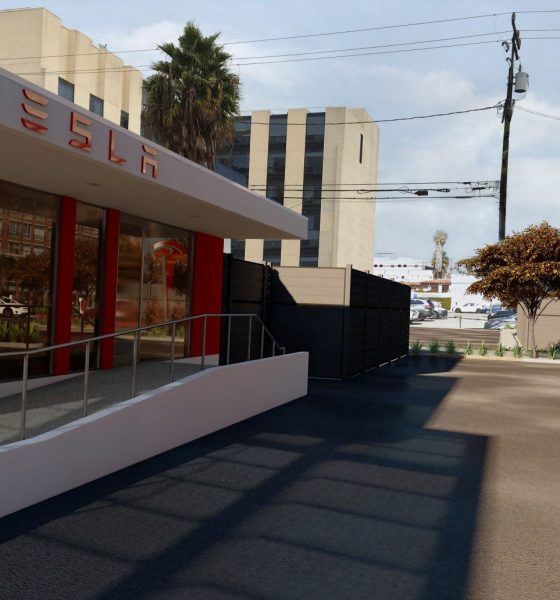

Tesla has submitted plans for a massive Supercharger featuring a Drive-In Movie Theater and Restaurant in Santa Monica, California.
For several years, Tesla and CEO Elon Musk have talked about putting a unique Supercharger featuring an old-school drive-in with movies, a diner, and other entertainment in Santa Monica. Finally, after several delays and changes in plans, what is perhaps the world’s most unique station is finally making progress after Tesla filed plans for a new Supercharger last week, which features the restaurant with indoor seating, which sits in a two-story building with an elevator, bathrooms, and a movie theater.
Elon Musk confirms major Tesla Santa Monica Supercharger: 50’s-style diner, drive-in movie clips
The plans were first shared by @MarcoRPTesla on Twitter.
The site will sit at 7001/7003 W. Santa Monica Boulevard in Los Angeles, and sits on a .565-acre lot. The site will feature 34 Superchargers: 29 being V3 and the remaining 5 to be Level 2.
-

- Credit: City of Santa Monica
-

- Credit: City of Santa Monica
-

- Credit: City of Santa Monica
-

- Credit: City of Santa Monica
The plans also show that two movie screens will be placed in an area viewable by people Supercharging their cars or eating in a restaurant. The filing states:
“Finally, there will be two movie screens for viewing by people charging their cars and/or eating in the restaurant. The movies to be shown will be features lasting approximately the same amount of time as it takes to charge a vehicle (~30 minutes). The two screens will be on both North and West property lines of the site to allow people to view screens from their vehicles and from the roof top seating area. A decorative bamboo landscape screen will be planted on the property lines to frame both movie screens. The operational hours for the Drive-In movie theatre will be from 7am-11pm pursuant to the Commercial Corner standards.”
A Switch in Plans
Originally, the Santa Monica Drive-In Supercharger was supposed to be located at 1401 and 1421-1425 Santa Monica Boulevard. The lot, which was at one time home to a Steve Taub Porsche-Audi, but this dealership closed down. For a couple of years, the lots were used to sell seasonal items like Christmas trees and Pumpkins for Halloween. That is until Tesla submitted their 2018 plans for a restaurant and drive-in movie theater. However, it would not be until 2021 that Tesla finally started making some progress with the site.
After Teslarati recovered renders of what the site might potentially look like in mid-2021, things started to come into question of whether Tesla would still build the drive-in Supercharger at this location.
Musk then commented in mid-February that Tesla would still be building the Supercharger, just in another location. It appeared that the other two lots did not have adequate space to house all of the features Tesla wanted, so the plans have finally been moved to another site, and perhaps the automaker’s long-awaited diner is finally on the way.
I’d love to hear from you! If you have any comments, concerns, or questions, please email me at joey@teslarati.com. You can also reach me on Twitter @KlenderJoey, or if you have news tips, you can email us at tips@teslarati.com.


News
Tesla owners who tap Emergency Drive Away for fun are in for a surprise
Tapping Activate on Tesla’s Emergency Drive Away reportedly triggers a $539 service bill without moving.

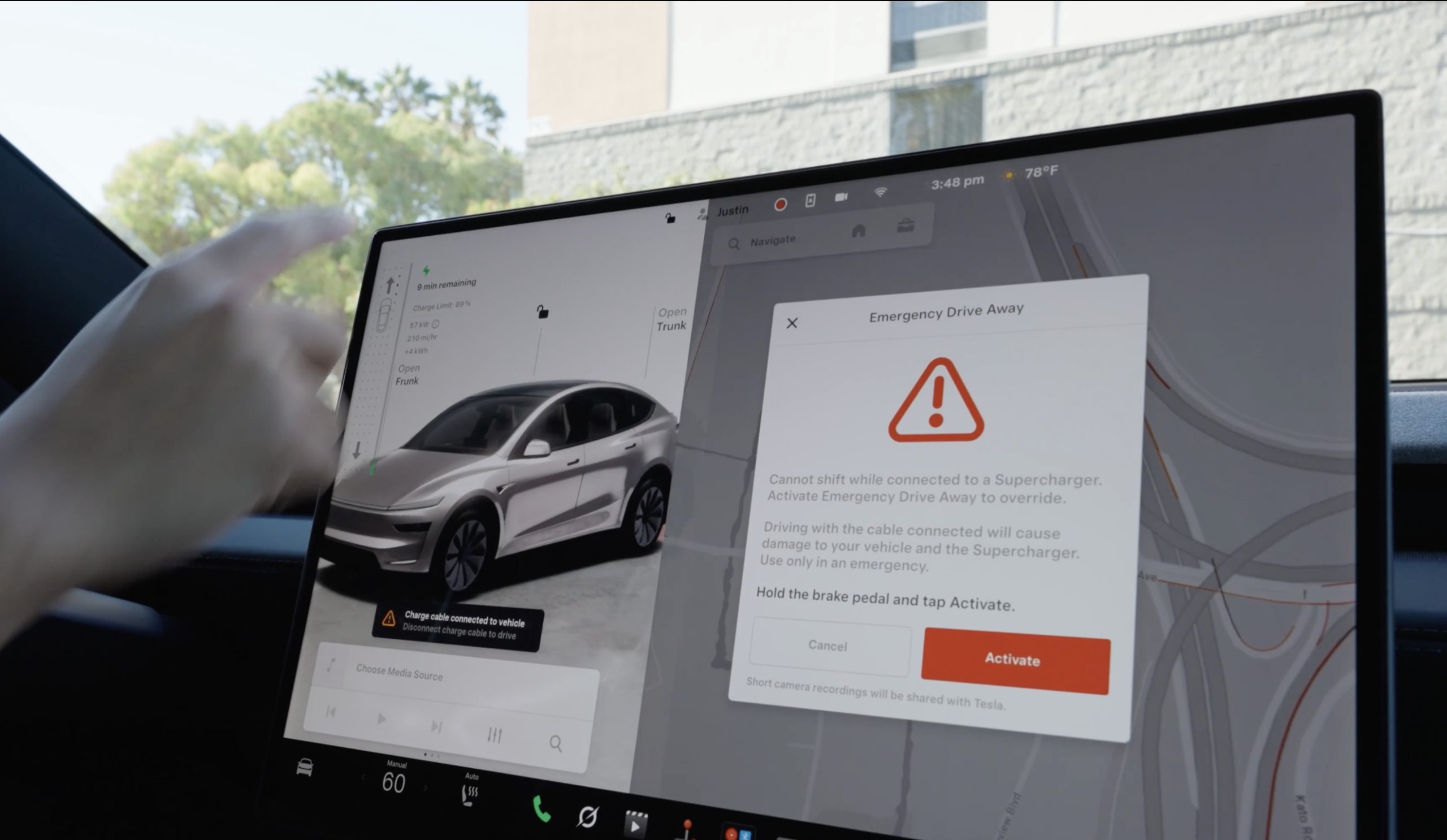
Tesla owners who press Activate on Emergency Drive Away may be on the hook for a service bill even if their car never leaves the Supercharger stall.
Yaro, who posts about Tesla service cases on X as @Tutrifour, said a customer called after tapping Activate while still plugged into a Supercharger. The owner was about to pull away, remembered the cable was still connected and stopped. The car never moved, but the touchscreen showed a red alert reading “Emergency Drive Away has been activated” with “Service is required” underneath. A Service Mode screenshot showed the active alert BMS_a228_EmergencyDriveAwayServiceRequired, which Yaro said only Tesla Service can clear.
Here is a lesson to Tesla owners. Don’t press Activate on the new Emergency Drive Away feature on your Tesla because service charges $539 to inspect the charge port and to clear the alert. Yes, even if you didn’t move the car an inch. https://t.co/NZJENw4SQv
— Yaro (@Tutrifour) October 30, 2026
The cost of clearing it was the bigger surprise. “Don’t press Activate on the new Emergency Drive Away feature on your Tesla because service charges $539 to inspect the charge port and to clear the alert. Yes, even if you didn’t move the car an inch,” Yaro wrote. The $539 figure comes from that single case, and Tesla has not published a set price for the inspection or commented on the post. Yaro also noted that the car would still charge with the alert on screen.
Tesla launched Emergency Drive Away on October 1 with software update 2026.38.3, letting drivers pull away from a U.S. Supercharger with the cable still attached, as Teslarati reported. To use it, a driver shifts into Drive while connected, holds the brake and taps Activate. The prompt warns that driving with the cable connected will damage the vehicle and the Supercharger, and that short camera recordings will be shared with Tesla.
Tesla Charging has been clear about what follows a real activation. Repairs to a Supercharger stall can run up to $25,000 depending on the site, a service visit for the car’s charge port is mandatory, and deliberate misuse “will invoke additional penalties.” What the company had not spelled out is that the service requirement is triggered the moment Activate is pressed, not the moment the cable breaks away.
From an engineering standpoint, that is the cautious choice. Once Activate is pressed, the car cannot be sure the charge port latch was not stressed, so flagging it for inspection removes the guesswork. It also means the button carries a price on its own, which is a stronger deterrent against casual use than any warning screen.
Customer called because they have an active alert after tapping ACTIVATE on the new Emergency Drive Away feature. They didn’t actually drive away but were about to until they “remembered” they had the charge cable connected.
This alert can only be cleared by Tesla Service. https://t.co/SkHyJJPFwU
— Yaro (@Tutrifour) October 28, 2026
The report follows the feature’s first known real world use, when a driver in Austin during F1 weekend appeared to trigger it by accident and dragged the Supercharger cable along with the car. The Reddit user who filmed it said the driver seemed to have only half read the prompts.
For owners, the takeaway is to treat the red prompt as a stop sign. If it appears after shifting out of Park by mistake, shift back and unplug the normal way from the touchscreen, the Tesla app or the button on the charge handle. Activate is meant for moments when staying at the stall is the bigger risk, and Tesla is now pricing it that way.
Elon Musk
Elon Musk calls Earth’s data centers “peanuts” next to what SpaceX is planning in orbit
Elon Musk says SpaceX capex efficiency is underestimated as orbital data centers loom by 2028.
Elon Musk is pushing back on one of the biggest worries hanging over SpaceX stock. In a reply on X on Sunday, Musk said the company’s capital expenditure efficiency is severely underestimated. He was responding to a Milk Road Stocks post citing analyst Kyle Reidhead, who estimates SpaceX will need to spend roughly $470 billion over the next five quarters.
Reidhead built that figure around the target SpaceX set on its third quarter earnings call: 13 gigawatts or more of compute by the end of 2027. In his breakdown, Nvidia captures 83 to 89 percent of the spending. SpaceX ended the quarter with 1.7 GW of nameplate compute and guided to $35 billion to $40 billion in fourth quarter capex, as Teslarati reported.
Musk did not attach a number to his claim, but the earnings call shows the argument. CFO Bret Johnsen said new compute currently pays for itself in under a year at today’s pricing, and Musk said that window could shrink to six months next year. Using that pace, Reidhead argues about $230 billion of the $470 billion could come from operating cash flow and about $60 billion from SpaceX’s roughly $90 billion cash pile, leaving around $180 billion to borrow. Musk confirmed last week that SpaceX had already closed a new $40 billion debt raise to buy GPUs.
The ground buildout is not the end goal. It is what is meant to pay for the move to orbit. Replying on Friday to charts built from Sequoia partner Shaun Maguire’s SpaceX model, Musk wrote that “Terrestrial compute will be peanuts compared to orbital compute,” adding that orbital compute deployed per month “probably exceeds terrestrial around the end of 2028 and then far exceeds it in 2029.”
Maguire’s model shows how steep that path is. It has capex climbing from $88 billion this year to $290 billion in 2027 and $369 billion in 2028, with SpaceX burning $77.8 billion in cash this year and $122.6 billion next year before turning $114.9 billion cash positive in 2028. Musk’s response to the model was, “I think we can do better.”
The orbital half runs through Starmind. SpaceX plans to operate up to 1 million AI satellites flying in clusters of about 10, linked by roughly 10 terabits of bandwidth, with deployment of thousands of units starting as soon as late 2027 out of its Gigasat factory in Bastrop, Texas, according to SpaceX’s space safety page. Musk has said each Starmind spacecraft will carry more than 250 kW of solar power.
Getting there depends on launch volume. Maguire’s model assumes 250 Starship flights in 2028, up from two this year and 38 next year. The nearer test is financial: SpaceX guided to $33 billion to $37 billion in first quarter 2027 revenue, more than double the $14.58 billion it booked in Q3, and Musk reposted that guidance again on Sunday morning.
Elon Musk
SpaceX President to gift Trump Accounts her SpaceX stock
Gwynne Shotwell’s 2 million SpaceX shares are headed to children’s Trump Accounts starting this December.
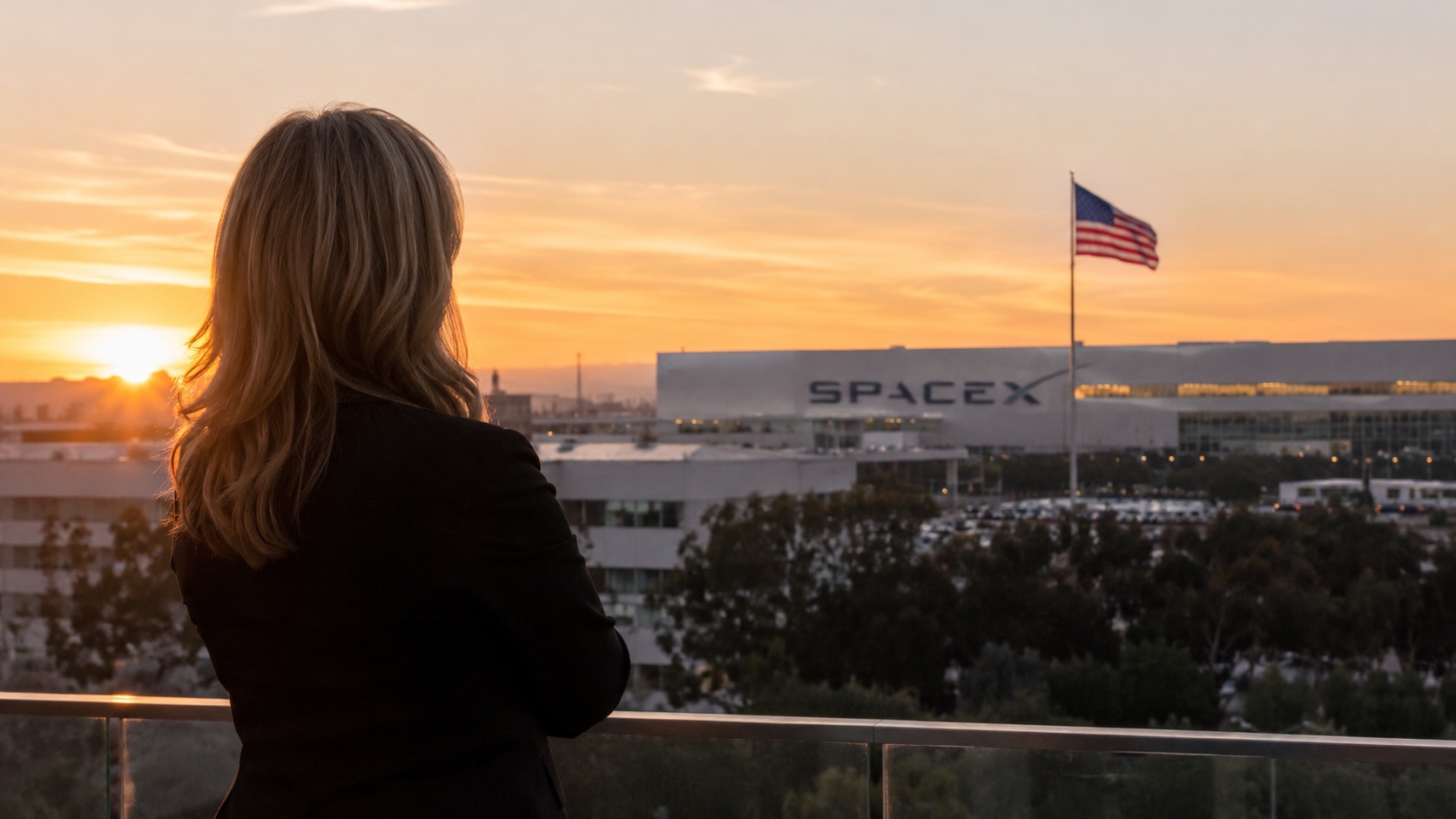
SpaceX President Gwynne Shotwell said Friday that more than 2 million SpaceX shares belonging to her and her husband, Robert, will be distributed to children’s Trump Accounts in December, turning a pledge she made over the summer into an actual transfer. “Robert and I are thrilled that our gift of over 2 million shares of SpaceX stock will be distributed to children’s Trump accounts in December!” Shotwell wrote on X, adding that the shares are “transferring to escrow as we speak.”
The first round goes to children aged 11 to 17 who live in ZIP codes where the median family income is $57,000 or less, along with kids in ZIP codes with too few residents for the Census to report that figure. Shotwell said those families should receive a notice by Monday, Reuters reported.
A second gift is expected to be finalized in the next few weeks. That round will cover eligible children in military families serving overseas, children in foster care, and more kids in Texas counties near the Shotwells’ home where median family income is $90,000 or less. Elon Musk replied to the announcement with “Cool” and a heart emoji.
Shotwell first announced the donation on July 6, less than a month after SpaceX priced its record IPO at $135 per share on the Nasdaq. IPO filings showed Shotwell owned about 12.6 million SpaceX shares, Quartz reported at the time, which makes the gift roughly one sixth of her stake. At the roughly $146 per share used to value Musk’s own pledge earlier this month, 2 million shares are worth about $290 million.
How the stock would actually reach the accounts had been an open question since July. Treasury guidance acknowledged that stock donations could flow into Trump Accounts, but it did not explain the mechanics for a program whose contributions default into an S&P 500 index fund. Shotwell thanked the Treasury, the IRS, the Dell Foundation, Greater Horizons, Invest America and the law firms Morgan Lewis and Gibson Dunn for “working over the past few months to make this happen.”
The transfer also works as a dry run for a far larger gift. On October 19, Musk said he would give one of his SpaceX shares to every kid in America next year and called it “the first of many.” With roughly 72 million children in the country, that pledge is worth about $10.5 billion. President Donald Trump thanked Musk the same day and said the shares would go through Trump Accounts, though neither SpaceX nor the Treasury has published how or when that distribution will happen.
Shotwell’s recipients also fill a gap in the program itself. Trump Accounts launched on July 4, and the $1,000 Treasury deposit only goes to babies born between 2025 and 2028. Teenagers aged 11 to 17 receive no government seed money, so for many of the families getting a notice on Monday, SpaceX stock will be the first asset in the account. The accounts convert into retirement accounts when the child turns 18.

Tesla owners who tap Emergency Drive Away for fun are in for a surprise

Elon Musk calls Earth’s data centers “peanuts” next to what SpaceX is planning in orbit


