
Investor's Corner
Tesla drives Panasonic’s profit forecast up 30%, supplier to test 4680 line in 2021

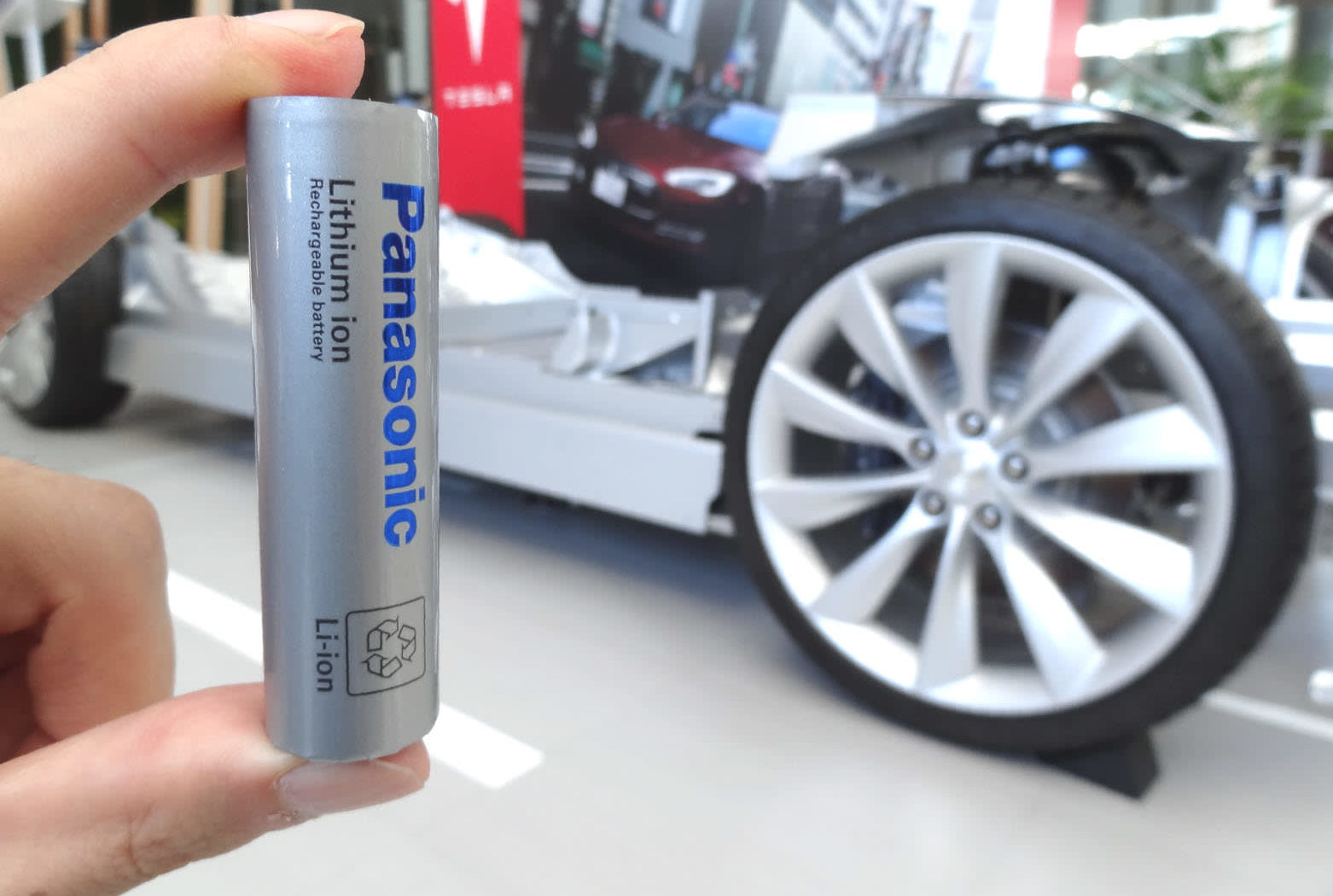
Tesla’s demand for automotive batteries has driven supplier Panasonic’s profitability forecast up 30% this year as the Japanese company looks to rebound from lockdowns and lackluster demand in 2020 caused by the coronavirus. Additionally, Panasonic executives revealed that the battery manufacturer would set up a test line in Japan for Tesla’s 4680 battery cells, a new battery unveiled by Tesla in September 2020.
Panasonic is looking to utilize the growing demand for electric cars in the United States and China to offset a tough 2020 caused by the coronavirus pandemic. Due to its long and strong partnership with Tesla, Panasonic plans to leverage the automaker’s popularity in both of the key regions to bring in more profitability, and projections are showing that is exactly what will happen.
Panasonic is expecting its automotive unit to post 50 billion yen in operating profit, Chief Financial Officer Hirokazu Umeda said in a press briefing, according to Reuters. Tesla takes in “nearly all” of Panasonic’s automotive batteries, Umeda said, and they account for around 40% of Panasonic’s total business.
Forecasts for Panasonic’s overall operating profit project 27.6% increases to 330 billion yen, or around $3.034 billion. In Q1 2021, Panasonic posted an operating profit of 31.8 billion yen ($292.43 billion), a 40% decrease compared to the same period in 2020. The biggest factor to this substantial decrease was Panasonic’s weak earnings report from its Life Solutions unit that manufactures lighting and materials for buildings. Automotive components of Panasonic reported profitable figures but were offset by the Life Solutions decreases.
The Automotive unit of Panasonic is where growth and profitability are being recorded. Panasonic plans to begin expanding its product line, and it begins with a test manufacturing line in Japan later this year that will produce Tesla’s cylindrical 4680 battery cells. The cells were unveiled by Tesla last year in September at the company’s Battery Day. Several performance improvements are outlined by Tesla’s new cell. They include a five-times increase in energy density, a 16% increase in range, and an improvement in power output by six times.
Tesla debuts new 4680 battery cell: 500% more energy, 6X power, range increase
The cells will also help reduce manufacturing costs and will contribute to a 14% decrease in price per kWh, bringing electric cars to price parity with their internal combustion engine rivals.
Panasonic is also investing in supply chain management services and recently acquired Blue Yonder, a U.S. supply chain software company, for $7.1 billion.
Analysts project Panasonic’s profitability to hit 327.56 billion yen, slightly lower than the company projects for itself. This is based on estimates from 16 analysts, according to Refinitiv data.




A Tesla analyst today said that investors should not lose sight of what is truly important in the grand scheme of being a shareholder, and that any near-term drama between CEO Elon Musk and U.S. President Donald Trump should not outshine the progress made by the company.
Gene Munster of Deepwater Management said that Tesla’s progress in autonomy is a much larger influence and a significantly bigger part of the company’s story than any disagreement between political policies.
Munster appeared on CNBC‘s “Closing Bell” yesterday to reiterate this point:
“One thing that is critical for Tesla investors to remember is that what’s going on with the business, with autonomy, the progress that they’re making, albeit early, is much bigger than any feud that is going to happen week-to-week between the President and Elon. So, I understand the reaction, but ultimately, I think that cooler heads will prevail. If they don’t, autonomy is still coming, one way or the other.”
BREAKING: GENE MUNSTER SAYS — $TSLA AUTONOMY IS “MUCH BIGGER” THAN ANY FEUD 👀
He says robotaxis are coming regardless ! pic.twitter.com/ytpPcwUTFy
— TheSonOfWalkley (@TheSonOfWalkley) July 2, 2025
This is a point that other analysts like Dan Ives of Wedbush and Cathie Wood of ARK Invest also made yesterday.
On two occasions over the past month, Musk and President Trump have gotten involved in a very public disagreement over the “Big Beautiful Bill,” which officially passed through the Senate yesterday and is making its way to the House of Representatives.
Musk is upset with the spending in the bill, while President Trump continues to reiterate that the Tesla CEO is only frustrated with the removal of an “EV mandate,” which does not exist federally, nor is it something Musk has expressed any frustration with.
In fact, Musk has pushed back against keeping federal subsidies for EVs, as long as gas and oil subsidies are also removed.
Nevertheless, Ives and Wood both said yesterday that they believe the political hardship between Musk and President Trump will pass because both realize the world is a better place with them on the same team.
Munster’s perspective is that, even though Musk’s feud with President Trump could apply near-term pressure to the stock, the company’s progress in autonomy is an indication that, in the long term, Tesla is set up to succeed.
Tesla launched its Robotaxi platform in Austin on June 22 and is expanding access to more members of the public. Austin residents are now reporting that they have been invited to join the program.
Elon Musk
Tesla surges following better-than-expected delivery report
Tesla saw some positive momentum during trading hours as it reported its deliveries for Q2.
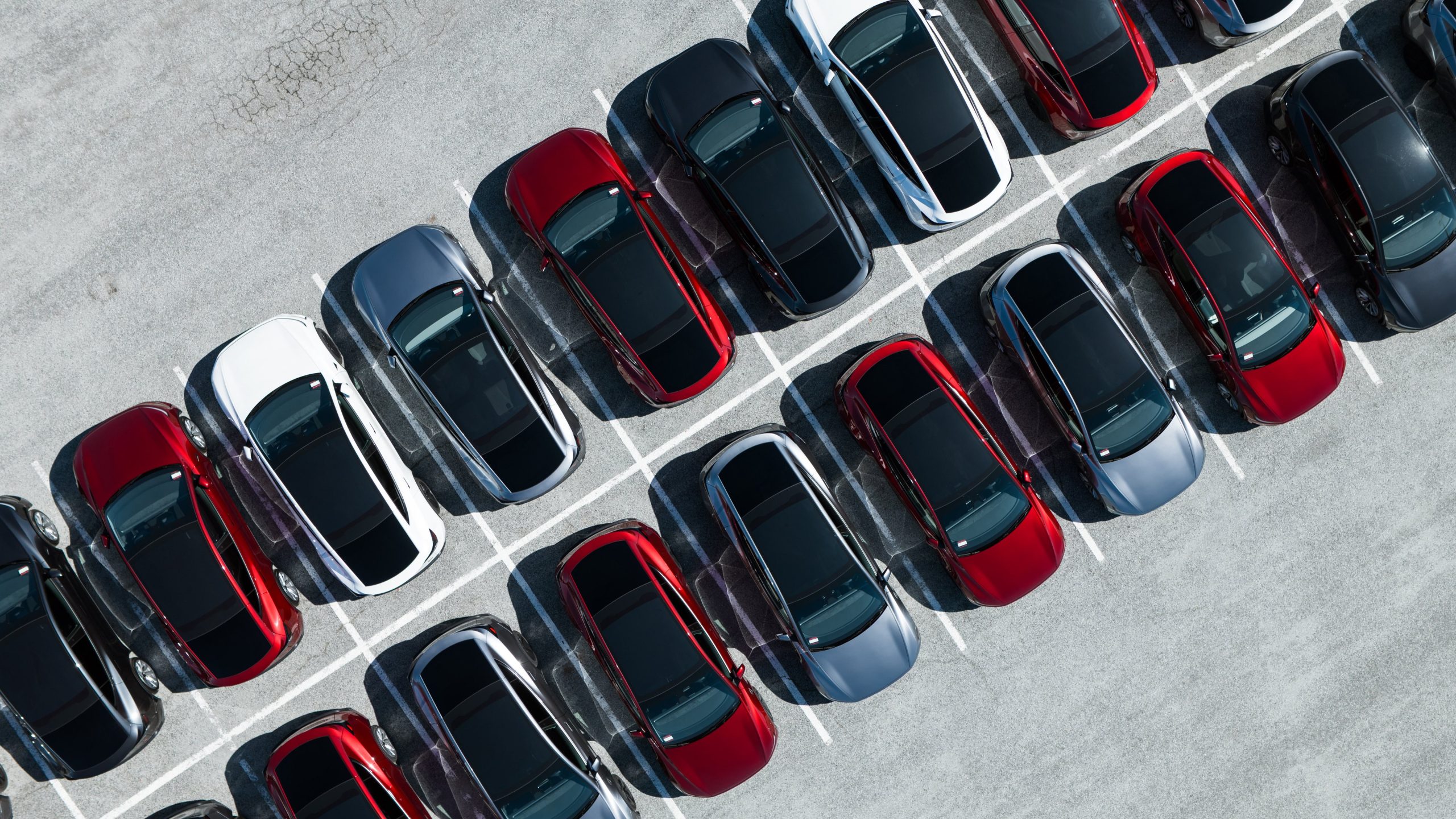
Tesla (NASDAQ: TSLA) surged over four percent on Wednesday morning after the company reported better-than-expected deliveries. It was nearly right on consensus estimations, as Wall Street predicted the company would deliver 385,000 cars in Q2.
Tesla reported that it delivered 384,122 vehicles in Q2. Many, including those inside the Tesla community, were anticipating deliveries in the 340,000 to 360,000 range, while Wall Street seemed to get it just right.
Tesla delivers 384,000 vehicles in Q2 2025, deploys 9.6 GWh in energy storage
Despite Tesla meeting consensus estimations, there were real concerns about what the company would report for Q2.
There were reportedly brief pauses in production at Gigafactory Texas during the quarter and the ramp of the new Model Y configuration across the globe were expected to provide headwinds for the EV maker during the quarter.
At noon on the East Coast, Tesla shares were up about 4.5 percent.
It is expected that Tesla will likely equal the number of deliveries it completed in both of the past two years.
It has hovered at the 1.8 million mark since 2023, and it seems it is right on pace to match that once again. Early last year, Tesla said that annual growth would be “notably lower” than expected due to its development of a new vehicle platform, which will enable more affordable models to be offered to the public.
These cars are expected to be unveiled at some point this year, as Tesla said they were “on track” to be produced in the first half of the year. Tesla has yet to unveil these vehicle designs to the public.
Dan Ives of Wedbush said in a note to investors this morning that the company’s rebound in China in June reflects good things to come, especially given the Model Y and its ramp across the world.
He also said that Musk’s commitment to the company and return from politics played a major role in the company’s performance in Q2:
“If Musk continues to lead and remain in the driver’s seat, we believe Tesla is on a path to an accelerated growth path over the coming years with deliveries expected to ramp in the back-half of 2025 following the Model Y refresh cycle.”
Ives maintained his $500 price target and the ‘Outperform’ rating he held on the stock:
“Tesla’s future is in many ways the brightest it’s ever been in our view given autonomous, FSD, robotics, and many other technology innovations now on the horizon with 90% of the valuation being driven by autonomous and robotics over the coming years but Musk needs to focus on driving Tesla and not putting his political views first. We maintain our OUTPERFORM and $500 PT.”
Moving forward, investors will look to see some gradual growth over the next few quarters. At worst, Tesla should look to match 2023 and 2024 full-year delivery figures, which could be beaten if the automaker can offer those affordable models by the end of the year.
Investor's Corner
Tesla delivers 384,000 vehicles in Q2 2025, deploys 9.6 GWh in energy storage
The quarter’s 9.6 GWh energy storage deployment marks one of Tesla’s highest to date.

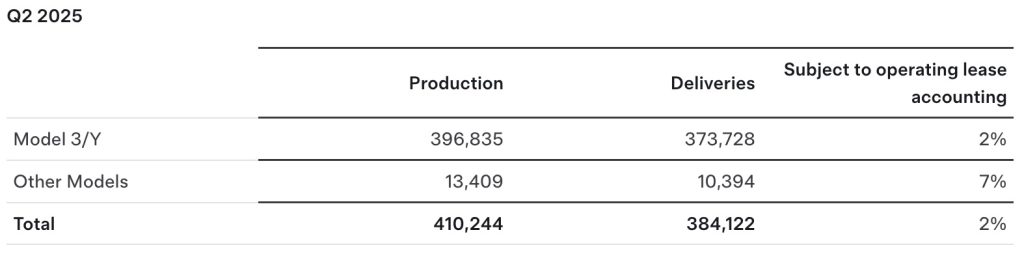
Tesla (NASDAQ: TSLA) has released its Q2 2025 vehicle delivery and production report. As per the report, the company delivered over 384,000 vehicles in the second quarter of 2025, while deploying 9.6 GWh in energy storage. Vehicle production also reached 410,244 units for the quarter.
Model 3/Y dominates output, ahead of earnings call
Of the 410,244 vehicles produced during the quarter, 396,835 were Model 3 and Model Y units, while 13,409 were attributed to Tesla’s other models, which includes the Cybertruck and Model S/X variants. Deliveries followed a similar pattern, with 373,728 Model 3/Ys delivered and 10,394 from other models, totaling 384,122.
The quarter’s 9.6 GWh energy storage deployment marks one of Tesla’s highest to date, signaling continued strength in the Megapack and Powerwall segments.
Year-on-year deliveries edge down, but energy shows resilience
Tesla will share its full Q2 2025 earnings results after the market closes on Wednesday, July 23, 2025, with a live earnings call scheduled for 4:30 p.m. CT / 5:30 p.m. ET. The company will publish its quarterly update at ir.tesla.com, followed by a Q&A webcast featuring company leadership. Executives such as CEO Elon Musk are expected to be in attendance.
Tesla investors are expected to inquire about several of the company’s ongoing projects in the upcoming Q2 2025 earnings call. Expected topics include the new Model Y ramp across the United States, China, and Germany, as well as the ramp of FSD in territories outside the US and China. Questions about the company’s Robotaxi business, as well as the long-referenced but yet to be announced affordable models are also expected.

Why Tesla’s Q3 could be one of its biggest quarters in history

Tesla Full Self-Driving testing continues European expansion: here’s where

xAI’s Memphis data center receives air permit despite community criticism


-
 Elon Musk3 days ago
Tesla investors will be shocked by Jim Cramer’s latest assessment
-
 News1 week ago
Tesla Robotaxi’s biggest challenge seems to be this one thing
-
 News2 weeks ago
Texas lawmakers urge Tesla to delay Austin robotaxi launch to September
-
 Elon Musk2 weeks ago
First Look at Tesla’s Robotaxi App: features, design, and more
-

 Elon Musk2 weeks ago
xAI’s Grok 3 partners with Oracle Cloud for corporate AI innovation
-
 News2 weeks ago
SpaceX and Elon Musk share insights on Starship Ship 36’s RUD
-
 News2 weeks ago
Watch Tesla’s first driverless public Robotaxi rides in Texas
-
 News2 weeks ago
Tesla has started rolling out initial round of Robotaxi invites