News
Suspect linked to four Tesla store attacks arrested with incendiary devices

The Loveland Police Department has issued a news release about an arrest that it made following several vandalism incidents against the Loveland Tesla store.
A 40-year-old suspect was taken into custody as a result.
The arrest:
- As per Tim Doran, the Chief of Police at Loveland, authorities arrested 40-year-old Lucy Grace Nelson, who also goes by the name Justin Thomas Nelson on Monday, February 24.
- Nelson is alleged to have been involved in four incidents at the Loveland Tesla location. The incidents were reported on January 29, February 2, and February 7. Incendiary devices were discovered at the scene.
- During the arrest on Monday night, Nelson was found in the Loveland Tesla store location while in possession of additional incendiary devices. The suspect was also carrying materials attributed to vandalism.
- In a comment to FOX News, Loveland Police Department Public Information Officer Chris Padgett noted that the messages left at the store were “very offensive” and “derogatory in nature.”
- Nelson was processed at the Larimer County Jail, but was released on a $100,000 bond.

The charges:
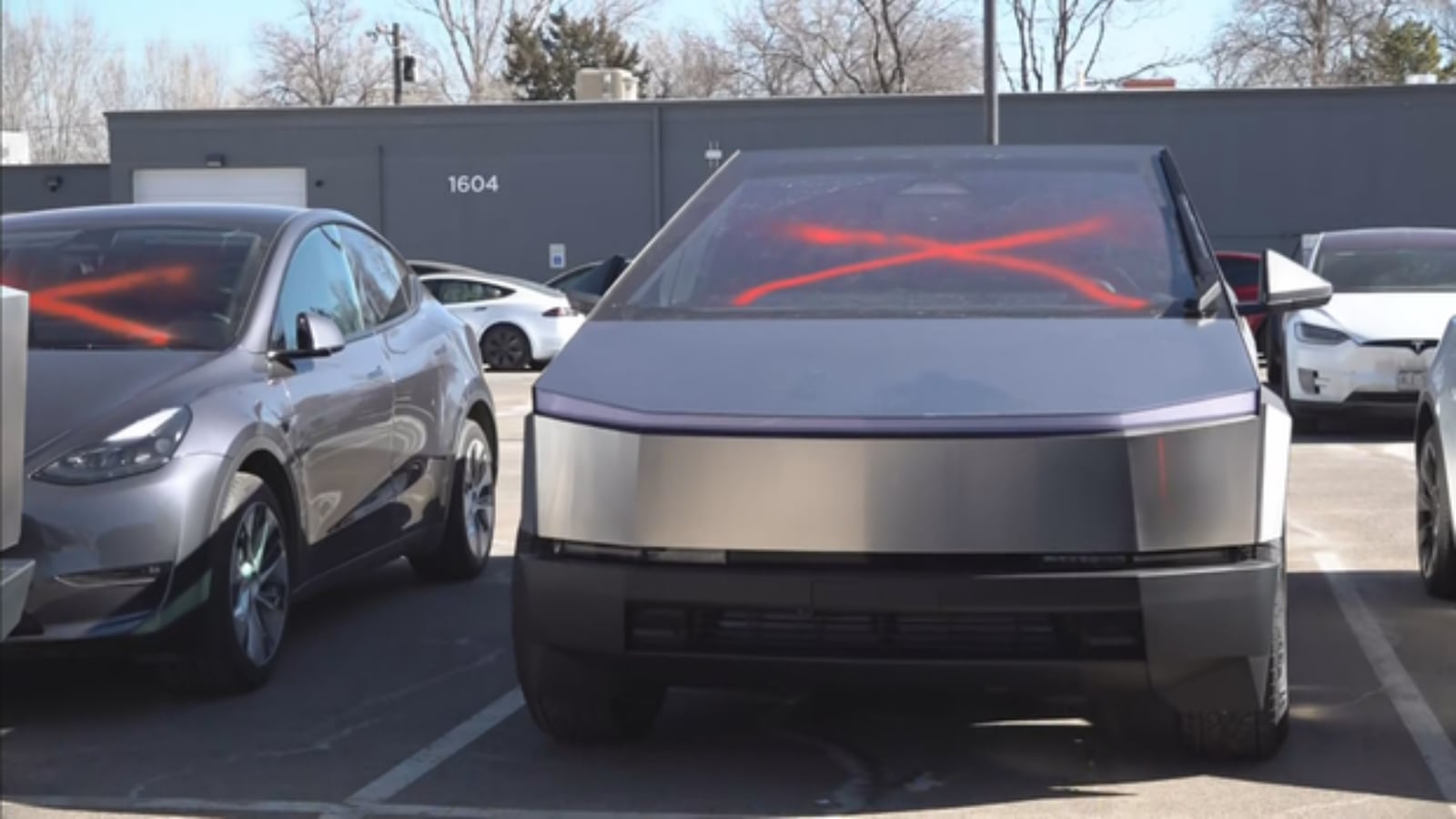
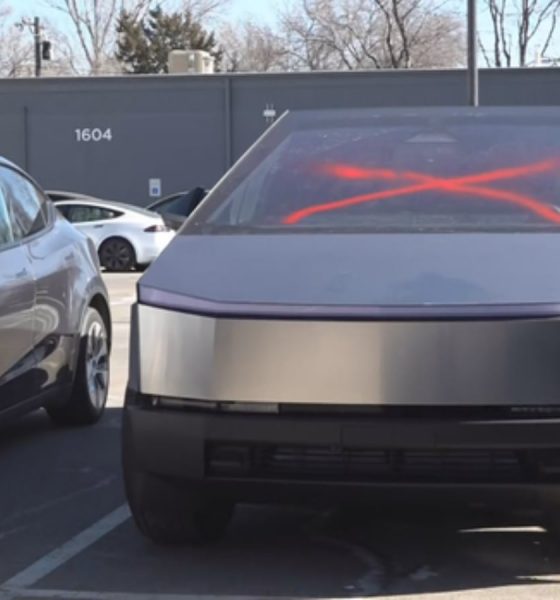
- Due to the repeated vandalism incidents, the Tesla store saw some of its windows smashed. Some Teslas’ windshields were also painted, and messages such as “Nazi Cars” were left in the location.
- As noted by the Loveland Police Department, Nelson was booked into the Larimer County Jail on several charges:
- CRS 18-12-109(4) Explosives or Incendiary Devices Use During Felony, Class 2 Felony
- CRS 18-4-501(1)(4)(d) Criminal Mischief $2,000 < $5,000 Business, Class 6 Felony
- CRS 18-2-101(4) Criminal Attempt to Commit Class 3 Felony, Class 4 Felony
- The Loveland Police is working closely with the Bureau of Alcohol, Tobacco, Firearms and Explosives’ Denver Field Division. Federal charges are expected to follow.
- “These incidents were not only unlawful, dangerous, and unsettling, they also created an atmosphere of discomfort and worry. Those who work at the business, along with those living in the community, have had to deal with such concerns since the first incident on January 29th,” Padgett noted in a comment to USA Today.

Don’t hesitate to contact us with news tips. Just send a message to simon@teslarati.com to give us a heads up.


News
Tesla Cybercab spotted next to Model Y shows size comparison
The Model Y is Tesla’s most-popular vehicle and has been atop the world’s best-selling rankings for the last three years. The Cybercab, while yet to be released, could potentially surpass the Model Y due to its planned accessible price, potential for passive income for owners, and focus on autonomy.

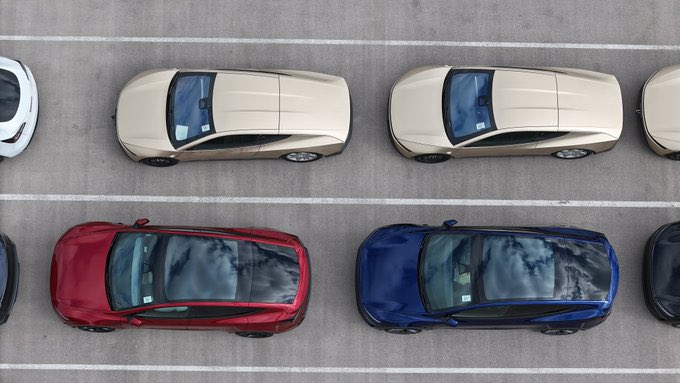
The Tesla Cybercab and Tesla Model Y are perhaps two of the company’s most-discussed vehicles, and although they are geared toward different things, a recent image of the two shows a side-by-side size comparison and how they stack up dimensionally.
The Model Y is Tesla’s most-popular vehicle and has been atop the world’s best-selling rankings for the last three years. The Cybercab, while yet to be released, could potentially surpass the Model Y due to its planned accessible price, potential for passive income for owners, and focus on autonomy.
Geared as a ride-sharing vehicle, it only has two seats. However, the car will be responsible for hauling two people around to various destinations completely autonomously. How they differ in terms of size is striking.
In a new aerial image shared by drone operator and Gigafactory Texas observer Joe Tegtmeyer, the two vehicles were seen side by side, offering perhaps the first clear look at how they differ in size.
Tesla Model Y vs. Tesla Cybercab:
✅ Overall Length:⁰Model Y: 188.7 inches (4,794 mm)⁰Cybercab: ~175 inches (≈4,445 mm)⁰→ Cybercab is about 13–14 inches shorter (roughly the length of a large suitcase).
✅ Overall Width (excluding mirrors):⁰Model Y: 75.6 inches (1,920 mm)… https://t.co/PsVwzhw1pe pic.twitter.com/58JQ5ssQIO
— TESLARATI (@Teslarati) March 25, 2026
Dimensionally, the differences are striking. The Model Y stretches roughly 188 inches long, 75.6 inches wide, excluding its mirrors, and stands 64 inches tall on a 113.8-inch wheelbase. The Cybercab measures approximately 175 inches in length, about a foot shorter, and just 63 inches wide.
That narrower stance gives the Cybercab a dramatically more compact silhouette, making it easier to maneuver in tight urban environments and park in standard spaces that would feel cramped for the Model Y. Height is also lower on the Cybercab, contributing to its sleek, coupe-like profile versus the Model Y’s taller crossover shape.
Visually, the contrast is unmistakable. The Model Y presents as a family-friendly SUV with conventional doors, a prominent hood, and a spacious glass roof.
The Cybercab eliminates the steering wheel and pedals entirely, creating a clean, futuristic cabin that feels more lounge than cockpit.
Its doors open in a distinctive, wide-swinging motion, and the body features smoother, more aerodynamic lines optimized for autonomy. Parked beside a Model Y, the Cybercab appears almost toy-like in width and length, yet its low-slung stance and minimalist design emphasize agility over bulk.
🚨 We caught up with the Tesla Cybercab today in The Bay Area: pic.twitter.com/9awXiK26ue
— TESLARATI (@Teslarati) March 24, 2026
Cargo capacity tells another part of the story. The Model Y offers generous real-world utility: 4.1 cubic feet in the front trunk and 30.2 cubic feet behind the rear seats, expanding to 72 cubic feet with the second row folded flat.
It comfortably swallows groceries, luggage, or sports equipment for five passengers. The Cybercab, designed for two riders, trades that volume for targeted efficiency.
It features a rear hatch with enough space for two carry-on suitcases and personal items, plenty for the typical robotaxi trip, while maintaining impressive legroom and headroom for its occupants.
In short, the Model Y prioritizes versatility and family hauling with its larger footprint and abundant storage. The Cybercab sacrifices size for simplicity, cost, and urban nimbleness.
At roughly 12 inches shorter and 12 inches narrower, it embodies Tesla’s vision for scalable, affordable autonomy: smaller on the outside, smarter inside, and ready to redefine how we move through cities.
The Cybercab and Model Y both will contribute to Tesla’s fully autonomous future. However, the size comparison gives a good look into how the vehicles are the same, and how they differ, and what riders should anticipate as the Cybercab enters production in the coming weeks.
Elon Musk
Elon Musk says Tesla is developing a new vehicle: ‘Way cooler than a minivan’
It sounds as if Tesla could be considering a new vehicle to fit the mold of what a larger family would need, and as fans have been demanding it for several years and the company is phasing out the Model X, its only family-geared vehicle, it sounds as if it could be the perfect time.
Tesla CEO Elon Musk said the company is developing a new vehicle, and it will be “way cooler than a minivan.”
It sounds as if Tesla could be considering a new vehicle to fit the mold of what a larger family would need, and as fans have been demanding it for several years and the company is phasing out the Model X, its only family-geared vehicle, it sounds as if it could be the perfect time.
There are a handful of things Musk could be talking about, and as many Tesla owners have wanted a vehicle along the lines of a minivan for hauling around their family, speculation has persisted about what the company would do in terms of developing something for that exact use case.
There were several options, and some of them seemed to be already available. Musk posted on X yesterday that the Cybertruck has three sets of isofix attachments and could fit three child seats or three adults, and it seemed to be a way to deflect plans for a new, larger vehicle as a Model Y L appeared to be present at Giga Texas.
There is also the Robovan, the large people mover that Tesla unveiled at the “We, Robot” back in 2024.
Something way cooler than a minivan is coming
— Elon Musk (@elonmusk) March 25, 2026
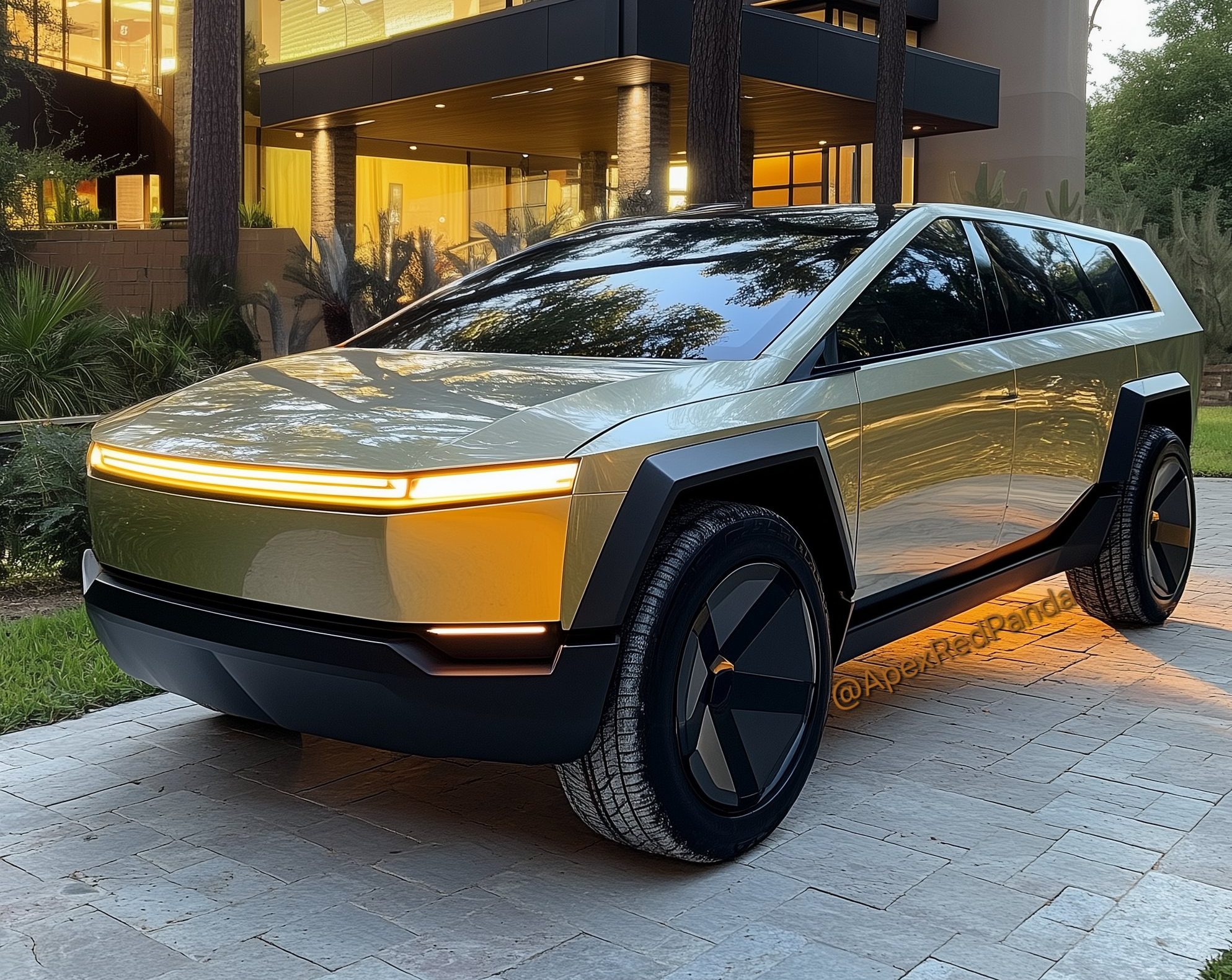
However, it seems Tesla could be developing something like a CyberSUV, something that is going to be large enough to haul around a car full of kids, but could be developed with the company’s aesthetic of the company’s most recent releases: this would likely include a light bar and a more sleek, futuristic look.
We’ve mocked up some potential looks for Tesla’s speculative vehicle in the past:
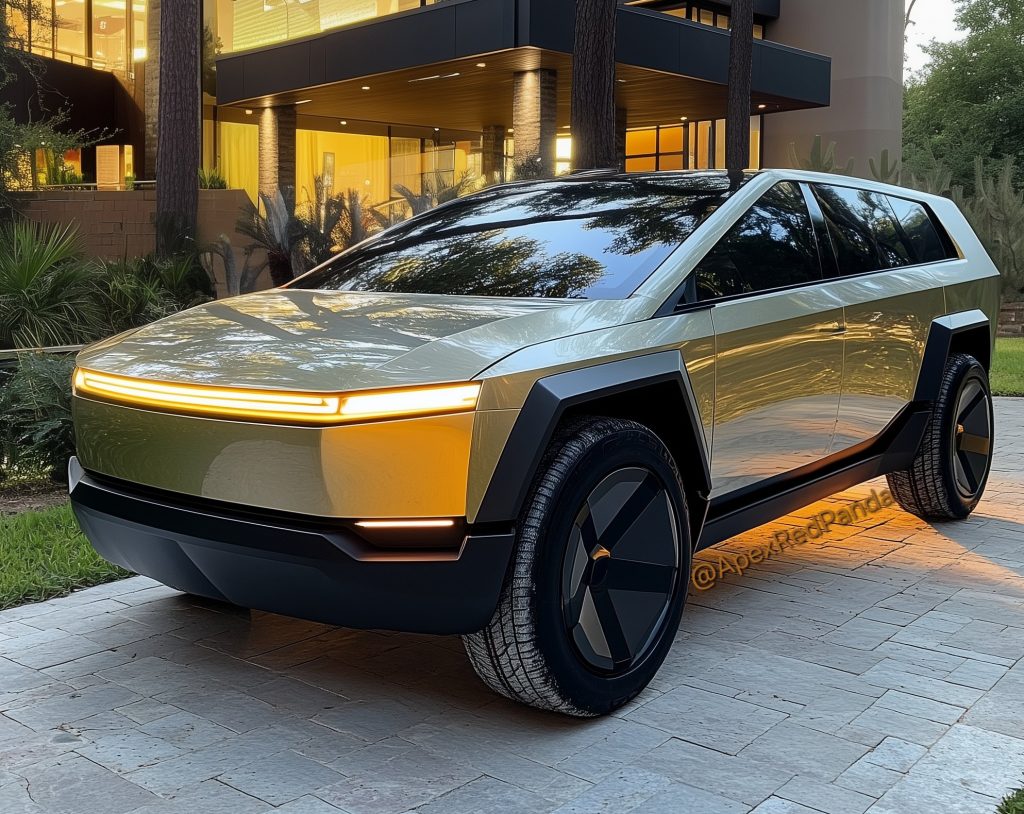
Tesla has teased the potential of a CyberSUV in the past, showing off clay models that it developed back in September in a teaser video called “Sustainable Abundance.”
Fans and owners have been calling for this development for a very long time, and it seems like Tesla might be ready to finally answer the call on a large SUV. With the segment being dominated by combustion engine vehicles, Tesla could truly disrupt the large SUVs that have been mainstays.
The Chevrolet Tahoe and GMC Yukon would feel some additional pressure, and it would be possible for Tesla to infiltrate some of those sales and pull consumers to electric powertrains.
As the Model S and Model X sunset process is truly hitting full swing, it might be time to consider Tesla’s next option in terms of vehicle development.
Elon Musk
Elon Musk’s $10 Trillion robot: Inside Tesla’s push to mass produce Optimus
Tesla’s surging Optimus job listings reveal a company sprinting from prototype to one million robot production.

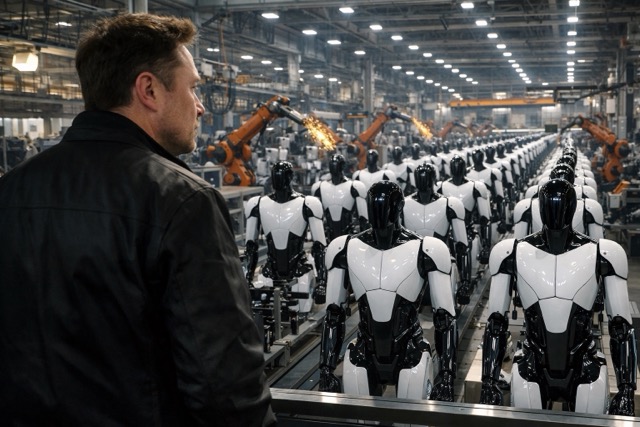
Tesla is accelerating its push to bring the Optimus humanoid robot to high volume production, and its recent job listings tells the story as clearly as any earnings call.
With well over 100 Optimus related job openings now posted across its U.S. facilities, Tesla is signaling a critical pivot for the program, moving it from a captivating tech demo to a serious manufacturing endeavor. Roles span the full spectrum of the product lifecycle, from Robotics Software Engineers and Manufacturing Engineers to Mechanical Integration Engineers and AI Engineers focused on world modeling and video generation. One active listing for a Software Engineer on the Optimus team asks candidates to build scalable and reliable data pipelines for Optimus manufacturing lines and develop automation tools that accelerate analysis and visualization for mass manufacturing.
Tesla is racing toward a one million unit annual production target. The clearest signal yet that Tesla is treating Optimus as its primary business came on January 28, 2026, during the company’s Q4 2025 earnings call. Musk announced that Tesla is ending production of the Model S and Model X, and will repurpose those lines at its Fremont, California factory to build Optimus humanoid robots.
A production intent prototype of Optimus Version 3 is planned to be ready in early 2026, after which Tesla intends to build a one million unit production line with a targeted production start by the end of 2026. To support that ramp, Tesla broke ground on a massive new Optimus manufacturing facility at Gigafactory Texas in late 2025, with ambitions to eventually reach 10 million units per year.
Tesla Giga Texas to feature massive Optimus V4 production line
The business case for scaling this aggressively is rooted in labor economics. Musk has stated that “Optimus has the potential to be the biggest product of all time,” reasoning that if Tesla can produce capable humanoid robots at scale and reasonable cost, every task currently performed by human labor becomes a potential application. In a separate statement, Musk framed Optimus’s long term importance even more bluntly, saying it could surpass Tesla’s vehicle business in scale with the potential to generate $10 trillion in revenue.
The industries Tesla is targeting first are those most burdened by repetitive physical labor. Early applications include manufacturing assembly, material handling and quality inspection, as well as logistics tasks like loading, unloading, sorting, and transporting goods in warehouses and distribution centers. Longer term, Tesla’s vision is for Optimus to penetrate household, medical, and logistics scenarios at the scale of a smartphone rollout.

Tesla Cybercab spotted next to Model Y shows size comparison

Elon Musk says Tesla is developing a new vehicle: ‘Way cooler than a minivan’

Elon Musk’s $10 Trillion robot: Inside Tesla’s push to mass produce Optimus

Elon Musk’s Boring Co. Tunnel Vision Challenge ends with a surprise for Louisiana, Maryland and Dallas

What is Digital Optimus? The new Tesla and xAI project explained


