Cybertruck
Tesla updates Cybertruck owners about key Powershare feature

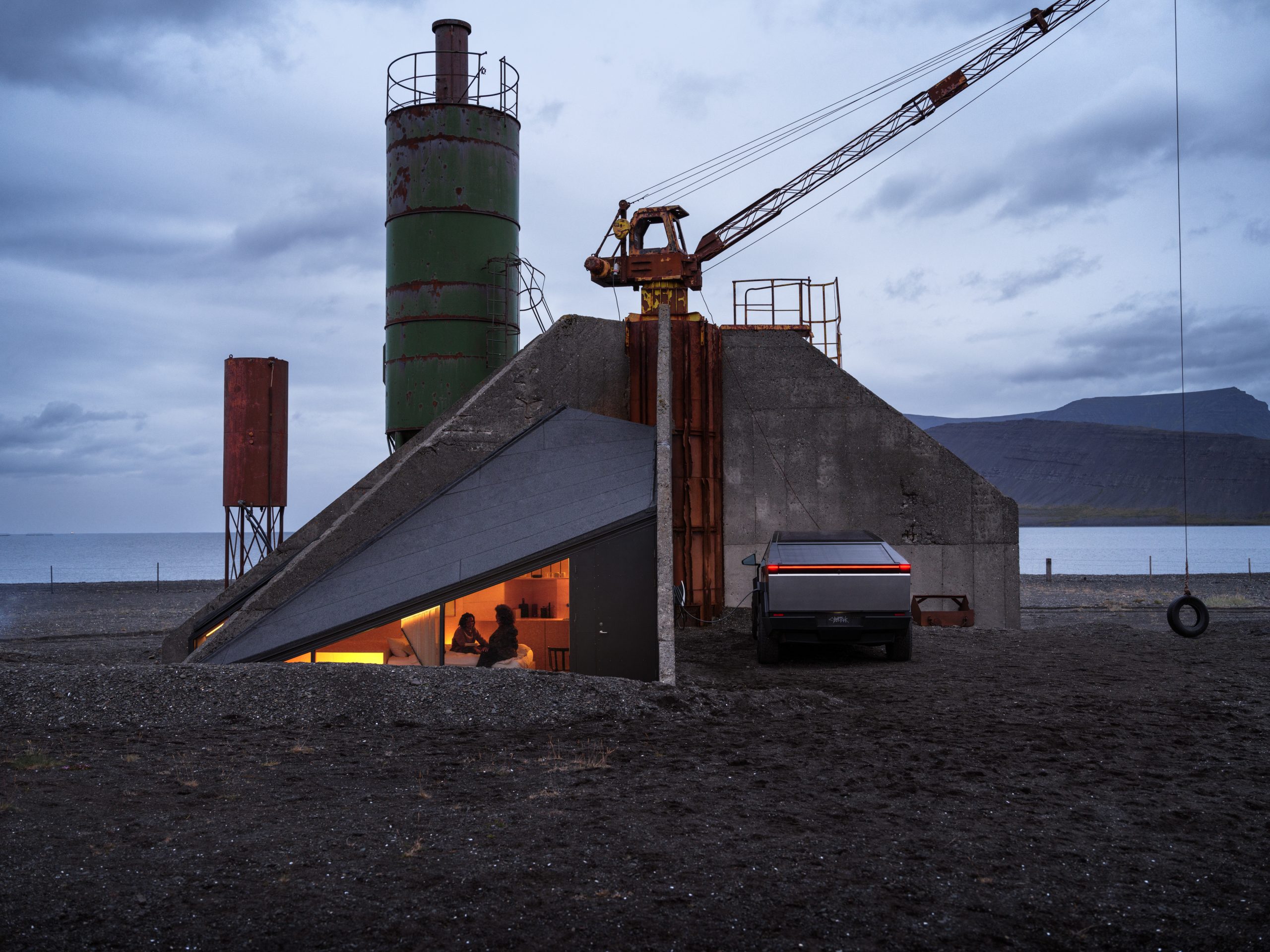
Tesla is updating Cybertruck owners on its timeline of a massive feature that has yet to ship: Powershare with Powerwall.
Powershare is a bidirectional charging feature exclusive to Cybertruck, which allows the vehicle’s battery to act as a portable power source for homes, appliances, tools, other EVs, and more. It was announced in late 2023 as part of Tesla’s push into vehicle-to-everything energy sharing, and acting as a giant portable charger is the main advantage, as it can provide backup power during outages.
Cybertruck’s Powershare system supports both vehicle-to-load (V2L) and vehicle-to-home (V2H), making it flexible and well-rounded for a variety of applications.
However, even though the feature was promised with Cybertruck, it has yet to be shipped to vehicles. Tesla communicated with owners through email recently regarding Powershare with Powerwall, which essentially has the pickup act as an extended battery.
Powerwall discharge would be prioritized before tapping into the truck’s larger pack.
However, Tesla is still working on getting the feature out to owners, an email said:
“We’re writing to let you know that the Powershare with Powerwall feature is still in development and is now scheduled for release in mid-2026.
This new release date gives us additional time to design and test this feature, ensuring its ability to communicate and optimize energy sharing between your vehicle and many configurations and generations of Powerwall. We are also using this time to develop additional Powershare features that will help us continue to accelerate the world’s transition to sustainable energy.”
Owners have expressed some real disappointment in Tesla’s continuous delays in releasing the feature, as it was expected to be released by late 2024, but now has been pushed back several times to mid-2026, according to the email.
Foundation Series Cybertruck buyers paid extra, expecting the feature to be rolled out with their vehicle upon pickup.
Cybertruck’s Lead Engineer, Wes Morrill, even commented on the holdup:
As a Cybertruck owner who also has Powerwall, I empathize with the disappointed comments.
To their credit, the team has delivered powershare functionality to Cybertruck customers who otherwise have no backup with development of the powershare gateway. As well as those with solar…
— Wes (@wmorrill3) December 12, 2025
He said that “it turned out to be much harder than anticipated to make powershare work seamlessly with existing Powerwalls through existing wall connectors. Two grid-forming devices need to negotiate who will form and who will follow, depending on the state of charge of each, and they need to do this without a network and through multiple generations of hardware, and test and validate this process through rigorous certifications to ensure grid safety.”
It’s nice to see the transparency, but it is justified for some Cybertruck owners to feel like they’ve been bait-and-switched.


Cybertruck
Tesla’s most delayed Cybertruck feature is finally here
Tesla finally links Cybertruck Powershare with Powerwall 3 for extended home backup after years overdue.


Tesla’s Cybertruck can now pair with a Powerwall 3 to keep a house running longer during an outage, a feature the company first promised when the truck launched in November 2023.
The official Cybertruck account posted the update on X Thursday: “Powerwall 3 & I can now power your house together. This extends your home backup by over 3 days, equivalent to 9 additional Powerwalls,” Cybertruck lead engineer Wes Morrill confirmed the rollout separately, calling it the first time a vehicle and a home battery have worked together this way. Powerwall 2 and Powerwall+ compatibility is still coming later this year, per both the Cybertruck account and Morrill.
Powerwall 3 & I can now power your house together⁰ ⁰This extends your home backup by over 3 days, equivalent to 9 additional Powerwalls pic.twitter.com/8G2twIm6AN
— Cybertruck (@cybertruck) September 10, 2026
Powershare itself is not new. Tesla enabled the version that lets Cybertruck power tools, appliances or another EV through its bed outlets when the truck launched in 2023. Home backup through a Powershare Gateway and Universal Wall Connector arrived in 2024, and Tesla extended that support to homes with solar the following year. What has been missing until now is Powershare working alongside an existing Powerwall, instead of functioning as a separate backup source competing for the same job.
The pairing matters because a single Powerwall home battery typically covers a home for about a day, less if usage is heavy or the outage stretches into a heat wave or freeze. A second Powerwall for more backup storage costs several thousand dollars installed. A Cybertruck instead uses a battery the owner already has, one large enough here to add roughly three more days of backup without mounting another unit or booking an installer visit. For households in wildfire, hurricane or winter storm regions where outages run past a day, that keeps the refrigerator and medical equipment running instead of shutting down.
The company told owners in October 2024 that Powerwall integration was coming sometime in 2025. That date passed, and in December 2025 Tesla pushed the target to mid-2026, with Morrill explaining at the time that two grid-forming devices need to negotiate which one manages a home during an outage, and that certifying the process across multiple generations of Powerwall took longer than expected.
For owners who bought Powershare hardware expecting it to work with whatever battery setup they already had, Thursday’s update closes a gap that has shown up repeatedly in owner complaints since Cybertruck deliveries began. Tesla has also rolled out a separate Powershare grid support program in Texas, letting Cybertrucks send power back to the grid during high demand events, so the truck’s role in a home’s energy setup keeps expanding even as individual pieces of it arrive later than promised.
Yesterday, we reported on Tesla Cybertruck getting some major adjustments from a manufacturing standpoint in an effort to make the all-electric pickup more cost-effective, more reliable, more serviceable, and more easily produced.
Tesla Cybertruck engineer reveals new changes in ‘constantly evolving’ pickup
One of those changes was the addition of a self-reinforcing polypropylene aero shield that sits underneath the truck. Previously, Tesla utilized aluminum for this, but the self-reinforcing polypropylene was more durable while also being cheaper and lighter.
Tesla has revealed another small change it made to the Cybertruck, and it has to do with the side repeater cameras.
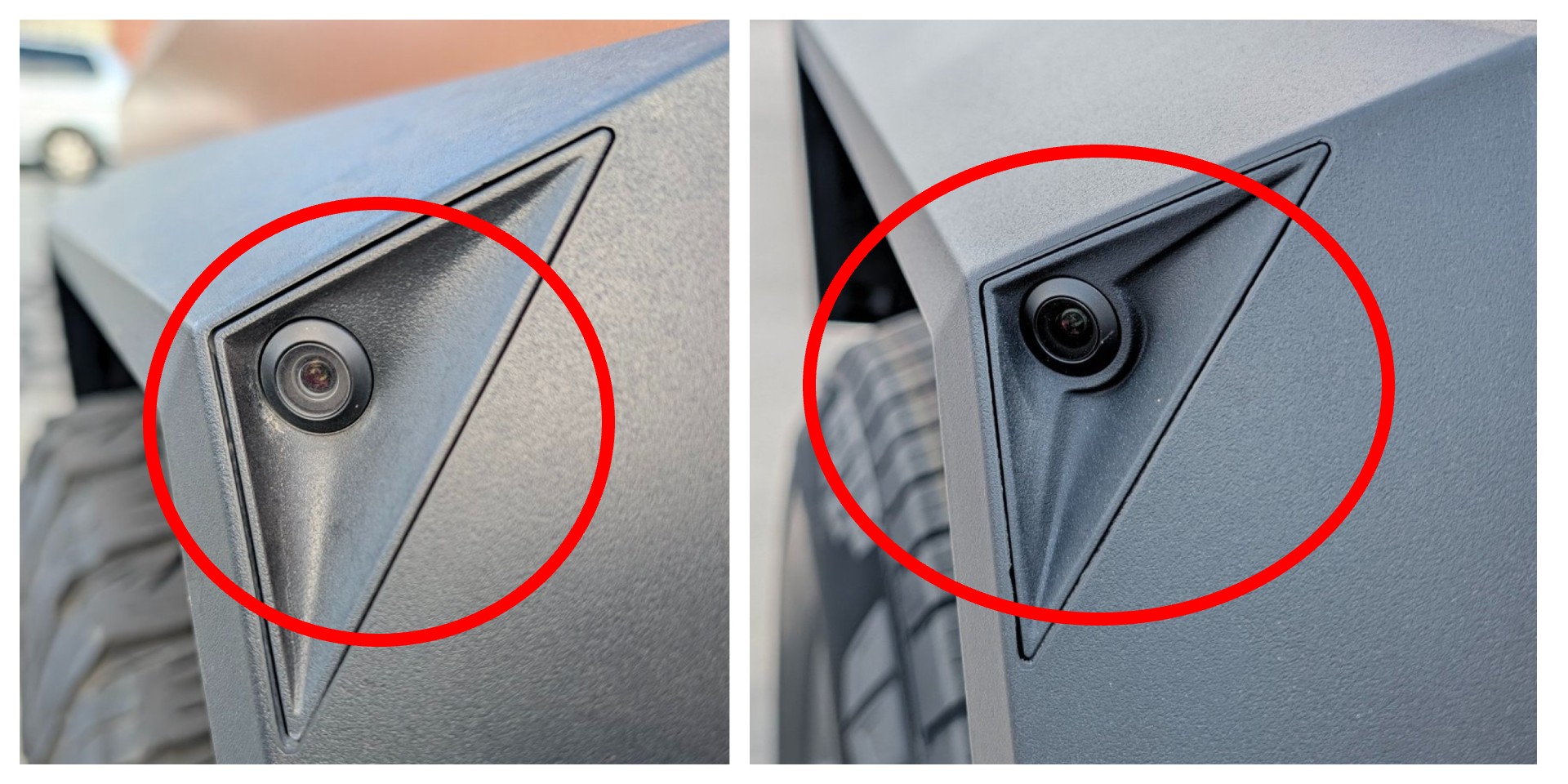
Tesla does not wait for a new model year to improve its vehicles. On September 8, Cybertruck lead engineer Wes Morrill posted side-by-side photos of an updated side repeater camera housing now rolling off the line at Gigafactory Texas.
The triangular camera pod mounted on the front fender looks almost identical at first glance. A closer look reveals a revised contour that uses the air already flowing around the truck to keep the lens clearer in rain and road spray.
The side repeater camera was updated – the version on the left is the newer part which uses passive geometry to create airflow disturbance that better keep water off the lens while driving. No cost penalty, just pure vision improvement. pic.twitter.com/wAbXtcL1Jf
— Wes (@wmorrill3) September 8, 2026
The side repeater cameras sit in an exposed position on the Cybertruck’s angular stainless-steel body.
In wet weather, they readily collect water droplets that can degrade the image Autopilot and Full Self-Driving use for lane changes and blind-spot monitoring. Early production trucks sometimes left owners wiping lenses by hand or accepting temporary restrictions on driver-assistance features.
Tesla has added washers to cameras on certain other models and on Cybercab prototypes, but those active systems add cost, complexity, and extra potential leak points.
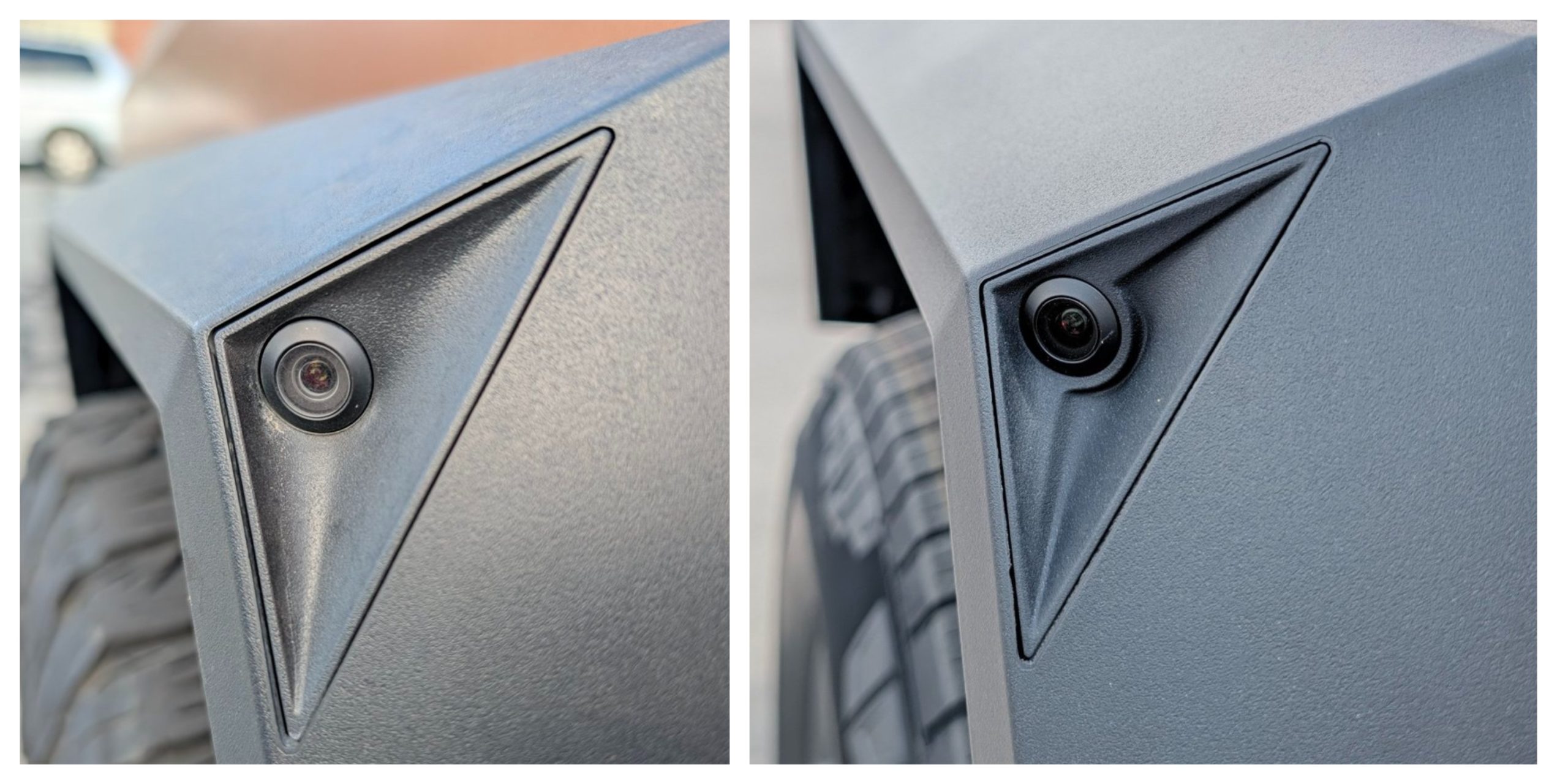
The new housing solves the problem with passive geometry. Subtle changes in the surround create localized airflow disturbances as the vehicle moves. Those eddies physically push water droplets away from the optical surface. Morrill called the result “pure vision improvement” achieved at “no cost penalty.” Once the production mold is updated, every subsequent part costs the same as the original.
The advantages compound quickly. Clearer cameras in rain improve the reliability of driver-assistance features precisely when they are needed most. The design consumes no extra energy and introduces no new failure modes.
New Cybertrucks built after the tooling changeover receive the updated part automatically. Some owners of trucks delivered as late as June 2026 have already confirmed they received the revised housing. Retrofit questions have appeared in replies, and the cameras appear electrically compatible, though Tesla has not announced an official service program.
A few millimeters of reshaped housing will not make headlines the way a new battery pack does, but these changes are incremental and increase the Cybertruck’s effectiveness as a vehicle over time.
This improvement illustrates how Tesla continues to refine the Cybertruck after volume production began. Better wet-weather vision, zero added cost, and no extra hardware add up to a meaningful gain in everyday usability and safety.
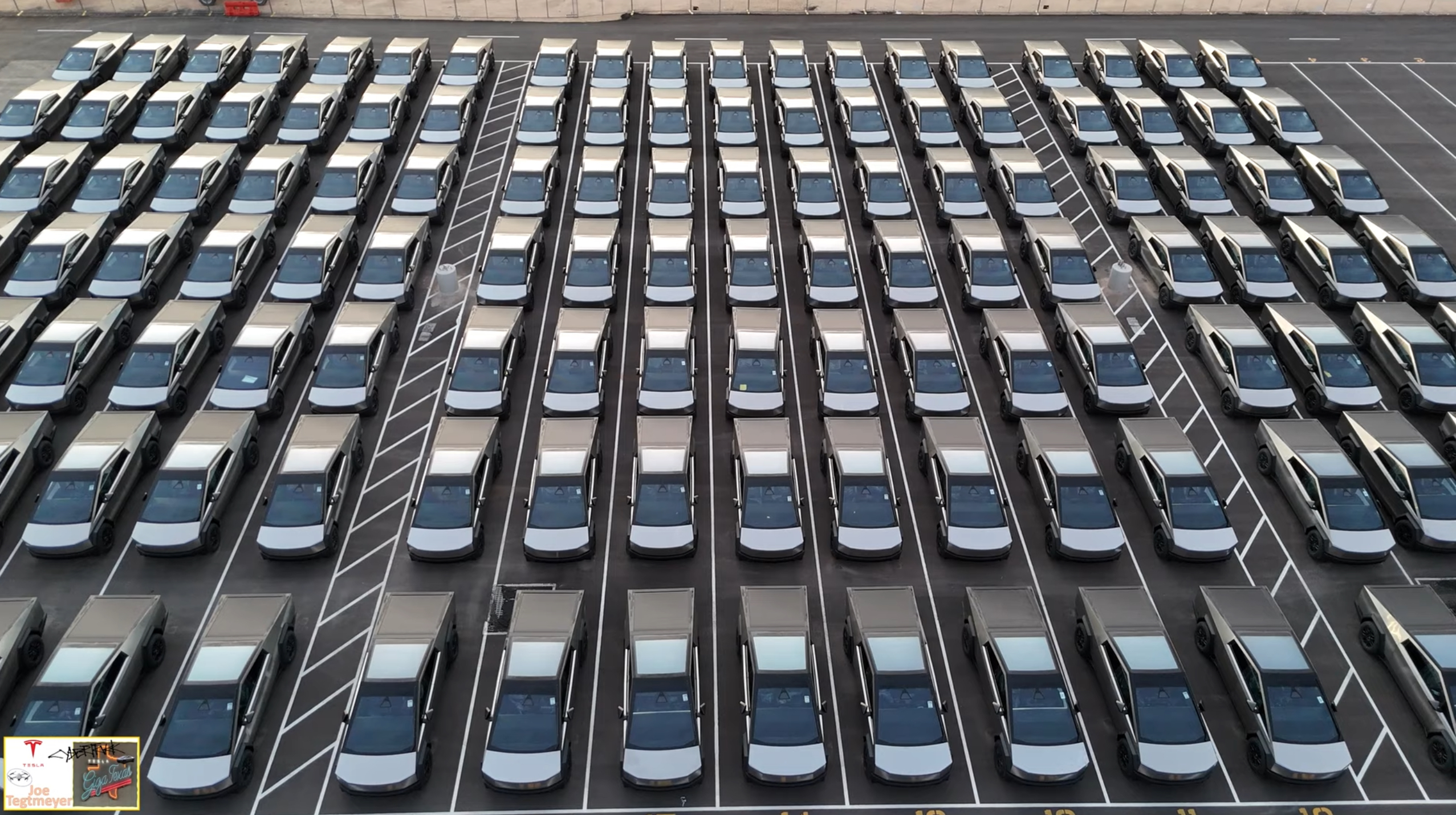
Tesla Cybertruck Lead Engineer Wes Morrill revealed the company has made several changes to the all-electric pickup, which he calls a “living thing, constantly evolving and improving.”
Cybertruck is manufactured at Tesla’s Gigafactory Texas just outside of Austin, and over the past few years, Tesla has continued to make small changes to the pickup to improve everything from cost, reliability, serviceablility, and manufacturability.
“The finish line isn’t getting to production. A product is a living thing, constantly evolving and improving,” Morrill added.
RELATED:
Tesla Cybertruck AWD is a steal at $60k, is it still at $75k? Full Review
Some of those changes are yet to be revealed, but perhaps the most notable one was the change Tesla made to the aero shield that sits underneath the truck. In the past, it was aluminum, but now the Cybertruck is using a self-reinforcing polypropylene.
Morrill said that the polypropylene is “stretched into fibers and then laminated into the form,” and is much more durable, much lighter, and significantly cheaper than aluminum when it is manufactured this way.
It also enabled some improvements in the geometry of the Cybertruck, improving the manufacturing around the bolts and edges, in addition to minor form changes. These all benefitted the Cybertruck in more ways than one: specifically with durability and improved drag.
I was surprised by how interested people were to find out we made a relatively benign change to the Cybertruck aero shield, a part of the car most people never even see. So I’ll share some more details.
Here are two photos, the left is one of the latest trucks off the… pic.twitter.com/F5cZo2CZKf
— Wes (@wmorrill3) September 7, 2026
Typically, Teslas are not necessarily identified by model year because these changes are fluid and occur when the company sees fit to implement them. It is not like other automotive companies, which usually make sweeping manufacturing changes when building a new model year.
Instead, Teslas are recognized by their “generation” or “era.” For example, those with a newer Model Y might refer to their car as a “Juniper.” This is the same with Model 3, as many refer to the new body style as the “Highland.”
Tesla’s manufacturing changes are proof of the company’s constant need to improve its products and move things forward with its vehicles. There is no need to drag one’s feet and wait until next year if the product can be made better right now, and that’s precisely what Tesla did with the Cybertruck.

How SpaceX Is raising Raptor’s sea-level thrust while holding engine mass steady

Tesla Assisted Driving expands to tenth EU country


