Lifestyle
Understanding the Tesla 12V Battery Service Warning

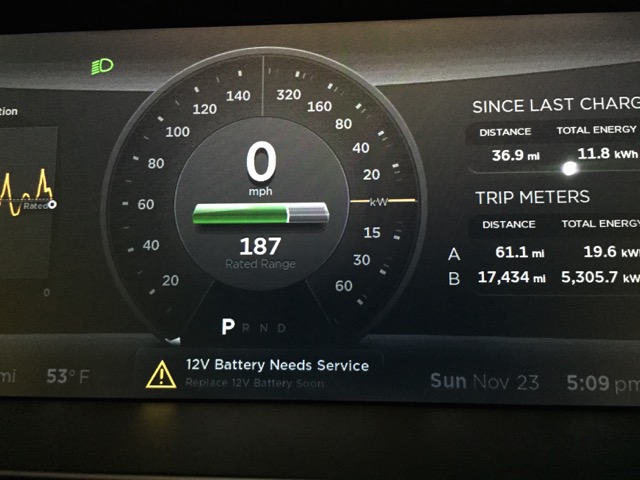
During the time when I was sitting on the sideline waiting patiently for delivery of my Model S, I read up on pretty much anything and everything related to the vehicle. I remember reading about 12V battery failures on the Model S, something Elon himself even commented on during one of the earnings calls.
RELATED: Tesla Model S 12V Lithium-Ion battery replacement (up to 70% lighter, 4x life)
It was reported that Tesla had chosen a poor vendor for the 12V battery which impacted early Model S owners but apparently this issue is still happening across later production vehicles. My Model S as well as several others that I personally know of received the 12V battery service indicator. For me this took place after 7 months and 18,000 miles of ownership.
Purpose of the Tesla 12V battery
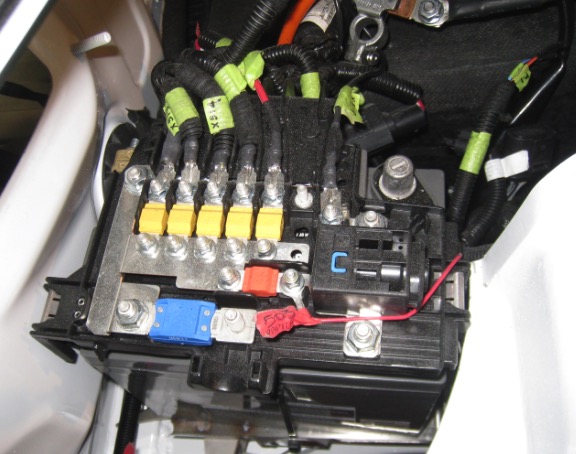
Tesla Model S 12V Battery (source: TMC forum)
The 12V battery in the Model S performs many of the same duties as it would in any internal combustion engine (ICE) car.The connections to the 12V battery on a Model S appear to be a bit more complex than in a traditional ICE as seen in the following picture (source: TMC forum).
RELATED: Why Tesla’s lead acid 12V battery needs to be lithium-ion based
The 12V battery maintains power for critical systems when the main battery pack is damaged or disabled. It powers the hazard lights, airbags, door locking and unlocking operations, as well as other critical componets of the Model S. The 12V battery also ensures that electronics are “awake” and listening to the key FOB in order to automatically lock and unlock the vehicle based on proximity. It also allows the car to maintain its 3G connection for remote access when the rest of the vehicle is powered off. If the 12V battery happens to fail, it will isolate the main battery pack from the car and prevent charging. This is a safety feature of the Model S designed to help protect first responders in the event of an accident.
What does my warning mean?
The “12V Battery Needs Service” warning can indicate a number of problems and the only way to truly understand the reason for the alert is to call Tesla Service (they’re available 24×7) and have them pull the logs. This is something that Tesla service can diagnose remotely.
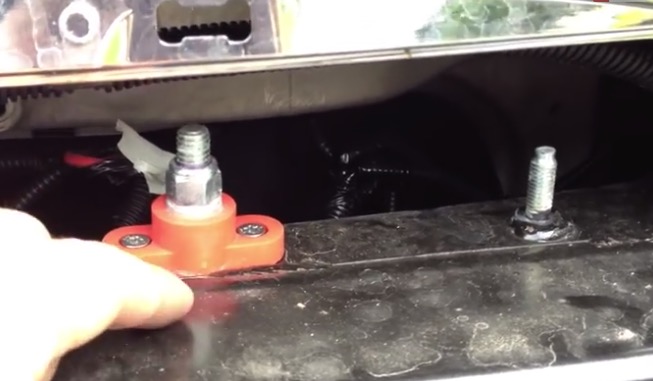
Tesla 12V battery terminal
In severe cases Tesla Service will tell you to stop driving the car, but generally it’s an indication that the voltage level has dropped below a certain threshold but the vehicle can continue to operate normally until replaced. In the rare event that the the 12V battery dies while driving, the car will become disabled and will require a jump start to power on again. Our friend Kman has a good video on getting access to the terminals behind the nosecone to jump start the 12V, but please consult Tesla service and take caution before attempting this on your own.
Depending on the severity of the issue, there may be a 2-3 week lead time before Tesla Service replaces the 12V battery.
Many owners manage to get the battery replaced quickly, but in my case a busy Tesla Service Center combined with the fact that it was Thanksgiving holiday during a snowy New England week, had me driving with the warning light on for almost 2 weeks (about 1,000 miles) without encountering any issues.
Another interesting point to note is that Tesla may call you before you even see 12V battery service warning. Multiple owners have reported this proactive stance in advance of a warning which is great to see. Evidently Tesla’s early warning threshold is supersedes the trigger that kicks off the dash indicator.
Why are the 12V batteries failing?
Some owners are on their 3rd 12V battery already. Many others are reporting failures at the 1 year mark. In ICE cars you can normally expect about 4 years of life before needing to replace the 12V battery which begs the question – why are Tesla 12V batteries failing?
Some of the failures have been in the DC to DC converter that charges the 12V battery through the main battery pack. That converter can be seen as an equivalent to the alternator in your traditional ICE car. However, this doesn’t seem to be the main cause of the 12V battery failures. Current conjecture is that vampire load and the excessive strain on the 12V are causing the reliability issues.
Tesla may have a lingering design issue in their use of the 12V battery.
From my reading, I think they upgraded the quality of the battery in the earlier models but we’re still facing the same underlying design issue in the way the 12V is stressed. Can Tesla fix the way the 12V battery is used with software updates alone? We don’t know, but fortunately they’re taking care of all of the replacements in the meantime. Unless they can address it remotely via software updates, there could be a factory “recall” brewing (and I use this term loosely).
Either way, Tesla should be more upfront about these issues and let owners know what they’re doing to address the underlying problem.
Getting the 12V battery serviced
From everthing I’ve heard and experienced through my own Model S, the replacement including labor and parts is 100% covered by Tesla.
Tesla Service can handle the replacement at your location, but given the poor weather conditions here in New England, I opted to have them pick up my Model S and do the replacement in the comfort of their own Service Center. They were able to service it within the same day, and to Tesla fashion they also updated/fixed a bunch of other minor things for free, while at it.
Summary
The 12V battery is a relatively inexpensive part in the Model S and is fairly simple to replace, but the bigger concern is why they seem to be failing so quickly. It isn’t a major issue for now but certianly something we should continue monitoring as concerned Model S owners.
I’ve started a poll over on TMC to see what kind of failure rate we’re seeing on the 12V battery so feel free to contribute to it or use it as a way monitor progress. So far over 75% of respondents have had their 12V battery replaced within 2 years.


Elon Musk
Tesla ditches India after years of broken promises
Tesla has ditched its plans to build a factory in India after years of failed negotiations.

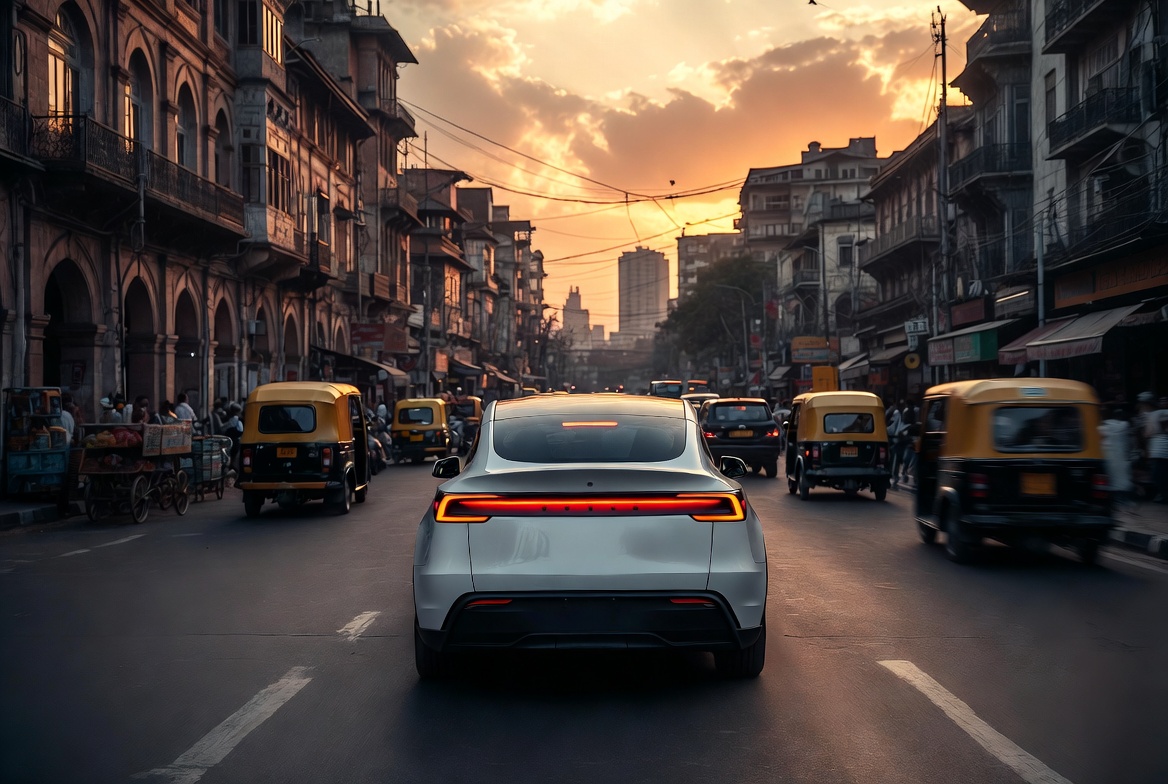
Tesla’s long-running effort to establish a manufacturing presence in India is officially over. India’s Minister of Heavy Industries H.D. Kumaraswamy confirmed on May 19, 2026 that Tesla has informed authorities it will not proceed with a manufacturing facility in the country.
Tesla first signaled serious interest in India around 2021, when it began hiring local staff and lobbying the Indian government for lower import tariffs. The ask was straightforward: reduce duties enough for Tesla to test the market with imported vehicles before committing capital to a local factory. India’s position was equally firm, with an ask of Tesla to commit to manufacturing first, then receive tariff relief. Neither side moved, and the talks quietly collapsed.
Tesla to open first India experience center in Mumbai on July 15
India had offered a policy that would reduce import duties from 110% down to 15% on EVs priced above $35,000, provided companies committed at least $500 million toward local manufacturing investment within three years. Tesla declined to participate. The tariff standoff was only part of the problem. Analysts pointed to significant gaps in India’s local supply chain, inadequate industrial infrastructure, and a mismatch between Tesla’s premium pricing and the purchasing power of India’s automotive market as additional factors that made the investment difficult to justify.
First signs of an unraveling relationship came in April 2024, when Musk abruptly cancelled a planned trip to India where he was set to meet Prime Minister Modi and announce Tesla’s market entry. By July 2024, Fortune reported that Tesla executives had stopped contacting Indian government officials entirely. The government at that point understood Tesla had capital constraints and no plans to invest.
The more fundamental issue is that Tesla’s existing factories are currently operating at approximately 60% capacity, making a commitment to building new manufacturing capacity in a new market difficult to defend to investors. Tesla will continue selling imported Model Y vehicles through its existing showrooms in Mumbai, Delhi, Gurugram, and Bengaluru, but local production is no longer part of the plan.
Elon Musk
Trump’s invite for Elon just reshuffled Tesla’s big Signature Delivery Event
Tesla rescheduled its final Model S farewell to May 20 after Musk joined Trump in China.
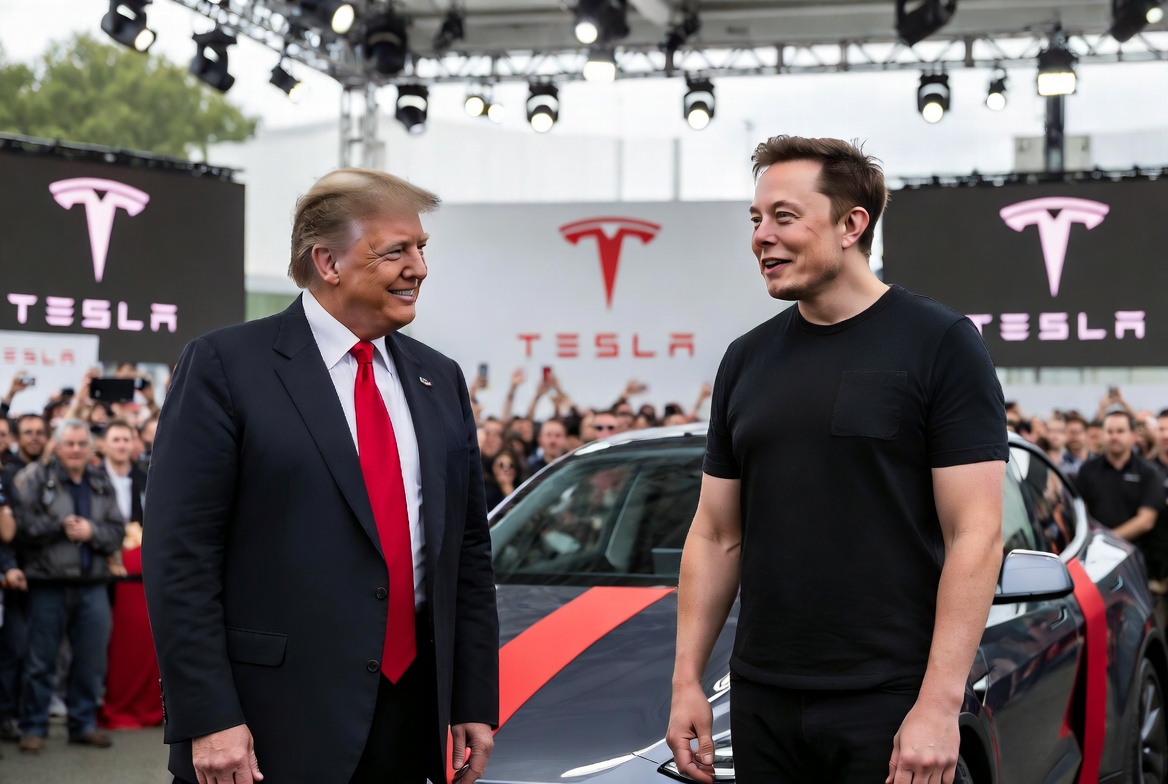
Tesla has rescheduled its Model S and Model X Signature Edition delivery event to Wednesday, May 20, 2026, after abruptly calling off the original May 12 celebration. The event will take place at Tesla’s factory at 45500 Fremont Boulevard in Fremont, California, the same location where the Model S first rolled off the line in 2012. Invitees received a follow-up email asking them to reconfirm attendance and download a new QR code ticket, with Tesla noting that all travel and accommodation expenses remain the buyer’s responsibility.
The reason behind the original cancellation came into focus the same day it was announced. President Trump invited Elon Musk, Apple’s Tim Cook, BlackRock’s Larry Fink, Boeing’s Kelly Ortberg, and executives from Goldman Sachs, Blackstone, Citigroup, and Meta to join his trip to China this week for a summit with President Xi Jinping. The agenda covers trade, artificial intelligence, export controls, Taiwan, and the Iran war, following weeks of escalating friction between Washington and Beijing over AI technology, sanctions, and rare earth exports. Trump wrote on Truth Social, “I am very much looking forward to my trip to China, an amazing Country, with a Leader, President Xi, respected by all.”
Tesla launches 200mph Model S “Gold” Signature in invite-only purchase
The vehicles at the center of all this are the last Model S and Model X units Tesla will ever build. Priced at $159,420 each, the 250 Model S and 100 Model X Signature Edition units come finished in Garnet Red with a one-year no-resale agreement, giving Tesla right of first refusal if the owner decides to sell. As Teslarati reported, the Model S defined Tesla’s early identity as a serious luxury automaker, and the Fremont factory line that built it is now being converted to manufacture Optimus humanoid robots.
Musk’s inclusion in the China delegation drew attention given his very public relationship with Trump, and the invitation signals the two have moved past and past grievances. Trump originally brought Musk on to lead the Department of Government Efficiency following his inauguration, and despite a sharp public dispute in mid-2025, the two have appeared together repeatedly in recent months. A seat on the China trip, the most diplomatically consequential visit of Trump’s current term, puts Musk back at the table on U.S. economic policy at a moment when Tesla’s China revenue remains one of the company’s most important financial pillars.
Lifestyle
Tesla Semi hauls fresh Cybercab batch as Robotaxi era takes hold
A Tesla Semi was filmed hauling Cybercab units out of Giga Texas for the first time.
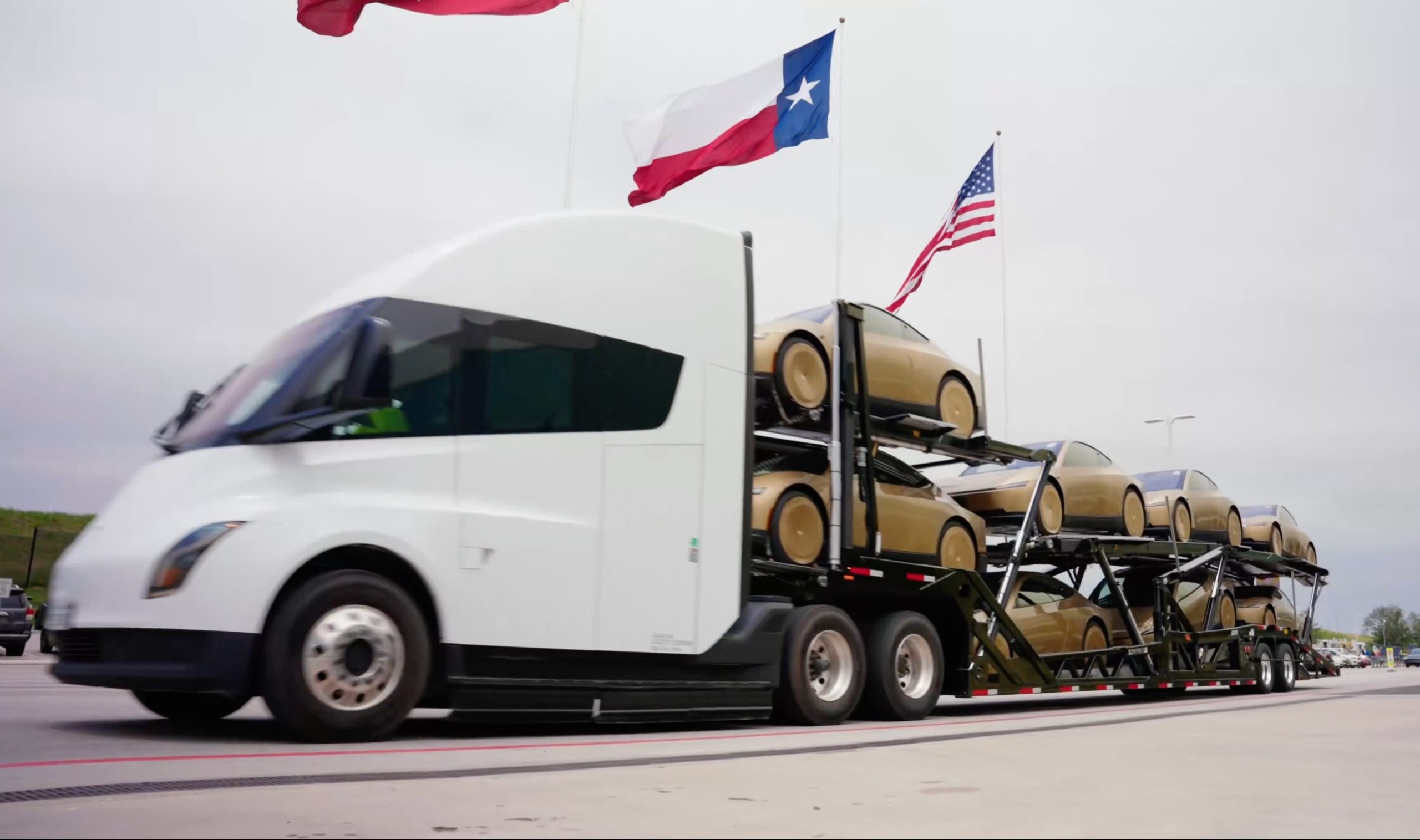
A Tesla Semi loaded with Cybercab units was recently filmed leaving Gigafactory Texas, marking what appears to be the first documented delivery run of Tesla’s autonomous two-seater. The footage shows multiple Cybercabs secured on a flatbed trailer being hauled by a production Tesla Semi, a truck rated for a gross combination weight of 82,000 lbs. The location is consistent with Giga Texas in Austin, where Cybercab production has been ramping since February 2026.
The sighting follows a wave of Cybercab activity at the Austin facility. In late April, drone operator Joe Tegtmeyer spotted approximately 60 Cybercabs parked in two organized groups in the factory’s outbound lot, the largest concentration observed to date. Units being staged in an outbound lot is a standard pre-delivery step, and the Semi footage is the logical next frame in that sequence.
En route with @tesla_semi pic.twitter.com/ZfuOjaeLH1
— Tesla Robotaxi (@robotaxi) May 7, 2026
This is not the first time Tesla has used its own Semi to move Tesla products. When the Semi was unveiled in 2017, Musk noted it would be used for Tesla’s own operations, and over the years Semi prototypes were spotted carrying cargo ranging from concrete weights to Tesla vehicles being delivered to consumers. In 2023, a Semi was photographed transporting a Cybertruck on a trailer ahead of that vehicle’s delivery launch.
The Cybercab itself was first revealed publicly at Tesla’s “We, Robot” event on October 10, 2024, at Warner Bros. Studios in Burbank, where 20 pre-production units gave attendees rides around the studio lot. Musk stated at the event that Tesla intends to produce the Cybercab before 2027. The first production unit rolled off the Giga Texas line on February 17, 2026, with Musk posting on X: “Congratulations to the Tesla team on making the first production Cybercab.”
Tesla’s annual production goal is 2 million Cybercabs per year once multiple factories reach full design capacity, with the company targeting a price under $30,000 per unit. Tesla has confirmed plans to expand its robotaxi service to seven cities in the first half of 2026, including Dallas, Houston, Phoenix, Miami, Orlando, Tampa, and Las Vegas, building on the unsupervised service already running in Austin. Musk has said he expects robotaxis to cover between a quarter and half of the United States by end of year.

Tesla scales back driver monitoring with latest Full Self-Driving release

Tesla Full Self-Driving expands in Europe, entering its second country


