Lifestyle
Elon Musk delivered Jay Leno his first Tesla and it’s still on his mind

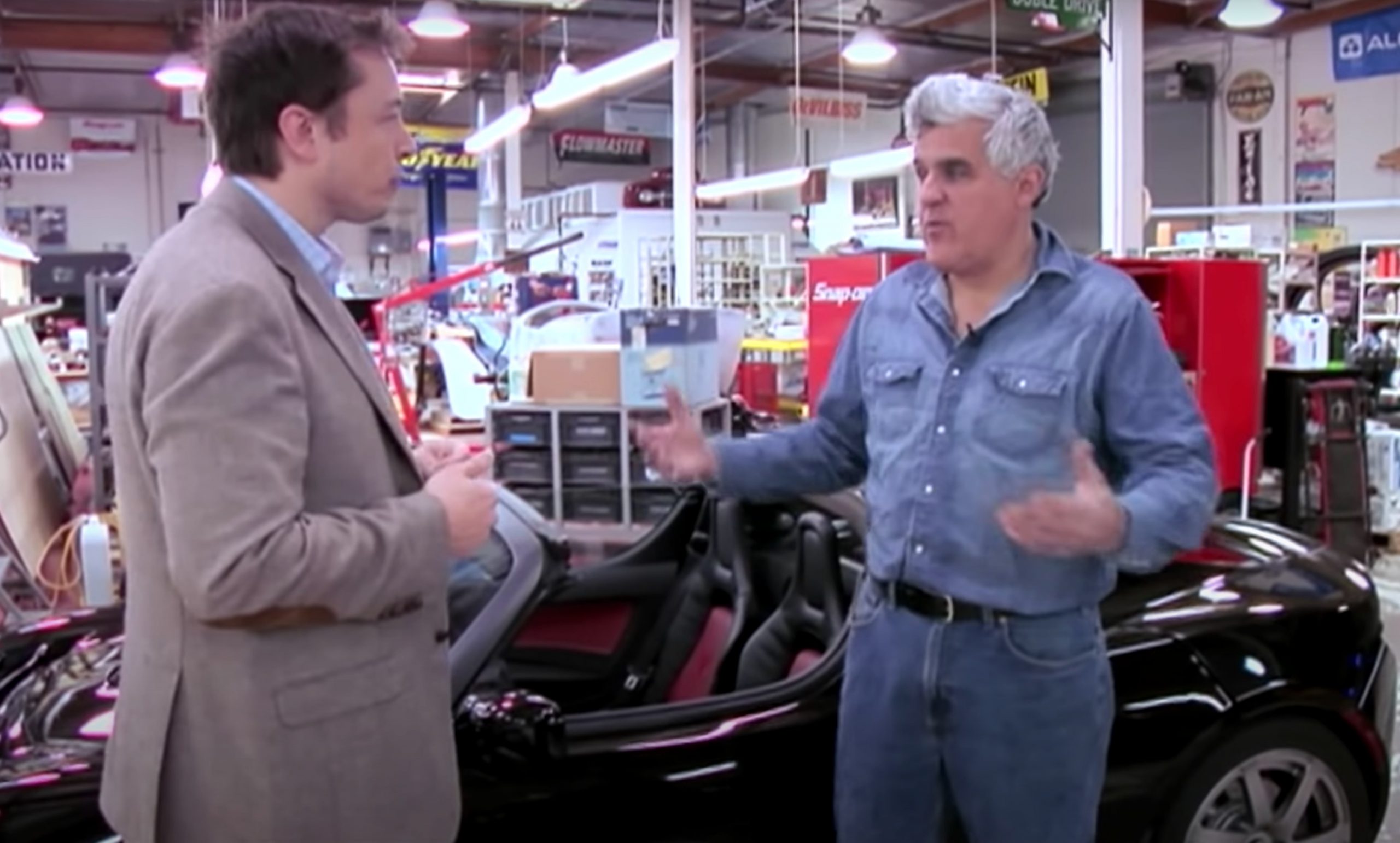
Jay Leno’s legendary career in television led to him chasing his passion for driving and owning the fastest, most expensive, and most unique vehicles in the world. On April 19, Leno released previously unseen footage of a young Tesla CEO Elon Musk, bringing him the first production model of the Roadster.
Perhaps what is most impressive is that twelve years later, Tesla continues to quench Leno’s thirst for automobiles, despite owning some of the rarest and most sought after cars in the world. The 2008 Roadster ignited Jay’s interest in the next generation of high-performance and electrified transportation. Before taking the silent sports car for a spin throughout Los Angeles, Leno was educated on the vehicle’s finer points from Elon Musk himself.
Leno and Musk’s relationship started at the former late-night show host’s garage in Los Angeles. Musk delivered the first-ever Tesla Roadster to Leno during an overcast day in 2008, where the CEO of the then-named “Tesla Motors” took Jay through a crash course of how the electric vehicle startup was building its initial vehicle.
The Roadster’s design was based on the Lotus Elise but utilized no Lotus parts for its exterior. The body was made out of carbon fiber and manufactured by French supplier Sotira. The 6,831 battery cells were put into a pack with blades and powered the battery enough to give the car 244 miles of EPA estimated range when fully charged. The vehicle’s weight was roughly 30% heavier than its inspiration in the Lotus; it offered a longer body and a battery pack that contributed significantly to the increase in mass.
Leno was impressed by the instant torque, the aerodynamics, and the aesthetically-pleasing shape of the car. “I just want to say, it’s a real sports car, it handles good, it’s fast, and hey, if this is the future, I’m not that worried,” Leno yells into his microphone before speeding away.
Fast forward eleven years later in November 2019. In Hawthorne, California, at a rocket ship manufacturing facility, Tesla is at it again. This time, it was unveiling its sixth vehicle, The Cybertruck, which would inevitably end up in the hands of Jay Leno in January 2020, after it was spotted outside SpaceX headquarters during the filming a segment of Jay Leno’s Garage.
Leno’s collection of cars includes some of the best and most rare vehicles on Earth. Despite having a garage filled with automobiles that is worth an estimated $52 million, his commentary when describing Tesla’s vehicles speaks for itself.
A vocal supporter of the electric vehicle movement and Tesla in specific, Leno said his love for the electric vehicle company comes from a battery car’s clear-as-day advantage over internal combustion engines. “There’s no maintenance. They’re faster than the gas car. So there’s almost no reason to have a gas car unless you’re doing long-haul duty.”
Leno sees a future that involves more electric vehicles than internal combustion ones. His extensive knowledge of the automotive industry describes a transition that seems to be the equivalent of when gas cars took over in 1911,” he said to CNBC. “Steam ran everything from 1800 to about 1911. Then internal combustion took over from 1911 to right about now. And I predict that a child born today probably has as much chance of driving in a gas car as people today have been driving a car with a stick shift.”
In a world where any car is available to Leno, his decision to continuously mention Tesla shows the impressive nature of the company’s cars. Twelve years after the talk show host and comedian drove the Roadster, it remains on his mind. So much so that it incited him to share with the world footage that has not been seen before.
Watch Jay Leno’s throwback footage of the 2008 Tesla Roadster below.


Lifestyle
Tesla teases “Halloween Mode” update with Optimus rising from a graveyard
Tesla’s Halloween teaser hides a covered vehicle and an Optimus hand rising from the ground.

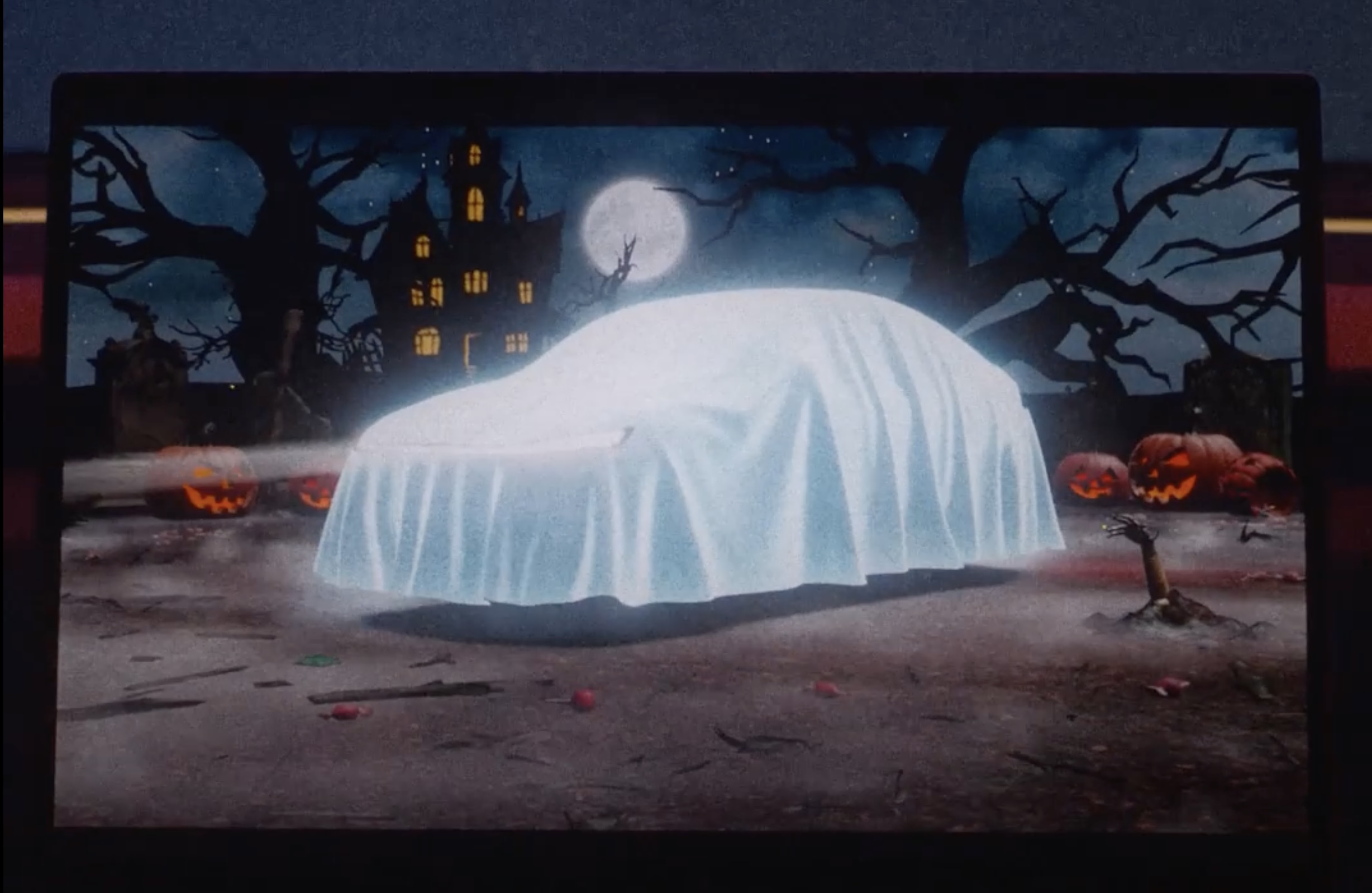
Tesla has started teasing a Halloween software update for its vehicles, with a short clip on X that reads, “Halloween is coming.” The clip opens on a glowing pumpkin before pulling back to the car’s center touchscreen, where the usual parked visualization has been replaced by a graveyard scene, and the vehicle draped with a white sheet so it reads as a cartoon ghost.
Halloween is coming pic.twitter.com/lM3ASUeOqX
— Tesla (@Tesla) October 1, 2026
The second detail is a robotic hand clawing its way out of the dirt like a zombie, which looks to be the hand of Tesla’s latest Optimus V3 humanoid robot. While Tesla still has not formally shown Optimus Gen 3 walking around in service, renders pulled from Tesla’s Android app last month gave the clearest look yet, including far more refined hands that Tesla has said carry 22 degrees of freedom. The hand has been the hardest part of the program. Musk has called it the majority of the robot’s engineering difficulty, and Tesla’s patents describe a design driven by tendons with the actuators moved into the forearm.
Tesla Optimus V3 hand and arm details revealed in new patents
Optimus also has a Halloween track record. Last October the robot handed out candy in Times Square, and a costumed “zombie” Optimus shuffled around the Tesla Diner in Los Angeles on Halloween night.
On the software side, Tesla’s 2025 Holiday Update expanded Santa Mode with a Santa sleigh, snowmen, snow effects, and a festive lock chime, so it wouldn’t be too far fetched if we saw something similar but themed for a Halloween Mode.
Lifestyle
Tesla’s newest feature lets you floor it out of a Supercharger while plugged in
Tesla’s new Emergency Drive Away feature lets owners flee a Supercharger while still plugged in.
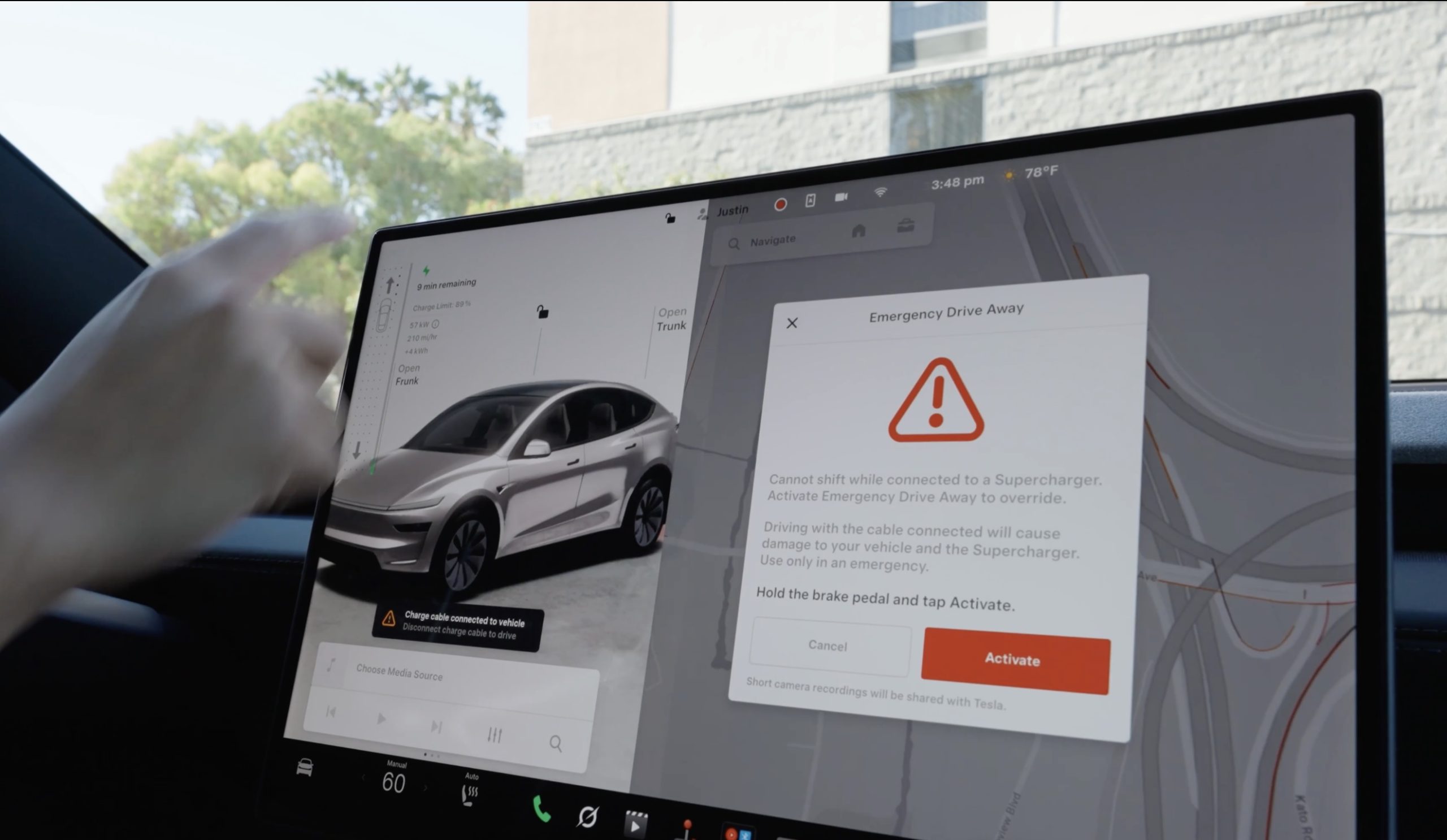
Tesla has given drivers a way to escape while a vehicle is plugged-in at a Supercharger, in the event of an emergency. The company’s charging team announced a new feature on X called Emergency Drive Away, which lets a driver shift into Drive and pull away while the charging cable is still connected to the car.
Until now, a Tesla would not leave Park with a charge cable plugged in. Drivers had to release the latch from the touchscreen, the Tesla app, or the button on the charge handle, then wait for the port to let go. Emergency Drive Away removes that lockout, but Tesla is clear that it comes at a cost. “Use of this feature will damage your vehicle and the Supercharger,” the company wrote, adding that the function is meant for emergencies only and that deliberate misuse will lead to “additional penalties.” Tesla did not say what those penalties are.
Emergency Drive Away lets you shift into Drive while still plugged into a Supercharger pic.twitter.com/40GSzyP4lG
— Tesla Charging (@TeslaCharging) October 1, 2026
The in-car prompt is just as direct, with the warning reading: “Driving with the cable connected will cause damage to your vehicle and the Supercharger. Short camera recordings will be shared with Tesla.” That footage gives Tesla a way to separate a real emergency from someone who simply did not want to wait for the latch.
The feature requires software update 2026.38.3, and Tesla said in replies to owners that it works at every Supercharger in the United States without new stall hardware. Model S and Model X vehicles built before 2021 are not supported, and the company says the feature applies to U.S. Superchargers “for now,” leaving Canada and other markets out at launch.
Tesla Supercharger argument leads to tragic shooting incident
Tesla did not tie the announcement to any specific event, but it arrives two months after a gunman opened fire at an In-N-Out in Twin Falls, Idaho, on August 1, targeting three people in two Teslas at the neighboring Supercharger. One of them, a 66 year old man from Salt Lake City, was killed. Superchargers have been the scene of violence before, including a fatal shooting at a station near Denver in 2023.
In the weeks after Twin Falls, owners pushed Tesla for a native way to escape a stall, and many pointed back to EVject, the aftermarket breakaway connector Tesla sued in 2024 over claims it lacked overtemperature protection. The two companies later reached an agreement that led EVject to recall its earlier connectors in favor of a version with thermal sensors.
Our mission has always been about providing peace of mind and eliminating sitting duck scenarios.
We patented the built-in breakaway charger tip on Feb 15, 2023. Awarded Jan 30, 2024. Then shared the designs with @TeslaCharging
Thank you @Tesla for rolling out a solution. This… https://t.co/djOzswLw9N
— EVject (@EVject) October 2, 2026
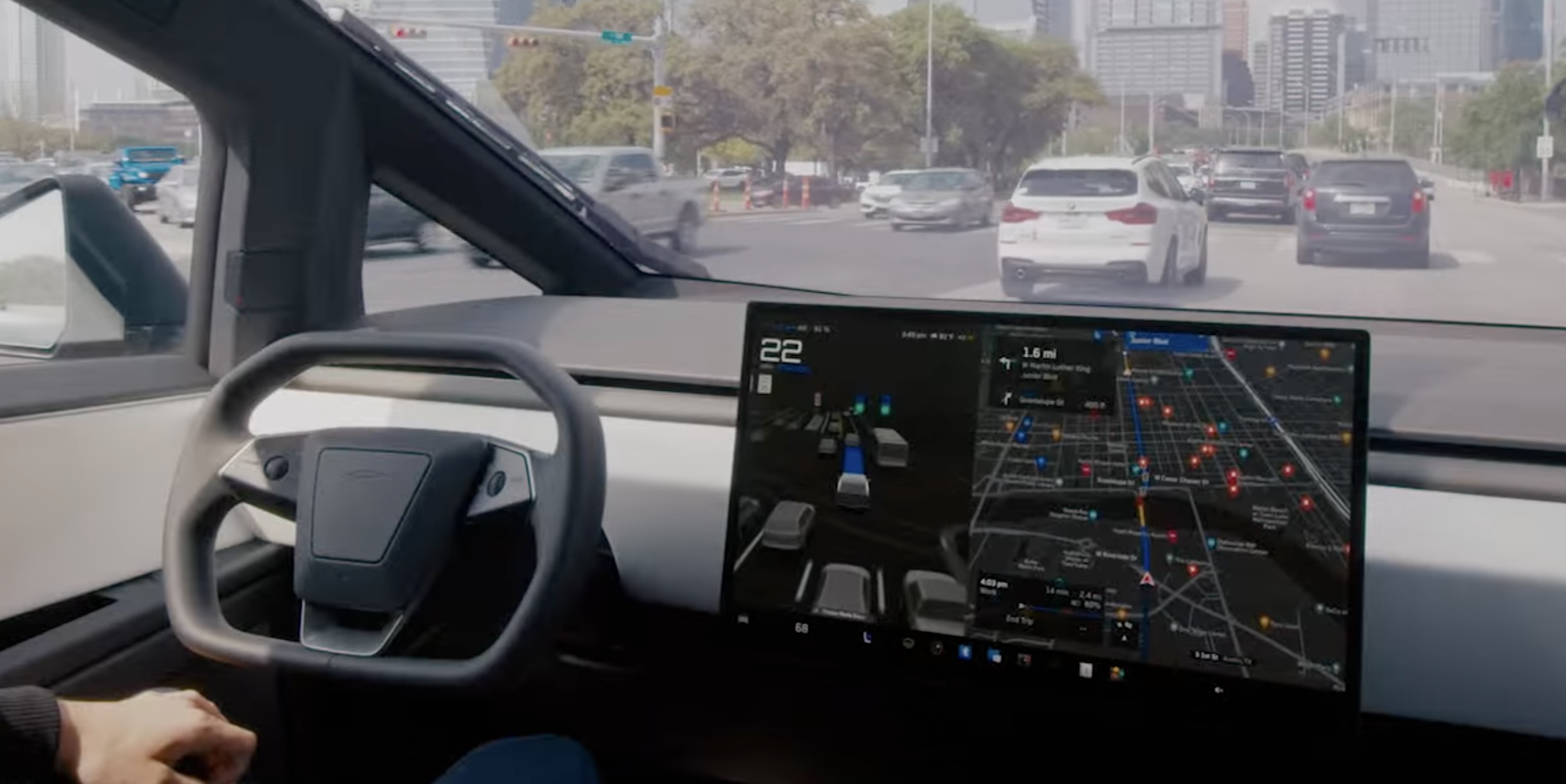
Tesla’s Automatic Collision Evasion feature can be seen in one of the first owner videos of it in action.
Tesla owner Spencer (@scotsrule08) posted on Monday that the feature “worked flawlessly,” saying FSD reengaged itself just as he was about to hit a curb. Ashok Elluswamy, who leads Tesla’s AI team, shared the clip and wrote, “A guardian angel always looking out for you.”
The video arrives in the middle of a staged rollout. Tesla first shipped Automatic Collision Evasion with FSD (Supervised) v14.3.9 in software update 2026.27.6 earlier this month, which Teslarati covered as it reached cars. Update 2026.27.10, which began going out on September 19, carried the feature improvements with FSD v14.3.10, according to release notes tracked by Not a Tesla App. The newer 2026.27.11 build is now reaching another wave of vehicles.
The new Automatic Collision Evasion feature worked flawlessly! FSD reengaged itself just as I was about to hit a curb.
Kudos @Tesla_AI team! 👏 pic.twitter.com/Fbp15HhpL2
— Spencer (@scotsrule08) September 28, 2026
The feature only runs on HW4 vehicles, and it requires an active FSD purchase or subscription with both FSD (Supervised) and Automatic Emergency Braking enabled. HW3 owners receive FSD v14.2 Lite in the same updates, but that build does not include collision evasion.
Tesla’s release notes describe two triggers. The first is an imminent frontal collision that braking alone may not prevent, in which case the car can activate FSD to steer, brake or accelerate around the hazard. That scenario is limited to highways below 85 mph, with no pedestrians or cyclists detected and no slippery road surface. The second covers a driver who appears inattentive, such as reaching into the back seat, or who seems to have switched off FSD by accident. Spencer’s curb clip appears to fall into that second category.
Tesla plans big safety improvements for Full Self-Driving v15
Once the system takes over, the accelerator is muted and light brake input will not cancel the maneuver. Drivers need to apply firm, deliberate steering force to take back control, and the car chimes to hand control back once the danger has passed.
Elluswamy recently noted that earlier hazard prediction, faster reaction time and better collision avoidance would arrive with FSD v15, the next major version.

Elon Musk follows Trump’s lead, says a SpaceX name change is coming

Starlink launches Communities Program for passive income through internet sharing


