News
FBI taps Tesla Sentry Mode footage to help catch man behind alleged hate crimes

It appears that some members of the Federal Bureau of Investigation (FBI) are now becoming familiar with Tesla’s built-in security features like Sentry Mode, which allows vehicles to record videos from their cameras to actively monitor their surroundings. This was undoubtedly the case in an incident back in December, which involved slashed tires, arson, and what appears to be a racially motivated attack against a church.
In an affidavit dated April 15, 2021, FBI Special Agent Casey Anderson outlined the events that led to an incident that resulted in the destruction of the Martin Luther King, Jr. Community Presbyterian Church in Springfield, Massachusetts. The suspect behind the incident, 44-year-old Maine resident Dushko Vulchev, is a naturalized United States citizen from Bulgaria. As per the FBI agent’s affidavit, Vulchev had previously run afoul of the law prior to his apparent arson in December, having been convicted of threatening a foreign official in 2015 and a series of offenses such as domestic violence assault in 2017.
The Martin Luther King, Jr. Community Presbyterian Church in Springfield, Massachusetts before the fires. (Credit: CourtListener)
The Attacks
In December 2020, the MLK Church experienced a series of fires, one of which eventually destroyed the whole building. The first of these fires were reported on December 13, when the fire department was deployed to extinguish a blaze behind the church. On the same day, a vehicle had its tires slashed two miles away from the church. The next day, a BMW about 1.5 miles away from the MLK church and a Tesla parked less than a mile away from the church had their tires slashed. In the case of the Tesla, its owner found that one of the vehicle’s wheels was also missing.
Another fire behind the Martin Luther King, Jr. Community Presbyterian Church was set on December 15, 2020, at around 6:32 p.m. The Springfield Police Department (SPD) Arson and Bomb Squad investigated the fire and promptly determined that the blaze had been intentionally ignited. Interestingly enough, another fire in the church was reported at 11:03 p.m. that same day. Upon investigation, the SFD reported that the blaze had been “intentionally set to eventually involve the structure” of the church.
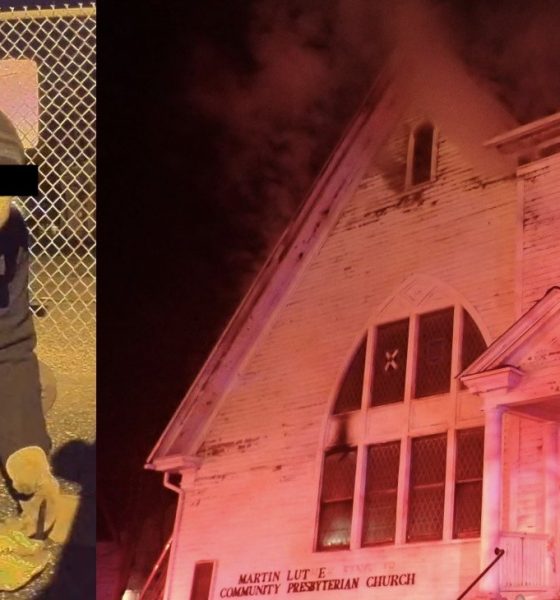
Things essentially calmed down until December 27, when a Dodge Charger had its tires slashed just 400-500 feet away from the MLK Church. At around 5:06 a.m. the next day, the American International College campus police reported a new blaze at the MLK Church. This time, the fire was started just outside the basement side door, where it burned through and up through the church’s main floor. The blaze essentially destroyed the church, and upon investigation, the SPD concluded that the fire was intentional.
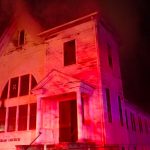
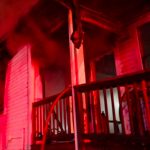
Photos of the MLK Church during the December 28, 2020 blaze. (Credit: CourtListener)
The Investigation
Investigators working on the case were able to obtain several video footage relevant to the case. In the first tire slashing incident on December 13, footage from the City of Springfield recorded a gray Chevy Cruze pulling up into the same parking lot as the vehicle that was attacked. The car was found to have been registered to the suspect, Vulchev. City video footage captured the suspect crossing the street in the direction of the MLK Community Center later that day. The gray Chevy Cruze was also recorded circling the MLK Church.
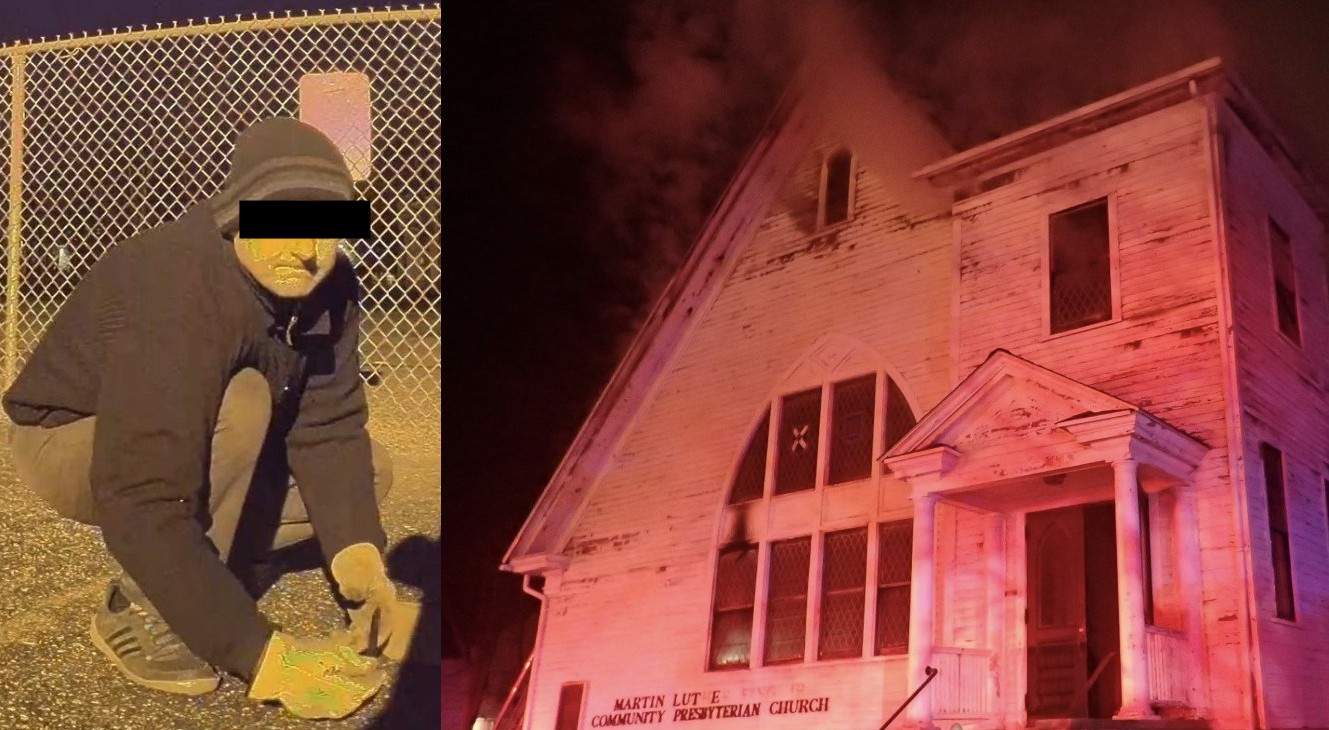
Vulchev’s Chevy Cruze was sighted by city video footage once more the next day, when the BMW tire slashing incident transpired. As per the FBI agent’s affidavit, a while male matching Vulchev’s height, gait, and clothing, was spotted approaching the BMW. Later that day, a Tesla became the next victim of the suspect’s tire slashing tendencies. But this time around, the special agent didn’t just have a faraway shot of a man approaching a vehicle. This time around, authorities were able to get a clear shot of Vulchev as he was slashing and stealing the Tesla’s tires and stealing a wheel, thanks to Sentry Mode. Tesla’s built-in cameras even captured the suspect putting the stolen goods inside his trunk.
Special Agent Casey Anderson related his experience with Teslas and their built-in cameras in his affidavit. “Based on my training and experience and this investigation, I am aware that the Tesla referenced above is equipped with cameras at various points around the body. ATF Special Agent Marc Maurino (“SA Maurino”) and I have reviewed video footage retrieved from the Tesla showing an individual that I can identify as Vulchev, based on my observation of Vulchev during the Vulchev PPD Interview.
“The video footage from the Tesla shows Vulchev at a close distance crouching near the Tesla and using a tire iron to remove the wheels. Additional Tesla video footage captured Vulchev removing one of the Tesla’s wheels and placing it in the trunk of Vulchev’s car. Vulchev’s face is clearly visible in the video. Vulchev was wearing grey pants and a dark-colored sweatshirt, Adidas three-stripe sneakers, a black hat with two grey stripes, and light-colored work gloves, the agent noted in his affidavit.
Vulchev and his vehicle were spotted around the MLK Church fires, as well as subsequent tire slashing incidents.
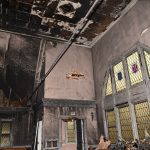
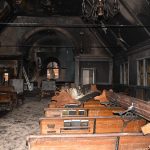
The MLK Church after the December 28, 2020 fire. (Credit: CourtListener)
The Arrest
On December 30, 2020, a complaint about a vehicle driving erratically was reported to authorities. When provided with the license plate of the vehicle in question, it was determined that the car was Vulchev’s. Police stopped the suspect’s vehicle on suspicion of erratic driving and possible links to the multiple tire slashing incidents. Since they were aware of the ongoing federal investigation into the fires against MLK Church, local authorities promptly contacted FBI Supervisory Special Agent of the Springfield Resident Agency Matthew Fontaine.
Special Agent Fontaine arrived at the scene of the stop, and upon initial investigation, the FBI agent noted that the suspect may have been living in his car for some time. The FBI agent spoke with the suspect for about eight minutes outside, and immediately, Fontaine noted that Vulchev was wearing the sneakers that were captured clearly by Tesla’s Sentry Mode. PPD officers initially released the suspect, though he was arrested the day after over his links to the multiple tire slashing incidents and the Martin Luther King, Jr. Community Presbyterian Church fires.
On January 4, 2021, the FBI and ATF conducted a search of Vulchev’s vehicle, where they found a computer, a hard drive, and several USB storage devices. A search of the computer revealed Vulchev’s shocking racially charged stance against non-white people. This was seen in messages to an ex-girlfriend—who currently has a lifetime protective order against Vulchev—which featured numerous slurs against Muslims and blacks. Vulchev’s apparent hate against non-whites was notable, as seen in a message to his ex-girlfriend where he was complaining about the race of ABC’s The Bachelorette. A search of the suspect’s phone revealed photos of several notable items, such as a firearm, an image of Adolf Hitler in an Adidas tracksuit, and a “White Lives Matter” mural, as well.
With these in mind, FBI Special Agent Casey Anderson noted that there is probable cause to believe that Vulchev committed damage to religious property, which is in violation of 18 USC §§ 247(c) and (d)(3), and the use of fire to commit a federal felony, which is in violation of USC § 844(h)(1). As per a press release from the US Department of Justice, Vulchev is currently in state custody and is due to make an initial appearance in federal court in Springfield at a later date.
FBI Special Agent Casey Anderson’s complete affidavit could be accessed below.
gov.uscourts.mad.233009.2.1_1 by Simon Alvarez on Scribd
Don’t hesitate to contact us for news tips. Just send a message to tips@teslarati.com to give us a heads up.




Tesla’s Full Self-Driving (Supervised) is heading to Czechia after the Czech Ministry of Transport recognised the Dutch RDW’s provisional type approval, making the country the seventh EU member state to clear the system for public roads. Tesla Europe announced on 21 September 2026 that “FSD Supervised is now approved in Czechia” and that rollout “will begin soon.”
The decision marks a notable reversal. Earlier in 2026, Prague had declined to automatically recognise the Netherlands’ April approval, citing concerns over speed-limit compliance, traffic-sign recognition and driver-attention monitoring, and arguing that a coordinated EU approach was preferable. Officials said months of expert review, talks with Tesla and other member states, and real-world data from countries already using the system resolved those issues.
🚨 Tesla FSD heading to Czechia 🇨🇿 pic.twitter.com/mkzlM9QjrB
— TESLARATI (@Teslarati) September 21, 2026
“Safety remains the top priority,” the ministry stated.
FSD Supervised remains a Level 2 driver-assistance system: the driver must stay engaged and is legally responsible. Eligible vehicles need AI4, the company’s most up-to-date hardware version. Tesla is expected to push the feature over the air in the coming days, following the pattern seen after earlier national approvals.
Europe’s rollout began when Dutch regulator RDW issued a provisional EU type approval on 10 April 2026 after extensive testing. Mutual recognition then produced a rapid cascade: Lithuania (20 May), Estonia (29 May), Denmark (9 June), Belgium (10 June) and Slovenia (7 September). Czechia now completes that list of seven.
The approvals cover only a modest share of the EU population, but they add political weight ahead of a 6 October vote by the Technical Committee on Motor Vehicles. A qualified majority, at least 15 of 27 member states representing 65 percent of the EU population, could open the remaining markets, including large ones such as Germany, France, Italy and Spain that have so far preferred to wait for a bloc-wide decision.
For Czech Tesla owners, the immediate prize is access to the same supervised highway and city driving already available in the other six countries. For Tesla, each new market generates additional European driving data and strengthens the case that FSD Supervised can operate safely under the continent’s varied road rules. The Czech approval is therefore both a local milestone and another incremental step toward a wider European launch.
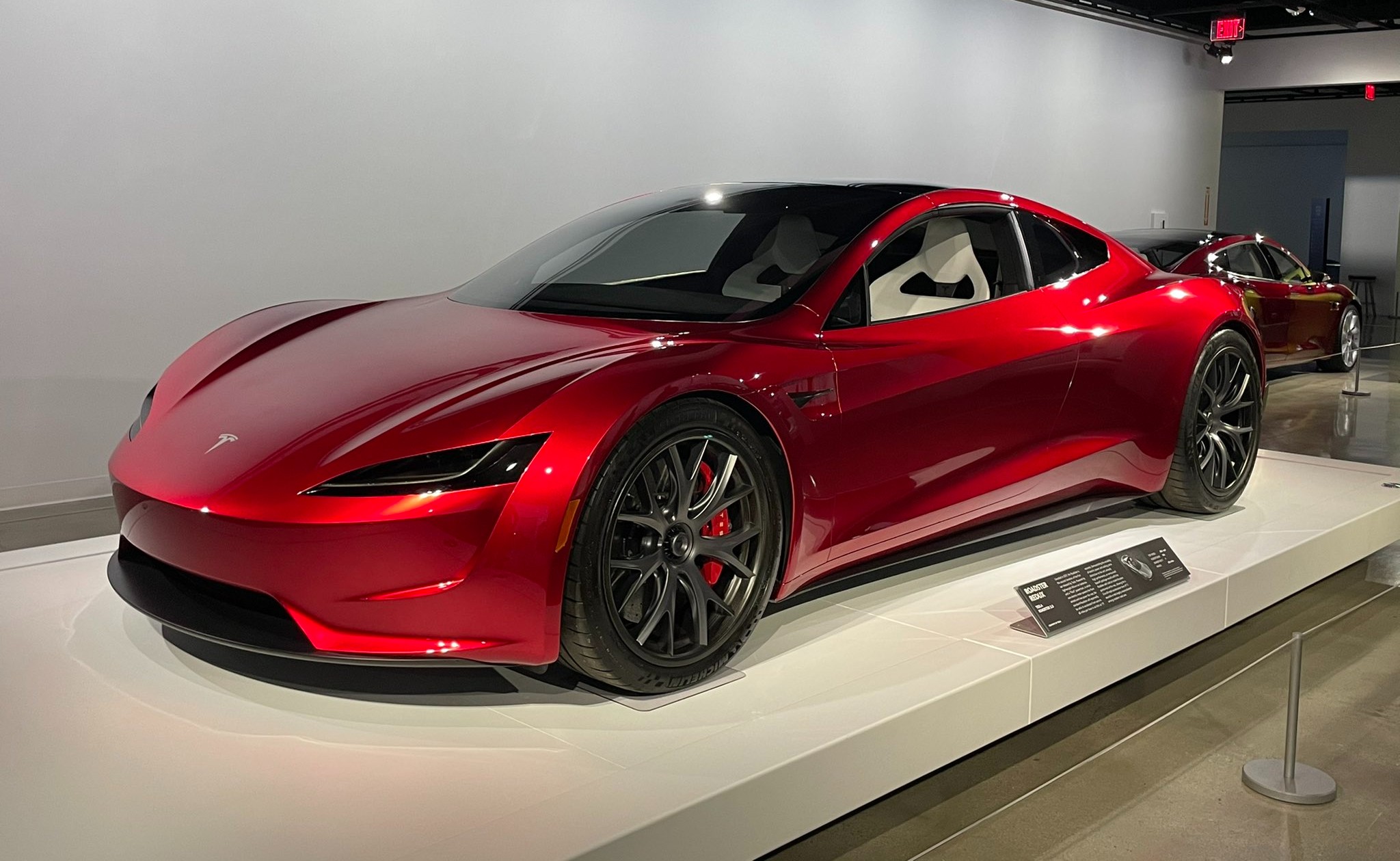
The Federal Aviation Administration (FAA) has established a Temporary Flight Restriction over SpaceX’s McGregor, Texas, rocket development and test facility, a move widely viewed as preparation for Tesla’s October 1 Roadster reveal. The restriction took effect September 18 and runs through October 2.
NOTAM FDC 6/3825 covers a 1.5-nautical-mile radius around the site near Waco and extends from the surface to 10,000 feet above ground level. The FAA cited hazards under 14 CFR 91.137(a)(3) and barred aircraft and drones from the zone. Tesla’s invitation to reservation holders already placed the event in Waco, about 20 minutes from McGregor, making the timing and location more than coincidental.
A TFR has appeared around SpaceX’s McGregor Testing Site up to 10,000ft and runs through until the 2nd of October 👀 pic.twitter.com/rcZ4p4JkLm
— Niall Anderson (@INiallAnderson) September 18, 2026
What stands out is the altitude. Typical recent TFRs at McGregor for engine static fires and component tests have used far lower ceilings, often around 2,000 feet. Raising the limit to 10,000 feet is unusually high even compared with some Starbase restrictions and signals operations that go beyond a standard ground-level engine test.
That extra airspace has fueled speculation about the long-promised SpaceX Package for the Roadster. Elon Musk has described cold-gas thrusters that could deliver sub-one-second 0-60 times and, more dramatically, brief lift-off. Reports earlier this year indicated Tesla planned a remote-controlled demonstration at McGregor in which the car would leave the ground with no one inside; spectators kept hundreds of yards away because of the noise.
The 10,000-foot envelope would give operators a large safety buffer even if the vehicle only hovers a short distance.
Tesla has not confirmed a flight demo. The company has only used the phrase “Go for launch” and posted a teaser image of the car on what looks like a launch pad. The TFR itself mentions only hazards. Still, closing airspace this high and this close to the reveal date strongly suggests the event will include more than a static display.
Whether the Roadster actually hovers on October 1 remains to be seen. What is certain is that the FAA has cleared a large vertical slice of Texas sky for whatever Tesla and SpaceX intend to show. Reservation holders heading to Waco will be among the first to find out if the car can do more than drive.
Elon Musk
Elon Musk drops a surprise update on Boring Company’s next big dig
Musk says Boring Company could shrink the Austin to San Antonio drive to just minutes.

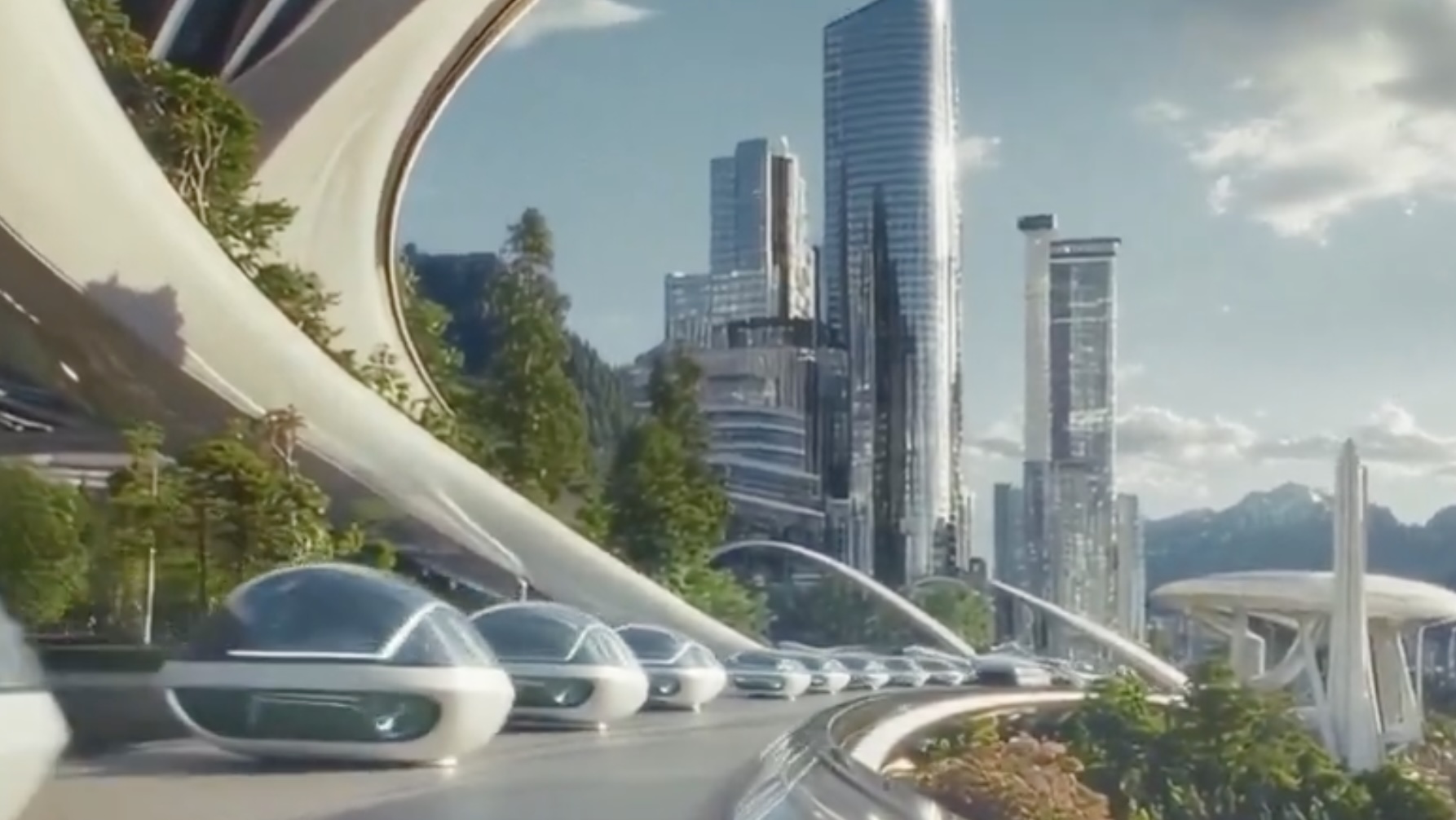
Elon Musk says The Boring Company is working on what he called “a simple, precursor Hyperloop” tunnel connecting Austin and San Antonio, targeting speeds above 200 mph and cutting a drive that can take up to two and a half hours down to a consistent under 30 minutes. Musk posted the idea on X Sunday, in a reply to a repost of an AI generated video imagining a science fiction future with human colonies on other worlds, which he shared with the line “This is the future we shall bring into being.”
This is the future we shall bring into being pic.twitter.com/8aD0w8MDVc
— Elon Musk (@elonmusk) September 20, 2026
The Boring Company’s own account picked up the idea in the same thread, adding a detail about how the trip would actually work: “Because Loop/Hyperloop is express (i.e. no intermediate stops), one could travel from an Austin parking lot to a favorite San Antonio restaurant in about 30 minutes. As long as they both have Loop stations.” That framing ties the proposed intercity link to the same station model the company already runs in Las Vegas, where riders enter the tunnel network through small, garage style stops rather than one central terminal.
This is not the company’s first run at the Austin to San Antonio corridor. Boring Company floated tunnels between the two cities as far back as 2021, and later competed for a separate San Antonio Loop project tied to the airport before that specific bid stalled. Pitches for tunnels in Chicago, Los Angeles, and a New York to Washington corridor have followed a similar pattern of big announcement without a shovel in the ground.
What is different this time is the balance sheet, especially since The Boring Company closed a 3 billion dollar funding round led by investors in the United Arab Emirates earlier this month at a valuation near 23 billion dollars, giving the tunneling company more capital to chase speculative projects than it had during its earlier Texas pitches. The company is also mid-build on two other intercity systems it has actually broken ground on, inc;luding a Nashville tunnel linking downtown to the airport, where a second boring machine finished commissioning in June, and its Las Vegas network, where the station count keeps climbing on paper faster than tunnels get dug.
That gap between announcement and execution is the reason to treat Sunday’s post as an opening bid rather than a project. A tunnel spanning roughly 80 miles between two metro areas, running at speeds Boring Company has not demonstrated over any real distance, would dwarf anything the company has built. For now, the Austin to San Antonio Hyperloop exists as a caption under an AI generated space video.

Tesla Full Self-Driving expands to another European country

Tesla Roadster event requires restricted airspace, and the FAA obliges


