News
Tesla launches ‘Mad Max’ Full Self-Driving Speed Profile, its fastest yet

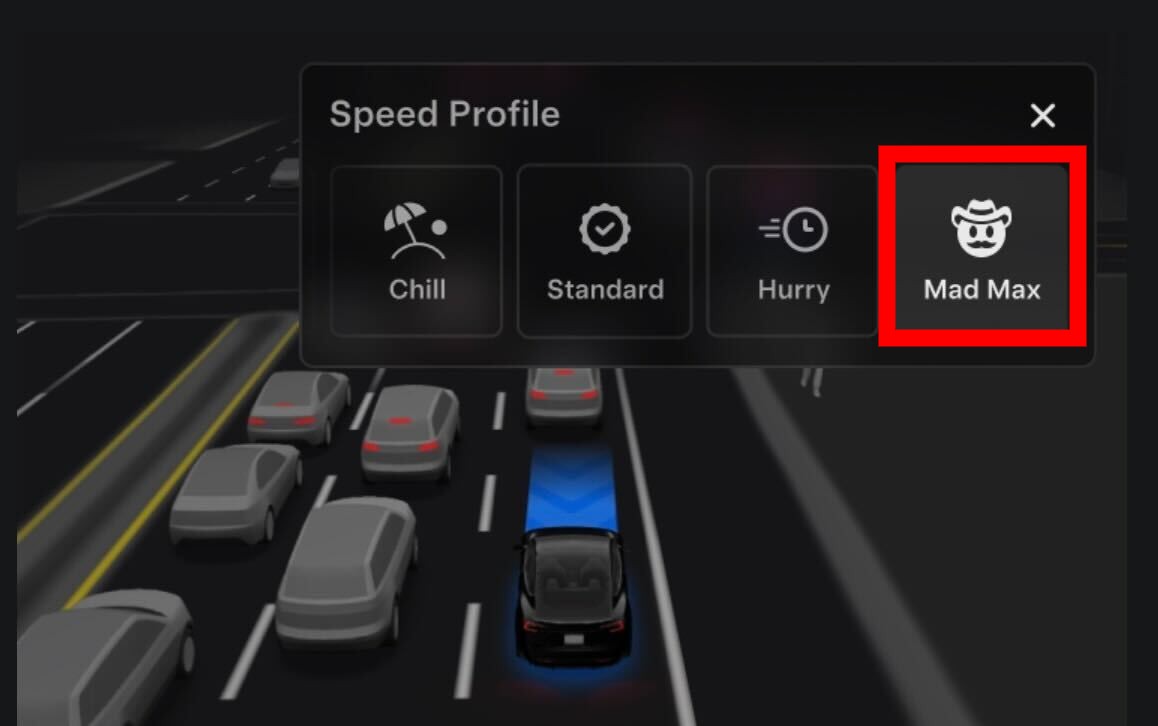
Tesla launched its fastest Full Self-Driving Speed Profile with the v14.1.2 Software Update on Wednesday, as “Mad Max” mode has overtaken “Hurry” as the most spirited travel option on FSD.
On Wednesday evening, Tesla’s Head of AI, Ashok Elluswamy, teased that the v14.1.2 Software Update would be released to those drivers in the Early Access Program (EAP). He said it was a “much-awaited feature.”
Tesla just teased something crazy with the next Full Self-Driving update
Many people, myself included, believed it would be the introduction of “Banish,” which would be a perfect complement to the Actually Smart Summon (ASS) suite, as it would find a parking spot and park itself after dropping you off at the front door of your destination.
However, Elluswamy’s post on X finished with two emojis: one a race car, the other being smoke behind the car.
FSD v14.1.2, going to early access today, will debut a much awaited feature 🏎️💨
— Ashok Elluswamy (@aelluswamy) October 15, 2025
On Wednesday night, we received the v14.1.2 software update to the new Model Y, which revealed that “Mad Max” mode was the new addition:
BREAKING: Tesla Full Self-Driving v14.1.2 is here!
MAD MAX MODE is here! pic.twitter.com/AKM2VwxiXV
— TESLARATI (@Teslarati) October 16, 2025
The release notes state that:
“Introduced new speed profile MAD MAX, which comes with higher speeds and more frequent lane changes than Hurry.”
It is pretty interesting that Tesla would introduce yet another speed profile that is even faster and more aggressive than “Hurry.” Personally, I’ve found Hurry to be realistic in terms of other drivers and their aggressiveness, speed of travel, and overall lane change behavior, especially on interstates.
Mad Max mode will be an interesting adjustment.
Tesla CEO Elon Musk first talked about Mad Max mode back in 2018 in posts on X, first mentioning the feature with the Tesla Semi:
It’s real pic.twitter.com/L9h3F86Guo
— Elon Musk (@elonmusk) June 25, 2018
Musk then teased Mad Max mode in 2019 with an early Autopilot update, stating that it would be an ideal option for aggressive traffic seen in places like Los Angeles. There was formerly a mode of the same name back in the late 2010s:
Are you on Mad Max Mode? This may be too meek for places like the LA Freeway …
— Elon Musk (@elonmusk) April 6, 2019
Now that it’s here, we’ll be testing it very soon and giving you a good idea of what to expect when it releases to others in the coming weeks.


Elon Musk
Musk forces Judge’s exit from shareholder battles over viral social media slip-up
McCormick insisted in a court filing that she harbors no actual bias against Musk or the defendants. She claimed she either never clicked the “support” button, LinkedIn’s version of a “like,” or did so accidentally.
Many Tesla fans are familiar with the name Kathaleen McCormick, especially if they are investors in the company.
McCormick is a Delaware Chancery Court Judge who presided over Tesla CEO Elon Musk’s pay package lawsuit over the past few years, as well as his purchase of Twitter. However, she will no longer be sitting in on any issues related to Musk.
Elon Musk demands Delaware Judge recuse herself after ‘support’ post celebrating $2B court loss
In a rare admission of potential optics issues in one of America’s most powerful corporate courts, Delaware Chancery Court Chancellor Kathaleen McCormick stepped aside Monday from a cluster of shareholder lawsuits targeting Elon Musk and Tesla’s board.
The move came just days after Musk’s legal team highlighted her apparent “support” on LinkedIn for a post that mocked the billionaire over his 2022 tweets about the $44 billion Twitter acquisition.
McCormick insisted in a court filing that she harbors no actual bias against Musk or the defendants. She claimed she either never clicked the “support” button, LinkedIn’s version of a “like,” or did so accidentally.
She wrote in a newly published memo from the Delaware Chancery Court:
“The motion for recusal rests on a false premise — that I support a LinkedIn post about Mr. Musk, which I do not in fact support. I am not biased against the defendants in these actions.”
Yet she granted the reassignment anyway, acknowledging that the intense media scrutiny surrounding her involvement had become “detrimental to the administration of justice.”
The consolidated cases will now be handled by three of her colleagues on the Delaware Court of Chancery, the nation’s go-to venue for high-stakes corporate disputes. The lawsuits accuse Musk and Tesla directors of breaching fiduciary duties through lavish executive compensation and lax governance oversight.
One prominent claim, filed by a Detroit pension fund, challenges massive stock awards granted to board members, alleging the payouts harmed the company. The litigation also overlaps with issues stemming from Musk’s turbulent 2022 Twitter purchase.
McCormick’s history with Musk made her a lightning rod. In 2022, she presided over the fast-tracked lawsuit that ultimately forced Musk to complete the Twitter deal after he tried to back out.
Then in 2024, she struck down his record $56 billion Tesla compensation package, ruling the approval process was flawed and overly CEO-friendly. The Delaware Supreme Court later reinstated the pay on technical grounds, but the ruling fueled Musk’s long-standing criticism of the state’s judiciary.
Musk has repeatedly urged companies to reincorporate elsewhere, arguing Delaware courts have grown hostile to visionary leaders. Monday’s recusal hands him a symbolic victory and underscores how personal social-media activity can collide with judicial impartiality standards.
Delaware law requires judges to step aside if there’s even a “reasonable basis” to question their neutrality.
Court watchers say the episode highlights growing tensions in corporate America’s legal epicenter. While McCormick maintained her impartiality, the appearance of bias proved too costly to ignore. The cases will proceed without her, but the broader debate over Delaware’s dominance in business litigation is far from over.
Elon Musk
Elon Musk has generous TSA offer denied by the White House: here’s why
Musk stepped in on March 21 via a post on X, writing: “I would like to offer to pay the salaries of TSA personnel during this funding impasse that is negatively affecting the lives of so many Americans at airports throughout the country.”
Tesla and SpaceX CEO Elon Musk made a generous offer to pay the salaries of Transportation Security Administration (TSA) employees last week, but the offer was denied by the White House.
In a striking display of private-sector initiative clashing with federal bureaucracy, the White House has turned down an offer from Elon Musk to personally cover the salaries of TSA officers amid an ongoing partial government shutdown. The rejection, reported last Wednesday by multiple outlets, highlights the legal and political hurdles facing unconventional solutions to Washington’s funding gridlock.
The impasse began weeks ago when Congress failed to pass funding for the Department of Homeland Security (DHS), leaving TSA employees, essential workers who screen millions of travelers daily, without paychecks while still required to report for duty.
Frustrated travelers have endured record-long security lines at major airports, with reports of chaos and delays rippling across the country.
Musk stepped in on March 21 via a post on X, writing: “I would like to offer to pay the salaries of TSA personnel during this funding impasse that is negatively affecting the lives of so many Americans at airports throughout the country.”
I would like to offer to pay the salaries of TSA personnel during this funding impasse that is negatively affecting the lives of so many Americans at airports throughout the country
— Elon Musk (@elonmusk) March 21, 2026
But it was not for no reason.
White House spokesperson Abigail Jackson responded on behalf of the Trump administration, expressing appreciation for Musk’s gesture.
However, the legal obstacles, which would be insurmountable, would inhibit Musk from doing so. Jackson said:
“We greatly appreciate Elon’s generous offer. This would pose great legal challenges due to his involvement with federal government contracts.”
Musk’s companies hold significant federal contracts, including NASA launches through SpaceX and potential Defense Department work, raising concerns about conflicts of interest, ethics rules, and anti-bribery statutes that prohibit private payments to government employees. Administration officials also indicated they expect the shutdown to end soon, making external funding unnecessary.
The episode underscores deeper tensions in Washington. Musk, who has advised on government efficiency efforts and maintains a close relationship with President Trump, has frequently criticized wasteful spending and bureaucratic delays.
His offer came as airport security lines ballooned, drawing public frustration toward both parties. TSA officers, many of whom rely on paychecks to cover mortgages and family expenses, have continued working without compensation, a situation that has drawn bipartisan concern but little immediate resolution.
Critics of the rejection argue it prioritizes red tape over practical relief for frontline workers and travelers. Supporters of the White House position counter that allowing private funding sets a dangerous precedent and could undermine congressional authority over the budget.
The White House eventually came to terms with the TSA on Friday and started paying them once again, and lines at airports instantly shrank. The Department of Homeland Security (DHS) said that TSA staf would begin receiving paychecks “as early as” today.
Elon Musk
Tesla FSD mocks BMW human driver: Saves pedestrian from near miss
Tesla FSD anticipated a BMW driver’s lane drift before the human behind the wheel could react.

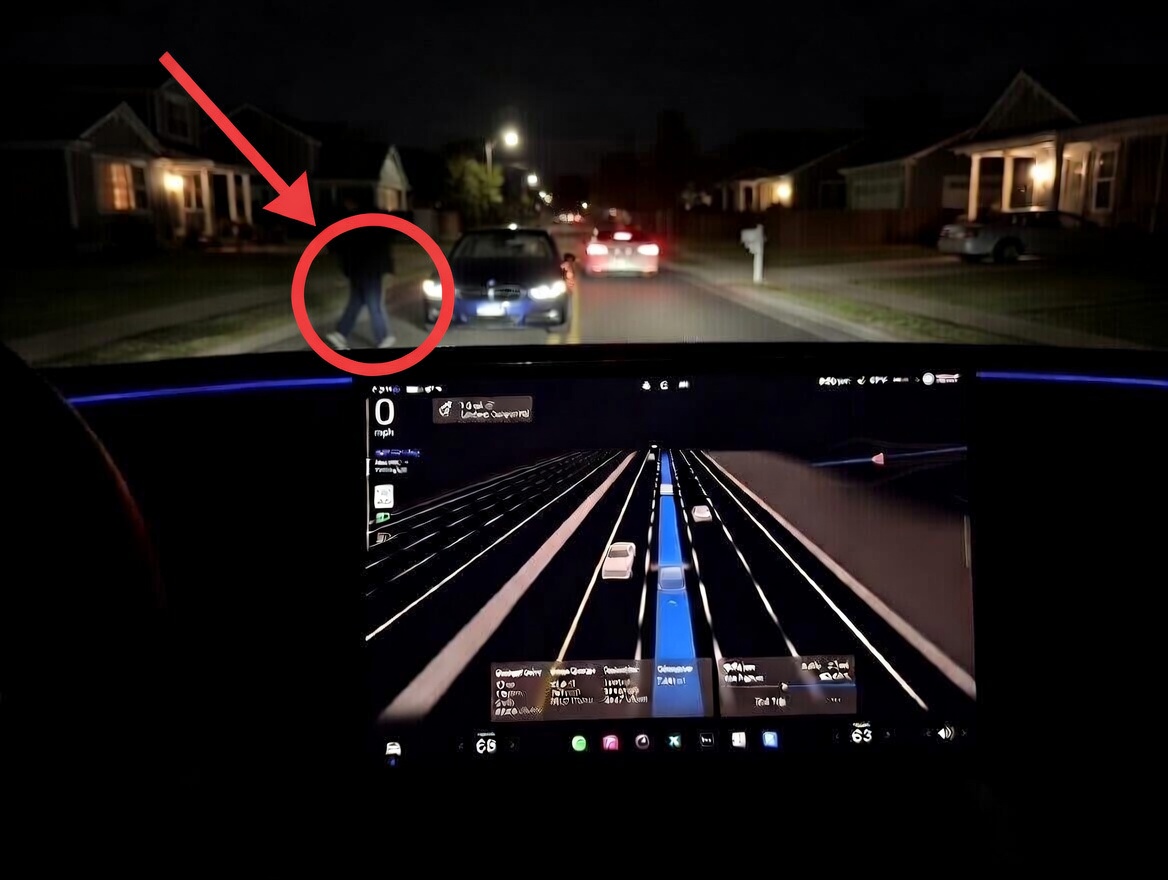
A video posted to r/TeslaFSD this week put a sharp spotlight on Tesla’s Full Self-Driving (FSD) software being able to react to pedestrian intent than an actual human driver behind the wheel. In the Reddit clip, a BMW driver can be seen rolling through a neighborhood street completely unaware of a pedestrian stepping in to cross. At the same time, a Tesla driving on FSD had already begun slowing down before the pedestrian even began their attempt to cross the street The BMW kept moving, prompting the pedestrian to hop back, while the Tesla came to a stop and provide right-of-way for the human to safely cross.
That gap between what the BMW driver saw and what FSD had already processed is the story. Tesla FSD wasn’t reacting to a person in the street, rather it was reading the signals that a person was about to enter it based on the pedestrian’s movement, trajectory, and their trajectory to telegraph intent.
Tesla’s FSD is now built on an end-to-end neural network trained on billions of real-world miles, learning to interpret subtle human behavioral cues the same way an experienced human driver does instinctively. The difference is consistency. A human driver distracted for two seconds misses what FSD does not.
Tesla sues California DMV over Autopilot and FSD advertising ruling
Reddit commenters in the thread were blunt about the BMW driver’s failure, with several pointing out that the pedestrian was visible well before the crossing. One response put it plainly that the car on FSD saw the situation developing before the human in the other car had registered there was a situation at all.
Tesla has published data showing FSD (Supervised) is 54% safer than a human driver, accumulated across billions of miles driven on the system. Elon Musk has said FSD v14 will outperform human drivers by a factor of two to three, and that v15 has “a shot” at a 10x improvement. Pedestrian safety is where the stakes are highest, and where intent prediction closes the gap fastest. At 30 mph, a car covers roughly 44 feet per second. An extra second of awareness from reading a person’s body language rather than waiting for them to step out is often the difference between a near miss and a fatality.
Video and community discussion: r/TeslaFSD on Reddit
FSD saves man from becoming a pancake. BMW driver nearly flattens him.
by
u/Qwertygolol in
TeslaFSD

Musk forces Judge’s exit from shareholder battles over viral social media slip-up

Elon Musk has generous TSA offer denied by the White House: here’s why

Tesla FSD mocks BMW human driver: Saves pedestrian from near miss

Elon Musk says Tesla is developing a new vehicle: ‘Way cooler than a minivan’

Elon Musk launches TERAFAB: The $25B Tesla-SpaceXAI chip factory that will rewire the AI industry


