Lifestyle
Tesla Model 3: A change is coming and it will be huge

As I’ve mentioned before, I started fantasizing about attending this event long before we knew invites would come by way of a lottery system. I stashed my little fantasy football championship winnings to help soften the blow of last minute airfare in case of a miracle. That miracle happened and the significance of it all is really starting to sink in.
What it means to Tesla
Thursday’s event will be the start of Tesla’s next chapter; their most important one yet. That is, developing a compelling and affordable long range EV. Tesla’s secret master plan, which shows a publication date of nearly 10 years ago, boils down to:
- Build sports car
- Use that money to build an affordable car
- Use that money to build an even more affordable car
- While doing above, also provide zero emission electric power generation options
- Don’t tell anyone.
This is finally it. Their moment in the spotlight is finally coming. Their mass-market car will be shown to the world, live on the internet, to the joy of enthusiasts and pain of (I presume) auto and oil execs everywhere. Once unveiled, the clock starts ticking. Tesla has but one shot to get it right. That not only means building a compelling car, which I have no doubt they will, but producing it efficiently, with a high level of quality, on time and within their promised price point. They will have to ramp up production in a manner not yet seen in automotive history, communicate at a caliber far beyond their corporate age, and figure out how to do it all while still continuing their current miracles of pushing out two of the best vehicles money can buy while simultaneously building a charging infrastructure from scratch. That was a mouthful to say so imagine what it really means for Tesla to do.
What it means to the world
Never before have we seen such a frenzied environment surrounding the ability to pay $1,000 for a place in line to buy a car that won’t even exist for 18-24 months. I’ve known of people reserving vehicles or being put on a waiting list for a future offering, such as the Hummer H2. I’ve also known scores of people who know of and await the coming of a future car model, if only to admire it. But again, we’ve never seen anything like this. I can say that before even knowing the magnitude of “this” because I, like Steve Hanley, think we will see 100,000 reservations by the end of April 1st. We’ll know the number eventually, and thus start to truly appreciate the magnitude. Here’s the thing though, Tesla’s goal was never to rule the world or be the biggest or best or most profitable automaker in the world. In fact, their mission is quite simple:
To accelerate the advent of sustainable transport by bringing compelling mass market electric cars to market as soon as possible.
Without the Model 3 even being seen yet, Tesla is already well on their way to achieving that mission. Everyone and their mother is putting out an EV, compliance car or otherwise, and we all know this little “insignificant” start up from California is a primary reason. People are starting to get it. The P85D YouTube videos went viral immediately and even the most critical gear heads can’t deny the awesomeness of that kind of acceleration. Lawmakers are starting to get it, in some cases, and are enacting laws to protect charging spaces, give parking or tax incentives or access to HOV lanes. The press is starting to get it. Most of what I come across about Tesla these days is positive. A change is coming and it will be huge. An increase in the expectation of car quality, efficiency and dealership experience will force change in the industry. A decrease of the use of gasoline could lead to political, economic and environmental changes. The implications of electrification of cars are larger than we can even imagine at this point. How many current Tesla owners invested in home solar panels after getting the car that would not have otherwise thought of doing so? How many future owners will do the same? How many new jobs can come from an increased demand in green energy? The Tesla Model 3 means exponentially more to the world than just what it as a car can offer.

Component of a Ford Model T battery
What it means to the United States
A certain mogul turned reality star turned presidential candidate likes to claim that we don’t win anymore. When it comes to the auto industry, it’s sort of true. Credit where credit is due (Ford especially) but the past few decades have seen our dominance in the industry threatened, if not decimated. Tesla is a force to be reckoned with and people across the globe are clamoring for this American car. I’ll repeat that – there is world wide demand for a car designed and built right here in the United States. Apple, should they get in the game, is also an American company. Google is too. We could be on the verge of another major shift, in that America could become the country to beat in the car game. And the Gigafactory? Thousands of jobs. A second (or third or fourth) factory elsewhere in the states would mean thousands more. More competition in the world of autonomous driving could also shape the landscape of the way our cities and people move. Again, the implications are huge and almost certainly unknown at this point, and it all rests in the hands of a successful Model 3.

Displayed next to a football signed by Connor Barwin, Philadelphia Eagle, environmentalist and Tesla owner.
What it means to me
I’ve loved cars my whole life. My first dream car was a mid 90s Dodge Intrepid. (“4.5 liter 32 valve engine”, I used to repeat to anyone who would listen.) Mine was going to be neon green with tinted windows that had rainbow sparkles. The first car I designed myself was named the Chinchilla and had a “computer” that would give you directions. The first Supercar I remember reading about in Car and Driver was the Vector Avtech, which until searching it just now, I remember as being named Antech. (Google also informed me I was 9 when it appeared at the Geneva Auto show.) A favorite memory of my late father was him taking my arm and walking me away when, at 22, my eyes widened upon the site of a t-tops Firebird at a used car lot. (I’ll admit that he was right. For my $2200 budget, that dinky 1998 Ford Escort ZX2 coupe was perfect.)
I am now fully submerged in the Tesla Kool-Aid in that I believe the Model 3 will be as significant to the history of automobiles as the Model T. Knowing that I will be there, in person to witness the unveiling, is a privilege that I will cherish for the rest of my life. In fact, it’s no accident that when someone gave me a wooden piece that belonged to a Model T’s battery system, I immediately found a prominent place to display it in my home. I’m a car nerd that has evolved into an EV nerd and can hardly put into words my excitement about being a part of history. Not just as an attendee on Thursday night but as an early Tesla owner. Yes, I realize my 2014 Model S is not considered early to this crowd, but in 30 years any Model S, Model X and even Model 3 owner will be considered an early adopter of EV technology. I will wear as a badge of honor the story of that time I got to witness history unfold before my eyes.
On a more personal level, this event also means a lot to me. I am now connected to, and greatly enriched by, every single person who has read my posts, commented, reached out to arrange to get together and even offered to pick me up from LAX. I’ve sipped tea with wonderful people, shared meals with owners’ families, spoken to curious school children and immensely enjoyed every single interaction – both online and in person – with fellow owners and enthusiasts. While Tesla in general and Model S ownership specifically has contributed to this more than the Model 3 event itself, this event is an extension of it all, a pathway to Tesla’s survival and thus the survival of this community that has taken me in and given me a voice.

Some of the features of my “Chinchilla” concept car.


Elon Musk
How to use Grok Bot to block spam calls and texts
Musk told users to ask Grok Bot to scrub their phone numbers from spam lists.

Elon Musk has a new use case for Grok Bot, and it is the spam call. On Thursday he replied to an X user named Arash with a short instruction: “Ask your @Grok @Bot to remove your phone number from spam call & text lists!” Arash had said he got tired of the calls, had an AI bot find his number on listing sites and file removal requests, and packaged the process as a free skill for others.
The skill is called Spam-Call Scrubber, which is described to find a phone number on people search sites and data brokers, submits the opt outs, completes the confirmation emails those sites send back, and rechecks on a schedule the user picks. Using it requires the Grok Bot app. The pitch is time saved, since most broker opt outs sit behind separate forms on separate sites.
Ask your @Grok @Bot to remove your phone number from spam call & text lists!
— Elon Musk (@elonmusk) October 15, 2026
Musk said Grok Bot now gives each bot its own email address, and that it can detect scam emails. On Thursday he also said SpaceX would make users whole if the bot botches a purchase or leaks a card, then told users to shop away from Amazon after the retailer blocked the agent, as Teslarati reported. The terms of service we reviewed at the time put responsibility for what an agent does on the user.
For Tesla owners, Grok Bot is not just a phone app. Tesla brought Grok Bot into its vehicles on September 22, and we argued earlier this week that the Cybercab’s real advantage may be the errands it runs during a ride. Every Cybercab and the rest of the Model Y Robotaxi fleet has it enabled. The more routine tasks like this one become, the more a rider has reason to hand over something personal in the back seat.
The new Spam-Call Scrubber skill can be downloaded for free and works on sites that honor removal requests, while noting that listings can reappear, and illegal robocallers do not check any registry. Whether Spam-Call Scrubber cuts anyone’s call volume is something the first wave of users will find out, and Musk’s endorsement guarantees that wave is coming.
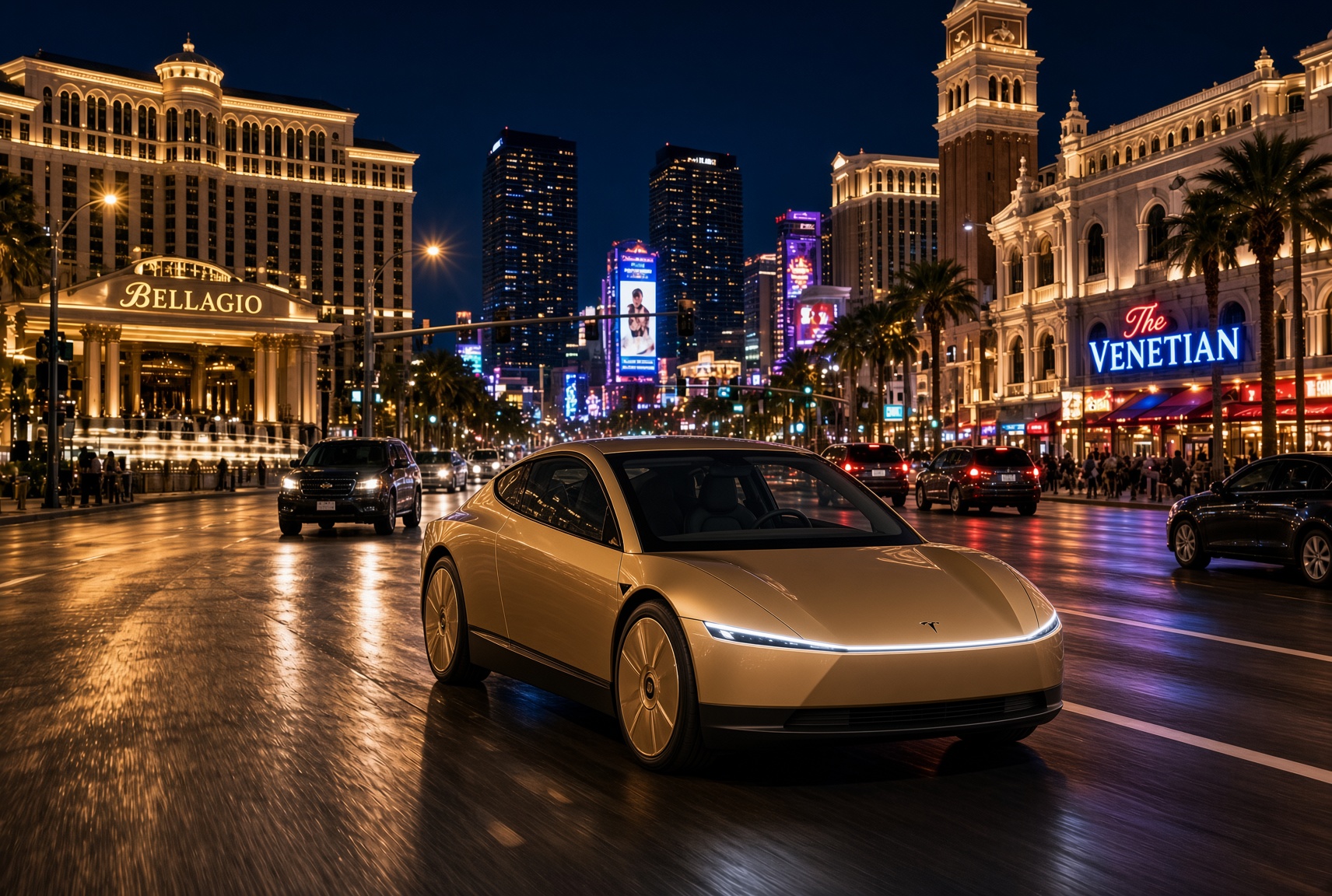
For a century, the car has asked the same thing of its owner, which is basically to pay attention. Even the best ride-hailing app like Uber or Lyft only moved the problem into someone else’s hands. You stopped driving, but you still sat in a stranger’s car, while half listening, and wondering whether to take a phone call in the car without being rude. The Cybercab has no wheel, no pedals and no driver. With Grok @bot now live inside it, it becomes something else entirely, and I think that matters more than the fleet count that everyone is tracking.
Grok @bot is an agent, not a voice assistant. A rider signs in once, and from then on can say what they need and watch it happen. Order dinner from a favorite restaurant. Fill the grocery cart. Move money, answer email, adjust a calendar, push a work project forward. Tesla engineer Yun-Ta Tsai confirmed it is enabled across every Cybercab and the rest of the Model Y fleet, and Tesla’s own pitch is that Full Self-Driving handles the commute while Grok handles the errands.
Think about what that does to a thirty minute ride. Uber sells you a trip, while Waymo sells you the same trip in a more private setting. Tesla is selling the thirty minutes themselves, returned to you with an assistant attached. Errands that used to eat a Saturday get done between pickup and drop off. The ride stops being dead time between two places and becomes a place of its own.
Tesla integrates Grok Bot into its vehicles for the ultimate personal assistant
Best of all, your Bots follow you into any Cybercab, and presumably your own Tesla, then logs you out automatically when you step out. Anyone can bolt a chatbot onto a screen, but much harder to own the vehicle, the autonomy stack and the assistant at once. It also quietly ties SpaceX’s Super Intelligence business to Tesla’s fleet, after Tesla converted its xAI stake into SpaceX equity. The relationship between those two companies is getting harder to describe as separate.
This is also where the hard questions start, because an agent that can spend your money in a vehicle other people also ride in needs some answers. How does it handle a voice it shouldn’t trust? What gets recorded, who can see it, and for how long? What happens when a rider leaves halfway through a task?
If Tesla gets those answers right, the scoreboard changes. We have been counting Cybercabs and wait times. The more telling number may be what riders accomplish per trip. That is data almost no one else will ever have, and it is the real reason to watch Grok @bot.
What do you think? Leave me a comment.
Lifestyle
Tesla’s mirrorless Cybercab will give riders a visibility upgrade
Tesla engineer confirms Cybercab update letting riders pull up rear and repeater cameras on demand.
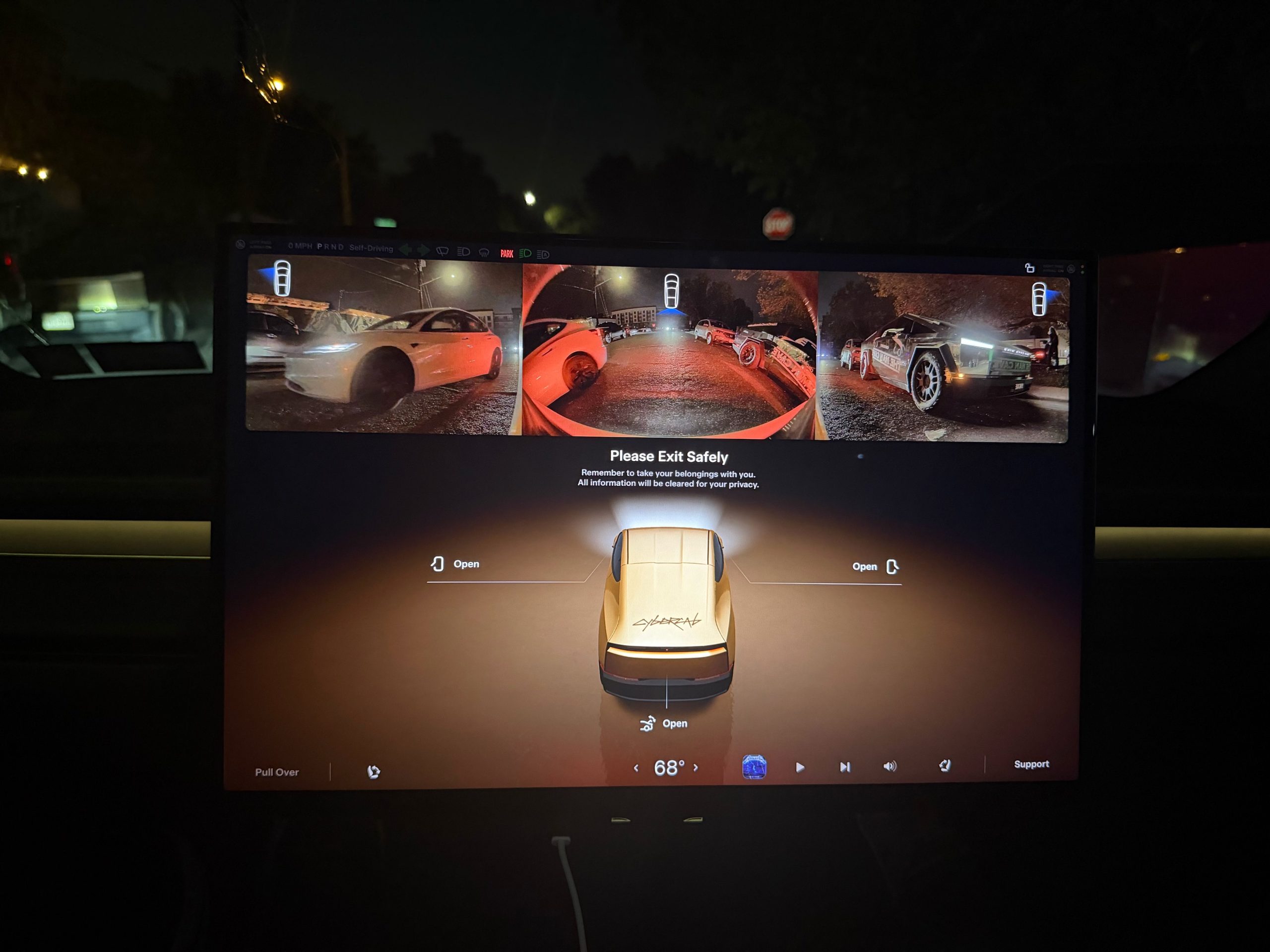
Tesla is working on a Cybercab update that would let passengers pull up the vehicle’s rear and side cameras on demand, and the request came straight from a rider.
The exchange played out on X late Friday. Cybercab rider Dan Burkland shared photos of the two-seater’s cabin screen after an evening ride, praised the UI team’s work, and left one request: let riders open the rear and repeater cameras whenever they want, “especially for peace of mind.” Tesla UI software engineer Evan (@CarCoder) answered with two words: “In development.”
The Tesla UI team absolutely crushed it with the infotainment software. Nicely done @CarCoder!
One feature request: Allow folks to pull up the rear & repeater cameras on demand. This would be great especially for peace of mind. https://t.co/mNAOSLx6pE
— Dan Burkland (@DBurkland) October 10, 2026
The idea fits a pattern Teslarati has tracked since public rides began. Days after paid Cybercab service opened in Austin, Tesla sent riders a survey that asked them to rate the touchscreen, the app and the cabin, and to pick the features they wanted most. We reported on that survey in September, and a camera view is the kind of small software change Tesla can push quickly if riders keep asking.
It also speaks to something unique about the vehicle. With no steering wheel, no pedals and no driver, passengers have no mirror to check and no way to see behind them. The hardware is clearly built for camera awareness, from the repeater cameras to the rear camera. Letting a passenger look through those same cameras would give a nervous first time rider a way to confirm what is around the car.
The timing matters because the fleet is growing fast. Tesla’s Robotaxi account said on Saturday that more than 300 Cybercabs are now serving Austin, an eightfold increase in 30 days, and Tesla AI chief Ashok Elluswamy named Dallas as the next city. More cars and more cities mean more people riding in a driverless vehicle for the first time, which is exactly when small trust features carry weight.
For now, the feature is confirmed only as in development. If Tesla follows its usual pattern with Cybercab software, riders could see it appear in a point release without any announcement, and Teslarati will watch for it.

The Starship moon landing number NASA and Elon Musk can’t agree on

Tesla’s secretive “Project Crystal Sun” gets a big green light in Texas


