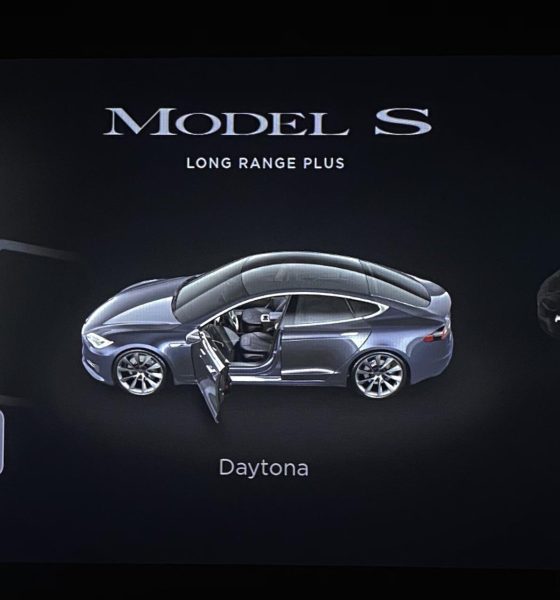

Tesla has rolled out a new Adaptive Air Suspension widget display on the Instrument Panel of the Model S sedan and Model X SUV. The addition came with the 2020.36 Software Update, which was released to owners on August 29th, 2020.
In mid-August, Tesla released improvements to the Adaptive Suspension system by adding a real-time visualization feature to the Model S and X. The feature was available on the dash screen, allowing drivers to see exactly what was going on with their car’s suspension in real-time for an immersive and detailed update of the vehicle’s activity.
Now, Tesla has moved the visualization to the instrument cluster behind the steering wheel, more conveniently positioned for driver’s to keep up with the suspension system’s response to unruly terrain during navigation.
Reddit member u/Udarag shared an image of the Suspension visualization feature on his Model S Long Range Plus instrument panel.
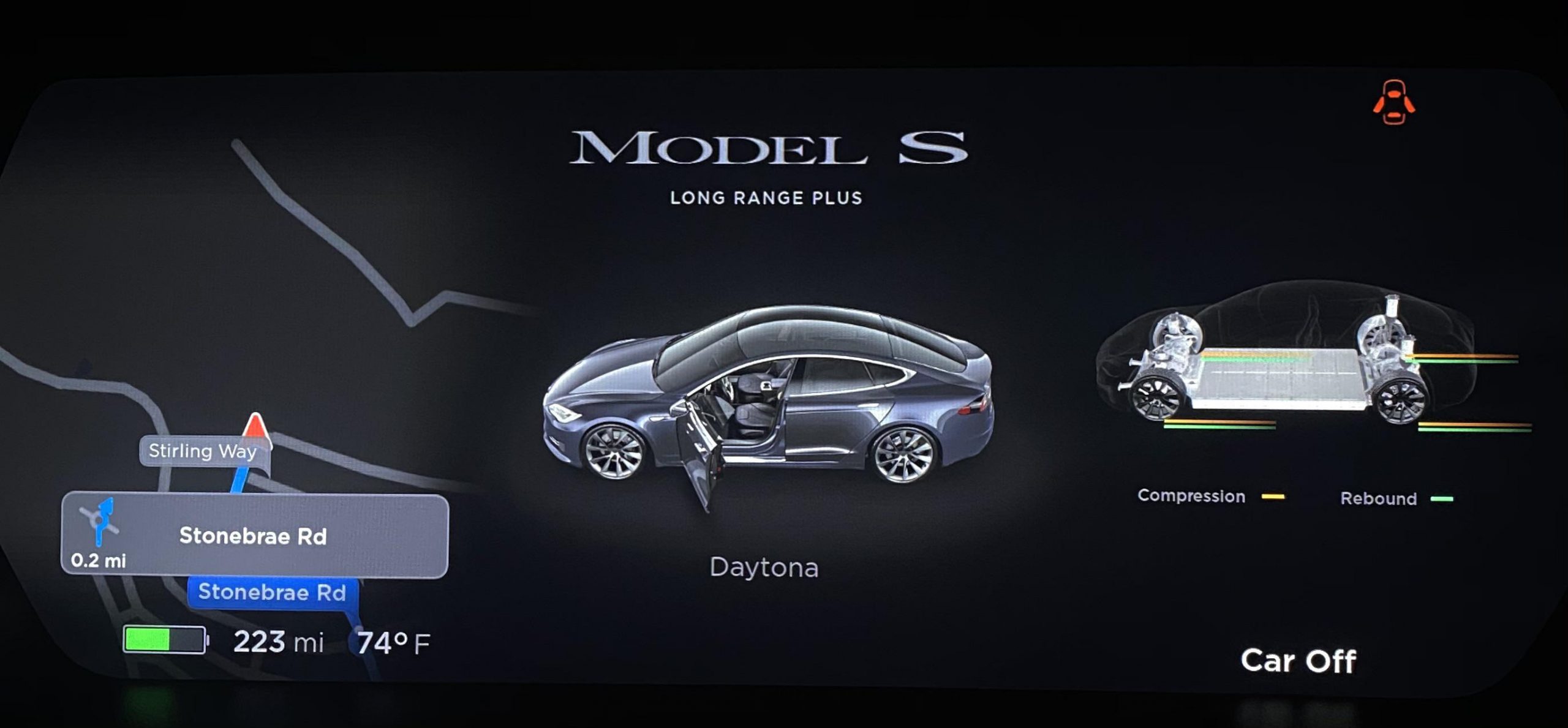
According to TeslaScope.com, Tesla released the Suspension Instrument Panel Display to every market where the Model S and Model X are available. The company states in the release notes that:
“The real-time visualization shows how the suspension system is dynamically adjusting each wheel’s damping to account for changing road conditions. This can now be displayed on the right or left side of the instrument panel. To view, hold the respective steering wheel scroll button briefly until the available instrument panel options are displayed. Roll the scroll button to choose Suspension.”
Tesla performed the initial rollout of the Suspension Visualization on August 21st, and the improvements were aimed toward increasing driver awareness of what stress the vehicle’s systems were under at all times. In addition to the visualization, the update also introduced a simplified suspension control logic that allowed vehicles to support both temporary and permanent ride heights.
The Model 3 and Model Y do not have any Adaptive Air Suspension features because they equip a different shock system than the Model S and the Model Y. Teslarati reported in February that the Model 3 and Model Y both had Air Suspension harnesses listed within the company’s Parts Catalog. However, CEO Elon Musk told us that there were no plans to give the two mass-market vehicles this functionality, at least for now.
Allowing owners to see what the suspension system is doing in real-time will give drivers a good sense of what is going on with the vehicle while it is traveling over heavy terrain. Snow and unpaved roads that are challenging for cars to navigate over will give owners an excellent opportunity to see how the shocks respond to dips and divots within the driving surface.


Elon Musk
Elon Musk’s Boring Co. Tunnel Vision Challenge ends with a surprise for Louisiana, Maryland and Dallas
The Boring Company stunned three cities today, awarding New Orleans, Baltimore, and Dallas free underground Loop tunnels.

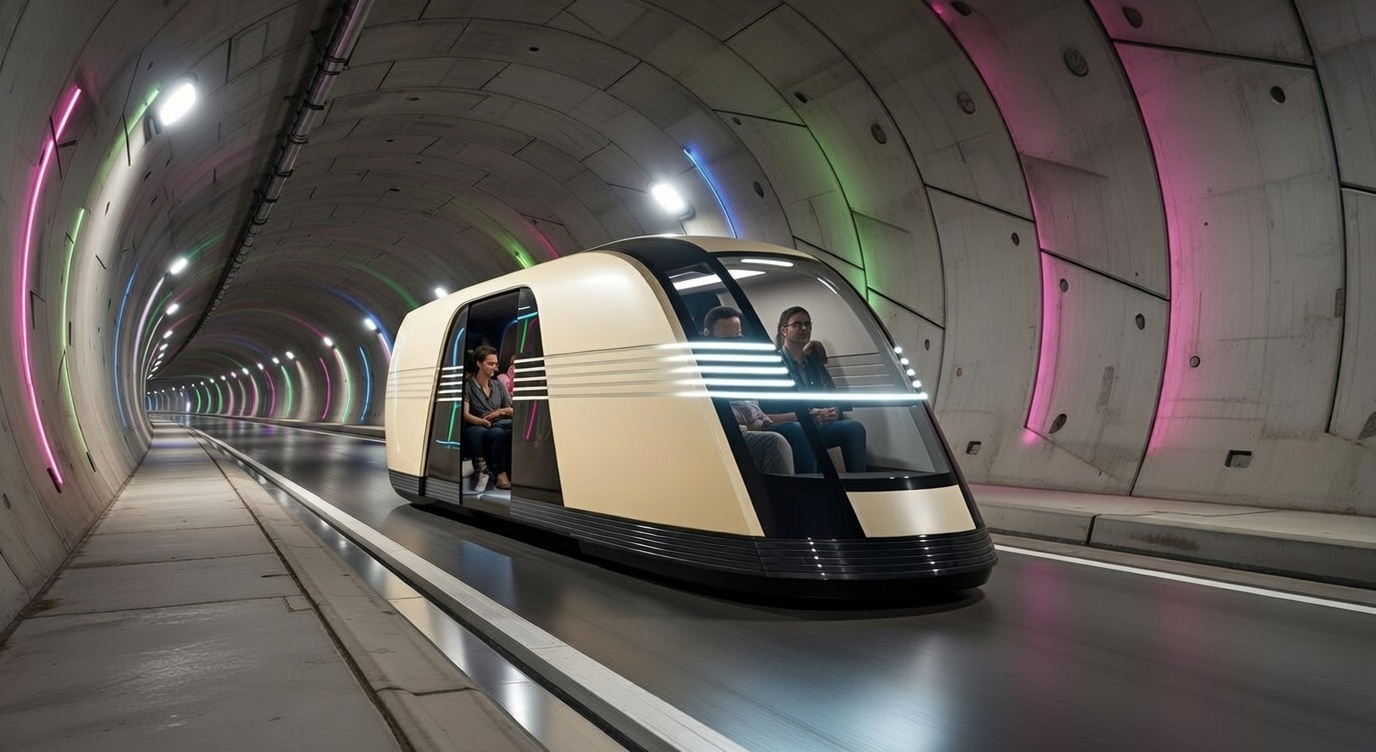
Elon Musk’s The Boring Company (TBC) announced today that it is building free underground Loop tunnels in three American cities: New Orleans, Louisiana; Baltimore, Maryland; and Dallas, Texas. The company had promised one winner when it launched the Tunnel Vision Challenge in January. After receiving 487 submissions, it selected three, committing to fund and construct all of them pending a feasibility review, entirely at its own expense. For a company that has faced years of skepticism over the gap between its promises and its delivered projects, choosing to expand its commitment rather than narrow it is a notable shift in both scale and accountability.
All three projects will now enter a rigorous, fully funded diligence phase that includes meetings with elected officials, regulators, community and business leaders, geotechnical borings, and a complete investigation of subsurface utilities and infrastructure. TBC confirmed that all costs associated with this diligence process are 100% funded by the company. If all three projects pass feasibility, all three get built. If only one clears the bar, that one gets built. The company’s willingness to fund the due diligence regardless of outcome removes one of the most common early-stage barriers that kills promising infrastructure proposals before they leave a spreadsheet.
Beyond the three winners, TBC announced it will continue working with two additional entrants it found compelling enough to pursue independently: the Hendersonville Utility Tunnel in Hendersonville, Tennessee, and the Morgan’s Wonderland Tunnel in San Antonio, Texas, which would notably serve one of the nation’s premier theme parks built specifically for guests with special needs.
The challenge also coincides with TBC’s most active construction period to date. The company recently began drilling on the Music City Loop near the Tennessee State Capitol in Nashville, and in February it broke ground on a Loop in Dubai. Musk has long argued that the fundamental problem with urban infrastructure is cost and bureaucratic inertia, not engineering. “The key to solving traffic is making going 3D either up or down,” he said in 2018, a conviction now reflected in a company structure built to absorb the financial risk that typically stalls public projects for years.
Music City Loop could highlight The Boring Company’s real disruption
The Tunnel Vision Challenge’s most underappreciated element may be what it produced beyond three winners. Submissions came from individuals, companies, and governments across states including Alaska, Arkansas, Colorado, Kansas, Louisiana, Maryland, New York, and Texas, as well as from international entrants. Musk captured the underlying logic years ago when he said, “Traffic is driving me nuts. I’m going to build a tunnel boring machine and just start digging.” Today, three American cities are counting on exactly that.
Tunnel Vision Challenge results!
We’ve been overwhelmed with the amazing submissions…so we are announcing three winners!
The Thrilling Three are:
– NOLA Loop (New Orleans, LA)
– Ravens Loop (Baltimore, MD)
– University Hills Loop (Dallas, TX)What happens next? TBC and the… https://t.co/cY2ULftfiK
— The Boring Company (@boringcompany) March 24, 2026
News
Tesla launches first ‘true’ East Coast V4 Supercharger: here’s what that means
What truly distinguishes this installation from the hundreds of “V4” stalls already scattered across the network? Most existing V4 dispensers, rolled out since 2023, feature welcome upgrades like longer cables, built-in touchscreen displays, integrated credit-card readers for non-Tesla users, and improved ergonomics.
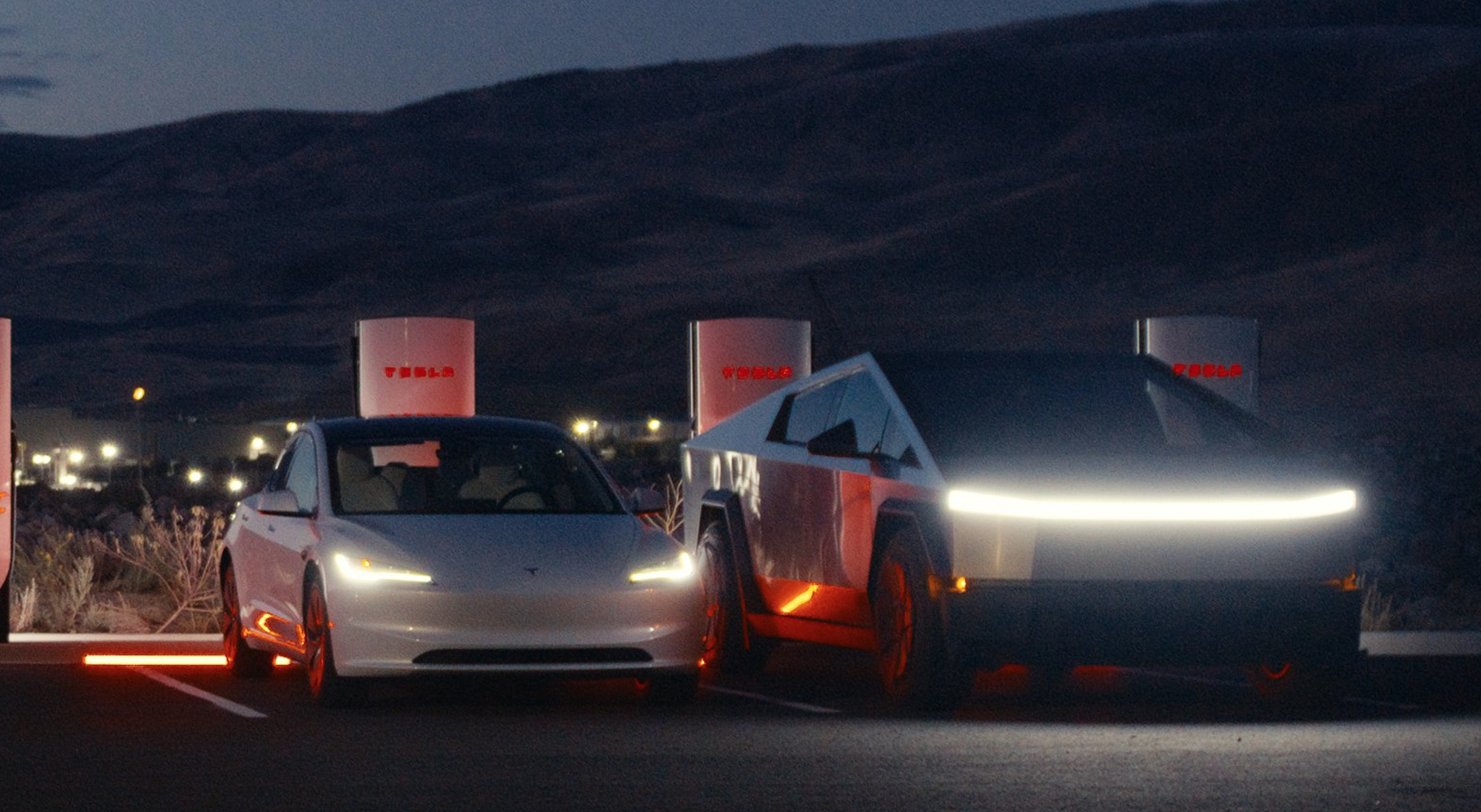
Tesla has launched its first “true” V4 Supercharger on the East Coast, and while that may be sort of confusing, here’s what we mean by that.
Tesla has opened its first true V4 Supercharging station on the East Coast in Kissimmee, Florida, just south of Orlando.
The eight-stall site, powered by an advanced 1.2 MW V4 power cabinet, is capable of delivering up to 500 kW, making it one of only four fully operational 500 kW-capable V4 stations in the United States.
Pricing is dynamic and competitive, as Tesla owners pay $0.40 per kWh during peak hours (8 a.m. to midnight), dropping to an attractive $0.20/kWh off-peak (midnight to 8 a.m.).
Non-Tesla EVs, which can now plug directly into the NACS ports thanks to the open standard, are charged a premium—$0.56/kWh peak and $0.28/kWh off-peak—reflecting Tesla’s strategy to monetize network access while rewarding its own customers.
What’s Makes This a “True” V4 Supercharger
What truly distinguishes this installation from the hundreds of “V4” stalls already scattered across the network? Most existing V4 dispensers, rolled out since 2023, feature welcome upgrades like longer cables, built-in touchscreen displays, integrated credit-card readers for non-Tesla users, and improved ergonomics.
However, nearly all of these have been paired with legacy V3 power cabinets. These hybrid setups, sometimes informally called V3.5, deliver charging curves virtually identical to standard V3 stations, typically topping out at 250-325 kW depending on the vehicle and site conditions.
In contrast, Kissimmee’s true V4 architecture incorporates next-generation 1.2 MW power cabinets. These support battery voltages up to 1,000 V (double the 500 V of V3 systems) and can push up to 500 kW per stall.
NEWS: Tesla has opened its first true V4 Supercharging station on the East Coast, capable of delivering up to 500 kW charging speeds.
• Location: Kissimmee, Florida (near Orlando)
• 8 charging stalls
• Fees for Tesla owners: $0.40/kWh ($0.20/kWh off-peak)
• Fees for all… pic.twitter.com/E8AkaibWsC— Sawyer Merritt (@SawyerMerritt) March 19, 2026
One compact cabinet efficiently powers all eight stalls, slashing the physical footprint and reportedly keeping deployment costs under $40,000 per stall, far cheaper than earlier designs.
Right now, the primary beneficiary is the Cybertruck, which can achieve dramatically faster charging at low states of charge.
Everyday models like the Model 3 and Model Y see little immediate difference in peak speeds, but the hardware lays the groundwork for future vehicles with higher-voltage batteries.
Tesla launches faster Cybertruck charging at all V4 Superchargers
This milestone signals Tesla’s accelerating push toward a high-power, future-proof Supercharger network.
As true V4 sites multiply, charging times will shrink, grid efficiency will improve, and the entire EV ecosystem, Tesla and non-Tesla alike, will benefit from the infrastructure lead Tesla continues to expand. For drivers in central Florida, the Kissimmee station is more than just another charging stop; it’s a glimpse of the faster, smarter charging era that’s finally arriving.
Elon Musk
Tesla reveals various improvements to the Semi in new piece with Jay Leno
Tesla Chief Designer Franz von Holzhausen and Semi Program Director Dan Priestley joined Leno in a 47-minute segment revealing all of the various things it did to make the Semi even better as it heads toward volume production this year.
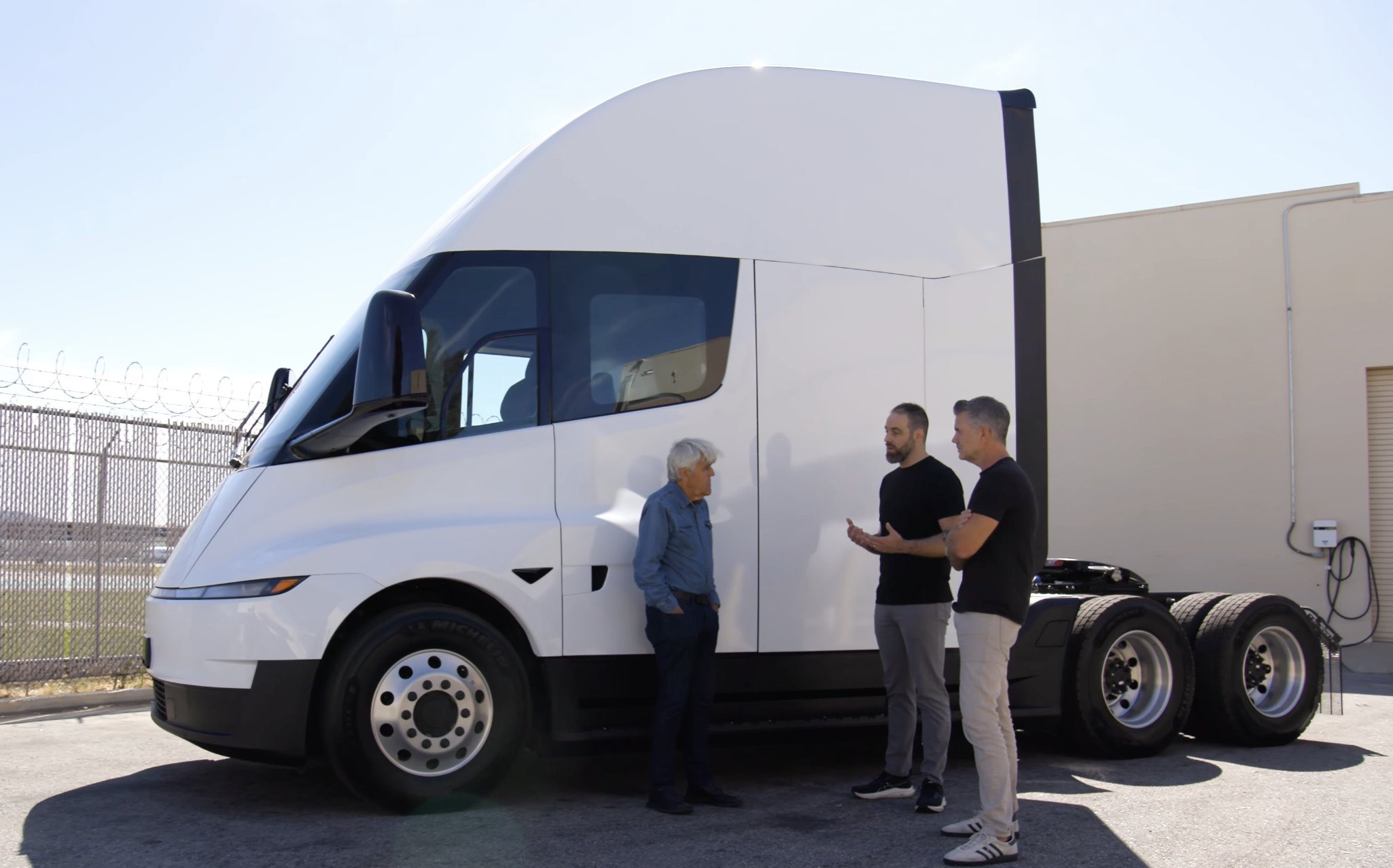
Tesla has revealed the various improvements it has made to the Semi with its redesign, which was unveiled late last year, on a new episode of Jay Leno’s Garage.
Tesla Chief Designer Franz von Holzhausen and Semi Program Director Dan Priestley joined Leno in a 47-minute segment revealing all of the various things it did to make the Semi even better as it heads toward volume production this year.
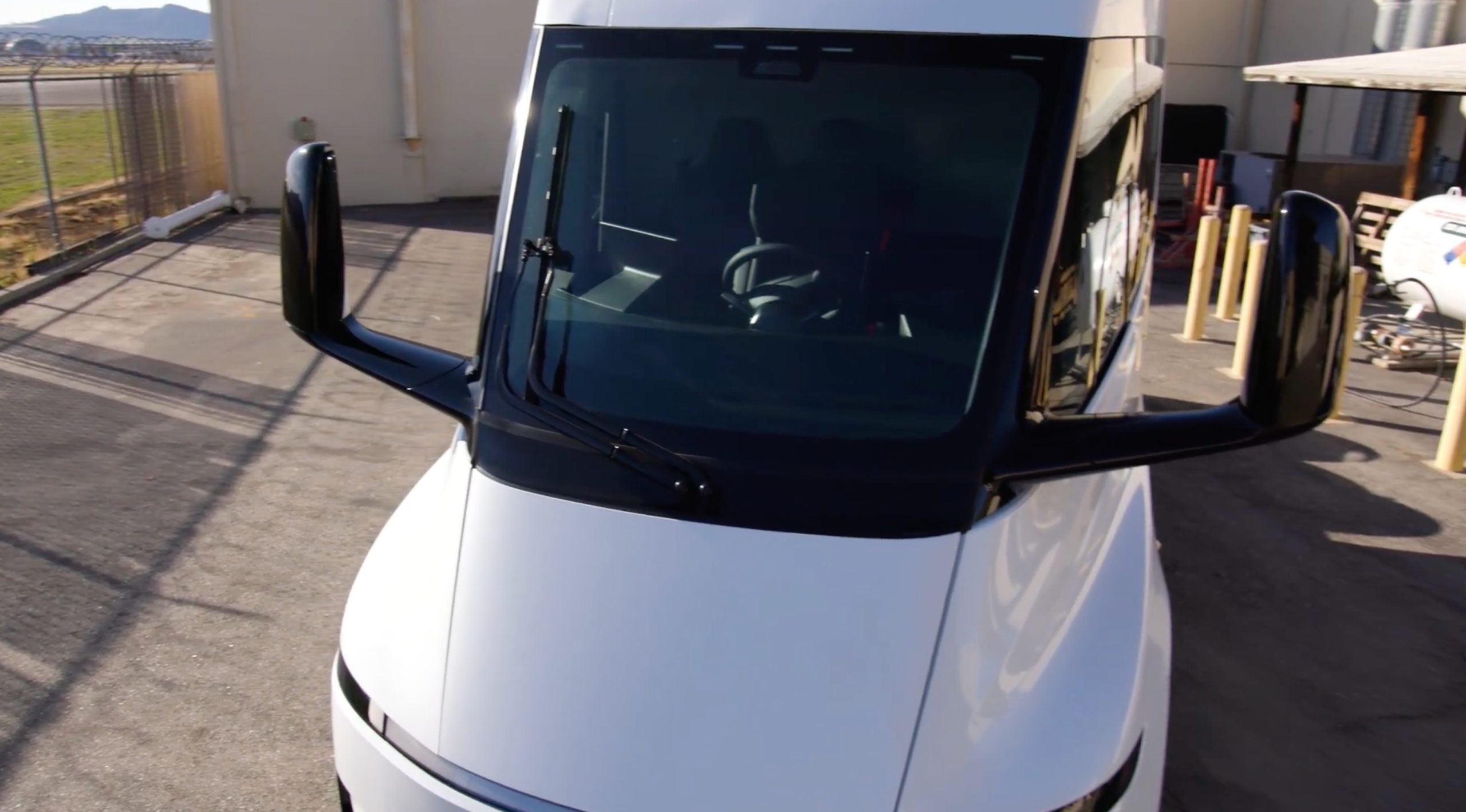
Last year, Tesla revealed it had updated the Semi design to fit the bill of its aesthetic, which, on its other vehicles, includes things like lightbars and a sleeker and more aerodynamic design. The changes were not all to appease the eye, but the drivers who will use the Semi on a daily basis to haul goods regionally as the program gets off the ground running.
Weight Reduction
Priestley revealed almost immediately that Tesla was able to cut out about 1,000 pounds of weight from the Semi compared to the previous version.
This does several things, all of which are positive to the mission of a Class 8 truck, which is to haul goods and obtain more efficient travel to cut down on logistics costs.
Initially, this can increase payload capacity, which is often the biggest value driver for fleets that frequently hit gross vehicle weight limits. Tesla’s early Pilot Program members, like PepsiCo. and Frito-Lay, are large-scale companies. They will benefit from a decreased overall weight.
Lighter vehicles also require less energy to accelerate, climb hills, and maintain highway speeds. This new design has that advantage, and as Leno said in his first drive with the Semi as he hauled another unit behind, “I don’t feel like I’m pulling anything.”
Drag Coefficient
Franz said one of the goals of the Semi was to get the drag coefficient down below that of a Bugatti Veyron. This would increase efficiency tremendously, a major need with a large truck like a Semi.
Drag coefficient is extremely valuable when it comes to electric vehicles, because the displacement of air is incredibly important for range ratings.
Franz said aerodynamic efficiency has been improved by 7 percent compared to the last model. He says the coefficient is around 0.4.
New Features and Improvements
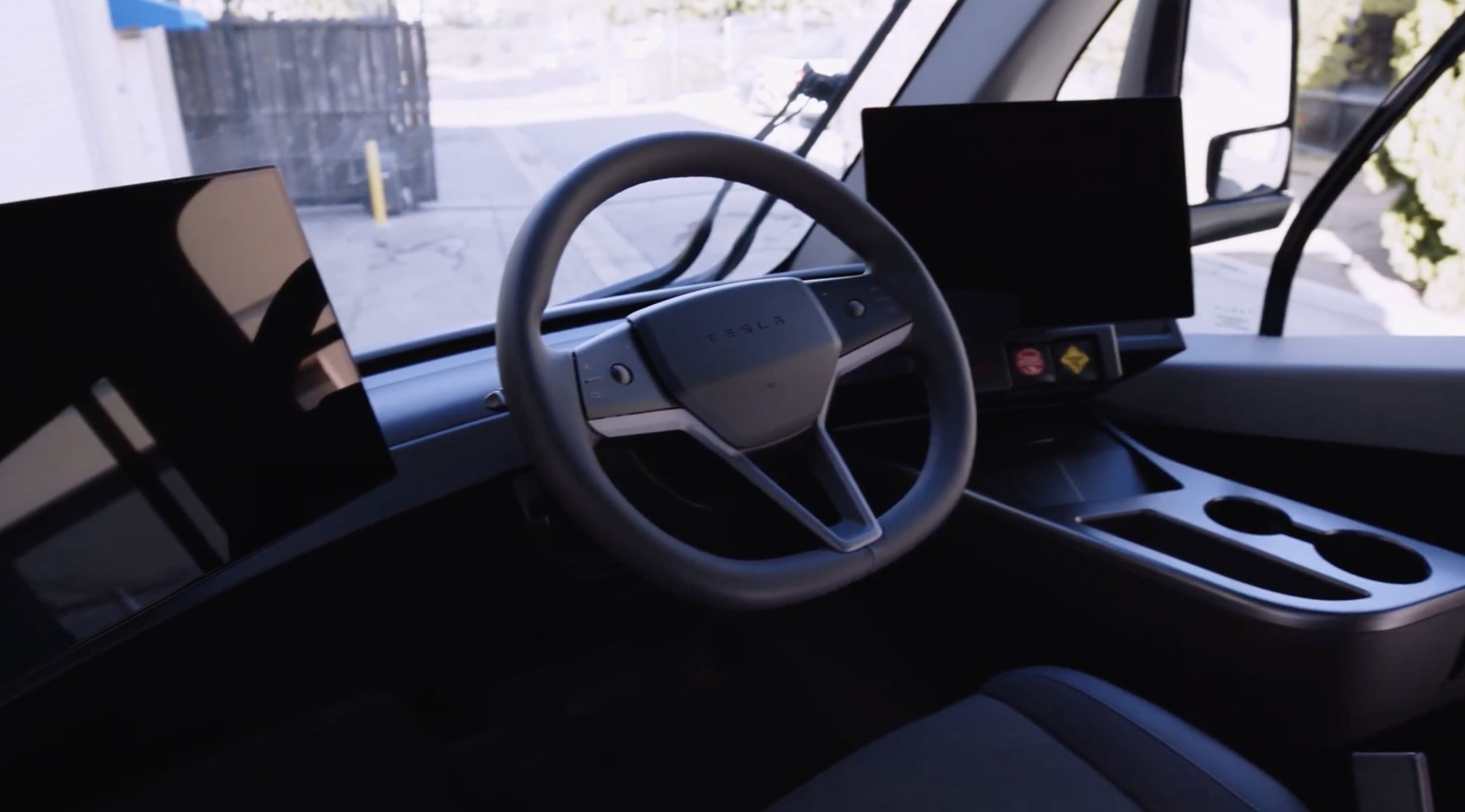
Priestley shed some additional light on the Semi and some of the improvements the company has made under the hood.
These include:
- Fully Electric Steering Assist
- Cybertruck actuators are being used for more strength
- Tesla included a 48-volt architecture
- Semi will utilize 4680 battery cells, which are designed to last 1 million miles
These changes come after Tesla rolled out the Semi to various companies for its Pilot Program, which yielded tremendous results. Due to the years it has been working with those companies, it knew what things it had to change and what it had to improve upon before selling the Semi openly.
Fleet Data
The fleet data Tesla has gathered from the Pilot Program has been one of the most widely discussed parts of the Semi program.
Franz and Priestley said that there are currently a few hundred Semi units in the real world, and Tesla has gathered 13.5 million miles. One of those units has traveled over 440,000 miles in the years it has been on the road.
Tesla Semi’s latest adoptee will likely encourage more of the same
Pilot Program members have reported an uptime of 95 percent, and Tesla’s maintenance and Service teams have kept things running:
“80% of breakdowns if you have one, are returned back to the customer in less than 24 hours, and half are back in less than 1 hour.”
Demand
Priestley says demand for the Semi has never been higher, and due to the recent political climate and the impact things have had on gas prices, Tesla has never received more inquiries for the Semi than it has recently.
Many companies will be surprised to hear that the Semi Pilot Program has been an overwhelming success. As Tesla begins to build out the infrastructure for the vehicle, it will only benefit the all-electric Class 8 trucks that keep things moving.
CEO Elon Musk said Tesla plans to start high-volume production this year. The company also plans to start deliveries this year.

Elon Musk’s Boring Co. Tunnel Vision Challenge ends with a surprise for Louisiana, Maryland and Dallas

Tesla launches first ‘true’ East Coast V4 Supercharger: here’s what that means


