News
Tesla Model Y on FSD saves couple after encountering King of edge cases
Experts have noted that if confirmed, this could be the world’s first recorded meteorite collision involving a Tesla.

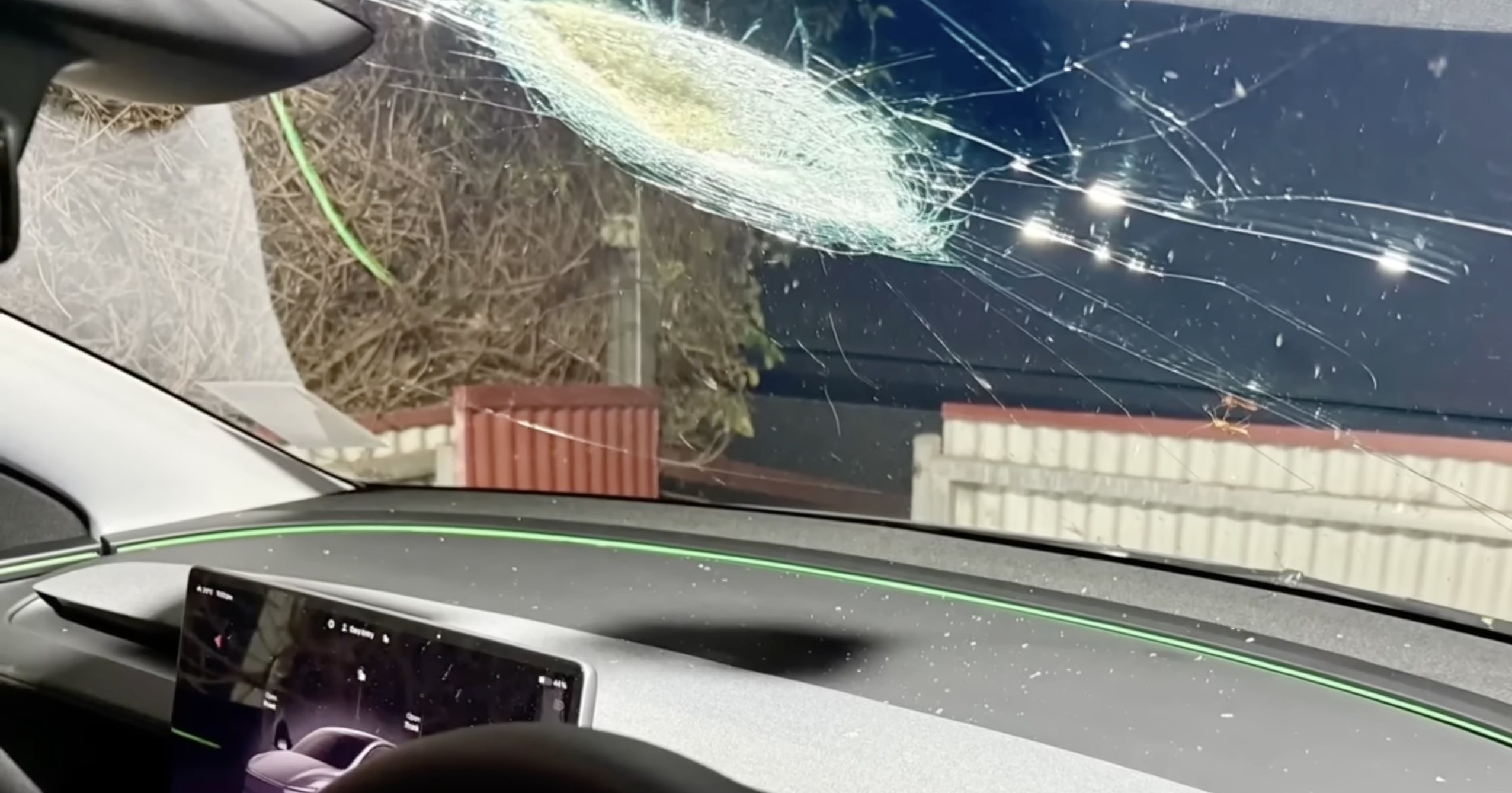
A South Australian Tesla driver is thanking his Model Y’s Full Self-Driving system after a mysterious object, possibly a meteorite, slammed into his car’s windshield while it had FSD engaged.
The impact sent hot glass fragments flying through the cabin as the vehicle continued driving without human input through the darkness. Experts have noted that if confirmed, this could be the world’s first recorded meteorite collision involving a Tesla.
The Tesla owner was enjoying a quiet drive home when they hit the king of edge cases
Veterinarian Dr. Andrew Melville-Smith and his wife were traveling north on Augusta Highway on the night of October 19 when a sudden blast struck their newly delivered Model Y. At the time, it was clear, pitch black night, and Dr. Melville-Smith and his wife were just listening to a podcast while FSD was operating the vehicle, as noted in a Yahoo News report.
Suddenly, something hit the Tesla’s windshield. “Then there was, (what) I can only describe as a very, very violent explosion. The whole inside of the car was literally blasted with glass fragments. It was full of white smoke, and it smelled like the car was on fire,” Dr. Melville-Smith stated.
The vet stated that he and his wife were stunned for a good 10 seconds, and for a bit, he and his wife thought they had crashed. Images of the crash’s aftermath showed a massive crack on the Tesla’s windshield, which Dr. Melville-Smith noted was hot to the touch. The object that hit the Tesla’s windshield was so hot that part of the vehicle’s windshield was partly melted.
FSD kept driving despite the possible meteorite strike
Thankfully, the Tesla was operating with its FSD (Supervised) system engaged at the time. Thus, despite the vehicle being hit by what might be a literal meteorite, and despite Dr. Melville-Smith and his wife being stunned because of the impact, their Tesla just kept driving steadily.
“I thought we’d had an accident, but then I looked at the screen and went ‘Oh, we’re still driving. We were moving around, so it obviously thought we were paying attention, and it was happy to keep driving to Port Augusta. After we pulled over, we saw the big crater in the windscreen,” the vet said.
The South Australian Museum is now examining the case, with geologist Dr. Kieran Meaney stating the scorched glass and heat damage do suggest a potential meteorite strike. “The little detail that’s really selling it for me at the moment is that whatever it was that hit the windscreen seems to have been very hot,” Meaney explained. However, the object has yet to be recovered.
Check out a video of the remarkable edge case below.


News
Tesla’s troublesome Auto Wipers get a major upgrade
Tesla has quietly deployed a major over-the-air (OTA) update across its entire fleet, implementing a new patent that could finally solve one of the most complained-about features in its vehicles: the Auto Wipers.

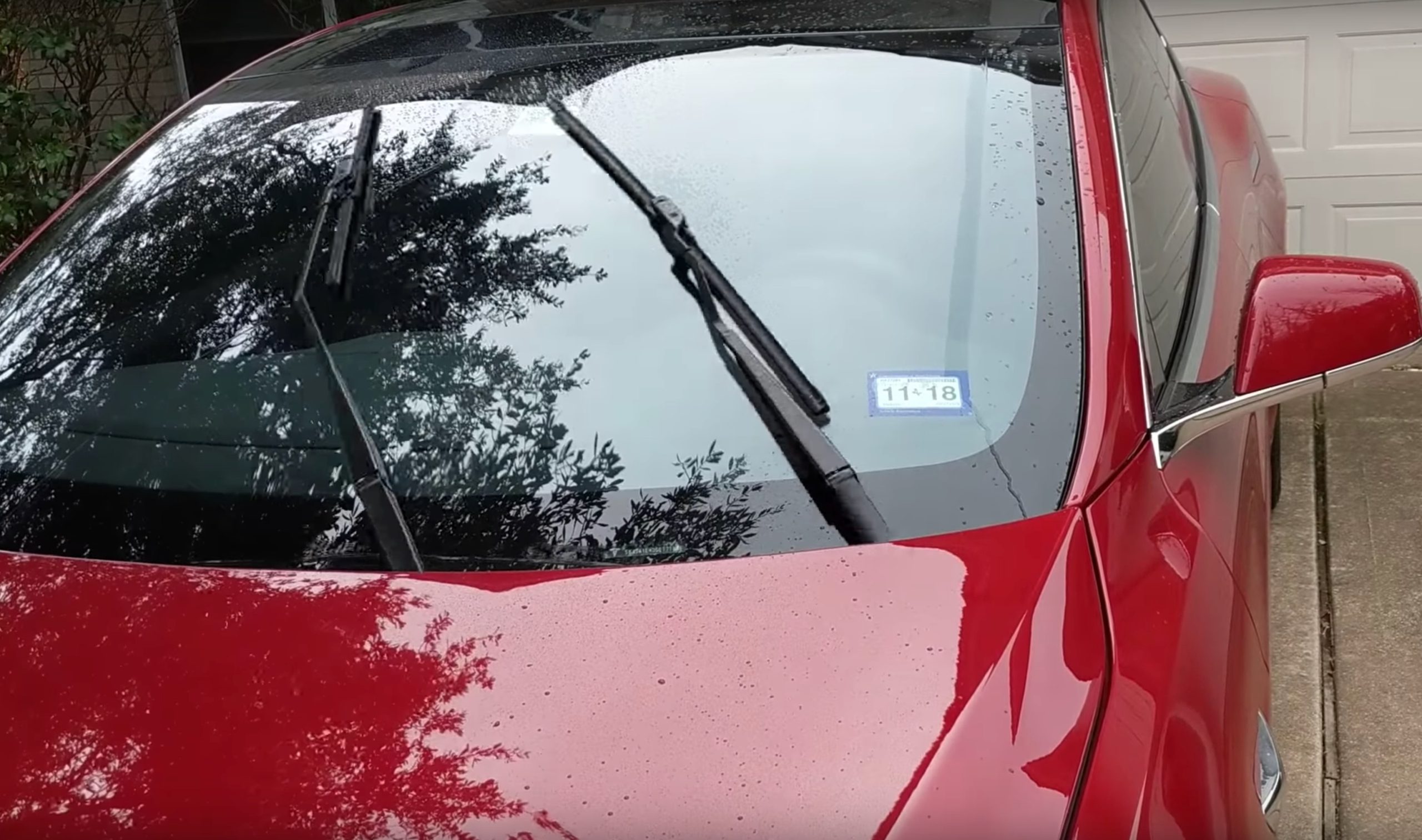
One of Tesla’s most complained-about features is that of the Auto Wipers, but they have recently received a major upgrade that impacts every vehicle in the company’s fleet, a company executive confirmed.
Tesla has quietly deployed a major over-the-air (OTA) update across its entire fleet, implementing a new patent that could finally solve one of the most complained-about features in its vehicles: the Auto Wipers.
Confirmed by senior Tesla AI engineer Yun-Ta Tsai on April 10, the improvement is based on patent US 20260097742 A1. It introduces an “energy balance model” that adds a tactile, physics-driven layer to the existing camera-based system—without requiring any new hardware.
🚨 Tesla has already implemented a new patent that improves the accuracy of the Auto Wiper system https://t.co/QjjKHKxSNv pic.twitter.com/mEbd04oJAu
— TESLARATI (@Teslarati) April 10, 2026
Tesla drivers have griped about auto wipers since the company ditched traditional rain sensors in favor of Tesla Vision around 2018.
Owners routinely report the wipers failing to activate in light drizzle or mist, leaving windshields streaked and visibility dangerously reduced. Just as often, they formerly blasted into high-speed mode on dry, sunny days, screeching across glass and risking scratches or premature blade wear.
This is a rare occurrence anymore, but many owners still report the feature having the wipers perform at the incorrect speed or frequency when precipitation is falling.
Tesla has tried repeatedly to fix the problem through software alone.
Early “Deep Rain” initiatives and the 2023 Autowiper v4 update used multi-camera video and refined neural networks, with Elon Musk promising “super good” performance. The 2024.14 update added manual sensitivity boosts, and later FSD versions claimed further gains. Yet complaints persisted.
Elon Musk apologizes for Tesla’s quirky auto wipers, hints at improvements
Vision systems struggle with edge cases—glare, bugs, reflections, or faint mist—because they rely purely on visual inference rather than physical detection
The new patent takes a different approach. The car’s computer constantly measures electrical power delivered to the wiper motor. It subtracts predictable losses—internal motor friction, linkage drag, and aerodynamic resistance—leaving only the friction force between the rubber blade and windshield glass.
Water lubricates the glass, sharply reducing friction; dry or icy surfaces increase it dramatically. This real-time “tactile” data acts as an independent check on the camera’s visual cues, instantly shutting down false triggers on dry glass and fine-tuning speed for actual rain.
The system can also detect ice and auto-activate defrost heaters, while long-term friction trends alert drivers when blades need replacing.
By fusing vision with precise motor-load physics, Tesla has created a hybrid sensor that is both elegant and cost-free. Owners have waited years for reliable auto wipers; this OTA rollout may finally deliver them.
News
Tesla Roadster unveiling set for this month: what to expect
As Tesla finally edges toward production and an updated reveal, enthusiasts aren’t asking for compromises; they’re demanding the original vision be honored. Here are five clear expectations that will come with the vehicle’s unveiling, which is still set for later this month, hopefully.
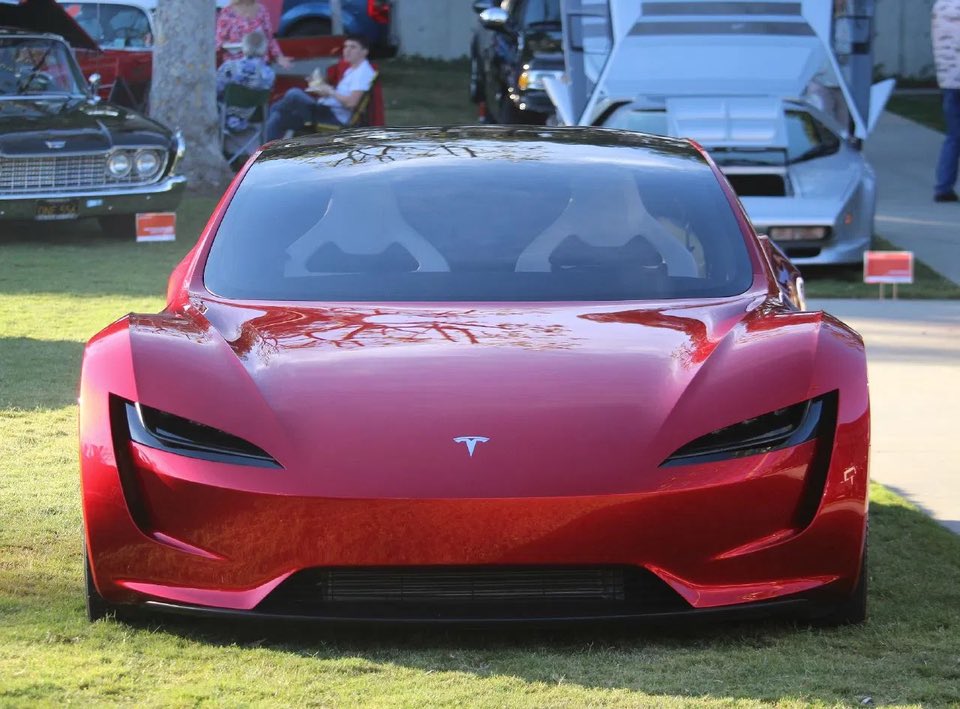
The Tesla Roadster has been the ultimate carrot on a stick since its 2017 unveiling. Promised as the fastest production car ever made, with 0-60 mph in under two seconds and a top speed over 250 mph, it has endured years of delays.
As Tesla finally edges toward production and an updated reveal, enthusiasts aren’t asking for compromises; they’re demanding the original vision be honored. Here are five clear expectations that will come with the vehicle’s unveiling, which is still set for later this month, hopefully.
Performance and Safety Do Not Go Hand in Hand, and That’s the Point
The Roadster is not a family sedan or a daily commuter. It is a no-holds-barred supercar meant to embarrass six-figure exotics on track days. Tesla should resist the temptation to load it with every passive-safety nanny and electronic guardian that dulls the raw feedback drivers crave.
Owners want to feel the road, not be shielded from it. Strip away unnecessary electronic limits so the car can deliver the visceral thrill Elon Musk originally described. Safety ratings will still be strong because of Tesla’s structural excellence, but the Roadster’s mission is speed, not coddling.
He said late last year:
“This is not a…safety is not the main goal. If you buy a Ferrari, safety is not the number one goal. I say, if safety is your number one goal, do not buy the Roadster…We’ll aspire not to kill anyone in this car. It’ll be the best of the last of the human-driven cars. The best of the last.”
Musk was clear that this will not be a car that will be the safest in Tesla’s lineup, but that’s the point. It’s not made for anything other than pushing the limits.
Tesla Needs to Come Through on a HUGE Feature
The Roadster unveiling would be wildly disappointing if it were only capable of driving. Tesla has long teased the potential ability to float or hover, and they need to come through on something that is along those lines.
The SpaceX cold-gas thruster package was never a joke. Musk, at one time, explicitly said owners could opt for a set of thrusters capable of lifting the car off the ground for short hops or dramatic launches. That feature is what separates the Roadster from every other hypercar on the planet.
If the production version arrives without it—or with a watered-down “maybe later” version—enthusiasts will feel betrayed. Deliver the thrusters, make them functional, and let the Roadster literally hover above the competition.
An Updated Design Might Be Warranted
It’s been nine years since Tesla first rolled off the next-gen Roadster design and showed it to the world.
The 2017 concept still looks sharp, but eight years is an eternity in automotive styling. The sharp lines and aggressive stance now compete against the angular Cybertruck and the next-generation vehicles rolling out of Fremont and Austin.
Tesla Roadster patent hints at radical seat redesign ahead of reveal
A subtle refresh, maybe with sharper headlights, revised aero elements, and modern materials, would keep the Roadster feeling current without losing its identity. Fans don’t want a complete redesign, just enough evolution to prove Tesla still cares.
Self-Driving Isn’t a Necessity for the Tesla Roadster
Full Self-Driving hardware and software belong in the Model 3, Model Y, and the upcoming robotaxi—not in a two-seat rocket built for canyon carving. The Roadster’s entire appeal is the direct connection between driver, steering wheel, and asphalt.
Offering FSD as standard would dilute the purity that separates it from every other Tesla. Make autonomy an optional delete or simply omit it. Let the Roadster remain the purest driving machine in the lineup, because that’s what it is all about.
Tesla Needs to Come Through on the Unveiling Timeline
The last thing Tesla needs right now is another complaint about not hitting timelines or expectations. This unveiling has already been pushed back one time, from April 1 to “probably in late April.”
Repeated delays have tested even the most patient fans. Whatever date the company now sets for the next major reveal or start of production must be met. No more “next year” promises. The Roadster has waited long enough. When it finally arrives, it must feel worth every extra month.
If Tesla hits these five marks, the Roadster won’t just be another fast car—it will be the machine that redefines what a Tesla can be. The world is watching.
News
Tesla Cabin Camera gets an incredible new feature for added driver safety
The company quietly expanded the capabilities of its in-cabin camera with the rollout of Software Update 2026.8.6. Tesla hacker greentheonly revealed that coding for the software version provides details on now tracking the age of the driver.
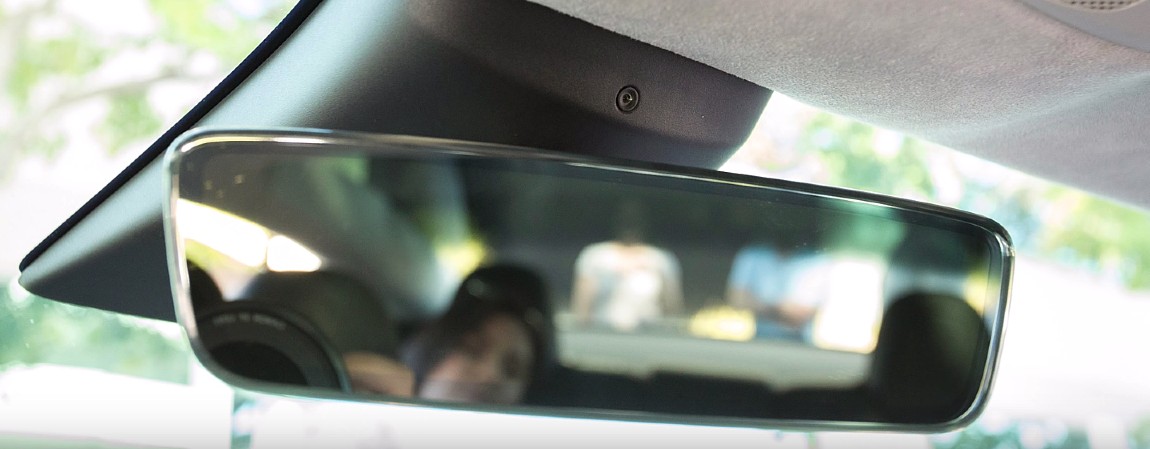
Tesla’s interior Cabin-facing Camera just got a brand new feature that is an incredible addition, as it provides yet another layer of added safety.
The company quietly expanded the capabilities of its in-cabin camera with the rollout of Software Update 2026.8.6. Tesla hacker greentheonly revealed that coding for the software version provides details on now tracking the age of the driver.
The camera, which is positioned just above the rearview mirror, is now performing facial analysis to estimate the driver’s age. While not yet user-facing, the feature is the latest example of Tesla’s ongoing push to refine its driver monitoring system for both everyday safety and future Robotaxi operations.
Ha, interesting, cabin camera / driver monitor is now (2026.8.6) doing “driver age” checking.
I wonder if it’s going to filter out children or elderly too?
— green (@greentheonly) April 10, 2026
The cabin camera already processes images entirely onboard the vehicle for privacy, sharing data with Tesla only if owners enable it during safety-critical events.
Age estimation likely uses computer vision to classify facial features, similar to existing attention-tracking algorithms. Potential applications include preventing underage drivers from engaging Full Self-Driving (FSD) or shifting into drive, acting as a secondary safety lock.
It could also be linked to Robotaxi readiness: the upcoming Cybercab will need robust occupant verification to ensure children cannot hail or ride unsupervised.
In consumer vehicles, it could enable tailored FSD behaviors—more conservative acceleration and braking for elderly drivers, for instance—or simply block unauthorized use by minors.
Beyond age checks, the cabin camera powers Tesla’s comprehensive driver monitoring system, introduced years earlier and continuously improved. It first gained prominence for detecting inattentiveness. When Autopilot or FSD is active, the camera tracks eye gaze, head position, and steering inputs in real time.
If the driver looks away too long or fails to keep their hands ready, the system issues escalating visual and audible alerts before disengaging assistance. This has dramatically reduced misuse cases and helped Tesla meet stricter regulatory demands for hands-on supervision.
The camera also monitors for drowsiness. Activated above roughly 40 mph (65 km/h) after at least 10 minutes of manual driving, the Driver Drowsiness Warning analyzes facial cues—frequency of yawns and blinks—alongside driving patterns like lane drifting or erratic steering.
When fatigue is detected, a clear on-screen message and chime prompt the driver to pull over and rest, or even to activate Full Self-Driving. Tesla explicitly states this feature enhances active safety without relying on facial recognition for identity.
These layered capabilities create a robust safety net. Inattentiveness detection alone has curbed distracted driving during assisted operation. Drowsiness alerts address a leading cause of highway crashes by intervening before impairment escalates.
Adding age verification extends this protection: it could flag inexperienced young drivers for extra caution or restrict high-autonomy features, while preparing vehicles for a future where robotaxis must safely manage passengers of all ages.
With privacy safeguards intact and processing done locally, Tesla’s cabin camera continues evolving from a simple attention monitor into a sophisticated guardian—advancing safer roads today and autonomous mobility tomorrow.

Tesla’s troublesome Auto Wipers get a major upgrade

Tesla Roadster unveiling set for this month: what to expect


