
News
Tesla’s spring update arrives with adaptive headlights and more
The highly anticipated adaptive headlights are finally set to roll out to owners in the U.S. and Canada.

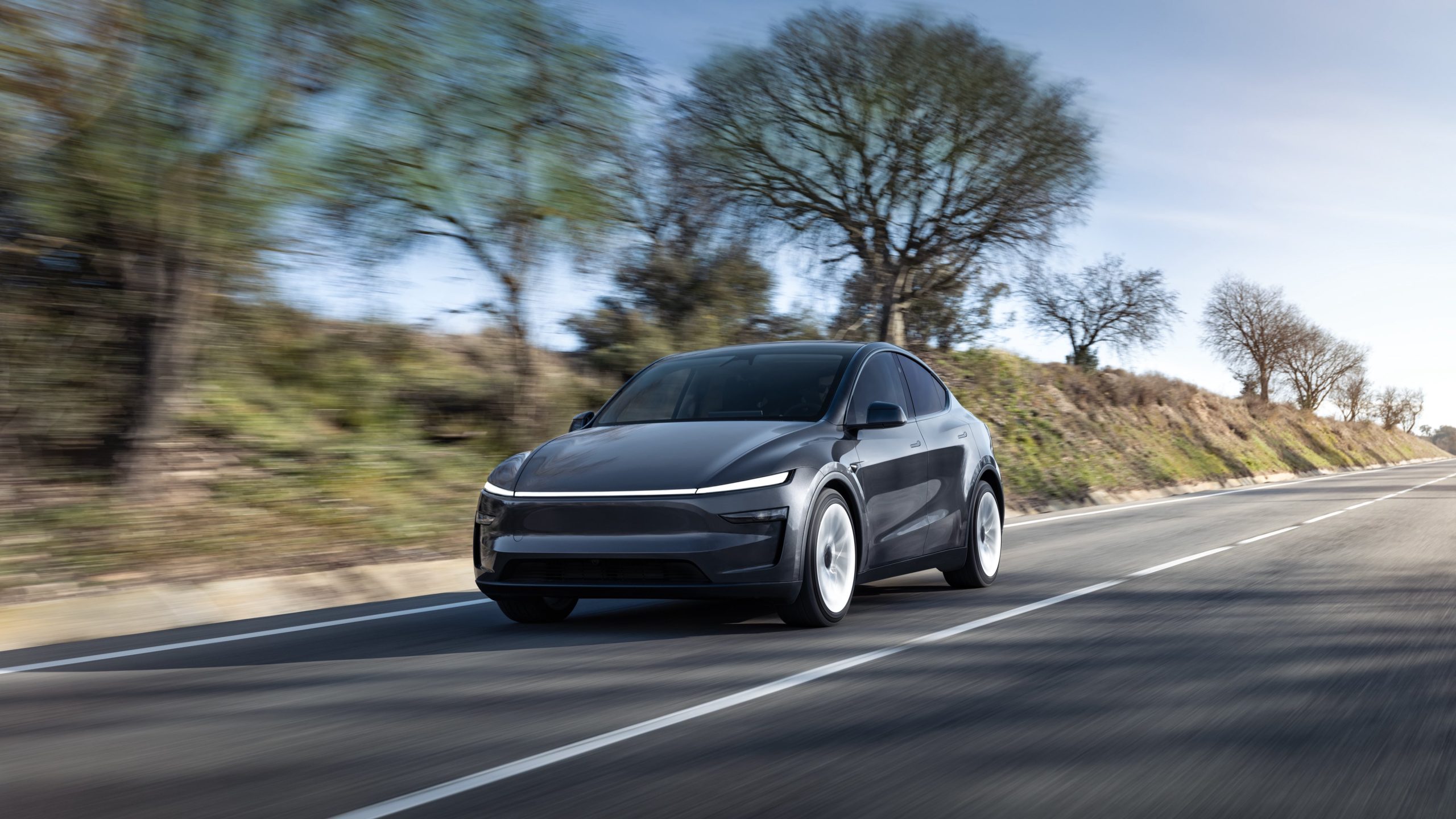
Tesla shared release notes for its spring update over the weekend, and the forthcoming update includes new features such as the highly anticipated adaptive headlights, custom trunk height settings, and more.
In a post on X on Saturday, Tesla said that the 2025 spring update would be rolling out soon, along with noting that the software version would include the highly anticipated adaptive headlights for owners in the U.S. and Canada. The update also adds features such as the ability to set custom frunk and trunk heights at saved locations, view and select alternative trip routing plans, and a number of other minor improvements.
After the release of the new Model Y, Tesla’s VP of Vehicle Engineering Lars Moravy confirmed in February that the matrix headlights and adaptive headlights would be making their way to the U.S. soon, alongside their inclusion in the refreshed model. Additionally, Moravy went on to confirm that the adaptive headlights would be coming to the Cybertruck after speculation around the topic.
READ MORE ON TESLA SOFTWARE UPDATES: Tesla’s new Model Y gets first software update—Here’s what’s in it
You can see the full release notes for Tesla’s 2025 spring update below, as shared by the company over the weekend.
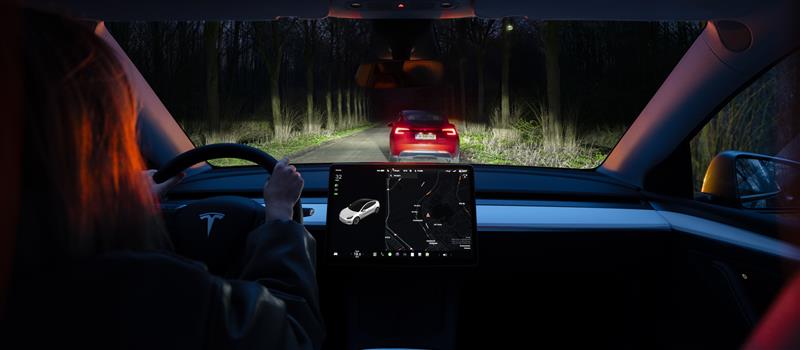
Adaptive Headlights (U.S. and Canada)
Credit: Tesla | X
High beams adapt to reduce glare for other drivers and cyclists. By detecting other road users, and selectively dimming individual pixels of the headlight, your high beams stay on more often for greater visibility at night.
If your vehicle has the necessary hardware, you will see the setting under Controls > Lights > Adaptive Headlights
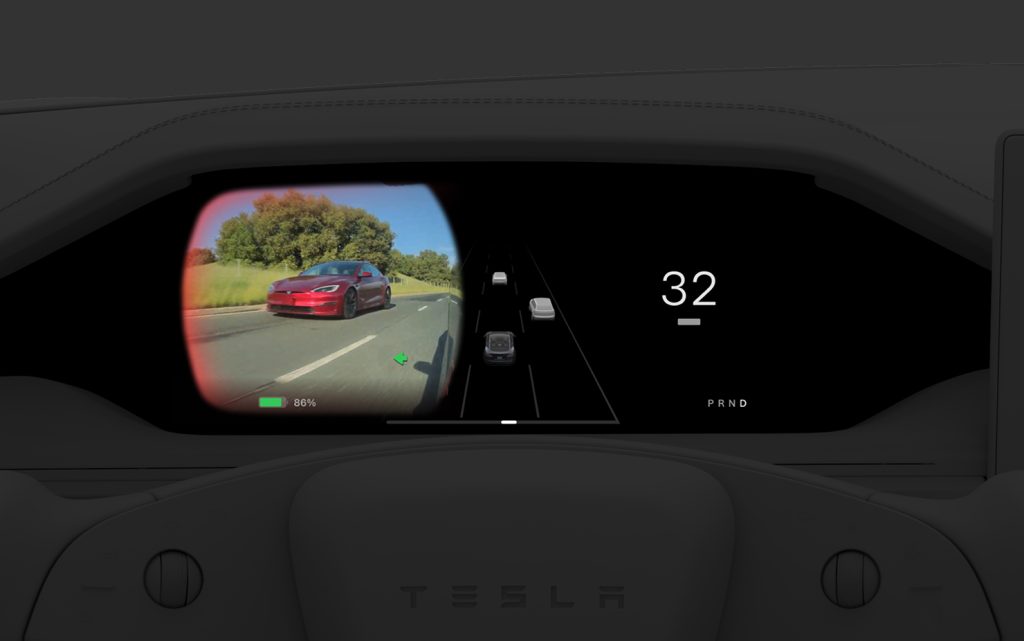
Blind Spot Camera on Driver Screen (New Model S/X)
Credit: Tesla | X
Blind Spot Camera feed is now available on the instrument panel.
Controls > Display > Automatic Blind Spot Camera & select Driver Screen
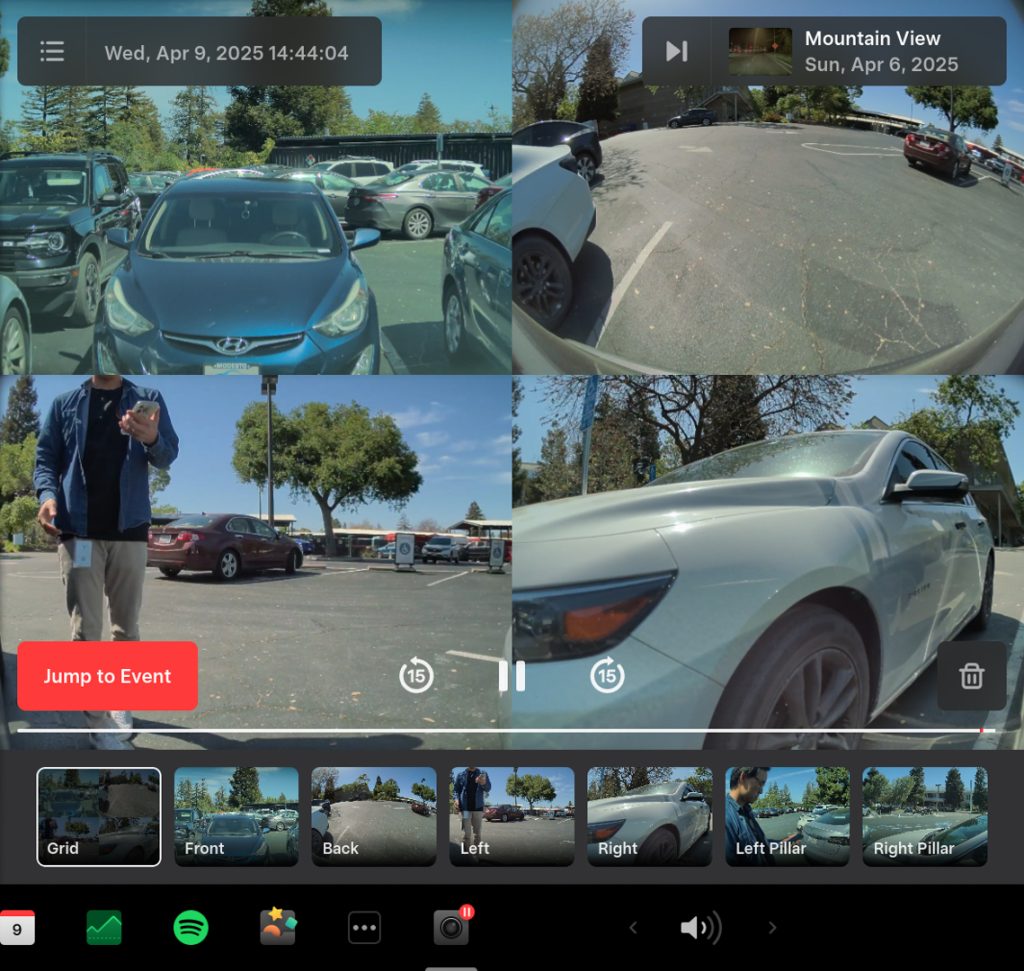
Dashcam Update & Side Camera Recording (Newer Model S, 3, X, and Y)
Credit: Tesla | X
Your vehicle’s side cameras (B-Pillar) will now be recorded to both Dashcam and Sentry clips, increasing the total number of camera views from 4 to 6.
The Dashcam Viewer app has also been redesigned with a grid view and quick access to the next video, making it easier review recordings.
Alternative Trip Plans
Credit: Tesla | X
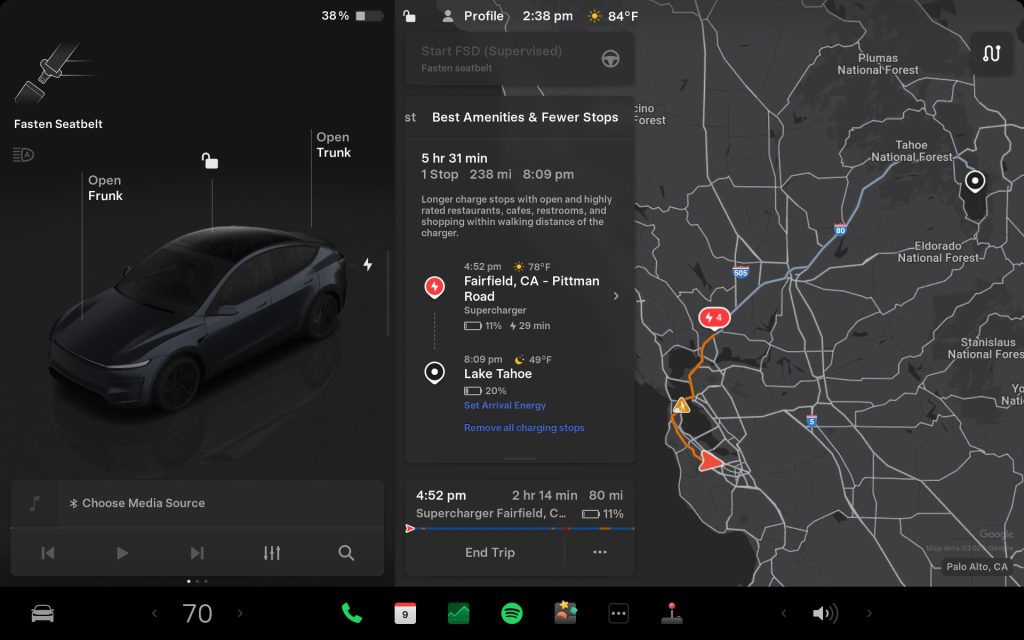
Multiple trip plans are now available for you to choose from, allowing you to better suit your travel needs. Also, when viewing a charger location page, nearby restaurants, cafes, and shops within walking distance are displayed at the bottom
Fastest: offers the quickest route
Best Amenities: prioritizes stops near open and highly rated restaurants, shops, and restrooms
Fewer Stops: minimizes charging stops
Comfort Drive Mode in Autopilot (Cybertruck)
Your Cybertruck will now automatically transition to Comfort Drive Mode when Autopilot is engaged.
Lane Departure Avoidance (Cybertruck)
Credit: Tesla | X
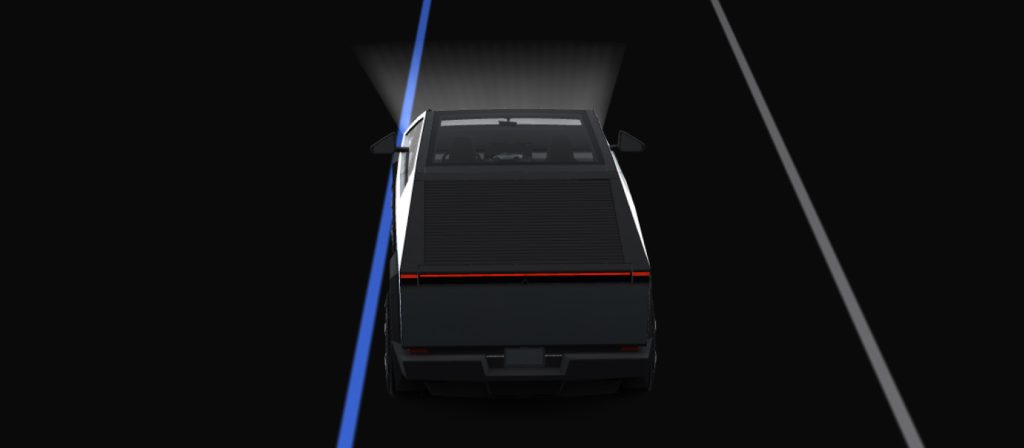
This feature warns you if your vehicle drifts near or out of your lane. With this update, your Cybertruck can now also assist you.
When enabled, a blue indicator line will appear on the touchscreen, showing which lane marking is being crossed. You can customize Lane Departure Avoidance in Controls > Autopilot > Lane Departure Avoidance.
Save Trunk Height Based on Location (Model 3, Model Y, New Model S/X, New Model 3)
Credit: Tesla | X
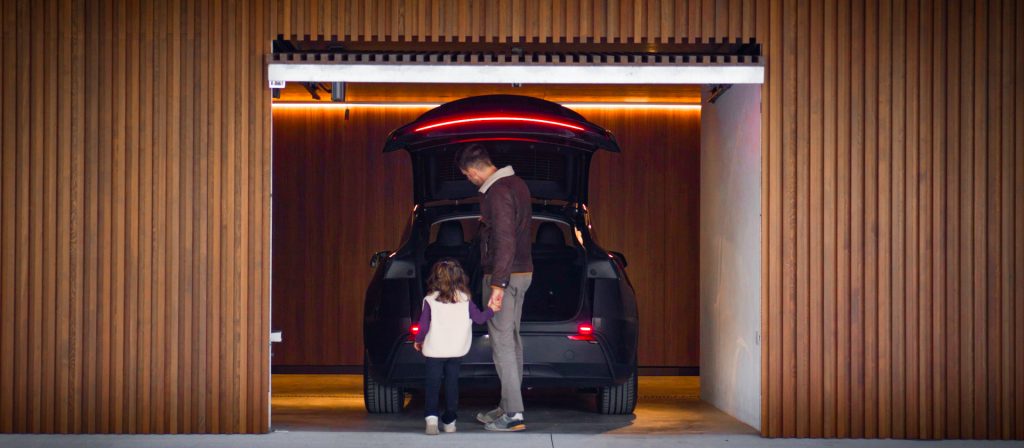
Customize the opening height of your trunk & save it as the default for a specific location, such as your garage.
To set height, manually adjust the lift gate to your preferred opening height, then press & hold the trunk close button until you hear a chime.
Save Frunk Height Based on Location (Cybertruck)
Customize the opening height of your frunk & save it as the default or for a specific location, such as your garage. Manually adjust to your preferred height, then press & hold frunk exterior button until you hear a chime.
Avoid Highways
Navigation can now avoid highways when possible. Go to Controls > Navigation > Avoid Highways
Keyboard languages
Credit: Tesla | X
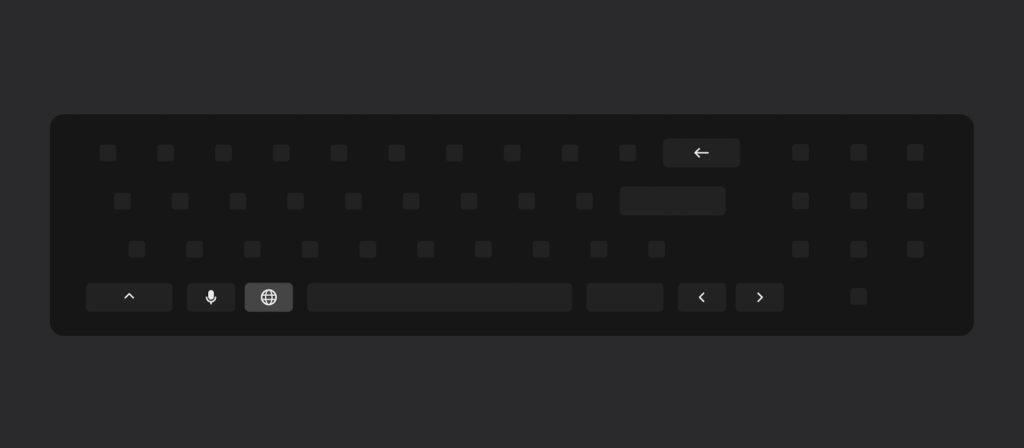
Switch between different language input methods on your touchscreen. Go to Controls > Display > Keyboards
Keep Accessory Power On
Use or charge devices through USB ports / inductive phone charger / low voltage outlets (depending on what your vehicle is equipped with) after exiting your Tesla, as long as battery is >20 percent
Minor Updates
- Media search results are now filtered by sources, providing faster and more streamlined access to content
- You can now shuffle an entire Apple Music playlist that contains more than 100 songs
- Easily scroll through your SiriusXM favorites by tapping the steering wheel button left or right
- Sign in with your Amazon Music Free account. Requires Premium Connectivity or an active WiFi connection
- See what song will play next on YouTube Music playlists in the Up Next view of the media player
- If your hotspot is enabled, it will automatically connect to your vehicle once you start driving, so you won’t have to reconnect each time
Tesla launches Holiday Update: Apple Watch app, Sentry Mode upgrades, and more





News
Tesla debuts hands-free Grok AI with update 2025.26: What you need to know
All new Tesla vehicles delivered on or after July 12, 2025, will include Grok AI out of the box

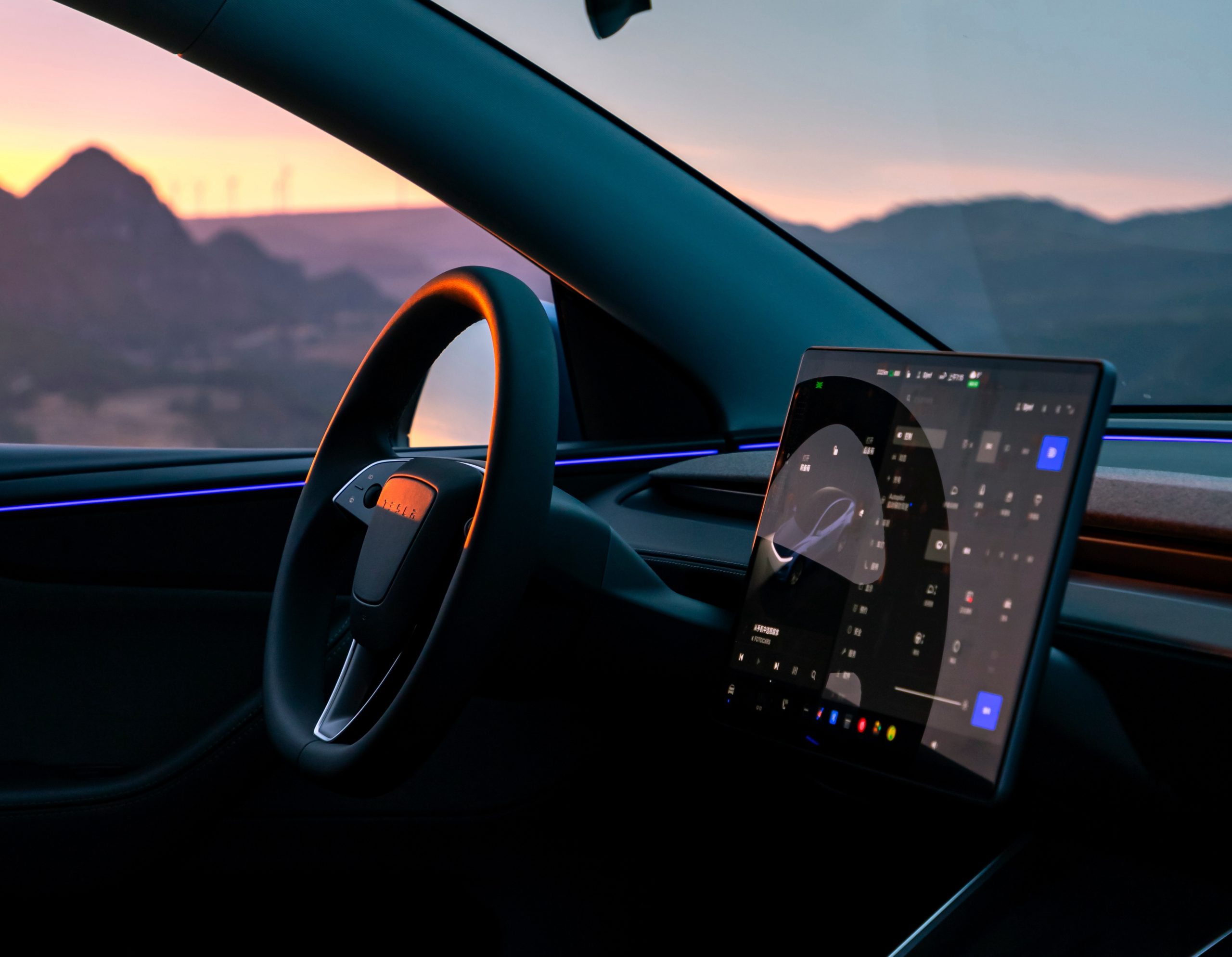
Tesla has begun rolling out Grok, an in-car conversational AI assistant developed by xAI, to eligible vehicles starting July 12. The feature marks the most direct integration yet between Elon Musk’s artificial intelligence startup and Tesla’s consumer product lineup, offering drivers hands-free access to a chat-style companion while on the road.
Grok comes pre-installed on new vehicles
According to Tesla’s FAQ page for the feature, all new vehicles delivered on or after July 12, 2025, will include Grok AI out of the box. Owners of older vehicles may gain access through an over-the-air update, provided their vehicle meets a few hardware and software requirements.
Specifically, Grok is currently only supported on Tesla models equipped with an AMD infotainment processor and running vehicle software version 2025.26 and higher. Compatible models include the Model S, Model 3, Model X, Model Y, and Cybertruck. A Premium Connectivity subscription or active Wi-Fi connection is also required.
Tesla notes that additional vehicle compatibility may arrive in future software updates.
Grok’s features and limitations for now
Drivers can engage with Grok using the App Launcher or by pressing and holding the voice command button on the steering wheel. Grok is designed to answer questions and hold conversations using natural language, offering responses tailored to its chosen personality—ranging from “Storyteller” to the more eccentric “Unhinged.”
For fun, Tesla posted a demonstration of Grok likely running on “Unhinged” talking about what it would do to Optimus when they are on a date, much to the shock of the humanoid robot’s official social media account.
It should be noted, however, that Grok cannot currently issue commands to the vehicle itself, at least for now. Traditional voice commands for tasks like climate control, navigation, or media remain separate from Grok as of writing.
The feature is being released in Beta and does not require a Grok account or xAI subscription to activate, although that policy may change over time.
Grok privacy and in-car experience
Tesla emphasizes that interactions with Grok are securely processed by xAI and not linked to a user’s Tesla account or vehicle. Conversations remain anonymous unless a user signs into Grok separately to sync their history across devices.
Tesla has also begun promoting Grok directly on its official vehicle webpages, showcasing the feature as part of its in-car experience, further highlighting the company’s increasing focus on AI and infotainment features on its all-electric vehicles.
News
Tesla cleared in Canada EV rebate investigation
Tesla has been cleared in an investigation into the company’s staggering number of EV rebate claims in Canada in January.
Canadian officials have cleared Tesla following an investigation into a large number of claims submitted to the country’s electric vehicle (EV) rebates earlier this year.
Transport Canada has ruled that there was no evidence of fraud after Tesla submitted 8,653 EV rebate claims for the country’s Incentives for Zero-Emission Vehicles (iZEV) program, as detailed in a report on Friday from The Globe and Mail. Despite the huge number of claims, Canadian authorities have found that the figure represented vehicles that had been delivered prior to the submission deadline for the program.
According to Transport Minister Chrystia Freeland, the claims “were determined to legitimately represent cars sold before January 12,” which was the final day for OEMs to submit these claims before the government suspended the program.
Upon initial reporting of the Tesla claims submitted in January, it was estimated that they were valued at around $43 million. In March, Freeland and Transport Canada opened the investigation into Tesla, noting that they would be freezing the rebate payments until the claims were found to be valid.
READ MORE ON ELECTRIC VEHICLES: EVs getting cleaner more quickly than expected in Europe: study
Huw Williams, Canadian Automobile Dealers Association Public Affairs Director, accepted the results of the investigation, while also questioning how Tesla knew to submit the claims that weekend, just before the program ran out.
“I think there’s a larger question as to how Tesla knew to run those through on that weekend,” Williams said. “It doesn’t appear to me that we have an investigation into any communication between Transport Canada and Tesla, between officials who may have shared information inappropriately.”
Tesla sales have been down in Canada for the first half of this year, amidst turmoil between the country and the Trump administration’s tariffs. Although Elon Musk has since stepped back from his role with the administration, a number of companies and officials in Canada were calling for a boycott of Tesla’s vehicles earlier this year, due in part to his association with Trump.
News
Tesla Semis to get 18 new Megachargers at this PepsiCo plant
PepsiCo is set to add more Tesla Semi Megachargers, this time at a facility in North Carolina.
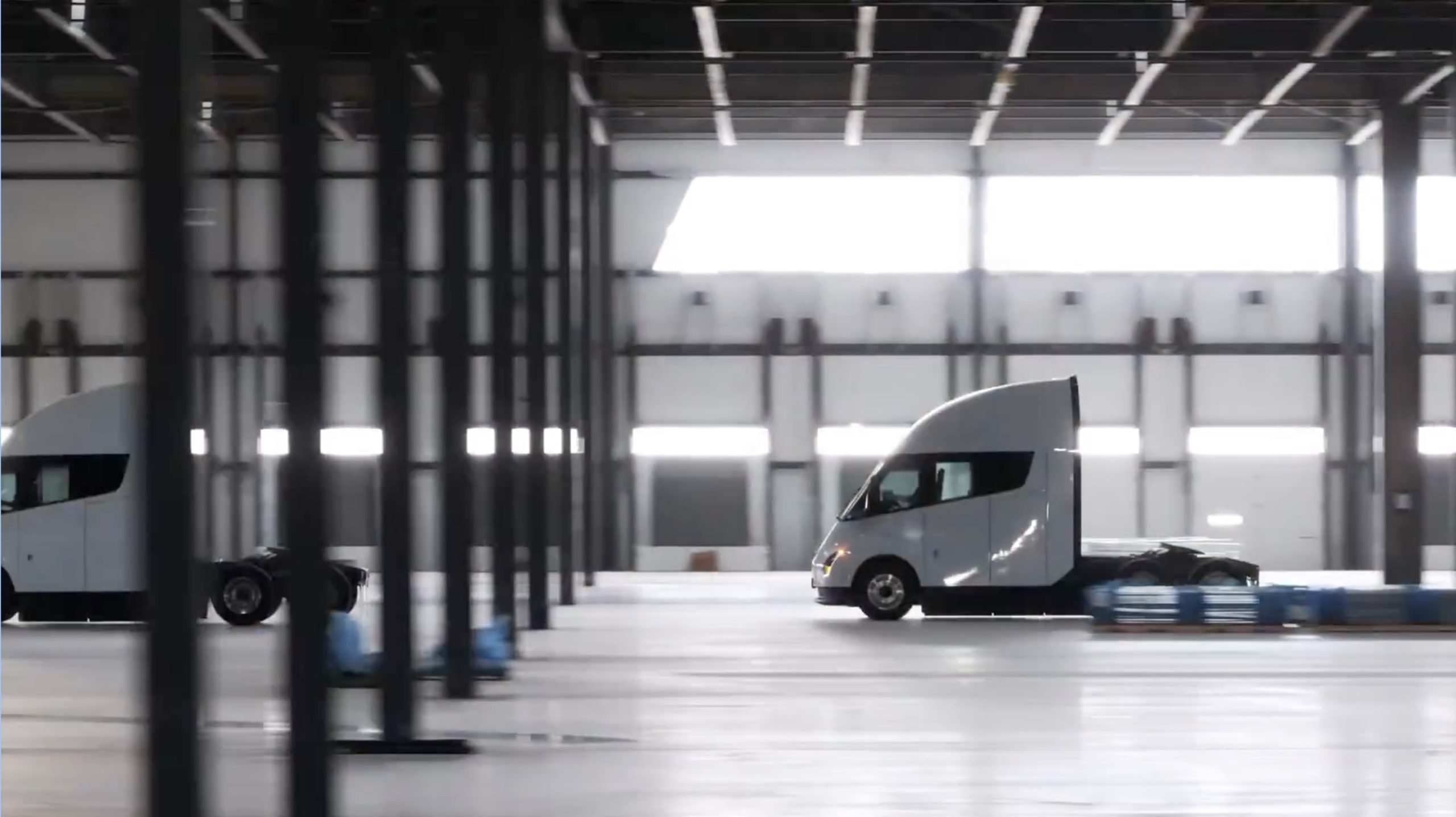
Tesla partner PepsiCo is set to build new Semi charging stations at one of its manufacturing sites, as revealed in new permitting plans shared this week.
On Friday, Tesla charging station scout MarcoRP shared plans on X for 18 Semi Megacharging stalls at PepsiCo’s facility in Charlotte, North Carolina, coming as the latest update plans for the company’s increasingly electrified fleet. The stalls are set to be built side by side, along with three Tesla Megapack grid-scale battery systems.
The plans also note the faster charging speeds for the chargers, which can charge the Class 8 Semi at speeds of up to 1MW. Tesla says that the speed can charge the Semi back to roughly 70 percent in around 30 minutes.
You can see the site plans for the PepsiCo North Carolina Megacharger below.
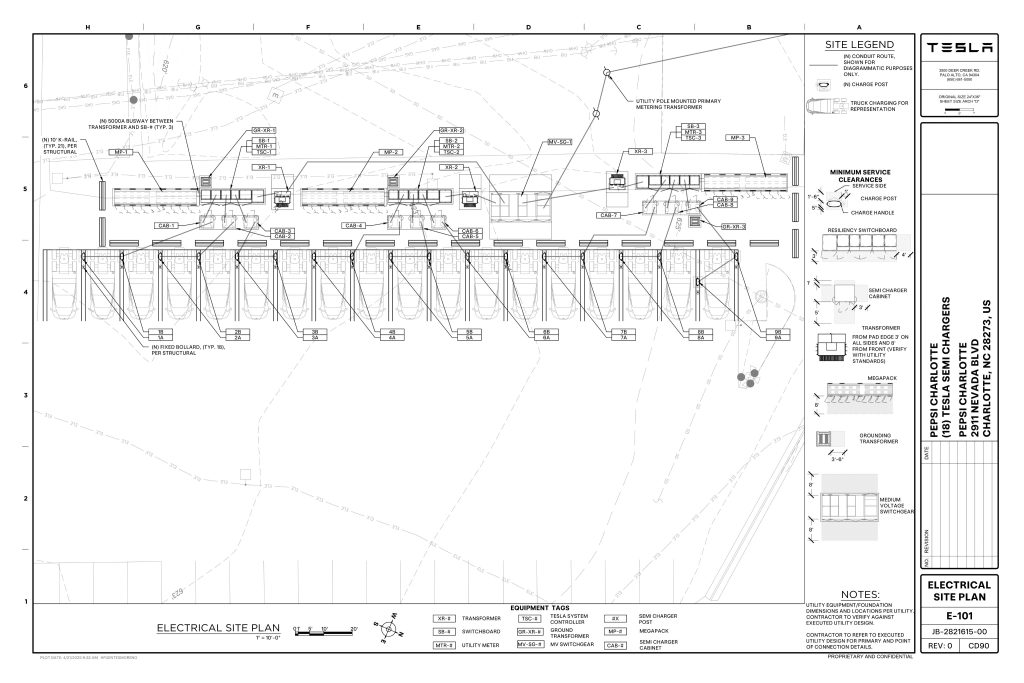
Credit: PepsiCo (via MarcoRPi1 on X)
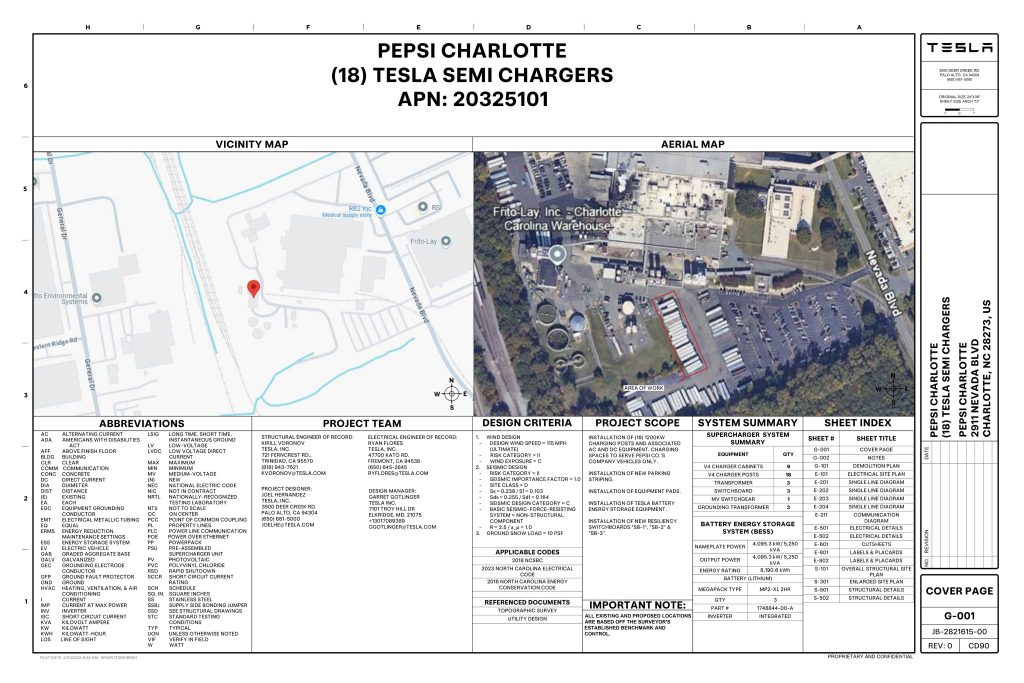
Credit: PepsiCo (via MarcoRPi1 on X)
READ MORE ON THE TESLA SEMI: Tesla to build Semi Megacharger station in Southern California
PepsiCo’s Tesla Semi fleet, other Megachargers, and initial tests and deliveries
PepsiCo was the first external customer to take delivery of Tesla’s Semis back in 2023, starting with just an initial order of 15. Since then, the company has continued to expand the fleet, recently taking delivery of an additional 50 units in California. The PepsiCo fleet was up to around 86 units as of last year, according to statements from Semi Senior Manager Dan Priestley.
Additionally, the company has similar Megachargers at its facilities in Modesto, Sacramento, and Fresno, California, and Tesla also submitted plans for approval to build 12 new Megacharging stalls in Los Angeles County.
Over the past couple of years, Tesla has also been delivering the electric Class 8 units to a number of other companies for pilot programs, and Priestley shared some results from PepsiCo’s initial Semi tests last year. Notably, the executive spoke with a handful of PepsiCo workers who said they really liked the Semi and wouldn’t plan on going back to diesel trucks.
The company is also nearing completion of a higher-volume Semi plant at its Gigafactory in Nevada, which is expected to eventually have an annual production capacity of 50,000 Semi units.
Tesla executive teases plan to further electrify supply chain

Tesla debuts hands-free Grok AI with update 2025.26: What you need to know

Tesla cleared in Canada EV rebate investigation

Tesla Semis to get 18 new Megachargers at this PepsiCo plant


-
 Elon Musk2 weeks ago
Tesla investors will be shocked by Jim Cramer’s latest assessment
-
 Elon Musk2 days ago
xAI launches Grok 4 with new $300/month SuperGrok Heavy subscription
-
 Elon Musk5 days ago
Elon Musk confirms Grok 4 launch on July 9 with livestream event
-
 News1 week ago
Tesla Model 3 ranks as the safest new car in Europe for 2025, per Euro NCAP tests
-
 Elon Musk2 weeks ago
A Tesla just delivered itself to a customer autonomously, Elon Musk confirms
-

 Elon Musk1 week ago
xAI’s Memphis data center receives air permit despite community criticism
-
 News2 weeks ago
Xiaomi CEO congratulates Tesla on first FSD delivery: “We have to continue learning!”
-
 News2 weeks ago
Tesla sees explosive sales growth in UK, Spain, and Netherlands in June