News
Tesla bull sees a new path to 600,000 deliveries per quarter
“We believe the launch of a lower cost model represents the first step to getting back to a ~500k quarterly delivery run-rate, which will be important to stimulate demand for its fleet with the EV tax credit expiring at the end of September.”

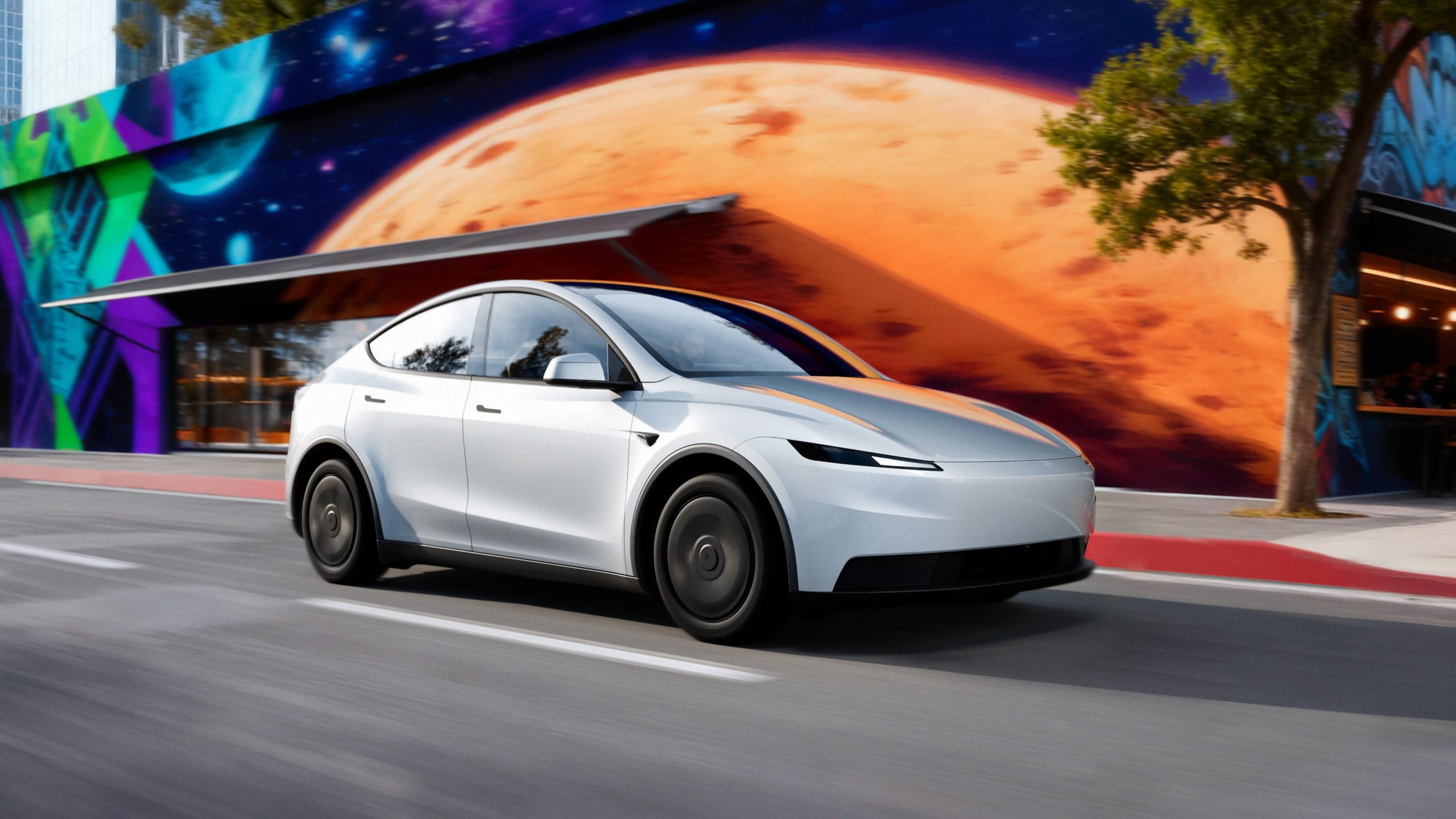
Tesla (NASDAQ: TSLA) bull Dan Ives of Wedbush Securities published a new note to investors on Thursday evening, which seemed to open up the possibility of the automaker returning to a growth rate in terms of deliveries.
After nearly two years of leveling off with deliveries, which was expected, Tesla is now slated to potentially return to growth, Ives says, as it has introduced new, more affordable models. It launched its Standard offerings for the Model 3 and Model Y this week, a strategy to bring cheaper cars to customers amid the loss of the $7,500 tax credit.
🚨 Wedbush’s Dan Ives put up a new Tesla $TSLA note:
“The AI valuation will start to get unlocked in the Tesla story and we believe the march to an AI driven valuation for TSLA over the next 6-9 months has now begun in our view with FSD and autonomous penetration of Tesla’s…
— TESLARATI (@Teslarati) October 10, 2025
In his note to investors, Ives said:
“We believe the launch of a lower cost model represents the first step to getting back to a ~500k quarterly delivery run-rate, which will be important to stimulate demand for its fleet with the EV tax credit expiring at the end of September.”
Although these cars come in only slightly under $40,000, there is some belief that they will do two things: attract car buyers looking for an under-$40k EV with Tesla’s technology and infrastructure, or push those on the fence to the now-Premium models, which are simply the Long Range Rear-Wheel-Drive and Long Range All-Wheel-Drive.
Ives said in the note that Tesla’s plans for a $25,000 car are “on hold,” but it seems as if that vehicle will be the Cybercab, which the company unveiled a year ago today.
That project seems to be moving forward as well, based on what we saw at both Fremont and Gigafactory Texas yesterday. At Fremont, the Cybercab was spotted on the Test Track, while crash-tested units were spotted at the factory in Austin.
After the Standard models were rolled out and the Cybercab or another $25,000 unit arrives, Ives believes Tesla could actually get closer to 600,000 deliveries per quarter, he said on CNBC this morning:
BREAKING: DAN IVES SAYS — $TSLA WILL DELIVER ABOVE 600K CARS PER QUARTER 👀
He says Tesla stock is going to $600+ ! pic.twitter.com/fWLfMnH1XH
— TheSonOfWalkley (@TheSonOfWalkley) October 10, 2025
Moving forward, Tesla has much more going for it than its potential growth in quarterly deliveries. Ives recognizes that a majority of what Tesla’s value will come from in the future: AI and autonomy.
Ives said:
“The AI valuation will start to get unlocked in the Tesla story and we believe the march to an AI driven valuation for TSLA over the next 6-9 months has now begun in our view with FSD and autonomous penetration of Tesla’s installed base and the acceleration of Cybercab in the US representing the golden goose for Musk & Co. We believe Tesla could reach a $2 trillion market cap early 2026 in a bull case scenario and $3 trillion by the end of 2026 as full scale volume production begins of the autonomous and robotics roadmap.”
Ives and Wedbush maintained their $600 price target and ‘Outperform’ rating on Tesla stock.


News
Tesla shows off mysterious vehicle at Giga Texas
The mysterious structure, partially unboxed amid construction materials, has sparked widespread speculation among Tesla enthusiasts and analysts. Many are convinced it is the long-rumored Model Y L, the extended-wheelbase variant already popular in China, now arriving in Texas for potential U.S. production.
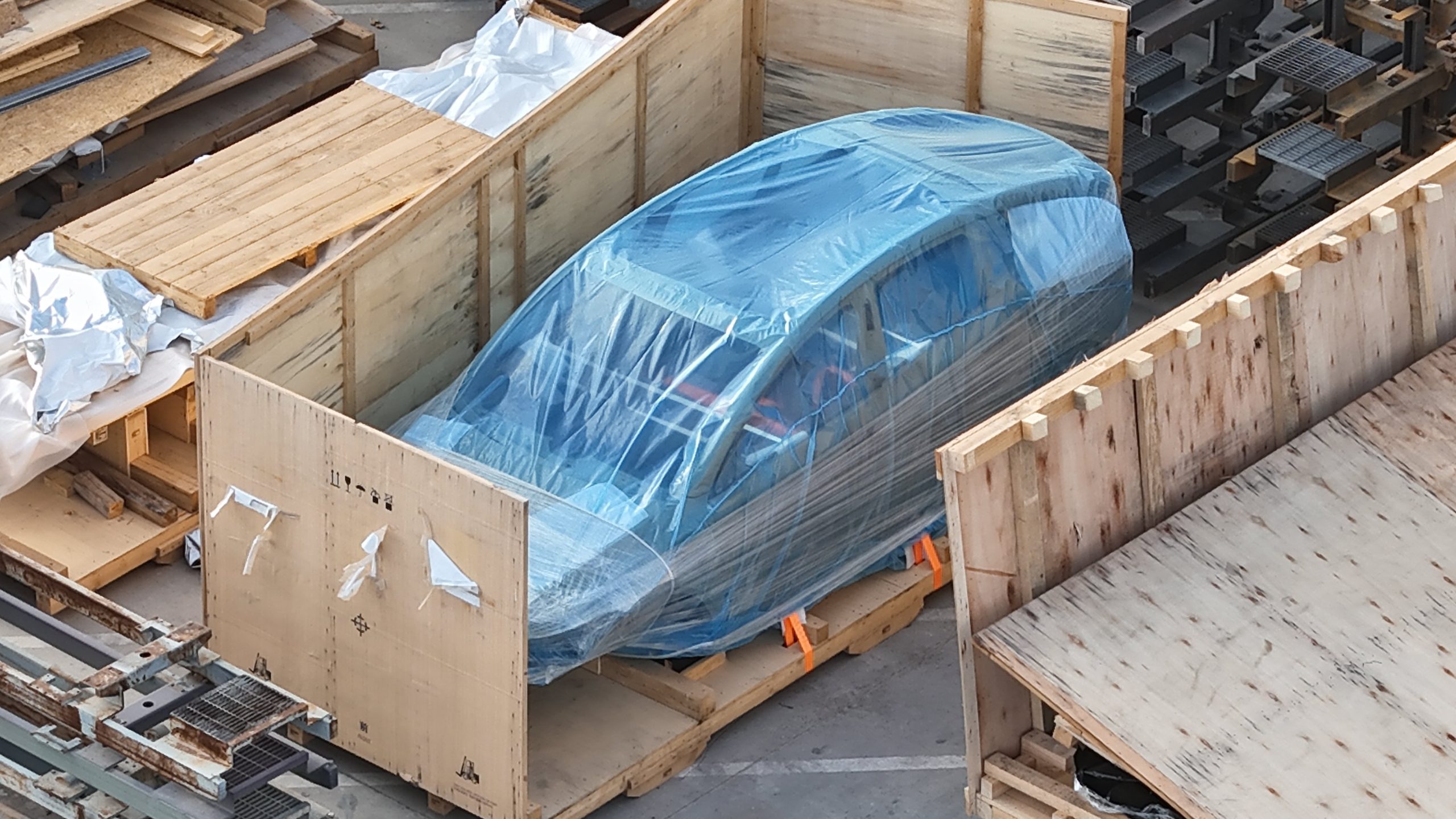
Tesla seemingly showed off a mysterious vehicle at Giga Texas, one that seems to be completely different than anything the company currently makes for the U.S. market.
The vehicle, which was spotted on the plant’s property, appears to be similar to the Model Y L that has not yet launched in North America, and is currently built at Gigafactory Shanghai in China.
Drone pilot Joe Tegtmeyer captured intriguing footage at Tesla’s Giga Texas on March 23, 2026, revealing what appears to be a large, blue plastic-wrapped vehicle body resting inside a wooden shipping crate outdoors.
Well this is interesting at Giga Texas today … what do YOU think this is? 🤔😎 pic.twitter.com/U9pLvqbf7L
— Joe Tegtmeyer 🚀 🤠🛸😎 (@JoeTegtmeyer) March 23, 2026
The mysterious structure, partially unboxed amid construction materials, has sparked widespread speculation among Tesla enthusiasts and analysts. Many are convinced it is the long-rumored Model Y L, the extended-wheelbase variant already popular in China, now arriving in Texas for potential U.S. production.
The images show an elongated silhouette that stands out from standard Model Y bodies. Side-by-side comparisons shared in replies to Tegtmeyer’s post highlight key differences: the rear door extends farther over the wheel arch than on a regular Model Y, and the rear glass appears to run all the way to the spoiler lip without the metal trim seen on shorter versions.
One overlay analysis noted that the visible proportions align precisely with the Chinese-market Model Y L, which measures approximately 4.98 meters long with a 3.04-meter wheelbase, which is about seven inches longer overall than the standard Model Y sold in the U.S.
Model Y L, with a support structure on top, likely for shipping. pic.twitter.com/ET3w46DjpJ
— Owen Sparks (@OwenSparks) March 23, 2026
The vehicle is a bare “body-in-white” shell, typical of prototypes sent abroad for tooling validation and local manufacturing ramp-up. Tesla has already launched the six- and seven-seat Model Y L in China and other markets, where it offers roughly 10% more cargo space and greater family-friendly versatility.
This sighting fits Tesla’s broader strategy. Industry observers expect the company to localize Model Y L production at Giga Texas by mid-2026 to serve American families seeking extra room without stepping up to the larger Cybertruck or a future full-size SUV.
Bringing the design stateside could add tens of thousands of annual deliveries while leveraging existing Model Y lines. People have been adamant that they want the Model Y L in the U.S., especially as Tesla plans to fade the Model X, the company’s most ideal vehicle for large families, out of production in the near future.
Tesla Model Y lineup expansion signals an uncomfortable reality for consumers
While Tesla has made no official comment, the timing, amid Giga Texas expansion and steady Model Y output, suggests the mysterious crate is more than a random prototype.
If confirmed as the Model Y L, it marks another step in Tesla’s effort to refresh its bestselling SUV for global demand. The vehicle would perform exceptionally well in the U.S., and despite the company’s rather mute stance on bringing it to America, this might be the biggest hint to date that it could be on the way.
Cybertruck
Tesla Cybertruck just won a rare and elusive crash safety honor
Only the most outstanding of performances in crash tests can warrant an IIHS Top Safety Pick+ award, as vehicles listed with that ranking must achieve “Good” ratings in the small overlap front, updated side, and updated moderate overlap front tests, along with “Acceptable” or “Good” headlights standard on all trims.
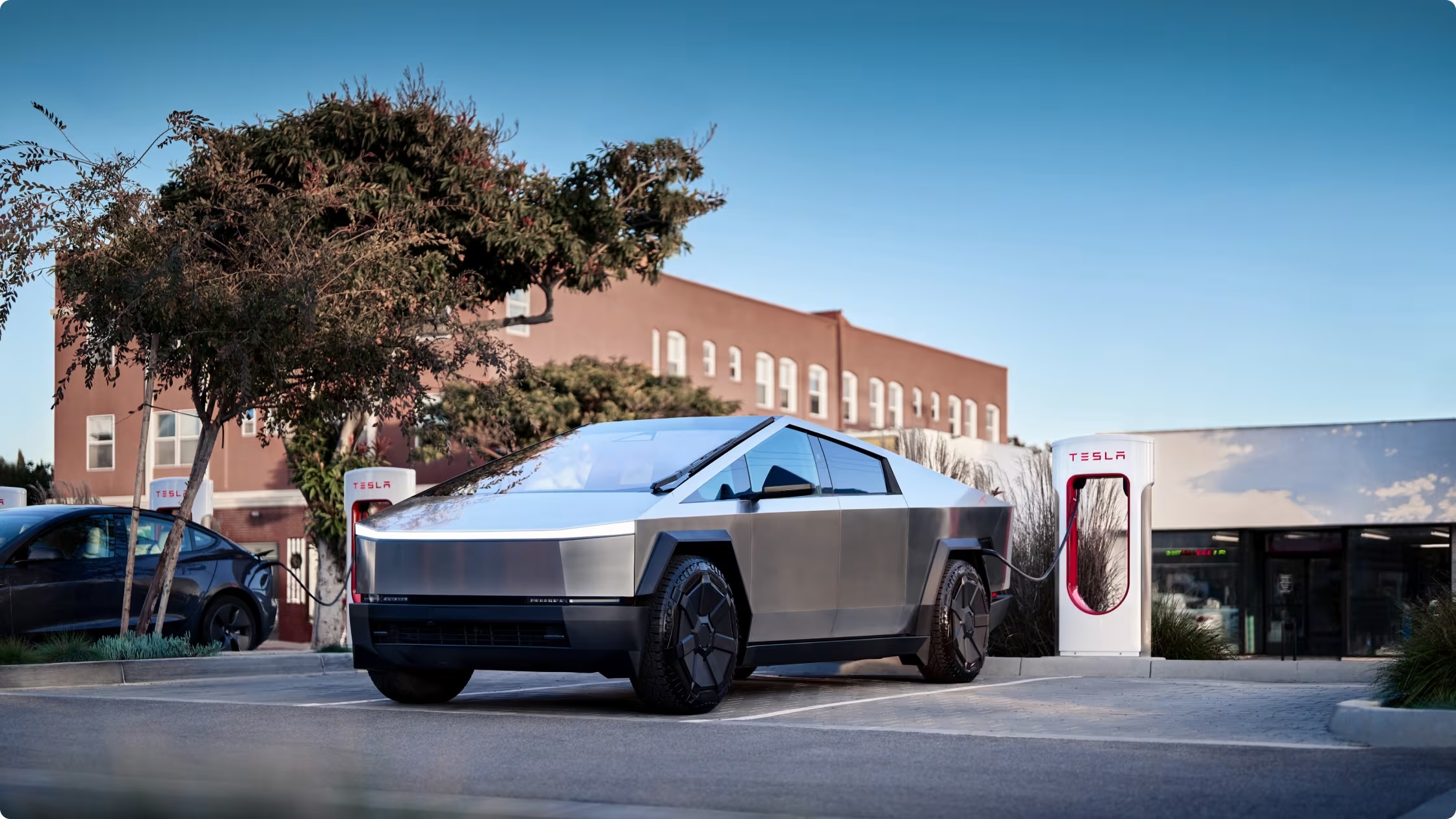
Tesla Cybertruck landed a rare and elusive safety honor from the Insurance Institute for Highway Safety (IIHS). It was the only pickup truck in the U.S. market to do so.
The IIHS rewarded the Cybertruck with the Top Safety Pick+ honors, the highest marks a vehicle can receive from the agency.
Only the most outstanding of performances in crash tests can warrant an IIHS Top Safety Pick+ award, as vehicles listed with that ranking must achieve “Good” ratings in the small overlap front, updated side, and updated moderate overlap front tests, along with “Acceptable” or “Good” headlights standard on all trims.
🚨 Absolutely insane.
Tesla Cybertruck was the ONLY pickup on the market to be awarded a Top Safety Pick+ rating by the IIHS
The safest rating out there belongs to Cybertruck 📐 pic.twitter.com/Y8gLOqaL0d
— TESLARATI (@Teslarati) March 24, 2026
Cybertruck was the only truck to also win an NHTSA Five-Star Safety rating, making it the only pickup available on the market to be recognized with top marks from both agencies.
There are a multitude of options for pickups in the U.S. market, as it is one of the most popular vehicle types for consumers in the country. Pickups are great vehicles for anyone who does any sort of hauling or is just looking for extra space for any variety of reasons.
Pickups are also inherently safer than other body types on the road, mostly because they are larger and heavier, making them more favorable against other vehicle types in the event of a collision. However, Tesla has a significant advantage in safety with its vehicles because it engineers them to not only be safer in collisions, but also easier to repair.
The Cybertruck managed to achieve “Good” ratings, the highest marks available by the IIHS, in all three Crashworthiness categories, as well as “Good” ratings in both Crash Avoidance and Mitigation assessments.
It also received “Good” ratings across all driver and pedestrian crash-test performance metrics, except for one, where it earned an “Acceptable” rating for rear passengers in the Chest category.
The Cybertruck’s outstanding crash test performance has won it this incredible mark as the pickup still tends to be one of the more polarizing vehicle designs on the market.
It is no secret that Tesla has struggled with demand of the Cybertruck due to pricing, but the recent rollout of a trim that was temporarily priced at just $59,990 showed plenty of people want the all-electric pickup.
Elon Musk
Elon Musk’s Boring Co. Tunnel Vision Challenge ends with a surprise for Louisiana, Maryland and Dallas
The Boring Company stunned three cities today, awarding New Orleans, Baltimore, and Dallas free underground Loop tunnels.

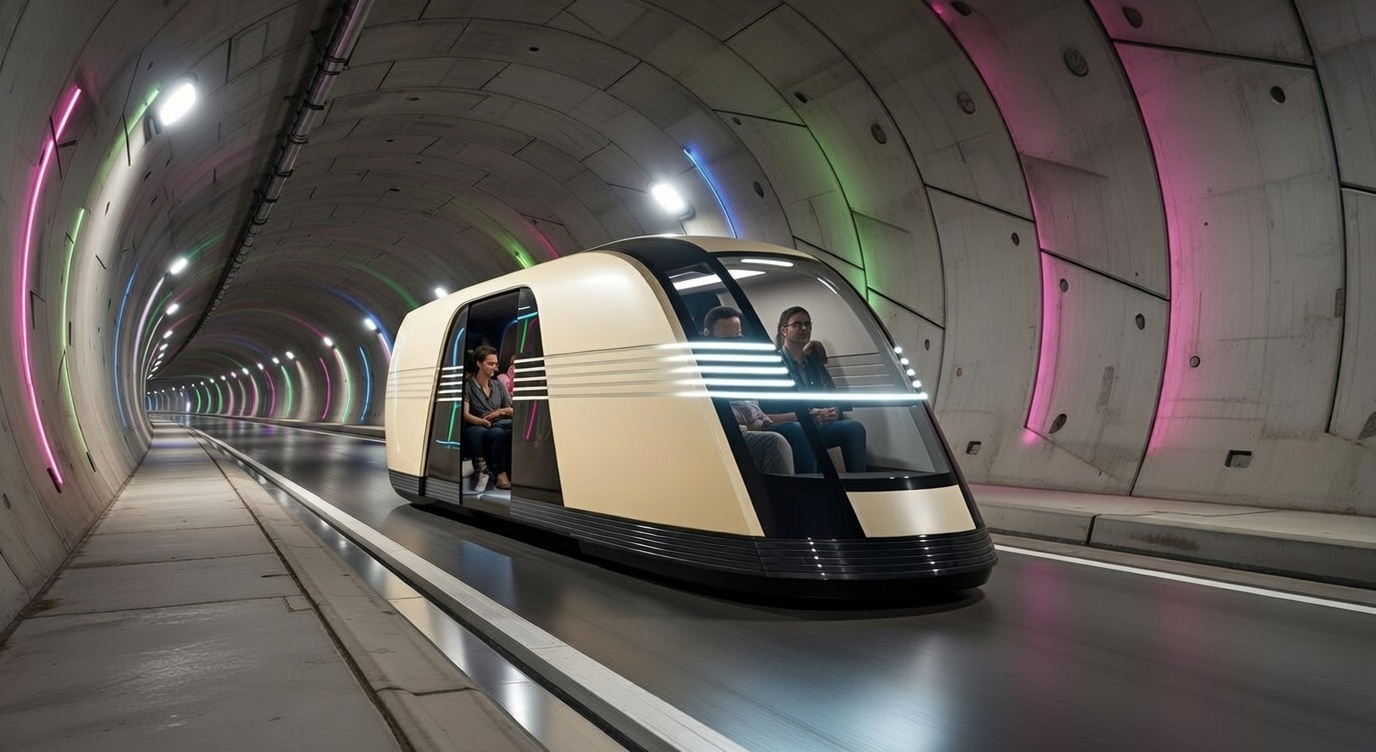
Elon Musk’s The Boring Company (TBC) announced today that it is building free underground Loop tunnels in three American cities: New Orleans, Louisiana; Baltimore, Maryland; and Dallas, Texas. The company had promised one winner when it launched the Tunnel Vision Challenge in January. After receiving 487 submissions, it selected three, committing to fund and construct all of them pending a feasibility review, entirely at its own expense. For a company that has faced years of skepticism over the gap between its promises and its delivered projects, choosing to expand its commitment rather than narrow it is a notable shift in both scale and accountability.
All three projects will now enter a rigorous, fully funded diligence phase that includes meetings with elected officials, regulators, community and business leaders, geotechnical borings, and a complete investigation of subsurface utilities and infrastructure. TBC confirmed that all costs associated with this diligence process are 100% funded by the company. If all three projects pass feasibility, all three get built. If only one clears the bar, that one gets built. The company’s willingness to fund the due diligence regardless of outcome removes one of the most common early-stage barriers that kills promising infrastructure proposals before they leave a spreadsheet.
Beyond the three winners, TBC announced it will continue working with two additional entrants it found compelling enough to pursue independently: the Hendersonville Utility Tunnel in Hendersonville, Tennessee, and the Morgan’s Wonderland Tunnel in San Antonio, Texas, which would notably serve one of the nation’s premier theme parks built specifically for guests with special needs.
The challenge also coincides with TBC’s most active construction period to date. The company recently began drilling on the Music City Loop near the Tennessee State Capitol in Nashville, and in February it broke ground on a Loop in Dubai. Musk has long argued that the fundamental problem with urban infrastructure is cost and bureaucratic inertia, not engineering. “The key to solving traffic is making going 3D either up or down,” he said in 2018, a conviction now reflected in a company structure built to absorb the financial risk that typically stalls public projects for years.
Music City Loop could highlight The Boring Company’s real disruption
The Tunnel Vision Challenge’s most underappreciated element may be what it produced beyond three winners. Submissions came from individuals, companies, and governments across states including Alaska, Arkansas, Colorado, Kansas, Louisiana, Maryland, New York, and Texas, as well as from international entrants. Musk captured the underlying logic years ago when he said, “Traffic is driving me nuts. I’m going to build a tunnel boring machine and just start digging.” Today, three American cities are counting on exactly that.
Tunnel Vision Challenge results!
We’ve been overwhelmed with the amazing submissions…so we are announcing three winners!
The Thrilling Three are:
– NOLA Loop (New Orleans, LA)
– Ravens Loop (Baltimore, MD)
– University Hills Loop (Dallas, TX)What happens next? TBC and the… https://t.co/cY2ULftfiK
— The Boring Company (@boringcompany) March 24, 2026

Tesla shows off mysterious vehicle at Giga Texas

Tesla Cybertruck just won a rare and elusive crash safety honor


