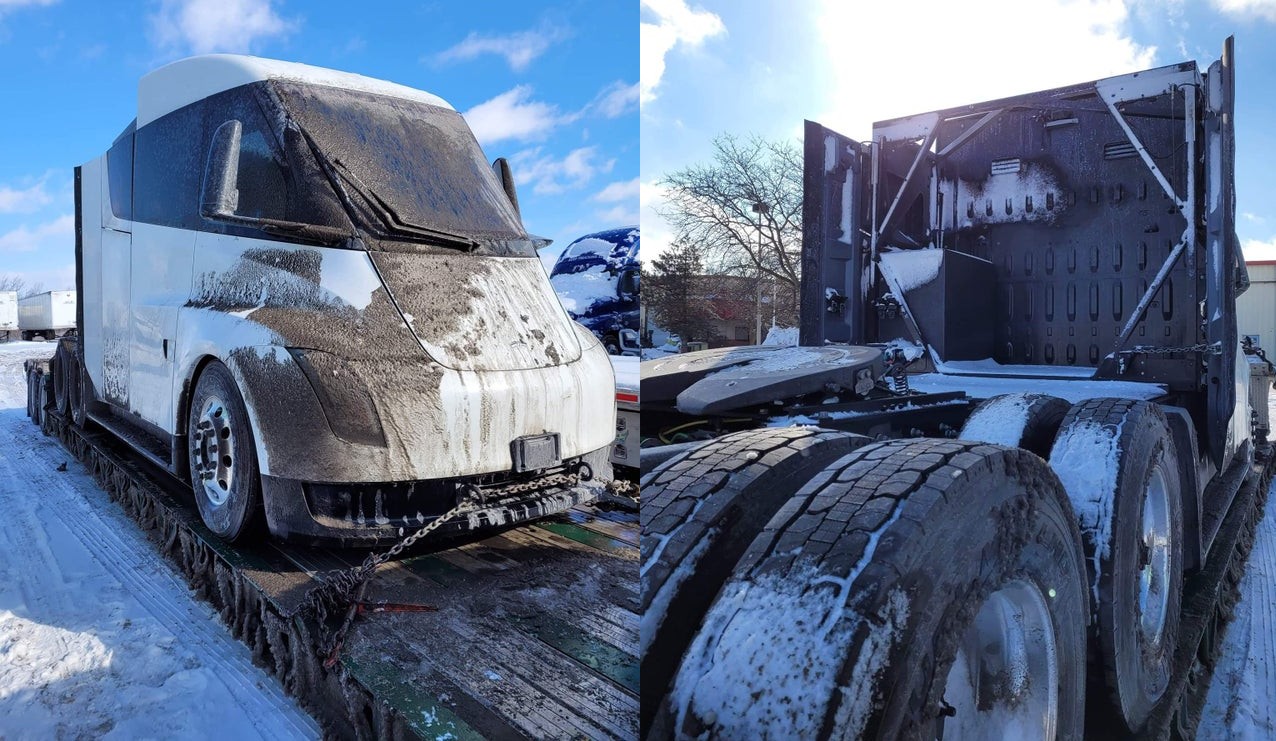
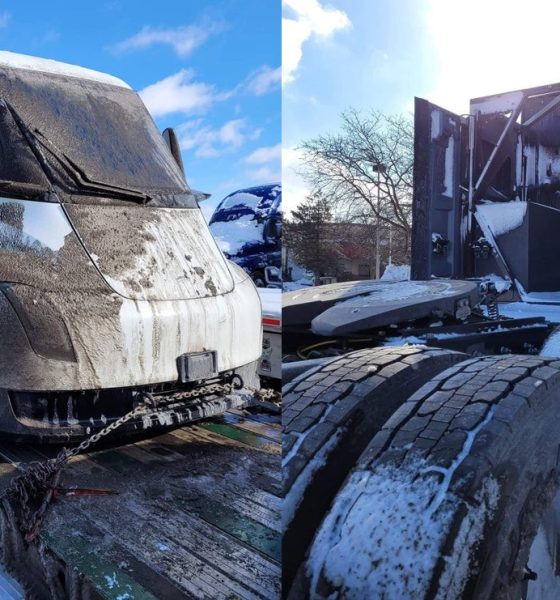

A white Tesla Semi has recently been spotted in Chicago, IL being transported at the back of a flatbed truck. Interestingly enough, the all-electric Class 8 truck appeared like it underwent some serious testing, as evidenced by its extremely dirty appearance and the layers of mud and snow caked around its body and tires. Even more interestingly, this Semi seems to be different compared to the vehicle that was spotted recently in California.
Images of the dirty white Tesla Semi were shared on the r/TeslaMotors subreddit, where a number of eagle-eyed EV enthusiasts immediately noticed that the vehicle featured some differences compared to the Semi being transported in Sacramento a few days ago. These differences include the parts that were installed behind the Class 8 all-electric truck’s cabin, as well as the tires used in each vehicle.
-

- Credit: bigschlong24lg/Reddit
-

- Credit: bigschlong24lg/Reddit
-
- Credit: bigschlong24lg/Reddit
-
- Credit: bigschlong24lg/Reddit
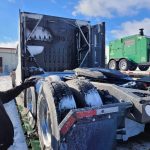
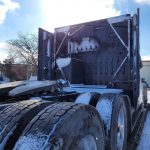
The white Tesla Semi sighted in Sacramento featured a rather large, mysterious box at its rear, which was connected to what appeared to be several thick data cables. This part is completely absent in the road-weary Semi spotted in Chicago. The vehicle spotted in California was also fitted with Bridgestone tires, while the vehicle in Illinois was fitted with a set of Goodyear tires instead. Differences in the color of the trailers used to transport the vehicles further suggested that the sightings corresponded to two separate Tesla Semis.
The idea of Tesla using more than one new Semi prototype makes sense, especially considering that reports emerged in late December that the electric car maker was building four new units of the Class 8 truck at Gigafactory Nevada. Among the four, two will reportedly be used for road testing, one will be used for durability testing, and one will be used for cold-weather testing. Interestingly enough, there are cold-weather test facilities in Minnesota such as Automotive Environmental Testing (AET) in Baudette, over 600 miles away from Chicago.
What's that box, @elonmusk? #Tesla #Semi
Photo 1 w/ box: @klwtts
Photo 2 w/o box: bigschlong24lg on Reddit pic.twitter.com/YhSU1OdAB6— ALEX (@ajtourville) February 6, 2021
Recent rumors about the Semi have emerged recently, providing a potential glimpse at the upcoming ramp of the all-electric Class 8 truck. Citing a longtime Tesla supplier, TSLA investor and EV advocate Sawyer Merritt noted that Tesla would likely start building Semi release candidates around May 2021, with pilot production starting in July 2021. By the end of the year, Tesla is reportedly looking to produce 100 Semis per week, allowing the company to end 2021 with a total of 2,500 Semis built.
Don’t hesitate to contact us for news tips. Just send a message to tips@teslarati.com to give us a heads up.


Energy
Tesla Model 3 and Model Y can now do what only Cybertruck could
Tesla Model 3 and Model Y can power your home with Powerwall 3 during outages.

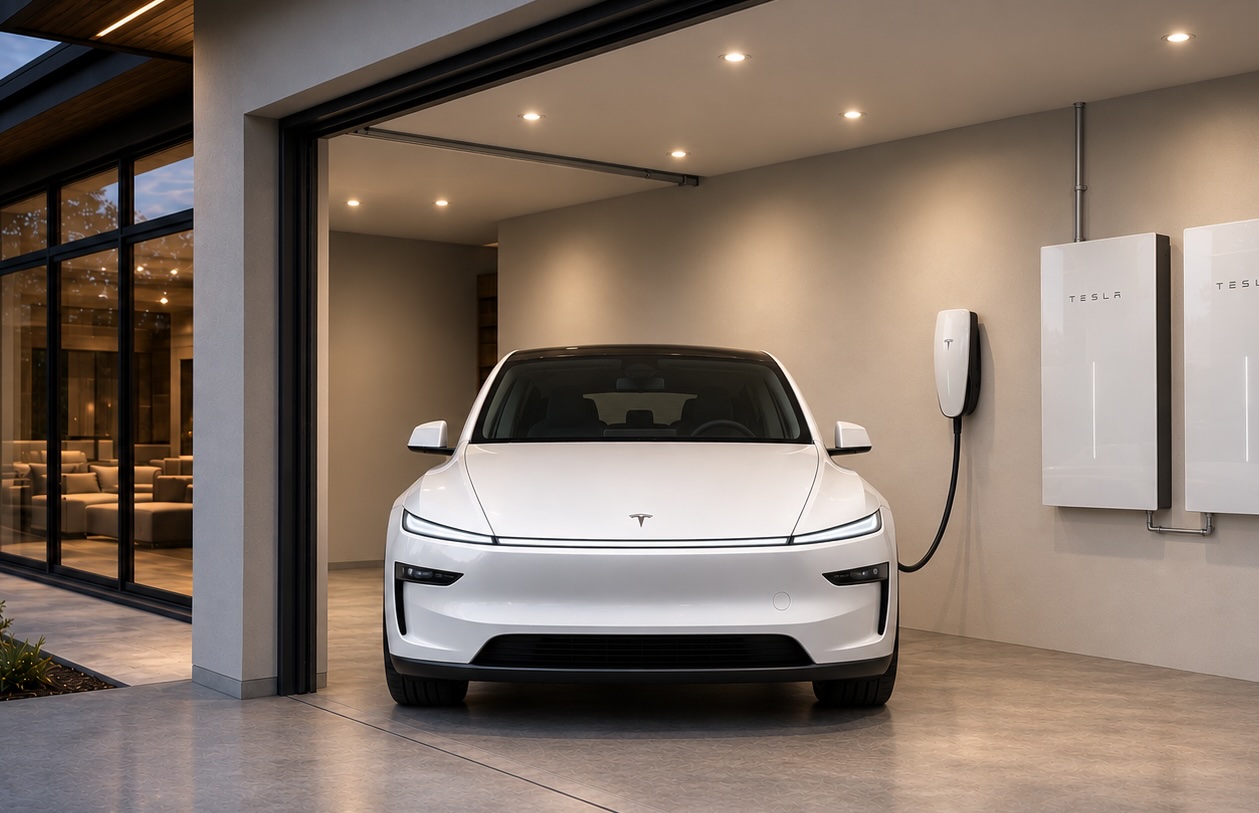
Tesla has turned its two top sellers into backup batteries for the house.
Tesla Energy announced on Tuesday that Powershare Home Backup is now available for new Model 3 and Model Y vehicles paired with a Powerwall 3, saying the car can “extend your home backup by over 2 days.” Minutes later, Tesla’s main account quoted the post with a broader pitch: “With Powerwall 3, every Tesla can now serve as your home’s backup battery.”
Until this week, the Cybertruck was the only Tesla that could send power back into a home, and that capability only began working alongside Powerwall 3 last month, after years of ambitious targets.
Tesla’s updated Powershare page says every Model 3 and Model Y ordered in the U.S. or Puerto Rico on or after October 1, 2026 can use the feature. Some, but not all, earlier cars also qualify. Owners can check on the touchscreen under Software, then Additional Vehicle Information, where a capable car shows “Powershare Support: Enabled.” As Electrek reported, bidirectional power on the two cars runs through an inverter Tesla calls PCS2 Lite, and the company has not said when that part entered production on each trim.
The home side is simpler. A house that already has a Powerwall 3 and either a Wall Connector 3 or Universal Wall Connector needs no additional equipment, and Tesla says compatibility is enabled through a software update. When the grid drops, the Powerwall and the car work together, with up to 11.52 kW of continuous power available. Tesla’s “over two days” estimate assumes a home using 30 kWh per day and a car starting at a 90 percent charge. Standard trims are rated for up to two days, while the Cybertruck adds more than three.
There are limits. Powerwall 2 and Powerwall+ support is listed as “coming soon.” Model S and Model X are not included, and Grid Support, the program that lets Cybertruck owners in Texas send power back to the grid during demand spikes for bill credits, is not available for Model 3 or Model Y.
The rollout also lines up with something Elon Musk said more than three years ago. At Tesla’s March 2023 Investor Day, Musk said, “I don’t think very many people are going to want to use bidirectional charging, unless you have a Powerwall.” Tesla has now shipped the feature for its volume cars with exactly that requirement attached.
The Powerwall pairing was the hard part on Cybertruck. Tesla told owners in December 2025 that Powershare with Powerwall had been pushed to mid 2026, and lead engineer Wes Morrill explained that two devices capable of forming a home’s grid have to negotiate which one leads during an outage, across multiple generations of hardware. With that work done for the truck, Tesla was able to extend it to the Model 3 and Model Y within a month.
Ford and GM have offered home backup from their EVs for several years, but both require a separate inverter and backup hardware. Tesla’s version leans on equipment many Powerwall 3 owners already have on the wall. Powershare for the two cars also ships as part of software update 2026.38.3, the same release that began delivering Halloween Mode on Tuesday.

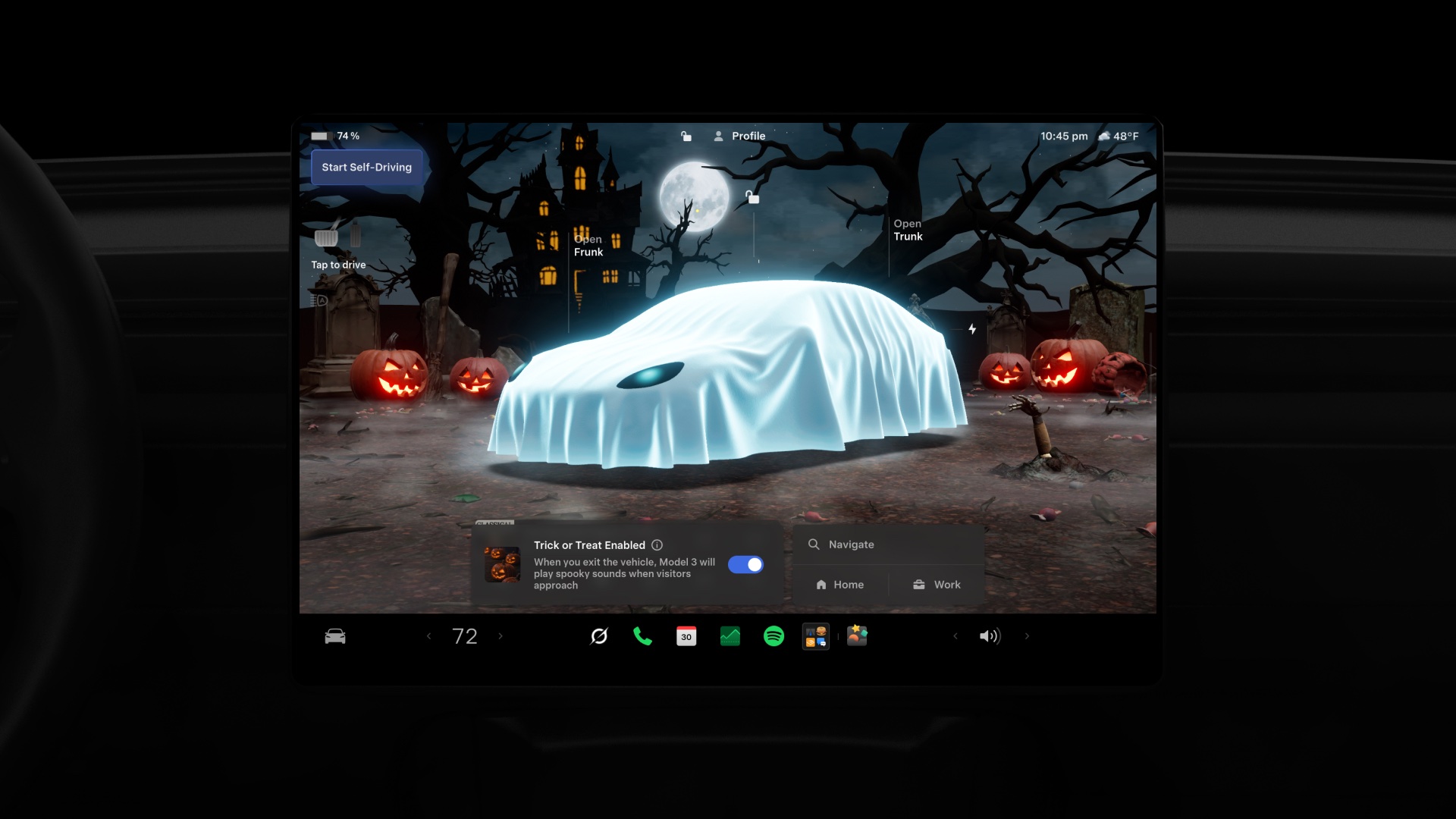
Tesla is now starting to ship a “Halloween Mode” that is filled with some creepy and fun features; the company says, “This spooky update turns your Tesla into a haunted house on wheels.”
The update is just the latest in a series of updates that Tesla typically ships out in a seasonal fashion. The Spring and Summer Updates provided some fun novelty items while also packing some cool features that are actually useful for the ownership experience.
This one seems to be more fun-forward, and there are not any updates to the Full Self-Driving suite or overall operation of the vehicle. Instead, these novelty features are geared toward getting you in the mood for the Fall and Halloween.
Halloween Mode now rolling out 🎃
This spooky update turns your Tesla into a haunted house on wheels
– Ghost costume on your car’s avatar
– Enable Trick or Treat to play spooky sounds & flicker the lights when visitors approach
– New haunting light show, wraps & lock sound
– A rather chilling Photobooth
– Frighten people remotely by speaking through the app…your car will say it in a voice of its own
Side effects may include neighborhood notoriety
— Tesla (@Tesla) October 6, 2026
New Ghost Costume on Car Avatar
Driver Visualization will now show your vehicle as a ghost, as an all-white sheet is draped over the vehicle. Pedestrians are turned into mummies or skeletons, and other vehicles are all a spooky green:
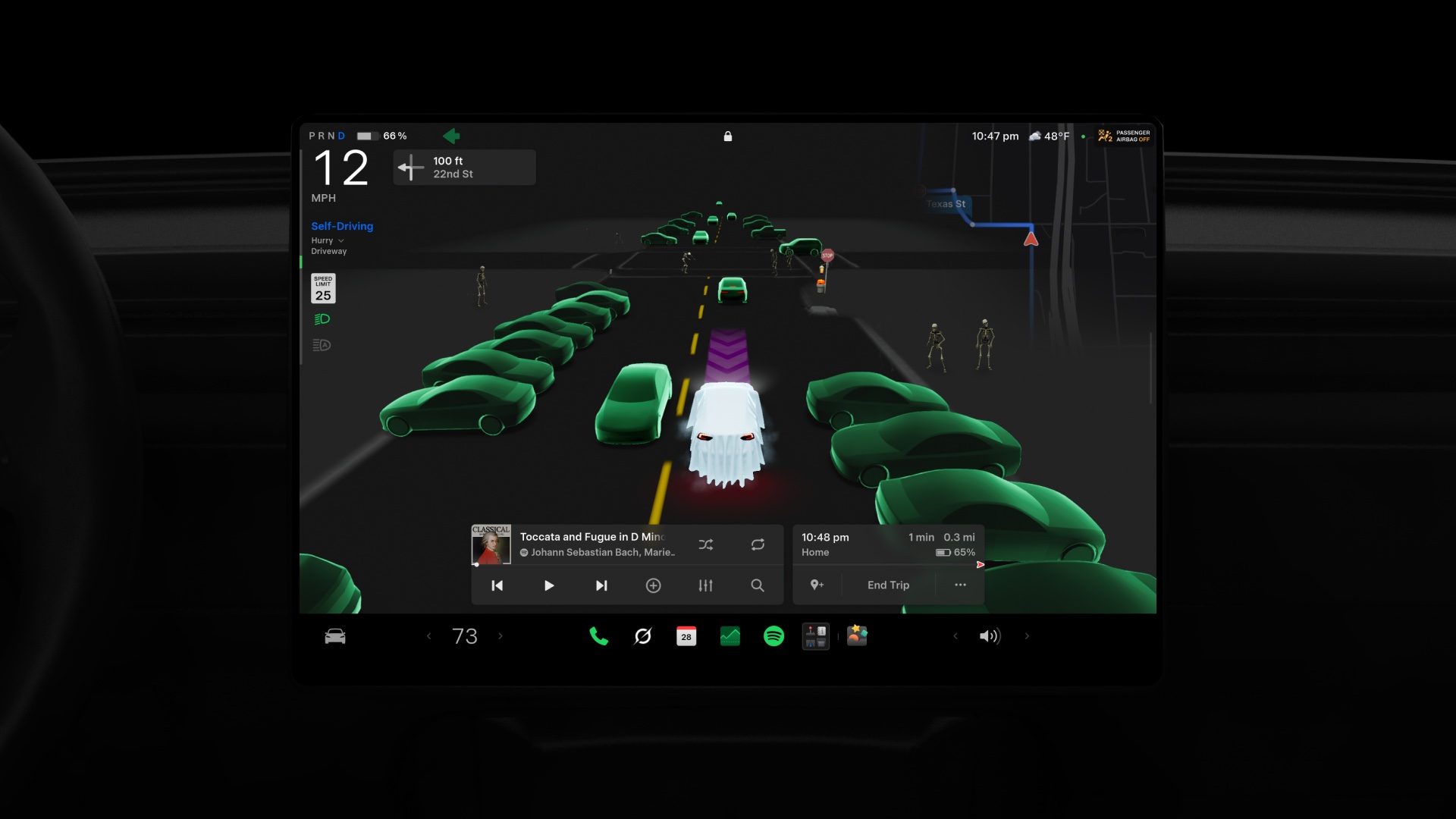
Credit: Tesla
Additionally, the Park Scene with your Tesla now displays that ghost costume draped over your vehicle in the foreground of a scary backdrop with Jack-o-Lanterns and a haunted house:
Credit: Tesla
Trick or Treat Mode
Trick or Treat Mode will enable the vehicle to play spooky sounds and flicker the lights as visitors approach. This might be a nice touch for when you’re handing out candy to kids on Halloween Night.
Other Features
Tesla is also adding a new Light Show, new Wrap Options, and a new Lock Sound with this update.
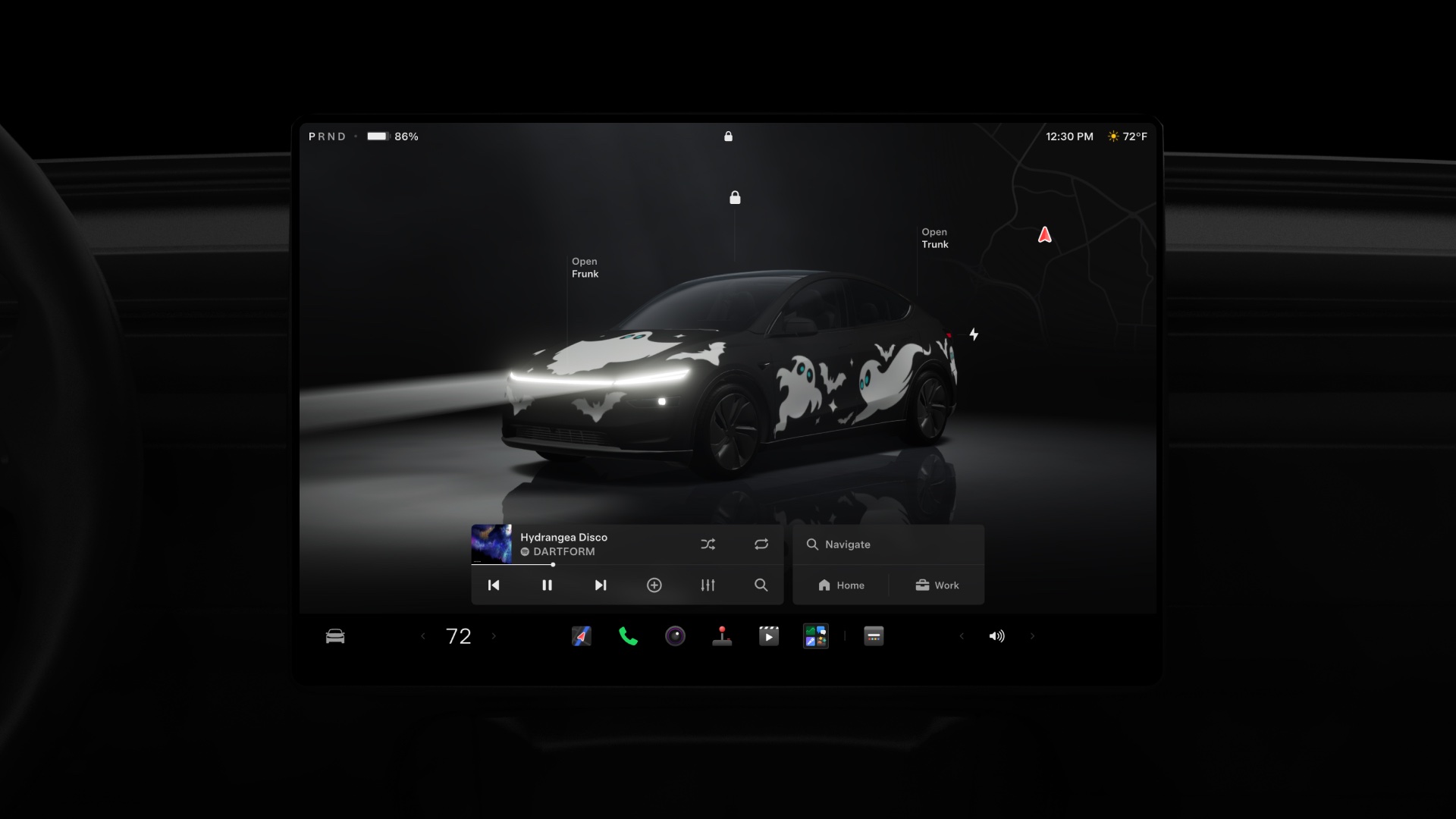
Credit: Tesla
Additionally, Photobooth has a new Halloween option:
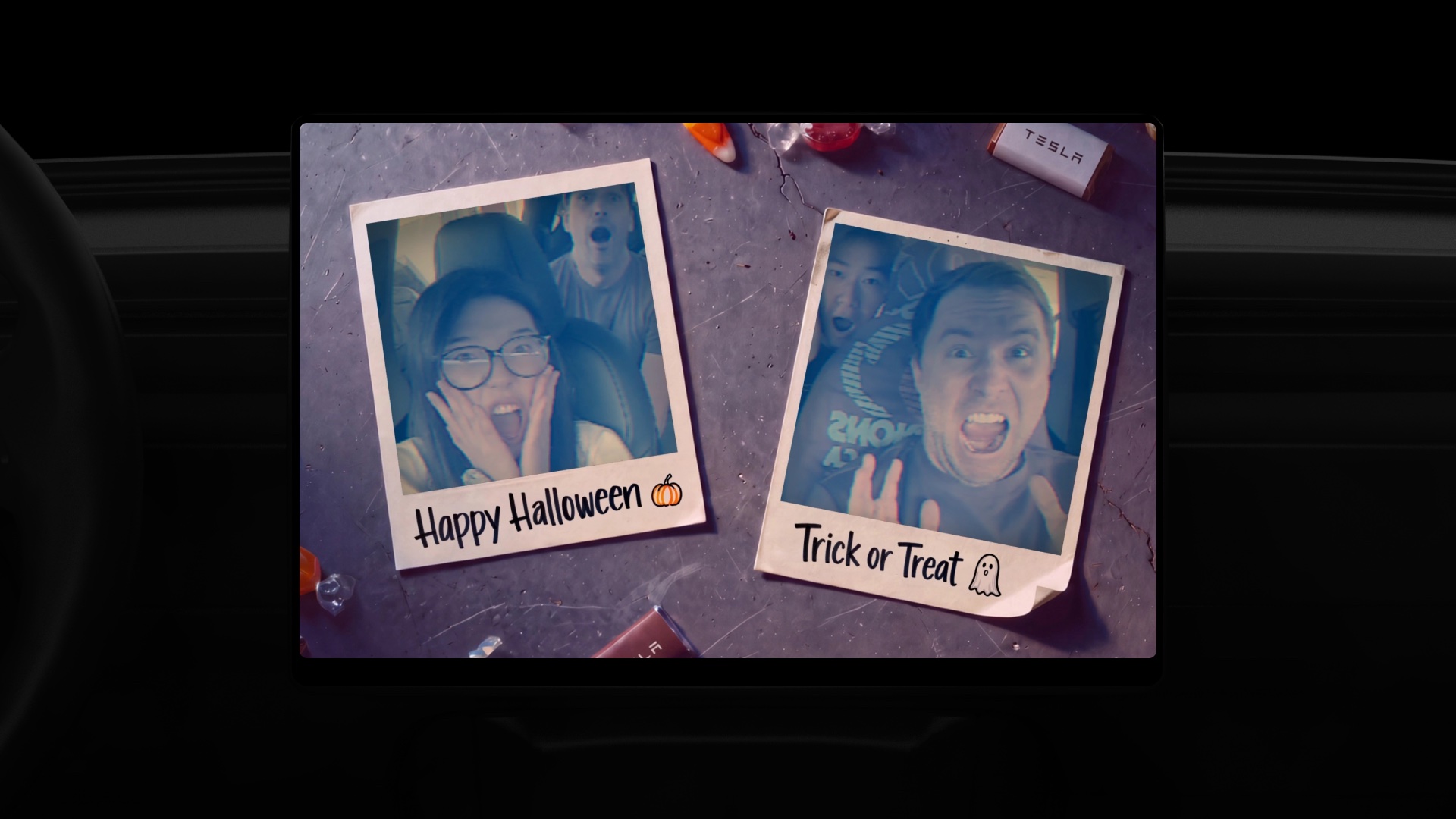
Credit: Tesla
You will also be able to speak remotely through the app and transmit your voice to people outside, which is not a new feature, but the car will say it in a voice of its own, which is a new feature with that bullhorn-like feature.
Investor's Corner
SpaceX reveals how its 1 Million AI satellite network will work and prevent space collisions
SpaceX reveals plans for one million Starmind AI satellites and calls out operators hiding maneuvers.
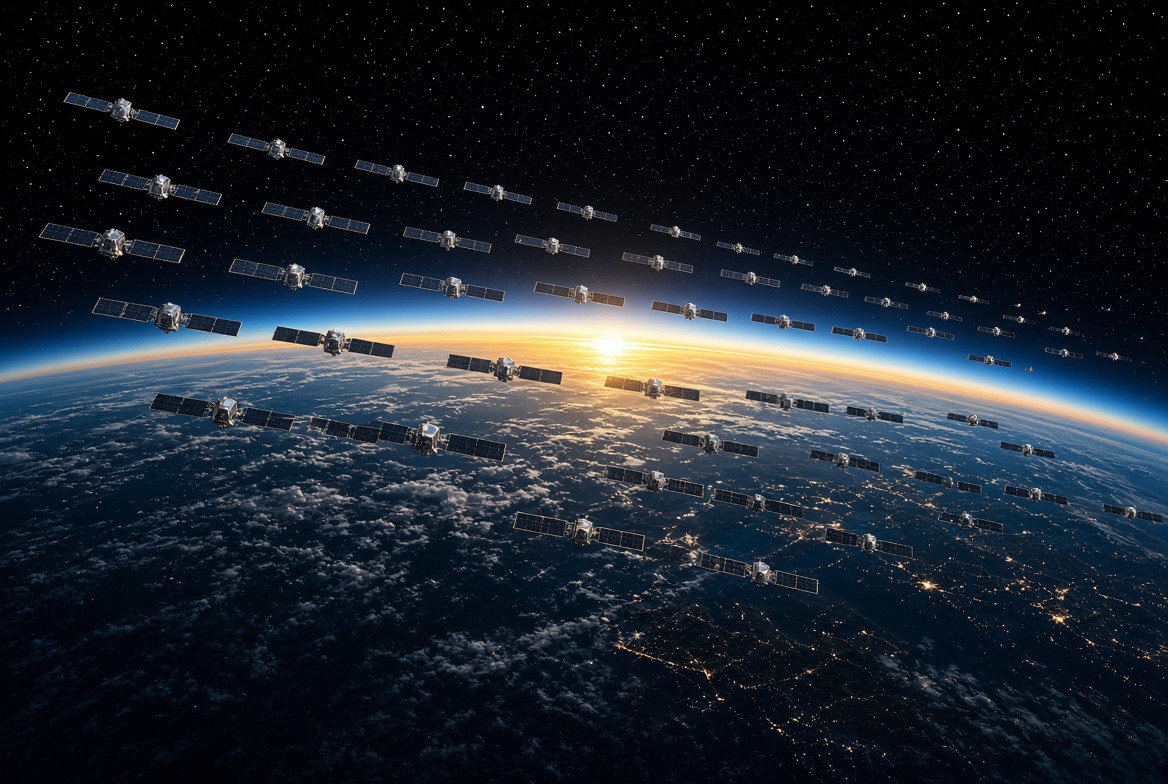
SpaceX has put the largest satellite count it has ever published into writing, and it says that plan only works if every other operator in orbit starts sharing what it knows.
In a new Space Safety page highlighted Tuesday morning by Sawyer Merritt on X, SpaceX said it “plans to operate up to 100,000 Starlink satellites and up to 1 million Starmind AI satellites to meet the growing demand for broadband and supercompute.” Starlink has a little over 11,000 satellites in orbit today, so the target alone implies roughly a ninefold expansion of the broadband network.
Starmind is SpaceX’s orbital AI compute constellation. Elon Musk confirmed the Starmind name in June after an xAI trademark filing surfaced, and in August SpaceX said it was working with Nvidia on the compute payload. The FCC accepted the filing for up to one million satellites back in February.
FCC accepts SpaceX filing for 1 million orbital data center plan
SpaceX also released a new render of what a full Starmind constellation could look like. Alongside it, SpaceX VP Michael Nicolls explained why the satellites will not operate on their own. “We need to operate clusters of satellites in tight formation to get enough coherent compute to run AI models efficiently,” Nicolls said. “A cluster will be 10-ish satellites connected with 10 terabits or so of bandwidth between them, and interconnected to the broader constellation.”
That is the most specific detail SpaceX has given on how Starmind will be built. Instead of a million independent servers, the network would work as tightly packed groups of about 10 satellites acting as one compute unit, with Starlink’s laser links carrying results back to Earth.
There is a bright and exciting future for humanity ahead – and space is fundamental to that future.
To achieve this, space safety must be done right. We encourage every operator to not only share ephemeris data proactively the same way Starlink already does, but to also adopt the high standards of space safety that SpaceX and Starlink use every day → https://t.co/QizAkQZvEm
— Starlink (@Starlink) October 6, 2026
Packing satellites that close together, at that scale, makes collision avoidance the central problem, and most of the Space Safety page is aimed at other operators. SpaceX said Starlink encountered collision risks with about 650 unique maneuvering third party satellites in 2026, and only about half of them shared data. Over six months, Starlink recorded roughly 164,000 more collision risks where the closest approach came within four hours of an unannounced maneuver.
Some operators keep maneuver plans private over proprietary concerns, while others cannot get government permission to share them. SpaceX called those policies “counterproductive,” saying they “largely only serve to create preventable collision risk between satellites.” Starlink is also offering a free ephemeris sharing and screening platform that returns risk results within a minute, backed by its Stargaze network of 30,000 optical sensors.
The push comes as the Starmind application draws opposition from astronomers and environmental groups. In a September filing with the FCC, SpaceX said each Starmind satellite could weigh up to 4,000 kg, nearly seven times the mass of a Starlink V2 Mini. Musk has brushed off crowding concerns before, telling viewers in June that “space is enormous” and that SpaceX already knows how to run very large constellations safely.
SpaceX’s Starmind page says its Gigasat factory in Bastrop, Texas, is designed to produce AI satellites at scale, with deployment of thousands of units starting as soon as late 2027.

Tesla Model 3 and Model Y can now do what only Cybertruck could

Tesla ships ‘spooky’ Halloween Mode with creepy and fun features


