News
Tesla engineering job openings are up 243% in Q1 2018 compared to 2017

Data gathered by professional networking website LinkedIn recently revealed that Tesla has been ramping up its hiring efforts, especially for its engineering jobs. During the first quarter of 2018, Tesla had 865 engineering-related job openings, a 243% increase from the same period last year.
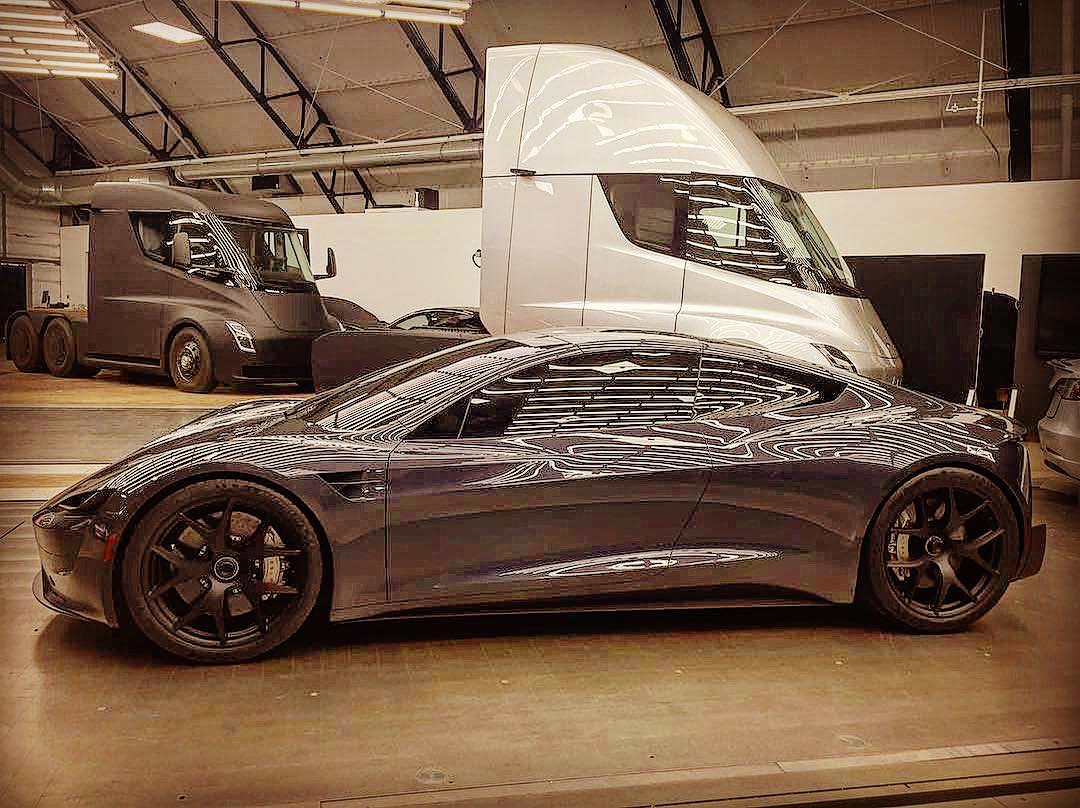
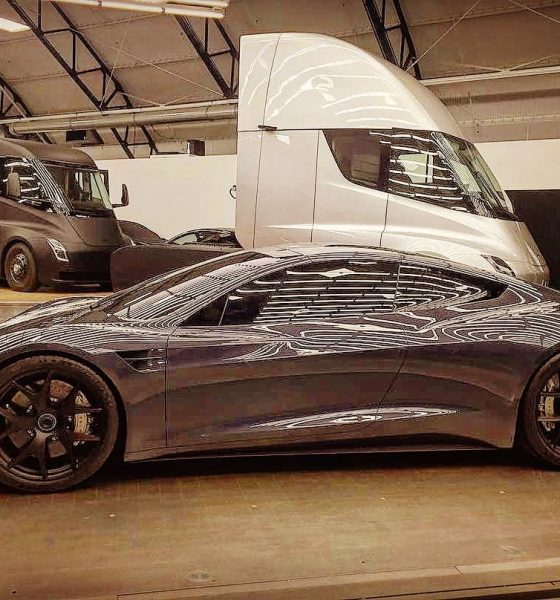
According to LinkedIn editor Queenie Wong, the sudden influx of engineering job openings at Tesla might seem radical, but it should not come as a shock. Tesla, after all, is currently engaged in its most ambitious project yet — mass producing its most disruptive vehicle to date, the Model 3. Considering that Tesla is showing no signs of slowing down, and the company’s plans of expanding its vehicle lineup to the Model Y, Semi, next-gen Roadster, and a yet-to-be-named truck, the company needs an ever-growing workforce to support its goals.
In a statement to LinkedIn, Autotrader and Kelley Blue Book executive publisher Karl Brauer noted that Tesla’s nature of being part tech company and part carmaker means that it is always hungry for talent, particularly in the engineering department.
“Some argue that Tesla is a tech company while others argue it’s an automaker, but it’s certainly at the crossroads of those two. It’s not surprising that they’re very hungry for talented engineering individuals who can help them get to where they want to go,” Brauer said.
According to SAE International chief product officer Frank Menchaca, the engineers that Tesla is looking for must have multiple skills in emerging technologies. In a posting for a design engineer opening, for example, the Elon Musk-led company wrote that the position requires someone who can function as a “hybrid of a mechanical engineer, software engineer, and electrical engineer” who has strong competencies in manufacturing concepts.
“Those skill sets are around the ability for engineers to integrate software, cybersecurity and user experience, that if you dial the clock back 20 years, traditional mechanical engineers didn’t have to think about,” Menchaca said.
Overall, it is this dynamic nature of Tesla that appears to be incredibly attractive to applicants, and why the company made LinkedIn’s list of top companies that American professionals like to work for. Tesla outranked some of the world’s largest brands like Apple and Disney, with LinkedIn tracking 500,000 job applicants to the company over 2017.
Back in January, Elon Musk personally extended an invitation to interested applicants who would like to work in Gigafactory 1 using his personal Twitter account. Earlier last month, Tesla also posted an opening for a Mechanical Design Engineer for the Model Y, the company’s upcoming crossover SUV that’s expected to start production in 2019. Tesla’s Gigafactory 2 in Buffalo, a facility designed to produce the company’s Solar Roof tiles and photovoltaic panels, is also ramping up hiring. The company is expected to hold five information sessions over the next month.



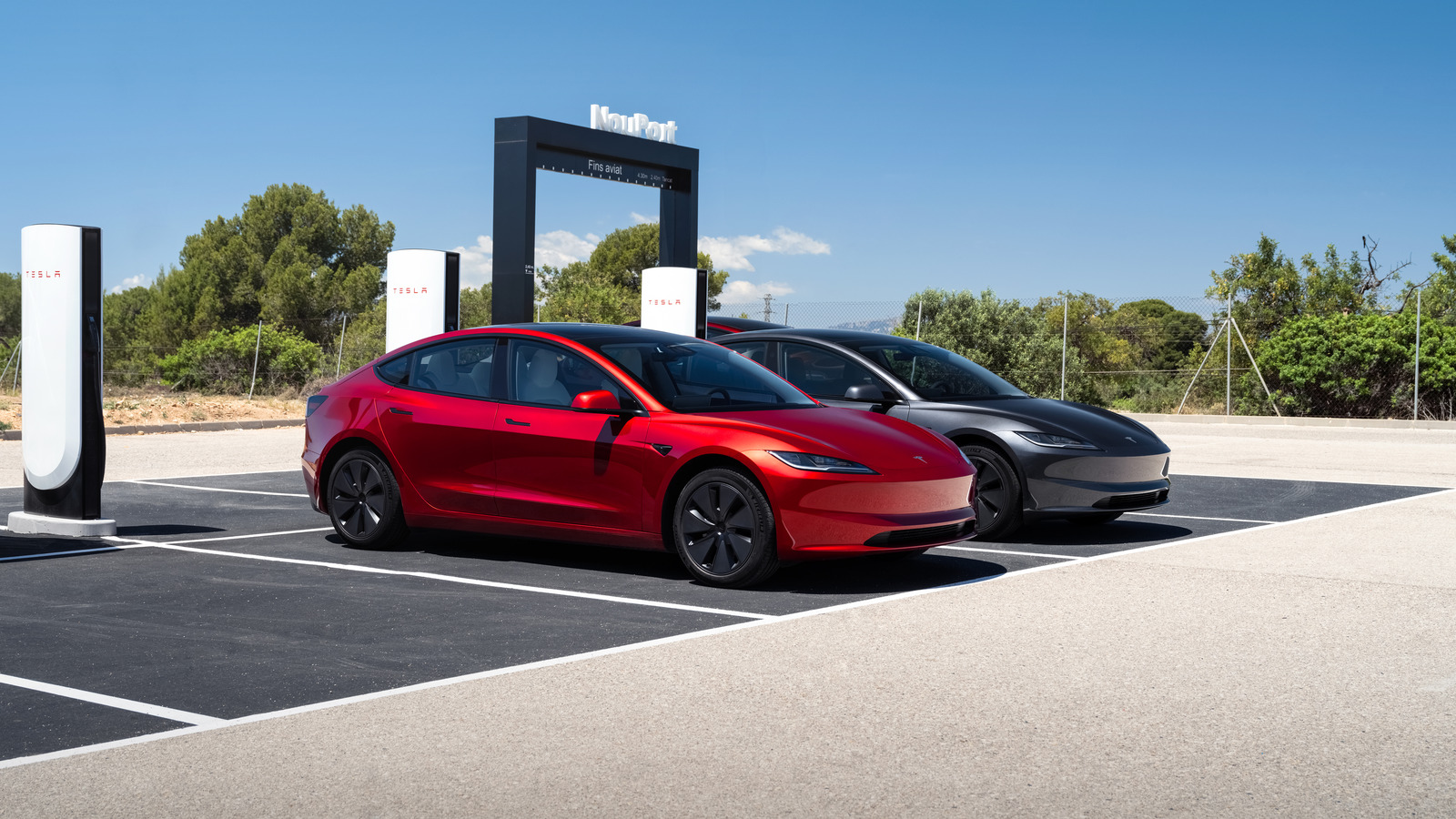
The Tesla App is now giving owners a better indication of what to expect when visiting a Supercharger site, as it is now sharing Site Maps in the app itself, making the feature no longer exclusively available in the car.
Tesla owners can now preview a Supercharger’s layout and live stall status from their phone thanks to the App’s new software version, v4.61.0. Zooming into a supported Supercharger on the charging map now switches the familiar street view into a site-specific map that shows stall positions, occupied bays, out-of-service posts, and a live count of open Superchargers.
It will even show you which specific Tesla model is charging at each occupied stall.
You can now see Live Site Maps in the latest Tesla app (4.61.0.) pic.twitter.com/JIL8QzR8hu
— Zack (@BLKMDL3) September 18, 2026
This is the same view drivers first saw inside the car with the 2025 Holiday Update, which started as a pilot for Tesla in California and Texas. Those early maps showed layout, nearby amenities, and the status of each operational stall. The feature has spread to most Superchargers in the U.S., but now Tesla wants the feature available through the Smartphone App, which is now rolling out to owners.
The in-vehicle screen maps remain a richer 3D canvas and originally required AMD Ryzen infotainment hardware, which left many Intel-based Model 3 and Model Y owners without the view. The app version removes that hardware barrier, so any owner can now get a preview of their upcoming Supercharger stop on their phone.
Anyone with the updated version of the app can open a Site Map on their phone. The feature has provided some additional peace of mind to anxious travelers and those who might be looking for a place that is less congested for faster charging speeds. It is a meaningful addition to many owners, especially for trips to unfamiliar locations.
You can now pick a Supercharger location that might be more aligned with what you are looking for or need: you can pick a site based on what stalls are open, where ADA stalls sit, how you will pull in, and more, instead of circling a crowded lot after arriving. Owners of older cars now have access to the feature without having to purchase a new vehicle altogether.
Site Mpas will not reserve a stall, nor will it change how Fast Charging works. Tesla does something simpler and more useful by giving owners a dedicated preview of the Supercharger they’re about to charge, turning an unknown parking lot into a place that may seem more familiar thanks to the preview.
Interested in ordering a Tesla? Use my referral code for three free months of Full Self-Driving (Supervised) here.
Investor's Corner
Tesla Optimus Gen 3 shows off a cleaner, factory-ready design in new app discovery
Renders hidden inside Tesla’s Android app show Optimus Gen 3’s design before any official reveal.

![Tesla Optimus Gen 3 [Credit: Tesla]](https://www.teslarati.com/wp-content/uploads/2026/03/tesla-optimus-gen3-diner.jpg)
Tesla may have accidentally given a first look at its newest Optimus Gen 3 humanoid robot when photos were found in the Tesla smartphone app.
Design files tucked inside a recent Android version of the Tesla app appear to show the third generation humanoid robot next to the older Gen 2.5 prototype. The assets were extracted from the app package by Tesla community member @wholemars, who posted the renders on X late Tuesday night before deleting them. The Tesla Newswire reshared the side by side comparison on Wednesday, and the images have circulated widely since.
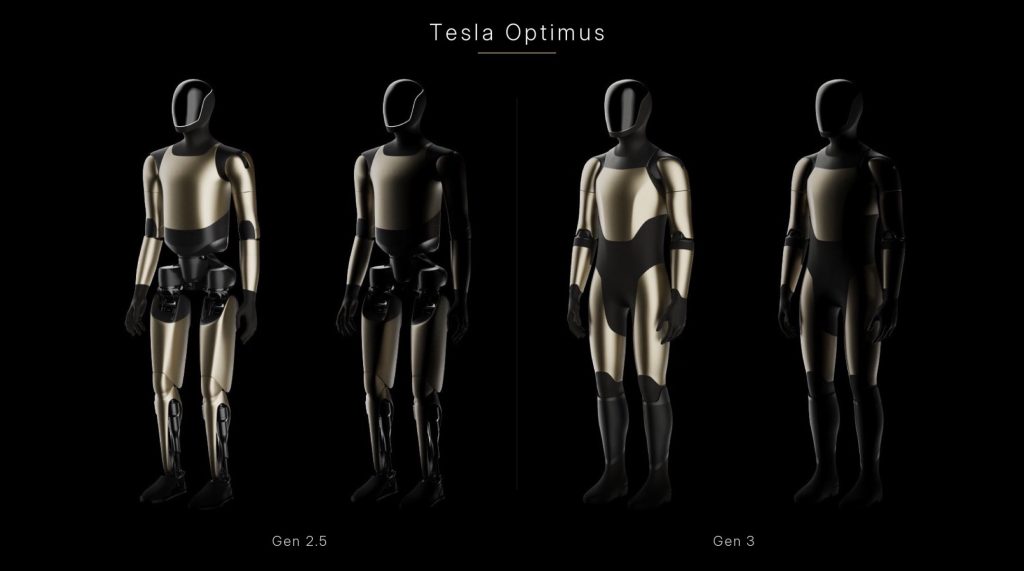
Tesla Optimus Gen 2.5 vs Gen 3 comparison via @WholeMars on X
The files are labeled “gen3” and were built as models for Tesla app’s own interface, as validated directly by Grok to be official.
The comparison shows a robot that looks built for a factory line rather than a lab bench. Gen 2.5’s exposed mechanical linkages and gold plating on the knees and shins are gone. In their place, Gen 3 uses matte black fairings on the lower legs, paired with a more contoured champagne gold body. Flexible covers now seal the joint where the torso meets the upper thighs, keeping bearings and moving parts sealed from debris and unnecessary contact.
The body panels fit more tightly, and the hands, which Tesla has said carry 22 degrees of freedom, look far more refined than those on earlier units.
This most recent leak fills a gap Tesla has left open for most of the year. Elon Musk said on March 31 that Optimus 3 was walking around but needed “some finishing touches” before it could be shown, a delay Teslarati covered when Tesla missed its first quarter reveal target. Musk later said Tesla would hold the design back until closer to production, partly to keep competitors from copying it. No reveal date has been announced.
The app itself has been preparing for Optimus for months. In July, code in the Tesla app pointed to a dedicated robot phone key, a consent screen for collecting video and spatial data while Optimus works inside a home, and an alert system for low battery and mechanical faults. Finished 3D models of Gen 3 suggest the interface owners will eventually use is moving past placeholder code toward something Tesla intends to ship.
Manufacturing is moving in parallel. Tesla tore out the original Model S and Model X lines at Fremont this summer to make room for Optimus production, with a planned capacity of one million robots a year. At Giga Texas, the steel frame of a dedicated Optimus factory is nearing completion ahead of a targeted 2027 start, with Musk pointing to an eventual output of 10 million units annually.
News
Tesla Semi lands the biggest electric truck deal in U.S. history
Tesla leads a record 2,500 truck order, but not every truck will be a Semi.
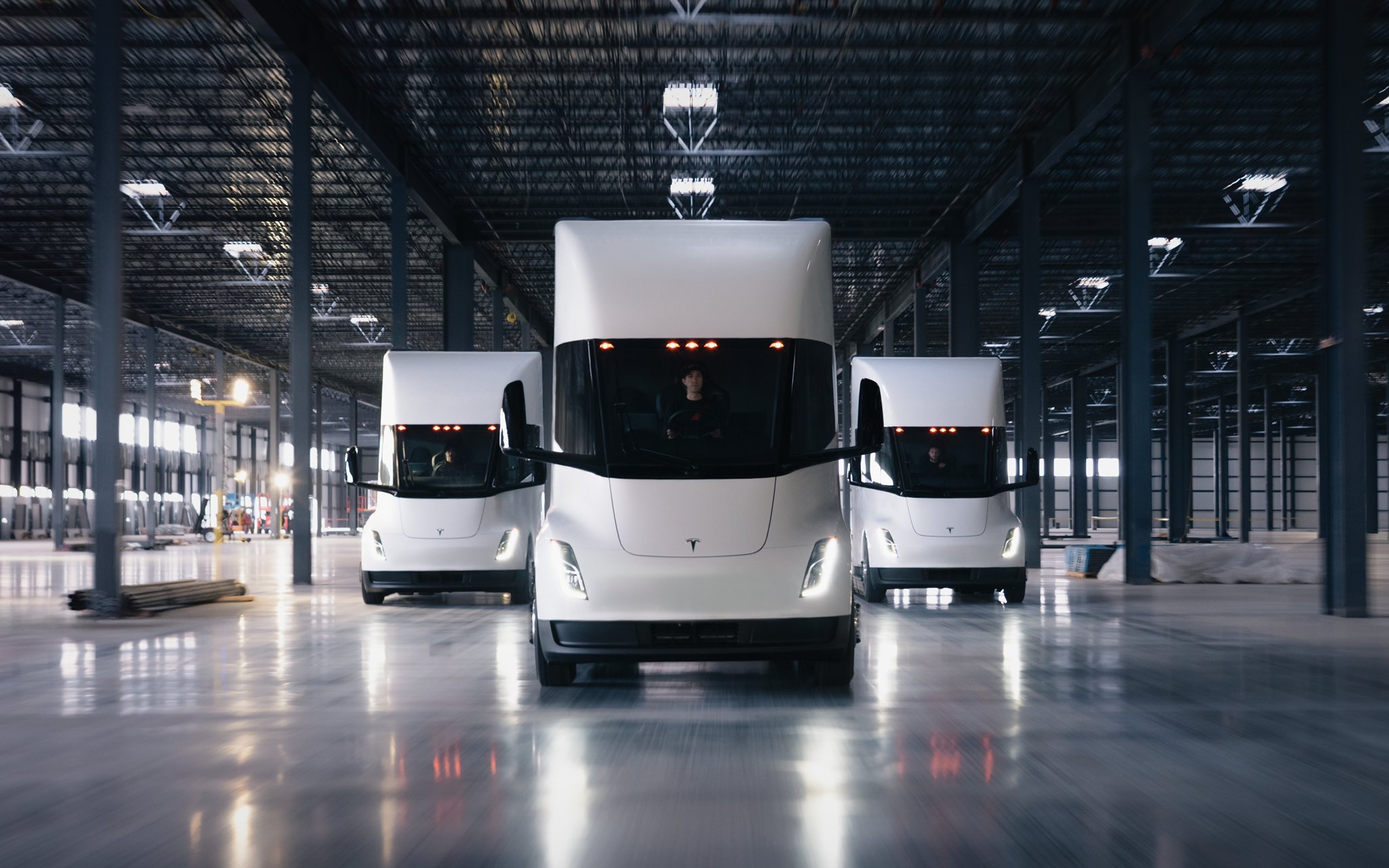
Tesla has landed the largest electric truck order in U.S. history. ZET SCALE, a new alliance of shippers and carriers, named Tesla its primary manufacturer on Tuesday for an initial order of 2,500 electric Class 8 trucks. The deal alone would nearly double the number of electric heavy trucks operating in the country.
According to the press release from Catalyst Mobility, the nonprofit formerly known as CALSTART, Kenworth, RIDE and Volvo were also selected as secondary manufacturers that carriers can pick if their operations call for it. No split between the four brands has been published, so the exact number of Semis in the order is not yet known.
Tesla was selected as the primary OEM for the largest electric Class 8 order in the US by ZET SCALE, a new shippers’ alliance
With 2,500 Semis on order, this will double the entire US electric Class 8 fleet
We’re serious about scale, and ZET SCALE is too!… pic.twitter.com/IiTAdzgken
— Tesla Semi (@tesla_semi) September 22, 2026
Tesla won the top slot through a competitive request for proposals. The alliance, which Catalyst Mobility runs with the Smart Freight Centre, scored bidders on price, range, charging capability and production capacity. Pooling freight demand from founding shippers, including Microsoft and PepsiCo, let every truck maker bid lower than it would for a single fleet. “The Tesla Semi is designed for lower cost per mile operations than diesel,” said Dan Priestley, director of the Tesla Semi program, as noted in the press release.
The financing is built to pull in carriers who have avoided electric trucks. ZET Financial is issuing the purchase order for all 2,500 units and will place them with fleets through a fair market value lease. The trucks will be deployed over the next few years across 10 freight hubs in Los Angeles, Stockton, Bakersfield, Seattle and Tacoma, Houston, Dallas, San Antonio, Chicago, Atlanta, and the Newark and New York area. ZET SCALE says the first order is only the opening round, with a longer term goal of 10,000 trucks or more.
Even if Tesla ends up with only a majority share, it would still be the biggest Semi deal to date. Einride’s 500 unit order in August was the previous record, and WattEV’s 370 truck order in May was the largest California deal at the time. Einride’s CEO has since said he expects all 500 trucks delivered by the end of 2027.
The announcement lands two days before Tesla formally inaugurates its Semi factory in Nevada on September 24. The 1.7 million square foot plant sits next to Gigafactory Nevada’s 4680 cell lines and is designed for 50,000 trucks a year.

Tesla App now shows you what your Supercharger will look like upon arrival
![Tesla Optimus Gen 3 [Credit: Tesla]](https://www.teslarati.com/wp-content/uploads/2026/03/tesla-optimus-gen3-diner-80x80.jpg)
Tesla Optimus Gen 3 shows off a cleaner, factory-ready design in new app discovery


