News
NASA’s Curiosity Rover takes valiant selfie as it weathers Mars’ huge storm

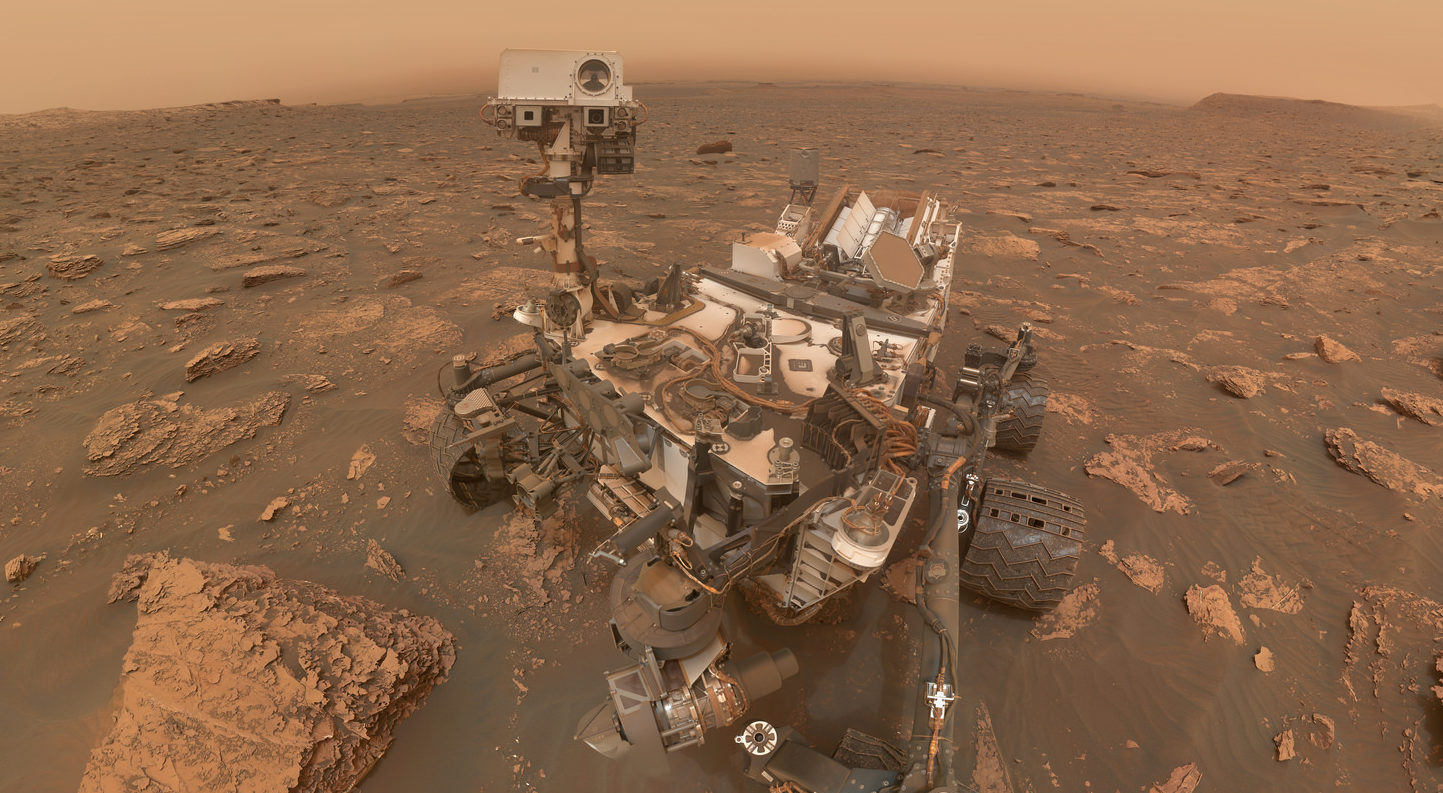
NASA’s Curiosity Rover recently took a selfie at it continues to weather a massive dust storm that has enveloped a massive area of the Red Planet. The spunky rover’s latest self-portrait was taken on Sol 2028, almost six years into its mission.
Immediately noticeable in the image was the thickness of the dust surrounding Curiosity, officially known as the Mars Science Laboratory (MSL). As could be seen in the rover’s self-portrait, which was shared by Seán Doran, the whole background is covered by a thick haze, completely blocking out mountains in the distance. Despite being covered by Martian dust due to the storm, however, Curiosity remains fully operational, thanks to its Radioisotope Thermoelectric Generator (RTG), which converts heat from plutonium into electricity, enabling it to work despite being devoid of sunlight.

NASAs Mars Curiosity Rover takes a selfie in the middle of a massive storm. [Credit: Seán Doran/Flickr]
Curiosity’s RTG is designed with a plutonium core that generates electricity with its heat. Curiosity’s RTG is capable of producing 120 watts, and based on rough estimates; it would take around 14 years of constant operation before the plutonium decays to such a point that it only produces 100 watts. Even then, Curiosity would still be able to function, making it likely that the power source will outlast the rover’s other components, such as its wheels.
The absence of sunlight has been a particular point of concern for another one of NASA’s Martian rovers — Opportunity — which was caught in the middle of the dust storm. Being solar-powered, Opportunity relies on solar panels to recharge its batteries. Due to the storm blocking out the sun, however, the 14-year veteran has lost contact with Earth, and in a recent press conference, NASA noted that the rover has probably entered low power fault mode, which shuts down all of its systems except its mission clock.
Curiosity, for its part, was fortunate enough to escape the center of the storm. Back on June 12, Curiosity took a photo suggesting that the massive dust storm was beginning to encroach in its area of operations, according to a Space.com report. During NASA’s recent press conference for Opportunity, the space agency noted that the storm had already covered 15.8 million square miles (41 million square kilometers), which equates to the size of North America and Russia combined.
Curiosity is currently operating in Mars’ Gale Crater; a 96-mile-wide (154 kilometers) area believed to have once been a vast Martian lake. Curiosity was deployed in the crater to study its geology, which contains both clays and sulfate minerals, which form in water under varying conditions and suggest that the Red Planet may have harbored conditions favorable for life in its distant past.
Curiosity was delivered to Mars beneath a hovering rocket-powered crane in August 2012 and began exploring Gale Crater soon after. While the rover began its mission studying the crater’s floor, Curiosity’s ultimate goal is is currently in the process of climbing Aeolis Mons (nicknamed Mount Sharp), a massive mountain rising 5.5 kilometers (18.000 ft) out of the crater’s center. Just like the walls of an Earthly canyon, Mount Sharp flank hosts layers of data-rich sediment that allow the rover’s science team to understand Mars more deeply than ever before.


Energy
Tesla Model 3 and Model Y can now do what only Cybertruck could
Tesla Model 3 and Model Y can power your home with Powerwall 3 during outages.

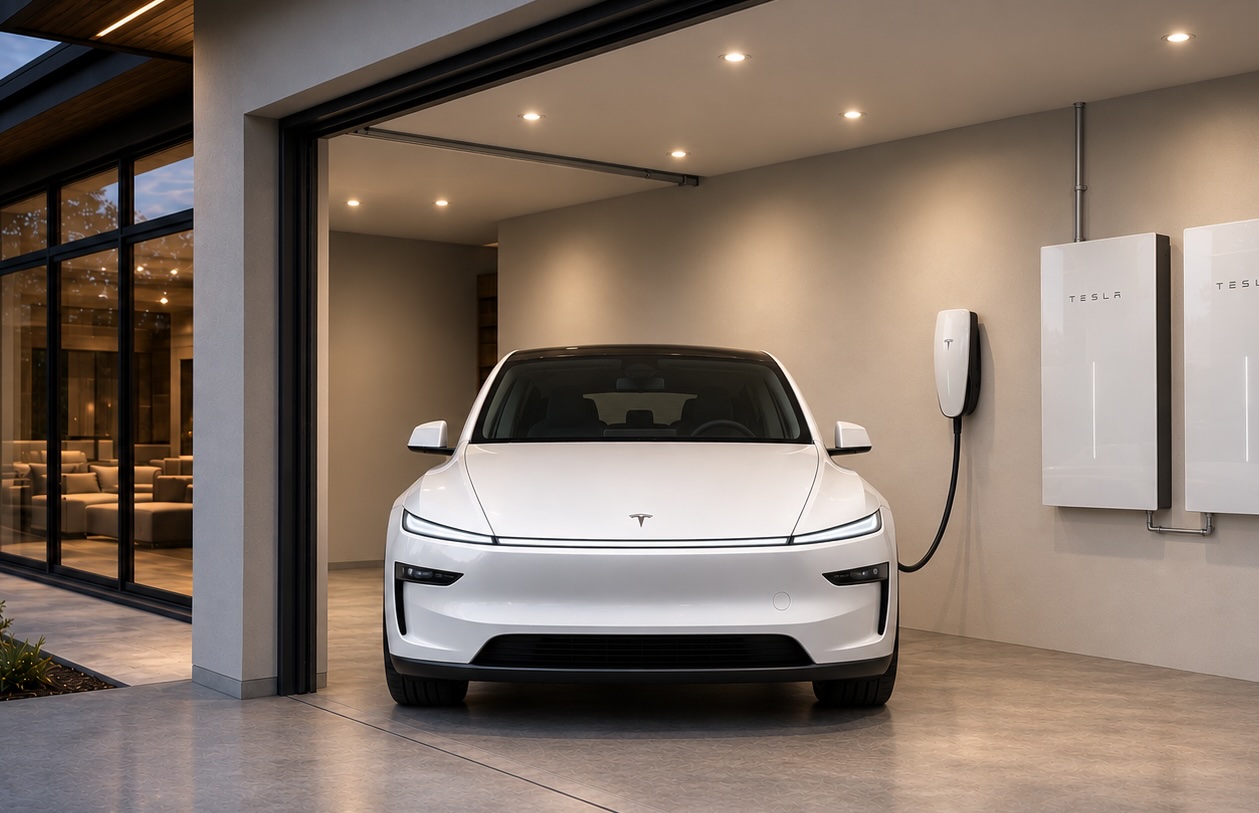
Tesla has turned its two top sellers into backup batteries for the house.
Tesla Energy announced on Tuesday that Powershare Home Backup is now available for new Model 3 and Model Y vehicles paired with a Powerwall 3, saying the car can “extend your home backup by over 2 days.” Minutes later, Tesla’s main account quoted the post with a broader pitch: “With Powerwall 3, every Tesla can now serve as your home’s backup battery.”
Until this week, the Cybertruck was the only Tesla that could send power back into a home, and that capability only began working alongside Powerwall 3 last month, after years of ambitious targets.
Tesla’s updated Powershare page says every Model 3 and Model Y ordered in the U.S. or Puerto Rico on or after October 1, 2026 can use the feature. Some, but not all, earlier cars also qualify. Owners can check on the touchscreen under Software, then Additional Vehicle Information, where a capable car shows “Powershare Support: Enabled.” As Electrek reported, bidirectional power on the two cars runs through an inverter Tesla calls PCS2 Lite, and the company has not said when that part entered production on each trim.
The home side is simpler. A house that already has a Powerwall 3 and either a Wall Connector 3 or Universal Wall Connector needs no additional equipment, and Tesla says compatibility is enabled through a software update. When the grid drops, the Powerwall and the car work together, with up to 11.52 kW of continuous power available. Tesla’s “over two days” estimate assumes a home using 30 kWh per day and a car starting at a 90 percent charge. Standard trims are rated for up to two days, while the Cybertruck adds more than three.
There are limits. Powerwall 2 and Powerwall+ support is listed as “coming soon.” Model S and Model X are not included, and Grid Support, the program that lets Cybertruck owners in Texas send power back to the grid during demand spikes for bill credits, is not available for Model 3 or Model Y.
The rollout also lines up with something Elon Musk said more than three years ago. At Tesla’s March 2023 Investor Day, Musk said, “I don’t think very many people are going to want to use bidirectional charging, unless you have a Powerwall.” Tesla has now shipped the feature for its volume cars with exactly that requirement attached.
The Powerwall pairing was the hard part on Cybertruck. Tesla told owners in December 2025 that Powershare with Powerwall had been pushed to mid 2026, and lead engineer Wes Morrill explained that two devices capable of forming a home’s grid have to negotiate which one leads during an outage, across multiple generations of hardware. With that work done for the truck, Tesla was able to extend it to the Model 3 and Model Y within a month.
Ford and GM have offered home backup from their EVs for several years, but both require a separate inverter and backup hardware. Tesla’s version leans on equipment many Powerwall 3 owners already have on the wall. Powershare for the two cars also ships as part of software update 2026.38.3, the same release that began delivering Halloween Mode on Tuesday.

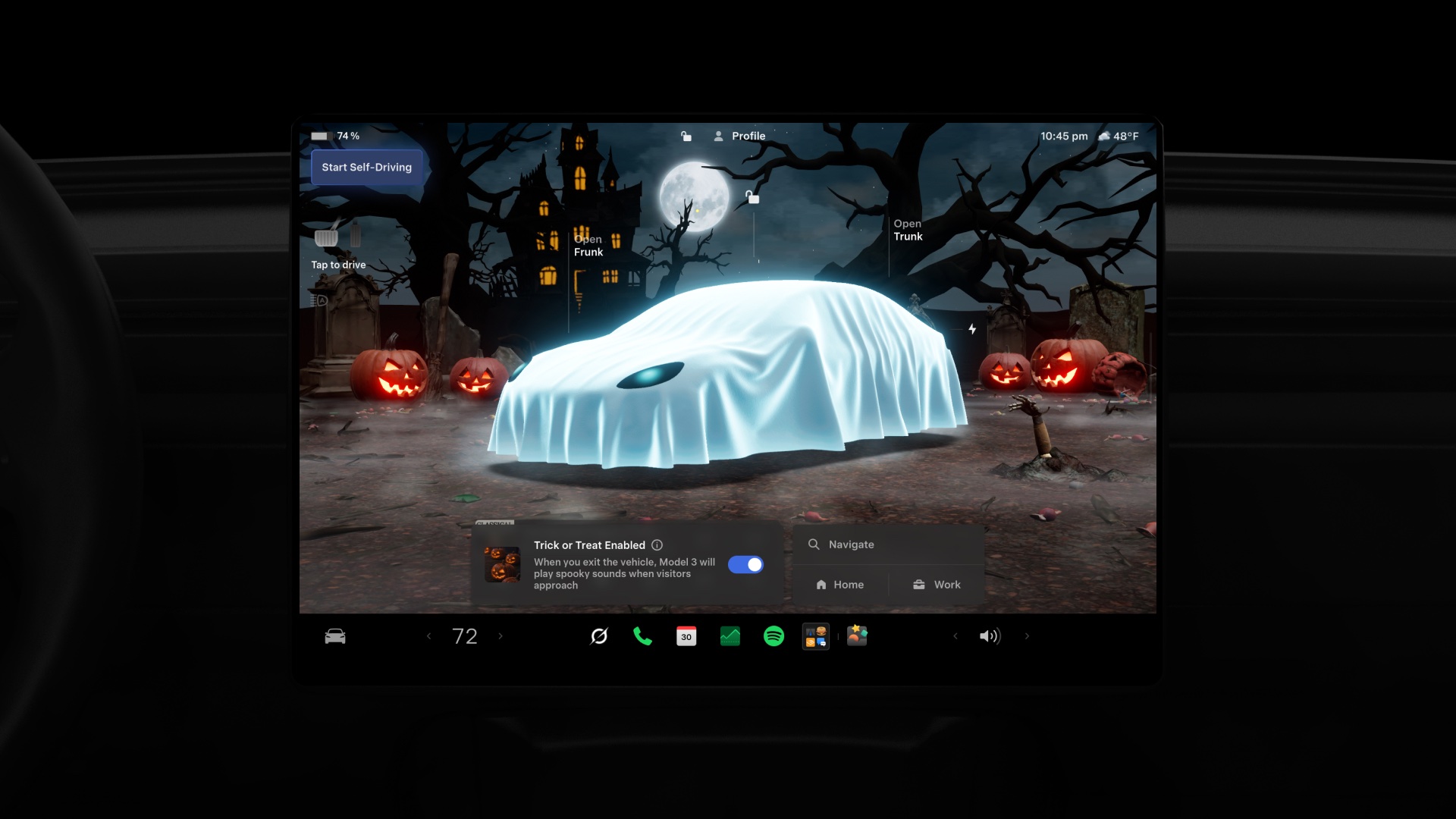
Tesla is now starting to ship a “Halloween Mode” that is filled with some creepy and fun features; the company says, “This spooky update turns your Tesla into a haunted house on wheels.”
The update is just the latest in a series of updates that Tesla typically ships out in a seasonal fashion. The Spring and Summer Updates provided some fun novelty items while also packing some cool features that are actually useful for the ownership experience.
This one seems to be more fun-forward, and there are not any updates to the Full Self-Driving suite or overall operation of the vehicle. Instead, these novelty features are geared toward getting you in the mood for the Fall and Halloween.
Halloween Mode now rolling out 🎃
This spooky update turns your Tesla into a haunted house on wheels
– Ghost costume on your car’s avatar
– Enable Trick or Treat to play spooky sounds & flicker the lights when visitors approach
– New haunting light show, wraps & lock sound
– A rather chilling Photobooth
– Frighten people remotely by speaking through the app…your car will say it in a voice of its own
Side effects may include neighborhood notoriety
— Tesla (@Tesla) October 6, 2026
New Ghost Costume on Car Avatar
Driver Visualization will now show your vehicle as a ghost, as an all-white sheet is draped over the vehicle. Pedestrians are turned into mummies or skeletons, and other vehicles are all a spooky green:
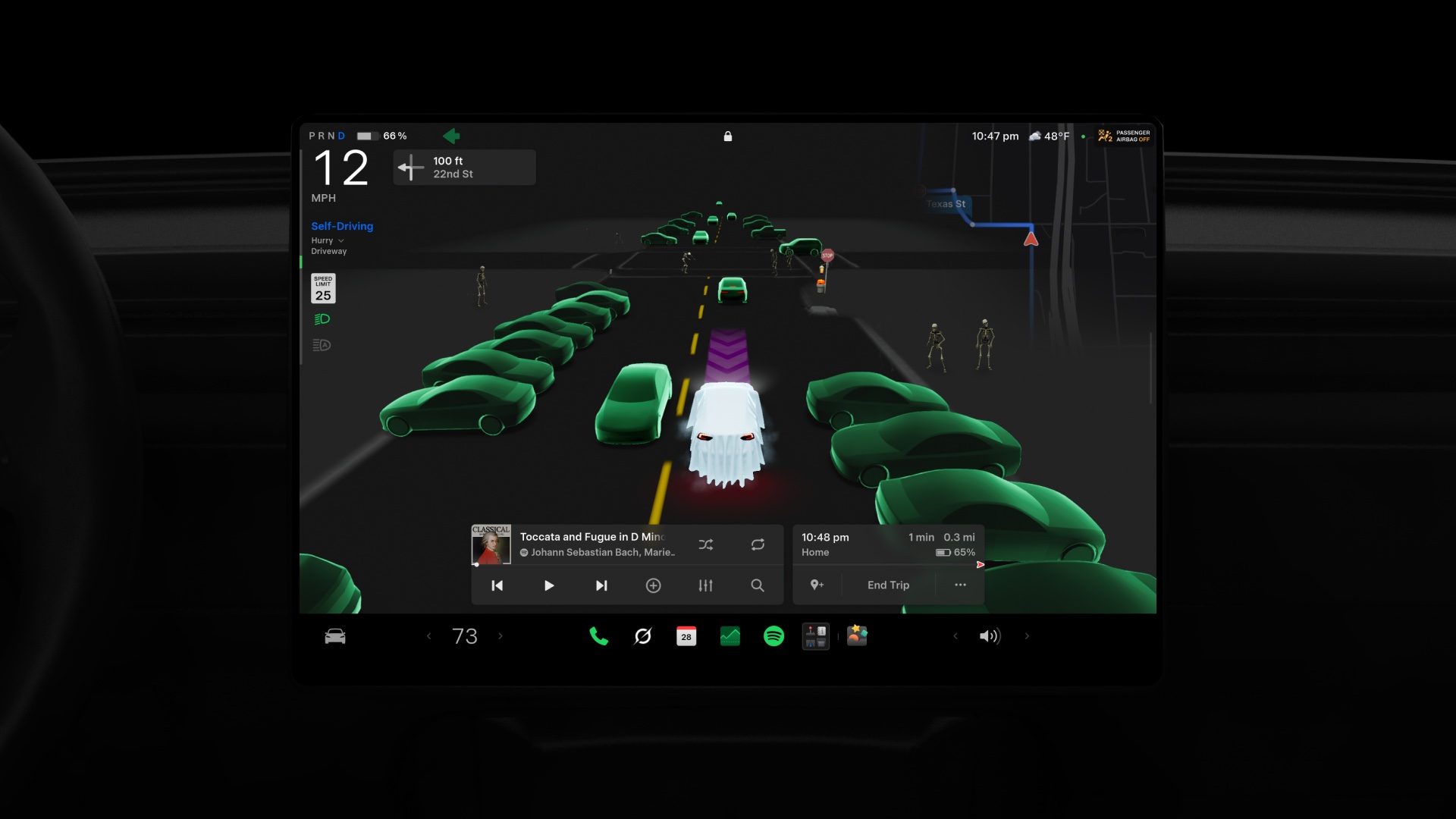
Credit: Tesla
Additionally, the Park Scene with your Tesla now displays that ghost costume draped over your vehicle in the foreground of a scary backdrop with Jack-o-Lanterns and a haunted house:
Credit: Tesla
Trick or Treat Mode
Trick or Treat Mode will enable the vehicle to play spooky sounds and flicker the lights as visitors approach. This might be a nice touch for when you’re handing out candy to kids on Halloween Night.
Other Features
Tesla is also adding a new Light Show, new Wrap Options, and a new Lock Sound with this update.
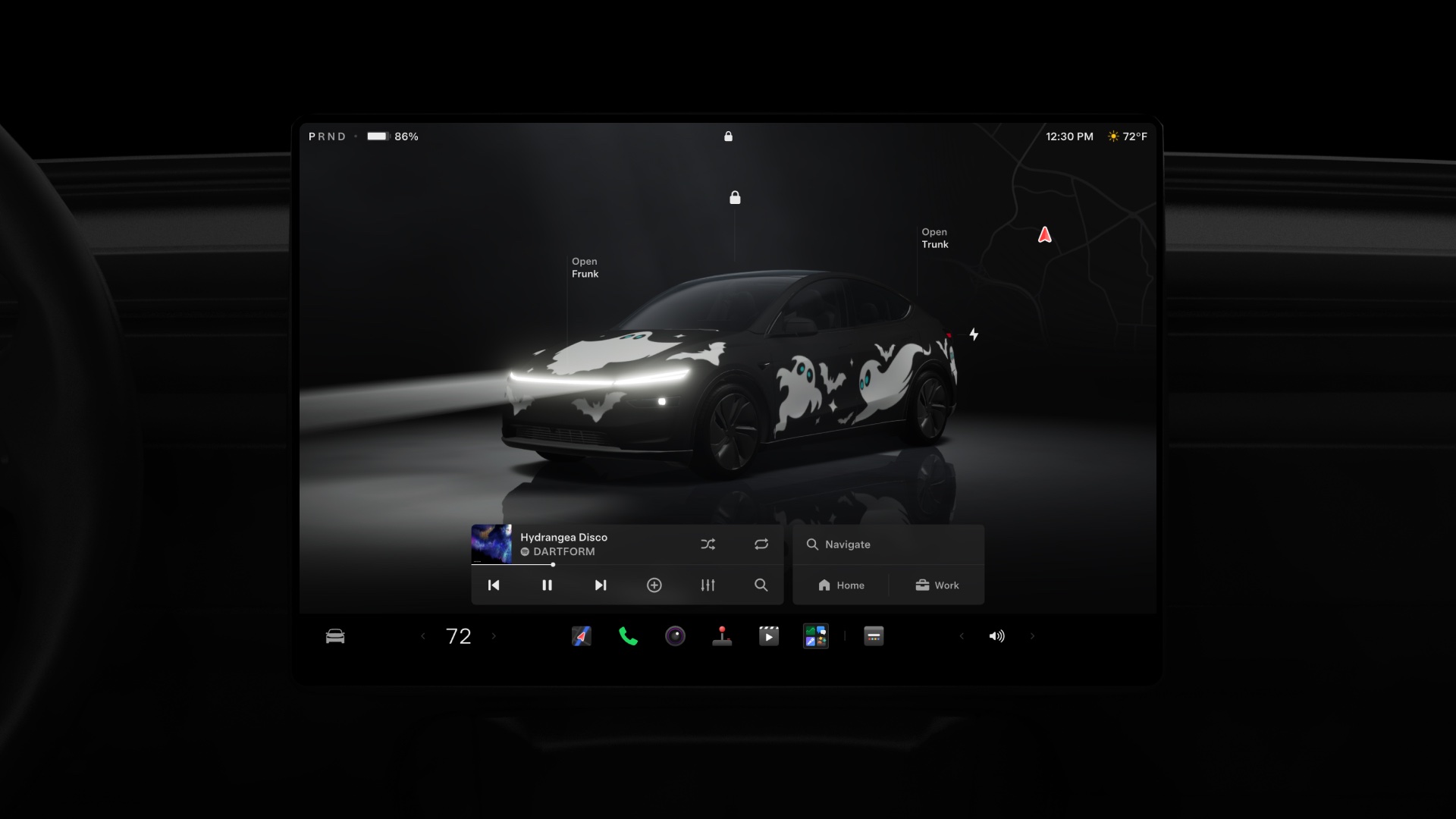
Credit: Tesla
Additionally, Photobooth has a new Halloween option:
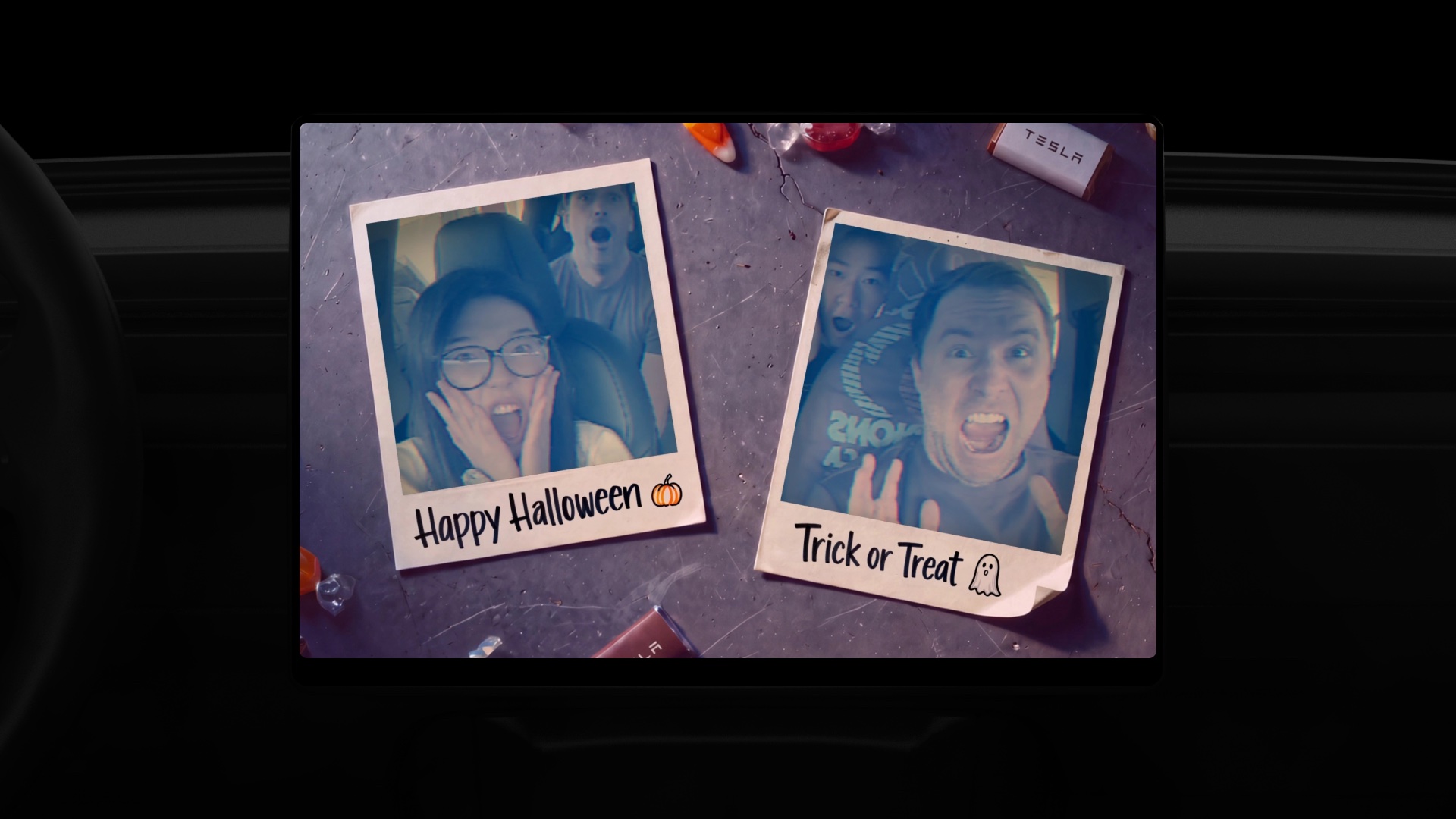
Credit: Tesla
You will also be able to speak remotely through the app and transmit your voice to people outside, which is not a new feature, but the car will say it in a voice of its own, which is a new feature with that bullhorn-like feature.
Investor's Corner
SpaceX reveals how its 1 Million AI satellite network will work and prevent space collisions
SpaceX reveals plans for one million Starmind AI satellites and calls out operators hiding maneuvers.
SpaceX has put the largest satellite count it has ever published into writing, and it says that plan only works if every other operator in orbit starts sharing what it knows.
In a new Space Safety page highlighted Tuesday morning by Sawyer Merritt on X, SpaceX said it “plans to operate up to 100,000 Starlink satellites and up to 1 million Starmind AI satellites to meet the growing demand for broadband and supercompute.” Starlink has a little over 11,000 satellites in orbit today, so the target alone implies roughly a ninefold expansion of the broadband network.
Starmind is SpaceX’s orbital AI compute constellation. Elon Musk confirmed the Starmind name in June after an xAI trademark filing surfaced, and in August SpaceX said it was working with Nvidia on the compute payload. The FCC accepted the filing for up to one million satellites back in February.
FCC accepts SpaceX filing for 1 million orbital data center plan
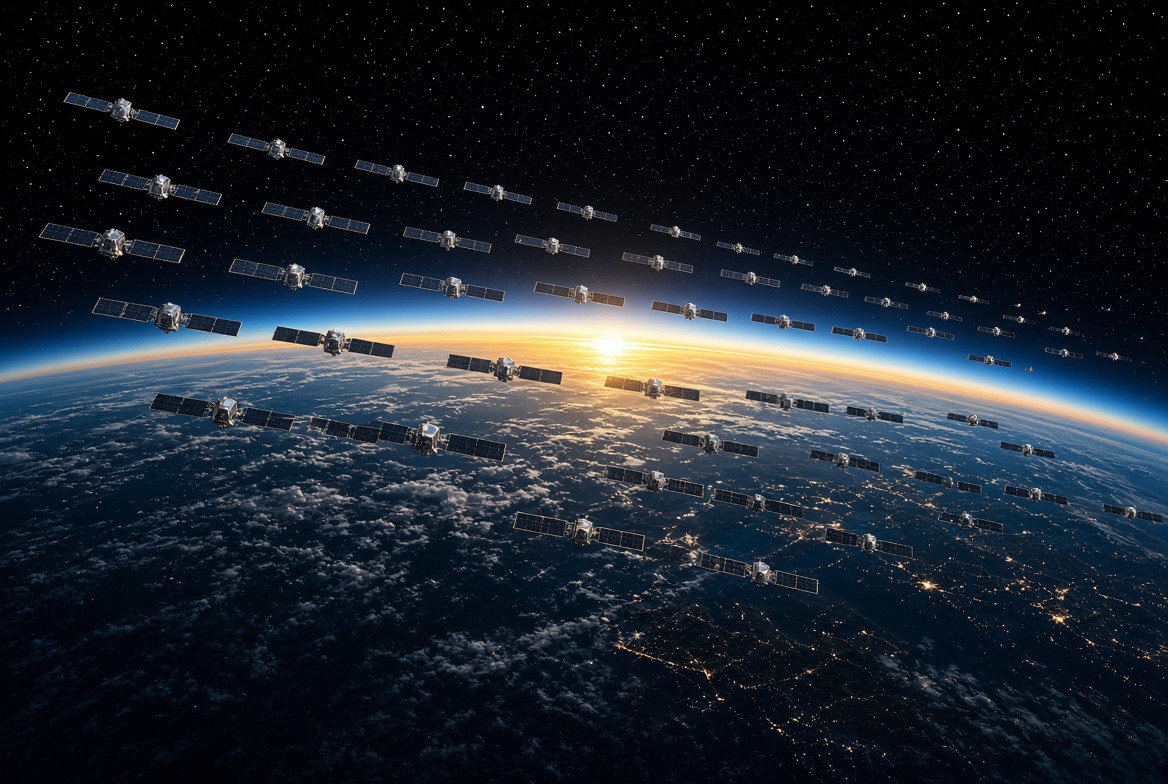
SpaceX also released a new render of what a full Starmind constellation could look like. Alongside it, SpaceX VP Michael Nicolls explained why the satellites will not operate on their own. “We need to operate clusters of satellites in tight formation to get enough coherent compute to run AI models efficiently,” Nicolls said. “A cluster will be 10-ish satellites connected with 10 terabits or so of bandwidth between them, and interconnected to the broader constellation.”
That is the most specific detail SpaceX has given on how Starmind will be built. Instead of a million independent servers, the network would work as tightly packed groups of about 10 satellites acting as one compute unit, with Starlink’s laser links carrying results back to Earth.
There is a bright and exciting future for humanity ahead – and space is fundamental to that future.
To achieve this, space safety must be done right. We encourage every operator to not only share ephemeris data proactively the same way Starlink already does, but to also adopt the high standards of space safety that SpaceX and Starlink use every day → https://t.co/QizAkQZvEm
— Starlink (@Starlink) October 6, 2026
Packing satellites that close together, at that scale, makes collision avoidance the central problem, and most of the Space Safety page is aimed at other operators. SpaceX said Starlink encountered collision risks with about 650 unique maneuvering third party satellites in 2026, and only about half of them shared data. Over six months, Starlink recorded roughly 164,000 more collision risks where the closest approach came within four hours of an unannounced maneuver.
Some operators keep maneuver plans private over proprietary concerns, while others cannot get government permission to share them. SpaceX called those policies “counterproductive,” saying they “largely only serve to create preventable collision risk between satellites.” Starlink is also offering a free ephemeris sharing and screening platform that returns risk results within a minute, backed by its Stargaze network of 30,000 optical sensors.
The push comes as the Starmind application draws opposition from astronomers and environmental groups. In a September filing with the FCC, SpaceX said each Starmind satellite could weigh up to 4,000 kg, nearly seven times the mass of a Starlink V2 Mini. Musk has brushed off crowding concerns before, telling viewers in June that “space is enormous” and that SpaceX already knows how to run very large constellations safely.
SpaceX’s Starmind page says its Gigasat factory in Bastrop, Texas, is designed to produce AI satellites at scale, with deployment of thousands of units starting as soon as late 2027.

Tesla Model 3 and Model Y can now do what only Cybertruck could

Tesla ships ‘spooky’ Halloween Mode with creepy and fun features


