Firmware
Tesla showcases Autopilot, Full Self-Driving tech in Autonomy Day (Live Blog)

Tesla is holding its Autonomy Day today, with the company inviting investors to its headquarters in Palo Alto, CA to get a deep dive into the company’s full self-driving initiatives. During the event, Tesla will be sharing its full self-driving roadmap to attendees. Several key executives involved in the company’s autonomous driving project such as CEO Elon Musk, VP of Engineering Stuart Bowers, VP of Hardware Engineering Pete Bannon, and Sr. Director of AI Andrej Karpathy will be addressing the event’s attendees as well.
Investors will also have the opportunity to experience test rides in vehicles that are equipped with Autopilot and Full Self-Driving features that are yet to be released. With Autonomy Day, Tesla has the potential to establish itself as a key player in the autonomous vehicle race, a competition that is currently being dominated by big players such as Waymo and GM Cruise. Elon Musk’s stance on Full Self-Driving being attainable using a system that consists primarily of cameras and artificial intelligence will also be put to the test.
The following are live updates from Tesla’s Autonomy Day. Fellow Teslarati reporter Dacia Ferris and I will be updating this article in real-time, so please keep refreshing the page to view the latest updates on this story.
Dacia 14:20 PT: Aaaand that’s a wrap! So good to hear from Elon’s brain after the trip down sheep meme world of late. Thanks for following along everyone!
Simon: 14:16 PT: Thanks for joining us for today’s live blog, everyone! Till the next time, and super appreciate your continued support for Teslarati!

Dacia 14:15 PT: IMPORTANT –> Tesla will be liable if there is an accident while using the Tesla Network, per Elon.
Dacia 14:14 PT: “[Autonomy] is basically our entire expense structure,” Elon responds to a question on how much Tesla is spending on FSD development.
Dacia 14:10 PT: A human driver is like a camera on a gimbal…it can’t see everywhere at the same time. A Tesla can see all things at all times. The things it focuses on, however, start to become very human like all the time. It turns and focuses on things in a way similar to how humans operate, Elon explains.
Dacia 14:08 PT: The neural net is eating into the software base over time… A neural net is like a cruise missile…you wouldn’t use that to swat a fly, Elon responds to a question about the types of computing happening inside the FSD computer.
Dacia 14:06 PT: Low-density areas will probably have customers owning their Tesla vehicles, only occasionally renting them vs. higher density areas with higher rates of rental, Elon predicts how customers will use the Tesla Network.
Dacia 14:05 PT: “If you have a massive amount of data saying that autonomy is safe…they’ll listen to it. They may take a long time to digest…but they’ll come to the right conclusion,” Elon comments on the regulatory process for FSD.
Dacia 14:03 PT: Tesla pickup truck mentioned!! Nothing dropped, though. Elon just says it will be revealed later this year.
Dacia 14:02 PT: “It’s financially insane to buy anything other than a Tesla [today]…it’s like buying a horse,” Elon says confidently. He’s very certain about this, given the tech advances and advantages Tesla’s vehicles have.

Dacia 13:59 PT: “We’re going to bias our sales strategy towards the smaller battery packs,” Elon says, the point being to have a higher volume of cars for the Tesla Network.
RELATED: Learn more about Tesla’s “Robotaxi” self-driving rideshare service
Dacia 13:58 PT: False and foolish = HD maps and LiDAR – the final word from Musk on two no-go’s for FSD cars. Mark his words.
Dacia 13:52 PT: Elon Musk thinks a rental car fleet instead of using the Tesla Network would be unweildy. “Try it,” he challenges an investor challenging him on that notion.
Dacia 13:50 PT: Any robo taxi that isn’t electric will not be competitive, Elon predicts. He also said that the cars will not need human supervision at all eventually, plugging themselves in, etc.
Dacia 13:49 PT: Robo taxis will be in extremely high demand for a very long time. The auto industry is very slow to adapt…there are new cars on the road right now that are still not as good as the original Model S, Elon expresses his confidence in the Tesla Network’s financial success.
Dacia 13:45 PT: Both Model S and Model 3 cars will used as robo taxis, Elon confirms. THIS IS BIG: The current battery pack is good for about 300-500,000 miles. The new battery pack that will probably go into production for next year will operate for **1 million miles** with minimal maintenance, he announces, specifying that the improvements are driven by the Tesla Network development. As parts become less and less important (steering wheels, pedals, etc.), they will delete them from the cars.
Dacia 13:39 PT: “You’ll be able to add or subtract your car to the fleet from your phone,” Elon says, teasing how the Robotaxi Tesla Network will operate.” You could have your car operate 1/3 of the week or longer…The fundamental utility of your vehicle will increase by a factor of 5.”
Dacia 13:37 PT: “The whole thing was designed to be a Robotaxi since October 2016,” Elon says referring to the FSD intentions for Tesla. “We said we’re gonna do the Robotaxi, and we’re gonna do the robo taxi…it just might not be on time, he jokes, referring to Elon Standard Time. Today he definitely seems determined to express his…determination.
Simon 13:36 PT: Elon Musk reiterates the Tesla Master Plan. He also jokingly notes that while he’s usually late, he and the Tesla team gets things done. Musk then notes that the Robotaxi service (Tesla Network) will likely be rolled out on 2020.

Dacia 13:30 PT: Nine million successful lane changes have been logged in Tesla cars, per Bowers. They are now seeing 100,000 automated lane changes per day. That’s a lot for the NN to learn from! No simulator necessary.
Simon 13:29 PT: Stuart describes the development cycle of Tesla’s Full Self-Driving computer, and how it blends in perfectly with the company’s neural networks.
Simon 13:21 PT: Stuart Bowers takes the stage. Notes that Navigate on Autopilot has already accumulated 70 million miles so far.
Simon 13:19 PT: Elon notes that in terms of regulators, platooning for trucks could get approval first. This sounds a lot like the Tesla Semi’s Convoy Mode, which allows the vehicles to draft semi-autonomously with each other. Perhaps the Semi will enter the market with Convoy Mode ready to use?
Dacia 13:18 PT: We expect to have FSD ready by second quarter of next year for no-hands on steering wheel, no looking out the window use, Elon predicts regarding the Autopilot timeline. FSD will be “feature complete” this year.
Dacia 13:13 PT: Elon on GPS: We don’t want to use GPS as primary navigation. It’s fine for tips and tricks, places you know and drive in confidently…counterintuitive shortcuts. But the GPS overlay data should only be helpful but never primary. If it’s ever primary, that’s a problem.
Dacia 13:11 PT: We have 425,000 cars with this hardware…providing data…that’s a massive compression of real world data, Elon touts. “I suppose there could be another use for the hardware,” Elon speculates. “Maybe some sort of AWS angle.” He’s referring to Amazon’s cloud computing, or something similar, perhaps.
Dacia 13:07 PT: “You only need radar in the forward direction because you’re going really fast,” Elon concludes.
Dacia 13:06 PT: “LiDAR is lame,” Elon replies to a comment about his ‘slam’ on the tech during the presentation. The man is clear about his feelings. “We’re gonna dump LiDAR, mark my words. That’s my prediction.” He then talks about SpaceX’s use of their own LiDAR because it makes sense. LiDAR in cars is “stupid”, he says…in case you were wondering how he **really** feels.
Simon 13:00 PT: Elon lightly mentions a mode beyond Mad Max once more. Looks like an “LA Traffic Mode” might really be released in the future.
Dacia 12:56 PT: If I were to summarize my entire talk in one slide it would be this, Andrej concludes. And that includes incidents of flying cars (the rightmost image).

Dacia 12:51 PT: After only 6 seconds of NN analysis, the 3D reproduction of the scene recorded is amazing. Depth perception is just..wow. LiDAR is used to annotate what vision is seeing.

Dacia 12:49 PT: You all used your own neural network in your brains to get here…you didn’t shoot lasers from your eyes to drive, Andrej says, explaining why NN is better for FSD than LiDAR.
Dacia 12:47 PT: “We’re gonna turn on Augmented Vision…it’s kind of scary, actually,” Elon tells the audience, referring to the test drives to come after the presentation.

Dacia 12:45 PT: “Everyone is training the network all the time, is what it comes down to,” Elon recaps the explanation of how the NN gets its data and how that data is used.
Dacia 12:44 PT: We ask the fleet to send us data focused on a problem to be solved, and that’s used to train the neural network further, Andrej explains. He previously mentioned “tunnel” problems as an example, here is using cut ins from cars coming from other lanes. The false positives and false negatives are then analyzed, used for retraining.
Simon 12:42 PT: Andrej describes how Tesla trains its Neural Network through vehicles in Shadow Mode. Based on the AI Director’s presentation, the improvements in Tesla’s capability to predict cut-ins on the road were the result of fleet learning.
Dacia 12:38 PT: “Using simulators, it’s like grading your own homework,” Elon doubles down against using simulators vs. real world driving. “It would be a monumental achievement of human capability,” he says, referring to creating a simulation that actually modeled reality.
Dacia 12:37 PT: On simulations, Tesla uses them extensively, including for training data. But there really is no substitute for real data. The modeling isn’t the same…the real world throws some crazy stuff at you. Snow, trees, construction sites, plastic bags flying in the wind, etc., all interact differently and give different data, Andrej continues teaching the investor audience how NN’s work.
Simon 12:32 PT – Neural Networks like data. Lots of it. More data just makes them work better. There really is no substitute for physical data. Andrej shows a comparison of its simulation vs its real-world road data.
Dacia 12:30 PT: Neural network training seems a lot like mathematical opinion making.
Simon 12:30 PT: Andrej describes the work being done by Tesla to train its neural networks. The amount of detail in terms of labeling data is insane.
Dacia 12:28 PT: “It really is the Matrix,” Elon comments as Andrej explains how computers “see” things and learn from them.
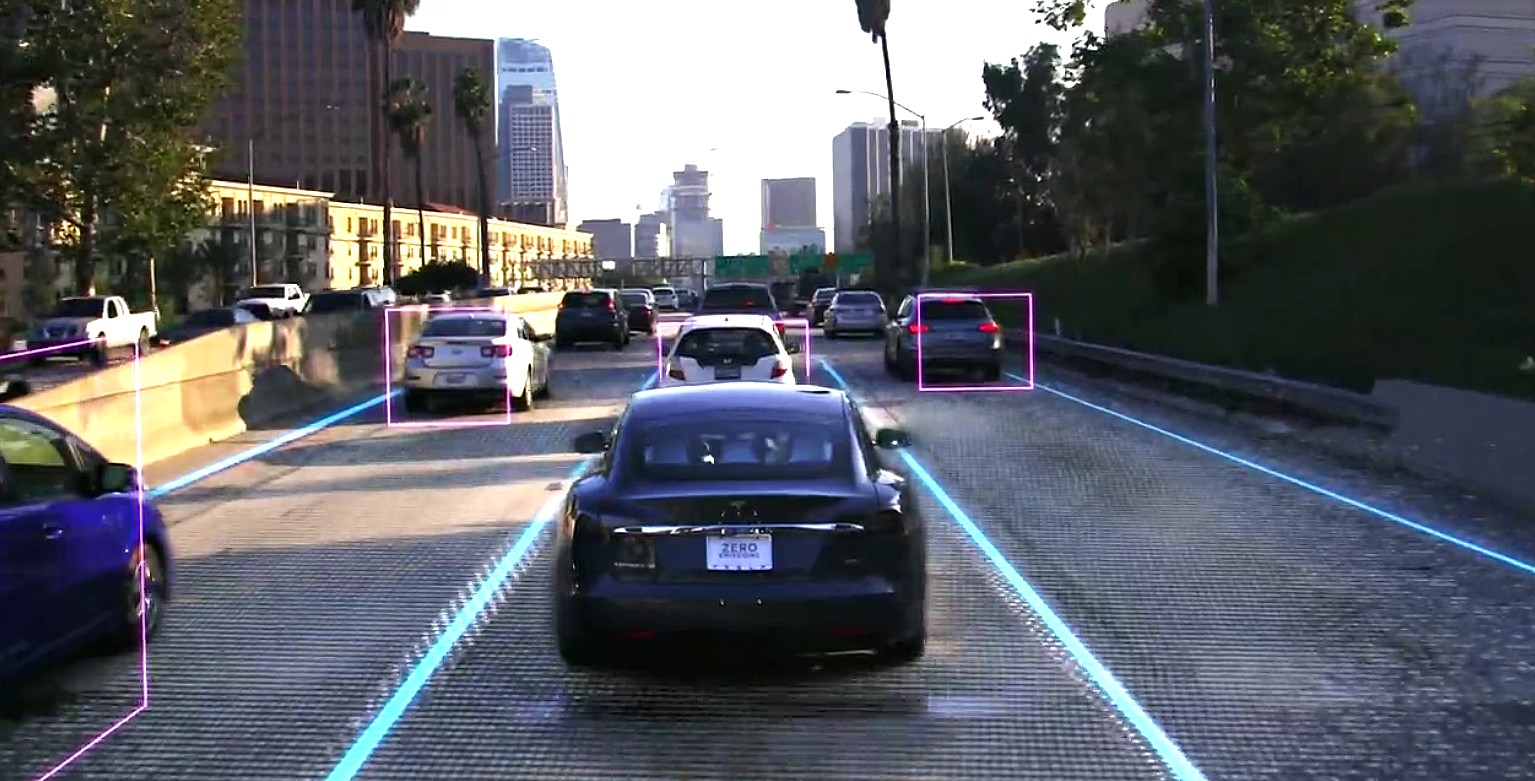
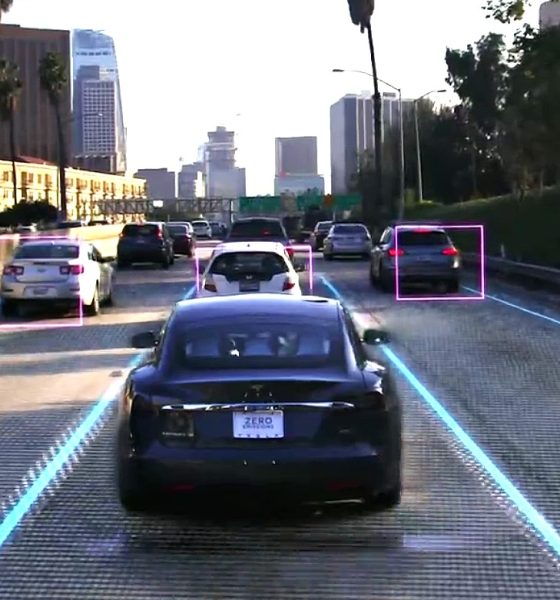
Simon 12:27 PT: Andrej Karpathy takes the stage. A video of Tesla Vision is shown on stage. Particularly interesting is how high-definition the video in the sample was. Andrej proceeds to explain how neural networks are similar to the human brain.

Dacia 12:26 PT: Andrej Karpathy, Sr. Director of AI at Tesla, his team is resposible for training the neural networks. Elon thinks he may be the best “computer vision guy” in the world. (Elon’s IQ would probably know these things.)
Dacia 12:32 PT: People effectively program Google with their queries… We have quite a good simulation, but it doesn’t fully capture the real world. If it did, it would be proof that WE were living in a simulation, Elon responds to critique about real world miles needed for FSD.
Simon 12:22 PT: Elon on simulated miles. “Simulations don’t capture the real world,” Elon said.
Dacia 12:21 PT: That’s a hard problem. Anyone who can solve (hack) it, I’d hire in a second, Elon emphasis the difficulty in completely encrypting Tesla’s chip software. It’s already a “hard chip to crack.” PWN2OWN – the 3 year live stream?
Dacia 12:17 PT: The neural processor design is custom by Tesla, not external IP, Bannon confirms for an investor. *** Fabricating is being done by Samsung in Austin, TX. ***
Dacia 12:16 PT: The next generation chip will be about 3X better than the current one…about 2 years away, Elon answers a question regarding what’s next for FSD computer, after saying he doesn’t want to talk much about it. The man is always looking forward to the next milestone, as impossible as it seems.
Dacia 12:14 PT: Power consumption for FSD is 250 watts per mile, per Elon. It also depends on the type of driving, per Elon.
Simon 12:13 PT: Elon Musk speaks his mind about the use of LiDAR for full self-driving once more. “LiDAR is a fool’s errand, and anyone who relies on LiDAR is doomed. It’s like having expensive appendices. You’ll see,” he said.
Dacia 12:10 PT: (over Nvidia) Elon mentions “Xavier” power requirements are higher and power requirement is 7x and costs 7x. You can do neural networks that are 7X more powerful on Tesla’s chip vs. NVIDIA’s, Bannon explains to an investor in the audience.
Dacia 12:07 PT: “It seems improbable. How could it be that Tesla, who has never designed a chip before, would design the best chip in the world? But that is objectively what has occurred,” Elon touts.”All Tesla’s being produced right now have this chip,” he doubles down. “All Tesla cars right now have everything necessary for FSD. All you have to do is update the software.”
Simon 12:08 PT: A wild next-generation Tesla Roadster has appeared.

Simon 12:05 PT: Elon Musk notes that Tesla switched over to switched over Model S and X about a month ago, Model 3 about 10 days ago. Every car today has this hardware installed.
Teslarati Audience 12:00 PT: “Like i am 100% sure all the finance guys in the audience understand like less than 1% of this… I study CS and i understand maybe 2-5% of this…” @meamZ_MZ
Simon 12:02 PT: Pete Bannon’s in-depth presentation of Hardware 3 and Tesla’s custom solutions shows just how much of a tech company Tesla really is. I’ve yet to see a carmaker present anything similar to date.
Dacia 12:01 PT: You need 1 TB per second of bandwith per engine to operate FSD, 2 on the chip, Bannon continues. Again highlighting how amazing this computer is.
Dacia 11:56 PT: FSD only operates software that’s cryptographically signed by Tesla – it will NOT operate software that isn’t Tesla’s, Bannon says. Wow. I wonder if that will be part of a PWN2OWN or Bug Bounty program?
Dacia 11:55 PT: 50 trillion operations per second was the goal performance for HW3, 72 trillion operations per second achieved. Amazing. Makes me think of SpaceX’s engines always overachieving the performance goals.
Dacia 11:53 PT: The size of the CPU is in the “sweet spot” between cell phone CPU size and high-end CPU size, Bannon says as a picture of HW3’s processor is on screen.
Tesla’s neural network processor. (Credit: Tesla)
Dacia 11:52 PT: “The general principal of this is that any part of this could fail and the car keeps driving,” Elon clarifies the importance of the redundancy built into the FSD computer. A picture of the full computer is on the screen – it fits in the top part of the glove box. So small, so powerful.
Dacia 11:45 PT: “Hopefully you’ll all still be awake by then,” Pete Bannon, system architect for FSD, jokes prior to beginning his presentation. I should have grabbed coffee. Three years from start of FSD group to deployment of HW3 in all 3 Tesla cars – that’s amazing.

Simon 11:43 PT: Elon Musk has taken the stage and gives the floor to Pete Bannon. Pete describes the timeline of Tesla’s Full Self-Driving chip. Retrofitting employee cars started December. “It’s the fastest systems development program I have ever seen,” Bannon said.
Simon 11:35 PT: During the third quarter earnings call, Andrej mentioned something about a large Neural Network that Tesla had already trained, but was not able to deploy due to computational constraints. Personally excited to see this neural net in action when paired with Hardware 3.
Simon 11:32 PT: So just to review, we’re expecting to see a number of pertinent updates on Tesla’s Full Self-Driving initiatives today. Personally looking forward to Stuart Bowers, Pete Bannon, and Andrej Karpathy’s segments in the event.
Simon 11:32 PT: This song will effectively be stuck in my head for the rest of the day. I guarantee it.
Dacia 11:31 PT: “New Rule” for live stream events in future: More than one soundtrack for film reel.
Dacia 11:30 PT: Okay, half hour late now. Well…it did say Autonomy “Day”.
Dacia 11:26 PT: I love that the Tesla Semi is in this video roll. Would be even MORE awesome if the Semi was part of the Autopilot demo.
Simon 11:24 PT: We’re approaching 25 mins late. Looks like Autonomy Day will start in Elon Time. Not sure if that’s a good sign or a bad sign.
Dacia 11:14 PT: Seeing complaints on Twitter about the video, now. Some are amusing, some not so much.
Simon 11:10 PT: We’re at 13 mins late now. But the new footage sure is sweet. The Roadster shots are particularly amazing.
Dacia 11:10 PT: Well, the livestream is late…but this video footage is amazing. We haven’t seen most of these shots before. There are some Autopilot features intertwined – nice touch!


Firmware
Tesla unlocks in-car web conferencing to extend Google Meet, Teams and beyond
Tesla’s Summer Update lets owners join Google Meet, Teams, and Discord calls via cabin camera.

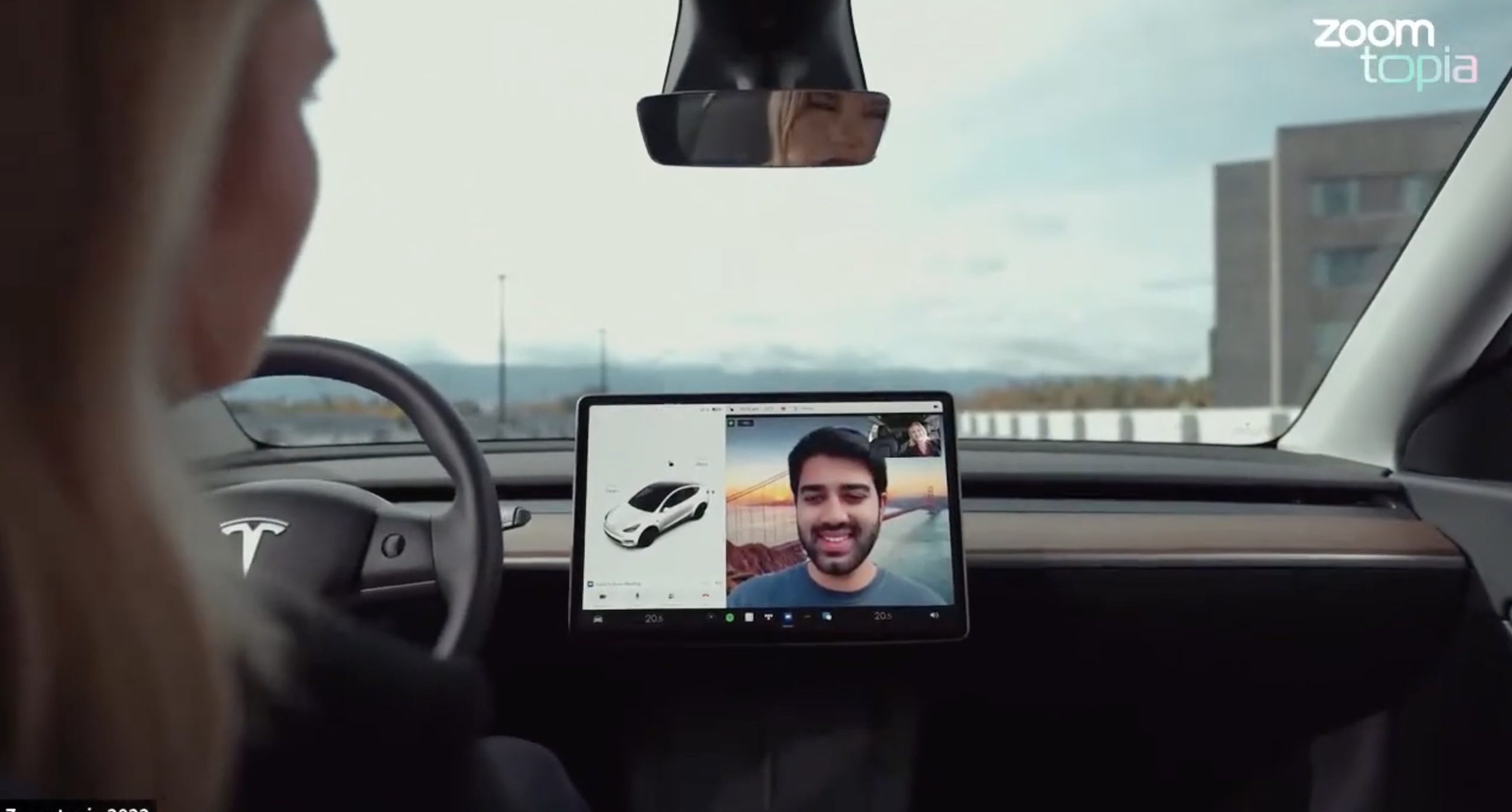
Tesla’s 2026 Summer Update, which just began rolling out to customer vehicles, now links the built-in web browser with the in-cabin camera feed and microphone input, thereby letting owners join video calls on nearly any browser-based service instead of just Zoom.
The change appears in Tesla’s own release notes for software version 2026.26 under “Web Browser,” which states that the vehicle can now use its interior camera and cabin microphone when a website requests access, with permission granted the same way a desktop browser handles it. As NotATeslaApp notes, this feature opens the door to Google Meet, Microsoft Teams, Discord, and other webcam-enabled sites to activate the in-car cabin-facing camera. The feed automatically crops and zooms to center the driver in frame.
Tesla has offered in-car video calling before, but only through a dedicated Zoom app that launched at the end of 2022, a stripped-down browser preloaded with Zoom’s own web client and gated behind Premium Connectivity. Opening the full browser to any camera-requesting site removes that walled garden. Elon Musk first called video conferencing “definitely a future feature” back in 2020, when the pandemic pushed remote meetings into daily life, so this update effectively finishes something Tesla has been promising for six years.
Tesla Summer Update begins rolling out: a look at the new features
The feature keeps the same restrictions that applied to Zoom on Tesla vehicles. It only works while the car is parked; shifting into Drive disables the camera feed, according to the release notes. It is also limited to vehicles running Tesla’s AMD Ryzen infotainment hardware, meaning older Intel-based Model S and Model X units, along with early Model 3 and Model Y builds, don’t get it.
Turning the browser into a general entry point for the in-cabin camera, rather than routing everything through one local app, widens the number of third-party sites that can ask for access, even though Tesla’s permission prompt.
With the Summer update only days into its rollout, be sure to stay with us on TikTok and X to see the latest video demonstrations.
Elon Musk
Tesla confirmed HW3 can’t do Unsupervised FSD but there’s more to the story
Tesla confirmed HW3 vehicles cannot run unsupervised FSD, replacing its free upgrade promise with a discounted trade-in.
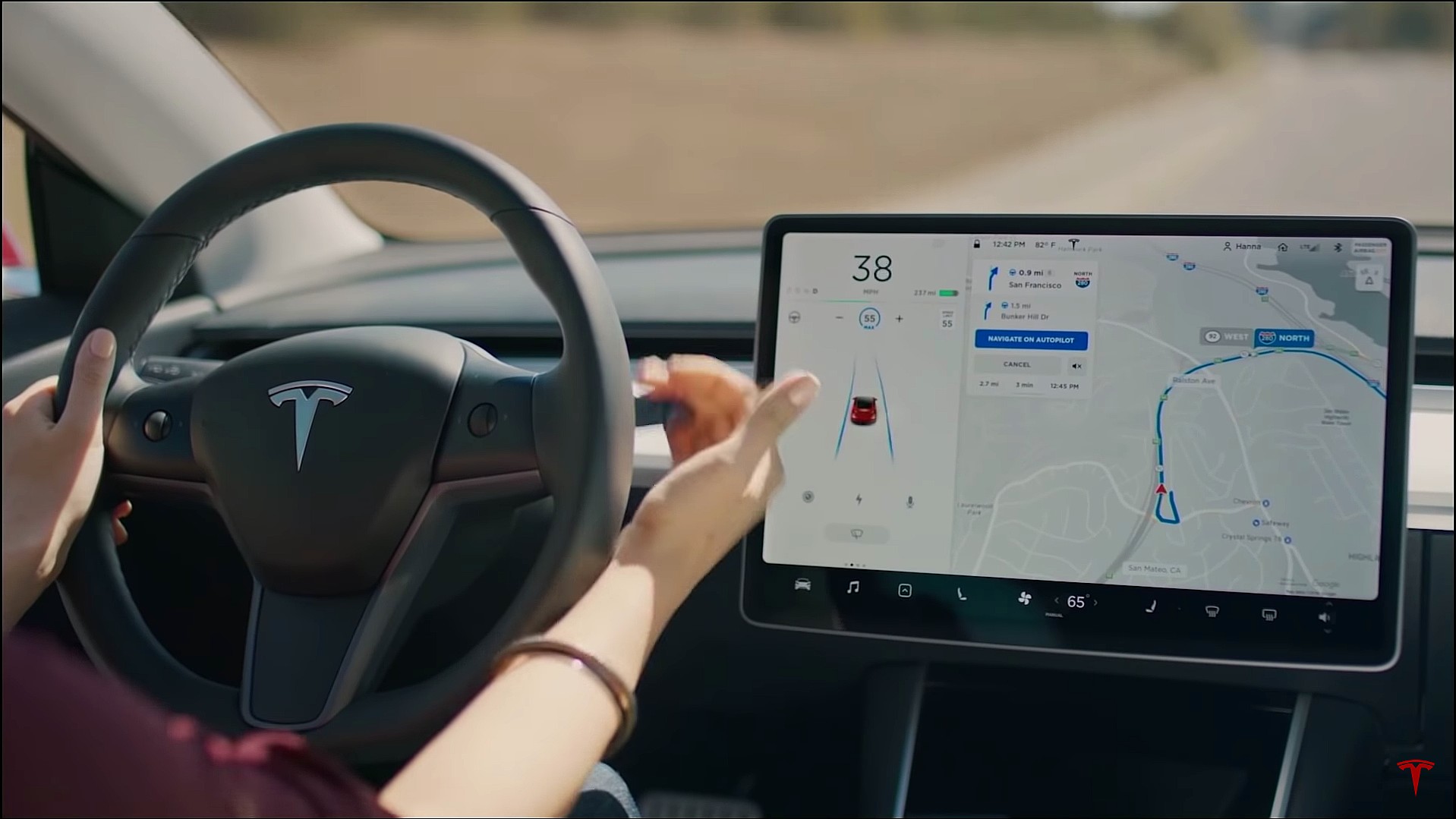
Tesla has officially confirmed that early vehicles with its Autopilot Hardware 3 (HW3) will not be capable of unsupervised Full Self-Driving, while extending a path forward for legacy owners through a discounted trade-in program. The announcement came by way of Elon Musk in today’s Tesla Q1 2026 earnings call.
🚨 Our LIVE updates on the Tesla Earnings Call will take place here in a thread 🧵
Follow along below: pic.twitter.com/hzJeBitzJU
— TESLARATI (@Teslarati) April 22, 2026
The history here matters. HW3 launched in April 2019, and Tesla sold Full Self-Driving packages to owners on the understanding that the hardware was sufficient for full autonomy. Some owners paid between $8,000 and $15,000 for FSD during that period. For years, as FSD’s AI models grew more demanding, HW3 vehicles fell progressively further behind, eventually landing on FSD v12.6 in January 2025 while AI4 vehicles moved to v13 and then v14. When Musk acknowledged in January 2025 that HW3 simply could not reach unsupervised operation, and alluded to a difficult hardware retrofit.
The near-term offering is more concrete. Tesla’s head of Autopilot Ashok Elluswamy confirmed on today’s call that a V14-lite will be coming to HW3 vehicles in late June, bringing all the V14 features currently running on AI4 hardware. That is a meaningful software update for owners who have been frozen at v12.6 for over a year, and it represents genuine effort to keep older hardware relevant. Unsupervised FSD for vehicles is now targeted for Q4 2026 at the earliest, with Musk describing it as a gradual, geography-limited rollout.
For HW3 owners, the over-the-air V14-lite update is welcomed, and the discounted trade-in path at least acknowledges an old obligation. What happens next with the trade-in pricing will define how this chapter ultimately gets written. If Tesla prices the hardware path fairly, acknowledges what early adopters are owed, and delivers V14-lite on the June timeline it committed to today, it has a real opportunity to convert one of the longest-running sore subjects among early adopters into a loyalty story.
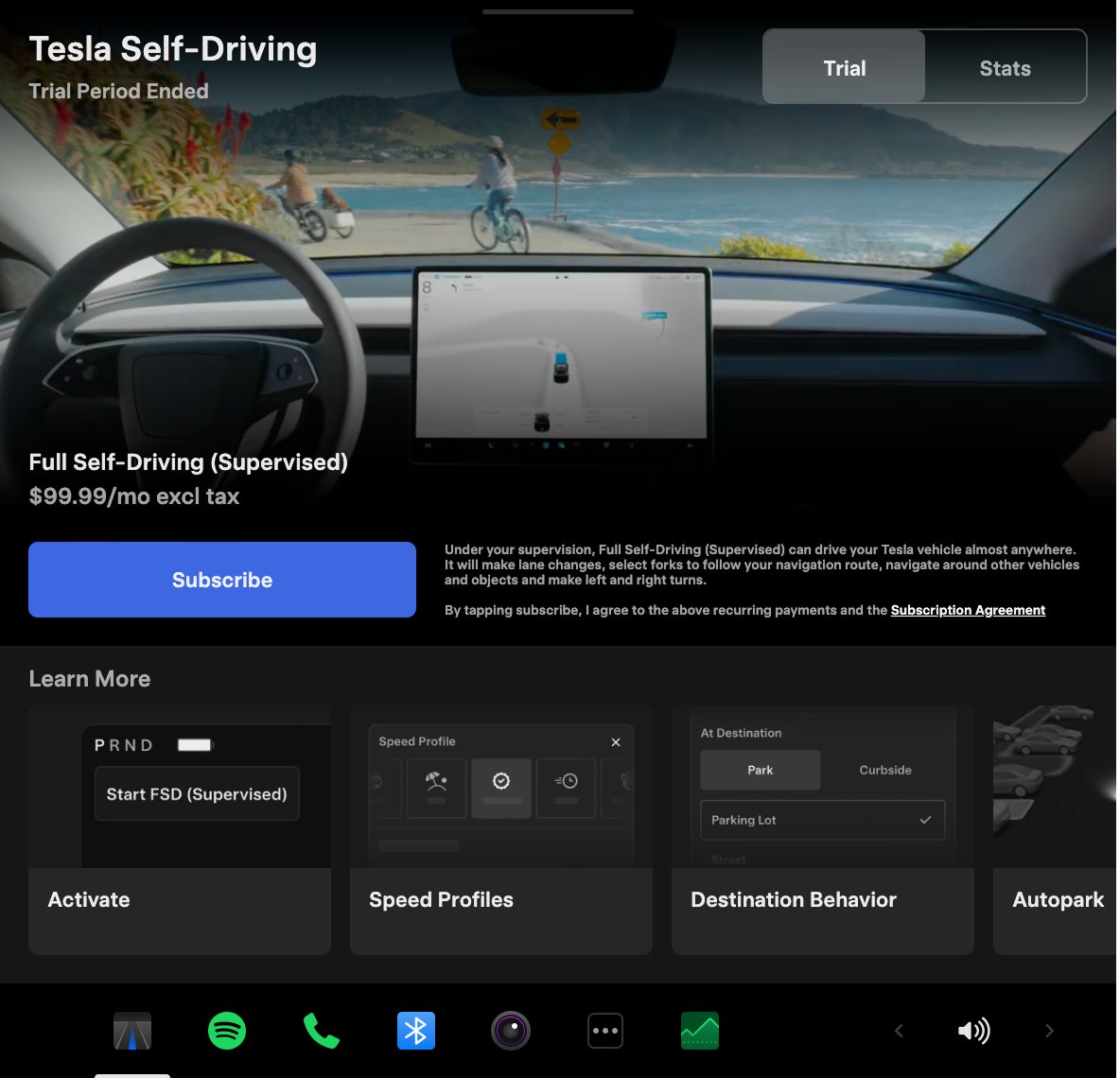
Tesla announced its Spring 2026 software update, and it’s the most feature-dense seasonal release the company has put out. The update covers twelve named changes spanning FSD, voice AI, safety lighting, dashcam storage, and pet display customization, among other things.
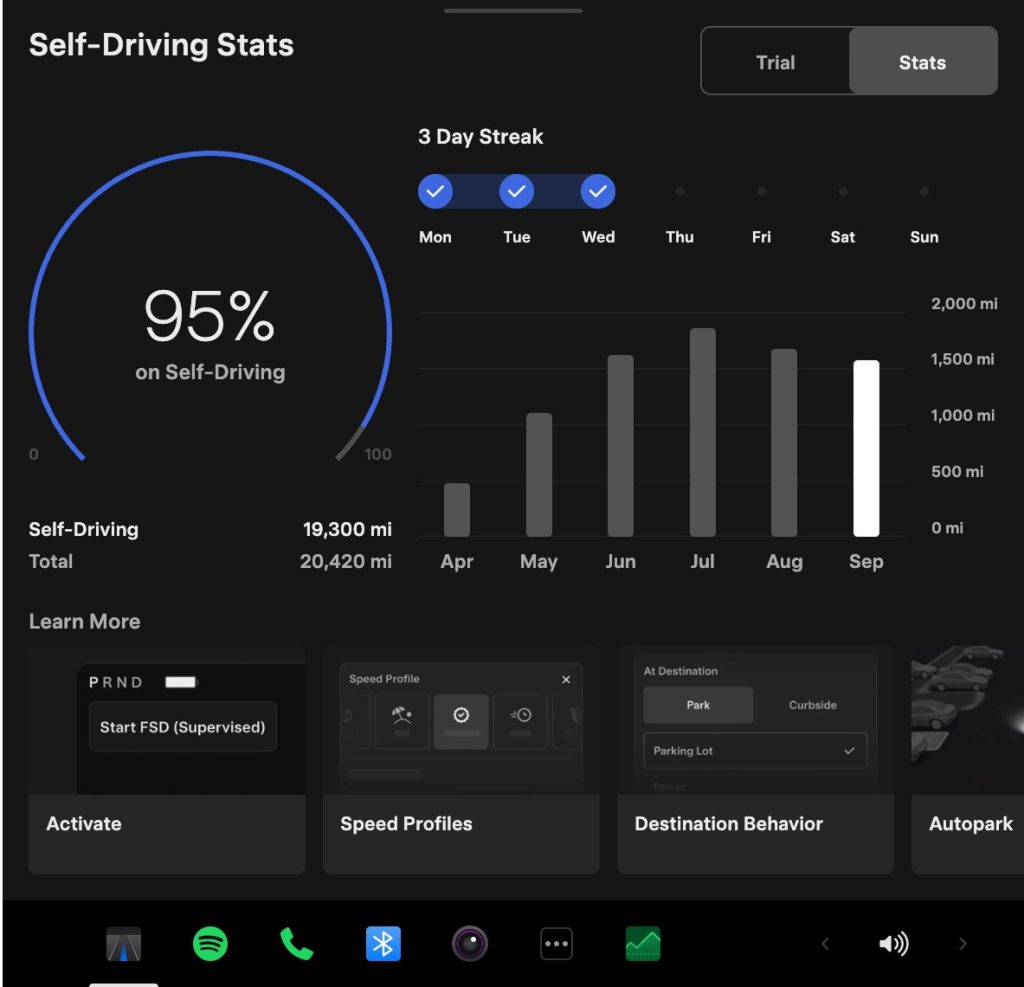
The centerpiece for owners with AI4 hardware is a redesigned Self-Driving app. The new interface lets owners subscribe to Full Self-Driving with a single tap and view ongoing FSD usage stats directly in the vehicle.
Grok gets its biggest in-car upgrade yet. The update adds a “Hey Grok” hands-free wake word along with location-based reminders, so a driver can now say “remind me to pick up groceries when I get home” without touching the screen. Grok first arrived in vehicles in July 2025, but each update has pushed it closer to genuine daily utility. Musk framed the broader vision clearly at Davos in January, saying Tesla is “really moving into a future that is based on autonomy.”
On safety, the update introduces enhanced blind spot warning lights that integrate directly with the cabin’s ambient lighting, building on the blind spot door warning that arrived in update 2026.8.
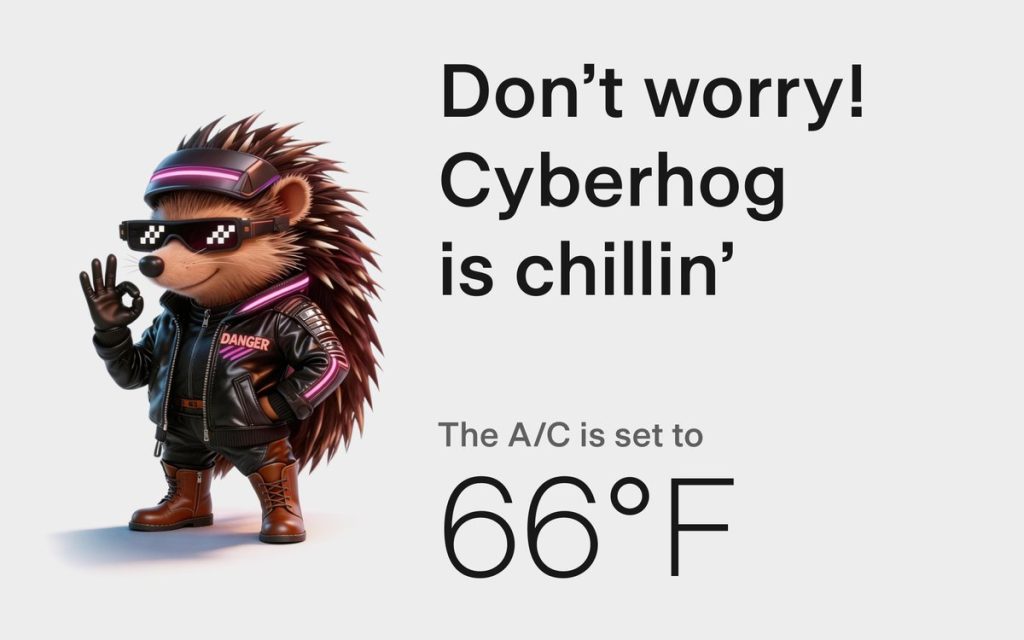
Dog Mode has been renamed Pet Mode and now lets owners choose a dog, cat, or hedgehog icon and add their pet’s name to the display.
Dashcam retention now extends up to 24 hours, up from the previous one-hour rolling loop, with a permanent save option for any clip. Weather maps now show rain and snow with better color differentiation and include the past hour of precipitation data along the route.
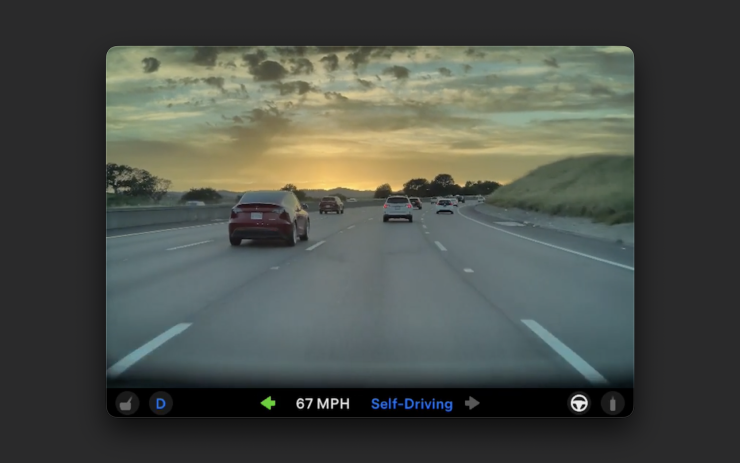
Tesla has now established a clear rhythm of two major OTA pushes per year. As with last year’s Spring update, that cycle started taking shape in 2025 with adaptive headlights and trunk customization. The 2025 Holiday Update then added Grok to the vehicle for the first time. This Spring follows that structure: the Holiday update introduces new architecture, and the Spring update broadens it across the fleet.
Two notable features still did not make it. IFTTT automations, which launched in China earlier this year, were held back from this North American release for unknown reasons, and Apple CarPlay remains absent, reportedly still delayed by iOS 26 and Apple Maps compatibility issues.
Below is the full list of feature updates released by Tesla.
— Tesla (@Tesla) April 13, 2026

Elon Musk roasts India’s billionaire Mukesh Ambani as Starlink fight heats up

Elon Musk’s surprise addition to the X Takeover lineup has fans talking

It’s official: SpaceX takes aim at Verizon, AT&T, and T-Mobile

The Pentagon taps Elon Musk to design the battlefield of the future

Tesla Roadster’s new patent preps white-knuckle speeds, keeping it grounded


