News
Tesla Model S Drive Unit Replacement by the Numbers

During my early days of researching the Tesla Model S, I had concerns about a number of things that were emerging in the press. Fires, Model S drive unit issues, and handling in the snow. Tesla quickly addressed the “firegate” issue by retrofitting the Model S with a titanium shield. My concerns around winter driving, in particular handling in the snow, also became a non-issue after watching several winter driving videos put together by Bjørn Nyland.
Within no time, I became a new Model S owner and quickly learned that driving in the winter could actually be quite fun with a good set of winter tires. Tesla later introduced the all-wheel drive “D” models putting to rest any remaining doubt that the Model S could be the best and safest handling car in the world.
But one question still remains for me, Has Tesla dealt with the Drive Unit issues?
Model S Drive Unit Replacement by the Numbers
There is a group of Model S owners across the forums, but also validated by major publications such as Edmunds, that have had one or more drive unit replacements.
Early reports of drive unit issues ranged from total failures that left the Model S inoperable, to more recent complaints of clunking and milling noises. Elon has said in the past that many of these pre-emptive drive unit replacements were unnecessary and a simple $0.50 shim was all that was really needed, yet Tesla Service centers have been proactively replacing drive units.
The following polls from TMC show that a majority of Model S owners have had their drive units replaced.
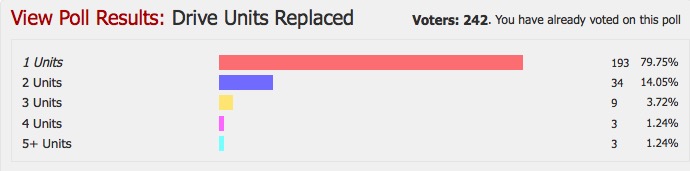
While the poll only represents a small sample of Model S owners, one might draw significance in the numbers as the density circles around owners needing a drive unit replacement at relatively low mileage, and without any harsh driving prior to failure.
The polls also give insight to the motive behind each drive unit replacement.

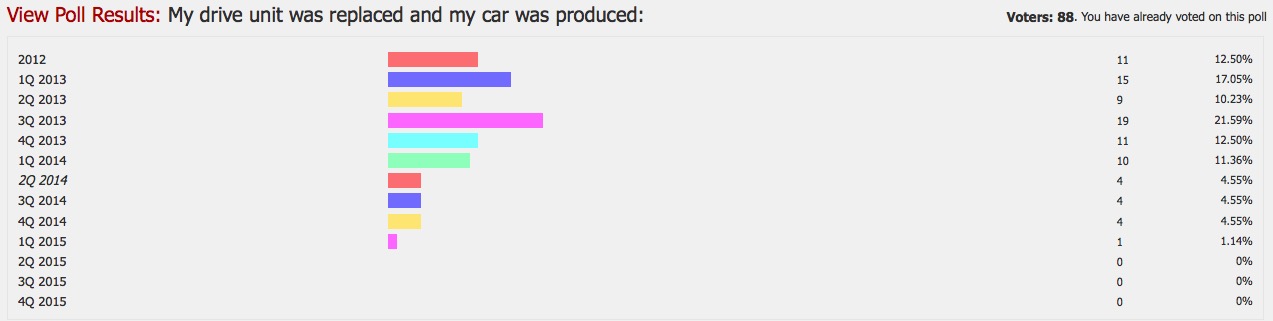
Though it appears the issues mainly center around earlier versions of the Model S, there’s been reports of newer Model S with Autopilot hardware hearing milling noises coming from the drive unit. One viewer described the sound as “sawing wood”.
Tesla’s Response to Drive Unit Issues
In typical Tesla fashion, the company acted fast to address the issues, and curb concerns by offering an unlimited mile/8 year warranty on the drive unit. I think this was a great response by Tesla which put to rest any concerns about the quality and long term durability of their drive units.
Elon is now talking about building a power train that will last a million miles and I believe Tesla continues to put significant energy into improving the drive units. Tesla continues to honor the warranty and is proactively replacing drive units that show early signs of problems.
My Experience
After 12 months of Model S ownership and 30k miles drive, I started hearing a humming noise from the rear of my Model S during highway cruising. The noise was unusual as I had gotten used to hearing only the noise of the tires and wind, but there was a new noise only noticeable when cruising or decelerating with regeneration at 65 MPH and over. The noise continued to become more audible over the next few months, but I learned to live with it and did not contact Tesla. My personal rule of thumb on noise related issues is to wait for passengers to comment on it first. It’s my self crazy check.
Two months after the original drive unit humming noises began, a higher pitched milling type noise started occuring when traveling at speeds of 20 MPH or less. The sound varied depending on how much power was being used. That’s when I reached out to Tesla.
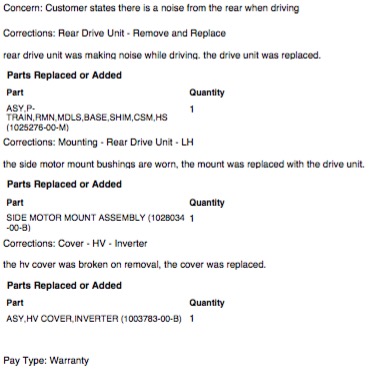
Tesla service record
Tesla service had me come in for a test drive which they can do on demand without you needing to wait. We drove about a block before the Tesla service technician said the drive unit needed to be replaced.
The explanation was that tolerances inside the drive unit have led to metal particles getting into the fluid around the drive unit, and as the concentration of particles increased, it caused the noise from the drive unit to become louder when under load. The new drive units evidently have better tolerances and are less prone to having metal particles being shaved off.
At that time, Tesla service has been very backed up here in Massachusetts so my appointment for the drive unit replacement was scheduled six weeks out. I put on another 4,000 miles during that wait time, with an increasingly louder drive unit, before it was finally replaced.
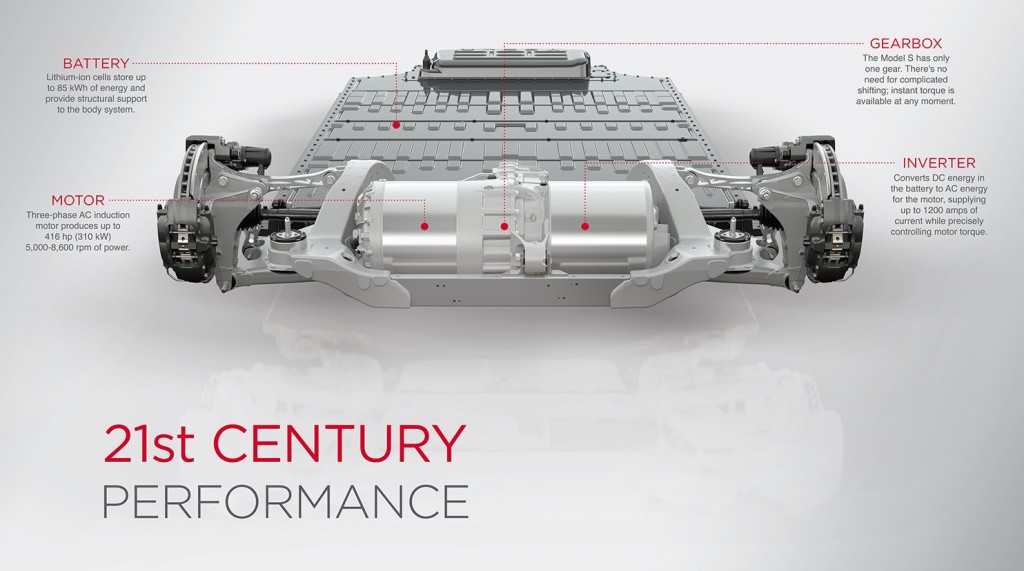
When Tesla replaces a drive unit, they replace both the drive unit and inverter as you can see from a copy of the parts list. The last letter in the drive unit part number (“M” in my case) seems to indicate the generation of the drive unit. The later the letter the better, with the “Q”s seeming to have the best longevity according to the forums.
I’m happy to say that I’ve logged 8,000 miles of happy and noise-free driving after my drive unit replacement. The replacement was done recently so my guess is that I have a newer unit, and thus hope this will be my only replacement.
Thankfully for all of us, Tesla has a first class warranty and level of service. While it goes without saying that inconveniences such as this may happen, rest assured that Tesla has you covered and will always strive to make things right.



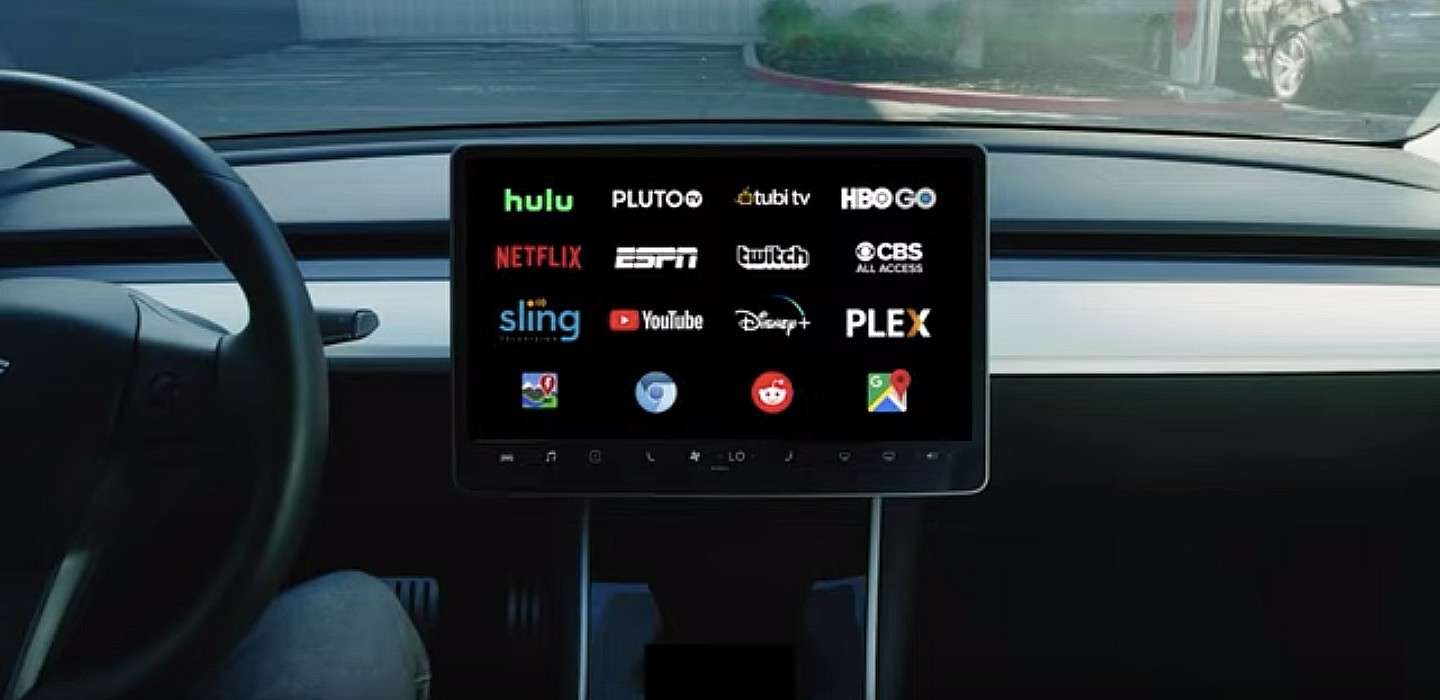
The in-car Tesla Theater is among the most unique features available within the cars. When charging, parked, camping, or just hanging out, vehicle occupants can access a variety of streaming platforms on the large center screen, helping keep them entertained during downtime.
However, the Theater might be getting plenty more streaming platforms, something that owners have requested for some time.
Tesla owners recently discovered that visiting Apple TV in the vehicle browser can launch a fullscreen interface that looks and behaves like a dedicated application rather than an ordinary webpage:
Today I learned that if you go to Apple TV in the Tesla browser, it will open up an actual Apple TV app, fully functional. Not just the site.
Apparently there are more apps than just the few that show on the apps page. pic.twitter.com/os1Ypfm4JR
— Jason W (@jmwilt21) August 20, 2026
The experience drops the usual address bar and browser chrome, presenting catalogs, continue watching rows, and playback controls in the same window Tesla Theater already uses for its listed services. Independent testers soon found similar treatment for HBO Max, Paramount+, Peacock, Disney+, and Prime Video when those sites are opened from the car browser.
This shift is a plausible early signal that Tesla is widening Theater support without a formal software note. Theater has long been a set of web views rather than native applications, so recognizing extra domains and stripping the browser frame is a small server-side change that can expand the catalog quickly.
Owners still lack permanent Theater icons for the newly recognized services, and video remains limited to Park, yet the smoother launch is a meaningful step toward a broader lounge while charging.
Tesla Theater arrived with software version 10 in September 2019. The first video services were Netflix, YouTube, and Hulu, available only while parked and originally tied to WiFi. Spotify arrived in the same era as music rather than Theater video. Disney+ joined officially in July 2021 with the 2021.24 update, giving owners another major catalog on the center screen. Twitch and TikTok later appeared among the default Theater tiles, and Tesla Tutorials remained a persistent educational tile.
Not every addition stayed put. In December 2023, a Holiday software build removed the Disney+ tile for many United States owners after a public dispute involving advertising on X. Hulu stayed visible even though Disney owned it. Visiting disneyplus.com in the browser often restored the tile, which suggested the removal was a recognition list change rather than a complete block. Owners have also reported occasional blank Theater grids after updates, usually fixed by language toggles, resets, or later firmware.
Tesla axes Disney+ from vehicles with Musk-Iger rivalry, but there’s a workaround
Code archives from 2024 listed many unused source names, including Apple TV and Prime Video, that never became official icons, which now looks like groundwork for the current fullscreen browser behavior.
Now that this hint toward an expanded Theater experience has been recognized, Tesla could follow through with these additional shortcuts as a sign that more streaming platforms are available in Teslas than ever before.
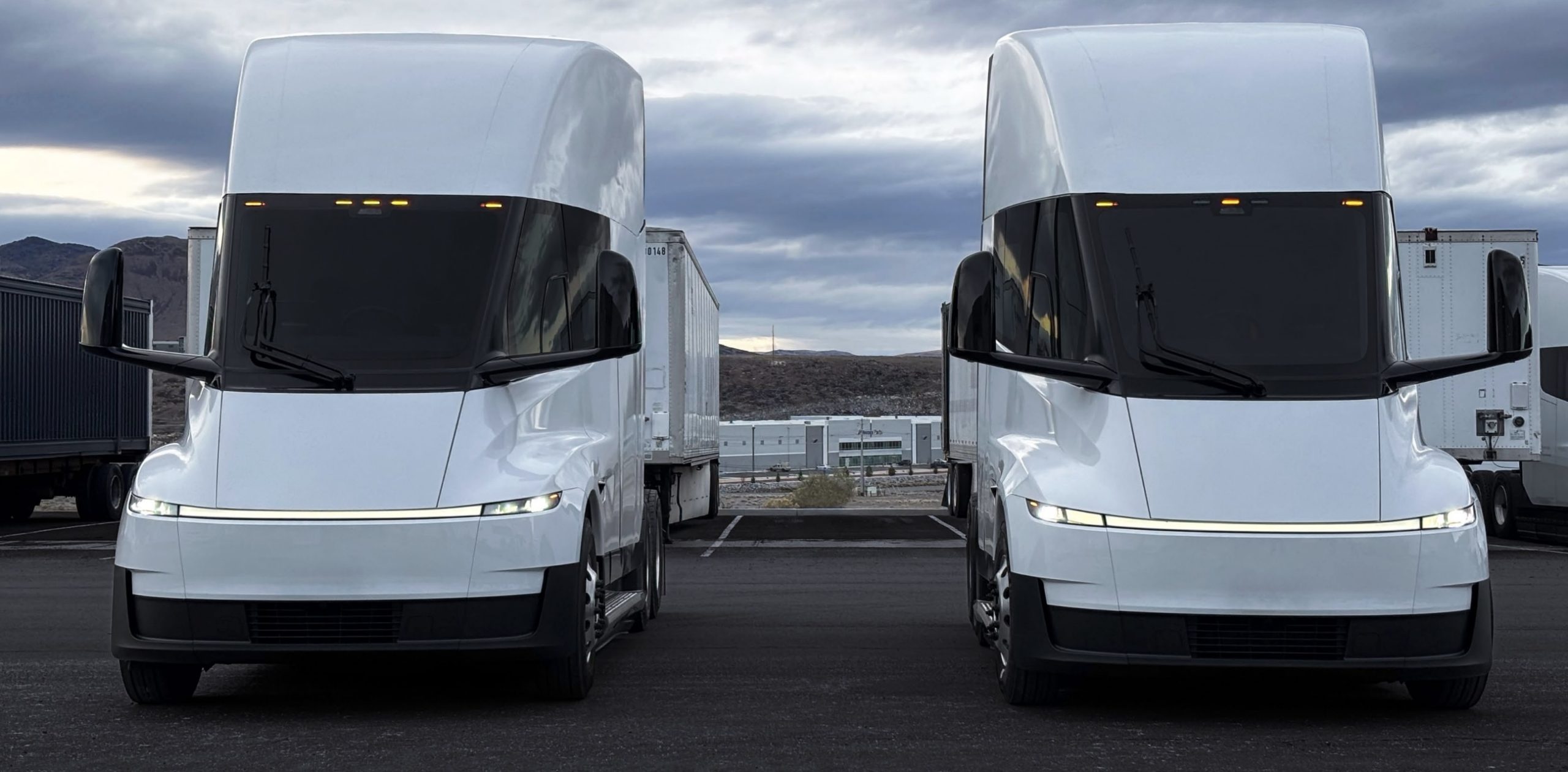
Tesla recently received its largest order for the all-electric Semi from Einride, a Swedish transport service, for 500 units, a groundbreaking invoice to receive before the first deliveries begin.
Even more remarkable, Einride CEO Roozbeh Charli said in a recent interview that he expects his company to take delivery of all 500 — the entire order — before the end of 2027. He even expects to have 75 Tesla Semi units in the Einride fleet before the end of this year.
🚨 Einride CEO Roozbeh Charli on the Tesla Semi partnership:
“If we start with the Amazon announcement that we did earlier this year, that was on the back of having gone through a proving period together with them and proving out our technology. Then we took that next step in… pic.twitter.com/oazkXjwoig
— TESLARATI (@Teslarati) August 28, 2026
Charli said the Tesla partnership was part of a broader push, along with its earlier partnership with Amazon. Einride is assisting Amazon with the use of its Saga AI platform, which helps eliminate questions about budgeting and forecasting for logistics companies.
The Semi, as well as Tesla’s production and subsequent delivery of the units to Einride, will help the company “to have a good supply of vehicles that we can deploy on the [Saga AI] platform,” Charli said. “Tesla is also a relationship we’ve had for a while, and as the Tesla Semi deliveries are firming up, we decided to do a larger commitment to that and deploy that on our platform.”
In its initial announcement, Einride said it anticipated taking delivery of the trucks over the next two years, but now it appears the company is expecting all 500 units within the next 16 months.
Built at a dedicated factory in Sparks, Nevada, the Tesla Semi has been perhaps the biggest and most intensive testing process the company has ever had for a single vehicle model. For the past several years, Tesla has been working with many companies, most notably Frito-Lay and PepsiCo, to gain knowledge on the performance on regional routes.
Tesla plans to launch the Semi officially on September 24, five months after production started ramping.
Additionally, drivers have said they are happy about the Semi’s performance and that its numerous safety and productivity features have made their jobs and routes much easier.
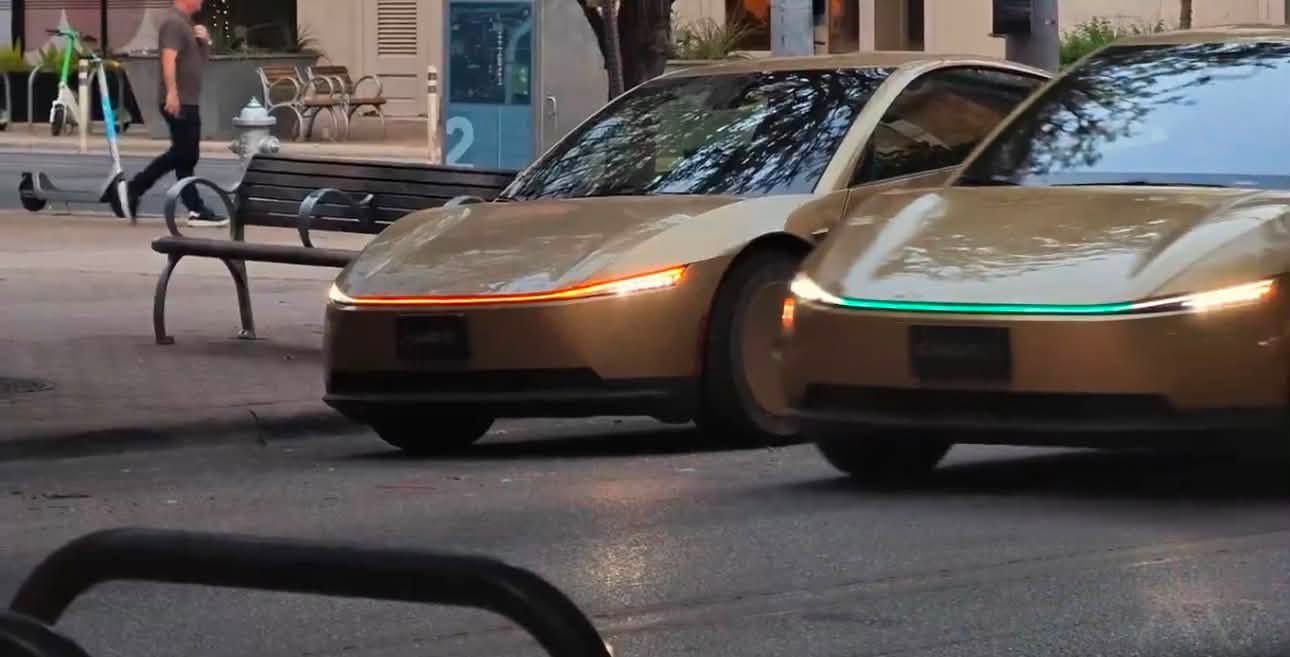
Tesla Cybercab is using a unique strategy for picking up the correct rider, which is a crucial part of ride-hailing to ensure people end up in the right place and are charged the correct price.
Cybercab will utilize an RGB strip in its front light bar that will illuminate in a variety of different colors to mark itself.
This identifying mark will also appear in the Robotaxi app, giving riders in the same location a notable distinction in an effort to avoid any confusion regarding who should get in each vehicle.
🚨 Tesla is using different light bar colors to help riders understand which vehicle is theirs
Pretty cool strategy pic.twitter.com/eGMpEMeRpc
— TESLARATI (@Teslarati) August 27, 2026
Other ride-hailing services use similar strategies: Lyft and Uber rides are recognizable through driver identity, vehicle type and color, as well as license plate. Waymo will display the rider’s initials on top of the vehicle, letting them know that the specific vehicle for them has arrived.
Tesla’s strategy is unique and interesting, but there are some flaws. Cybercab’s main purpose is aimed toward being an autonomous ride for all, including those who have disabilities like being blind or even color blind.
Tesla will likely have something in the pipeline for those who cannot see colors or have limited vision. There will definitely be multiple ways to identify which vehicle is the one that “you” specifically ordered.
Cybercab is set to start giving public rides next Thursday, September 3, in Austin, as it announced a dedicated event last week and invited many members of the Tesla community.
Additionally, members of the public will be invited as well. Tesla has been offering employee rides in Cybercab for nearly two months.

Tesla Theater might be getting plenty more streaming platforms

Tesla Semi’s biggest adoptee gives an update on production timeline


