News
Tesla adjusts Robotaxi safety monitor strategy in Austin with new service area
The positioning of the driver, as well as the driver’s hands being closer to the steering wheel, is more similar to what Tesla is doing in the Bay Area Robotaxi program than it is to what it has done in Austin.

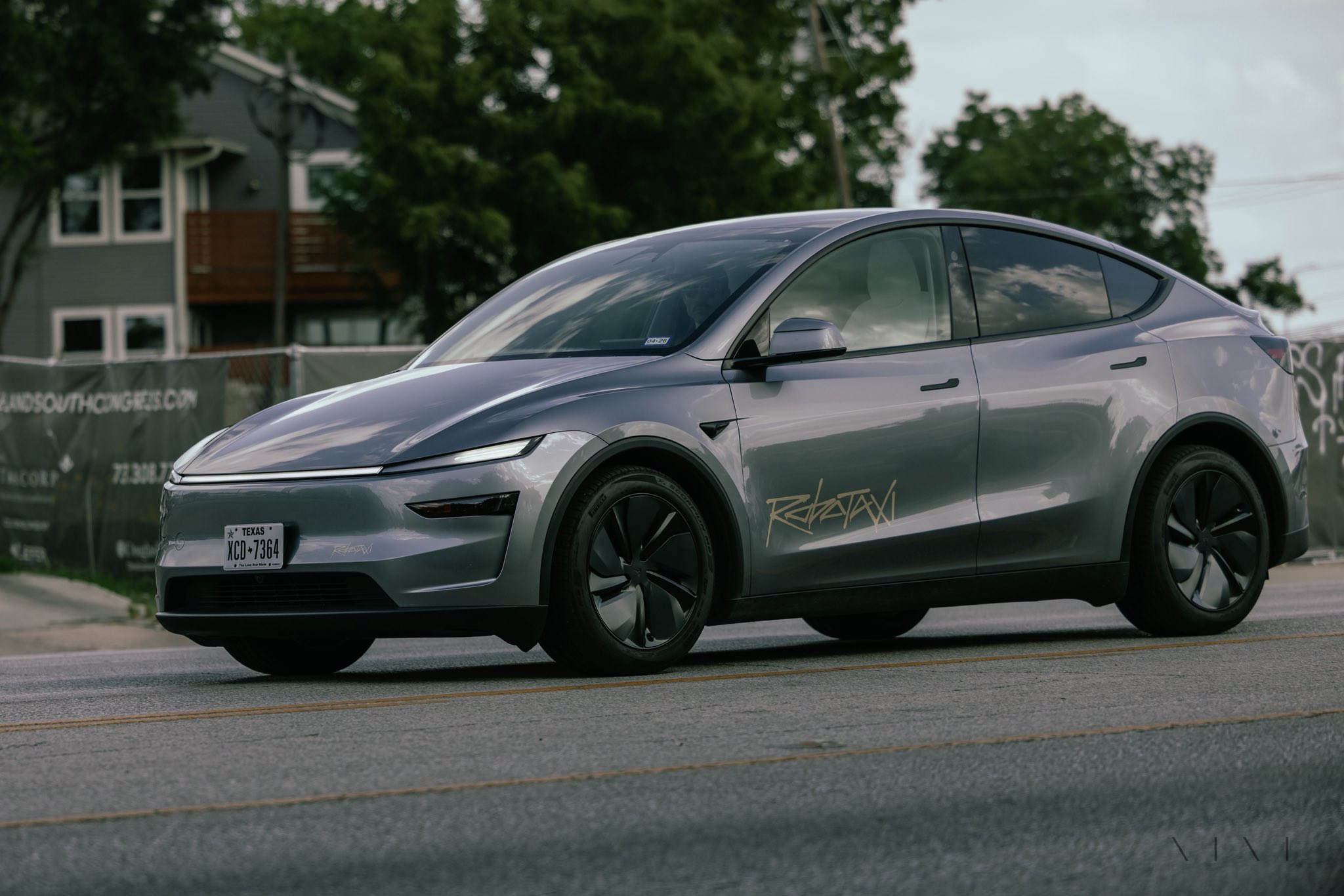
Tesla has adjusted its Robotaxi safety monitor strategy in Austin after it expanded its service area in the city last week for the third time.
Tesla has been operating its Robotaxi platform in Austin since June 22. The vehicles have been operated without a driver, but Tesla has placed safety monitors in the passenger’s seat as a precaution.
The safety monitors are responsible for performing any necessary interventions and maintaining a safe and comfortable cabin for riders as they experience Tesla’s first venture into the driverless ride-sharing space.
Last week, Tesla expanded its service area in Austin for the third time, expanding it from about 90 square miles to 170 square miles. The expansion included new territory, including the Austin-Bergstrom International Airport, Tesla’s Gigafactory Texas, and several freeways.
Tesla Robotaxi geofence expansion enters Plaid Mode and includes a surprise
The freeway is an area that is uncharted territory for the Tesla Robotaxi program, and this fact alone encouraged Tesla to switch up its safety monitor positioning for the time being.
For now, they will be riding in the driver’s seat when routes require freeway travel:
Sept 1 in Austin and our Robotaxi arrived with Tesla safety driver in the driver seat, similar to the Bay area (no logo on the car). Here’s that first moment when I realized, our autonomous car was heading onto the freeway. pic.twitter.com/1QfyN2Ubzf
— Gail 🇺🇸 (@gailalfaratx) September 2, 2025
The positioning of the driver, as well as the driver’s hands being closer to the steering wheel, is more similar to what Tesla is doing in the Bay Area Robotaxi program than it is to what it has done in Austin.
This is sure to draw criticism from skeptics, but it is simply a step to keep things controlled and safe while the first Robotaxi drives take passengers on the highway with this version of the Full Self-Driving software.
This FSD version differs from the one that customers have in their own vehicles, but CEO Elon Musk has indicated something big is coming soon. FSD v14 is coming to vehicles in the near future, and Musk has said its performance is pretty incredible.
Tesla’s Elon Musk shares optimistic teaser about FSD V14: “Feels sentient”


Elon Musk
Elon Musk demands Delaware Judge recuse herself after ‘support’ post celebrating $2B court loss
A banner on the post read “Katie McCormick supports this,” using LinkedIn’s heart-in-hand “support” icon, an endorsement stronger than a simple “like.” Musk’s lawyers argue the action creates “a perception of bias against Mr. Musk,” warranting immediate recusal to preserve judicial impartiality.
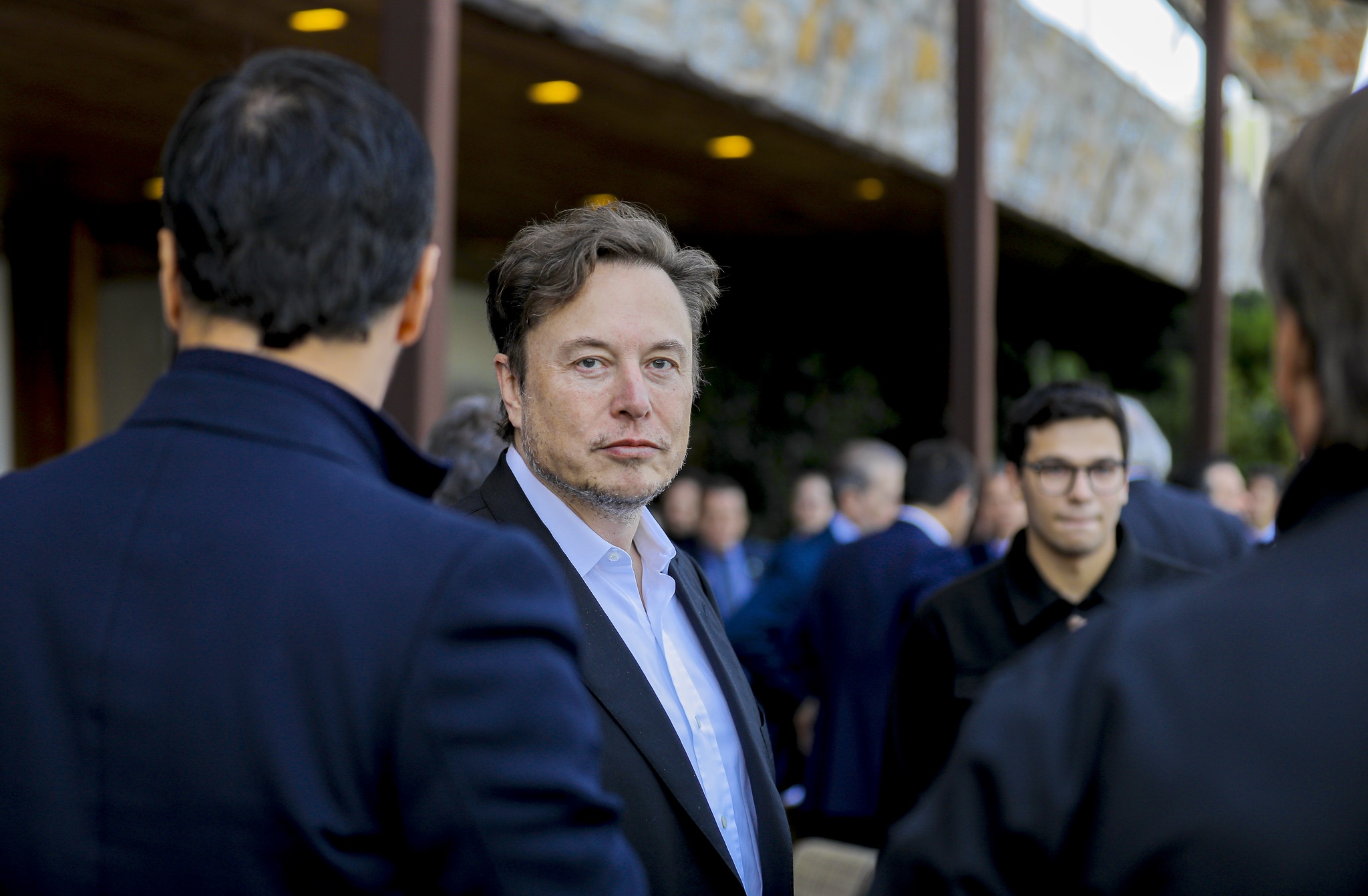
Tesla CEO Elon Musk’s legal team has filed a motion demanding that Delaware Chancellor Kathaleen McCormick disqualify herself from an ongoing high-stakes Tesla shareholder lawsuit.
The filing, submitted March 25, cites an apparent LinkedIn “support” reaction from McCormick’s account to a post celebrating a $2 billion jury verdict against Musk in a separate California securities-fraud case.
The move escalates long-simmering tensions between Musk, Tesla, and the Delaware judiciary, where McCormick previously presided over the landmark challenge to Musk’s record $56 billion 2018 compensation package.
Delaware Supreme Court reinstates Elon Musk’s 2018 Tesla CEO pay package
The LinkedIn post was written by Harry Plotkin, a Southern California jury consultant who assisted the plaintiffs who sued Musk over 2022 tweets about his Twitter acquisition. Plotkin praised the trial team for “standing up for the little guy against the richest man in the world.”
The New York Post initially reported the story.
A banner on the post read “Katie McCormick supports this,” using LinkedIn’s heart-in-hand “support” icon, an endorsement stronger than a simple “like.” Musk’s lawyers argue the action creates “a perception of bias against Mr. Musk,” warranting immediate recusal to preserve judicial impartiality.
This appears to be unequivocal proof she denied the pay package because of her own personal beliefs and not the law.
Corruption. https://t.co/8dvgcfYuvh
— TESLARATI (@Teslarati) March 25, 2026
McCormick swiftly denied intentional endorsement. In a letter to attorneys, she stated she was unaware of the interaction until LinkedIn notified her. She wrote:
“I either did not click the ‘support’ icon at all, or I did so accidentally. I do not believe that I did it accidentally.”
The chancellor maintains the reaction was inadvertent, but critics, including Musk allies, call the explanation implausible given the platform’s deliberate interface.
McCormick’s central role in the Tesla pay-package litigation underscores the stakes. In Tornetta v. Musk, in January 2024, she ruled the 2018 performance-based stock-option grant, potentially worth $56 billion at the time and now valued far higher, was invalid.
The package consisted of 12 tranches of options, each vesting only after Tesla achieved ambitious market-cap and operational milestones. McCormick found Musk exercised “transaction-specific control” over Tesla as a controlling stockholder, the board lacked sufficient independence, and proxy disclosures to shareholders were materially deficient.
Applying the entire-fairness standard, she concluded defendants failed to prove the deal was fair in process or price and ordered full rescission, an “unfathomable” remedy she described as necessary to deter fiduciary breaches.
After the ruling, Tesla shareholders ratified the package a second time in June 2024. McCormick rejected that ratification in December 2024, holding that post-trial votes could not cure defects.
Tesla appealed. On December 19 of last year, the Delaware Supreme Court unanimously reversed the rescission remedy while largely leaving McCormick’s liability findings intact. The high court deemed total unwinding inequitable and impractical, restoring the package but awarding the plaintiff only nominal $1 damages plus reduced attorneys’ fees. Musk ultimately received the full award.
The current recusal motion arises in yet another Tesla derivative suit before McCormick. Legal observers say granting it could signal heightened scrutiny of judicial social-media activity; denial might reinforce perceptions of an insular Delaware bench.
Broader fallout includes accelerated corporate migration out of Delaware, Musk himself moved Tesla’s incorporation to Texas after the first ruling, and renewed debate over whether the state’s specialized courts remain the gold standard for corporate governance disputes.
A decision is expected soon; whichever way it lands, the episode highlights the fragile balance between judicial independence and public confidence in high-profile litigation.
News
Tesla Cybercab spotted next to Model Y shows size comparison
The Model Y is Tesla’s most-popular vehicle and has been atop the world’s best-selling rankings for the last three years. The Cybercab, while yet to be released, could potentially surpass the Model Y due to its planned accessible price, potential for passive income for owners, and focus on autonomy.
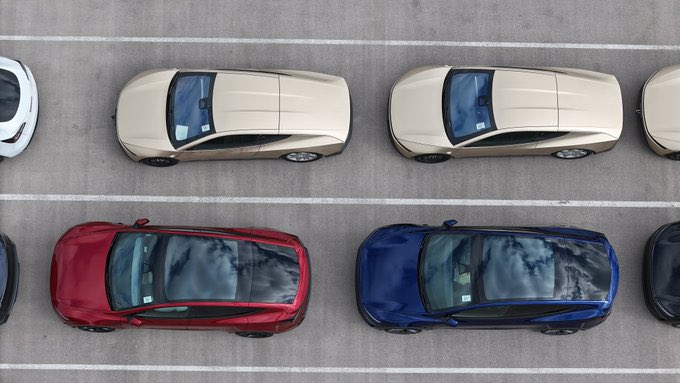
The Tesla Cybercab and Tesla Model Y are perhaps two of the company’s most-discussed vehicles, and although they are geared toward different things, a recent image of the two shows a side-by-side size comparison and how they stack up dimensionally.
The Model Y is Tesla’s most-popular vehicle and has been atop the world’s best-selling rankings for the last three years. The Cybercab, while yet to be released, could potentially surpass the Model Y due to its planned accessible price, potential for passive income for owners, and focus on autonomy.
Geared as a ride-sharing vehicle, it only has two seats. However, the car will be responsible for hauling two people around to various destinations completely autonomously. How they differ in terms of size is striking.
In a new aerial image shared by drone operator and Gigafactory Texas observer Joe Tegtmeyer, the two vehicles were seen side by side, offering perhaps the first clear look at how they differ in size.
Tesla Model Y vs. Tesla Cybercab:
✅ Overall Length:⁰Model Y: 188.7 inches (4,794 mm)⁰Cybercab: ~175 inches (≈4,445 mm)⁰→ Cybercab is about 13–14 inches shorter (roughly the length of a large suitcase).
✅ Overall Width (excluding mirrors):⁰Model Y: 75.6 inches (1,920 mm)… https://t.co/PsVwzhw1pe pic.twitter.com/58JQ5ssQIO
— TESLARATI (@Teslarati) March 25, 2026
Dimensionally, the differences are striking. The Model Y stretches roughly 188 inches long, 75.6 inches wide, excluding its mirrors, and stands 64 inches tall on a 113.8-inch wheelbase. The Cybercab measures approximately 175 inches in length, about a foot shorter, and just 63 inches wide.
That narrower stance gives the Cybercab a dramatically more compact silhouette, making it easier to maneuver in tight urban environments and park in standard spaces that would feel cramped for the Model Y. Height is also lower on the Cybercab, contributing to its sleek, coupe-like profile versus the Model Y’s taller crossover shape.
Visually, the contrast is unmistakable. The Model Y presents as a family-friendly SUV with conventional doors, a prominent hood, and a spacious glass roof.
The Cybercab eliminates the steering wheel and pedals entirely, creating a clean, futuristic cabin that feels more lounge than cockpit.
Its doors open in a distinctive, wide-swinging motion, and the body features smoother, more aerodynamic lines optimized for autonomy. Parked beside a Model Y, the Cybercab appears almost toy-like in width and length, yet its low-slung stance and minimalist design emphasize agility over bulk.
🚨 We caught up with the Tesla Cybercab today in The Bay Area: pic.twitter.com/9awXiK26ue
— TESLARATI (@Teslarati) March 24, 2026
Cargo capacity tells another part of the story. The Model Y offers generous real-world utility: 4.1 cubic feet in the front trunk and 30.2 cubic feet behind the rear seats, expanding to 72 cubic feet with the second row folded flat.
It comfortably swallows groceries, luggage, or sports equipment for five passengers. The Cybercab, designed for two riders, trades that volume for targeted efficiency.
It features a rear hatch with enough space for two carry-on suitcases and personal items, plenty for the typical robotaxi trip, while maintaining impressive legroom and headroom for its occupants.
In short, the Model Y prioritizes versatility and family hauling with its larger footprint and abundant storage. The Cybercab sacrifices size for simplicity, cost, and urban nimbleness.
At roughly 12 inches shorter and 12 inches narrower, it embodies Tesla’s vision for scalable, affordable autonomy: smaller on the outside, smarter inside, and ready to redefine how we move through cities.
The Cybercab and Model Y both will contribute to Tesla’s fully autonomous future. However, the size comparison gives a good look into how the vehicles are the same, and how they differ, and what riders should anticipate as the Cybercab enters production in the coming weeks.
Elon Musk
Elon Musk says Tesla is developing a new vehicle: ‘Way cooler than a minivan’
It sounds as if Tesla could be considering a new vehicle to fit the mold of what a larger family would need, and as fans have been demanding it for several years and the company is phasing out the Model X, its only family-geared vehicle, it sounds as if it could be the perfect time.
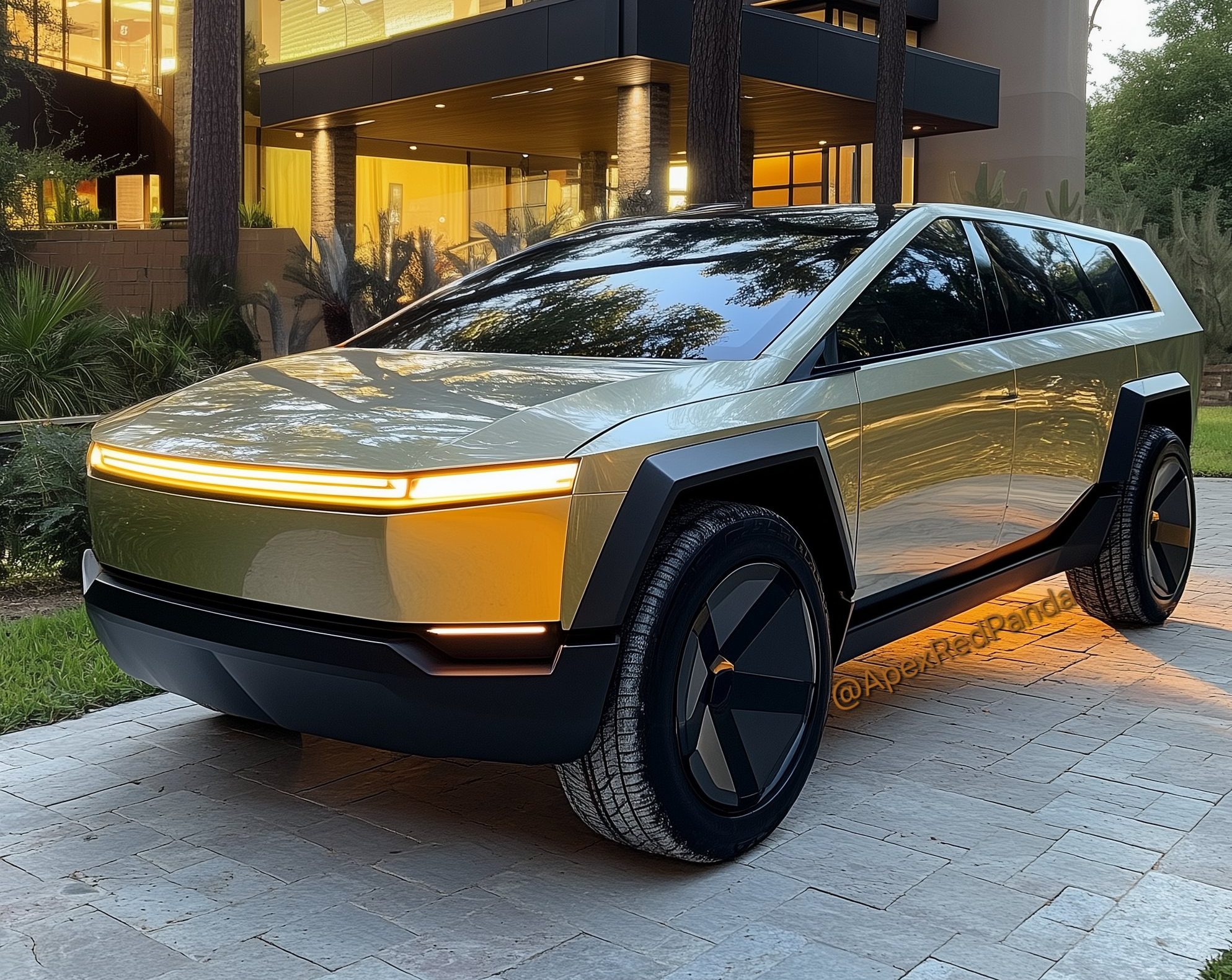
Tesla CEO Elon Musk said the company is developing a new vehicle, and it will be “way cooler than a minivan.”
It sounds as if Tesla could be considering a new vehicle to fit the mold of what a larger family would need, and as fans have been demanding it for several years and the company is phasing out the Model X, its only family-geared vehicle, it sounds as if it could be the perfect time.
There are a handful of things Musk could be talking about, and as many Tesla owners have wanted a vehicle along the lines of a minivan for hauling around their family, speculation has persisted about what the company would do in terms of developing something for that exact use case.
There were several options, and some of them seemed to be already available. Musk posted on X yesterday that the Cybertruck has three sets of isofix attachments and could fit three child seats or three adults, and it seemed to be a way to deflect plans for a new, larger vehicle as a Model Y L appeared to be present at Giga Texas.
There is also the Robovan, the large people mover that Tesla unveiled at the “We, Robot” back in 2024.
Something way cooler than a minivan is coming
— Elon Musk (@elonmusk) March 25, 2026
However, it seems Tesla could be developing something like a CyberSUV, something that is going to be large enough to haul around a car full of kids, but could be developed with the company’s aesthetic of the company’s most recent releases: this would likely include a light bar and a more sleek, futuristic look.
We’ve mocked up some potential looks for Tesla’s speculative vehicle in the past:
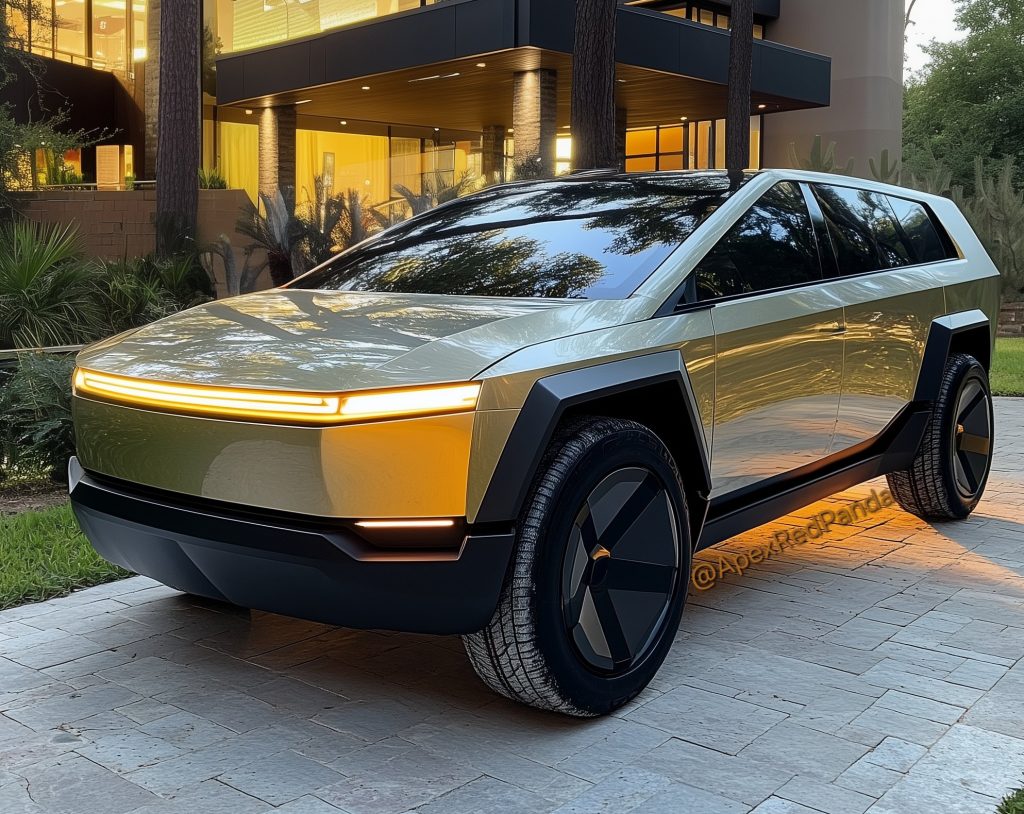
Tesla has teased the potential of a CyberSUV in the past, showing off clay models that it developed back in September in a teaser video called “Sustainable Abundance.”
Fans and owners have been calling for this development for a very long time, and it seems like Tesla might be ready to finally answer the call on a large SUV. With the segment being dominated by combustion engine vehicles, Tesla could truly disrupt the large SUVs that have been mainstays.
The Chevrolet Tahoe and GMC Yukon would feel some additional pressure, and it would be possible for Tesla to infiltrate some of those sales and pull consumers to electric powertrains.
As the Model S and Model X sunset process is truly hitting full swing, it might be time to consider Tesla’s next option in terms of vehicle development.

Elon Musk demands Delaware Judge recuse herself after ‘support’ post celebrating $2B court loss

Tesla Cybercab spotted next to Model Y shows size comparison

Elon Musk says Tesla is developing a new vehicle: ‘Way cooler than a minivan’

Elon Musk’s Boring Co. Tunnel Vision Challenge ends with a surprise for Louisiana, Maryland and Dallas

What is Digital Optimus? The new Tesla and xAI project explained


