Lifestyle
Tesla will host a “private Model 3 viewing” on June 2 for referral program winners

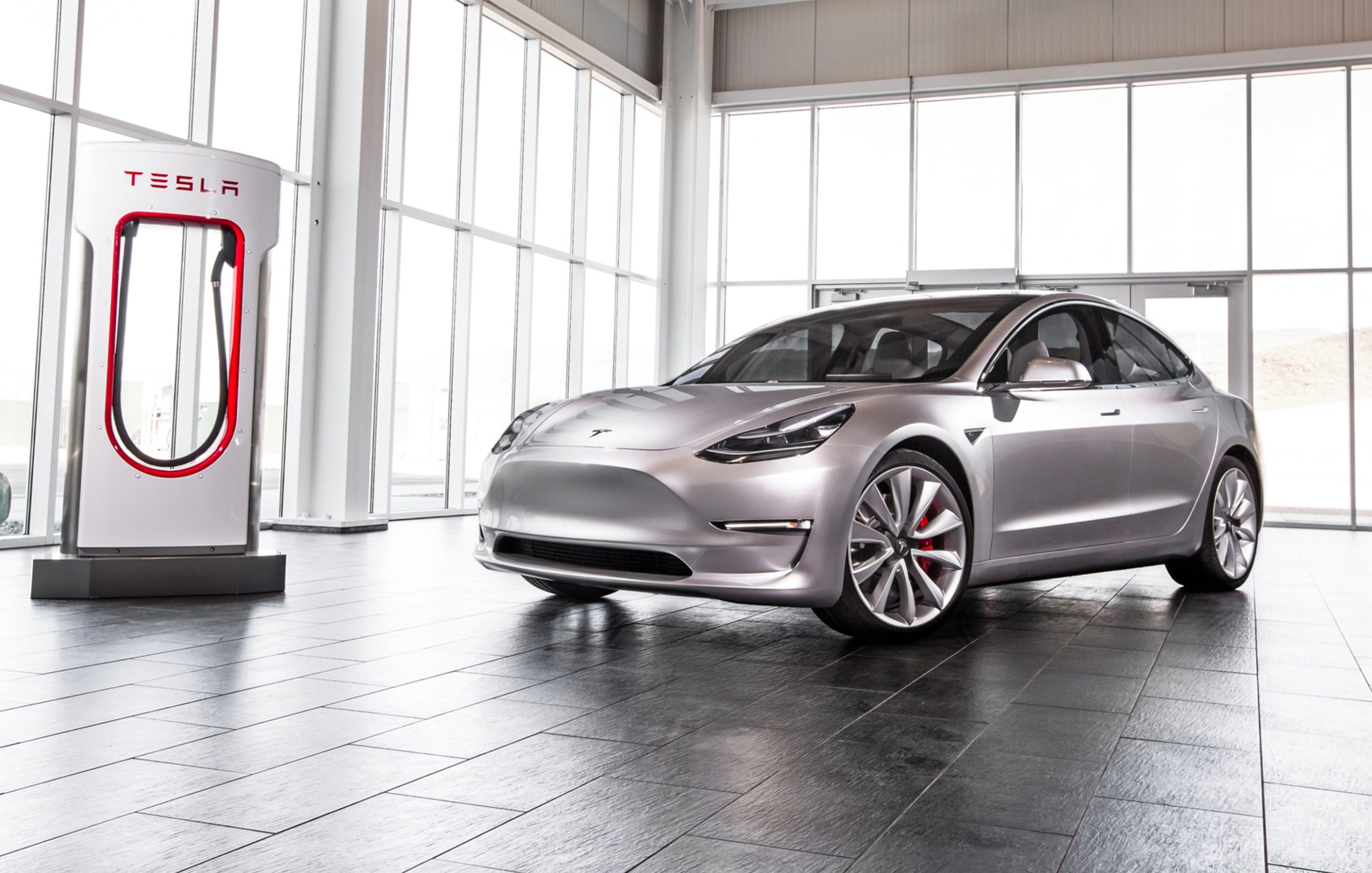
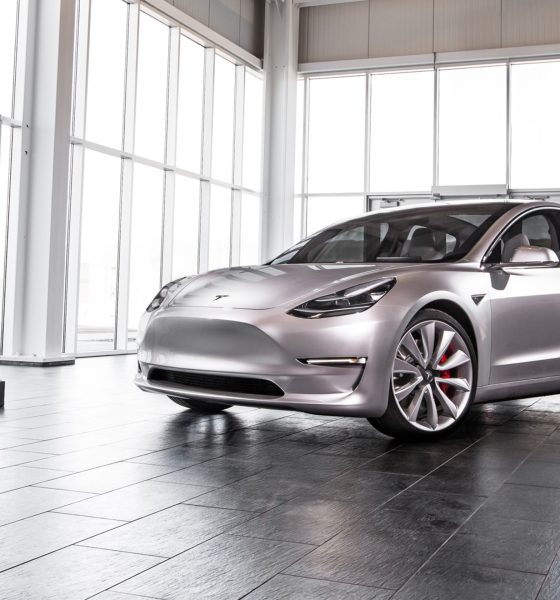
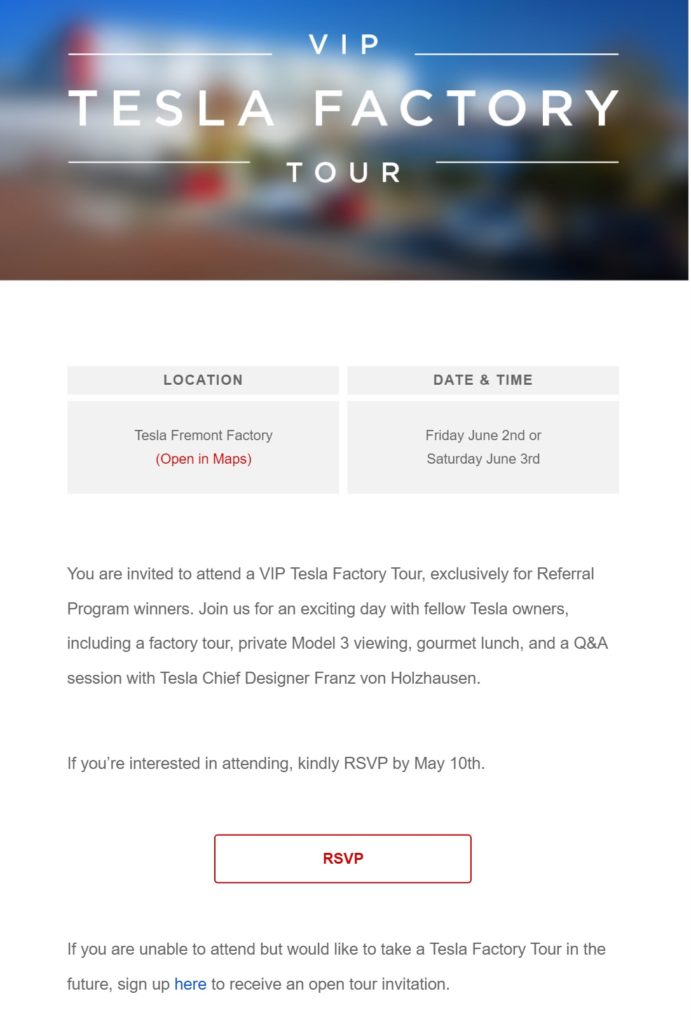
Winners of Tesla’s sixth referral program which concluded early this year have begun to receive official e-mail invitations to attend a “private Model 3 viewing” at the Tesla Factory in Fremont, California. Winners have been asked to RSVP by May 10th and choose from either a Friday, June 2nd event attendance or one the following day on June 3rd.
The e-mail sent by Tesla with subject line Your Exclusive Invitation: VIP Tesla Factory Tour outlines details for the exclusive event for existing Model S and Model X owners that made 5 or more qualifying referrals between October 16, 2016 and January 15, 2017.
Aside from being one of the first to bear witness to what is likely the final production version of Tesla’s highly anticipated Model 3 ahead of the official July launch event, referral program winners and their guest will be treated to an extended VIP factory tour which will also include a Q&A with Tesla’s Chief Designer Franz von Holzhausen.
We’ve provided a copy of the email sent to Teslarati courtesy of the popular Tesla-focused YouTube Channel DÆrik, and founder of TeslaInventory.com.
Today’s event invitation is a first sign that final production of the Model 3 is well underway. The invite comes on the heels of a series of sightings of what appears to be a near-final version of the mass market electric sedan. It was just days ago that we received our first close-up look of a very production-ready Model 3 interior.
Though Tesla didn’t explicitly state that the upcoming “private Model 3 viewing” is of a final production version, it’s unlikely that they would showcase a non-final product to the public, especially during a “VIP Tesla Factory Tour” at the location where the vehicle is being produced.
Hat tip to Dennis Pascual @dennis_p


Elon Musk
Trump’s invite for Elon just reshuffled Tesla’s big Signature Delivery Event
Tesla rescheduled its final Model S farewell to May 20 after Musk joined Trump in China.
Tesla has rescheduled its Model S and Model X Signature Edition delivery event to Wednesday, May 20, 2026, after abruptly calling off the original May 12 celebration. The event will take place at Tesla’s factory at 45500 Fremont Boulevard in Fremont, California, the same location where the Model S first rolled off the line in 2012. Invitees received a follow-up email asking them to reconfirm attendance and download a new QR code ticket, with Tesla noting that all travel and accommodation expenses remain the buyer’s responsibility.
The reason behind the original cancellation came into focus the same day it was announced. President Trump invited Elon Musk, Apple’s Tim Cook, BlackRock’s Larry Fink, Boeing’s Kelly Ortberg, and executives from Goldman Sachs, Blackstone, Citigroup, and Meta to join his trip to China this week for a summit with President Xi Jinping. The agenda covers trade, artificial intelligence, export controls, Taiwan, and the Iran war, following weeks of escalating friction between Washington and Beijing over AI technology, sanctions, and rare earth exports. Trump wrote on Truth Social, “I am very much looking forward to my trip to China, an amazing Country, with a Leader, President Xi, respected by all.”
Tesla launches 200mph Model S “Gold” Signature in invite-only purchase
The vehicles at the center of all this are the last Model S and Model X units Tesla will ever build. Priced at $159,420 each, the 250 Model S and 100 Model X Signature Edition units come finished in Garnet Red with a one-year no-resale agreement, giving Tesla right of first refusal if the owner decides to sell. As Teslarati reported, the Model S defined Tesla’s early identity as a serious luxury automaker, and the Fremont factory line that built it is now being converted to manufacture Optimus humanoid robots.
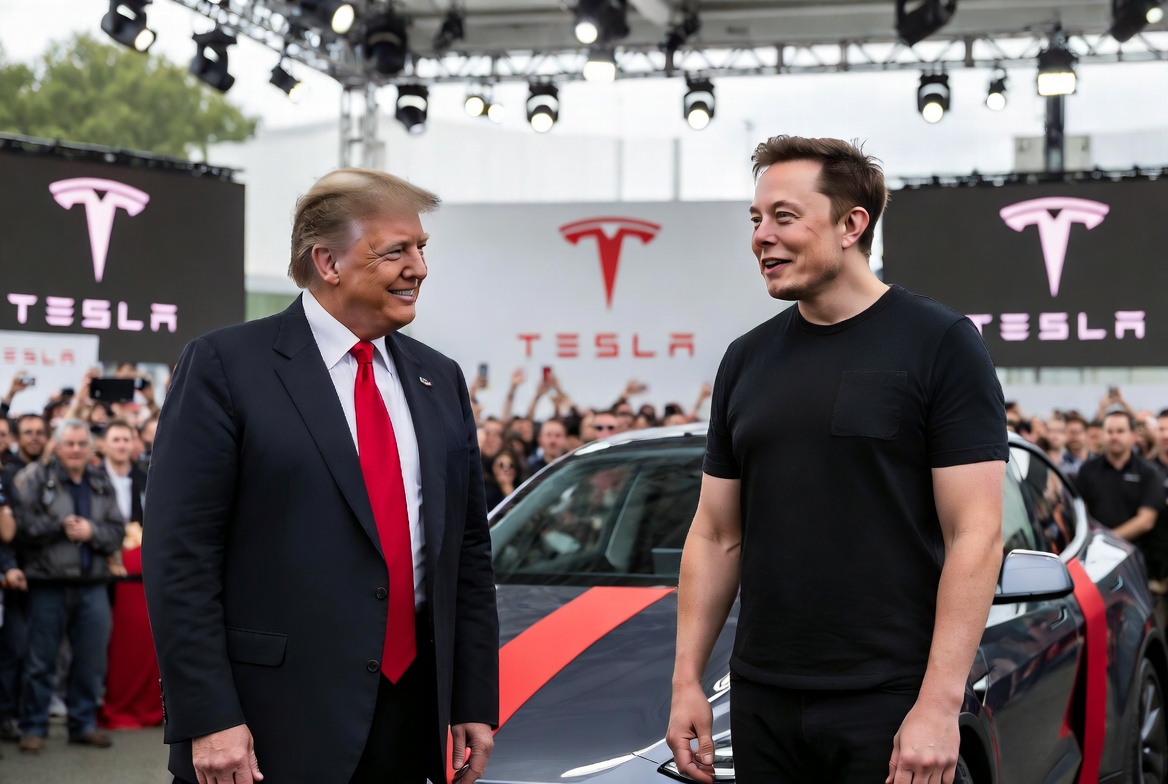
Musk’s inclusion in the China delegation drew attention given his very public relationship with Trump, and the invitation signals the two have moved past and past grievances. Trump originally brought Musk on to lead the Department of Government Efficiency following his inauguration, and despite a sharp public dispute in mid-2025, the two have appeared together repeatedly in recent months. A seat on the China trip, the most diplomatically consequential visit of Trump’s current term, puts Musk back at the table on U.S. economic policy at a moment when Tesla’s China revenue remains one of the company’s most important financial pillars.
Lifestyle
Tesla Semi hauls fresh Cybercab batch as Robotaxi era takes hold
A Tesla Semi was filmed hauling Cybercab units out of Giga Texas for the first time.
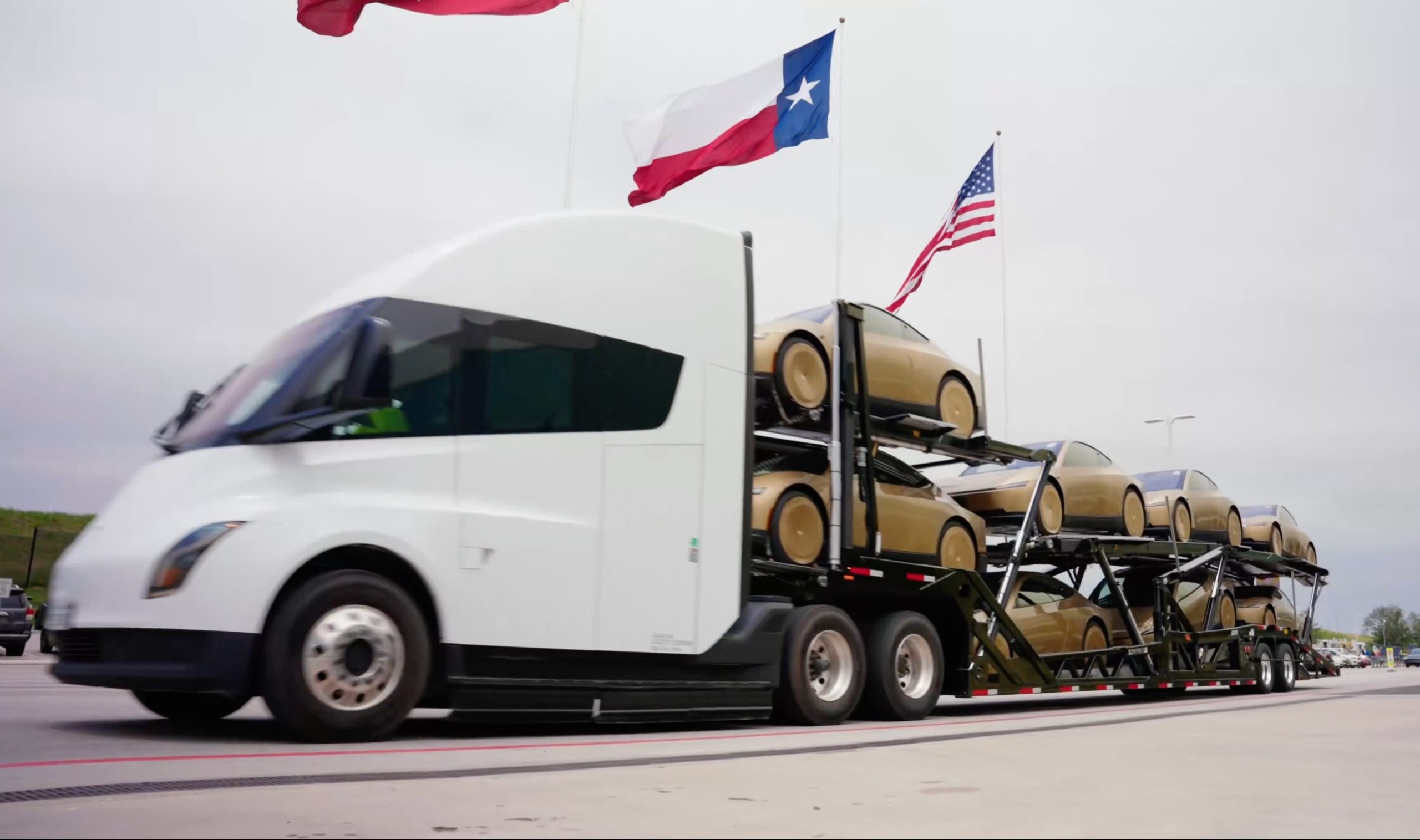
A Tesla Semi loaded with Cybercab units was recently filmed leaving Gigafactory Texas, marking what appears to be the first documented delivery run of Tesla’s autonomous two-seater. The footage shows multiple Cybercabs secured on a flatbed trailer being hauled by a production Tesla Semi, a truck rated for a gross combination weight of 82,000 lbs. The location is consistent with Giga Texas in Austin, where Cybercab production has been ramping since February 2026.
The sighting follows a wave of Cybercab activity at the Austin facility. In late April, drone operator Joe Tegtmeyer spotted approximately 60 Cybercabs parked in two organized groups in the factory’s outbound lot, the largest concentration observed to date. Units being staged in an outbound lot is a standard pre-delivery step, and the Semi footage is the logical next frame in that sequence.
En route with @tesla_semi pic.twitter.com/ZfuOjaeLH1
— Tesla Robotaxi (@robotaxi) May 7, 2026
This is not the first time Tesla has used its own Semi to move Tesla products. When the Semi was unveiled in 2017, Musk noted it would be used for Tesla’s own operations, and over the years Semi prototypes were spotted carrying cargo ranging from concrete weights to Tesla vehicles being delivered to consumers. In 2023, a Semi was photographed transporting a Cybertruck on a trailer ahead of that vehicle’s delivery launch.
The Cybercab itself was first revealed publicly at Tesla’s “We, Robot” event on October 10, 2024, at Warner Bros. Studios in Burbank, where 20 pre-production units gave attendees rides around the studio lot. Musk stated at the event that Tesla intends to produce the Cybercab before 2027. The first production unit rolled off the Giga Texas line on February 17, 2026, with Musk posting on X: “Congratulations to the Tesla team on making the first production Cybercab.”
Tesla’s annual production goal is 2 million Cybercabs per year once multiple factories reach full design capacity, with the company targeting a price under $30,000 per unit. Tesla has confirmed plans to expand its robotaxi service to seven cities in the first half of 2026, including Dallas, Houston, Phoenix, Miami, Orlando, Tampa, and Las Vegas, building on the unsupervised service already running in Austin. Musk has said he expects robotaxis to cover between a quarter and half of the United States by end of year.
Tesla has taken home the “Overall Loyalty to Make” award from S&P Global Mobility for the fourth consecutive year, reinforcing Tesla owners’ willingness to come back. The 2025 awards are based on S&P Global Mobility’s analysis of 13.6 million new retail vehicle registrations in the U.S. from October 2024 through September 2025. The complete list of 2025 winners includes General Motors for Overall Loyalty to Manufacturer, Tesla for Overall Loyalty to Make, Chevrolet Equinox for Overall Loyalty to Model, Mini for Most Improved Make Loyalty, Subaru for Overall Loyalty to Dealer, and Tesla again for both Ethnic Market Loyalty to Make and Highest Conquest Percentage.
Tesla’s streak in this category started in 2022, and the brand has now won the Highest Conquest Percentage award for six straight years, meaning it keeps pulling buyers away from other brands at a rate no competitor has matched. Tesla’s retention among Asian households reached 63.6% and among Hispanic households 61.9%, rates that significantly outpace national averages for those groups. That breadth of appeal across demographics adds a layer of significance to a win that some might dismiss as routine.
The timing matters too. After several consecutive quarters of decline, Tesla’s share of U.S. EV sales jumped to 59% in Q4 2025. That rebound, arriving just as competitors were flooding the market with new models and incentives, suggests Tesla’s loyalty numbers are not simply the result of limited alternatives. Buyers are still choosing it when they have plenty of other options.
What keeps Tesla owners coming back has a lot to do with the and convenience of charging. The Supercharger network is the most straightforward example. With over 65,000 Superchargers globally, it remains the largest and most reliable fast-charging network in the world, and owners who have built their routines around it face a real practical cost when considering a switch. Competitors have made progress, but the consistency, speed, and availability of Tesla’s network is still the benchmark the rest of the industry is chasing. Then there is the software side. Tesla has built a model where the car you own today is functionally different from the car you bought two years ago, through over-the-air updates that add continuous game-changing improvements such as Full Self-Driving that has moved from a driver-assist feature to an increasingly capable autonomous system. For many Tesla owners, leaving the brand means starting over with a car that will not get meaningfully better over time, and that is a trade-off fewer and fewer are willing to make.

Tesla patent aims to make massive change to common automotive part

SpaceX and Google mull massive partnership on Musk’s orbital data dream: report


