
Lifestyle
A road trip without Tesla Autopilot is akin to torture

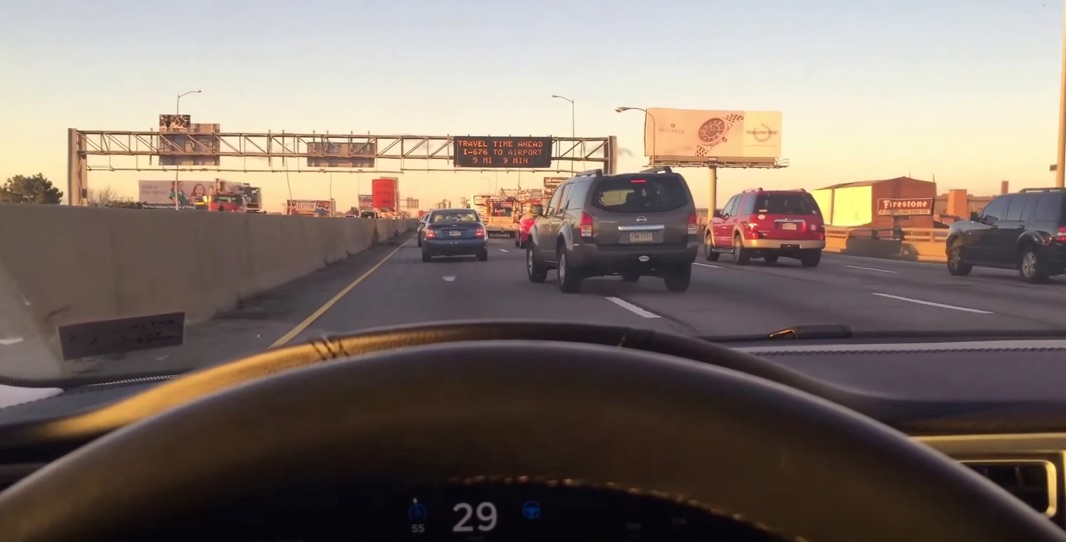
I’ve recently returned from a family beach vacation that required about 600 miles of road travel. As an avid enthusiast and follower of the developments of Tesla, I am very aware of Autopilot’s capabilities and limitations and I hope it is one of the last times I have to cover such distance without its assistance. At the time of this writing, the current abilities of the system would have made the drive immeasurably better. 600 miles may not seem like a huge journey to some people, but compared to my regular travel diet, it may as well have been a million.
Let me set the tone. It has become an annual tradition for my in-laws to invite my family along to their beach vacation. The travel portion alone is a 1-2 day micro-convoy, typically lead by the father-in-law. Starting around Hershey, Pennsylvania, and enduring a passive Civil War history lesson on our way to Myrtle Beach, South Carolina. It always amazes me how regional diction can vary so much with a slight change in latitude. The normal traffic volume obstacles generally steal years from your life around Washington DC and Richmond, Virgina if you choose to take the I-95 straight shot down. Stopped traffic with no exit in sight is not a good match for our tiny-bladdered precious cargo. Therefore, we take the long way around and hope for thinner crowds.
In my younger years, before children, corrective lenses and normal bodily wear and tear, I would go as far to say that I enjoyed the long drive. My undivided attention to the road and surroundings must have added a layer of control and ease that I no longer feel. Now I am responsible for more lives. Ironically, the same lives that I am constantly trying to protect are also unintentionally adding sensory distractions, exponentially diluting the focus that needs to be dedicated to the road.
“Holding onto the wheel as you generally progress in a straight line forward seems more akin to torture.”
I still enjoy driving, but I hardly consider highway travel to be true driving. Holding onto the wheel as you generally progress in a straight line forward seems more akin to torture. Winding local roads that provide constant stimulation and driving dynamics are much more enjoyable. I’m not sure what the statistics would say, but I am a safer, more alert, driver on roads like this.
While the task of following the leader may seem incredibly simple on the surface, a deeper evaluation reveals why the assistance of Autopilot would excel in all the areas that a human might struggle. Attention, fatigue, refined control, and response time are common weaknesses that every person has to some extent. This type of driving can be quite dangerous, and it’s important to not lose respect for that.
It is extremely difficult to devote complete attention to the road for the entirety of 600 miles. There is a pretty good chance that most drivers will find themselves looking around occasionally. We passed a couple of crashes along the way and observed a few near misses from people rubbernecking. Even if you had unbroken focus, unexpected events can happen during a quick blind-spot check.
Autopilot cannot see infinitely in all directions, but it is still able to constantly maintain its views in normal traffic. It won’t look away for a moment. As a machine, it’s programmed to perform its given task and cannot be distracted or break focus.
Fatigue is a very real risk that grows more dangerous with every mile. It can seemingly creep up and at any moment. While it helps to have company in the vehicle, if conversation wanes, things can get dicey.
Again, Autopilot cannot grow tired over time. There is no way that it can fall asleep.
I think it is safe to assume that nearly everyone has wandered onto the rumble strips on the edge of the lane at some point – often causing a slight overreaction to correct. Or maybe you just seem to drift along within your lane, visiting each side from time to time. I have to admit, despite my acknowledgment of drifting, it sometimes seems that a conscious effort to correct it is temporarily not effective. I don’t want to quickly veer back into alignment in a big action that would seem like I lost control or attention, but my attempts to make a slow move back to the middle of the lane are not working. Can I blame the car or the road for this? Perhaps it’s the trend of the car in front of me and my mental ‘autopilot’ is just following the same path. Maybe I’m being hypnotized and lured in by the rhythmic dashed lines sweeping by. Whatever the cause, soon the neighboring semi’s graceful forward stampede gets a bit too close for comfort and I snap out of it as my heart goes into momentary adrenaline mode. A good anxiety recipe for the travelers around me. It is important for people like me to admit that we are crappy drivers. At least I’m not the moron that is too lazy to flick the turn signal wand for lane shifts.
As Autopilot matures, so does its ability to stay centered within a lane. As soon as I get assistance from Autopilot, the road and people around me will become that much safer. Like a train fixed to a track, it can’t be hypnotized or anxious through my own or neighboring human error. And it certainly will not shift from one to another without the driver initiating via a signal.
Among the most important benefits of Autopilot has to be the response time. The scenario that comes to mind is sudden deceleration events. Maybe your eyes are focused on a roadside sight or the neighboring lane when the vehicle in front of yours begins to slow. Even if you catch it in time to slow before a collision, a sudden slowing of your own vehicle reduces the reaction time for the drivers behind you. It gets exponentially more dangerous for a driver to the rear and often ends in contact. Reaction time circles back to the fact that autopilot is always paying attention.
My travels would have been far less stressful if I had the aid of Autopilot. The closest experience I had to an Autopilot environment took place while I was in the passenger seat while my wife drove. I was able to take in some truly breathtaking views that I may have missed if I were safely focused on traffic. Who knew that the Virginian Appalachian mountains were so beautiful? A scenic overlook that could easily be missed since the highway wound around bends in a clearing.
Full autonomy will be the ultimate protection against me and my driving tendencies. For now, the beta Autopilot can serve as the perfect supplement to my inadequacies.
Not to undersell the importance of safety, but I want to be able to enjoy a long road trip again. I want to feel comfortable enough to pry just one hand off the wheel so that I can annihilate a can of Pringles while the kids are too engrossed in Finding Nemo to notice I should have shared. I want to feel like I’m no longer terrorizing my wife and the drivers around me with my inexplicable tendency to grind and ping pong the edges of my lane.
I fantasize about this incredible sense of ease that Autopilot would add to a trip of this sort. The desire for more frequent and further road trips may find welcome. Road travel once defined an era of adventure and exploration. It powered local tourism and small business economies. Before highways became monsters and gas pumps robbed us of our planet’s future in addition to hard-earn money, there was a sense of unbound geographical freedom. It sparked the imagination of the children in the back seat while giving adults conquered goals. I want that. I need that. I need Autopilot.








Elon Musk
X account with 184 followers inadvertently saves US space program amid Musk-Trump row
Needless to say, the X user has far more than 184 followers today after his level-headed feat.

An X user with 184 followers has become the unlikely hero of the United States’ space program by effectively de-escalating a row between SpaceX CEO Elon Musk and President Donald Trump on social media.
Needless to say, the X user has far more than 184 followers today after his level-headed feat.
A Near Fall
During Elon Musk and Donald Trump’s fallout last week, the U.S. President stated in a post on Truth Social that a good way for the United States government to save money would be to terminate subsidies and contracts from the CEO’s companies. Musk responded to Trump’s post by stating that SpaceX will start decommissioning its Dragon spacecraft immediately.
Musk’s comment was received with shock among the space community, partly because the U.S. space program is currently reliant on SpaceX to send supplies and astronauts to the International Space Station (ISS). Without Dragon, the United States will likely have to utilize Russia’s Soyuz for the same services—at a significantly higher price.
X User to the Rescue
It was evident among X users that Musk’s comments about Dragon being decommissioned were posted while emotions were high. It was then no surprise that an X account with 184 followers, @Fab25june, commented on Musk’s post, urging the CEO to rethink his decision. “This is a shame this back and forth. You are both better than this. Cool off and take a step back for a couple days,” the X user wrote in a reply.
Much to the social media platform’s surprise, Musk responded to the user. Even more surprising, the CEO stated that SpaceX would not be decommissioning Dragon after all. “Good advice. Ok, we won’t decommission Dragon,” Musk wrote in a post on X.
Not Planned, But Welcomed
The X user’s comment and Musk’s response were received extremely well by social media users, many of whom noted that @Fab25june’s X comment effectively saved the U.S. space program. In a follow-up comment, the X user, who has over 9,100 followers as of writing, stated that he did not really plan on being a mediator between Musk and Trump.
“Elon Musk replied to me. Somehow, I became the accidental peace broker between two billionaires. I didn’t plan this. I was just being me. Two great minds can do wonders. Sometimes, all it takes is a breather. Grateful for every like, DM, and new follow. Life’s weird. The internet’s weirder. Let’s ride. (Manifesting peace… and maybe a Model Y.)” the X user wrote.
Lifestyle
Tesla Cybertruck takes a bump from epic failing Dodge Charger
The Cybertruck seemed unharmed by the charging Charger.
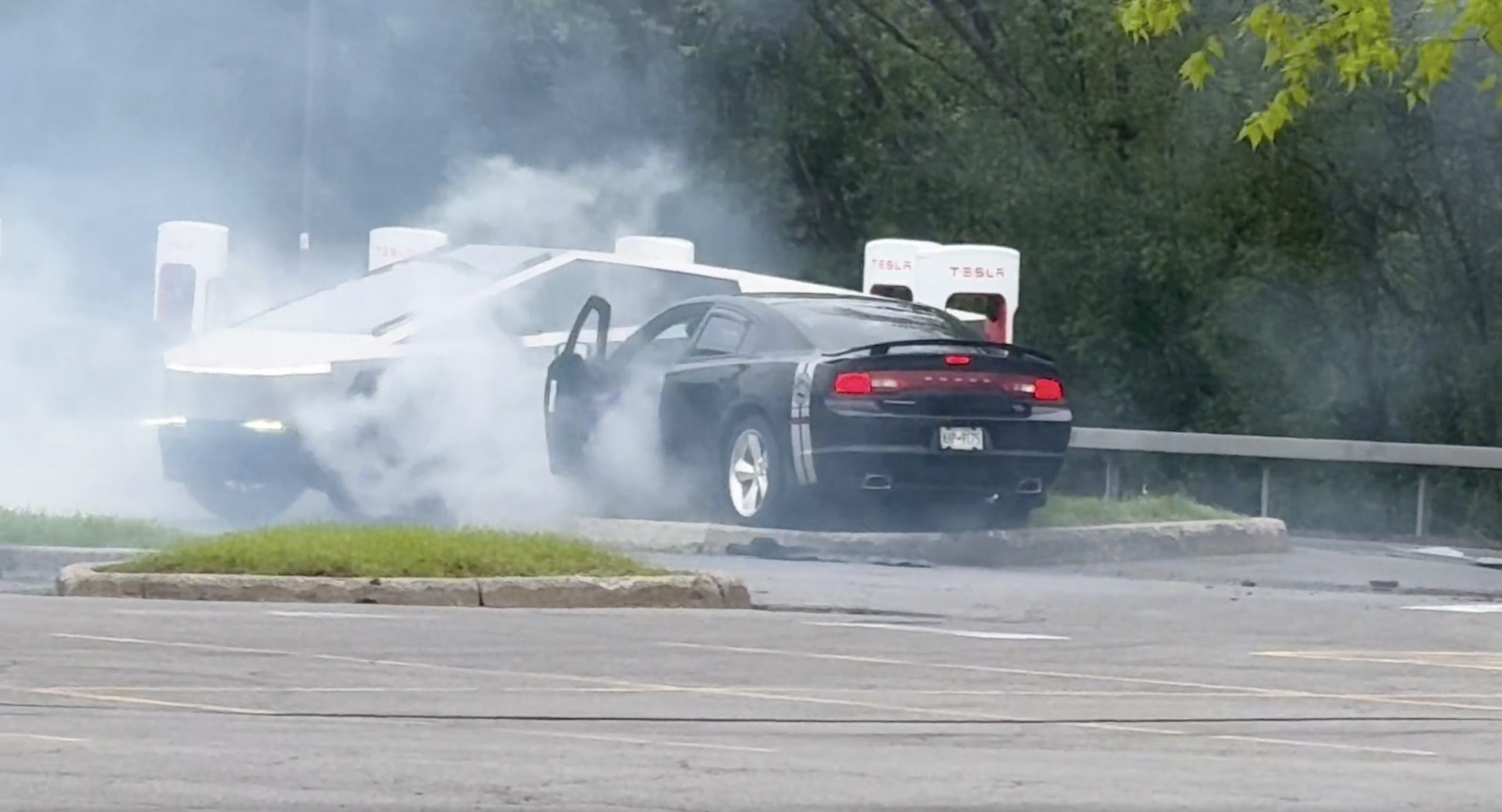
There comes a time in a driver’s life when one is faced with one’s limitations. For the driver of a Dodge Charger, this time came when he lost control and crashed into a Tesla Cybertruck–an absolute epic fail.
A video of the rather unfortunate incident was shared on the r/TeslaLounge subreddit.
Charging Charger Fails
As could be seen in the video, which was posted on the subreddit by Model Y owner u/Hammer_of_something, a group of teens in a Dodge Charger decided to do some burnouts at a Tesla Supercharger. Unfortunately, the driver of the Charger failed in his burnout or donut attempt, resulting in the mopar sedan going over a curb and bumping a charging Cybertruck.
Ironically, the Dodge Charger seemed to have been parked at a Supercharger stall before its driver decided to perform the failed stunt. This suggests that the vehicle was likely ICE-ing a charging stall before it had its epic fail moment. Amusingly enough, the subreddit member noted that the Cybertruck did not seem like it took any damage at all despite its bump. The Charger, however, seemed like it ran into some trouble after crashing into the truck.
Alleged Aftermath
As per the the r/TeslaLounge subreddit member, the Cybertruck owner came rushing out to his vehicle after the Dodge Charger crashed into it. The Model Y owner then sent over the full video of the incident, which clearly showed the Charger attempting a burnout, failing, and bumping into the Cybertruck. The Cybertruck owner likely appreciated the video, in part because it showed the driver of the Dodge Charger absolutely freaking out after the incident.
The Cybertruck is not an impregnable vehicle, but it can take bumps pretty well thanks to its thick stainless steel body. Based on this video, it appears that the Cybertruck can even take bumps from a charging Charger, all while chilling and charging at a Supercharger. As for the teens in the Dodge, they likely had to provide a long explanation to authorities after the incident, since the cops were called to the location.
Lifestyle
Anti-Elon Musk group crushes Tesla Model 3 with Sherman tank–with unexpected results
Ironically enough, the group’s video ended up highlighting something very positive for Tesla.
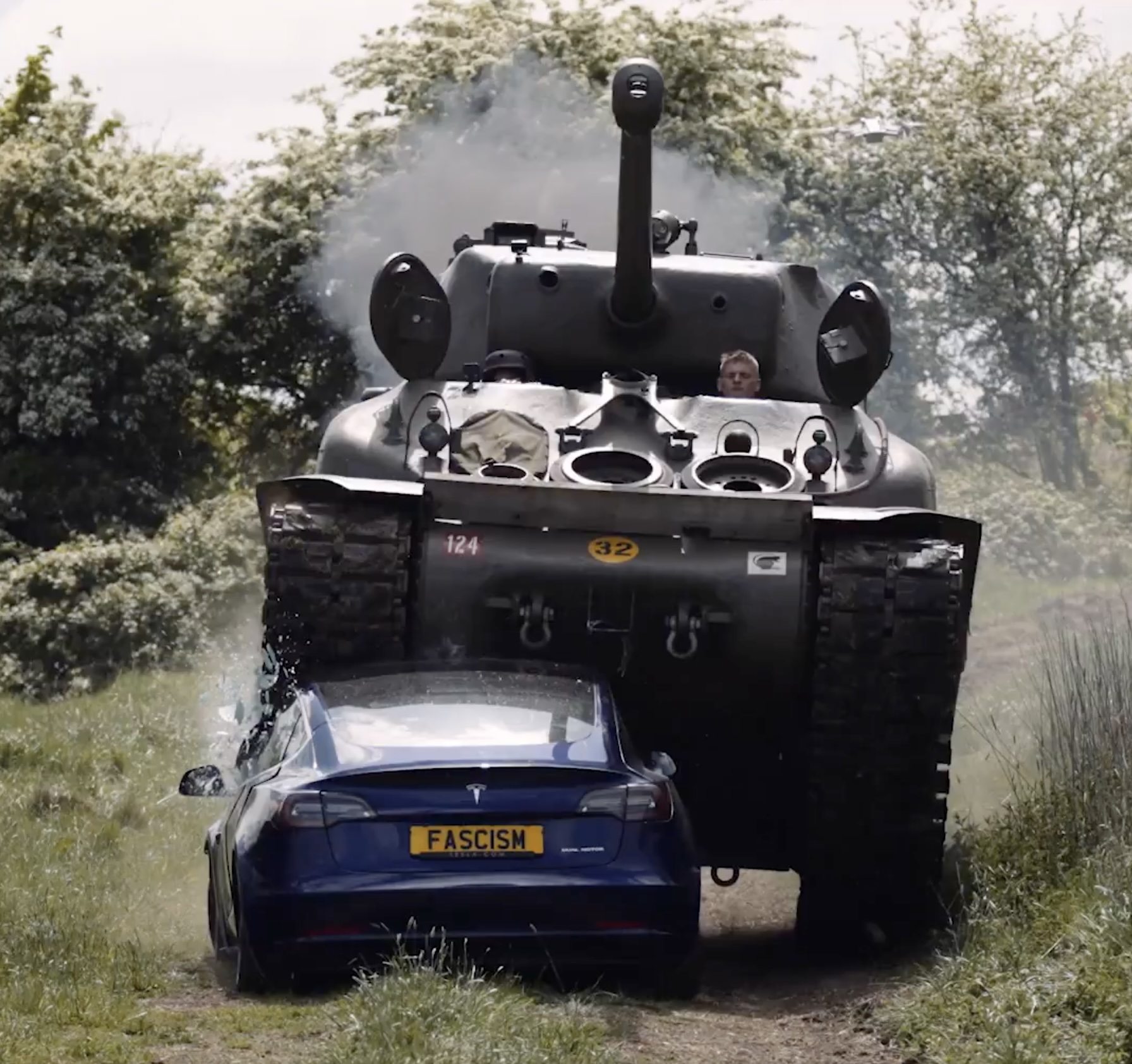
Anti-Elon Musk protesters and critics tend to show their disdain for the CEO in various ways, but a recent video from political action group Led By Donkeys definitely takes the cake when it comes to creativity.
Ironially enough, the group’s video also ended up highlighting something very positive for Tesla.
Tank vs. Tesla
In its video, Led By Donkeys featured Ken Turner, a 98-year-old veteran who served in the British army during World War II. The veteran stated that Elon Musk, the richest man in the world, is “using his immense power to support the far-right in Europe, and his money comes from Tesla cars.”
He also noted that he had a message for the Tesla CEO: “We’ve crushed fascism before and we’ll crush it again.” To emphasize his point, the veteran proceeded to drive a Sherman tank over a blue Tesla Model 3 sedan, which, of course, had a plate that read “Fascism.”
The heavy tank crushed the Model 3’s glass roof and windows, much to the delight of Led By Donkeys’ commenters on its official YouTube channel. But at the end of it all, the aftermath of the anti-Elon Musk demonstration ended up showcasing something positive for the electric vehicle maker.
Tesla Model 3 Tanks the Tank?
As could be seen from the wreckage of the Tesla Model 3 after its Sherman encounter, only the glass roof and windows of the all-electric sedan were crushed. Looking at the wreckage of the Model 3, it seemed like its doors could still be opened, and everything on its lower section looked intact.
Considering that a standard M4 Sherman weighs about 66,800 to 84,000 pounds, the Model 3 actually weathered the tank’s assault really well. Granted, the vehicle’s suspension height before the political action group’s demonstration suggests that the Model 3’s high voltage battery had been removed beforehand. But even if it hadn’t been taken off, it seemed like the vehicle’s battery would have survived the heavy ordeal without much incident.
This was highlighted in comments from users on social media platform X, many of whom noted that a person in the Model 3 could very well have survived the ordeal with the Sherman. And that, ultimately, just speaks to the safety of Tesla’s vehicles. There is a reason why Teslas consistently rank among the safest cars on the road, after all.

These Tesla, X, and xAI engineers were just poached by OpenAI

SpaceX share sale expected to back $400 billion valuation

Tesla Giga Texas continues to pile up with Cybercab castings


-
 Elon Musk1 week ago
Tesla investors will be shocked by Jim Cramer’s latest assessment
-
 News2 weeks ago
Tesla Robotaxi’s biggest challenge seems to be this one thing
-

 Elon Musk1 day ago
Elon Musk confirms Grok 4 launch on July 9 with livestream event
-
 News2 weeks ago
Watch the first true Tesla Robotaxi intervention by safety monitor
-
 News5 days ago
Tesla Model 3 ranks as the safest new car in Europe for 2025, per Euro NCAP tests
-
 Elon Musk2 weeks ago
A Tesla just delivered itself to a customer autonomously, Elon Musk confirms
-
 Elon Musk2 weeks ago
Elon Musk confirms Tesla Optimus V3 already uses Grok voice AI
-

 Elon Musk2 weeks ago
xAI welcomes Memphis pollution results, environmental groups push back